

SIST EN 12973:2020
(Main)Value Management
General Information
- Abstract
This document aims to:
a) guide and give ideas for leaders, managers, and teams to plan the deployment of Value Management approaches and effective application of Value Management core / specific methods;
b) help organizations improve performance, productivity, profitability and effectiveness;
c) address Value Management at the managerial level;
d) support people in strengthening value culture;
e) give guidance for strengthening Value Management and Value Management methods at different levels within the organization;
f) identify the conditions for effective Value Management;
g) give guidance for value-based decision-making;
h) stimulate and support innovation; and
i) establish a basis for developing training and certifying procedures for individual competences in Value Management.
Figure 1 presents the envisaged organization of documents relative to the Value Management field and the standards available at the CEN level for all users of this document.
(figure not reproduced)
Figure 1 - Documents in relation to Value Management
A system for certification of individual professional competence is maintained by the National Value Associations in Europe. The qualification "Professional in Value Management" (PVM) is recognized across Europe by National Value Associations as an indicator of competence. This qualification is also recognized in other countries outside Europe.
- Status
- Published
- Public Enquiry End Date
- 31-Oct-2017
- Publication Date
- 03-Feb-2020
- Technical Committee
- I13 - Imaginarni 13
- Current Stage
- 6060 - National Implementation/Publication (Adopted Project)
- Start Date
- 31-Jan-2020
- Due Date
- 06-Apr-2020
- Completion Date
- 04-Feb-2020
- Ref Project
EN 12973:2020 - Value Management



Overview
EN 12973:2020 - Value Management (CEN) is the European standard that defines Value Management principles, approaches and methods to help organisations improve performance, productivity and decision‑making. It updates and supersedes EN 12973:2000 and provides guidance for embedding a value culture, deploying Value Management at strategic and operational levels, and developing individual and organisational capability (including recognised professional qualification PVM - Professional in Value Management).
Key topics and technical requirements
- Scope and objectives: Guidance for leaders, managers and teams to plan and apply Value Management; support value‑based decision‑making, innovation and training/certification.
- Approaches: Describes informal, formal and study‑based Value Management approaches and how to communicate and integrate them across an organisation.
- Core principles: Strengthen value orientation; apply function thinking; adopt a structured holistic approach; manage complexity, risk and uncertainty.
- Drivers (levers): Identification and use of organisational levers to increase value and align priorities with stakeholder needs.
- Methods and tools: Core methods covered include Value Analysis / Value Engineering (VA/VE), Function Analysis, Function Cost, Functional Performance Specification (FPS), and Design to Cost / Design to Objectives (DTC/DTO). Annexes give further specific methods and tools.
- Levels of application: Guidance for top management (strategy, value culture, risk and portfolio contributions) and operational teams (scoping, conceptualisation, optimisation, re‑design).
- Capability development: Recommendations for training, team leadership, supporting structures, monitoring and integration with existing management systems.
- Certification: Notes pan‑European recognition of the PVM qualification maintained by National Value Associations.
Practical applications
- Improve product and service value by aligning functions with customer needs and reducing unnecessary cost or resource use.
- Guide strategic decision‑making, portfolio and programme prioritisation with value‑based indicators.
- Run VA/VE or function analysis studies to optimise design, cost and performance during concept, design or re‑design phases.
- Strengthen organisational culture to foster cross‑disciplinary collaboration and innovation.
- Develop training and certification schemes for Value Management competence.
Who should use this standard
- Senior leadership and strategy teams seeking value‑based governance
- Program and portfolio managers
- Design, engineering and product teams applying VA/VE and function analysis
- Continuous improvement, procurement and quality professionals
- Trainers, certifying bodies and National Value Associations
Related standards and compatibility
EN 12973:2020 is intended to complement existing management system standards (quality, risk management, dependability) by providing value‑and function‑oriented guidance that integrates with organisational processes.
Actionable takeaway: Use EN 12973:2020 to formalise a Value Management approach, adopt core methods (VA/VE, Function Analysis), and build a recognised competency path (PVM) to systematically increase organisational value.
Relations
- Effective Date
- 29-Jan-2020
- Effective Date
- 28-Jan-2026
- Effective Date
- 28-Jan-2026
- Effective Date
- 28-Jan-2026
- Effective Date
- 28-Jan-2026
- Effective Date
- 15-Apr-2009
Get Certified
Connect with accredited certification bodies for this standard

BSI Group
BSI (British Standards Institution) is the business standards company that helps organizations make excellence a habit.

Bureau Veritas
Bureau Veritas is a world leader in laboratory testing, inspection and certification services.

DNV
DNV is an independent assurance and risk management provider.
Sponsored listings
Frequently Asked Questions
SIST EN 12973:2020 is a standard published by the Slovenian Institute for Standardization (SIST). Its full title is "Value Management". This standard covers: This document aims to: a) guide and give ideas for leaders, managers, and teams to plan the deployment of Value Management approaches and effective application of Value Management core / specific methods; b) help organizations improve performance, productivity, profitability and effectiveness; c) address Value Management at the managerial level; d) support people in strengthening value culture; e) give guidance for strengthening Value Management and Value Management methods at different levels within the organization; f) identify the conditions for effective Value Management; g) give guidance for value-based decision-making; h) stimulate and support innovation; and i) establish a basis for developing training and certifying procedures for individual competences in Value Management. Figure 1 presents the envisaged organization of documents relative to the Value Management field and the standards available at the CEN level for all users of this document. (figure not reproduced) Figure 1 - Documents in relation to Value Management A system for certification of individual professional competence is maintained by the National Value Associations in Europe. The qualification "Professional in Value Management" (PVM) is recognized across Europe by National Value Associations as an indicator of competence. This qualification is also recognized in other countries outside Europe.
This document aims to: a) guide and give ideas for leaders, managers, and teams to plan the deployment of Value Management approaches and effective application of Value Management core / specific methods; b) help organizations improve performance, productivity, profitability and effectiveness; c) address Value Management at the managerial level; d) support people in strengthening value culture; e) give guidance for strengthening Value Management and Value Management methods at different levels within the organization; f) identify the conditions for effective Value Management; g) give guidance for value-based decision-making; h) stimulate and support innovation; and i) establish a basis for developing training and certifying procedures for individual competences in Value Management. Figure 1 presents the envisaged organization of documents relative to the Value Management field and the standards available at the CEN level for all users of this document. (figure not reproduced) Figure 1 - Documents in relation to Value Management A system for certification of individual professional competence is maintained by the National Value Associations in Europe. The qualification "Professional in Value Management" (PVM) is recognized across Europe by National Value Associations as an indicator of competence. This qualification is also recognized in other countries outside Europe.
SIST EN 12973:2020 is classified under the following ICS (International Classification for Standards) categories: 03.100.40 - Research and development. The ICS classification helps identify the subject area and facilitates finding related standards.
SIST EN 12973:2020 has the following relationships with other standards: It is inter standard links to SIST EN 12973:2000, SIST EN 16271:2014, SIST EN 1325:2014, SIST EN 17952:2024, SIST EN 9277:2015, SIST EN 12973:2000. Understanding these relationships helps ensure you are using the most current and applicable version of the standard.
SIST EN 12973:2020 is available in PDF format for immediate download after purchase. The document can be added to your cart and obtained through the secure checkout process. Digital delivery ensures instant access to the complete standard document.
Standards Content (Sample)
SLOVENSKI STANDARD
01-marec-2020
Nadomešča:
SIST EN 12973:2000
Upravljanje vrednosti
Value Management
Value Management
Management par la valeur
Ta slovenski standard je istoveten z: EN 12973:2020
ICS:
03.100.40 Raziskave in razvoj Research and development
2003-01.Slovenski inštitut za standardizacijo. Razmnoževanje celote ali delov tega standarda ni dovoljeno.
EN 12973
EUROPEAN STANDARD
NORME EUROPÉENNE
January 2020
EUROPÄISCHE NORM
ICS 03.100.40 Supersedes EN 12973:2000
English Version
Value Management
Management par la valeur Value Management
This European Standard was approved by CEN on 27 October 2019.
CEN members are bound to comply with the CEN/CENELEC Internal Regulations which stipulate the conditions for giving this
European Standard the status of a national standard without any alteration. Up-to-date lists and bibliographical references
concerning such national standards may be obtained on application to the CEN-CENELEC Management Centre or to any CEN
member.
This European Standard exists in three official versions (English, French, German). A version in any other language made by
translation under the responsibility of a CEN member into its own language and notified to the CEN-CENELEC Management
Centre has the same status as the official versions.
CEN members are the national standards bodies of Austria, Belgium, Bulgaria, Croatia, Cyprus, Czech Republic, Denmark, Estonia,
Finland, France, Germany, Greece, Hungary, Iceland, Ireland, Italy, Latvia, Lithuania, Luxembourg, Malta, Netherlands, Norway,
Poland, Portugal, Republic of North Macedonia, Romania, Serbia, Slovakia, Slovenia, Spain, Sweden, Switzerland, Turkey and
United Kingdom.
EUROPEAN COMMITTEE FOR STANDARDIZATION
COMITÉ EUROPÉEN DE NORMALISATION
EUROPÄISCHES KOMITEE FÜR NORMUNG
CEN-CENELEC Management Centre: Rue de la Science 23, B-1040 Brussels
© 2020 CEN All rights of exploitation in any form and by any means reserved Ref. No. EN 12973:2020 E
worldwide for CEN national Members.
Content Page
European foreword . 5
Introduction . 6
1 Scope . 9
2 Normative references . 10
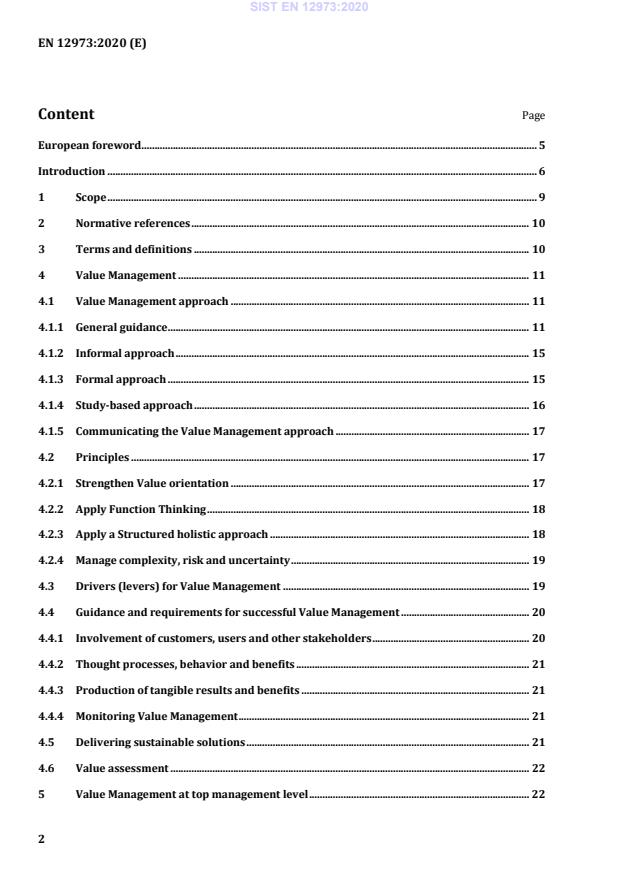
3 Terms and definitions . 10
4 Value Management . 11
4.1 Value Management approach . 11
4.1.1 General guidance . 11
4.1.2 Informal approach . 15
4.1.3 Formal approach . 15
4.1.4 Study-based approach . 16
4.1.5 Communicating the Value Management approach . 17
4.2 Principles . 17
4.2.1 Strengthen Value orientation . 17
4.2.2 Apply Function Thinking . 18
4.2.3 Apply a Structured holistic approach . 18
4.2.4 Manage complexity, risk and uncertainty . 19
4.3 Drivers (levers) for Value Management . 19
4.4 Guidance and requirements for successful Value Management . 20
4.4.1 Involvement of customers, users and other stakeholders . 20
4.4.2 Thought processes, behavior and benefits . 21
4.4.3 Production of tangible results and benefits . 21
4.4.4 Monitoring Value Management . 21
4.5 Delivering sustainable solutions . 21
4.6 Value assessment . 22
5 Value Management at top management level . 22
5.1 Value culture and strategy in the organization . 22
5.2 Strategic analysis . 23
5.2.1 General . 23
5.2.2 Vision, mission and strategy of an organization - Indicators . 23
5.2.3 Definition of the vision and the mission . 24
5.2.4 Definition of the strategic axes of the vision . 24
5.2.5 Definition of the objectives to be achieved . 24
5.2.6 Implementation of the vision and the strategy objectives . 24
5.2.7 Identification of value drivers (levers) . 25
5.2.8 Definition of Action Plans . 25
5.2.9 Definition of the indicators . 25
5.3 Risk, uncertainty and complexity . 25
5.3.1 Addressing risk and uncertainty. 25
5.3.2 Addressing complexity . 26
5.4 Contributions to portfolios . 26
5.5 Contributions to programs . 26
5.6 Contributions to innovation at all the levels of the organization . 26
6 Value Management at operational level . 27
6.1 Situations for use of Value Management methods . 27
6.1.1 General . 27
6.1.2 Situation of scoping . 27
6.1.3 Situation of conceptualization . 28
6.1.4 Situation of optimization . 28
6.1.5 Situation of re-design . 28
7 Developing Value Management capability . 28
7.1 General guidance on developing capability . 28
7.2 Wider training in Value Management and Value Culture . 29
7.3 Value Management team leaders . 29
7.4 Supporting structure . 29
7.5 Management information . 30
7.6 Implementation of Value Management methods . 30
8 Methods used in Value Management . 30
8.1 Core Methods used in Value Management . 30
8.2 Guidance on use of Value Management methods . 31
8.2.1 General guidance . 31
8.2.2 Value Analysis/Value Engineering (VA/VE) . 31
8.2.3 Function Analysis (FA) . 31
8.2.4 Function Cost (FC) . 32
8.2.5 The Functional Performance Specification (FPS) . 33
8.2.6 Design to Cost (DTC) / Design to Objectives (DTO) . 33
Annex A (informative) Methods and tools to be used within Value Management - Specific Value
Methods and tools . 35
Bibliography . 69
European foreword
This document (EN 12973:2020) has been prepared by Technical Committee CEN/TC 279 “Value
management, value analysis, function analysis”, the secretariat of which is held by BSI.
This European Standard shall be given the status of a national standard, either by publication of an identical
text or by endorsement, at the latest by July 2020, and conflicting national standards shall be withdrawn at
the latest by July 2020.
Attention is drawn to the possibility that some of the elements of this document may be the subject of patent
rights. CEN shall not be held responsible for identifying any or all such patent rights.
This document supersedes EN 12973:2000.
This document updates, extends and supersedes the previous document EN 12973:2000. New subject
matter has been developed to address Value Management within the context of existing management
systems and organizational culture. This standard significantly extends guidance for what an organization
should do or may do to optimize performance in its current situation and to develop capability and
approaches to secure future value improvement. The document also augments previous standard guidance
on a common basis for practice and methods.
According to the CEN-CENELEC Internal Regulations, the national standards organisations of the following
countries are bound to implement this European Standard: Austria, Belgium, Bulgaria, Croatia, Cyprus, Czech
Republic, Denmark, Estonia, Finland, France, Germany, Greece, Hungary, Iceland, Ireland, Italy, Latvia,
Lithuania, Luxembourg, Malta, Netherlands, Norway, Poland, Portugal, Republic of North Macedonia,
Romania, Serbia, Slovakia, Slovenia, Spain, Sweden, Switzerland, Turkey and the United Kingdom.
Introduction
The aim of this standard is to present, define and explain Value Management and provide guidance for the
introduction of the basic concepts, approaches, essential principles, drivers (levers), methods and tools for
effective Value Management.
Value Management is all about:
“Organizational Improvement, setting clear goals, improving productivity, creativity
and
return on investment.”
This standard sets out guidance on the essential elements of Value Management, which improve value,
competitiveness and performance for an organization and support leadership, cross-disciplinary work and
operational management.
Value Management in an organization is about proactively increasing value, it being the relationship
between the satisfaction of needs and the consumption of resources used in satisfying the needs. The fewer
resources used or/and the greater the satisfaction of needs, the greater the value. The application of Value
Management approaches and underpinning principles throughout an organization helps strengthen the
awareness and understanding among its members and teams of the factors which influence value for that
organization, while making decisions on a consistent basis.
This standard presents Value Management within the context of existing management systems and an
organizational culture: with value at the forefront of thinking and behavior. It aims to give specific guidance
as to what an organization should do, or may do to improve performance. It addresses the concepts of ‘value
culture’ (attitudes and understanding of value for the organization), ‘Value Management’ (the underlying
concept of the discipline), the ‘Value Management approach’ (the way the organization works to apply the
four principles of Value Management), and the deployment of ‘Value Management methods’ (specific value
methods and tools such as Function Analysis, Value Analysis, Value Engineering, as well as other methods
and tools). The standard gives guidance on developing capability for any organization including supply
chains and delivering innovative solutions.
The four principles of Value Management underpinning the Value Management approaches, namely
strengthen value orientation, apply function thinking, apply a structured, holistic approach and manage
complexity, risk and uncertainty complement and support other management standards being implemented
in the organization, for example, quality, risk and dependability. Crucially, the leadership in the organization
will be able to carry out their own informal, formal or study-based Value Management approach to improve
the organization and its products. European accredited training in Value Management is available to support
organizations and individuals.
WHAT is VALUE MANAGEMENT?
Value Management is an underlying concept applied within existing management systems and approaches
based on value and function-oriented thinking, behavior and methods, particularly dedicated to motivating
people, developing skills, promoting synergies and innovation, with the aim of maximizing the overall
performance of the organization.
Value culture implicitly combines function thinking with identifying the needs and finding the best ways to
satisfy these. When an organization aspires, and strives for a mature value culture, that culture naturally
aligns human behavior to improve value. Value culture using Value Management approaches underpinned
by Value Management principles, particularly function thinking, and drivers (levers) and methods as
described in this standard support organizations and people in increasing value.
Value Management is inherent within organizational culture, management approaches, selection of methods
and tools and decision-making with the aim of maximizing performance. Value Management enables the
organizational culture to enhance creativity and effectiveness in addressing the means to satisfy the needs,
from the users’ and customers’ perspective.
WHY use VALUE MANAGEMENT?
Value Management as a concept includes the organization’s Value Management approach considering its
four essential principles and four drivers (levers), supported by Value Management methods and tools.
In parallel with the evolution of Value Management there has been widespread development of system
standards and guidance to support organizations. Value Management contributes to and strengthens these
systems to help maximize the performance of the organization.
In simple environments, a focus on functional needs and value as a basis for decision-making sets clear
direction towards a sustainable solution for the organization. In dynamic or volatile environments,
consideration of uncertainty and complexity and development of a holistic approach to accommodate
multiple scenarios may become a guiding principle that sets a direction towards a sustainable solution for
the organization.
External or internal customers and users may all hold differing views in prioritizing the needs. Effective
Value Management will recognize, respect and integrate these perspectives as far as is relevant to improve
value.
The most visible benefits arising from effective Value Management include:
— better business decisions, which can be supported by customers and users by providing decision-
makers with a sound basis for their choices;
— increased effectiveness by organizing and using limited time and resources to best effect; delivering
better environmental, social, economic, and financial outcomes;
— improved products for users and customers by clearly understanding, prioritizing and satisfying their
real needs;
— enhanced competitiveness by facilitating technical and organizational innovation and resource
efficiency;
— aligning members of the organization to its goals, critical success factors and values through improved
internal communication and knowledge; and
— enhancing communication and efficiency through multi-disciplinary and multi-task teamwork.
The benefits of Value Management are available to all: providers and consumers in all sectors of society,
individuals, organizations, networks and governments.
WHO is VALUE MANAGEMENT primarily addressed to?
— any person aiming to achieve, deliver or improve sustainable performance;
— executive leaders and authorities seeking to increase satisfaction for users, customers and stakeholders
to enhance the performance of their organization;
— managers and people, at all levels, who use a Value Management approach to support decision-making;
and
— all those involved in Value Management development, deployment or training.
HOW is VALUE MANAGEMENT practiced?
The Value Management approach is the way an organization, which aims to deliver value, applies the four
essential Value Management principles and the four drivers (levers) for Value Management to strengthen its
approach. This standard sets out guidance for informal, formal and study-based Value Management
approaches to apply the Value Management principles and drivers (levers) for Value Management, relevant
for the organization within specific circumstances and scenarios with the aim of maximizing the overall
performance of the organization. The essence of a successful approach is based on establishing a clear
understanding of the relationship between the satisfaction of need and the resources used to satisfy it.
The development of the value culture within the organization is fundamental to optimizing performance.
The development of this culture requires training in function thinking appropriate to the activities,
responsibilities and accountability of the individuals.
A mature value culture shapes attitudes and working practices and encourages groups to collaborate and
tackle challenges to achieve agreed goals. An appropriate value culture reduces waste and unnecessary
effort and encourages the focus of limited resources on those areas which will give the greatest value.
Value Management embraces specific management tools, which may be applied in a rigorous and systematic
manner to address all kinds of issues ranging from design or production of a single component or service to
addressing vision, mission and/or development of strategic goals.
In larger organizations, a structured framework should be created and introduced to assist managers in
applying Value Management approaches, principles, drivers (levers) and methods consistently across the
organization. In such organizations, individuals may have specific and well-defined roles within the process.
In smaller organizations (such as Small and Medium-sized Enterprises), such roles may be less defined, and
an individual may effectively perform several of these as part of their duties.
This standard includes guidance for:
— successful Value Management;
— improving the contributions which Value Management can make for an organization;
— making sustainable decisions not only about environmental resources and responsibilities, but also
regarding social, and economic well-being of communities and financial performance of the
organization; and
— balancing and aligning the needs of customers and users of a product and other stakeholders with an
interest in or influence on a product.
Throughout this document the word ‘product‘ has a wide meaning, which embraces any tangible or
intangible result of activities or processes, including any goods, intellectual property, process,
service, system, strategy or organization.
1 Scope
This document aims to:
a) guide and give ideas for leaders, managers, and teams to plan the deployment of Value Management
approaches and the effective application of Value Management core / specific methods;
b) help organizations improve performance, productivity, profitability and effectiveness;
c) address Value Management at the managerial level;
d) support people in strengthening value culture;
e) give guidance for strengthening Value Management and Value Management methods at different levels
within the organization;
f) identify the conditions for effective Value Management;
g) give guidance for value-based decision-making;
h) stimulate and support innovation; and
i) establish a basis for developing training and certifying procedures for individual competences in Value
Management.
Figure 1 presents the envisaged organization of documents relative to the Value Management field and the
standards available at the CEN level for all users of this document.
Figure 1 — Documents in relation to Value Management
A system for certification of individual professional competence is maintained by the National Value
Associations in Europe. The qualification “Professional in Value Management” (PVM) is recognized across
Europe by National Value Associations as an indicator of competence. This qualification is also recognized in
other countries outside Europe.
2 Normative references
The following documents are referred to in the text in such a way that some or all of their content
constitutes requirements of this document. For dated references, only the edition cited applies. For undated
references, the latest edition of the referenced document (including any amendments) applies.
EN 1325, Value Management - Vocabulary - Terms and definitions
EN 16271, Value management - Functional expression of the need and functional performance specification -
Requirements for expressing and validating the need to be satisfied within the process of purchasing or
obtaining a product
3 Terms and definitions
For the purposes of this document, the terms and definitions given in EN 1325 and the following apply.
NOTE When a term, which is defined in this vocabulary, is used in the definition of another term, it is printed in
bold type.
ISO and IEC maintain terminological databases for use in standardization at the following addresses:
— IEC Electropedia: available at http://www.electropedia.org/
— ISO Online browsing platform: available at https://www.iso.org/obp
3.1
value
an assessment (sometimes measure) of how well an organization, project or product satisfies both the need
of the users and the objectives of stakeholders considering the impacts, uncertainties and resources
required to satisfy the need
Note 1 to entry: Product is defined in EN 1325:2014 as result of activities or processes, any goods, process, service,
system, strategy or organization. A product can include service, hardware, processed materials, software or a
combination thereof. A product can be tangible (e.g. assemblies or processed materials) or intangible (e.g. knowledge
or concepts), or a combination thereof. A product can be either intended (e.g. offering to customers) or unintended (e.g.
pollutant or unwanted effects).
Note 2 to entry: The concept of value is very close to the notion of effective and efficient use of resources in defining,
prioritizing and delivering needs; (or achieving the best balance) between contributions arising from any artefact
(result of knowhow, phenomenon originating in human activity, whether in physical or intangible form) and the sum of
the consumed resources and of impacts concurrent to their provision.
Note 3 to entry: The diagram below illustrates the general concept of value assessment.
Figure 2 — Value
3.2
value management
underlying concept applied within existing management systems and approaches based on value and
function-oriented thinking, behavior and methods, particularly dedicated to motivating people, developing
skills, and promoting synergies and innovation, with the aim of maximizing the overall performance of the
organization
3.3
value culture
an attitude, awareness and sufficient knowledge of what the concept of value represents and abilities of an
organization and its stakeholders to relate function thinking with solutions seeking before decision-taking
Note 1 to entry: Value culture relies upon effective function thinking.
3.4
function thinking
mind-set of considering separately the need to be satisfied and the means for delivering this need, informed
by awareness of functions and relationships between functions
3.5
value driver (lever)
attribute which when changed has a significant impact on the value of the subject under consideration
Note 1 to entry: The term value driver (lever) may be translated as enabler, which has significant influence on the
value of the subject under consideration. The value driver (lever) may be an environmental condition, parameter,
element, any constituent of the subject under consideration, or of the system it is part of, which, when changed, has a
significant impact on the value of that subject.
4 Value Management
4.1 Value Management approach
4.1.1 General guidance
The Value Management approach should be tailored to the organization and situation under question.
Important developments since publication of the previous edition of this standard should be recognized to
distinguish between the Value Management approach and the traditional applications of core methods on
complex products and systems for the organization. This standard introduces the concepts and it should not
be treated as procedural guidance. Core / specific methods and tools are described in Clause 8.
An organization typically sets out or develops various approaches to management, which bring a focus on
customer service, organizational and product performance, develops a culture, motivates people and applies
skills, with the aim of improving the overall performance of the organization.
The way the organization applies the Value Management essential principles and the drivers (levers) for
Value Management becomes its distinctive Value Management approach to establish a value culture across
the organization, stimulate innovation and deliver continuous improvement with the aim of maximizing the
overall performance of the organization.
The organization should apply each Value Management principle and strengthen each driver (lever) for
Value Management to enhance its global efficiency and improve its Value Management approach in order to
maximize relevance and optimize performance, productivity, efficiency and effectiveness.
Four essential Value Management principles and four drivers (levers) for Value Management which typically
have a significant impact on value are listed in Figure 3 and are explained in 4.2 and 4.3 respectively.
Figure 3 — Summary of Value Management principles and drivers (levers)
The organization should assess its existing value culture and Value Management approach.
The organization should make decisions on value orientation to help the organization set direction for any
future scenario.
The organization should strengthen its Value Management approach to improve value realized by the
organization.
The organization should develop and design its Value Management approach to suit the environment of the
organization. Combinations of the three following approaches may be adopted:
— An informal or intuitive Value Management approach, which relies upon existing value culture to guide
decisions and actions to apply Value Management principles and deploy the drivers (levers) for Value
Management and thereby enhance organizational performance;
— A formal Value Management approach, which relies upon the way in which the organization deploys
specific processes, sets goals and applies methods to apply Value Management principles, and deploy
the drivers (levers) for Value Management and thereby enhance organizational performance. This is
particularly relevant in a complex and uncertain situation;
— A Value Management study-based approach, which relies upon deployment of Value Management
methods through project focused activities, sometimes within a Value Management program of specific
projects, to enhance performance within a discrete part of an organization or network under
consideration. The Value Management study-based approach may be seamlessly integrated into the
organization’s normal business processes.
The organization should communicate the Value Management approach or approaches to all employees and
other relevant stakeholders.
The Value Management approach when introduced to an organization can be applied effectively at all levels
of the organization:
— top management;
— program level;
— portfolios of projects;
— business re-structuring, or re-positioning or improvement initiatives;
— operational level.
It can also be applied for the achievement of targets, such as:
— establishing project briefs;
— identification of the business and project strategy;
— selection of the preferred option;
— optimization of the design and method of delivery;
— evaluation of the project post completion;
— validation of change;
— increase satisfaction for customers, users and other stakeholders.
The organization should assess the effectiveness of its Value Management approach by reference to:
— value delivered by the approach;
— the extent to which needs, and objectives are satisfied;
— improvements in collective intelligence, resilience, relevance, performance, productivity and
competitiveness of an organization; and
— the quality levels achieved by the organization.
Stakeholders shall understand the needs which shall be satisfied by the organization or product under
consideration, when making a decision to improve value.
The Value Management approach is shown in Figure 4.
Figure 4 — The Value Management Approach
The Value Management approach relies on a value culture taking into account value for customers, users and
other stakeholders. At the operational level (including project-oriented activities), and sometimes at the top
management level too, it implies the use of appropriate methods and tools. Value Management approaches
address both management by value, whereby the concepts of function and value are taken fully into account
in management and decision-making, and management of value, which is aimed at the successful delivery of
results through the use of one or more Value Management methods.
The concept of Value Management exists in any organizational system at some level of maturity. This can be
assessed according to functions which drive performance. This standard sets out the basis for function
thinking, establishing a value culture and a Value Management approach, which are valid for the particular
organization.
Value oriented thinking requires the understanding that each action, including development of culture and
the mission itself, should be judged not only for its ability to improve value, but also to improve value to the
very limit of what is optimal for the organization. An organization may have informal, formal and study-
based approaches to Value Management.
An organization, which, when making decisions to create value, relies primarily upon the value culture
within the organization, is taking an informal Value Management approach. The informal approach to
recognize value and assess changes in value may rely upon management judgement (i.e. there are no specific
value metrics). In this informal situation, it is important for the organization and the external stakeholders
to understand the general business model of the organization to create value for stakeholders within the
organization or for customers of the organization or both. The informal approach should make it clear which
manager or leader has responsibility when management judgement is applied. This ‘informal Value
Management’ may cover ways in which stakeholders (especially owners and leaders) recognize value
culture and ways in which owners and leaders can encourage or inspire all people in the organization or
network to adopt an appropriate value culture. The informal approach might also call for deployment of
Value Management methods e.g. Function Analysis of situations and products, Value Engineering studies,
and Functional Performance Specification for new products.
An organization which deploys Value Management methods in a formal way typically has specific Value
Management processes and goals, which are explicitly recognizable or integrated in an organizational
system and which can be formally assessed and accounted for. The system may include (or establish) a
formal Value Management program to achieve the goals. The Value Management program may comprise the
deployment of Value Management studies and methods: Function Analysis of market needs and product
related functions, Value Engineering studies, Functional Performance Specification for new products, (and)
Design to Cost / Design to Objectives studies to establish the production system for the new products or,
other appropriate methods. This formal approach typically has a mechanism in place to recognize value and
to assess changes in value (i.e. monitor value metrics). The decisions on what is formalized up to which level
are dictated by organizational objectives for value to be achieved in both short, medium and long term. This
decision-making may be aligned with organizational strategy, governance and public transparency. An
optimal process for enhancing value will inherently generate the level of formality that is needed.
Performance trends of the organization using Key Performance Indicators (KPIs) should be produced to
inform people of the benefits being achieved through the implementation of the Value Management
approach. Visual management approaches are useful.
Typical benefits the organization can expect from the Value Management approach can include:
— improve the effectiveness of the organization;
— improve the efficiency of the organization;
— improve profitability of the organization;
— increase customer satisfaction;
— establish win/win solutions;
— motivate individuals;
— develop skills;
— promote synergies;
— stimulate and develop innovation.
The Value Management structure within the organization comprises the set of interrelated or interacting
elements of an organization, which coordinates and strengthens the Value Management approach within the
organization.
NOTE 1 The Value Management structure is a framework within which core / specific methods of Value
Management are deployed to improve performance.
NOTE 2 The Value Management structure establishes policies and objectives. Its elements include the organization’s
structure, roles and responsibilities, planning and operational activities.
4.1.2 Informal approach
An informal approach (sometimes called intuitive approach) occurs when an organization has developed a
value culture aligned with its goals. The informal approach depends on developing function thinking as a
mind-set at a certain level of maturity.
This value culture supports a way of thinking in the organization which enables individuals to apply an
informal Value Management approach as well as thinking intuitively and informally in their normal working
processes, decision-making and actions to improve the performance of the organization.
An effective informal approach requires that the organization applies Value Management principles and
deploys the drivers (levers) for Value Management and is aware of the capability of Value Management
methods and has competence to select and apply appropriate Value Management methods.
The informal approach may be used when a suitable value culture exists within the organization, for
example for strategic choices and decisions for the organization, for considering the launching of a new
project, for the preparation of a difficult choice among the proposed solutions for an important issue.
When the value culture is widely spread in an organization, the informal Value Management approach may
be used by the organization, at all levels, for everyday decisions, with the aim of improving the performance
of the organization.
4.1.3 Formal approach
The formal Value Management approach is characterized by being both visible and trackable as far as
required and by being considered to improve overall performance of the organization – in the short, medium
and / or long-term.
The formal Value Management approach with regard to functions, relationships between functions and
required performances, as explicitly or implicitly expressed in this standard – should be appropriately
integrated in and adapted to the overall management system and language used by the organization.
A formal Value Management approach occurs when an organization:
— has developed a value culture aligned with its goals;
— deploys specific processes, sets goals and uses Value Management methods to apply Value Management
principles to enhance organizational performance;
— deploys the Value Management principles and drivers (levers) for Value Management to strengthen the
Value Management approach.
The value culture supports a way of thinking in the organization which enables individuals to apply a formal
Value Management approach, as well as thinking intuitively and informally in their normal working
processes, decision-making and actions to improve the performance of the organization.
An effective formal Value Management approach requires that the organization applies the Value
Management principles and drivers (levers) for Value Management, and applies systems and processes,
which may include most of the steps listed below:
— defining the objective(s) of the Value Management approach;
— developing and designing organizational systems and processes, which recognize Value Management
principles, drivers (levers) and methods;
— formally deploying Value Management methods;
— appointing and clearly identifying top level ownership for the effectiveness of the formal Value
Management approach;
— establishing scenarios and propositions, which address complexity, uncertainty and the environment
facing the organization;
— appointing an experienced Value Management team leader trained and experienced in Value
Management;
— mobilizing appropriate resources from the disciplines normally involved in the specific issue to be
addressed (e.g. team of specialists for the development of a material product, representatives of Design,
Industrial Engineering, Marketing, Purchasing, etc.);
— choosing and using Value Management methods best suited to address the issue to be studied;
— undertaking a Value Management study or studies;
— selecting, recording and presenting proposals to the key decision maker(s) to authorize the
development and implementation of the selected proposals;
— preparing an action plan with clear ownership, specific tasks and setting timescale for implementation
and delivery of each proposal;
— monitoring and measuring the outcomes against expectations;
— feeding back information and results wherever required throughout the organization;
— applying lessons learned for continuous improvement in the overall performance of the organization,
the formal Value Management approach, and the future products to be created by the organization;
— any other steps perti
...