

SIST EN 17966:2024
(Main)Fire protection equipment - Carbon dioxide extinguishing systems for use on premises - Design and installation (ISO 6183:2022, modified)
General Information
- Abstract
This document specifies requirements and gives recommendations for the design, installation, testing, maintenance and safety of fixed carbon dioxide firefighting systems in buildings, plants or other structures. It is not applicable to extinguishing systems on ships, in aircraft, on vehicles or on mobile fire appliances, or to below ground systems in the mining industry; nor does it apply to carbon dioxide pre-inerting systems.
Design of systems where unclosable opening(s) of the protected volume exceed a specified area and where the opening(s) can be subject to the effect of wind is not specified, although general guidance on the procedure to be followed in such cases is given (see 7.4.3.2).
- Status
- Published
- Public Enquiry End Date
- 25-Jul-2023
- Publication Date
- 11-Nov-2024
- Technical Committee
- POZ - Požarna varnost
- Current Stage
- 6060 - National Implementation/Publication (Adopted Project)
- Start Date
- 07-Nov-2024
- Due Date
- 12-Jan-2025
- Completion Date
- 12-Nov-2024

Overview
EN 17966:2024 - Fire protection equipment: Carbon dioxide extinguishing systems for use on premises - Design and installation (ISO 6183:2022, modified) - is a European standard published by CEN (approved 5 August 2024). It specifies requirements and guidance for the design, installation, testing, maintenance and safety of fixed carbon dioxide (CO2) firefighting systems in buildings, plants and other structures. The standard excludes systems on ships, aircraft, vehicles, mobile fire appliances, below-ground mining systems and CO2 pre-inerting systems. Special guidance is provided where protected volumes have unclosable openings or are subject to wind (see clause 7.4.3.2).
Key Topics and Requirements
EN 17966:2024 covers the full lifecycle of fixed CO2 systems with emphasis on safety and performance:
- Use and limitations - appropriate applications and temperature or occupancy constraints for CO2 systems.
- Safety - hazards to personnel, warning notices, occupiable vs unoccupiable area rules, electrical and electrostatic safety, and earthing.
- System design - specifications, working documents, carbon dioxide supply (quality, quantity, storage), container arrangement and piping distribution.
- Enclosures (total flooding) - structural strength, loss through openings and interaction with ventilation systems.
- Detection, actuation and control - automatic detection, shutdown of plant/equipment, operating devices, alarms and visual indicators.
- Flow and concentration calculations - system hydraulics, friction and pressure drop, total flooding quantity, KB factor methodology, local application sizing (rate by area/volume).
- Commissioning and acceptance - pre- and post-installation testing, enclosure checks, functional and remote monitoring tests, documentation and completion certificates.
- Inspection, maintenance, testing and training - inspection routines, service schedules and required training for safe operation.
Applications and Who Uses It
EN 17966:2024 is intended for professionals involved in the specification, installation and upkeep of fixed CO2 fire suppression systems:
- Fire protection engineers and system designers using CO2 for total flooding or local applications.
- Installation contractors and commissioning authorities ensuring compliance.
- Facility owners, plant managers and safety officers in industrial plants, electrical rooms, process areas and other premises where CO2 is selected.
- Maintenance/service organizations and training providers responsible for periodic testing and personnel safety.
Related Standards
- Based on and modified from ISO 6183:2022; designers should also consider other applicable national or European standards for fire detection, electrical safety and building services when implementing EN 17966:2024.
Keywords: EN 17966:2024, carbon dioxide extinguishing systems, CO2 fire suppression, design and installation, fixed CO2 systems, total flooding, fire protection equipment.
Relations
- Effective Date
- 28-Jan-2026
- Effective Date
- 28-Jan-2026
- Effective Date
- 28-Jan-2026
- Effective Date
- 28-Jan-2026
- Effective Date
- 28-Jan-2026
- Effective Date
- 28-Jan-2026
- Effective Date
- 28-Jan-2026
- Effective Date
- 28-Jan-2026
- Effective Date
- 28-Jan-2026
- Effective Date
- 28-Jan-2026
- Effective Date
- 28-Jan-2026
- Effective Date
- 28-Jan-2026
- Effective Date
- 28-Jan-2026
- Effective Date
- 28-Jan-2026
- Effective Date
- 28-Jan-2026
Get Certified
Connect with accredited certification bodies for this standard

CIS Institut d.o.o.
Personal Protective Equipment (PPE) certification body. Notified Body NB-2890 for EU Regulation 2016/425 PPE.

Kiwa BDA Testing
Building and construction product certification.
Kmetijski inštitut Slovenije
Agricultural Institute of Slovenia. Soil testing, plant health, agricultural product analysis.
Sponsored listings
Frequently Asked Questions
SIST EN 17966:2024 is a standard published by the Slovenian Institute for Standardization (SIST). Its full title is "Fire protection equipment - Carbon dioxide extinguishing systems for use on premises - Design and installation (ISO 6183:2022, modified)". This standard covers: This document specifies requirements and gives recommendations for the design, installation, testing, maintenance and safety of fixed carbon dioxide firefighting systems in buildings, plants or other structures. It is not applicable to extinguishing systems on ships, in aircraft, on vehicles or on mobile fire appliances, or to below ground systems in the mining industry; nor does it apply to carbon dioxide pre-inerting systems. Design of systems where unclosable opening(s) of the protected volume exceed a specified area and where the opening(s) can be subject to the effect of wind is not specified, although general guidance on the procedure to be followed in such cases is given (see 7.4.3.2).
This document specifies requirements and gives recommendations for the design, installation, testing, maintenance and safety of fixed carbon dioxide firefighting systems in buildings, plants or other structures. It is not applicable to extinguishing systems on ships, in aircraft, on vehicles or on mobile fire appliances, or to below ground systems in the mining industry; nor does it apply to carbon dioxide pre-inerting systems. Design of systems where unclosable opening(s) of the protected volume exceed a specified area and where the opening(s) can be subject to the effect of wind is not specified, although general guidance on the procedure to be followed in such cases is given (see 7.4.3.2).
SIST EN 17966:2024 is classified under the following ICS (International Classification for Standards) categories: 13.220.20 - Fire protection. The ICS classification helps identify the subject area and facilitates finding related standards.
SIST EN 17966:2024 has the following relationships with other standards: It is inter standard links to SIST EN 54-26:2015, SIST EN 12094-5:2006, SIST EN 54-22:2015+A1:2020, SIST EN 12094-11:2003, SIST EN 54-31:2015+A1:2016, SIST EN 54-3:2014+A1:2019, SIST EN 54-1:2021, SIST EN 54-11:2001, SIST EN 54-12:2015, SIST EN 54-10:2002, SIST EN 12094-13:2001, SIST EN ISO 7731:2008, SIST EN 54-23:2010, SIST EN 54-18:2006, SIST EN 12094-10:2003. Understanding these relationships helps ensure you are using the most current and applicable version of the standard.
SIST EN 17966:2024 is available in PDF format for immediate download after purchase. The document can be added to your cart and obtained through the secure checkout process. Digital delivery ensures instant access to the complete standard document.
Standards Content (Sample)
SLOVENSKI STANDARD
01-december-2024
Oprema za požarno zaščito - Gasilni sistemi z ogljikovim dioksidom za uporabo v
prostorih - Načrtovanje in vgradnja (ISO 6183:2022, spremenjen)
Fire protection equipment - Carbon dioxide extinguishing systems for use on premises -
Design and installation (ISO 6183:2022, modified)
Brandschutzeinrichtungen - Kohlenstoffdioxid-Löschanlagen für den Einsatz in
Gebäuden - Planung und Einbau (ISO 6183:2022, modifiziert)
Équipement de protection contre l'incendie - Installations d'extinction par dioxyde de
carbone utilisées dans les bâtiments - Conception et installation (ISO 6183:2022,
modifiée)
Ta slovenski standard je istoveten z: EN 17966:2024
ICS:
13.220.20 Požarna zaščita Fire protection
2003-01.Slovenski inštitut za standardizacijo. Razmnoževanje celote ali delov tega standarda ni dovoljeno.
EN 17966
EUROPEAN STANDARD
NORME EUROPÉENNE
October 2024
EUROPÄISCHE NORM
ICS 13.220.20
English Version
Fire protection equipment - Carbon dioxide extinguishing
systems for use on premises - Design and installation (ISO
6183:2022, modified)
Équipement de protection contre l'incendie - Brandschutzeinrichtungen - Kohlenstoffdioxid-
Installations d'extinction par dioxyde de carbone Löschanlagen für den Einsatz in Gebäuden - Planung
utilisées dans les bâtiments - Conception et installation und Einbau (ISO 6183:2022, modifiziert)
(ISO 6183:2022, modifiée)
This European Standard was approved by CEN on 5 August 2024.
CEN members are bound to comply with the CEN/CENELEC Internal Regulations which stipulate the conditions for giving this
European Standard the status of a national standard without any alteration. Up-to-date lists and bibliographical references
concerning such national standards may be obtained on application to the CEN-CENELEC Management Centre or to any CEN
member.
This European Standard exists in three official versions (English, French, German). A version in any other language made by
translation under the responsibility of a CEN member into its own language and notified to the CEN-CENELEC Management
Centre has the same status as the official versions.
CEN members are the national standards bodies of Austria, Belgium, Bulgaria, Croatia, Cyprus, Czech Republic, Denmark, Estonia,
Finland, France, Germany, Greece, Hungary, Iceland, Ireland, Italy, Latvia, Lithuania, Luxembourg, Malta, Netherlands, Norway,
Poland, Portugal, Republic of North Macedonia, Romania, Serbia, Slovakia, Slovenia, Spain, Sweden, Switzerland, Türkiye and
United Kingdom.
EUROPEAN COMMITTEE FOR STANDARDIZATION
COMITÉ EUROPÉEN DE NORMALISATION
EUROPÄISCHES KOMITEE FÜR NORMUNG
CEN-CENELEC Management Centre: Rue de la Science 23, B-1040 Brussels
© 2024 CEN All rights of exploitation in any form and by any means reserved Ref. No. EN 17966:2024 E
worldwide for CEN national Members.
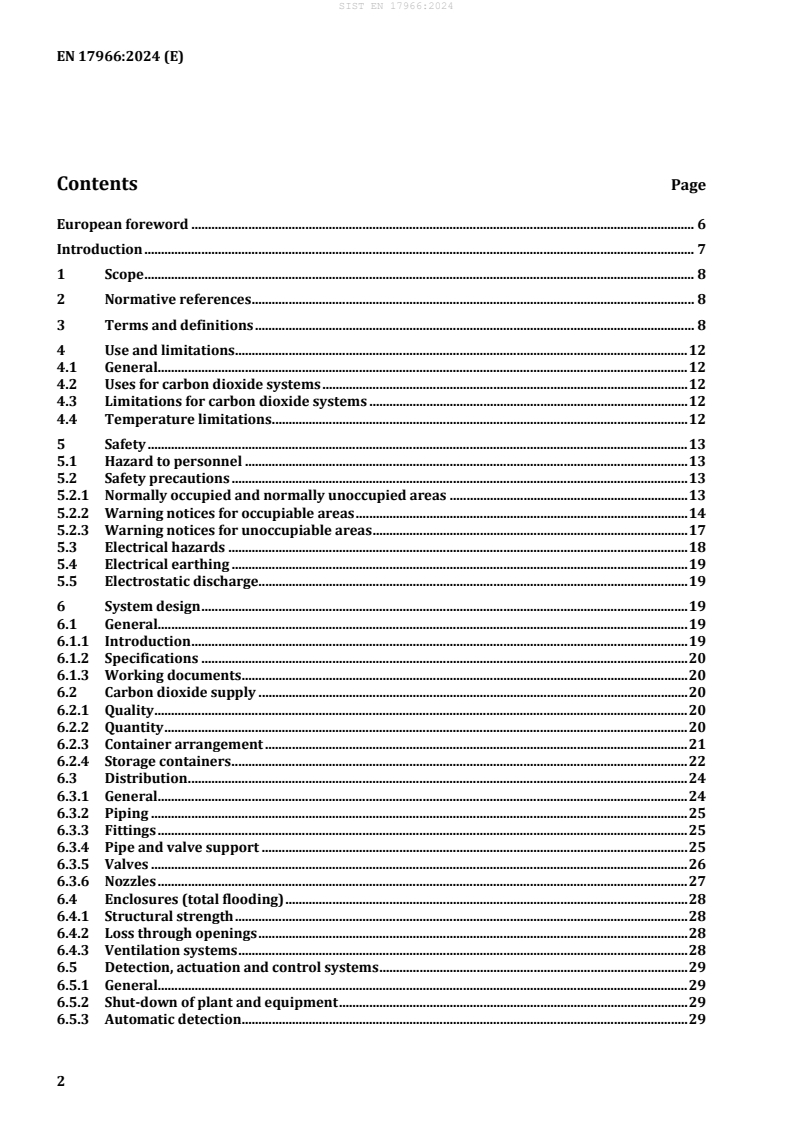
Contents Page
European foreword . 6
Introduction . 7
1 Scope . 8
2 Normative references . 8
3 Terms and definitions . 8
4 Use and limitations . 12
4.1 General. 12
4.2 Uses for carbon dioxide systems . 12
4.3 Limitations for carbon dioxide systems . 12
4.4 Temperature limitations . 12
5 Safety . 13
5.1 Hazard to personnel . 13
5.2 Safety precautions . 13
5.2.1 Normally occupied and normally unoccupied areas . 13
5.2.2 Warning notices for occupiable areas . 14
5.2.3 Warning notices for unoccupiable areas . 17
5.3 Electrical hazards . 18
5.4 Electrical earthing . 19
5.5 Electrostatic discharge. 19
6 System design . 19
6.1 General. 19
6.1.1 Introduction . 19
6.1.2 Specifications . 20
6.1.3 Working documents . 20
6.2 Carbon dioxide supply . 20
6.2.1 Quality . 20
6.2.2 Quantity . 20
6.2.3 Container arrangement . 21
6.2.4 Storage containers . 22
6.3 Distribution . 24
6.3.1 General. 24
6.3.2 Piping . 25
6.3.3 Fittings . 25
6.3.4 Pipe and valve support . 25
6.3.5 Valves . 26
6.3.6 Nozzles . 27
6.4 Enclosures (total flooding) . 28
6.4.1 Structural strength . 28
6.4.2 Loss through openings . 28
6.4.3 Ventilation systems . 28
6.5 Detection, actuation and control systems . 29
6.5.1 General. 29
6.5.2 Shut-down of plant and equipment . 29
6.5.3 Automatic detection . 29
6.5.4 Operating devices . 29
6.5.5 Control equipment . 30
6.5.6 Audible alarms and visual indicators . 31
7 Carbon dioxide flow and concentration calculations . 32
7.1 General . 32
7.2 System flow calculations . 32
7.2.1 General . 32
7.2.2 Friction losses . 33
7.2.3 Pressure drop . 33
7.2.4 Valves and fittings . 34
7.2.5 As-installed calculations . 34
7.2.6 Specific requirements . 34
7.3 Carbon dioxide concentration requirements . 34
7.3.1 Flame extinguishment . 34
7.3.2 Inerting . 34
7.4 Total flooding quantity . 35
7.4.1 General . 35
7.4.2 Design quantity . 35
7.4.3 KB factor . 36
7.5 Design of local application systems . 38
7.5.1 General . 38
7.5.2 Carbon dioxide requirements . 39
7.5.3 Rate by area method . 39
7.5.4 Rate by volume method . 41
7.6 Duration of protection — total flooding systems . 42
7.7 System performance . 43
7.7.1 Discharge time . 43
7.7.2 Extended discharge . 43
8 Commissioning and acceptance . 43
8.1 General . 43
8.2 Tests . 43
8.2.1 General . 43
8.2.2 Enclosure check . 44
8.2.3 Review of mechanical components . 44
8.2.4 Review of enclosure integrity . 45
8.2.5 Review of electrical components . 45
8.2.6 Preliminary functional tests . 46
8.2.7 System functional operational test . 46
8.2.8 Remote monitoring operations (if applicable) . 47
8.2.9 Control panel primary power source . 47
8.2.10 Completion of functional tests . 47
8.3 Completion certificate and documentation . 47
9 Inspection, maintenance, testing and training . 48
9.1 General . 48
9.2 Inspection . 48
9.2.1 General . 48
9.2.2 Container . 48
9.2.3 Hose . 48
9.2.4 Enclosures . 48
9.3 Maintenance . 49
9.3.1 General . 49
9.3.2 User's programme of inspection . 49
9.3.3 Service schedule . 49
9.4 Training . 49
Annex A (normative) Working documents . 50
A.1 General. 50
A.2 Working documents . 50
A.3 Specific details . 51
A.3.1 Pre-engineered systems . 51
A.3.2 Engineered systems . 51
A.4 Completion certificate and documentation . 51
Annex B (normative) Carbon dioxide system pipe and orifice size determination . 56
Annex C (informative) System performance verification . 66
Annex D (informative) General information on carbon dioxide . 67
D.1 General. 67
D.2 Free efflux . 68
D.3 Hazards to personnel . 70
Annex E (informative) Examples of calculations . 72
E.1 Rate by volume method — Example 1 . 72
E.1.1 Hazard . 72
E.1.2 Actual dimensions . 72
E.1.3 Assumed volume . 72
E.1.4 Percent perimeter enclosed . 73
E.1.5 Discharge rate for 71 % enclosure . 73
E.1.6 Discharge rate . 73
E.1.7 Carbon dioxide requirement . 73
E.2 Rate by volume method — Example 2 . 73
E.2.1 Hazard . 73
E.2.2 Actual dimensions . 73
E.2.3 Assumed volume . 73
E.2.4 Percent perimeter enclosed . 74
E.2.5 Discharge rate for 0 % enclosure . 74
E.2.6 Discharge rate . 74
E.2.7 Carbon dioxide requirement . 74
E.3 Rate by area method . 74
E.3.1 Hazard . 74
E.3.2 Surface dimensions . 74
E.3.3 Nozzle location . 74
E.3.4 Procedure . 74
E.3.5 Total flow rate . 74
E.3.6 Carbon dioxide requirement . 74
E.4 Total flooding system . 75
E.4.1 Storeroom . 75
E.4.2 Actual dimensions . 75
E.4.3 Assumed volume . 75
E.4.4 Additional volume for ventilation . 75
E.4.5 Deductible volume . 75
E.4.6 Total surface area of all sides . 75
E.4.7 Total surface area of all openings . 76
E.4.8 Area . 76
E.4.9 Carbon dioxide design quantity . 76
Bibliography . 77
European foreword
This document (EN 17966:2024) has been prepared by Technical Committee CEN/TC 191 “Fixed
firefighting systems”, the secretariat of which is held by BSI.
This European Standard shall be given the status of a national standard, either by publication of an
identical text or by endorsement, at the latest by April 2025, and conflicting national standards shall be
withdrawn at the latest by April 2025.
Attention is drawn to the possibility that some of the elements of this document may be the subject of
patent rights. CEN shall not be held responsible for identifying any or all such patent rights.
The text of ISO 6183:2022 has been prepared by Technical Committee ISO/TC 21 “Equipment for fire
protection and fire fighting” of the International Organization for Standardization (ISO) and has been
taken over as EN 17966:2024 by Technical Committee CEN/TC 191 “Fixed firefighting systems”, the
secretariat of which is held by BSI, with common modifications which are indicated by a straight line in
the margin of the text.
Any feedback and questions on this document should be directed to the users’ national standards body.
A complete listing of these bodies can be found on the CEN website.
According to the CEN-CENELEC Internal Regulations, the national standards organisations of the
following countries are bound to implement this European Standard: Austria, Belgium, Bulgaria, Croatia,
Cyprus, Czech Republic, Denmark, Estonia, Finland, France, Germany, Greece, Hungary, Iceland, Ireland,
Italy, Latvia, Lithuania, Luxembourg, Malta, Netherlands, Norway, Poland, Portugal, Republic of North
Macedonia, Romania, Serbia, Slovakia, Slovenia, Spain, Sweden, Switzerland, Türkiye and the United
Kingdom.
Introduction
This document is intended for use by those concerned with purchasing, designing, installing, testing,
inspecting, approving, operating and maintaining carbon dioxide (CO ) extinguishing systems.
This document applies only to carbon dioxide fixed fire-extinguishing systems in buildings and other
premises on land. Although the general principles can apply to other uses (e.g. maritime use), for these
other uses, it is likely that additional considerations will have to be taken into account and the application
of the requirements given in this document is therefore unlikely to be fully satisfactory. General
information about carbon dioxide as an extinguishing medium is given in Annex D. This can be useful
background information for those unfamiliar with the characteristics of this medium.
It has been assumed in the preparation of this document that the execution of its provisions will be
entrusted to those persons appropriately qualified and experienced in the specification, design,
installation, testing, approval, inspection, operation and maintenance of systems and equipment, for
whose guidance it has been prepared, and who can be expected to exercise a duty of care to avoid the
unnecessary release of carbon dioxide. New requirements to minimize the need to release carbon dioxide
during testing and commissioning procedures are included in this third edition. These are linked to the
inclusion of enclosure integrity testing.
Carbon dioxide has for many years been a recognized effective medium for the extinction of flammable
liquid fires as well as fires in the presence of electrical and ordinary Class A hazards. Nevertheless, in the
planning of comprehensive schemes, it should be remembered that there can be hazards for which this
media is not suitable, and that in certain circumstances or situations there can be dangers in its use
requiring special precautions.
The use of carbon dioxide is no longer recommended for total flooding of occupied areas if more
appropriate extinguishing agents are available. EN 15004 provides requirements for other extinguishing
agents that can be more appropriately used in these areas.
It is important that the fire protection of a building or plant be considered as a whole. Carbon dioxide
systems form only a part, albeit an important part, of the available facilities. It cannot be assumed that
their adoption necessarily removes the need to consider supplementary measures, such as the provision
of portable fire extinguishers or other mobile appliances for first aid or emergency use, or to deal with
special hazards.
Advice on these matters can be obtained from the appropriate manufacturer of the carbon dioxide or the
extinguishing system. Information can also be sought from the appropriate fire authority, the health and
safety authorities, and insurers. In addition, reference needs to be made, as appropriate, to the other
national standards and statutory regulations of a given country.
It is essential that firefighting equipment be carefully maintained to ensure instant readiness when
required. Routine maintenance is liable to be overlooked or given insufficient attention by the owner of
the system. It is, however, neglected at the peril of the lives of occupants of the premises and at the risk
of crippling financial loss. The importance of maintenance cannot be too highly emphasized. Inspection,
preferably by a third party, should include an evaluation concluding that the extinguishing system
continues to provide adequate protection for the risk (protected zones as well as state-of-the-art can
change over time).
1 Scope
This document specifies requirements and gives recommendations for the design, installation, testing,
maintenance and safety of fixed carbon dioxide firefighting systems in buildings, plants or other
structures. It is not applicable to extinguishing systems on ships, in aircraft, on vehicles or on mobile fire
appliances, or to below ground systems in the mining industry; nor does it apply to carbon dioxide pre-
inerting systems.
Design of systems where unclosable opening(s) of the protected volume exceed a specified area and
where the opening(s) can be subject to the effect of wind is not specified, although general guidance on
the procedure to be followed in such cases is given (see 7.4.3.2).
2 Normative references
The following documents are referred to in the text in such a way that some or all of their content
constitutes requirements of this document. For dated references, only the edition cited applies. For
undated references, the latest edition of the referenced document (including any amendments) applies.
EN ISO 7731, Ergonomics — Danger signals for public and work areas — Auditory danger signals
(ISO 7731)
EN 15004-1, Fixed firefighting systems — Gas extinguishing systems — Part 1: Design, installation and
maintenance (ISO 14520-1 modified)
EN 12094 (all parts), Fixed firefighting systems — Components for gas extinguishing systems
EN 54 (all parts), Fire detection and fire alarm systems
3 Terms and definitions
For the purposes of this document, the following terms and definitions apply.
ISO and IEC maintain terminology databases for use in standardization at the following addresses:
— ISO Online browsing platform: available at https://www.iso.org/obp
— IEC Electropedia: available at https://www.electropedia.org/
3.1
approved
acceptable to a relevant authority (3.2)
Note 1 to entry: In determining the acceptability of installations or procedures, equipment or materials, the
authority can base acceptance on compliance with the appropriate standards.
3.2
authority
organization, office or individual responsible for approving equipment, installations or procedures
3.3
automatic/manual switch
means of converting the system from automatic to manual actuation
Note 1 to entry: This can be in the form of a manual switch on the control panel or other units, or a personnel door
interlock. In all cases, this changes the actuation mode of the system from automatic and manual to manual only or
vice versa.
3.4
clearance
air gap between equipment, including piping and nozzles and unenclosed or uninsulated live electrical
components at other than ground potential
3.5
deep-seated fire
fire involving solids subject to smouldering
Note 1 to entry: Examples of a deep-seated fire include baled, stacked or piled materials such as paper, wool and
grain.
3.6
design concentration
concentration of carbon dioxide, including a safety factor (3.25), required for system design purposes
3.7
engineered system
system in which the supply of carbon dioxide is discharged through a system of pipes and nozzles in
which the size of each section of pipe and nozzle orifice has been calculated in accordance with the
requirements of this document
3.8
extinguishing concentration
minimum concentration of carbon dioxide required to extinguish a fire involving a particular fuel under
defined experimental conditions excluding any safety factor (3.25)
3.9
fill density
mass of carbon dioxide per unit volume (3.12) of container
3.10
design quantity
mass of carbon dioxide required to achieve the design concentration (3.6) within the protected volume
(3.11)
3.11
volume
protected space enclosed by the building elements
3.12
high pressure storage
storage of carbon dioxide in pressurized containers at ambient temperatures
3.13
hold time
period of time during which a concentration of carbon dioxide not less than 85 % of the design
concentration is maintained
Note 1 to entry: See 7.6.2.
3.14
inspection
examination for conformity by measuring, observing, or testing the relevant characteristics of an item
[Source: EN 13306:2017, 8.1 [3] ]
3.15
liquid discharge time
time during which predominantly liquid carbon dioxide is present at the nozzle
3.16
lock-off device
manually operated shut-off valve installed in the discharge piping downstream of the carbon dioxide
containers, or other type of device that mechanically prevents agent container actuation
Note 1 to entry: The actuation of this device provides an indication of system isolation.
Note 2 to entry: The intent is to prevent the discharge of carbon dioxide into the hazard area when the lock-off
device is activated.
3.17
local application system
automatic or manual fire-extinguishing system in which a fixed supply of carbon dioxide is permanently
connected to fixed piping with nozzles arranged to discharge the carbon dioxide directly to a fire
occurring in a defined area that has no enclosure surrounding it, or is only partially enclosed, and that
does not produce an extinguishing concentration (3.8) throughout the entire volume (3.11) containing
the protected hazard
3.18
low pressure storage
storage of carbon dioxide in pressurized containers at a controlled low temperature, normally −18 °C to
−20 °C
Note 1 to entry: The pressure in this type of storage is approximately 21 bar .
3.19
maintenance
combination of all technical, administrative and managerial actions during the life cycle of an item
intended to retain it in, or restore it to, a state in which it can perform the required function
Note 1 to entry: Technical maintenance actions include observation and analyses of the items state (e.g. inspection,
monitoring, testing, diagnosis, prognosis, etc.) and active maintenance actions (e.g. repair, refurbishment).
[Source: EN 13306:2017, 2.1 – modified: Note 2 and 3 to entry are deleted. [3] ]
3.20
maximum working pressure
maximum equilibrium pressure developed in the component or system at the highest temperature (50 °C,
or higher, if specified by the manufacturer)
Note 1 to entry: For high pressure storage (3.12), at the maximum fill density (3.9). For a container in transit, the
equilibrium pressure can differ from that in storage within a building.
Note 2 to entry: For low pressure storage (3.18), the pressure corresponding to the maximum controlled
temperature of −18 °C.
1 5 2
1 bar = 0,1 MPa = 10 Pa; 1 MPa = 1 N/mm .
3.21
minimum working pressure
minimum equilibrium pressure at the lowest temperature (-20 °C or lower, if specified by manufacturer)
3.22 Terms related to occupied and unoccupiable areas
3.22.1
normally occupied area
area intended for occupancy
3.22.2
normally unoccupied area
area not normally occupied by people, but which may be entered occasionally for brief periods
3.22.3
unoccupiable area
area which cannot be occupied by people due to dimensional or other physical constraints
EXAMPLE Shallow voids and cabinets.
3.23
pre-engineered system
system consisting of a supply of extinguishant of specified capacity coupled to pre-calculated pipework
and nozzle arrangement up to maximum permitted limits
Note 1 to entry: No deviation is permitted from the limits specified by the manufacturer or authority (3.2).
3.24
pre-liquid vapour flow time
time from the opening of the container or selector valve (3.26) to the start of predominantly liquid flow
at the most unfavourable nozzle
3.25
safety factor
multiplier of the carbon dioxide extinguishing concentration (3.8), used to determine minimum design
concentration (3.6)
3.26
selector valve
valve installed in the discharge piping downstream of the storage containers, used to direct the carbon
dioxide to the appropriate hazard
Note 1 to entry: It is used where one or more storage containers are arranged to selectively discharge carbon
dioxide to any of several separate hazards.
3.27
surface fire
fire involving combustible or flammable liquids, gases and solids not subject to smouldering
3.28
total flooding system
system arranged to discharge carbon dioxide into an enclosed space to achieve the appropriate design
concentration (3.6)
3.29
working pressure
equilibrium pressure of the system or component at 20 °C
4 Use and limitations
4.1 General
The design, installation, service and maintenance of carbon dioxide fire-extinguishing systems shall be
performed by those competent in fire-extinguishing system technology. Maintenance and installation
shall only be performed by qualified personnel and companies.
4.2 Uses for carbon dioxide systems
Carbon dioxide, local application and total flooding systems are useful within the limits of this document
in extinguishing fires involving specific hazards or equipment.
The following are typical of such hazards, but the list is not exhaustive:
a) combustible or flammable liquid and gases;
b) electrical hazards such as transformers, switches, circuit breakers, rotating equipment and electronic
equipment;
c) engines utilizing gasoline and other flammable liquid fuels;
d) ordinary combustibles such as paper, wood, and textiles.
4.3 Limitations for carbon dioxide systems
Carbon dioxide cannot extinguish fires involving certain types of materials such as:
a) chemicals containing their own supply of oxygen, such as cellulose nitrate; or
b) metals and chemicals which react with carbon dioxide, e.g. alkali metals and metal hydrides.
While carbon dioxide does not extinguish certain fuels containing their own oxygen of combustion, it
does not react dangerously with these materials or increase their burning rate. Carbon dioxide, if used in
this situation in a total flooding system, provides protection for adjacent combustibles or can be
successfully used if the reactive metals or hydride are first covered by another material. Examples of the
latter condition are sodium stored or used under kerosene, cellulose nitrate in a solution of lacquer
thinner, and magnesium chips covered with heavy oil.
4.4 Temperature limitations
All devices shall be designed for the service they will encounter and shall not be readily rendered
inoperative or susceptible to accidental operation. Devices shall normally be designed to function
properly from −20 °C to +50 °C, or marked to indicate temperature limitations, or in accordance with the
manufacturer's specifications, which shall be marked on the name-plate, or (where there is no name-
plate) in the manufacturer's instruction manual.
5 Safety
5.1 Hazard to personnel
The discharge of carbon dioxide at a fire-extinguishing concentration creates serious hazards to
personnel, such as suffocation and reduced visibility during and after the discharge period. Hazards to
personnel created by the discharge of carbon dioxide shall be considered in the design of the system.
Carbon dioxide gas is heavier than air and will collect in pits, wells, shaft bottoms or other low-lying areas,
and can migrate into adjacent places outside the protected space. Consideration shall also be given to
places to which the carbon dioxide can migrate or collect in the event of a discharge from a safety relief
device of a storage container.
In addition to the release by response of a safety relief device, the following aspects shall also be
considered:
a) release when the system is triggered by flowing out of overpressure vents or other openings in the
protected area;
b) release during opening of accesses to the flooded protected zone (e.g. in the context of
reconnaissance or exting
...