

SIST EN 13031-2:2025
(Main)Greenhouses: Design and construction - Part 2: Greenhouses in garden centres open to the public
General Information
- Abstract
This document specifies principles and requirements for the determination of controlled snow loads on the transparent cladding of greenhouses open to the public.
This document can be applied either to the greenhouse or only to the transparent cladding system.
Fire resistance-related aspects are not covered in this document.
- Status
- Published
- Public Enquiry End Date
- 16-Jan-2024
- Publication Date
- 30-Dec-2024
- Technical Committee
- ISS SPL.GPO - Building construction
- Current Stage
- 6060 - National Implementation/Publication (Adopted Project)
- Start Date
- 12-Dec-2024
- Due Date
- 16-Feb-2025
- Completion Date
- 31-Dec-2024


Overview
EN 13031-2:2024 - published by CEN - defines principles and requirements for the determination of controlled snow loads on the transparent cladding of greenhouses open to the public (garden centres, botanical garden exhibits, retail greenhouses). The standard can be applied to the entire greenhouse or only to the transparent cladding system. It focuses on snow load actions where active measures (e.g., controlled heating or melting systems) limit roof snow accumulation. Fire-resistance aspects are not covered.
Key topics and technical requirements
- Controlled snow load definition: difference between the initial snow load expected at the start of heavy snowfall and the snow load removed by devices whose performance is guaranteed during heavy snowfall (per ISO 4355).
- Thermal coefficient (Ct): guidance for using a thermal coefficient for high-transmittance claddings (glass, certain foils). The standard references thresholds and methods (ISO 4355, Annex D) for when Ct < 1 can be applied.
- Special heat transmittance (Uo): concepts for heat energy flux from internal air to the melt layer and through the snow layer, used to evaluate melting performance.
- Snow load distribution: recommendations for how snow may distribute or slide on slippery transparent surfaces and how to consider these effects in structural design.
- Controlled heating requirements: performance and minimum internal temperature considerations for heating systems intended to melt/remove snow quickly enough to maintain plant-climate needs.
- Informative annexes:
- Annex A - thermal coefficients and model thresholds (min/max snow loads, Uo, temperature ranges)
- Annex B - methods (statistical and energy-flux based) for determining controlled snow loads and melt rates; includes special application for single short-term snowfall events in Mediterranean climates.
- National choices and Eurocode integration: the standard works with Eurocodes (EN 1990, EN 1991 series) and allows national application documents (NADs) for specific parameters (e.g., glazing design method, thermal coefficient use, minimum internal temperatures).
Practical applications
- Design and structural calculation of garden-centre and publicly accessible greenhouses where snow control systems (heating, melt devices) are part of the building strategy.
- Specification and validation of transparent cladding (glass, ETFE, polyethylene) performance under snowfall when active snow-removal is used.
- Engineering of controlled heating systems and operational procedures (setpoints, safety measures) to ensure plant-growing climate while limiting structural snow loads.
- Risk assessment and compliance documentation for project teams, manufacturers, and certifying bodies.
Who uses this standard
- Structural and façade engineers designing public greenhouses
- Greenhouse manufacturers and cladding system suppliers
- Garden centre and botanical garden facility designers and operators
- Regulatory authorities and national standards bodies preparing National Annexes
- Consultants performing snow-load and heating-system performance calculations
Related standards (selected)
- EN 1990, EN 1991 (Eurocodes) - structural design principles and snow actions
- ISO 4355 - bases for determination of snow loads on roofs
- EN 673 / EN 674 / EN 675 - methods for thermal transmittance (U value) of glass
Keywords: EN 13031-2:2024, greenhouses open to the public, controlled snow loads, transparent cladding, thermal coefficient Ct, Eurocodes, greenhouse design, garden centre greenhouses.
Get Certified
Connect with accredited certification bodies for this standard

Control Union Certifications
Global certification for agriculture and sustainability.

ECOCERT
Organic and sustainability certification.

FSC International
Forest Stewardship Council certification.
Sponsored listings
Frequently Asked Questions
SIST EN 13031-2:2025 is a standard published by the Slovenian Institute for Standardization (SIST). Its full title is "Greenhouses: Design and construction - Part 2: Greenhouses in garden centres open to the public". This standard covers: This document specifies principles and requirements for the determination of controlled snow loads on the transparent cladding of greenhouses open to the public. This document can be applied either to the greenhouse or only to the transparent cladding system. Fire resistance-related aspects are not covered in this document.
This document specifies principles and requirements for the determination of controlled snow loads on the transparent cladding of greenhouses open to the public. This document can be applied either to the greenhouse or only to the transparent cladding system. Fire resistance-related aspects are not covered in this document.
SIST EN 13031-2:2025 is classified under the following ICS (International Classification for Standards) categories: 65.040.30 - Greenhouses and other installations. The ICS classification helps identify the subject area and facilitates finding related standards.
SIST EN 13031-2:2025 is available in PDF format for immediate download after purchase. The document can be added to your cart and obtained through the secure checkout process. Digital delivery ensures instant access to the complete standard document.
Standards Content (Sample)
SLOVENSKI STANDARD
01-februar-2025
Rastlinjaki: Projektiranje in gradnja - 2. del: Rastlinjaki v vrtnih centrih
Greenhouses: Design and construction - Part 2: Greenhouses in garden centres open to
the public
Gewächshäuser - Bemessung und Konstruktion - Teil 2: Verkaufsgewächshäuser
Serres - Calcul et construction - Partie 2: Serres dans les jardineries ouvertes au public
Ta slovenski standard je istoveten z: EN 13031-2:2024
ICS:
65.040.30 Rastlinjaki in druge naprave Greenhouses and other
installations
2003-01.Slovenski inštitut za standardizacijo. Razmnoževanje celote ali delov tega standarda ni dovoljeno.
EN 13031-2
EUROPEAN STANDARD
NORME EUROPÉENNE
December 2024
EUROPÄISCHE NORM
ICS 65.040.30
English Version
Greenhouses - Design and construction - Part 2:
Greenhouses open to the public
Serres - Calcul et construction - Partie 2 : Serres dans Gewächshäuser - Bemessung und Konstruktion - Teil 2:
les jardineries ouvertes au public Gewächshäuser mit Zugang für die Öffentlichkeit
This European Standard was approved by CEN on 11 November 2024.
CEN members are bound to comply with the CEN/CENELEC Internal Regulations which stipulate the conditions for giving this
European Standard the status of a national standard without any alteration. Up-to-date lists and bibliographical references
concerning such national standards may be obtained on application to the CEN-CENELEC Management Centre or to any CEN
member.
This European Standard exists in three official versions (English, French, German). A version in any other language made by
translation under the responsibility of a CEN member into its own language and notified to the CEN-CENELEC Management
Centre has the same status as the official versions.
CEN members are the national standards bodies of Austria, Belgium, Bulgaria, Croatia, Cyprus, Czech Republic, Denmark, Estonia,
Finland, France, Germany, Greece, Hungary, Iceland, Ireland, Italy, Latvia, Lithuania, Luxembourg, Malta, Netherlands, Norway,
Poland, Portugal, Republic of North Macedonia, Romania, Serbia, Slovakia, Slovenia, Spain, Sweden, Switzerland, Türkiye and
United Kingdom.
EUROPEAN COMMITTEE FOR STANDARDIZATION
COMITÉ EUROPÉEN DE NORMALISATION
EUROPÄISCHES KOMITEE FÜR NORMUNG
CEN-CENELEC Management Centre: Rue de la Science 23, B-1040 Brussels
© 2024 CEN All rights of exploitation in any form and by any means reserved Ref. No. EN 13031-2:2024 E
worldwide for CEN national Members.
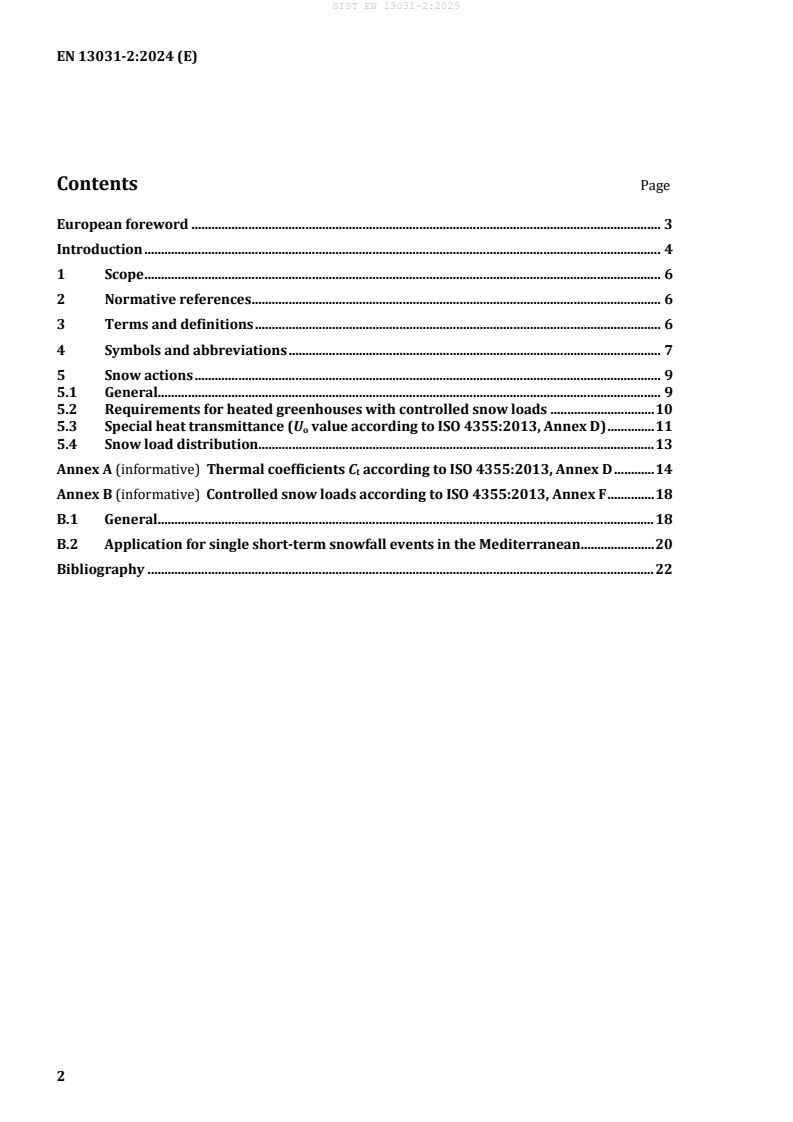
Contents Page
European foreword . 3
Introduction . 4
1 Scope . 6
2 Normative references . 6
3 Terms and definitions . 6
4 Symbols and abbreviations . 7
5 Snow actions . 9
5.1 General. 9
5.2 Requirements for heated greenhouses with controlled snow loads . 10
5.3 Special heat transmittance (U value according to ISO 4355:2013, Annex D) . 11
o
5.4 Snow load distribution . 13
Annex A (informative) Thermal coefficients C according to ISO 4355:2013, Annex D . 14
t
Annex B (informative) Controlled snow loads according to ISO 4355:2013, Annex F . 18
B.1 General. 18
B.2 Application for single short-term snowfall events in the Mediterranean . 20
Bibliography . 22
European foreword
This document (EN 13031-2:2024) has been prepared by Technical Committee CEN/TC 284
“Greenhouses”, the secretariat of which is held by NEN.
This European Standard shall be given the status of a national standard, either by publication of an
identical text or by endorsement, at the latest by June 2025, and conflicting national standards shall be
withdrawn at the latest by June 2025.
Attention is drawn to the possibility that some of the elements of this document may be the subject of
patent rights. CEN shall not be held responsible for identifying any or all such patent rights.
This document is related to greenhouses open to the public used for the exhibition, presentation and / or
retail of plants.
The Eurocodes recognize the responsibility of each Member State and have safeguarded their right to
determine values related to regulatory safety matters at national level through the use of National
Annexes.
Any feedback and questions on this document should be directed to the users’ national standards body.
A complete listing of these bodies can be found on the CEN website.
According to the CEN-CENELEC Internal Regulations, the national standards organisations of the
following countries are bound to implement this European Standard: Austria, Belgium, Bulgaria, Croatia,
Cyprus, Czech Republic, Denmark, Estonia, Finland, France, Germany, Greece, Hungary, Iceland, Ireland,
Italy, Latvia, Lithuania, Luxembourg, Malta, Netherlands, Norway, Poland, Portugal, Republic of North
Macedonia, Romania, Serbia, Slovakia, Slovenia, Spain, Sweden, Switzerland, Türkiye and the United
Kingdom.
Introduction
This document relates specifically to greenhouses open to the public, used for the exhibition, presentation
and / or sale of plants, such as greenhouses in garden centers or expositions in botanical gardens. Part 1
of this document is related to commercial production greenhouses used for the professional production
of plants with limited access for authorized personnel only.
The structural design of greenhouses open to the public is carried out using EN 1990 and the relevant
parts of EN 1991-series to EN 1999-series (Eurocodes 1 to 9) and any further parts, which may follow
(e.g. for glass), regarding the general principles and basic requirements for actions, structural resistance
and stability, serviceability, durability and robustness. National Application Documents (NAD) are
considered for each of the parts.
This document gives additional non-contradictory rules and complementary information for snow
actions on the transparent claddings of greenhouses, where special methods are used, to remove snow
and optimize the transmission of solar radiation, which would otherwise not permit the climate for a
successful growth of plants.
The snow load on the roof can be controlled by removing snow, for example by melting snow with a
system for controlled heating. Controlled snow load is the difference between the initial snow load
expected when heavy snowfall starts, and the snow load removed by a device whose performance is
guaranteed even during heavy snowfall, see ISO 4355. With this document the values for controlled snow
loads can be calculated, taking into account the thermal coefficient C for roof claddings with high thermal
t
transmittance.
For wind loads on greenhouses with multi-span roofs, EN 1991-1-4 gives conservative values for
aerodynamic force and pressure coefficients and structural factors. In supplement to calculations
according EN 1991-1-4, wind tunnel tests and proven and/or properly validated numerical methods may
be used to obtain load and response information.
As long as a structural Eurocode part on glass is not available, it is recommended to specify the glazing
and the relevant design regulations in the National Annex to this part of the standard. For flat glass panels
uniformly loaded perpendicular to their surface, simply supported along the edges and with nominal
thickness not less than 4 mm, EN 13031-1 can be used.
National choices are allowed in EN 13031-2 through the following clauses:
— Glazing and design method for the structural safety of glass panels (as long as the Eurocode Glass or
other regulations (NAD) are not available) (see above)
— 5.1 (1) for characteristic values of snow actions
— 5.1 (3) for the determination of thermal coefficients C < 1
t
— 5.2 (3) for minimum air temperature under the roof for controlled heating
— 5.2 (5) for safety measures for controlled heating
— 5.4 (2) for appropriate snow load distributions for sliding snow on slippery surfaces
National choice is allowed in EN 13031-2 on the use of the informative annexes:
— Annex A for the minimum roof snow load min s and the calculation of C using the formulae and the
i,t t
appropriate limitations within the given parameter ranges
— Annex B for the determination of C or C based on statistical evaluation of data of snowfall rates,
t,0 t
calculation of the heat energy flux and melt rates
When no national choice is given, the default values given in this document can be used. The National
Annex can contain, directly or by reference, further non-contradictory complementary information, in
line with the verbal forms “shall”, “should”, “may” and “can”, as they are used in the Eurocode.
1 Scope
This document specifies principles and requirements for the determination of controlled snow loads on
the transparent cladding of greenhouses open to the public.
This document can be applied either to the greenhouse or only to the transparent cladding system.
Fire resistance-related aspects are not covered in this document.
2 Normative references
The following documents are referred to in the text in such a way that some or all of their content
constitutes requirements of this document. For dated references, only the edition cited applies. For
undated references, the latest edition of the referenced document (including any amendments) applies.
EN 673, Glass in building — Determination of thermal transmittance (U value) — Calculation method
EN 674, Glass in building — Determination of thermal transmittance (U value) — Guarded hot plate method
EN 675, Glass in building — Determination of thermal transmittance (U value) — Heat flow meter method
EN 1990, Eurocode — Basis of structural and geotechnical design
EN 1991 (all parts), Eurocode 1 — Actions on structures
EN 1991-1-3, Eurocode 1 — Actions on structures — Part 1-3: General actions - Snow loads
EN ISO 6946, Building components and building elements — Thermal resistance and thermal transmittance
— Calculation methods (ISO 6946)
EN ISO 10077-1, Thermal performance of windows, doors and shutters — Calculation of thermal
transmittance — Part 1: General (ISO 10077-1)
EN ISO 10077-2, Thermal performance of windows, doors and shutters — Calculation of thermal
transmittance — Part 2: Numerical method for frames (ISO 10077-2)
ISO 4355, Bases for design of structures — Determination of snow loads on roofs
3 Terms and definitions
For the purposes of this document, the terms and definitions given in EN 1990, EN 1991 and the following
apply.
ISO and IEC maintain terminology databases for use in standardization at the following addresses:
— ISO Online browsing platform: available at https://www.iso.org/obp/
— IEC Electropedia: available at https://www.electropedia.org/
3.1
greenhouse
building structure that optimizes solar radiation transmission used for plants requiring regulated
climatic conditions
3.2
greenhouse open to the public
greenhouse (3.1) used for the professional presentation and / or sale of plants, such as garden centers or
expositions in botanical gardens, where people can have access to certain areas (traffic areas)
3.3
commercial production greenhouse
greenhouse (3.1) for professional production and / or protection of plants, where human occupancy is
restricted to authorized personnel, concerning low levels in number and duration
Note 1 to entry: Other persons shall be accompanied by authorized personnel.
3.4
transparent cladding
cladding, that allows transmission of solar radiation, required for the growth of plants
Note 1 to entry: Transparent cladding makes snow accumulation visible (impaired solar radiation); immediate
measures can be taken for removal of the snow.
3.5
controlled snow load
difference between the initial snow load expected during a heavy snowfall and the snow load removed
by a device whose performance is guaranteed even during heavy snowfall
3.6
controlled heating
heating operation with devices that are intended and capable of melting and / or removing an amount of
snow, to limit the roof snow load as fast as required
4 Symbols and abbreviations
4.1 For the purposes of this document, the following symbols and abbreviations apply.
4.2 Abbreviations:
NAD National Application Documents, e.g. National Annex to Eurocode, also National Code or
Standard or National Regulation of an Authority
ETFE Ethylene-Tetrafluoroethylene
PE Polyethylene
SWE Snow-water-equivalent
WMO World Meteorological Organization
4.3 Symbols:
NOTE The following symbols used in this document are based on EN 1990 and EN 1991.
Latin upper-case letters:
Ce exposure coefficient
C special exposure coefficient for controlled snow loads
e,c
C thermal coefficient
t
min C minimum value for C according to Annex A (model threshold)
t t
C basic value of the thermal coefficient (without roof angle influence f(α))
t,0
L latent heat of fusion of water (for ice, snow) in kJ/kg at melt temperature θ = 0,01 °C
f s,m
L , corrected latent heat of fusion in kJ/kg including the warming of snow
f c
Q heat energy flux density (rate) in W/m from the warm roof below to the melt layer
o
Q heat energy flux density (rate) in W/m from the melt layer via the snow to the air outside
s,e
R overall thermal resistance of the cladding in m K/W
T
R internal surface resistance (internal air to surface) in m K/W
si
R internal surface resistance for heat flow sideways in m K/W
si,sw
R internal surface resistance for heat flow upwards in m K/W
si,up
R external surface resistance (surface to external air) in m K/W
se
R thermal resistance of the material layer j in m K/W
λ,j
R thermal resistance of the frame, e.g. gladding bars and gutter, in m K/W
f
R thermal resistance of the gas space k in m K/W
g,k
R equivalent thermal resistance of the (thermal) screen space m in m K/W
ts,m
U K)
overall heat transmittance in W/(m
U heat transmittance of the transparent part of the cladding in W/(m K)
g
U heat transmittance of the frame in W/(m K)
f
U special heat transmittance in W/(m K) for snowmelt conditions for heat energy flux from
o
the internal air to the melt layer on the external roof surface excluding the external heat
min U
o
transfer into the air
max U
o
minimum value U for the calculation of C according to Annex A (model threshold)
o t
maximum value U for the calculation of C according to Annex A (model threshold)
o t
U special heat transmittance in W/(m K) for snowmelt conditions from the melt layer through
s,e
the roof snow layer into the external air
Latin lower-case letters:
c specific heat capacity of snow in kJ/(kg ⋅ K)
pi,s
d depth of layer j in a multi-layer glass unit
j
d depth of the roof snow layer
s
f(α) roof angle function for the thermal coefficient C
t
f(θ ) influence of the heating (internal air temperature) on the thermal coefficient C
i t
f(U ) influence of the thermal transmittance of the cladding on the thermal coefficient C
o t
f(s ) influence of the snowfall rate (related to the snow load) on the thermal coefficient C
k t
h heat transfer coefficient of the gas space k
s,k
h heat transfer coefficient for convection
c,i
m (Δt ) melt rate in kg/m within a certain time interval Δt
r i i
s characteristic snow load on the ground in kN/m
k
s controlled snow load in kN/m
c
s characteristic value of the controlled snow load in kN/m
c,k
s (Δt ) snowfall rate in kg/m within a certain time interval Δt
r i i
min s minimum roof snow load in kN/m (model threshold for C according Annex A)
i,t t
max s maximum ground snow load in kN/m (model threshold for C according Annex A)
k t
v mean wind speed (over 10 min) in m/s
m
Greek upper-case letters:
Σ Sum
Δ Difference
Δt time interval in hours or days
i
ΔT temperature difference in K between the internal air and the melt layer on the roof
i
surface
ΔT temperature difference in K between the melt layer and the external air
s,e
Greek lower-case letters:
α angle of roof pitch, measured from the horizontal
λ thermal conductivity in W/(mK) for a material layer j; (λ - upper value; λ - lower value)
j j,sup j,inf
λ effective thermal conductivity of a snow layer in W/mK with the depth d in m and the
s,eff s
equivalent fresh snow density ρ in kg/m
s,f
ε emissivity
μ shape coefficient at the location i for roof snow load distributions
i
Θ internal air temperature in °C
i
min θ minimum internal air temperature in °C (model threshold for C according Annex A)
i t
max θ maximum internal air temperature in °C (model threshold for C according Annex A)
i t
θ critical external air temperature in °C, lower limit for the melting of snow
e,crit
θ melting temperature of snow in °C: triple point θ = 0,01 °C
s,m s,m
θ external air temperature in °C
e
ρ fresh snow density in kg/m directly after snowfall above the melt layer
s,f
5 Snow actions
5.1 General
(1) Characteristic values of snow actions shall be calculated in accordance with EN 1991-1-3.
NOTE See National Application Document (NAD).
(2) According to EN 1991-1-3, a thermal coefficient C can be used for roof claddings with high thermal
t
2 2
transmittance (>1 W/(mK), such as glass). The exact limit for U ≥ 1 W/(mK) is based on
o
ISO 4355:2013, Annex D. If C < 1 is allowed to be used for greenhouses open to the public, this document
t
provides guidance for the proper application of the thermal coefficient C .
t
(3) Depending on the climate, in the National Annex one or several C -values may be given or one of the
t
following methods according to ISO 4355 can be chosen to calculate the controlled snow load:
— according to ISO 4355:2013, Annex D: using a formula to calculate C as a function of the controlled
t
heating (internal air temperature θ ), the heat transfer through the roof (U ) and the snowfall rate,
i o
correlated to the maximum ground snow load. The C -formula and the required limitations for the
t
application are given in Annex A.
— according to ISO 4355:2013, Annex F: calculating a controlled snow load directly by statistical
evaluation of meteorological data using a thermo-dynamic model of the accumulation and ablation
of roof snow with melting at the bottom due to heat transfer through the roof cladding.
Recommendations are given in Annex B.
(4) The choice of the method depends on the availability of measurement data, tools for a statistical
evaluation and a suitable thermo-dynamic model, but also on the winter climate (see Annex A, Table A.1).
5.2 Requirements for heated greenhouses with controlled snow loads
(1) The heating can be taken into account for a controlled reduction of the roof snow load, if the cladding
is transparent with a sufficiently large heat transmission and the internal air temperature directly under
the roof is high enough. The melt water drainage should be adequate.
NOTE Generally, 1 W/(m K) is supposed to enable a sufficiently large heat transmission. The calculation of C
t
according to Annex A is limited to claddings with the special heat transmittance Uo ≥ 1 W/(m K).
(2) Requirements for controlled heating regarding both, heating and safety, depend on the local snow
climate, experience and state of the art of the technical equipment. If the following requirements for
controlled heating regarding both, heating and safety, are met, the greenhouse can be considered as
heated.
(3) Requirements for controlled heating: The heating shall maintain an internal air temperature under
the roof during and after snowfall with a defined (minimum) internal air temperature min θ well above
I
5 °C (min θ > > 5 °C), until the snow is removed.
i
Minimum internal air temperatures can be defined in the National Annex e.g. min θ = 12 °C or min
i
θ = 18 °C or agreed upon on a project-specific basis between the relevant parties such as clients,
i
constructors and designers, depending on the tolerance of the plants, the snow climate, technical
equipment and previous practical experiences.
(4) During the melting of snow, ventilations should be closed and (thermal) screens should be opened to
maximize the heat energy flux. Alternatively, the U-value of the cladding shall be corrected, see 5.3 (2).
NOTE The presence or absence of (thermal) screens are taken into account in the calculation of the special heat
transmittance U . Heating above the screens (snow melting tubes near the gutter) is helpful to avoid obstructions
o
of the melt water drainage.
(5) Safety measures: Greenhouses should only be considered as heated, if an automatic back-up system
is available, capable of taking over the heating, before the temperature drops below 5 °C. A warning
system and an emergency electrical power supply should be present as well.
Safety measures for the heating system may be defined in the National Annex.
5.3 Special heat transmittance (Uo value according to ISO 4355:2013, Annex D)
(1) For the choice and calculation of the thermal coefficient C , a special heat transmittance U of the
t o
greenhouse roof cladding is required. U includes the heat transfer from the air inside to the inner surface
o
of the cladding, through the cladding to the bottom of the snow layer and excludes the heat transfer
outside, because melting of snow occurs.
(2) The U -value can be calculated from the U-value of the roof cladding, as shown in Formula (1). If
o
(thermal) screens are not pulled back and the melting is not done via gutter heating, the U-value shall be
corrected by the sum of the equivalent thermal resistances of the screens including air space Σ R .
ts,m
U = (1)
− RR+∑
se ts,m
U
where the following parameters in accordance with ISO 4355, EN 673 and EN ISO 6946 are used:
2 2
R external surface resistance in m K/W, recommended as R = 0,04 m K/W;
se se
R equivalent thermal resistance of the (thermal) screen space m in m K/W;
ts,m
U overall heat transmittance of the roof cladding in W/(m K).
(3) For the overall heat transmittance of the roof cladding, frames (e.g. cladding bars and gutter) may be
included, as shown in Formula (2). For the purpose of snowmelt, the influence of heat-permeable metal
frames can be neglected. For a more detailed approach, for metal frames without heat separation, R = 0
f
can be taken, see EN ISO 10077-1 (with R - thermal resistance of the frame in m K/W).
f
U = (Σ A ⋅ U + Σ A ⋅ U ) / Σ A with U = 1 / R (2)
g g f f T
where
R is the overall thermal resistance of the cladding in m K/W;
T
U is the heat transmittance of the transparent part of the cladding;
g
U is the heat transmittance of the frame;
f
A, A , A are the areas of the cladding in total, the transparent part and the frame.
g f
(4) The internal surface resistance R changes with the direction of the heat flow mainly due to
si
convection. For greenhouse roofs the value R for a heat flow sideways may be replaced by R for a
si,sw si,up
heat flow upwards.
(5) For the purpose of the calculation of snowmelt (as opposed to the protection against heat loss) the
upper limits (subscript: sup) of the thermal resistances R , R and R are required, as shown in
T,sup λ,j,sup s,k,sup
Formula (3).
R = R + Σ R + Σ R + R (3)
T,sup si,up λ,j,sup s,k,sup se
where
R is the internal surface resistance for heat flow upwards in m K/W;
si,up
R is the thermal resistance of the material layer j in m K/W: R = d / λ ;
λ,j,sup j j j
with: λ - thermal conductivity in W/(mK) and: d - depth of layer j in m;
j j
R is the thermal resistance of a gas or air space k in m K/W: R = 1 / h ;
s,k,sup s,k s,k
with: h - heat transfer coefficient of the air or gas space.
s,k
For multi-layer glass units or plastic sheets with larger cavities, the heat flow and circulation in the cavity
changes with the orientation. The thermal resistance of the gas space R may be adapted accordingly.
s,k
(6) For multiwall plastic sheets, the U- and U -values should be provided by the supplier.
o
In case of a heat protective cladding, e.g. multi-layer glass or plastic with additives, reflective layers,
coatings or surface structures, the heat transmittance requirement of U ≥ 1 W/(m K) shall be checked
by a calculation or test in accordance with ISO 4355 or EN 673, EN 674, EN 675, EN ISO 6946,
EN ISO 10077-1 or EN ISO 10077-2.
(7) As a simplified approach, to derive the special heat transmittance U , the reference standard
o
conditions in EN ISO 6946, EN ISO 10077-1 or EN 673 can be assumed and corrected for the external
surface resistance, the vertical orientati
...