

SIST EN 13452-2:2004
(Main)Railway applications - Braking - Mass transit brake systems - Part 2: Methods of test
General Information
- Abstract
This European Standard specifies test requirements for the braking of vehicles for urban transport systems, running on steel or rubber tyred wheels and guided by steel rails or other equivalent means. This standard applies to vehicles operating on: tramways; light railways; metros on steel wheels; metros on rubber tyred wheels; commuter/regional railways; and is applicable to: all newly designed vehicles; all major refurbishments, if these include either redesign or extensive modifications to the brake system; any new builds of existing designs of vehicles.
- Status
- Published
- Publication Date
- 31-May-2004
- Technical Committee
- IŽNP - Reilway applications
- Current Stage
- 6060 - National Implementation/Publication (Adopted Project)
- Start Date
- 01-Jun-2004
- Due Date
- 01-Jun-2004
- Completion Date
- 01-Jun-2004


Overview
EN 13452-2:2003 - Railway applications: Braking - Mass transit brake systems - Part 2: Methods of test (CEN) defines the test methods required to demonstrate compliance of mass-transit brake systems for urban and suburban rail vehicles. It covers static and dynamic type tests and routine tests for trams, light rail, metros (steel and rubber‑tyred), and commuter/regional trains. The standard applies to all newly designed vehicles, major refurbishments with brake redesign, and new builds of existing designs. It does not apply to special systems (e.g., suspended monorail, rack and pinion).
Key topics and technical requirements
- Scope and applicability: Tests for vehicles running on steel or rubber‑tyred wheels guided by rails or equivalent means; obligations for suppliers to declare non‑compliances to Transport Authorities.
- Test types:
- Static type tests: bench and on‑train checks to establish reference parameters (e.g., brake cylinder pressures, friction pair loads, actuator strokes, governor settings, application/release times, leakage, stored energy capacity, sanding systems).
- Dynamic type tests: on‑track performance verification for emergency, security and service braking, including tests under degraded adhesion and simulated environmental conditions.
- Holding and parking brake testing: specific type and routine procedures to verify retention and push‑through capacities.
- Routine tests: production checks applied to every unit prior to entry into service.
- Test programmes and repeatability: Type testing requires multiple runs - e.g., either three tests at three speeds or nine tests distributed across the speed range - and testing at specified load conditions (references to EL E, EL 4 or EL 6 loads). The Transport Authority defines exact acceptance criteria and repeatability bands (recommended ±10% for dry rail).
- Documentation: requirement for agreed test procedures and detailed test reports; guidance in Annex A on emergency/service/parking/holding and degraded adhesion testing.
- Integration: static tests must precede dynamic tests; bench testing may substitute where on‑vehicle tests are impractical (with Transport Authority agreement).
Applications - who uses this standard
- Transport Authorities / operators: to specify acceptance tests and set performance/acceptance criteria.
- Rolling‑stock manufacturers and suppliers: to design test programmes, perform type and routine tests, and document compliance.
- Testing laboratories and maintenance teams: to execute brake performance, safety and reliability assessments during commissioning and major refurbishments.
- Certification bodies: to evaluate brake system conformity for entry into service.
Related standards
- EN 13452-1:2003 - Railway applications - Braking - Mass transit brake systems - Part 1: Performance requirements (normative reference).
- Prepared under CEN/TC 256 (Railway applications) - use in conjunction with technical committee guidance.
Keywords: EN 13452-2:2003, mass transit brake systems, railway braking test methods, tram brake testing, light rail, metro braking, emergency brake tests, routine brake tests, brake system certification.
Relations
- Effective Date
- 28-Jan-2026
- Effective Date
- 28-Jan-2026
- Effective Date
- 28-Jan-2026
- Effective Date
- 28-Jan-2026
- Effective Date
- 28-Jan-2026
- Effective Date
- 28-Jan-2026
- Effective Date
- 18-Jan-2023
- Effective Date
- 15-Jul-2018
Get Certified
Connect with accredited certification bodies for this standard

IRIS Certification (UNIFE)
International Railway Industry Standard certification.

TÜV SÜD Rail GmbH
TÜV SÜD railway certification services.

Bureau Veritas Railway Certification
Railway and transportation certification.
Sponsored listings
Frequently Asked Questions
SIST EN 13452-2:2004 is a standard published by the Slovenian Institute for Standardization (SIST). Its full title is "Railway applications - Braking - Mass transit brake systems - Part 2: Methods of test". This standard covers: This European Standard specifies test requirements for the braking of vehicles for urban transport systems, running on steel or rubber tyred wheels and guided by steel rails or other equivalent means. This standard applies to vehicles operating on: tramways; light railways; metros on steel wheels; metros on rubber tyred wheels; commuter/regional railways; and is applicable to: all newly designed vehicles; all major refurbishments, if these include either redesign or extensive modifications to the brake system; any new builds of existing designs of vehicles.
This European Standard specifies test requirements for the braking of vehicles for urban transport systems, running on steel or rubber tyred wheels and guided by steel rails or other equivalent means. This standard applies to vehicles operating on: tramways; light railways; metros on steel wheels; metros on rubber tyred wheels; commuter/regional railways; and is applicable to: all newly designed vehicles; all major refurbishments, if these include either redesign or extensive modifications to the brake system; any new builds of existing designs of vehicles.
SIST EN 13452-2:2004 is classified under the following ICS (International Classification for Standards) categories: 45.040 - Materials and components for railway engineering. The ICS classification helps identify the subject area and facilitates finding related standards.
SIST EN 13452-2:2004 has the following relationships with other standards: It is inter standard links to SIST EN 13452-1:2004, SIST EN 15746-4:2021, SIST EN 16452:2015+A1:2019, SIST EN 16452:2015, SIST EN 14478:2005, SIST EN 14531-1:2005, oSIST prEN 13452-2:2023, oSIST prEN 13452-2:2023. Understanding these relationships helps ensure you are using the most current and applicable version of the standard.
SIST EN 13452-2:2004 is associated with the following European legislation: EU Directives/Regulations: 93/38/EEC; Standardization Mandates: M/024. When a standard is cited in the Official Journal of the European Union, products manufactured in conformity with it benefit from a presumption of conformity with the essential requirements of the corresponding EU directive or regulation.
SIST EN 13452-2:2004 is available in PDF format for immediate download after purchase. The document can be added to your cart and obtained through the secure checkout process. Digital delivery ensures instant access to the complete standard document.
Standards Content (Sample)
2003-01.Slovenski inštitut za standardizacijo. Razmnoževanje celote ali delov tega standarda ni dovoljeno.Železniške naprave - Zavore – Zavorni sistemi za mestni in primestni javni prevoz – 2.del: Poskusne metodeBahnanwendungen - Bremsen - Bremssysteme des öffentlichen Nahverkehrs - Teil 2: PrüfverfahrenApplications ferroviaires - Freinage - Systemes de freinage des transports publics urbains er suburbains - Partie 2: Méthodes d'essaisRailway applications - Braking - Mass transit brake systems - Part 2: Methods of test45.040Materiali in deli za železniško tehnikoMaterials and components for railway engineeringICS:Ta slovenski standard je istoveten z:EN 13452-2:2003SIST EN 13452-2:2004en01-junij-2004SIST EN 13452-2:2004SLOVENSKI
STANDARD
EUROPEAN STANDARDNORME EUROPÉENNEEUROPÄISCHE NORMEN 13452-2March 2003ICS 45.060.01English versionRailway applications - Braking - Mass transit brake systems -Part 2: Methods of testApplications ferroviaires - Freinage - Systèmes de freinagedes transports publics urbains er suburbains - Partie 2:Méthodes d'essaisBahnanwendungen - Bremsen - Bremssysteme desöffentlichen Nahverkehrs - Teil 2: PrüfverfahrenThis European Standard was approved by CEN on 27 December 2002.CEN members are bound to comply with the CEN/CENELEC Internal Regulations which stipulate the conditions for giving this EuropeanStandard the status of a national standard without any alteration. Up-to-date lists and bibliographical references concerning such nationalstandards may be obtained on application to the Management Centre or to any CEN member.This European Standard exists in three official versions (English, French, German). A version in any other language made by translationunder the responsibility of a CEN member into its own language and notified to the Management Centre has the same status as the officialversions.CEN members are the national standards bodies of Austria, Belgium, Czech Republic, Denmark, Finland, France, Germany, Greece,Hungary, Iceland, Ireland, Italy, Luxembourg, Malta, Netherlands, Norway, Portugal, Slovakia, Spain, Sweden, Switzerland and UnitedKingdom.EUROPEAN COMMITTEE FOR STANDARDIZATIONCOMITÉ EUROPÉEN DE NORMALISATIONEUROPÄISCHES KOMITEE FÜR NORMUNGManagement Centre: rue de Stassart, 36
B-1050 Brussels© 2003 CENAll rights of exploitation in any form and by any means reservedworldwide for CEN national Members.Ref. No. EN 13452-2:2003 ESIST EN 13452-2:2004
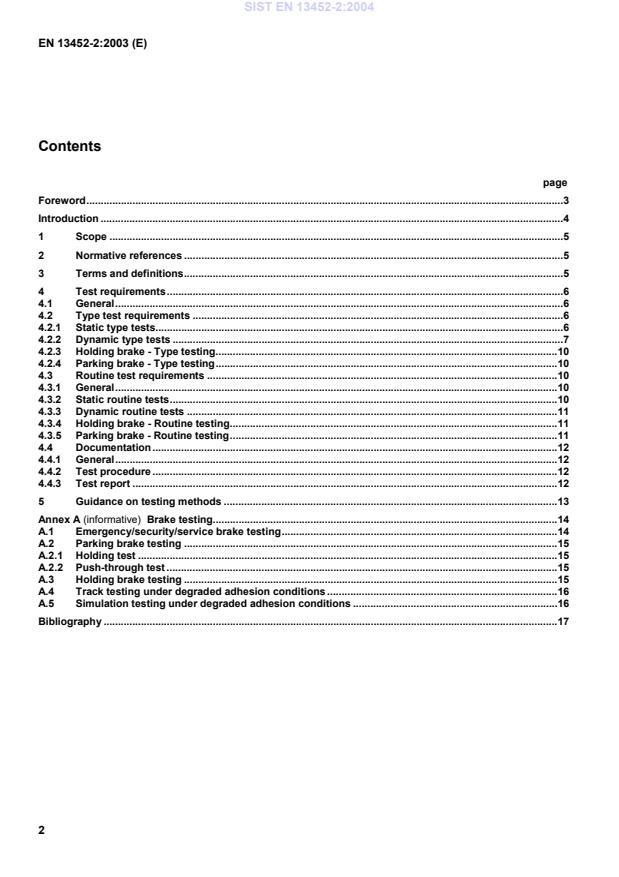
Brake testing.14A.1Emergency/security/service brake testing.14A.2Parking brake testing.15A.2.1Holding test.15A.2.2Push-through test.15A.3Holding brake testing.15A.4Track testing under degraded adhesion conditions.16A.5Simulation testing under degraded adhesion conditions.16Bibliography.17SIST EN 13452-2:2004
...