

ISO 18292:2011/Cor 1:2012
(Corrigendum)Energy performance of fenestration systems for residential buildings — Calculation procedure — Technical Corrigendum 1
General Information
- Abstract
- Status
- Published
- Publication Date
- 22-Mar-2012
- Technical Committee
- ISO/TC 163/SC 2 - Calculation methods
- Drafting Committee
- ISO/TC 163/SC 2 - Calculation methods
- Current Stage
- 6060 - International Standard published
- Start Date
- 23-Mar-2012
- Due Date
- 09-Feb-2015
- Completion Date
- 09-Feb-2015


Overview
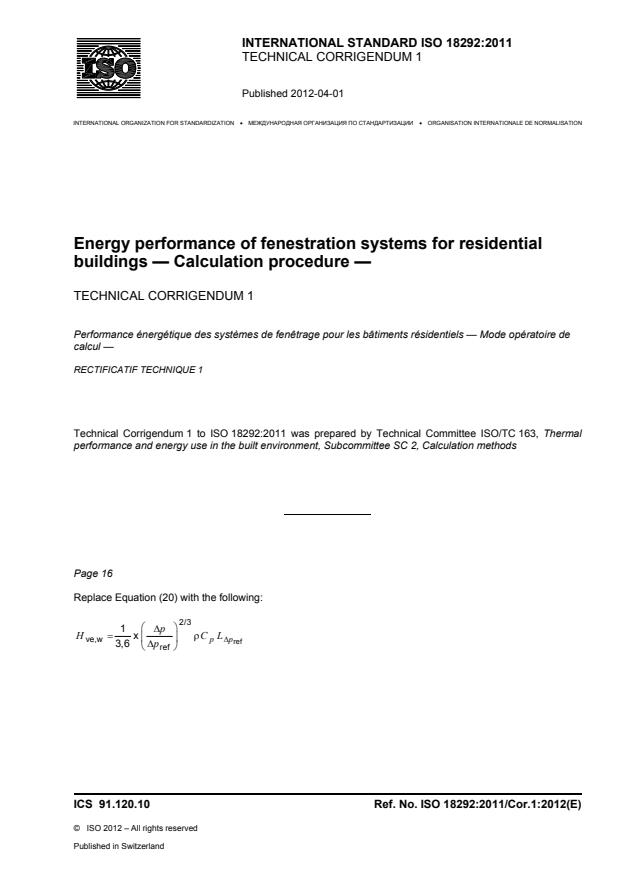
ISO 18292:2011/Cor 1:2012 is a technical corrigendum to the international standard ISO 18292:2011, which addresses the energy performance of fenestration systems in residential buildings. This corrigendum, published by the International Organization for Standardization (ISO) on April 1, 2012, provides a critical correction to the calculation procedure used to evaluate the thermal efficiency and overall energy impact of windows, doors, and other fenestration elements.
Fenestration systems significantly influence the energy consumption of residential buildings by affecting heat transfer, solar gain, and air infiltration. Accurate calculation methods are essential to ensure compliance with energy efficiency regulations and to promote sustainable building designs.
Key Topics
Correction to Calculation Procedure
The corrigendum specifically replaces Equation (20) on page 16 of the original standard, which is a formula used in evaluating pressure differences and heat transfer related to fenestration components.Thermal Performance Metrics
The standard focuses on methods to quantify thermal losses or gains through fenestration systems, critical for assessing building envelope efficiency.Energy Use Optimization
By applying the corrected calculation method, building designers and engineers can better predict energy consumption patterns and optimize fenestration design for enhanced energy savings.ISO/TC 163/SC 2 Involvement
The Technical Committee ISO/TC 163, Subcommittee SC 2, specializing in thermal performance and energy use in buildings, is responsible for the corrigendum, reinforcing the document's authoritative basis.
Applications
Building Design and Engineering
Architects and engineers utilize the corrected calculation procedure in ISO 18292:2011/Cor 1:2012 to accurately model fenestration energy performance during the design phase of residential buildings.Energy Certification and Compliance
Regulatory bodies and energy auditors reference the standard to ensure new or renovated buildings meet energy efficiency codes related to window and door specifications.Product Development and Testing
Manufacturers of windows, doors, and glazing systems employ the standard to test and certify their products' energy performance, ensuring market competitiveness.Simulation Software Development
Software tools for building energy simulation integrate these calculation methods to provide reliable predictions of fenestration-related energy losses and gains.
Related Standards
- ISO 10077 - Thermal performance of windows, doors and shutters - Calculation of thermal transmittance
- ISO 13789 - Thermal performance of buildings - Transmission and ventilation heat transfer coefficients
- EN 410 - Glass in building - Determination of luminous and solar characteristics of glazing
- ISO 52016 - Energy performance of buildings - Calculation of energy needs for heating and cooling
- ISO 18614 - Thermal performance of building components - Behavioral analysis for advanced fenestration systems
These related standards complement ISO 18292 by providing comprehensive methodologies for assessing different aspects of building envelope and fenestration energy performance.
By adhering to the corrected calculation procedures in ISO 18292:2011/Cor 1:2012, stakeholders in residential building design and construction can improve the accuracy of energy performance evaluations, leading to more sustainable and energy-efficient homes worldwide.
Relations
- Effective Date
- 09-May-2020
Get Certified
Connect with accredited certification bodies for this standard

DIBt (Deutsches Institut für Bautechnik)
German Institute for Building Technology.
DIN CERTCO
DIN Group product certification.

Aboma Certification B.V.
Specialized in construction, metal, and transport sectors.
Sponsored listings
Frequently Asked Questions
ISO 18292:2011/Cor 1:2012 is a standard published by the International Organization for Standardization (ISO). Its full title is "Energy performance of fenestration systems for residential buildings — Calculation procedure — Technical Corrigendum 1". This standard covers: Energy performance of fenestration systems for residential buildings — Calculation procedure — Technical Corrigendum 1
Energy performance of fenestration systems for residential buildings — Calculation procedure — Technical Corrigendum 1
ISO 18292:2011/Cor 1:2012 is classified under the following ICS (International Classification for Standards) categories: 91.120.10 - Thermal insulation of buildings. The ICS classification helps identify the subject area and facilitates finding related standards.
ISO 18292:2011/Cor 1:2012 has the following relationships with other standards: It is inter standard links to ISO 18292:2011. Understanding these relationships helps ensure you are using the most current and applicable version of the standard.
ISO 18292:2011/Cor 1:2012 is available in PDF format for immediate download after purchase. The document can be added to your cart and obtained through the secure checkout process. Digital delivery ensures instant access to the complete standard document.
Standards Content (Sample)
INTERNATIONAL STANDARD ISO 18292:2011
TECHNICAL CORRIGENDUM 1
Published 2012-04-01
INTERNATIONAL ORGANIZATION FOR STANDARDIZATION МЕЖДУНАРОДНАЯ ОРГАНИЗАЦИЯ ПО СТАНДАРТИЗАЦИИ ORGANISATION INTERNATIONALE DE NORMALISATION
Energy performance of fenestration systems for residential
buildings — Calculation procedure —
TECHNICAL CORRIGENDUM 1
Performance énergétique des systèmes de fenêtrage pour les bâtiments résidentiels — Mode opératoire de
calcul —
RECTIFICATIF TECHNIQUE 1
Te
...