

ISO 18292:2011
(Main)Energy performance of fenestration systems for residential buildings — Calculation procedure
General Information
- Abstract
ISO 18292:2011 specifies a procedure for calculation of the energy performance of fenestration systems used in residential buildings, for rating of fenestration systems, doors and skylights, including the effects of frame, sash, glazing, and shading components. ISO 18292:2011 specifies procedures for the calculation of the heating and cooling energy use in residential buildings, internal and external climatic conditions, and relevant building characteristics. These procedures can accommodate all climatic conditions and installation details. It is the responsibility of the appropriate regulatory authority to identify the clauses of ISO 18292:2011 to be applied in their area of jurisdiction and the climatic data and reference building specification(s) to be used.
- Status
- Published
- Publication Date
- 15-Mar-2011
- Technical Committee
- ISO/TC 163/SC 2 - Calculation methods
- Drafting Committee
- ISO/TC 163/SC 2 - Calculation methods
- Current Stage
- 9093 - International Standard confirmed
- Start Date
- 15-Mar-2022
- Completion Date
- 29-Aug-2026


Overview
ISO 18292:2011 - "Energy performance of fenestration systems for residential buildings - Calculation procedure" defines a standardized method to calculate the energy contribution of windows, doors and skylights (fenestration systems) in residential buildings. The standard converts product thermal and optical properties into comparable energy performance indices for heating and cooling, using national or local climate data and reference building specifications. It is intended for manufacturers, regulators, energy assessors and designers who need transparent, reproducible window energy ratings.
Key topics and technical requirements
- Scope: Applies to complete fenestration systems (frame, sash, glazing and shading) in residential buildings and covers both heating and cooling seasons.
- Inputs required:
- Thermal transmittance (U-value) of the whole system.
- Total solar energy transmittance (g-value or SHGC) and solar-optical data.
- Air infiltration / permeability and ventilation characteristics.
- Relevant climatic data and reference building parameters.
- Calculation methods: Supports monthly, seasonal and hourly energy-balance procedures (per ISO 13790) so calculations can be adapted to accuracy needs and data availability.
- Outputs: Annual fenestration energy performance indices-separate values for heating (P_E,H,w) and cooling (P_E,C,w), expressed in kWh/m² per year (energy need contribution per unit area).
- Additional elements:
- Daylight potential is defined (DP) but not included in the energy performance value.
- Procedures account for all climatic conditions and installation details; regulatory authorities select applicable clauses, climatic data and reference buildings.
- Documentation: Standard specifies the assessment report content and references related test standards (thermal, solar, air permeability).
Applications and users
- Window, door and skylight manufacturers - to demonstrate product energy performance and compare designs.
- Energy assessors and certifiers - to derive product ratings for building energy labeling and compliance checks.
- Building designers and architects - to evaluate fenestration impact on heating/cooling loads and to optimize glazing and shading strategies.
- Regulators and standards bodies - to specify national rating rules, climate data and reference building types for market regulation.
- Test laboratories - to translate measured U-values, g-values and infiltration data into annual energy metrics.
Related standards
Relevant complementary documents (cited in ISO 18292) include:
- ISO 13790 (building energy calculation methods)
- ISO 10077-1/2, ISO 15099 (thermal performance of windows and frames)
- ISO 9050 / EN 410 (glazing solar and luminous properties)
- ISO 15927 series (climatic data)
- EN 13363 (solar protection devices)
ISO 18292:2011 is a practical, standardized bridge between component test data (U-value, g-value, air permeability) and meaningful fenestration energy performance metrics used for regulation, product rating and energy-conscious design.
Relations
- Effective Date
- 25-Aug-2026
- Effective Date
- 25-Aug-2026
- Effective Date
- 25-Aug-2026
- Effective Date
- 09-May-2020
Get Certified
Connect with accredited certification bodies for this standard

DIBt (Deutsches Institut für Bautechnik)
German Institute for Building Technology.
DIN CERTCO
DIN Group product certification.

Aboma Certification B.V.
Specialized in construction, metal, and transport sectors.
Sponsored listings
Frequently Asked Questions
ISO 18292:2011 is a standard published by the International Organization for Standardization (ISO). Its full title is "Energy performance of fenestration systems for residential buildings — Calculation procedure". This standard covers: ISO 18292:2011 specifies a procedure for calculation of the energy performance of fenestration systems used in residential buildings, for rating of fenestration systems, doors and skylights, including the effects of frame, sash, glazing, and shading components. ISO 18292:2011 specifies procedures for the calculation of the heating and cooling energy use in residential buildings, internal and external climatic conditions, and relevant building characteristics. These procedures can accommodate all climatic conditions and installation details. It is the responsibility of the appropriate regulatory authority to identify the clauses of ISO 18292:2011 to be applied in their area of jurisdiction and the climatic data and reference building specification(s) to be used.
ISO 18292:2011 specifies a procedure for calculation of the energy performance of fenestration systems used in residential buildings, for rating of fenestration systems, doors and skylights, including the effects of frame, sash, glazing, and shading components. ISO 18292:2011 specifies procedures for the calculation of the heating and cooling energy use in residential buildings, internal and external climatic conditions, and relevant building characteristics. These procedures can accommodate all climatic conditions and installation details. It is the responsibility of the appropriate regulatory authority to identify the clauses of ISO 18292:2011 to be applied in their area of jurisdiction and the climatic data and reference building specification(s) to be used.
ISO 18292:2011 is classified under the following ICS (International Classification for Standards) categories: 91.120.10 - Thermal insulation of buildings. The ICS classification helps identify the subject area and facilitates finding related standards.
ISO 18292:2011 has the following relationships with other standards: It is inter standard links to EN 17213:2020, EN 17213:2020+A1:2025, EN ISO 52018-1:2017, ISO 18292:2011/Cor 1:2012. Understanding these relationships helps ensure you are using the most current and applicable version of the standard.
ISO 18292:2011 is available in PDF format for immediate download after purchase. The document can be added to your cart and obtained through the secure checkout process. Digital delivery ensures instant access to the complete standard document.
Standards Content (Sample)
INTERNATIONAL ISO
STANDARD 18292
First edition
2011-04-01
Energy performance of fenestration
systems for residential buildings —
Calculation procedure
Performance énergétique des systèmes de fenêtrage pour les
bâtiments résidentiels — Mode opératoire de calcul
Reference number
©
ISO 2011
PDF disclaimer
This PDF file may contain embedded typefaces. In accordance with Adobe's licensing policy, this file may be printed or viewed but
shall not be edited unless the typefaces which are embedded are licensed to and installed on the computer performing the editing. In
downloading this file, parties accept therein the responsibility of not infringing Adobe's licensing policy. The ISO Central Secretariat
accepts no liability in this area.
Adobe is a trademark of Adobe Systems Incorporated.
Details of the software products used to create this PDF file can be found in the General Info relative to the file; the PDF-creation
parameters were optimized for printing. Every care has been taken to ensure that the file is suitable for use by ISO member bodies. In
the unlikely event that a problem relating to it is found, please inform the Central Secretariat at the address given below.
© ISO 2011
All rights reserved. Unless otherwise specified, no part of this publication may be reproduced or utilized in any form or by any means,
electronic or mechanical, including photocopying and microfilm, without permission in writing from either ISO at the address below or
ISO's member body in the country of the requester.
ISO copyright office
Case postale 56 • CH-1211 Geneva 20
Tel. + 41 22 749 01 11
Fax + 41 22 749 09 47
E-mail copyright@iso.org
Web www.iso.org
Published in Switzerland
ii © ISO 2011 – All rights reserved
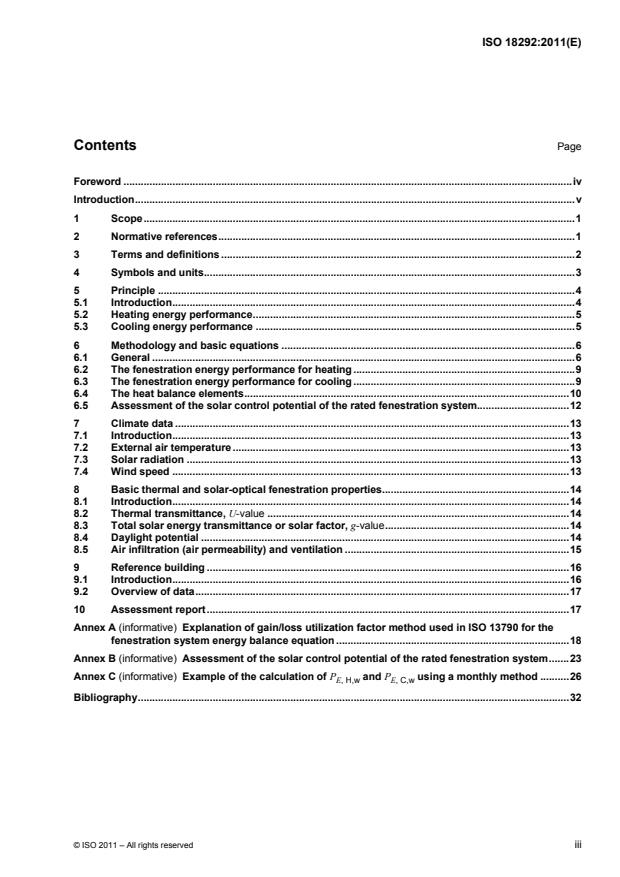
Contents Page
Foreword .iv
Introduction.v
1 Scope.1
2 Normative references.1
3 Terms and definitions .2
4 Symbols and units.3
5 Principle .4
5.1 Introduction.4
5.2 Heating energy performance.5
5.3 Cooling energy performance .5
6 Methodology and basic equations .6
6.1 General .6
6.2 The fenestration energy performance for heating .9
6.3 The fenestration energy performance for cooling .9
6.4 The heat balance elements.10
6.5 Assessment of the solar control potential of the rated fenestration system.12
7 Climate data .13
7.1 Introduction.13
7.2 External air temperature .13
7.3 Solar radiation .13
7.4 Wind speed .13
8 Basic thermal and solar-optical fenestration properties.14
8.1 Introduction.14
8.2 Thermal transmittance, U-value .14
8.3 Total solar energy transmittance or solar factor, g-value.14
8.4 Daylight potential .14
8.5 Air infiltration (air permeability) and ventilation .15
9 Reference building .16
9.1 Introduction.16
9.2 Overview of data.17
10 Assessment report.17
Annex A (informative) Explanation of gain/loss utilization factor method used in ISO 13790 for the
fenestration system energy balance equation .18
Annex B (informative) Assessment of the solar control potential of the rated fenestration system.23
Annex C (informative) Example of the calculation of P and P using a monthly method .26
E, H,w E, C,w
Bibliography.32
Foreword
ISO (the International Organization for Standardization) is a worldwide federation of national standards bodies
(ISO member bodies). The work of preparing International Standards is normally carried out through ISO
technical committees. Each member body interested in a subject for which a technical committee has been
established has the right to be represented on that committee. International organizations, governmental and
non-governmental, in liaison with ISO, also take part in the work. ISO collaborates closely with the
International Electrotechnical Commission (IEC) on all matters of electrotechnical standardization.
International Standards are drafted in accordance with the rules given in the ISO/IEC Directives, Part 2.
The main task of technical committees is to prepare International Standards. Draft International Standards
adopted by the technical committees are circulated to the member bodies for voting. Publication as an
International Standard requires approval by at least 75 % of the member bodies casting a vote.
Attention is drawn to the possibility that some of the elements of this document may be the subject of patent
rights. ISO shall not be held responsible for identifying any or all such patent rights.
ISO 18292 was prepared by Technical Committee ISO/TC 163, Thermal performance and energy use in the
built environment, Subcommittee SC 2, Calculation methods.
iv © ISO 2011 – All rights reserved
Introduction
This International Standard specifies a procedure for the determination of energy rating of window and door
products and other products that are installed in building envelope openings, also known as fenestration
systems. To enable the fenestration industry and their clients to utilize energy performance instead of thermal
transmittance to assess their products, there is a need for a simple, clear, accurate and transparent procedure
that enables the energy performance of these products to be assessed using national climate data and
nationally selected reference buildings.
This International Standard specifies detailed procedures for calculating the energy performance of
fenestration products. In this International Standard, the energy performance is derived from thermal
transmittance, solar gain, and air infiltration data obtained using standard procedures. Converting that value
into an energy rating for the fenestration system is the responsibility of each country's appropriate national
body. It is intended that the details of that rating system be published in a publicly available document. These
procedures require the use of reference conditions, which differ between countries and can represent
conditions other than actual. Allowing different reference conditions enables each country to determine its own
reference values in accordance with local conditions. As long as these conditions are publicly available and
the calculation is based on standardized procedures as specified in this International Standard, it is possible to
calculate the energy performance of a specific product to the desired national reference conditions.
INTERNATIONAL STANDARD ISO 18292:2011(E)
Energy performance of fenestration systems for residential
buildings — Calculation procedure
1 Scope
This International Standard specifies a procedure for calculation of the energy performance of fenestration
systems used in residential buildings, for rating of fenestration systems, doors and skylights, including the
effects of frame, sash, glazing, and shading components. This International Standard specifies procedures for
the calculation of the heating and cooling energy use in residential buildings, internal and external climatic
conditions, and relevant building characteristics.
These procedures can accommodate all climatic conditions and installation details. It is the responsibility of
the appropriate regulatory authority to identify the clauses of this International Standard to be applied in their
area of jurisdiction and the climatic data and reference building specification(s) to be used.
2 Normative references
The following referenced documents are indispensable for the application of this document. For dated
references, only the edition cited applies. For undated references, the latest edition of the referenced
document (including any amendments) applies.
ISO 6613, Windows and door height windows — Air permeability test
ISO 7345, Thermal insulation — Physical quantities and definitions
ISO 9050, Glass in building — Determination of light transmittance, solar direct transmittance, total solar
energy transmittance, ultraviolet transmittance and related glazing factors
ISO 9288, Thermal insulation — Heat transfer by radiation — Physical quantities and definitions
ISO 10077-1, Thermal performance of windows, doors and shutters — Calculation of thermal transmittance —
Part 1: General
ISO 10077-2, Thermal performance of windows, doors and shutters — Calculation of thermal transmittance —
Part 2: Numerical method for frames
ISO 12567-1, Thermal performance of windows and doors — Determination of thermal transmittance by the
hot-box method — Part 1: Complete windows and doors
ISO 12567-2, Thermal performance of windows and doors — Determination of thermal transmittance by hot
box method — Part 2: Roof windows and other projecting windows
ISO 13790:2008, Energy performance of buildings — Calculation of energy use for space heating and cooling
ISO 15099, Thermal performance of windows, doors and shading devices — Detailed calculations
ISO 15927-1, Hygrothermal performance of buildings — Calculation and presentation of climatic data —
Part 1: Monthly means of single meteorological elements
ISO 15927-4, Hygrothermal performance of buildings — Calculation and presentation of climatic data —
Part 4: Hourly data for assessing the annual energy use for heating and cooling
EN 410, Glass in building — Determination of luminous and solar characteristics of glazing
EN 1026, Windows and doors — Air permeability — Test method
EN 13363-1, Solar protection devices combined with glazing — Calculation of solar and light transmittance —
Part 1: Simplified method
EN 13363-2, Solar protection devices combined with glazing — Calculation of total solar energy transmittance
and light transmittance — Part 2: Detailed calculation method
3 Terms and definitions
For the purposes of this document, the terms and definitions given in ISO 7345 and ISO 9288 and the
following apply.
3.1
solar heat gain
g
total solar energy transmittance (solar factor)
NOTE 1 The solar heat gain of the whole fenestration system, including glazing, frame and solar shading device, is
denoted g .
w
NOTE 2 The total solar energy transmittance is also known as the solar heat gain coefficient with the acronym SHGC.
3.2
daylight potential
DP
τ
DP
potential of a fenestration system to supply a building with daylight
NOTE Daylight potential is not incorporated into the energy performance value.
3.3
thermal transmittance
U
heat flow rate in the steady state divided by area and by the temperature difference between the surroundings
on each side of a system
[ISO 7345:1987, 2.12]
NOTE The thermal transmittance of the whole fenestration system, including glazing, frame and solar shading device,
is denoted U .
w
3.4
energy performance of a fenestration system
EP
P
E
calculated annual energy need divided by area for heating and cooling caused by the fenestration system, in
the reference building under the reference climatic conditions
NOTE This International Standard defines a separate energy performance value for heating and cooling conditions.
2 © ISO 2011 – All rights reserved
4 Symbols and units
Symbols and units used are in accordance with ISO 7345 and ISO 9288. The quantities which are specific to this
International Standard are also defined in Table 1.
Table 1 — Symbols and units
Symbol Quantity Unit
A area m
C effective heat capacity of a conditioned space J/K
c specific heat capacity J/(kg·K)
F factor —
g total solar energy transmittance of a building element —
H heat transfer coefficient W/K
h surface coefficient of heat transfer W/(m ·K)
I solar irradiance W/m
sol
L overall air infiltration rate m /s
P annual energy performance kWh/m
E
Q quantity of heat kWh
q (volume) airflow rate m /s
V
R thermal resistance m ·K/W
T thermodynamic temperature K
t time, period of time hours
U thermal transmittance W/(m ·K)
α absorption coefficient of a surface for solar radiation —
γ tilt angle °
Γ heat balance ratio —
ε emissivity of a surface for long-wave thermal radiation —
η efficiency, utilization factor —
θ Celsius temperature °C
κ heat capacity per area J/(m ·K)
ρ density kg/m
r albedo —
−8 4
σ Stefan-Boltzmann constant (σ = 5,67 × 10) W/(m ·K )
τ time constant h
τ daylight potential —
DP
Φ heat flow rate, thermal power W
χ point thermal transmittance W/K
Ψ linear thermal transmittance W/(m·K)
NOTE These symbols are, where possible, the same as those in ISO 13790.
In this International Standard, the energy performance values are calculated in kilowatt hours per square
metre. Users may convert these values to other units as appropriate.
The subscripts indicated in Table 2 are used.
Table 2 — Subscripts
avg time-average m mass-related conductance or capacitance
base base nd need
C cooling, capacity ob obstacles
C,nd cooling need, or building need for cooling or orientation
DP daylight potential p pressure
E energy pre-cool pre-cool
e external, exterior, envelope pre-heat pre-heat
g ground ref reference
gl glazing, glazed element s designated space
gn gains seas seasonal
H heating, or horizontal set setpoint
H,nd heating need, or building need for heating sh shading
hor horizontal sol solar (heat gains)
ht heat transfer tr transmission (heat transfer)
i, j, k, m, n V
dummy integers volume
int internal (heat and temperature) ve ventilation (heat transfer)
ls loss w fenestration system
m monthly, designated month Δ difference
NOTE 1 These subscripts are in line with the subscripts used in ISO 13790.
NOTE 2 Variables are also defined when they appear for the first time.
5 Principle
5.1 Introduction
Energy performance of the fenestration system is expressed through energy performance indices, P , one
E
representative of the heating season and one representative of the cooling season.
This procedure shall be followed for all fenestration tilt angles, γ.
The P , and P values are the energy needs per area of the fenestration system per year, i.e. the
E, H,w E, C,w
contribution of the fenestration system to the energy needs of the reference building for heating and cooling.
P is the fenestration heating energy performance index, expressed in kilowatt hours per square metre,
E, H,w
while P is the fenestration cooling energy performance index, expressed in kilowatt hours per square
E, C,w
metre.
Different calculation procedures are possible as given in ISO 13790:
⎯ monthly energy balance calculation method;
⎯ seasonal energy balance calculation method;
⎯ hourly energy balance calculation method.
The energy need of the reference building caused by the fenestration system is considered to be independent
of the heating, ventilation, and air conditioning system in this International Standard.
4 © ISO 2011 – All rights reserved
5.2 Heating energy performance
Monthly method:
Q
H,nd,w,m,i
P = (1)
Ei,H,w, ∑
A
w,i
m = 1
Seasonal method:
Q
H,nd,w,seas,i
P = (2)
Ei,H,w,
A
w,i
Hourly method:
P is the annual heating energy associated with the fenestration system, expressed in kilowatt
E, H,w,i
hours per square metre.
NOTE For the hourly method, separating cooling and heating components is a complex task, which can involve
multiple steps; see ISO 13790:2008, 15.3.1.2.
where
P is the energy performance value of the fenestration system facing orientation i for the
E, H,w,i
heating season, expressed in kilowatt hours per square metre;
i is the orientation of the fenestration system, in degrees;
A is the area of the (projected) fenestration system area, in square metres;
w,i
Q is the net heat loss through the fenestration system, for the heating mode, per month, m,
H,nd,w,m
determined in accordance with 6.2, expressed in kilowatt hours;
Q is the net heat loss through the fenestration system, for the heating mode, per season,
H,nd,w,seas
seas, determined in accordance with 6.2, expressed in kilowatt hours.
For situations where fenestration systems are placed in more than one position:
AP
∑ or,iE, H,w,or,i
i
P = (3)
E,H,w
A
∑ or,i
i
where A is the area of the fenestration, in square metres, and at orientation i, in degrees.
or,i
5.3 Cooling energy performance
Monthly method:
Q
C,nd,w,m,i
P = (4)
Ei,C,w, ∑
A
w,i
m=1
Seasonal method:
Q
C,nd,w,seas,i
P = (5)
Ei,C,w,
A
w,i
Hourly method:
P is the annual cooling energy associated with the fenestration systems, expressed in
E, C,w,i
kilowatt hours per square metre.
NOTE For the dynamic method, separating cooling and heating components is a complex task which can involve
multiple steps; see ISO 13790:2008, 15.3.1.2.
where
P is the energy performance value of the fenestration system facing orientation i for the
E, C,w,i
cooling season, expressed in kilowatt hours per square metre;
i is the orientation of the fenestration system, in degrees;
A is the area of the (projected) fenestration system area, in square metres;
w,i
Q is the net heat gain through the fenestration system, for the cooling mode, per month, m,
C,nd,w,m
determined in accordance with 6.3, expressed in kilowatt hours;
Q is the net heat gain through the fenestration system, for the cooling mode, per season,
C,nd,w,seas,i
seas, determined in accordance with 6.3, expressed in kilowatt hours.
For situations where fenestration systems are placed in more than one position:
AP
or,iE, C,w,or,i
∑
i
P = (6)
E,C,w
A
∑ or,i
i
where A is the area of the fenestration system, in square metres, at orientation i, in degrees.
or,i
When calculating P using hourly methods, it is recommended that changes in U-values due to the exposure
E
to actual environmental conditions and angle dependency of g-value (SHGC) be considered. It is not therefore
recommended that fixed values that are used to compare products for U-value and g-value (SHGC) be used
to calculate energy performance. It is necessary to use the same building assumptions and boundary
conditions for both simplified and hourly calculation methods to ensure compatibility. Hourly calculation
programmes need to comply with validation and verification tests as specified in the Bibliography.
6 Methodology and basic equations
6.1 General
6.1.1 Introduction
For the evaluation of the energy performance for fenestration systems, all data used shall be for the same tilt
angle of either a typical situation for that fenestration system or the one given in national regulations.
The procedure presented in this International Standard includes two different parts, 6.1.2 and 6.1.3, that shall
be distinguished.
6 © ISO 2011 – All rights reserved
6.1.2 Part 1: Preparation of the national or regional fenestration system energy rating procedures
The following actions shall be performed once only by the responsible bodies as part of the overall preparation
of the national or regional fenestration system energy rating procedures:
⎯ determination of what is to be included having regard to the climate and other factors for the country
or region for which the rating scheme is being set up (e.g. whether to include heating, cooling or both,
whether to define a rating for daylighting);
⎯ the calculation of the energy use of a reference building in order to obtain the building-dependent
parameters needed for the rating of the fenestration system;
⎯ the choice of representative climate and other relevant data needed as parameters in the calculation
of the energy performance of the fenestration system, including all conversions that are independent
of the specifications of the fenestration system to be rated;
⎯ establishing procedures and templates for the conversion from calculated energy performance for
heating or cooling into a classification (rating);
⎯ if appropriate, establishing procedures and templates for the conversion from the day-lighting
performance of the fenestration system (characterized by a daylight potential) into a classification
(rating).
6.1.3 Part 2: Calculation of the energy performance of a specific fenestration system
The user applying this International Standard shall calculate the energy performance of a specific fenestration
system in accordance with the steps outlined here. The energy rating can be carried out either in a specific
orientation or as a weighted average of a number of orientations.
The calculation procedure consists of four steps. Each step involves the gathering of a specific set of input
data, followed by specific “pre-processing” calculations.
Figure 1 gives a detailed schematic overview of the calculation steps and the data that are needed as input;
the main sources of the data are also given. The detailed procedures are given in 6.2 to 6.5. Only the general
principles are provided here.
Step 1: Climate. Input data: Select appropriate nationally or regionally representative climate data, such as
external temperature and the intensity of solar radiation incident on the fenestration system with given
orientation and tilt.
Step 2: Building. Input data: Select appropriate data on one (or a set of) nationally specified reference
building(s) and reference occupancy, including reference services (heating, cooling and ventilation) and their
control.
Step 3: Fenestration system. Input data: Obtain the fenestration system properties: thermal transmittance,
solar transmittance, heat transfer due to air leakage, and daylight potential.
Step 4: Calculation procedure. From the building-related data (step 2), together with the fenestration system
data (step 3) and the climate data (step 1), the gain and loss utilization factors for heating and cooling
respectively are calculated for monthly and seasonal methods. For the hourly method, the energy balance of
the reference building is calculated each time a fenestration product is being evaluated.
Finally, with all input data available and all “pre-processing” calculations done, the energy performance of the
P , and for the cooling mode, P ,
fenestration system can be calculated for the heating mode,
E, H,w E, C,w
separately. This procedure is given in Clause 5.
It may be decided at a national level to present one annual energy performance value, combining the value for
heating with the value for cooling.
NOTE The energy performance value can be used as a basis for classification, using a continuous or discrete scale
and benchmarks, e.g. in a way similar to EN 15217 for the energy performance classification for buildings.
ISO 18292
National Standards / Regional Standards
Energy rating of fenestration systems
Thresholds of P and for energy rating
τ
E DP
References Energy performance of fenestration systems
Step 4: Calculation - Calculate energy performance and daylight potential of the window
P : Energy performance of window for heating
E, H,w
τ :
DP
P
: Energy performance of window for cooling
E, C,w Daylight potential
ISO 15099
Step 3: Window - Prepare thermal properties of the window
ISO 10077-1
ISO 10077-2
τ : Visible
vis
ISO 12567-1
transmittance
ISO 12567-2 of glazing
U : Thermal transmittance of window
U ,
H,w C,w
ISO 13790
g g : Total solar energy transmittance of window
,
H,w C,w
A :Visible
ISO 9050 gl
L : Air leakage rate of window
glazing area
p,ref
EN 410
F : Factor due to glazing maintenance and shading effects
sh,ob
EN 13363-1 Area of
A :
A : Area of window
w
w
window
EN 13363-2
EN 1026 γ : Tilt angle
ISO 6613
Step 2: Building - Prepare reference building data
θ θ :
,
θ θ :
int,set,H int,set,C ,
int,set,H int,set,C
Set point temperature
ISO 13790:2008 θ θ :
, Set point temperature
int,set,H int,set,C
National / η η :
Set point temperature η η : ,
,
H,gn,seas C,ls,seas
H,gn,m C,ls,m
Regional
Utilization factor
Utilization factor
standards
Default values of utilization factor
Step 1: Climate - Prepare weather data
(Hourly) (Monthly - average) (Seasonal - average)
θ External air
θ : External air :
e,m e,seas
θ : External air
temperature
e
temperature
ISO 15927-1
temperature
I : Solar
sol,m
ISO 15927-4
I : Solar irradiance I :
Solar
sol irradiance
sol,seas
ISO 13790
irradiance
v :Wind velocity
wind
Hourly method Monthly method Seasonal method Daylight potential
Figure 1 — Calculation procedure for energy performance values
8 © ISO 2011 – All rights reserved
6.2 The fenestration energy performance for heating
The fenestration energy performance for heating is the annual sum of the monthly contributions or the
seasonal weighted average for the seasonal utilization factor method, from the fenestration product to the
energy need for space heating. For the hourly method, the fenestration product energy performance for
heating is the annual sum of the hourly contribution from the fenestration product to the energy need for space
heating.
The contributions from the fenestration to the energy needs for space heating are calculated on a monthly
basis using Equation (7):
Qf=−Q η Q (7)
()
H,nd,w,m H,m H,ht,w,m H,gn,m H,gn,w,m
and on a seasonal basis using Equation (8):
Qf=−Q η Q
()
H,nd,w,seas H,seas H,ht,w,seas H,gn,seas H,gn,w,seas
(8)
where
Q is the net heat loss through the fenestration system, for the heating period, expressed in kilowatt
H,nd,w
hours;
Q is the overall heat transfer by transmission and infiltration through the fenestration system, for
H,ht,w
the heating mode, expressed in kilowatt hours, determined in accordance with 6.4;
Q is the overall solar heat gain through the fenestration system, for the heating mode, expressed
H,gn,w
in kilowatt hours, determined in accordance with 6.4;
f is the fraction of the month that is part of the heating season;
H,m
f is the fraction of the year that is the heating season;
H,seas
η is the dimensionless gain utilization factor for heating, determined in accordance with the
H,gn
procedure outlined in Annex A.
For hourly calculations, see 5.2.
The fraction of the month that is part of the heating season shall be calculated for each month m as:
Q
H,nd,m
f = (9)
H,m
QQ+
()
H,nd,m C,nd,m
NOTE 1 Since there are no internal heat gains coming in via the fenestration system, Q = Q .
H,gn,w H,sol,w
NOTE 2 The fraction f is already part of the calculation of the energy balance of the reference building in
H,m
accordance with ISO 13790.
6.3 The fenestration energy performance for cooling
The fenestration energy performance for cooling is the annual sum of the monthly contributions or the
seasonal weighted average for the seasonal utilization factor method, from the fenestration product to the
energy need for space cooling. For the hourly method, the fenestration product energy performance for
cooling is the annual sum of the hourly contribution from the fenestration product to the energy need for space
cooling.
The monthly contributions from the fenestration system to the energy need for space cooling shall be
calculated on a monthly basis using Equation (10):
Qf=−Q ηQ (10)
()
C,nd,w,m C,m C,gn,w,m C,ls C,ht,w,m
and on a seasonal basis using Equation (11):
Qf=−Q ηQ (11)
()
C,nd,w,seas C,seas C,gn,w,seas C,ls C,ht,w,seas
For hourly calculations, see 5.3.
where
Q is the net heat gain through the fenestration system, for the cooling mode, expressed in kilowatt
C,nd,w
hours;
Q is the overall heat transfer by transmission and infiltration through the fenestration system, for
C,ht,w
the cooling mode, expressed in kilowatt hours, determined in accordance with 6.4;
Q is the overall solar heat gain through the fenestration system, for the cooling mode, expressed
C,gn,w
in kilowatt hours, determined in accordance with 6.4;
f is the fraction of the month that is part of the cooling season;
C,m
f is the fraction of the year that is the cooling season;
C,seas
η is the dimensionless loss utilization factor for cooling, determined in accordance with the
C,ls
procedure outlined in Annex A.
The fraction of the month that is part of the cooling season shall be calculated for each month m as detailed in
ISO 13790:
Q
C,nd,m
(12)
f =
C,m
QQ+
()
H,nd,m C,nd,m
NOTE Since there are no internal heat gains coming in via the fenestration system, Q = Q .
C,gn,w C,sol,w
6.4 The heat balance elements
6.4.1 Heat transfer
The overall heat transfer by transmission and air leakage shall be calculated as follows.
For the heating mode:
t
QU=+AH θθ− (13)
()
()
H,ht,w H,w w H,ve,w int,set,H e,avg
where
U is the thermal transmittance (U-value) of the fenestration product for the heating mode,
H,w
expressed in watts per square metre kelvin, determined in accordance with 8.2;
H is the heat transfer coefficient due to air leakage of the fenestration system, expressed in watts
H,ve,w
per kelvin, determined in accordance with 8.5;
10 © ISO 2011 – All rights reserved
A is the area of the (projected) fenestration system area, expressed in square metres;
w
θ is equal to the set point temperature for heating, in degrees Celsius, to be determined in
int,set,H
accordance with Clause 9;
θ is equal to the time-averaged external air temperature, in degrees Celsius, to be determined in
e,avg
accordance with Clause 7;
t is the total length of the considered time period, in hours.
NOTE 1 Normally there is no difference between heating and cooling mode with respect to the value of the heat
transfer coefficient due to air leakage.
NOTE 2 For more details of this approach, see Annex A.
For the cooling mode:
t
QU=+AH θθ− (14)
()
()
C,ht,w C,w w C,ve,w int,set,C e,avg
where
U is the thermal transmittance (U-value) of the fenestration system for the cooling mode,
C,w
expressed in watts per square metre kelvin, determined in accordance with 8.2;
H is the heat transfer coefficient due to air leakage of the fenestration system, expressed in watts
C,ve,w
per kelvin, determined in accordance with 8.5;
A is the area of the (projected) fenestration system area, in square metres;
w
θ is equal to the set point temperature for cooling, in degrees Celsius, to be determined in
int,set,C
accordance with Clause 9;
θ is equal to the time-average external air temperature, in degrees Celsius, to be determined in
e,avg
accordance with Clause 7;
t is the total length of the considered time period, in hours.
NOTE 3 There can be a difference in U-value between heating and cooling mode if the fenestration system is adaptive
to the time period over which the calculation is made (e.g. season, day) and day and night (e.g. movable solar blind,
curtains, seasonal add-ons).
NOTE 4 Normally there is no difference between heating and cooling mode with respect to the value of the heat
transfer coefficient due to air leakage.
NOTE 5 For more details of this approach, see Annex A.
6.4.2 Solar gain
The overall solar heat gain through the fenestration system shall be calculated as follows.
For the heating mode:
t
QF= gIA (15)
H,gn,w sh,ob H,w sol w
where
F is the factor due to glazing maintenance and shading effects during the heating season,
sh,ob
determined in accordance with 8.3;
g is the dimensionless total solar energy transmittance of the fenestration system, for the heating
H,w
mode, determined in accordance with 8.3;
I is the average solar irradiance for the considered time period on the fenestration system plane,
sol
expressed in watts per square metre, determined in accordance with 7.3;
A is the area of the (projected) fenestration system area, in square metres;
w
t is the total length of the considered time period, in hours.
For the cooling mode:
t
QF= gIA (16)
C,gn,w sh,ob C,w sol w
where g is the dimensionless total solar energy transmittance of the fenestration system, for the cooling
C,w
mode, determined in accordance with 8.3.
NOTE There can be a difference in U-value or g-value between heating and cooling mode if the fenestration product
is adaptive to the time period over which the calculation is made (e.g. season, day) and day and night (e.g. movable solar
blind, curtains, seasonal add-ons).
6.5 Assessment of the solar control potential of the rated fenestration system
6.5.1 Principle
The rated fenestration system can:
a) have solar control provisions incorporated (e.g. solar control glazing, incorporated blinds);
b) be an assembly of glazing, frame, and solar control device (e.g. an add-on solar control provision film,
blind);
c) have no solar control provision.
The energy performance for cooling, P , reflects these differences.
E, C,w
A procedure is specified in 6.5.2 to assess the solar control potential of a rated fenestration system, without
the need to compare a series of different fenestration systems.
This is done by comparing the rating of the fenestration system against the rating of the same fenestration
system provided with a fictitious reference high-performance solar control provision.
If the difference in rating is small, the energy performance of the fenestration product for cooling is apparently
efficient, for the given conditions; adding a high-performance solar control provision does not lead to
significant improvement of the energy performance of the fenestration product for cooling.
If the difference in rating is large, the energy performance of the fenestration system for cooling is apparently
inefficient for the given conditions and hence subject to significant improvement by adding a solar control
provision.
12 © ISO 2011 – All rights reserved
6.5.2 Procedure
The following procedure can be used to assess the solar control potential of the rated fenestration system as
described in more detail in Annex B:
⎯ a fictitious reference high-performance solar control provision is defined;
⎯ a formula is given to calculate the new properties of the fenestration system with this added fictitious
reference solar control provision;
⎯ the energy performance is calculated for the fenestration system without and with this added fictitious
reference solar control provision;
⎯ a recommendation is given to national or regional fenestration system energy rating schemes to rate
the “solar control potential” of the fenestration system in the given conditions on the basis of the
difference between the energy performance as calculated for the fenestration system without and
with this added fictitious reference solar control provision.
The g-value for the combination of a fenestration system with additional external solar shading device is
derived using the simplified method given in EN 13363-1, EN 13363-2 and ISO 15099. EN 13363-1 gives
conservative values for the summer situation (assuming no ventilation between shading and fenestration
system).
NOTE See Annex B for background information and an example.
7 Climate data
7.1 Introduction
This clause specifies the procedure shown as step 1 in Figure 1.
The climate-related data, definitions, and procedures given in ISO 13790:2008, Annex F shall be used.
Typical data shall be defined on a regional or national basis.
7.2 External air temperature
The value for the external air temperature, θ , shall be the appropriate time-period mean external air
e
temperature, in degrees Celsius.
NOTE Temperature should be averaged over the appropriate time period; see A.2 for the difference with the degree-
day method.
7.3 Solar radiation
Follow the procedures specified in ISO 13790:2008, Annex F.
Validated theoretical models of solar radiation on vertical and tilted surfaces, at different orientations and
geographic places and times can also be used.
7.4 Wind speed
Wind speed (air velocity) is only needed when hourly calculation methods are used. It is a parameter to
calculate the external surface heat transfer coefficient as specified in ISO 15099. National standard values
can also be used.
8 Basic thermal and solar-optical fenestration properties
8.1 Introduction
Fundamental thermal and solar-optical fenestration properties are thermal transmittance, U, total solar energy
transmittance or solar factor, g, light transmittance, τ , and air leakage, L , where Δp is the pressure
vis Δp
difference at which the air leakage is measured, in pascals.
8.2 Thermal transmittance, U-value
The thermal transmittance, U-value, is determined for the whole fenestration product. Calculate the U-value as
specified in ISO 15099, ISO 10077-1, and ISO 10077-2. The U-value can also be determined by laboratory
measurement in accordance with the procedures specified in ISO 12567-1 and ISO 12567-2.
8.3 Total solar energy transmittance or solar factor, g-value
Total solar energy transmittance or solar factor, g, shall be calculated as follows:
a) whole fenestration system (frame + glazing) with or without shading devices: ISO 15099 or ISO 13790;
b) glazing: ISO 9050 and EN 410;
c) glazing with shading devices: EN 13363-1 and EN 13363-2.
The effect of the following shall be defined at a national level:
⎯ influence of incident angle on solar gain;
⎯ influence of the frame component;
⎯ in the case where no agreed national guidance for defining the influence of incident angle on solar
gain values is available, use the value defined in ISO 13790.
The tilt angle of the fenestration system may slightly affect its g-value. When no specific data for tilted
fenestration systems is available, the g-values obtained in the vertical position can be used.
8.4 Daylight potential
The daylight potential of a fenestration system indicates its potential to supply a building with daylight and
depends on the visible transmittance, the glazing to fenestration system area ratio and on the view factor from
the glazing to the sky and the ground. The latter parameter is used to determine the effect of different
fenestration system slope angles.
The visible transmittance, τ , shall be calculated for the glazing as specified in ISO 15099, ISO 9050 or
vis
EN 410. For shading devices it can also be calculated using the procedures in EN 13363-1 and EN 13363-2.
Quantify daylight potential of the fenestration system and quote this figure with the energy rating. Daylight
potential is an important parameter for fenestration system selection but is not used in the energy rating
procedure.
In this International Standard, the daylight potential of the fenestration system as a building component is
treated as independent of parameters such as the fenestration system height over floor, building overhangs
and of the interior of the building. These all affect the daylight performance in practical situations.
14 © ISO 2011 – All rights reserved
The daylight potential, τ , is given by Equation (17):
DP
A
gl
ττ=+FrF (17)
()
DP vis g−−s g g
A
w
where
τ is the visible transmittance of the glazing;
vis
F is the view factor from the glazing to the sky;
g–s
F is the view factor from the glazing to the ground;
g–g
r is the albedo of the ground (for temperate climates a value of 0,2 is normally used, for polar and
tropical climates other values may be more appropriate);
A is the visible glazing area of the fenestration system, in square metres;
gl
A is the area of the fenestration system, in square metres.
w
The view factor from the glazing to the sky depends on the type of the rated fenestration system: façade
fenestration system (vertical), roof fenestration system and skylight (sloped) or roof light (horizontal).
Self-shading effects from frame and sash may be neglected if frame and sash rebate is small compared to the
dimensions of the fenestration system (<1/20).
The relationships between the view factors and fenestration product angle are given below:
...