


ISO/IEC 8632-1:1999
(Main)Information technology — Computer graphics — Metafile for the storage and transfer of picture description information — Part 1: Functional specification
Information technology — Computer graphics — Metafile for the storage and transfer of picture description information — Part 1: Functional specification
ISO/IEC 8632 provides a file format suitable for the storage and retrieval of picture description information. The file format consists of an ordered set of elements that may be used to describe pictures in a way that is compatible between systems of different architectures, compatible with devices of differing capabilities and design, and meaningful to application constituencies. This picture description includes the capability for describing static images. The elements specified provide for the representation of a wide range of pictures on a wide range of graphical devices. The elements are organized into groups that delimit major structures (metafiles, pictures, and application structures), that specify the representations used within the metafile, that control the display of the picture, that perform basic drawing actions, that control the attributes of the basic drawing actions, that allow application-specific structuring to be overlaid on the graphical content, and that provide access to non-standard device capabilities. The metafile is defined in such a way that, in addition to sequential access to the whole metafile, random access to individual pictures and individual context-independent application structures is well-defined. Applications which require random access to pictures and/or context-independent application structures within pictures may, within the metafile, define directories to these pictures and/or context-independent application structures. The metafile may then be opened and randomly accessed without interpreting the entire metafile. In addition to a functional specification, two standard encodings of the metafile syntax are specified. These encodings address the needs of applications that require small metafile size plus minimum effort to generate and interpret, and maximum flexibility for a human reader or editor of the metafile. This part of ISO/IEC 8632 describes the format using an abstract syntax. The remaining parts of ISO 8632 specify standardized encodings that conform to this syntax: ISO/IEC 8632-3 specifies a binary encoding; ISO/IEC 8632-4 specifies a clear text encoding.
Technologies de l'information — Infographie — Métafichier de stockage et de transfert des informations de description d'images — Partie 1: Description fonctionnelle
General Information
- Status
- Published
- Publication Date
- 15-Dec-1999
- Technical Committee
- ISO/IEC JTC 1/SC 24 - Computer graphics, image processing and environmental data representation
- Drafting Committee
- ISO/IEC JTC 1/SC 24/WG 6 - Computer Graphics and Virtual Reality
- Current Stage
- 9093 - International Standard confirmed
- Start Date
- 08-Dec-2021
- Completion Date
- 14-Feb-2026
Relations
- Effective Date
- 15-Apr-2008
- Effective Date
- 15-Apr-2008
- Effective Date
- 15-Apr-2008
Overview
ISO/IEC 8632-1:1999 defines the functional specification for a computer graphics metafile format used for the storage and transfer of picture description information. The standard specifies an abstract syntax for a platform-independent metafile composed of an ordered set of elements that describe static images and graphical content in a way that is compatible across system architectures and device capabilities. It supports both sequential and well-defined random access to pictures and context-independent application structures, and establishes the conceptual model that standardized encodings must follow.
Key topics and requirements
- Metafile structure: Elements are organized into groups that delimit major structures such as metafiles, pictures, segments, and application structures.
- Element types: Definitions for delimiter, descriptor, control, graphical primitive, attribute, escape, external and segment elements-covering lines, markers, text, filled areas, cells, curves, symbols, and more.
- Representations and attributes: Mechanisms to specify device-independent representations, colour models, fonts, character sets, scaling modes, clipping, transformation and definable attributes.
- Access modes: Support for sequential and random access to individual pictures and application structures; directory definitions within the metafile enable efficient random access without interpreting the entire file.
- Extensibility: Provisions to expose non-standard device capabilities and to overlay application-specific structuring on graphical content.
- Abstract syntax and encodings: Part 1 provides the abstract functional definition; standardized encodings conform to this syntax-ISO/IEC 8632-3 (binary encoding) and ISO/IEC 8632-4 (clear text encoding) address specific encoding needs (compact binary vs. human-readable text).
- Conformance and normative references: The standard includes terms, definitions, symbols and conformance rules to guide implementers.
Applications and who uses it
ISO/IEC 8632-1 is useful wherever interoperable, device-independent storage or interchange of vector/structured graphics is required:
- Graphics and CAD software developers implementing import/export, archival, or interchange features.
- GIS and mapping systems exchanging complex vector maps or layered images.
- Printing and plotting device manufacturers that need to interpret or produce standardized metafiles.
- Archival and digital preservation projects storing long-term, platform-neutral picture descriptions.
- Visualization and scientific graphics tools requiring precise, structured picture descriptions.
- Standards bodies and implementers building encoders/decoders or conformance test suites.
Related standards
- ISO/IEC 8632-3 - binary encoding (compact, low-overhead)
- ISO/IEC 8632-4 - clear text encoding (human-readable, editable)
- ISO/IEC 8632-1 should be read in conjunction with these parts when implementing concrete file formats or tools.
Keywords: ISO/IEC 8632-1, metafile, computer graphics, picture description, metafile format, vector graphics, binary encoding, clear text encoding, random access metafile, image interchange.


Get Certified
Connect with accredited certification bodies for this standard

BSI Group
BSI (British Standards Institution) is the business standards company that helps organizations make excellence a habit.

NYCE
Mexican standards and certification body.
Sponsored listings
Frequently Asked Questions
ISO/IEC 8632-1:1999 is a standard published by the International Organization for Standardization (ISO). Its full title is "Information technology — Computer graphics — Metafile for the storage and transfer of picture description information — Part 1: Functional specification". This standard covers: ISO/IEC 8632 provides a file format suitable for the storage and retrieval of picture description information. The file format consists of an ordered set of elements that may be used to describe pictures in a way that is compatible between systems of different architectures, compatible with devices of differing capabilities and design, and meaningful to application constituencies. This picture description includes the capability for describing static images. The elements specified provide for the representation of a wide range of pictures on a wide range of graphical devices. The elements are organized into groups that delimit major structures (metafiles, pictures, and application structures), that specify the representations used within the metafile, that control the display of the picture, that perform basic drawing actions, that control the attributes of the basic drawing actions, that allow application-specific structuring to be overlaid on the graphical content, and that provide access to non-standard device capabilities. The metafile is defined in such a way that, in addition to sequential access to the whole metafile, random access to individual pictures and individual context-independent application structures is well-defined. Applications which require random access to pictures and/or context-independent application structures within pictures may, within the metafile, define directories to these pictures and/or context-independent application structures. The metafile may then be opened and randomly accessed without interpreting the entire metafile. In addition to a functional specification, two standard encodings of the metafile syntax are specified. These encodings address the needs of applications that require small metafile size plus minimum effort to generate and interpret, and maximum flexibility for a human reader or editor of the metafile. This part of ISO/IEC 8632 describes the format using an abstract syntax. The remaining parts of ISO 8632 specify standardized encodings that conform to this syntax: ISO/IEC 8632-3 specifies a binary encoding; ISO/IEC 8632-4 specifies a clear text encoding.
ISO/IEC 8632 provides a file format suitable for the storage and retrieval of picture description information. The file format consists of an ordered set of elements that may be used to describe pictures in a way that is compatible between systems of different architectures, compatible with devices of differing capabilities and design, and meaningful to application constituencies. This picture description includes the capability for describing static images. The elements specified provide for the representation of a wide range of pictures on a wide range of graphical devices. The elements are organized into groups that delimit major structures (metafiles, pictures, and application structures), that specify the representations used within the metafile, that control the display of the picture, that perform basic drawing actions, that control the attributes of the basic drawing actions, that allow application-specific structuring to be overlaid on the graphical content, and that provide access to non-standard device capabilities. The metafile is defined in such a way that, in addition to sequential access to the whole metafile, random access to individual pictures and individual context-independent application structures is well-defined. Applications which require random access to pictures and/or context-independent application structures within pictures may, within the metafile, define directories to these pictures and/or context-independent application structures. The metafile may then be opened and randomly accessed without interpreting the entire metafile. In addition to a functional specification, two standard encodings of the metafile syntax are specified. These encodings address the needs of applications that require small metafile size plus minimum effort to generate and interpret, and maximum flexibility for a human reader or editor of the metafile. This part of ISO/IEC 8632 describes the format using an abstract syntax. The remaining parts of ISO 8632 specify standardized encodings that conform to this syntax: ISO/IEC 8632-3 specifies a binary encoding; ISO/IEC 8632-4 specifies a clear text encoding.
ISO/IEC 8632-1:1999 is classified under the following ICS (International Classification for Standards) categories: 35.140 - Computer graphics. The ICS classification helps identify the subject area and facilitates finding related standards.
ISO/IEC 8632-1:1999 has the following relationships with other standards: It is inter standard links to ISO/IEC 8632-1:1992, ISO/IEC 8632-1:1992/Amd 2:1995, ISO/IEC 8632-1:1992/Amd 1:1994. Understanding these relationships helps ensure you are using the most current and applicable version of the standard.
ISO/IEC 8632-1:1999 is available in PDF format for immediate download after purchase. The document can be added to your cart and obtained through the secure checkout process. Digital delivery ensures instant access to the complete standard document.
Standards Content (Sample)
INTERNATIONAL ISO/IEC
STANDARD 8632-1
Second edition
1999-12-15
Information technology — Computer
graphics — Metafile for the storage and
transfer of picture description
information —
Part 1:
Functional specification
Technologies de l'information — Infographie — Métafichier de stockage
et de transfert des informations de description d'images —
Partie 1: Description fonctionnelle
Reference number
©
ISO/IEC 1999
PDF disclaimer
This PDF file may contain embedded typefaces. In accordance with Adobe's licensing policy, this file may be printed or viewed but shall not
be edited unless the typefaces which are embedded are licensed to and installed on the computer performing the editing. In downloading this
file, parties accept therein the responsibility of not infringing Adobe's licensing policy. The ISO Central Secretariat accepts no liability in this
area.
Adobe is a trademark of Adobe Systems Incorporated.
Details of the software products used to create this PDF file can be found in the General Info relative to the file; the PDF-creation parameters
were optimized for printing. Every care has been taken to ensure that the file is suitable for use by ISO member bodies. In the unlikely event
that a problem relating to it is found, please inform the Central Secretariat at the address given below.
© ISO/IEC 1999
All rights reserved. Unless otherwise specified, no part of this publication may be reproduced or utilized in any form or by any means, electronic
or mechanical, including photocopying and microfilm, without permission in writing from either ISO at the address below or ISO's member body
in the country of the requester.
ISO copyright office
Case postale 56 � CH-1211 Geneva 20
Tel. + 41 22 749 01 11
Fax + 41 22 734 10 79
E-mail copyright@iso.ch
Web www.iso.ch
Printed in Switzerland
ii © ISO/IEC 1999 – All rights reserved
© ISO/IEC
Contents
Page
1 Scope.1
2 Conformance .1
3 Normative references.1
4 Terms and definitions.3
4.1 Definitions.3
5 Symbols and abbreviated terms.11
6 Concepts .12
6.1 Introduction .12
6.2 Delimiter elements .13
6.3 Metafile descriptor elements.13
6.3.1 Identification.14
6.3.2 Functional capability.14
6.3.3 Default metafile state .17
6.3.4 Fonts and character sets.17
6.3.5 Picture directory.22
6.4 Picture descriptor elements.22
6.4.1 Scaling mode.23
6.4.2 Colour selection mode.23
6.4.3 Specification modes .23
6.4.4 VDC extent .23
6.4.5 CGM tailoring.24
6.4.6 Background colour .26
6.4.7 Device viewport control.26
6.4.8 Representations .26
6.4.9 Definable attributes.27
6.4.10 Application structure directory.27
6.5 Control elements.27
6.5.1 VDC space and range .27
iii
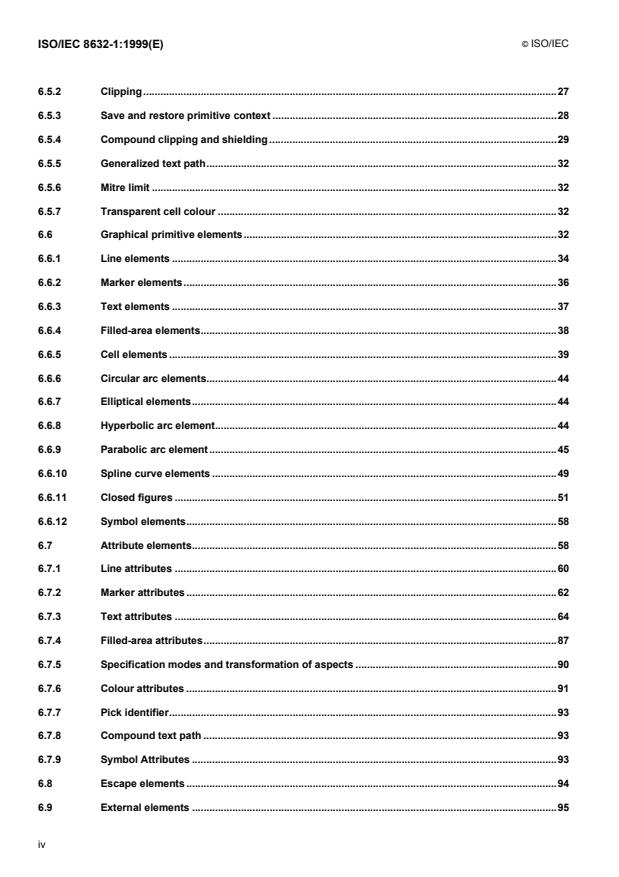
© ISO/IEC
6.5.2 Clipping.27
6.5.3 Save and restore primitive context .28
6.5.4 Compound clipping and shielding .29
6.5.5 Generalized text path.32
6.5.6 Mitre limit .32
6.5.7 Transparent cell colour .32
6.6 Graphical primitive elements.32
6.6.1 Line elements .34
6.6.2 Marker elements.36
6.6.3 Text elements .37
6.6.4 Filled-area elements.38
6.6.5 Cell elements .39
6.6.6 Circular arc elements.44
6.6.7 Elliptical elements.44
6.6.8 Hyperbolic arc element.44
6.6.9 Parabolic arc element.45
6.6.10 Spline curve elements .49
6.6.11 Closed figures .51
6.6.12 Symbol elements.58
6.7 Attribute elements.58
6.7.1 Line attributes .60
6.7.2 Marker attributes .62
6.7.3 Text attributes .64
6.7.4 Filled-area attributes.87
6.7.5 Specification modes and transformation of aspects .90
6.7.6 Colour attributes .91
6.7.7 Pick identifier.93
6.7.8 Compound text path .93
6.7.9 Symbol Attributes .93
6.8 Escape elements .94
6.9 External elements .95
iv
© ISO/IEC
6.10 Segment elements.95
6.10.1 Introduction .95
6.10.2 Local and global segments .95
6.10.3 Delimiting and naming segments.96
6.10.4 Segment attributes.96
6.10.5 Copy segment and inheritance.97
6.11 Metafile states.102
6.12 Registration .113
6.13 Application Structure Elements.113
6.13.1 Introduction .113
6.13.2 Location of and access to Application Structures .114
6.13.3 Nesting of Application Structures.114
6.13.4 Graphical Context of Application Structures .114
6.13.5 Application Structure Attributes.114
6.13.6 Relationship between application structures and segments .115
7 Abstract specification of elements.118
7.1 Introduction .118
7.2 Delimiter elements .120
7.2.1 BEGIN METAFILE.120
7.2.2 END METAFILE.121
7.2.3 BEGIN PICTURE .121
7.2.4 BEGIN PICTURE BODY.122
7.2.5 END PICTURE.122
7.2.6 BEGIN SEGMENT .122
7.2.7 END SEGMENT.123
7.2.8 BEGIN FIGURE .123
7.2.9 END FIGURE .123
7.2.10 BEGIN PROTECTION REGION .124
7.2.11 END PROTECTION REGION.124
7.2.12 BEGIN COMPOUND LINE .124
7.2.13 END COMPOUND LINE .124
v
© ISO/IEC
7.2.14 BEGIN COMPOUND TEXT PATH .125
7.2.15 END COMPOUND TEXT PATH .125
7.2.16 BEGIN TILE ARRAY .125
7.2.17 END TILE ARRAY .126
7.2.18 BEGIN APPLICATION STRUCTURE .127
7.2.19 BEGIN APPLICATION STRUCTURE BODY.127
7.2.20 END APPLICATION STRUCTURE.127
7.3 Metafile descriptor elements.128
7.3.1 METAFILE VERSION.128
7.3.2 METAFILE DESCRIPTION.128
7.3.3 VDC TYPE .128
7.3.4 INTEGER PRECISION .129
7.3.5 REAL PRECISION.129
7.3.6 INDEX PRECISION .129
7.3.7 COLOUR PRECISION.129
7.3.8 COLOUR INDEX PRECISION.130
7.3.9 MAXIMUM COLOUR INDEX.130
7.3.10 COLOUR VALUE EXTENT .130
7.3.11 METAFILE ELEMENT LIST .131
7.3.12 METAFILE DEFAULTS REPLACEMENT .132
7.3.13 FONT LIST.132
7.3.14 CHARACTER SET LIST.133
7.3.15 CHARACTER CODING ANNOUNCER .133
7.3.16 NAME PRECISION.134
7.3.17 MAXIMUM VDC EXTENT.135
7.3.18 SEGMENT PRIORITY EXTENT .135
7.3.19 COLOUR MODEL.135
7.3.20 COLOUR CALIBRATION.136
7.3.21 FONT PROPERTIES .138
7.3.22 GLYPH MAPPING .140
7.3.23 SYMBOL LIBRARY LIST.142
vi
© ISO/IEC
7.3.24 PICTURE DIRECTORY .142
7.4 Picture descriptor elements.142
7.4.1 SCALING MODE .142
7.4.2 COLOUR SELECTION MODE .143
7.4.3 LINE WIDTH SPECIFICATION MODE.143
7.4.4 MARKER SIZE SPECIFICATION MODE.144
7.4.5 EDGE WIDTH SPECIFICATION MODE.144
7.4.6 VDC EXTENT.145
7.4.7 BACKGROUND COLOUR .145
7.4.8 DEVICE VIEWPORT.146
7.4.9 DEVICE VIEWPORT SPECIFICATION MODE.146
7.4.10 DEVICE VIEWPORT MAPPING.147
7.4.11 LINE REPRESENTATION.147
7.4.12 MARKER REPRESENTATION .148
7.4.13 TEXT REPRESENTATION.148
7.4.14 FILL REPRESENTATION .149
7.4.15 EDGE REPRESENTATION.149
7.4.16 INTERIOR STYLE SPECIFICATION MODE.150
7.4.17 LINE AND EDGE TYPE DEFINITION .150
7.4.18 HATCH STYLE DEFINITION.151
7.4.19 GEOMETRIC PATTERN DEFINITION.152
7.4.20 APPLICATION STRUCTURE DIRECTORY .152
7.5 Control elements.153
7.5.1 VDC INTEGER PRECISION.153
7.5.2 VDC REAL PRECISION .153
7.5.3 AUXILIARY COLOUR .153
7.5.4 TRANSPARENCY .154
7.5.5 CLIP RECTANGLE.154
7.5.6 CLIP INDICATOR .155
7.5.7 LINE CLIPPING MODE .155
7.5.8 MARKER CLIPPING MODE.155
vii
© ISO/IEC
7.5.9 EDGE CLIPPING MODE .156
7.5.10 NEW REGION.156
7.5.11 SAVE PRIMITIVE CONTEXT .156
7.5.12 RESTORE PRIMITIVE CONTEXT .157
7.5.13 PROTECTION REGION INDICATOR .158
7.5.14 GENERALIZED TEXT PATH MODE .158
7.5.15 MITRE LIMIT.158
7.5.16 TRANSPARENT CELL COLOUR.159
7.6 Graphical primitive elements.159
7.6.1 POLYLINE .159
7.6.2 DISJOINT POLYLINE.159
7.6.3 POLYMARKER.160
7.6.4 TEXT .160
7.6.5 RESTRICTED TEXT.161
7.6.6 APPEND TEXT .162
7.6.7 POLYGON .163
7.6.8 POLYGON SET .164
7.6.9 CELL ARRAY .166
7.6.10 GENERALIZED DRAWING PRIMITIVE (GDP) .168
7.6.11 RECTANGLE.168
7.6.12 CIRCLE.168
7.6.13 CIRCULAR ARC 3 POINT.169
7.6.14 CIRCULAR ARC 3 POINT CLOSE .169
7.6.15 CIRCULAR ARC CENTRE.172
7.6.16 CIRCULAR ARC CENTRE CLOSE .172
7.6.17 ELLIPSE .173
7.6.18 ELLIPTICAL ARC.173
7.6.19 ELLIPTICAL ARC CLOSE .174
7.6.20 CIRCULAR ARC CENTRE REVERSED.175
7.6.21 CONNECTING EDGE.176
7.6.22 HYPERBOLIC ARC.176
viii
© ISO/IEC
7.6.23 PARABOLIC ARC .177
7.6.24 NON-UNIFORM B-SPLINE .177
7.6.25 NON-UNIFORM RATIONAL B-SPLINE.178
7.6.26 POLYBEZIER .178
7.6.27 POLYSYMBOL .179
7.6.28 BITONAL TILE.179
7.6.29 TILE.181
7.7 Attribute elements.183
7.7.1 LINE BUNDLE INDEX .183
7.7.2 LINE TYPE.183
7.7.3 LINE WIDTH .184
7.7.4 LINE COLOUR.184
7.7.5 MARKER BUNDLE INDEX .185
7.7.6 MARKER TYPE .185
7.7.7 MARKER SIZE.186
7.7.8 MARKER COLOUR.186
7.7.9 TEXT BUNDLE INDEX .186
7.7.10 TEXT FONT INDEX .187
7.7.11 TEXT PRECISION .187
7.7.12 CHARACTER EXPANSION FACTOR .188
7.7.13 CHARACTER SPACING .189
7.7.14 TEXT COLOUR.189
7.7.15 CHARACTER HEIGHT.189
7.7.16 CHARACTER ORIENTATION.190
7.7.17 TEXT PATH .190
7.7.18 TEXT ALIGNMENT.191
7.7.19 CHARACTER SET INDEX .191
7.7.20 ALTERNATE CHARACTER SET INDEX.192
7.7.21 FILL BUNDLE INDEX.192
7.7.22 INTERIOR STYLE.193
7.7.23 FILL COLOUR .193
ix
© ISO/IEC
7.7.24 HATCH INDEX.194
7.7.25 PATTERN INDEX .194
7.7.26 EDGE BUNDLE INDEX.195
7.7.27 EDGE TYPE.195
7.7.28 EDGE WIDTH .196
7.7.29 EDGE COLOUR .196
7.7.30 EDGE VISIBILITY.197
7.7.31 FILL REFERENCE POINT .197
7.7.32 PATTERN TABLE .198
7.7.33 PATTERN SIZE .198
7.7.34 COLOUR TABLE.199
7.7.35 ASPECT SOURCE FLAGS.199
7.7.36 PICK IDENTIFIER.200
7.7.37 LINE CAP.200
7.7.38 LINE JOIN.201
7.7.39 LINE TYPE CONTINUATION.202
7.7.40 LINE TYPE INITIAL OFFSET.202
7.7.41 TEXT SCORE TYPE.203
7.7.42 RESTRICTED TEXT TYPE.203
7.7.43 INTERPOLATED INTERIOR.204
7.7.44 EDGE CAP.205
7.7.45 EDGE JOIN.206
7.7.46 EDGE TYPE CONTINUATION.206
7.7.47 EDGE TYPE INITIAL OFFSET.207
7.7.48 SYMBOL LIBRARY INDEX.207
7.7.49 SYMBOL COLOUR .208
7.7.50 SYMBOL SIZE.208
7.7.51 SYMBOL ORIENTATION.208
7.8 Escape elements .209
7.8.1 ESCAPE.209
7.9 External elements .209
x
© ISO/IEC
7.9.1 MESSAGE .209
7.9.2 APPLICATION DATA.210
7.10 Segment elements.210
7.10.1 COPY SEGMENT .210
7.10.2 INHERITANCE FILTER .211
7.10.3 CLIP INHERITANCE.212
7.10.4 SEGMENT TRANSFORMATION .212
7.10.5 SEGMENT HIGHLIGHTING .213
7.10.6 SEGMENT DISPLAY PRIORITY.213
7.10.7 SEGMENT PICK PRIORITY.213
7.11 Application structure descriptor elements.214
7.11.1 APPLICATION STRUCTURE ATTRIBUTE .214
8 Metafile defaults .215
9 Profiles and conformance .219
9.1 Introduction .219
9.1.1 Objectives .219
9.1.2 Scope.219
9.1.3 Concept and purpose of profiles for CGM.219
9.1.4 Purpose of the Model Profile .220
9.2 Conformance .220
9.2.1 Conformance of profiles.220
9.2.2 Conformance of metafiles .221
9.2.3 Conformance of metafile generators .221
9.2.4 Conformance of metafile interpreters.222
9.3 Criteria for designing profiles.222
9.3.1 Criteria on the profile in its entirety .222
9.3.2 Criteria for the technical content of the profile.222
9.4 Form and format of a profile .222
9.5 Profile rules, proforma, and model profile .223
9.5.1 Overview .223
9.5.2 General principles.224
xi
© ISO/IEC
9.5.3 Metafile rules .226
9.5.4 Multi-element rules .226
9.5.5 Individual element rules .231
9.5.6 Generator implementation requirements .231
9.5.7 Interpreter implementation requirements.233
9.5.8 PPF Tables.236
Annex A (normative) Formal grammar of the functional specification of version 1 metafiles .238
A.1 Introduction .238
A.2 Notation used .
...
Questions, Comments and Discussion
Ask us and Technical Secretary will try to provide an answer. You can facilitate discussion about the standard in here.
Loading comments...