


ISO/IEC 8632-1:1992
(Main)Information technology — Computer graphics — Metafile for the storage and transfer of picture description information — Part 1: Functional specification
Information technology — Computer graphics — Metafile for the storage and transfer of picture description information — Part 1: Functional specification
Technologies de l'information — Infographie — Métafichier de stockage et de transfert des informations de description d'images — Partie 1: Description fonctionnelle
General Information
- Status
- Withdrawn
- Publication Date
- 04-Nov-1992
- Withdrawal Date
- 04-Nov-1992
- Technical Committee
- ISO/IEC JTC 1/SC 24 - Computer graphics, image processing and environmental data representation
- Drafting Committee
- ISO/IEC JTC 1/SC 24/WG 6 - Computer Graphics and Virtual Reality
- Current Stage
- 9599 - Withdrawal of International Standard
- Start Date
- 16-Dec-1999
- Completion Date
- 14-Feb-2026
Relations
- Effective Date
- 06-Jun-2022
- Effective Date
- 06-Jun-2022
- Effective Date
- 16-Oct-2025
- Effective Date
- 15-Apr-2008
- Effective Date
- 15-Apr-2008
- Effective Date
- 15-Apr-2008
Buy Documents
ISO/IEC 8632-1:1992 - Information technology -- Computer graphics -- Metafile for the storage and transfer of picture description information
ISO/IEC 8632-1:1992 - Technologies de l'information -- Infographie -- Métafichier de stockage et de transfert des informations de description d'images
Get Certified
Connect with accredited certification bodies for this standard

BSI Group
BSI (British Standards Institution) is the business standards company that helps organizations make excellence a habit.

NYCE
Mexican standards and certification body.
Sponsored listings
Frequently Asked Questions
ISO/IEC 8632-1:1992 is a standard published by the International Organization for Standardization (ISO). Its full title is "Information technology — Computer graphics — Metafile for the storage and transfer of picture description information — Part 1: Functional specification". This standard covers: Information technology — Computer graphics — Metafile for the storage and transfer of picture description information — Part 1: Functional specification
Information technology — Computer graphics — Metafile for the storage and transfer of picture description information — Part 1: Functional specification
ISO/IEC 8632-1:1992 is classified under the following ICS (International Classification for Standards) categories: 35.140 - Computer graphics. The ICS classification helps identify the subject area and facilitates finding related standards.
ISO/IEC 8632-1:1992 has the following relationships with other standards: It is inter standard links to ISO/IEC 8632-1:1992/Amd 2:1995, ISO/IEC 8632-1:1992/Amd 1:1994, ISO 8632-1:1987/Amd 1:1990, ISO/IEC 8632-1:1999; is excused to ISO/IEC 8632-1:1992/Amd 2:1995, ISO/IEC 8632-1:1992/Amd 1:1994. Understanding these relationships helps ensure you are using the most current and applicable version of the standard.
ISO/IEC 8632-1:1992 is available in PDF format for immediate download after purchase. The document can be added to your cart and obtained through the secure checkout process. Digital delivery ensures instant access to the complete standard document.
Standards Content (Sample)
ISO/IEC
INTERNATIONAL
STANDARD 86324
Second edi tian
1992-l o-01
e-e-_- -pl_-----------Y -.-------
_ __---_- -_-. - .- -_ -. - ---- ----_ ---_
_ __. _-. .______-_ I ____ __ ___ ___________._-. -___ ____. _ -__._- - _._, _. _ ._-_ . . _--._ _-_-e.- -- --.c- - .--.--.-.-- _--
Information technology - Computer graphics -
Metafile for the storage and transfer of picture
description information -
Part 1:
Functional speckfication
Technologies de l’inforn7a tion - lnfogr-aphie --- AMaficl~ier de stockage
et de tr&sfert des informations de description d’imges --
Pariie I: Description fonctionnelle
Reference nutnber
ISCMEC 8632-1:1992(E)
ISO/IEC 8632-l: 1992 (E)
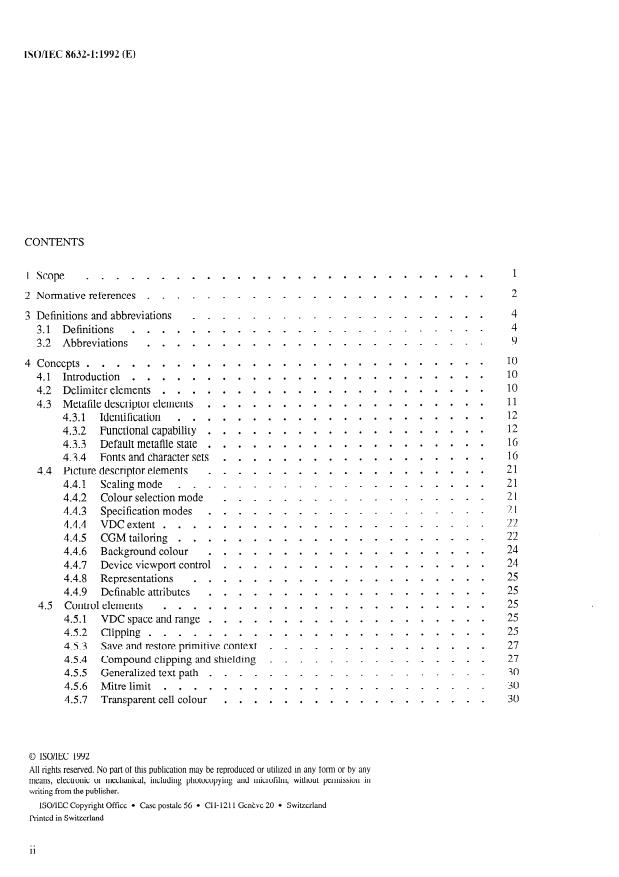
CONTENTS
. . . 1
. . . . . . . . .
. . . . . . .
1 Scope . . . . . . .
. . l . . . . .
. . . . . . . . .
2 Normative references . . . . .
. . . 4
. . . l . . . . .
. . . . . * .
3 Definitions and abbreviations
. 4
. . . . . . . . .
. . . . . . . . *
3.1 Definitions . . . .
. 9
. . . . . . . . . . . .
. . . . . .
3.2 Abbreviations . . .
. * . . . . . . 10
. . . . . . . . . . .
4 Concepts . . . . . . .
. . . . . . . . 10
. . . . . . . . . . .
4.1 Introduction . . . .
. . . . . . . . 10
. . . . . . . . . .
4.2 Delimiter elements . . .
. . . . . . . .
. . . . . . . . .
4.3 Metafile descriptor elements . .
. . . . . . . .
IdentifiLation . . . . . . . . . . .
4.3.1
12 L
. . . . . . . . . . .
Functional capab& . . . . . . . .
4.3.2
. .
. . . . . . . . . . 16
Default metafile state . . . . . . .
4.3.3
. . . 16
. . . . . . . . . . .
Fonts and character sets e . . .
4.3.4
. . . 21
. . . . . . . . . . .
4.4 Picture descriptor elements . . . . .
. . . . . . . . . .
. . . . . . . .
4.4.1 Scaling mode o . .
. . . . . . . . . . 0
Colour selection mode . . . . . . .
4.4.2
. . . 21
. . . . . . . . . . . . .
4.4.3 Specification modes . . .
. . . . . . 22
. . . . . . . . . .
4.4.4 VDC extent . . . . . .
. . . . . . . 22
. . . . . . . . . . .
4.4.5 CGM tailoring . . .
. . . . . . . . 24
. . . . . . . . . .
4.4.6 Background colour
. . . . . . . . 24
. . . . . . . . . .
4.4.7 Device viewport control
. . . . . . 25
. . . . * . . . . . . .
4.4.8 Representations . .
. . . . . 25
. . . . . . . . . . . . .
4.4.9 Definable attributes .
. . . . . . . . 25
4.5 Control elements . . . . . . . . . . .
. . . . . . . . 25
4.51 VDC space and rang; . . . . . . . . . . .
. . . . . . . . 25
. . . . . . . . . .
4.52 Clipping . . . . .
. . . . 27
. . . . . . . . . . .
4.5.3 Save and restore primitive context
. . . . 27
. . . . . . . . . . .
4.5.4 Compound clipping and shielding
. . . . 30
4.5.5 Generalized text path . . . . . . . . . . . . . . .
. . * . . . . . 30
4.5.6 Mitre limit . . . . . . . . . . . . . .
. . . . . . l . 30
4.5.7 Transparent cell colour . . . . . . . . . .
0 ISO/IEC 1992
All rights reserved. No part of this publication may be reproduced or utilized in any form or by any
photocopyin g and microfilm, without permission in
means, electronic or mechanical, including
writing from the publisher.
lSO/IEC Copyright Office l Case postale 56 l CH-1211 Genkve 20 l Switzerland
Printed in Switzerland
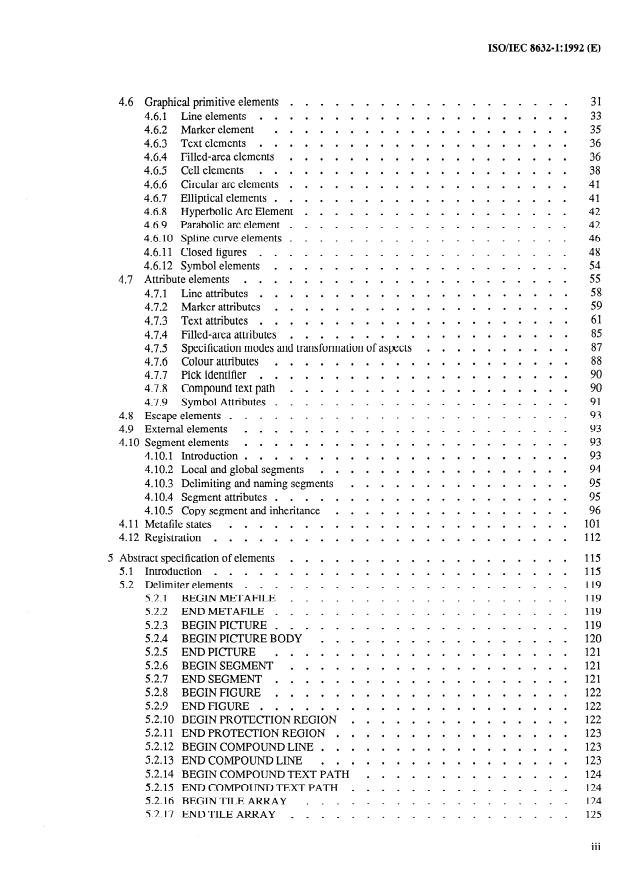
ISO/IEC 8632-l: 1992 (E)
. . . 31
. . . . . . . . . . .
. .
4.6 Graphical primitive elements . . .
. . . . . . . . . . . 33
. . . . .
4.6.1 Line elements . . . . .
. . . . . . . . . . . 35
. . . . .
4.6.2 Marker element . . . .
. . . . . . . . . . . 36
. . . . .
4.6.3 Text elements . m . . .
. . . . . . . . . 36
4.6.4 Filled-area elements . . . . . . . . . .
. . . . . . . . . . . . . . 38
. . . . .
4.6.5 Cell elements
. . . . . . . . . . . 41
4.6.6 Circular arc elements . . . . . . . .
. . . . . . . . . 41
. . . . . . .
4.6.7 Elliptical elements . . . .
. . . . . . . . . 42
. . . . . . .
4.6.8 Hyperbolic Arc Element . .
. . . . . . . . . 42
4.6.9 Parabolic arc element . . . . . . . . . .
. . . . . . . . . 46
4.6.10 Spline curve elements . . . . . . . . . .
. . . . . . . . . . . . 48
4.6.11 Closed figures . . . . . . . . .
. 54
. . . . . . . . . . . .
4.6.12 Symbol elements . . . . . . .
. . . . 55
. . . . . . . . . . .
.
4.7 Attribute elements . . . . . .
. . . 58
. . . . . . . .
. . . . .
4.7.1 Line attributes . . . . .
. . . 59
. . . . . . . .
. . . . .
4.7.2 Marker attributes . . . .
l . . . 61
. . . . . . .
. . . . .
4.7.3 Text attributes . . . . .
. . . . 85
. . . . . . . . . .
. .
4.7.4 Filled-area attributes . . .
. . . . 87
. . . . . .
4.7.5 SDecification modes and transformation of aspects
. . . . . 88
. . . . . . . .
.......
4.7.6 C&our attributes
. . . . . 90
. . . . . . . .
4.7.7 Pick identifier .
. . . . . 90
. . . . . . . .
4.7.8 Compound text path .
. . . 91
. . . . . . . . . .
4.7.9 Symbol Attributes .
. . . . . 93
. . . . . . . .
4.8 Escape elements .
. . . . . l . 93
. . . . . .
4.9 External elements .
. . . l . . . 93
. . . . . .
4.10 Segment elements .
. . . . . . . 93
. . . . . .
4.10.1 Introduction .
. . . . . . . . 94
.... . . . l .
4.10.2 Local and global segments
. . . . . . . . . 95
. . . . . .
4.10.3 Delimiting and naming segments
. . . . . . . 95
....... . . . . . .
4.10.4 Segment attributes
. . . . . . . . . 96
... . . . .
4.105 Copy segment and inheritance
. . . . . . . . . 101
.......... . . . .
4.11 Metafile states
. . . . . . . . . . 112
........... . . .
4.12 Registration
. . . . . . 115
...... . . . . . . .
5 Abstract specification of elements
. . . . . . . . 115
........... . . . . .
5.1 Introduction
. . . . . 119
......... . . . . . . . .
5.2 Delimiter elements
. . . . . . . . . 119
5.2.1 BEGIN METAFILE . . . . .
. . . . . . . . . . . . . 119
5.2.2 END METAFILE .
. . . . . . . . . . . . . 119
5.2.3 BEGIN PICTURE .
. . . 120
.... . . . . . . . l . .
5.2.4 BEGINPICTURE BODY
. . . . . 121
. . . . . . . .
5.2.5 END PICTURE
. . . 121
............. . . . . . . . . . .
5.2.6 BEGIN SEGMENT
. . . . . . . . 121
....... . . . . .
5.2.7 END SEGMENT
. . . . . . . . . . . 122
5.2.8 BEGIN FIGURE . . .
. 122
. . . . . . . . . . . . . .
5.2.9 END FIGURE .
. . 122
. . . . . . . . . . . . .
5.2.10 BEGIN PROTECTION REGION’
. 123
... . . . . . . . . . . . .
5.2.11 END PROTECTION REGION
.
.... . . . . . . . . . . . . 123
5.2.12 BEGIN COMPOUNDLINE
.
. . . . . . . . . . . . . 123
5.2.13 END COMPOUND LINE
. 124
. . . . . . . . . . . . .
5.2.14 BEGIN COMPOUND TEXT PATH l
. . . 1’4 L
. . . . . . . . . .
5.2.15 END COMPOUND TEXT PATH . .
. . . . . 124
..... . . . . . . . .
5.2.16 BEGINTILE ARRAY
. . . . . 125
...... . . . . . . . .
52.17 END TILE ARRAY
. . .
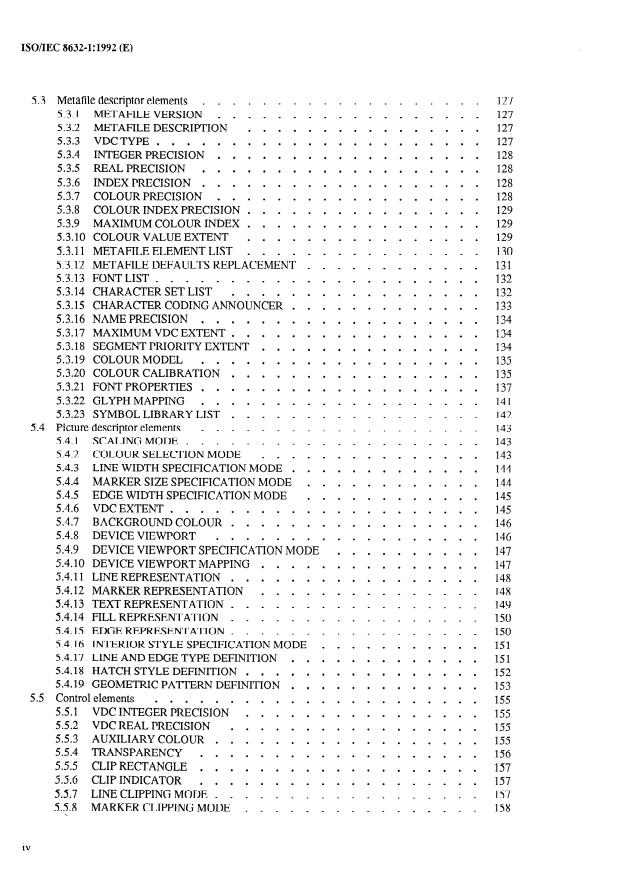
ISO/IEC 8632-l: 1992 (E)
. . . . . . . . 127
5.3 Metafile descriptor elements . . . . . . . . . . .
. . . . . . 127
5.3.1 METAFILE VERSION . . . . . . . . . .
. . . . . . 127
5.3.2 METAFILE DESCRIPTIbN l . . . . . . . . . .
. . . . . . . 127
5.3.3 VDCTYPE . . . . . . . . . . . . . . .
. . . . 128
5.3.4 INTEGER PRECISION . . . . . . . . . . . . . .
. . . . 128
5.3.5 REAL PRECISION . . . . . . . . . . . . . . .
. . . . 128
5.3.6 INDEXPRECISION . . . . . . . . . . . . . . .
. . . . 128
5.3.7 COLOUR PRECISION . . . . . . . . . . . .
. . . 129
5.3.8 COLOUR INDEX PRECISION . . . . . . . . . . . . .
. . . . 129
MAXIMUM COLOUR INDEX . . . . . . . . . . . .
5.3.9
. . . . . . 129
5.3.10 COLOUR VALUE EXTENT . . . . . . . . . .
. . . 130
5.3.11 METAFILE ELEMENT LIST . . . . . . . . . . . . .
. . . . . . e . . . . . 131
5.3.12 METAFILE DEFAULTS REPLACEMENT
. . . . . . . . . . . . . 132
5.3.13 FONT LIST . . . . . . . . .
CHARACTER SET LIST . . . . . . . . . . . . . 132
5.3.14
. . . . . . . . . . . . . 133
5.3.15 CHARACTER CODING A&ObN&
. . . . . . . . . . . . . . . 134
5.3.16 NAMEPRECISION . . . .
MAXIMUM VDC EXTENT . . . . . . . . . . . . . . . . . 134
5.3.17
. 134
5.3.18 SEGMENT PRIORITY EXTENT . . . . . . . . . . . . . .
. . 135
5.3.19 COLOUR MODEL . . . . . . . . . . . . . . .
. . . . . 135
5.3.20 COLOUR CALIBRAT;ON . . . . . . . . . . . .
. . . . . 137
5.3.21 FONTPROPERTIES . . . . . . . . . . . . . .
. . . 141
5.3.22 GLYPH MAPPING . . . . . . . . . . . . . .
. . . 142
5.3.23 SYMBOL LIBRARY I& . . . . . . . . . . . . . .
. . . . . . . . . * . . . 143
5.4 Picture descriptor elements . . . . . .
. . . . . . . . . . . 0 . . . 143
5.4.1 SCALINGMODE . . . . .
. . . . . . . . . . . . . . . 143
5.4.2 COLOUR SELECTION MODE
. . . . . 144
5.4.3 LINE WIDTH SPECIFICATION MODE . . . . . . . .
. . . . . . . . . . . . 144
5.4.4 MARKER SIZE SPECIFICATION MODE
EDGE WIDTH SPECIFICATION MODE . . . . . . . . . . . . 145
5.4.5
5.4.6 VDC EXTENT . . . . . . . . . . . . . . . . . . . . . 145
5.4.7 BACKGROUNDCOLOUR . . . . . . . . . . . . . . . . . 146
5.4.8 DEVICEVIEWPORT . . . . . . . . . . . . . . . . . . 146
5.4.9 DEVICE VIEWPORT SPECIFICATION MODE . . . . . . . . . . 147
5.4.10 DEVICE VIEWPORTMAPPING . . . . . . . . . . . . . . . 147
5.4.11 LINE REPRESENTATION . . . . . . . . . . . . . . . . . 148
5.4.12 MARKERREPRESENT-ATION . . . . . . . . . . . . . . . 148
. . . 149
5.4.13 TEXT REPRESENTATION . . . . . . . . . . . . . .
. . . . . . . . . . 150
5.4.14 FILL REPRESENTATION . . . . . . .
EDGE REPRESENTATION . . . . . . . . . . . . . . . . . 150
5.4.15
INTERIOR STYLE SPECIFICATION MODE . . . . . . . . . 151
5.4.16 . .
5.4.17 LINE AND EDGE TYPE DEFINITION . . . . . . . . . . . . 151
.
5.4.18 HATCH STYLE DEFINITION . . . . . . . . . . . . . 152
.
5.4.19 GEOMETRIC PATTERN DEFINIT;ON . . . . . . . . . . . . . 153
5.5 Control elements . . . . . . . . . . . . . . . . 155
5.5.1 vDc INTEGER ‘PREC&I;)N’ . . . . . . . . . . . . . . . . 155
5.5.2 VDC REAL PRECISION . . . . . . . . . . . . . . . . . 155
5.5.3 AUXILIARY COLOUR . . . . . . . . . . . . . . . . . . 155
5.5.4 TRANSPARENCY . . . . . . . . . . . . . . . . . . . 156
. 157
5.5.5 CLIP RECTANGLE . . . . . . . . . . . . . . . . . .
. . . . 157
5.5.6 CLIP INDICATOR . . . . . . . . . . . . . .
. 157
5.5.7 LINE CLIPPING MODE . . . . . . . . . . . . .
. 158
5.5.8 MARKER CLIPPING MODE’ . . . . : : . . . . . . . . .
iv
ISO/IEC 8632-l: 1992 (E)
. 158
5.5.9 EDGE CLIPPINGMODE . . . . . . . . . . . . . . . .
. . . 158
5.5.10 NEW REGION . . . . . . . . . . . . . . . . . .
. l . . . 159
5.5.11 SAVE PRIMITIVE CONTEXT . . . . . . . . . . .
. . . . . . . . . 160
5.5.12 RESTORE PRIMITIVE CONTEXT . . . . .
. . . . . . . 160
5.5.13 PROTECTION REGION INDICATOR . . . . . .
. . . . . . . . 161
5.5.14 GENERALIZED TEXT PATH MODE . . . . .
. . . . . . . . . . . . . 161
5.5.15 MITRE LIMIT . . . . . . . .
. . . . . . . . . . . . . 161
5.5.16 TRANSPARENT CELL COLOUR . .
. e . . . . . . . . . . . 163
5.6 Graphical primitive elements . . . . . .
. . . . . . . . . . . . . 163
5.6.1 POLYLINE . . . . . . . . .
. . . . . . . . . . . . . 163
5.6.2 DISJOINT POLYLINE . . . . .
. . . 163
5.6.3 POLYMARKER . . . . . . . . . . . . . . . . .
. . . . . . 164
5.6.4 TEXT . . . . . . . . . . . . .
. . . . . . . . . . 165
5.6.5 RESTRI&ED TEXT . . . . . . . . .
. . . . . . . . . . . . . 166
5.6.6 APPENDTEXT . . . . . . .
. . . . . . . . . . . 167
5.6.7 POLYGON . . . . . . . . . . .
. . . . . . . . . . . . . 168
5.6.8 POLYGON SET . . . . . . .
. . . . . . . . . . . . . 171
5.6.9 CELL ARRAY . . . . . . . .
. . . . . . . . . . 173
5.6.10 GENERALIZED DRAWING PRIMITIVE (GDP)
. . 173
......... . . . . . . . . . .
5.6.11 RECTANGLE
. . . . . . . . . 174
........... . . .
5.6.12 CIRCLE
. . . . . . . . 174
5.6.13 CIRCULAR ARC 3 POINT . . . . .
. . . . . . . . . . 175
5.6.14 CIRCULAR ARC 3 POINT CLOSE . . . .
. . . . . . . . . . . . 177
5.6.15 CIRCULAR ARC CENTRE .
. . . . . . . . . . . . 177
5.6.16 CIRCULAR ARC CENTRE CLOSE . .
....... . . . . . . . . . . . . 178
5.6.17 ELLIPSE
. . . . . . . . . . . 179
5.6.18 ELLIPTICAL’ARC’ . l
. . . . . . . . . 180
5.6.19 ELLIPTICAL ARC CL&E . . . .
. . * . . . . . . . . . 181
5.6.20 CIRCULAR ARC CENTRE REVERSED .
...... . . . . . . . . . . . . 181
5.6.2 1 CONNECTING EDGE
. . . . 182
....... . . . . . . . .
5.6.22 HYPERBOLIC ARC
. . . . . 182
5.6.23 PARABOLIC ARC . . . . . . . .
. . . . . . . . . . . . 183
5.6.24 NON-UNIFORM B-SPLIl?k l
.
5.6.25 NON-UNIFORM RATIONAL B-bPLIl& l . . . . . . . . . . . 183
. .
5.6.26 POLYBEZIER . . . . . . . . . . . 184
. . . . 185
5.6.27 POLYSYMBOL . . . . . . . . .
. . . . . . . 185
5.6.28 BITONAL TILE . . . . . .
. . . l . . . . 187
5.6.29 TILE . . . . .
.......... . . . . . . . . . . . 190
5.7 Attribute elements .
. . . . . . . . . 190
5.7.1 LINE BUNDLE INDEX . . . .
. . . . . . . . . . . 190
5.7.2 LINE TYPE . .
......... . . . . . . . . . . 191
5.7.3 LINE WIDTH . .
.
.... . . . . . . . . . . . 192
5.7.4 LINE COLOUR
. . . 192
.... . . . . . . . . .
5.7.5 MARKERBUNDLEINDEX’
........ . . . . . . . . . 192
5.7.6 MARKER TYPE l . .
. .
....... . . . . . . . 193
5.7.7 MARKER SIZE . . .
. . .
. . . . . . 194
5.7.8 MARKER COLOUI; . . .
. . . .
5.7.9 TEXT BUNDLE INDEk . . . . . . . . 194
.
. . . . .
5.7.10 TEXTFONT INDEX . . . . . . . . 195
. . . . . . . 195
5.7.11 TEXT PRECISION . . . . . .
. . . . . . . 196
5.7.12 CHARACTER EXPANSION FA;CT~R’ . . . . . .
. . . . . . . 196
5.7.13 CHARACTER SPACING . . . . . .
. . . . . . . 197
5.7.14 TEXT COLOUR . . . . . .
V
ISO/IEC 8632-l: 1992 (E)
. . . . . . . . . . 197
5.7.15 CHARACTERHEIGHT . . . . . . . .
. . . . . . . . . . . . 198
5.7.16 CHARACTERORIENTATION . . .
. . . . . . . . . . . . . . . . . . . 199
5.7.17 TEXT PATH
. . . . . . . . . . . . . . . . . 199
5.7.18 TEXT ALIGNMENT
. . . . . . . . . . . . 200
5.7.19 CHARACTER SET INDEX
. . . . . . . . . . . . 200
5.7.20 ALTERNATE CHARACTER’SE;. IND’EX’
. . . . . . . . . . . . . .
5.7.21 FILLBUNDLEINDEX . . .
. . 201
INTERIORSTYLE . . . . . . . . . . . . . . . .
5.7.22
. . . . . . . . . 202
5.7.23 FILLCOLOUR . . . . . . . . . .
. . . . . . . 202
5.7.24 HATCHINDEX . . . . . . . . . . . .
. . . . . . . . . . . . . . . 203
5.7.25 PATTERN INDEX . .
. . . . . . . . . . . . . 204
EDGEBUNDLEINDEX . . . .
5.7.26
. . . . . . . . . . . . . 204
EDGETYPE . . . . . . .
5.7.27
. . . . . . . . . . . . . . 205
EDGE WIDTH . . . . . .
5.7.28
. . . . . . . . . . . . . . 205
5.7.29 EDGECOLOUR . . . . .
.
. . . . . . . . . . . . . . . 206
5.7.30 EDGE VISIBILITY
. . . . 206
. . . . . . . . l .
5.7.31 FILLREFERENCEPOiNi’ . .
. . . . . 207
PATTERNTABLE . . . . . . . . . . . . .
5.7.32
. . . . . 207
PATTERNSIZE . . . . . . . . . . . . . .
5.7.33
. . . . . . . . 208
COLOURTABLE . . . . . . . . . . .
5.7.34
. . . . . . 209
ASPECT SOURCEFLAGS . . . . . . . . . .
5.7.35
. . . . . . . . 210
5.7.36 PICKIDENTIFIER . . . . . . . . . .
. . . . . . . . . . . . . . 210
5.7.37 LINE CAP . . . . . . .
. . 211
. . . . . . . . . . . .
5.7.38 LINE JOIN . . . . . . .
. . . . . 211
LINE TYPE CONTINUATION . . . . . . . . . .
5.7.39
. . 212
LINE TYPE INITIAL OFFSET . . . . . . . . . . . . .
5.7.40
. . 212
TEXTSCORETYPE . . . . . . . . . . . . . . . .
5.7.41
. . . . . 213
5.742 RESTRICTEDTEXTTYPE . . . . . . . . . . .
. . . . . . . . . . 214
5.7.43 INTERPOLATED INTERIOR . . . . .
. . . . . . . . . . 215
5.7.44 EDGE CAP . . . . . . . . . . .
. . . . . . . . . . . . . 216
5.7.45 EDGE JOIN .
. . . . . 216
5.7.46 EDGE TYPE CONTINUATION l . . . . . . . . .
. . . . . . . . . 217
5.7.47 EDGE TYPE INITIAL OFFSET . . . . .
. . . . . . . . . . . 217
5.7.48 SYMBOL LIBRARY INDEX . . . .
. . . . . . . . . . . . . . 218
5.7.49 SYMBOLCOLOUR . . . .
5.7.50 SYMBOL SIZE . . . . . . . . . . . . . . . . 218
5.7.5 1 SYMBOL 0RIENTAT;ON . . . . . . . . . . . . . . . . 219
5.8 Escape elements . . . . . . . . . . . . . . l . . . . . . . 220
5.8.1 ESCAPE . . . . . . . . . . . . . . . . . . . . . 220
5.9 External elements . . . . . . . . . . . . . . . . . . . . . 221
5.9.1 MESSAGE . . . . . . . . . . . . . . . . . . . 221
5.9.2 APPLICATION DATA. . . . . . . . . . . . . . . . . . 221
. . . . . . . . 222
5.10 Segment elements . . . . . . . . . . .
5.10.1 COPY SEGMENi’ . . . . . . . . . . . . . . . . .
5.10.2 INHERITANCE FILTER . . . . . 0 . . . . . . . . . . 222
5.10.3 CLIP INHERITANCE . . . . . . . . . . . . . .
5.10.4 SEGMENT TRANSFORMATION . . . . . . . . l . . . . .
. . . . 224
5.10.5 SEGMENT HIGHLIGHTING . . . . . . . . . .
5.10.6 SEGMENT DISPLAY PRIORITY . . . . . . . . . . 225
. . . .
5.10.7 SEGMENT PICK PRIORITY . . . . . . 225
. . . . . . . . .
6 Metafile defaults . . . . . . . . . . . 227
. . . . . . . . .
vi
ISO/IEC 8632-l: 1992 (E)
. . . 232
. . . . .
.............
7 Conformance
. . 232
. . . . . .
.........
7.1 Forms of co~formark
. . 232
. . . . . .
.........
7.2 Functional conformance of meta&
. . . . . . . 232
.
7.3 Full conformance of metafiles .
. . . . . . 232
.......... . .
7.4 Conformance of other encodings
. . . . 233
. . . .
A Formal grammar of the functional specification of version 1 metafiles
l . . . . 233
. . .
................
A. 1 Introduction
. . . . . 233
. . . . . .
.........
A.2 Notation used
. . . . . 233
............ . . .
A.3 Detailed grammar’
. . . 233
..... . . . . .
....
A.3.1 Metafile struc&re
. . . 234
. . . . .
.........
A.3.2 Metafile descriptor elements
. . . 236
. . . . .
.........
A.3.3 Picture descriptor elements
. . . 236
. . . . .
...... . . ....
A.3.4 Control elements
. . . . 237
. . l .
...........
A.3.5 Graphical elements
l . . . 240
. . l . .
...........
A.3.6 Attribute elements
. . . . . 243
. . .
............
A.3.7 Escape elements
. . . . . . . 243
.
A.3.8 External elements .
. . . . . . . 244
.............. .
A.4 Terminal symbols
. . . . . . . .
B Formal Grammar of the functional specification of version 2 metafiles
. . . 248
. . . l .
................
B.l Introduction
. l . . . 248
... l . . . .
.........
B.2 Notation used
. . . . . . . 248
.
............
B .3 Detailed grammar’
. . . . . . . . 248
.........
B.3.1 Metafile struck-e
. . . . . . . . 249
.........
B .3.2 Metafile descriptor elemenk
. . . . . . . . 252
.........
B.3.3 Picture descriptor elements
. . . . . . . . . 254
...........
B.3.4 Control elements
. . 255
. . . . . .
...........
B .3.5 Graphical elements
. . 257
. . . . . .
............
B.3.6 Attribute elements
. . . . . 261
. . .
B.3.7 Closed figure element .
. . . . . 261
. . .
B .3.8 Escape elements .
. . . . . 262
. . .
B.3.9 External elements .
. . . . . . . 262
............ .
B .3.10 Segment elements
. . . . . . . . 264
..............
B.4 Terminal symbols
. . . . . 272
. . .
C Formal grammar of the functional specification of version 3 metafiles
. . . . . l 272
................ . .
C.1 Introduction
. . . . . . . 272
............. .
C.2 Definitions
. . . . . 272
...... .... . . .
C.2.1 Notatidn &ed
. . . . . . . 272
.......... .
C.2.2 Structured Data Records:
. . . . . . . . 273
..............
C.3 Detailed Grammar
. . . . . . . . 273
............
C.3.1 Metafile structure
. . . . . . . . 278
.........
C.3.2 Metafile descriptor elements
. . . . . 281
......... . . .
C.3.3 Picture descriptor elements
. . . l . . . 285
............ .
C.3.4 Control elements
. . . . . . . 286
........... .
C.3.5 Graphical elements
. . . . . . . . 289
............
C.3.6 Attribute elements
. 294
. . . . . . .
............
C.3.7 Escape elements
. 294
. . . . . . .
............
C.3.8 External elements
. . . . . . . . 294
............
C.3.9 I Segment elements
. . . . . . . . 297
..............
C.4 Terminal symbols
. . . . . . . 307
.
D Guidelines for metafile generators and interpreters . . . . . .
. . . . . 307
. . .
D. 1 Introduction . . . . . . . . . . . . . . . .
vii
ISO/IEC 8632-l: 1992 (E)
. 307
D.2 Errors and degeneracies . . . . . . . . . . . . l . . . . . .
. . 308
. . . . . . . . . .
D.2.1 Syntax errors . . . . . . . . .
. . . . . . . . . . . . 308
D.2.2 Geometrically degenerate primitives . .
. 309
. . . . . . . . . . .
D.2.3 Mathematical singularities and ambiguities
. 309
. . . . . . . . . . . . .
D.3 General guidelines .
. 309
. . . . . . . . . . . . .
D.3.1 Indexes .
. . . . . . . . . . . . . .
D.3.2 Colour model .
. . . . . . . . . . . . . .
D.3.3 Order of metafile descriptor elements
. . . . . . . . . . 312
. . . . . .
D.3.4 Unsatisfied references . . .
. . . l . . . . . . . . . 312
. . . . .
D.4 Guidelines for element classes
. . . . . * 312
l . . . . l . . .
. .
D.4.1 Delimiter elements
. . . . . . 312
. . . . . . .
. . .
D.4.2 Metafile descriptor elemenk .
. . . . . . 312
. . . . . . . . .
.
D.4.3 Picture descriptor elements .
. . . . . . 313
. . . . . . . . .
.
D.4.4 Control elements . . . .
. . . . . 313
. . . . . . . . . .
D.4.5 Graphical primitive elements .
. . . . . . 316
. . . . . . . . . .
D.4.6 Attribute elements . . . .
. . . . . . . . 318
. . . . . . . .
D.4.7 Escape elements . . . .
. . . . . . . . . .
. . . . . .
D.4.8 External elements . . . .
. . . . . . . 318
. . . . . * . . .
D.4.9 Segment elements . . . .
. . . 320
. . . . . . . . . . .
. .
E Guidelines for private encodings . . .
. . . . . . . . . . 321
. . . . . .
F Reference models . . . . . . . .
. . . . 325
G Conversions between the CIEXYZ reference corour space and metafile colour spaces
. . . . . 325
Gl Introduction . . . . . . . . . . . . . . . . . . .
. . . . . 325
G’2 . Definitions . . . . . . . . . . . . . . . . . . .
. . . . . 325
G3 . CIELUV . . . . . . . . . . . . . . . . . . . .
. 325
. . . .
G.3.1 Conversion from the CIEXYZ reference colour space to CIELUV
. . 326
. . .
G.3.2 Conversion from CIELUV to the CIEXYZ reference colour space
. 327
. . . .
G4 . CIELAB . . . . . . . . . . . . . . . . . . . .
. 327
. . . .
G.4.1 Conversion from the CIEXYZ reference colour space to CIELAB
. . 328
. . .
G.4.2 Conversion from CIELAB to the CIEXYZ reference colour space
. 329
. . . l . .
RGB
G5 .
. . . . . . 329
G.5.1 Conversion frbm*the CIEXYZ*re fk,,,,‘,olour sphce.to kGi .
. 330
. . . .
G.5.2 Conversion from RGB to the CIEXYZ reference colour space . .
. . 331
. . .
G6 RGB-related . . . . . . . . . . . . . . . . . . .
. . . 331
. . .
G-7 . CMYK
. . . . 331
. .
G.7.1 Converkon fromC&YK to the &EXYZ refere’nce copout &a&
. . . . . 331
G.7.2 CMYK Calibration data . . . . . . . . . . . . .
. . . . . 332
G8 . Bibliography . . . . . . . . . . . . . . . . . . .
. . .
Vlll
ISO/IEC 8632-l: 1992 (E)
Foreword
IS0 (the International Organization for Standardization) and IEC (the International Electrotechnical
Commission) form the specialized system for worldwide standardization. National bodies that are members of
IS0 or IEC participate in the development of International Standards through technical committees established
by the respective organization to deal with particular fields of technical activity. IS0 and IEC technical
committees collaborate in fields of mutual interest. Other international organizations, governmental and non-
governmental, in liaison with IS0 and IEC, also take part in the work.
In the field of information technology, IS0 and IEC have established a joint technical committee, ISO/IEC
JTC 1, Draft International Standards adopted by the joint technical committee are circulated to national bodies
for voting. Publication as an International Standard requires approval by at least 75 % of the national bodies
casting a vote.
International Standard ISO/IEC 8632-l was prepared by Joint Technical Committee ISO/IEC JTC 1,
Information technology.
which has been technically
This second edition cancels and replaces the first edition (IS0 863291:1987),
revised.
ISO/IEC 8632 consists of the following parts, under the general title Information technology - Comyutel
graphics - IMetafile for the storage and transfer of picture description information :
Part I : Functional specification
Part 2: Character encoding
Part 3: Binary encoding
Fart 4: Clear text encoding
Annexes A, B, and C form an integral part of this part of ISO/IEC 8632. Annexes D, E, F and G are for
information only
ix
ISO/IEC 8632-l: 1992 (E)
Introduction
0.1 Purpose
The Computer Graphics Metafile provides a file format suitable for the storage and retrieval of picture
information. The file format consists of a set of elements that can be used to describe pictures in a way that
is compatible between systems of different architectures and devices of differing capabilities and design.
This picture description includes the capability for describing static pictures. Static pictures are those
where elements which may lead to dynamic effects (for example those leading to regeneration) are prohi-
bited within the picture body.
0.2 Reasons for this International Standard
The main reasons for producing a stand ard corn puter graphics metafile are
to allow picture information to be stored in an organized way on a graphical software system;
a>
to facilitate transfer of picture information between different graphical software systems;
b)
to enable picture information to be transferred between graphical devices;
c>
to enable picture information to be transferred between different computer graphics installations.
d)
0.3 Design requirements
To reach these objectives, a number of design principles were adopted:
The metafile should provide a suitable set of elements for the transfer of a wide range of pictorial
a>
information.
The metafile should address the more usual and essential features found on graphical devices
b)
directly and should provide access to less common facilities via an escape mechanism.
The design of the metafile should not preclude extension of ISO/IEC 8632 at a later stage to cover
C)
facilities beyond those included in this version of the Standard. It should also not preclude further
extensions to support future standards.
The metafile should be usable from GKS (Graphical Kernel System - IS0 7942) with both
d)
metafile input and metafile output functions. It should include the capability to support IS0 7942
(GKS) static picture capture.
X
ISO/IEC 8632-1: 1992 (E)
Introduction
Design requirements
ISO/IEC 8632 should address the needs of different applications that have conflicting require-
e)
ments for size of metafile, speed of generation and interpretation, readability, editability and ease
of transfer through different transport mechanisms.
0.4 Design criteria
The requirements of 0.3 were used to formulate the following criteria which were used to decide between
different design possibilities.
Completeness: In any area of ISO/IEC 8632, the functionality specified by ISO/IEC 8632 should
a>
be complete in itself.
Conciseness: Redundant elements or parameters should be avoided.
b)
Consistency: Contradictory elements should be avoided.
c)
Extensibility: The ability to add new elements and generality to ISO/IEC 8632 should not be pre-
d)
cluded.
Fidelity: The minimal results and characteristics of elements should be well defined.
e>
Implementability: An element should be able to be supported efficiently on most host systems
f)
and/or graphics hardware.
Orthogonality: The elements of the metafile should be independent of each other, or any depen-
s)
dencies should be structured and well defined.
Predictability: ISO/IEC 8632 should be such that the recommended or proper use of standard ele-
h)
ments guarantees the results of using a particular element.
Standard practice: Only those elements that reflect existing practice, that are necessary to support
existing practice, or that are necessary to support proposed standards should be standardized.
.
Usefulness: Functions should be powerful enough to perform useful tasks.
J)
Well-structured: The assumptions that elements make about each other should be minimized. An
k)
element should have a well-defined interface and a simply stated unconditional purpose. Mul-
tipurpose elements and side effects should be avoided.
0.5 Access to a metafile
The metafile has been designed so that, although its main usage is anticipated as being with completely
sequential access, non-sequential access is also possible. Once the basic environment of the metafile has
been established, individual pictures may be accessible if the medium, the encoding and the implementation
support this form of access.
0.6 Generation and interpretation of metafiles
The specific mechanisms of metafile generation and interpretation are not described by ISO/IEC 8632,
although it does describe the intended result of such interpretation. The basic set of metafile elements
includes a capability for the addition of application-dependent data, which do not have graphical meaning
and for which no intended interpretation results are described.
0.7 Distinction between formal specification and encodings
The functionality provided by the metafile is separated from the specification of any particular encoding
format. ISO/IEC 8632 provides for both standard and private encodings of the elements described in this
xi
ISO/IEC 8632-l: 1992 (E)
Distinction between formal specification and encodings
Introduction
part of ISO/IEC 8632. Guidelines for private encodings are specified in annex E ; these guidelines do not
form part of ISO/IEC 8632.
Three standard encodings are specified in parts 2, 3 and 4 of ISO/IEC 8632. Each of the standardized
encodings is capable of representing the full functionality described in this part of ISO/IEC 8632. Transla-
tion between the standardized encodings is possible without loss of picture information, although subse-
quent translation back into the original encoding may not result in precisely the same data stream, due to
different quantizations of precisions in the different encodings.
The character encoding specified in ISO/IEC 8632-2 is intended to provide an encoding of minimum size.
It conforms to the rules for code extension specified in IS0 2022 in the category of complete code system.
It is particularly suitable for transfer through networks that cannot support binary transfers.
The binary encoding specified in ISO/IEC 8632-3 provides an encoding that requires least effort to generate
and interpret on many systems.
The clear text encoding specified in ISO/IEC 8632-4 provides an encoding that can be created, viewed and
edited with standard text editors. It is therefore also suitable for transfer through networks that support only
transfer of text files.
0.8 Relationship to other International Standards
ISO/IEC 8632 draws extensively for its model of a graphics system on GKS (Graphical Kernel System -
IS0 7942). In addition, ISO/IEC 8632 specifies a metafile that may be used as a static picture-capture
metafile by GKS.
This part of ISO/IEC 8632 uses font concepts and the font architecture defined in ISO/IEC 9541-1 for
defining CGM references to fonts and font resources. The font properties of ISO/IEC 9541-1 are adopted,
where appropriate, to define CGM mechanisms to provide information useful for font substitution between
parties interchanging Metafiles. This part of ISO/IEC 8632 includes the minimum font description subset
defined in ISO/IEC 9541-2. Clause 3 contains a number of glossary definitions that are taken from, and are
identical to, those found in ISO/IEC 9541- 1. This part of ISO/IEC 8632 also defines access to extended
families of glyph based on the principles and procedures of ISO/IEC 10036.
This part of ISO/IEC 8632 uses a calorimetrically precise reference colour space to allow for interchange of
precise colour specifications. It uses concepts defined in ISO/IEC 8613/Amd.2 which are based on CIE
publications. ISO/IEC 8613/Amd.2 provides tutorial material on relevant definitions and colour concepts,
which is useful for understanding the material in this Standard but is not incorporated into this Standard in
that amount of detail.
The character encoding specified in ISO/IEC 8632-2 conforms to the code extension techniques of IS0
2022.
The binary encoding specified in ISO/IEC 8632-3 employs the mechanism for representing floating point
numbers specified in ANSI/IEEE 754-1986.
For certain elements, the CGM defines value ranges of parameters as being reserved for registration. The
meanings of these values will be defined using the established procedures (see 4.12) of the IS0 Interna-
tional Registration Authority for Graphical Items. These procedures do not apply to values and value
ranges defined as being reserved for private use; these values and ranges are not standardized. There is a
very close relationship between many of the elements in IS0 8632 and a subset of the functions in the CGI *
(Computer Graphics Interface - ISO/IEC 9636).
x11
ISO/IEC 8632-l: 1992 (E)
Versions Introduction
0.9 Versions
ISO/IEC 8632 defines several versions of the Computer Graphics Metafile. A version is defined by a for-
mal grammar and additional specifications contained in clauses 4, 5, and 6. Clause 7 contains conformance
criteria defined by version.
These versions are currently defined: Version 1 (one); Version 2 (two); and Version 3 (three).
NOTES
1 A valid Version 2 metafile is also a valid Version 3 metafile. A valid Version 1 metafile is also a valid Version 2
metafile.
2 Version 1 metafiles are as defined by the original CGM standard, which was designated IS0 8632:1987. Version 2
metafrles are as defined by the first amendment to the CGM standard, which was designated IS0
8632:1987/Amd.1:1990. Version 3 metafiles are as defined by an amendment to Version 2 of the CGM standard.
This amendment was originally designated ISO/IEC 8632: 1987/Amd.3: 1991, but was never published as an amend-
ment. Instead all documents were consolidated to produce this revision of IS0 8632; Versions 1, 2, and 3 are all
defined by this revision.
3 Many of the figures in this International Standard were produced using ISO/IEC 8632 standard Version 1
metafiles, as defined herein.
. . .
x111
This page intentionally left blank
ISO/IEC 8632-l : 1992 (E)
INTERNATIONAL STANDARD
Information technology - Computer graphics - Metafile for
the storage and transfer of picture description information -
Part 1 :
Functional specification
1 Scope
ISO/IEC 8632 provides a file format suitable for the storage and retrieval of picture description information.
The file format consists of an ordered set of elements that can be used to describe pictures in a way that is
compatible between systems of different architectures and devices of differing capabilities and design. This
picture description includes the capability for describing static images.
The elements specified provide for the representation of a wide range of pictures on a wide range of graphi-
cal devices. The elements are split into groups that delimit major structures (metafiles and pictures), that
specify the representations used within the metafile, that control the display of the picture, that perform
basic drawing actions, that control the attributes of the basic drawing actions and that provide access to
non-standard device capabilities.
The Metafile is defined in such a way that, in addition to sequential access to the whole metafile, random
access to individual pictures is well-defined; whether this is available in any system that uses ISO/IEC 8632
depends on the medium, the encoding and the implementation.
In addition to a functional specification, three standard encodings of the metafile syntax are specified.
These encodings address the needs of applications that require minimum metafile size, minimum effort to
generate and interpret, and maximum flexibility for a human reader or editor of the metafile.
This part of ISO/IEC 8632 describes the format using an abstract syntax. The remaining three parts of IS0
8632 specify three standardized encodings that conform to this syntax: ISO/IEC 8632-2 specifies a charac-
ter encoding that conforms to the rules for code extension specified in IS0 2022 in the category of complete
coding system; ISO/IEC 8632-3 specifies a binary encoding; ISO/IEC 8632-4 specifies a clear text encod-
ing.
ISO/IEC 8632-l: 1992 (E)
2 Normative references
The following standards contain provisions which, through reference in this text, constitute provisions of
this part of ISO/IEC 8632. At the time of publication, the editions indicated were valid. All standards are
subject to revision, and parties to agreements based on this part of ISO/IEC 8632 are encouraged to investi-
gate the possibility of applying the most recent editions of the standards listed below. Members of IEC and
IS0 maintain registers of currently valid International Standards.
ISOIIEC 646: 1991, Information technology - IS0 7-bit coded character set for information interchange.
IS0 7-bit and 8-bit coded character sets - Code extension
IS0 2022: 1986, Information processing -
techniques.
Procedure for registration of escape sequences.
IS0 2375: 1985, Data processing -
IS0 7942~1985, information processing systems - Computer graphics - Graphical Kernel System (GKS)
functional description.
ISOIIEC 8613: 1989lAmdS:-I>, Information processing systems - Text and ofice systems - Ofice document
Amendment 1: Tiled raster graphics.
architecture (ODA) and interchange format -
ISO/IEC 8613:1989/Amd.2:-11, Information processing systems - Text and ofice systems - Ofice document
architecture (ODA) and interchange format - Amendment 2: Colour.
ISO/IEC 9541- 1: 199 1, Information technology - Font information interchange - Part 1: Architecture.
Font information interchange - Part 2: Interchange format.
ISOAEC 9541-2: 199 1, Information technology -
Inter$acing techniques for dialogues
ISO/IEC 9636- 1: 199 1, Information technology - Computer graphics -
Part 1: Overview, profiles, and conformance.
with graphical devices (CGI) - Functional specification -
Intetiacing techniques for dialogues
ISOIIEC 9636-2: 1991, Information technology - Computer graphics -
with graphical devices (CGI) - Functional specification - Part 2: Control.
Interfacing techniques for dialogues
ISO/IEC 9636-3: 1991, Information technology - Computer graphics -
with graphical devices (CGI) - Functional specification - Part 3: Output.
Interjiacing techniques for dialogues
ISOAEC 9636-4: 199 1, Information technology - Computer graphics -
with graphical devices (CGI) - Functional specification - Part 4: Segments.
Procedures for registration of
ISO/IEC TR 9973: 1988, Information processing - Computer graphics -
.
graphical items.
ISO/IEC 10036:-l), Information technology - Font information interchange - Procedure for registration of
glyph and glyph collection identifiers.
1) To be published.
ISO/IEC 8632-l: 1992 (E)
Normative references
CCITT Recommendation T.4 (1988), Standardization of group 3 facsimile apparatus for document
transmission.
CCITT Recommendation T.6 (1988), Standardization of group 4 facsimile apparatus for document
transmission.
CIE Publication 15.2, Calorimetry, 1986 (2nd edition).
CIE Publication SOO2, Calorimetric Observers, 1986 (1st edition).
ISO/IEC 8632-1: 1992 (E)
3 Definitions and abbreviations
3.1 Definitions
For the purposes of ISOAEC 8632 the following definitions apply.
NOTE - As far as possible, commonly accepted graphics terminology is used.
3.1-l anisotropic mapping: A mapping in which the scale factors applied along each axis are not equal.
This is often used in reference to the mapping from VDC to distance units on the physical display surface.
With anisotropic mapping, the angle between any pair of non-parallel line segments can change; circles
cease to be circles and become ellipses after such a transformation. See “isotropic mapping”.
3.1.2 aspect ratio: The ratio of the width to the height of a rectangular area, such as a window or viewport.
For example, an aspect ratio of 2.0 indicates an area twice as wide as it is high.
3.1.3 aspect source flag (ASF): Indicator as to whether a particular attribute selection is to be individual or
bundled.
3.1.4 aspects of primitives: Ways in which the appearance of a primitive can vary. Some aspects are con-
trolled directly by primitive attributes; some are controlled indirectly through a bundle table.
3.1.5 attribute elements: Metafile elements that describe the appearance of graphical elements.
3.1.6 boundary: The mathematical locus that defines, in abstract VDC space, the limits of a region to be
filled (for fill primitives and closed figures). The visual appearance of interior style ‘hollow’ consists of a
depiction of the boundary obtained after clipping has been taken into account.
3.1.7 brightness: Attribute of a visual sensation according to which an area appears to emit more or less
light.
3.1.8 bundle: Set of attributes associated with one of the following graphical element types: line, marker,
text, and filled area.
3.1.9 bundle index: An index into a bundle table for a particular output primitive.
3.1.10 bundle table: An indexed table containing a set of attributes for each index.
3.1.11 character set: The set of displayable symbols mapped to individual characters in a TEXT, APPEND
TEXT, or RESTRICTED TEXT string. This corresponds to the “G-set” defined in IS0 2022. A character
set is independent of the font or typeface; examples of character sets are: ASCII (X3.4), German and Kata-
kana.
3.1.12 chroma: Colourfulness (chromaticncss) of an area judged in proportion to the brightness of a simi-
larly illuminated area that appears white or highly transmitting.
3.1.13 chromaticity: Ratio of each of a set of three tristimulus values to their sum. (As the sum of the three
chromaticity coordinates equals 1, two of them are sufficient to define a chromaticity.)
3.1.14 CIELAB colour space: A CIE recommended, approximately uniform, colour space with rectangular
coordinates L* , a *, and b * . L* is the approximate correlate of lightness, a* and b* are used to calculate
approximate correlates of hue and chroma. CIELAB uses the tristimulus ratios X/X,, Y /Yn, Z/Z, instead of
chromaticity coordinates as in CIELUV. X,, Y,, , Zn are the values of X, Y,Z for the appropriate chosen
reference white. The reduced perceptual significance of a given difference in chromaticity as the colour
becomes darker is incorporated by using the tristimulus ratios.
3.1.15 CIELUV colour space: A CIE recommended, approximately uniform, colour space with rectangular
coordinates L* , u *, and v * . L* is the approximate correlate of lightness, u* and v* are used to calculate
approximate correlates of hue and chroma. The colour stimulus is described by Y,u’sv’ and the the reference
white by Y,, uR’, v,‘. A given difference in chromaticity is reduced in magnitude by the factor L* as the
ISO/IEC 8632-l: 1992 (E)
Definitions
Definitions and abbreviations
colour becomes darker.
3.1.16 CIE tristimulus values: Amounts of the three reference colour stimuli, in a given trichromatic sys-
tem, required to match the colour of the stimulus considered.
3.1.17 CIE uniform colour spaces: Two CIE recommended, approximately uniform colour spaces,
CIELAB and CIELUV, are allowed in the CGM. These colour spaces are non-linear transformations of the
CIE 1931 XYZ tristimulus space, into the approximate perceptual correlates of lightness, hue, and chroma.
CIELAB and CIELUV closely approximate unifor
...
NORME
ISO/CEI
I NTE R NAT I O NALE
8632-1
Deuxième édition
1992-1 0-01
r? >.
Technologies de l'information -
Infographie - Métafichier de stockage et
de transfert des informations de
description d'images -
Partie 1:
Description fonctionnelle
Information technology - Computer graphics - Metafile for the storage
and transfer of picture description information -
Part 1: Functional specification
Numéro de référence
ISO/CEI 8632-1 :1992(F)
ISO/CEI 8632-1:1992 (F)
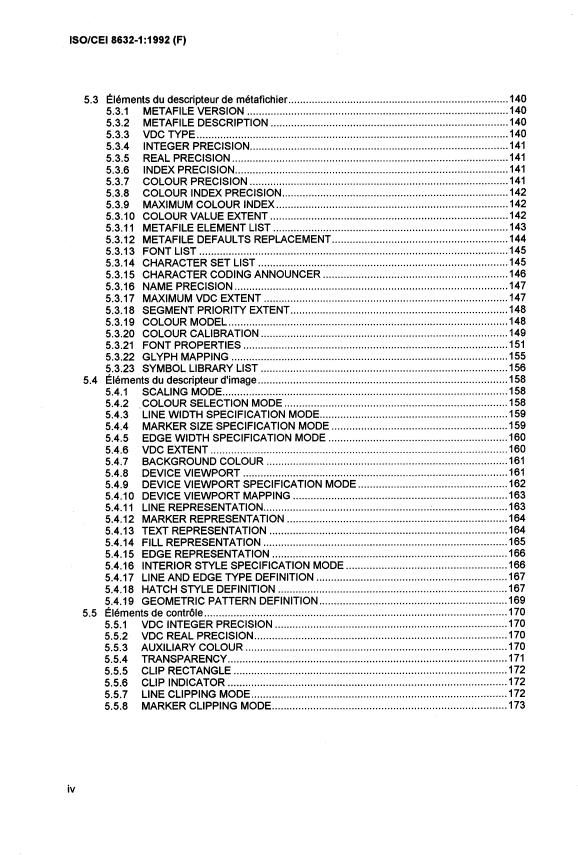
5.3 Éléments du descripteur de métafichier . 140
5.3.1 METAFILE VERSION . 140
5.3.2 METAFILE DESCRIPTION . 140
......................................................................................................... 140
5.3.3 VDC TYPE
5.3.4 INTEGER PRECISION . 141
............................................................................................. 141
5.3.5 REAL PRECISION
5.3.6 INDEX PRECISION . 141
5.3.7 COLOUR PRECISION . 141
5.3.8 COLOUR INDEX PRECISION . 142
5.3.9 MAXIMUM COLOUR INDEX . 142
5.3.10 COLOUR VALUE EXTENT . 142
5.3.11 METAFILE ELEMENT LIST . 143
5.3.12 METAFILE DEFAULTS REPLACEMENT . 144
5.3.13 FONT LIST . 145
5.3.14 CHARACTER SET LIST . 145
5.3.15 CHARACTER CODING ANNOUNCER . 146
5.3.1 6 NAME PRECISION . 147
5.3.17 MAXIMUM VDC EXTENT . 147
5.3.18 SEGMENT PRIORITY EXTENT . 148
5.3.1 9 COLOUR MODEL . 148
5.3.20 COLOUR CALIBRATION . 149
5.3.21 FONT PROPERTIES . 151
5.3.22 GLYPH MAPPING . 155
5.3.23 SYMBOL LIBRARY LIST . 156
5.4 Éléments du descripteur d'image . 158
5.4.1 SCALING MODE . 158
5.4.2 COLOUR SELECTION MODE . 158
5.4.3 LINE WIDTH SPECIFICATION MODE . 159
5.4.4 MARKER SIZE SPECIFICATION MODE . 159
5.4.5 EDGE WIDTH SPECIFICATION MODE . 160
5.4.6 VDC EXTENT . 160
5.4.7 BACKGROUND COLOUR . 161
5.4.8 DEVICE VIEWPORT . 161
5.4.9 DEVICE VIEWPORT SPECIFICATION MODE . 162
5.4.10 DEVICE VIEWPORT MAPPING . 163
5.4.11 LINE REPRESENTATION . 163
5.4.12 MARKER REPRESENTATION . 164
5.4.13 TEXT REPRESENTATION . 164
5.4.14 FILL REPRESENTATION . 165
............................................................................... 166
5.4.15 EDGE REPRESENTATION
5.4.16 INTERIOR STYLE SPECIFICATION MODE . 166
5.4.17 LINE AND EDGE TYPE DEFINITION . 167
5.4.18 HATCH STYLE DEFINITION . 167
5.4.19 GEOMETRIC PATTERN DEFINITION . 169
5.5 Éléments de contrôle . 170
5.5.1 VDC INTEGER PRECISION . 170
5.5.2 VDC REAL PRECISION . 170
5.5.3 AUXILIARY COLOUR . 170
5.5.4 TRANSPARENCY . 171
5.5.5 CLIP RECTANGLE . 172
5.5.6 CLIP INDICATOR . 172
5.5.7 LINE CLIPPING MODE . 172
5.5.8 MARKER CLIPPING MODE . 173
iv
ISOKEI 8632-1 :I992 (F)
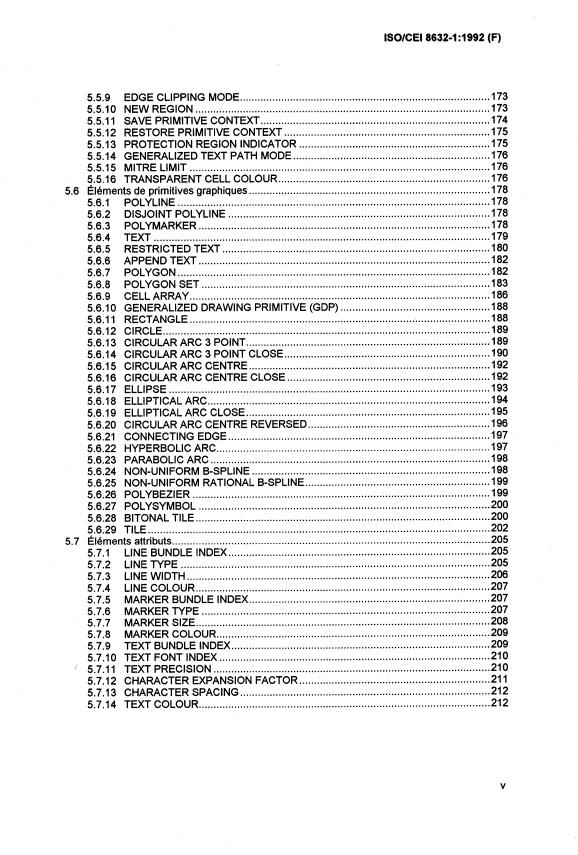
5.5.9 EDGE CLIPPING MODE . 173
5.5.10 NEW REGION . 173
5.5.11 SAVE PRIMITIVE CONTEXT . 174
5.5.12 RESTORE PRIMITIVE CONTEXT . 175
5.5.13 PROTECTION REGION INDICATOR . 175
5.5.14 GENERALIZED TEXT PATH MODE . 176
5.5.15 MITRE LIMIT . 176
5.5.16 TRANSPARENT CELL COLOUR . 176
5.6 Éléments de primitives graphiques . 178
5.6.1 POLYLINE . 178
5.6.2 DISJOINT POLYLINE . 178
5.6.3 POLYMARKER . 178
5.6.4 TEXT . 179
5.6.5 RESTRICTED TEXT . 180
5.6.6 APPEND TEXT . 182
5.6.7 POLYGON . 182
5.6.8 POLYGON SET . 183
5.6.9 CELL ARRAY . 186
5.6.10 GENERALIZED DRAWING PRIMITIVE (GDP) . 188
5.6.11 RECTANGLE . 188
5.6.12 CIRCLE . 189
5.6.13 CIRCULAR ARC 3 POINT . 189
5.6.14 CIRCULAR ARC 3 POINT CLOSE . 190
5.6.15 CIRCULAR ARC CENTRE . 192
5.6.16 CIRCULAR ARC CENTRE CLOSE . 192
5.6.17 ELLIPSE . 193
5.6.18 ELLIPTICAL ARC . 194
5.6.19 ELLIPTICAL ARC CLOSE . 195
5.6.20 CIRCULAR ARC CENTRE REVERSED . 196
5.6.21 CONNECTING EDGE . 197
5.6.22 HYPERBOLIC ARC . 197
5.6.23 PARABOLIC ARC . 198
................................................................................ 198
5.6.24 NON-UNIFORM B-SPLINE
5.6.25 NON-UNIFORM RATIONAL B-SPLINE . 199
5.6.26 POLYBEZIER . I99
5.6.27 POLYSYMBOL . 200
5.6.28 BITONAL TILE . 200
5.6.29 TILE . 202
5.7 Éléments attributs . 205
5.7.1 LINE BUNDLE INDEX . 205
5.7.2 LINE TYPE . 205
5.7.3 LINE WIDTH . 206
5.7.4 LINE COLOUR . 207
5.7.5 MARKER BUNDLE INDEX . 207
5.7.6 MARKER TYPE . 207
5.7.7 MARKER SIZE . 208
5.7.8 MARKER COLOUR . 209
5.7.9 TEXT BUNDLE INDEX . 209
5.7.10 TEXT FONT INDEX . 210
. 5.7.11 TEXT PRECISION . 210
5.7.12 CHARACTER EXPANSION FACTOR . 211
5.7.13 CHARACTER SPACING . 212
5.7.14 TEXT COLOUR . 212
V
ISO/CEI 8632-1 :1992 (F)
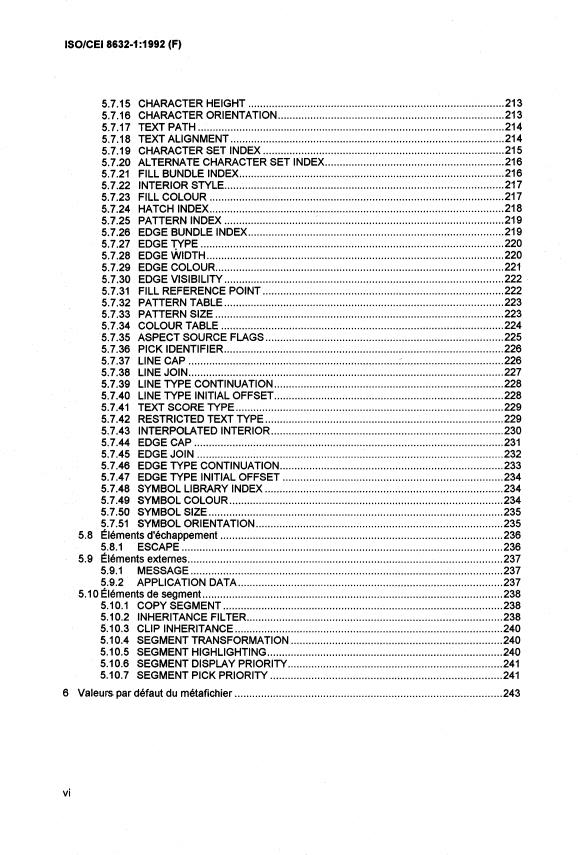
5.7.15 CHARACTER HEIGHT . 213
5.7.16 CHARACTER ORIENTATION . 213
5.7.17 TEXT PATH . 214
5.7.18 TEXT ALIGNMENT . 214
5.7.19 CHARACTER SET INDEX . 215
5.7.20 ALTERNATE CHARACTER SET INDEX . 216
5.7.21 FILL BUNDLE INDEX . 216
5.7.22 INTERIOR STYLE . 217
5.7.23 FILL COLOUR . 217
5.7.24 HATCH INDEX . 218
5.7.25 PATTERN INDEX . 219
5.7.26 EDGE BUNDLE INDEX . 219
5.7.27 EDGE ?PE . 220
5.7.28 EDGE WIDTH . 220
5.7.29 EDGE COLOUR . 221
5.7.30 EDGE VISIBILITY . 222
5.7.31 FILL REFERENCE POINT . 222
5.7.32 PATTERN TABLE . 223
5.7.33 PATTERN SIZE . 223
5.7.34 COLOUR TABLE . 224
5.7.35 ASPECT SOURCE FLAGS . 225
5.7.36 PICK IDENTIFIER . 226
5.7.37 LINE CAP . 226
5.7.38 LINE JOIN . 227
5.7.39 LINE TYPE CONTINUATION . 228
5.7.40 LINE TYPE INITIAL OFFSET . 228
5.7.41 TEXT SCORE TYPE . 229
5.7.42 RESTRICTED TEXT TYPE . 229
5.7.43 INTERPOLATED INTERIOR . 230
5.7.44 EDGE CAP . 231
5.7.45 EDGE JOIN . .
5.7.46 EDGE TYPE CONTINUATION . 233
5.7.47 EDGE TYPE INITIAL OFFSET . 234
................................................................................ 234
5.7.48 SYMBOL LIBRARY INDEX
5.7.49 SYMBOL COLOUR . 234
5.7.50 SYMBOL SIZE . 235
5.7.51 SYMBOL ORIENTATION . 235
5.8 Éléments d'échappement . 236
5.8.1 ESCAPE . 236
5.9 Éléments externes . 237
5.9.1 MESSAGE . 237
5.9.2 APPLICATION DATA . 237
5.1 O Éléments de segment . 238
5.1 0.1 COPY SEGMENT . 238
5.10.2 INHERITANCE FILTER . 238
5.10.3 CLIP INHERITANCE . 240
5.10.4 SEGMENT TRANSFORMATION . 240
5.1 0.5 SEGMENT HIGHLIGHTING . 240
5.10.6 SEGMENT DISPLAY PRIORITY . 241
5.10.7 SEGMENT PICK PRIORITY . 241
6 Valeurs par défaut du métafichier . 243
vi
lSOlCEl8632-I :I992 (F)
7 Conformité . 249
7.1 Formes de la conformité . 249
7.2 Conformité fonctionnelle des métafichiers . 249
7.3 Conformité complète des métafichiers . 249
7.4 Conformité des autres codages . 250
A Grammaire formelle de la spécification fonctionnelle des métafichiers version 1 . 251
A.l Introduction . 251
A.2 Notation utilisée . 251
A.3 Grammaire détaillée . 251
A.3.1 Structure du métafichier . 251
A.3.2 Éléments descripteurs de métafichier . 252
A.3.3 Éléments descripteurs d'image . 254
A.3.4 Éléments de contrôle . 254
A.3.5 Éléments graphiques . 255
A.3.6 Éléments attributs . 257
A.3.7 Éléments d'échappement . 260
A.3.8 Éléments externes . 261
A.4 Symboles terminaux . 261
B Grammaire formelle de la spécification fonctionnelle des métafichiers version 2 . 265
B.l Introduction . 265
B.2 Notation utilisée . 265
8.3 Grammaire détaillée . 265
B.3.1 Structure du métafichier . 265
8.3.2 Éléments descripteurs de métafichier . 266
8.3.3 Éléments descripteurs d'image . 268
B.3.4 Éléments de contrôle . 271
8.3.5 Éléments graphiques . 271
8.3.6 Éléments attributs . 274
................................................................................... 277
8.3.7 Éléments d'échappement
8.3.8 Éléments d'échappement . 278
B.3.9 Éléments externes . 278
8.3.1 O Éléments de segment . 278
B.4 Symboles terminaux . 280
C Grammaire formelle de la spécification fonctionnelle des métafichiers version 3 . 288
C.l Introduction . 288
C.2 Définitions . 288
..
C.2.1 Notation utilisée . 288
Enregistrements de données structurés . 288
C.2.2
C.3 Grammaire détaillée . 289
C.3.1 Structure du métafichier . 289
C.3.2 Éléments descripteurs de métafichier . 294
C.3.3 Éléments descripteurs d'image . 297
C.3.4 Éléments de contrôle . 300
C.3.5 Éléments graphiques . 301
C.3.6 Éléments attributs . 305
C.3.7 Éléments d'échappement . 309
C.3.8 Éléments externes . 309
C.3.9 Éléments de segment . 309
C.4 Symboles terminaux . 312
D Guidelines for metafile generators and interpreters1 . 321
D.l Introduction1 . 321
vii
ISQ/CEI 8632-1 :1992 (F)
D.2 Errors and degeneracies’ . 321
D.2.1 Syntax errors1 . 322
D.2.2 Geometrically degenerate primitives’ . 322
D.2.3 Mathematical singularities and ambiguities’ . 323
D.3 General guidelines’ . 323
D.3.1 Indexes1 . 323
D.3.2 Colour modell . 323
D.3.3 Order of metafile descriptor elements’ . 326
D.3.4 Unsatisfied references’ . 326
D.4 Guidelines for element classes . 326
D.4.1 Delimiter elements’ . 326
............................................................................. 326
D.4.2 Metafile descriptor elements’
D.4.3 Picture descriptor elements . . 326
D.4.4 Control elements . 327
D.4.5 Graphical primitive elements1 . 327
D.4.6 Attribute elements1 . 330
D.4.7 Escape elements1 . 332
D.4.8 External elements’ . 332
0.4.9 Segment elements’ . 332
E Guidelines for private encodings . 334
F Reference models’ . 335
G Conversions between the CIEXYZ reference colour space and metafile colour space . 339
G.l Introduction’ . 339
G.2 Definitions’ . 339
G.3 ClELUV . 339
G.3.1 Conversion from the CIEXYZ reference colour space to ClELUVl . 339
G.3.2 Conversion from CIELUV to the CIEXYZ reference colour space’ . 340
......................................................................................................................... 341
G.4 CIELAB
G.4.1 Conversion from the CIEXYZ reference colour space to CIELAB’ . 341
G.4.2 Conversion from CIELAB to the CIEXYZ reference colour space1 . 342
G.5 RGB . 343
G.5.1 Conversion from the CIEXYZ reference colour space to RGBl . 343
G.5.2 Conversion from RGB to the CIEXYZ reference colour space’ . 344
G.6 RGB-related’ . 345
G.7 CMYK’ . 345
G.7.1 Conversion from CMYK to the CIEXYZ reference colour space’ . 345
G.7.2 CMYK Calibration datal . 345
G.8 Bibliography’ . 346
Les annexes non normatives D. E. F. et G ne sont pas traduites .
1)
viii
ISO/CEI 8632-1 :I 992 (F.)
Avant-propos
L'ISO (Organisation internationale de normalisation) et la CE1 (Commission électrotechnique
internationale) forment ensemble un système consacré à la normalisation internationale considérée
comme un tout. Les organismes nationaux membres de IWO ou de la CE1 participent au
développement de Normes internationales par l'intermédiaire des comités techniques créés par
l'organisation concernée afin de s'occuper des différents domaines particuliers de l'activité
technique. Les comités techniques de I'ISO et de la CE1 collaborent dans des domaines d'intérêt
commun. D'autres organisations internationales, gouvernementales ou non gouvernementales, en
liaison avec I'ISO et la CE1 participent également aux travaux.
Dans le domaine des technologies de l'information, I'ISO et la CEI ont créé un comité technique
mixte, I'ISO/CEI JTC 1. Les projets de Normes internationales adoptés par le comité technique
mixte sont soumis aux organismes nationaux pour approbation, avant leur acceptation comme
Normes internationales. Les Normes internationales sont approuvées conformément aux
procédures qui requièrent l'approbation de 75 Y0 au moins des organismes nationaux votants.
La Norme internationale ISO/CEI 8632-1 a été élaborée par le comité technique mixte
ISO/CEI JTC 1, Technologies de l'information.
Cette deuxième édition annule et remplace la première édition (IS0 8632-1 :1987), qui a fait l'objet
d'une révision technique.
L'ISO/CEI 8632 comprend les parties suivantes, présentées sous le titre général Technologies de
l'information - lnfographie - Métafichier de stockage et de transfert des informations de
description d'images :
Partie I : Description fonctionnelle
Partie 2 : Codage des caractères
Partie 3 : Codage binaire
Partie 4 : Codage en clair des textes
Les annexes A, B, et C font partie intégrante de la présente partie de I'ISO/CEI 8632. Les annexes
D, E, F et G sont données uniquement à titre d'information.
ix
ISO/CEI 8632-1 :I992 (P)
Introduction
0.1 Objet
Le métafichier de données infographiques CGM offre un format de fichier approprié au stockage et
à la réutilisation d'informations graphiques. Le format du fichier consiste en un ensemble
d'élémenfs permettant de décrire des images d'une façon compatible entre systèmes présentant
des architectures différentes et des appareils de conception et fonctionnalités différentes. Cette
description d'image inclut la possibilité de décrire des images statiques. Les images statiques sont
celles dans lesquelles sont interdits dans le corps de l'image, les éléments pouvant induire des
effets dynamiques (par exemple ceux qui provoquent une régénération).
0.2 Raisons d'être de la présente Norme internationale
Les principales raisam quï ont conduit à l'élaboration d'un métafichier CGM normalisé sont
de pem~ & UR logiciel graphique de stocker des Fnformations graphiques de manière
a)
organisée ;
de faciliter le fraemshrt d"in;fsrmatiurrs graphiques entre systèmes utilisant des logiciels
b)
graphiques différents ;
ions graphiques entre appareils graphiques ;
6) de permettre le transfert cr"i
d) de permettre le transfert d'informations graphiques entre installations de traitements
infagraphiques différentes.
0.3 Prescriptions de conception
Pour atteindre les objectifs indiqués, un certain nombre de principes de conception ont été
adopt& :
II convient que la norme de métafichier offre un ensemble approprié d'éléments pour
a)
transférer une large gamme d'informations graphiques.
Ili convient que la norme de métafichier couvre les caractéristiques essentielles les plus
b)
couramment supportées par des appareils graphiques et permette d'accéder à des
fonctionnalités moins courantes par un mécanisme d'échappement.
X
lSOlCEl8632-1 :I 992 (F)
Prescriptions de conception Introduction
II convient que la conception de la norme de métafichier n'empêche pas l'extension de
c)
I'ISO/CEI 8632 dans une étape ultérieure pour traiter d'autres possibilités que celles
incluses dans cette version de la norme. II convient qu'elle n'exclut pas non plus de
nouvelles extensions pour supporter des normes futures.
II convient que la norme de métafichier soit utilisable à partir du système GKS (Graphical
d)
Kernel System - IS0 7942), avec à la fois les fonctions d'entrée et de sortie de
métafichier. II est recommandé qu'elle supporte la capture d'image statique de 1'1S0 7942
(GKS).
II convient que I'ISO/CEI 8632 réponde aux besoins de différentes applications ayant des
e)
prescriptions contradictoires en ce qui concerne la taille du métafichier, la vitesse de
génération et d'interprétation, la lisibilité, les possibilités d'édition ainsi que la facilité de
transfert par des mécanismes de transport différents.
0.4 Critères de conception
Les prescriptions de 0.3 ont été utilisées pour formuler les critères ci-dessous, qui ont servi à faire
un choix entre les différentes possibilités offertes au niveau de la conception.
Complétude : dans chaque domaine de I'ISO/CEI 8632, il convient que la fonctionnalité
prescrite par I'ISO/CEI 8632 soit intrinsèquement complète.
Concision : il convient que les paramètres ou éléments redondants soient évités.
Cohérence : il convient que les éléments contradictoires soient évités.
Possibilités d'extension : il convient que la possibilité d'ajouter de nouveaux éléments à
I'ISO/CEI 8632 ne soit pas exclue.
Fidélité : il convient que les caractéristiques et résultats minimaux des éléments soient
bien définis.
Facilité de mise en oeuvre : il convient qu'un élément puisse être supporté de manière
efficace par la plupart des systèmes hôtes et des matériels graphiques.
Orthogonalité : il convient que les éléments du métafichier soient indépendants les uns des
les dépendances, lorsqu'il y en a, soient structurées et clairement définies.
autres et que
Prévisibilité : il convient que I'ISO/CEI 8632 soit telle que, pour tout élément utilisé de
manière correcte ou recommandée, le résultat soit celui qui est défini.
Pratiques courantes : il convient que seuls les éléments qui traduisent les pratiques
existantes, qui sont nécessaires pour supporter les pratiques existantes ou qui sont
nécessaires pour supporter les normes proposées, soient normalisés.
Utilité : il convient que les fonctions soient assez puissantes pour exécuter des tâches
utiles.
Bonne structuration : il convient que les dépendances des éléments les uns par rapport aux
autres soient minimisées. II convient qu'un élément ait une interface parfaitement définie et
un usage inconditionnel clairement énoncé. II convient que les éléments à plusieurs
usages et les effets secondaires soient évités.
xi
ISO/CEI 8632-1 ~1992 (F)
Introduction Accès à un métafichier
0.5 Accès à un métafichier
Bien que le principal usage prévu d'un métafichier soit un accès purement séquentiel, le
métafichier a été conçu pour qu'un accès non séquentiel soit également possible. Lorsque
l'environnement de base du métafichier a été établi, chaque image peut être accédée
indépendamment si le support, le codage et la réalisation permettent ce type d'accès.
0.6 Génération et interprétation des métafichiers
Les mécanismes spécifiques de génération et d'interprétation des métafichiers ne sont pas décrits
dans I'ISO/CEI 8632, qui décrit cependant le résultat escompté d'une telle interprétation.
L'ensemble de base des éléments du métafichier inclut la possibilité d'adjonction de données
dépendantes de l'application, qui n'ont pas de signification graphique et pour lesquelles aucun
résultat d'interprétation n'est décrit.
0.7 Distinction entre spécification formelle et codages
La fonctionnalité offerte par le métafichier n'a pas de lien avec la spécification d'un format
particulier de codage. L'ISO/CEI 8632 autorise à la fois, des codages normalisés et des codages
privés des éléments décrits dans la présente partie de I'ISO/CEI 8632. Les principes recommandés
pour les codages privés sont prescrits dans l'annexe E ; ces principes ne font pas partie de
I'ISO/CEI 8632.
Trois codages normalisés sont prescrits dans les parties 2, 3 et 4 de I'ISO/CEI 8632. Chaque
codage normalisé est capable de représenter la totalité des fonctionnalités décrites dans la
présente partie de I'ISO/CEI 8632. Les transpositions entre codages normalisés sont possibles
sans perte d'information graphique, bien qu'une transposition ultérieure pour revenir au codage
initial puisse, dans certains cas, ne pas donner exactement le même flux de données, en raison
des quantifications différentes de la précision dans chacun des codages.
Le codage caractère prescrit dans I'ISO/CEI 8632-2 est destiné à fournir un codage
d'encombrement minimal. II est conforme aux règles d'extension de code de I'ISO 2022 dans la
catégorie des systèmes de code complet. II convient particulièrement pour les transferts à travers
des réseaux ne supportant pas les transferts binaires.
Le codage binaire décrit dans I'ISO/CEI 8632-3 est un codage exigeant moins de traitement de
génération et d'interprétration sur de nombreux systèmes.
Le codage texte en clair décrit dans I'ISO/CEI 8632-4 est un codage qui peut être créé, lu et édité
par des éditeurs de texte courants. Il convient donc aussi pour les transferts à travers les réseaux
qui ne supportent que le transfert de fichiers texte.
0.8 Relations avec d'autres Normes internationales
L'ISO/CEI8632 tire du système GKS (IS0 7942) une grande partie des informations de son
modèle de système graphique. De plus, I'ISO/CEI 8632 prescrit un métafichier qui peut être utilisé
par le système GKS comme métafichier de capture d'images statiques.
xi i
lSOlCEl8632-I :I 992 (F)
Relations avec d'autres Normes internationales
Introduction
La présente partie de I'ISO/CEI 8632 utilise les concepts des polices et l'architecture des polices
définis dans I'ISO/CEI 9541-1 pour déterminer les références de CGM aux polices et aux
ressources de polices. Les propriétés des polices de I'ISO/CEI 9541-1 sont adoptées, là où elles
conviennent, pour définir les mécanismes qui fournissent les informations utiles à la substitution de
polices entre des parties échangeant des métafichiers. La présente partie de I'ISO/CEI 8632
comprend le sous-ensemble minimum de description de police défini dans I'ISO/CEI 9541-2.
L'article 3 contient un certain nombre de définitions extraites de, et identiques à celles de
I'ISO/CEI 9541-1. L'ISO/CEI 9541-1 définit également l'accès à des groupes étendus de glyphes,
basé sur les principes et procédures de I'ISO/CEI 10036.
La présente partie de I'ISO/CEI 8632 utilise un espace de couleurs dont les références
colorimétriques sont précises, pour permettre les échanges de spécifications de couleurs de façon
précise. La présente partie de I'ISO/CEI 8632 utilise les concepts définis dans
I'ISO/CEI 861 3/Amd.2 basés sur des publications de la CIE. L'ISO/CEI 861 3/Amd.2 fournit des
informations explicatives au sujet des définitions concernées et des concepts de couleur, qui sont
utiles à la compréhension de ce sujet dans la présente partie de I'ISOEEI 8632 et ne sont pas
détaillées dans ce document.
Le codage caractère prescrit dans I'ISO/CEI 8632-2 est conforme aux techniques d'extension de
codes de I'ISO 2022.
Le codage binaire prescrit dans I'ISO/CEI 8632-3 utilise le mécanisme de représentation des
nombres en virgule flottante spécifié dans I'ANSVIEEE 754-1 986.
Pour certains éléments, CGM définit des intervalles de valeurs de paramètres réservés pour
enregistrement. La signification de ces valeurs sera définie à l'aide des procédures établies (voir
4.1 2) par l'Autorité internationale d'enregistrement des éléments graphiques de I'ISO. Ces
procédures ne s'appliquent pas aux valeurs et intervalles de valeurs définis comme réservés pour
usage privé ; ces dernières valeurs et intervalles ne sont pas normalisés. II existe une relation très
étroite entre la plupart de éléments de I'ISO/CEI 8632 et un sous ensemble des fonctions de CGI
(Computer Graphics Interface-ISO/CEl 9636).
0.9 Versions
L'ISO/CEI 8632 définit plusieurs versions du métafichier CGM. Un version est définie par une
grammaire formelle et des spécifications complémentaires contenues dans les articles 4, 5, et 6.
L'article 7 contient les critères de conformité définis par version.
Les versions actuellement définies sont : Version 1 (un) ; Version 2 (deux) ; et Version 3 (trois).
NOTES
I Un métafichier Version 2 correct, est aussi un métafichier Version 3 correct. Un métafichier Version 1
correct est aussi un métafichier Version 2 correct.
2 Les métafichiers Version 1 sont définis selon la norme CGM initiale, désignée sous le nom de
IS0 8632:1987. Les métafichiers Version 2 sont définis selon le premier amendement à la norme CGM,
désigné sous le nom de IS0 8632:1987/Amd1:1990. Les métafichiers Version 3 sont définis selon un
amendement à la Version 2 de la norme CGM. Cet amendement était initialement désigné sous le nom de
IS0 8632:1987/Amd3:1991, mais n'a pas été publié en tant qu'amendement. Tous les documents ont été
réunis pour produire la présente révision de I'ISO 8632 ; les Versions 1, 2, et 3 sont toutes définies dans
cette révision.
La plupart des figures de la présente partie de I'ISOICEI 8632 ont été produites en utilisant des
métafichiers Version 1 de I'ISO/CEI 8632.
xiii
NORME INTERNATIONALE ISOICEI 8632-1:1992 (F)
Technologies de l'information - Infographie -
Métafichier de stockage et de transfert des
informations de description d'images -
Partie 1 :
Description fonctionnelle
1 Domaine d'application
L'ISO/CEI 8632 fournit un format de fichier approprié au stockage et à la réutilisation
d'informations de description d'images. Un métafichier est composé d'un ensemble ordonné
d'éléments permettant de décrire des images d'une façon compatible entre des systèmes
présentant des architectures différentes et des appareils de conception et fonctionnalités
différentes. Cette description d'image inclut la possibilité de décrire des images statiques.
Les éléments prescrits permettent de représenter une large gamme d'images présentables sur la
plupart des appareils graphiques. Les élémen
...
Questions, Comments and Discussion
Ask us and Technical Secretary will try to provide an answer. You can facilitate discussion about the standard in here.
Loading comments...