

ISO 12984:2018
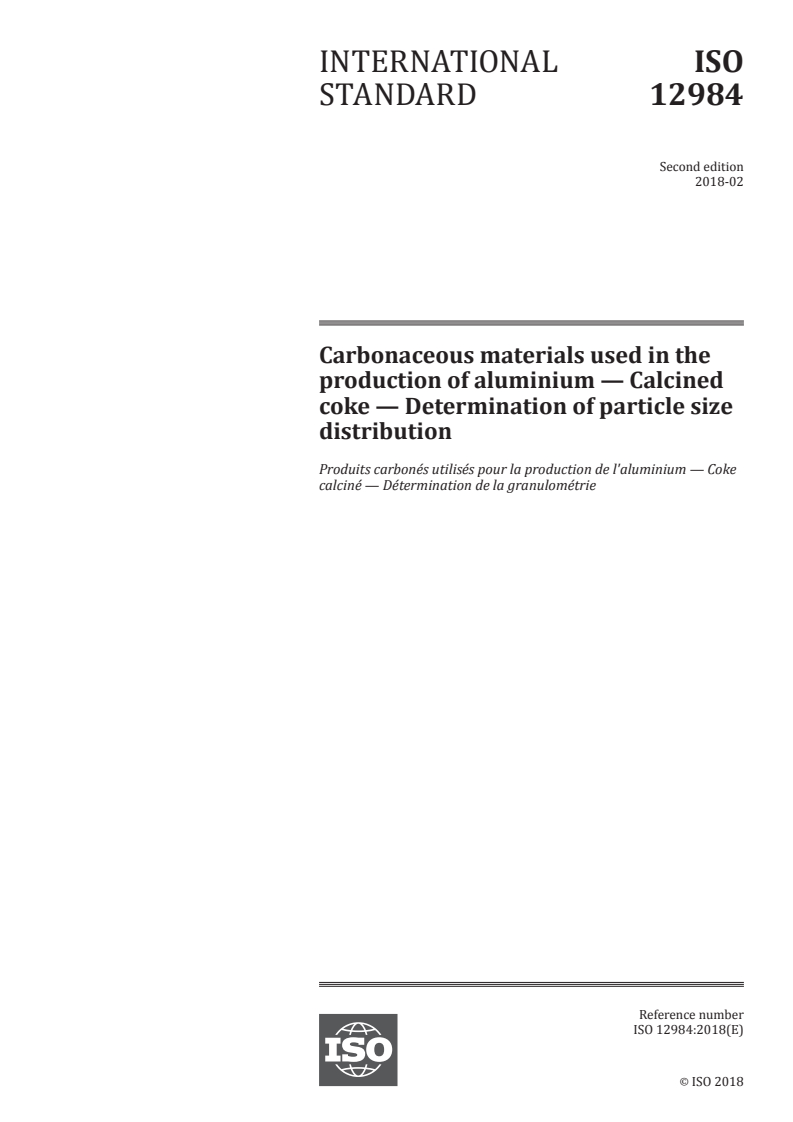
(Main)Carbonaceous materials used in the production of aluminium — Calcined coke — Determination of particle size distribution
General Information
- Abstract
ISO 12984:2018 specifies a method for the determination of the particle size distribution of a sample of coke having a typical size distribution as normally produced by calcination of delayed petroleum coke. The same procedure is applicable to consignments of calcined anthracite. This document does not apply to fractions of carbon material prepared by sieving and crushing or to filter fines. This method is applicable to the determination of particle sizes ranging from 0,25 mm to 16 mm, as the sum of the percentages of the size distribution above and below this range is typically less than 10 %. This document does not apply to determining particle sizes below 0,25 mm where a specific test for dust is used.
- Status
- Published
- Publication Date
- 21-Feb-2018
- Technical Committee
- ISO/TC 226 - Materials for the production of primary aluminium
- Drafting Committee
- ISO/TC 226/WG 6 - Anodes and coke
- Current Stage
- 9093 - International Standard confirmed
- Start Date
- 02-May-2024
- Completion Date
- 29-Aug-2026
Buy Documents
ISO 12984:2018 - Carbonaceous materials used in the production of aluminium -- Calcined coke -- Determination of particle size distribution
ISO 12984:2018 - Carbonaceous materials used in the production of aluminium — Calcined coke — Determination of particle size distribution/22/2018
Overview
ISO 12984:2018 specifies a standardized method for determining the particle size distribution of calcined coke used in the production of aluminium. This testing method is essential for quality control in aluminium manufacturing, ensuring consistent properties in raw materials. The method outlined in ISO 12984:2018 is also applicable to consignments of calcined anthracite, but does not apply to carbonaceous material processed by sieving, crushing, or filter fines. The particle size analysis covers sizes between 0.25 mm and 16 mm, providing a reliable overview of typical coke size distributions as produced by the calcination of delayed petroleum coke.
By following ISO 12984:2018, laboratories and producers can assess materials with confidence, allowing both suppliers and customers to verify that coke used for aluminium production meets agreed particle size specifications. This contributes to improved process control and end-product quality in the aluminium industry.
Key Topics
- Sample Scope: The standard applies to samples of calcined coke and calcined anthracite with a typical size distribution from the calcination process.
- Particle Size Range: The method is valid for particle sizes between 0.25 mm and 16 mm, with size fractions outside this range not comprising more than 10% of the total.
- Testing Principle: Analysis is performed by dry sieve testing, using a series of specified metal wire cloth sieves.
- Apparatus Requirements: Sieves conforming to ISO 565 and ISO 3310-1, batch-type sieve shaker, precision balances, and drying equipment.
- Sampling and Preparation: Samples must be representative and carefully prepared to avoid altering particle size, based on guidelines in ISO 6375.
- Result Expression: Outcome is reported as the percentage by mass retained on each sieve, and cumulative percentages for each size increment.
- Precision: Repeatability is defined for cumulative percentages, particularly between 20% and 80% of the sample.
Applications
ISO 12984:2018 plays a crucial role in several industry applications:
- Quality Assurance in Aluminium Production: Ensures calcined coke meets stringent specifications for use as a carbon material in the manufacture of aluminium.
- Supplier-Customer Agreements: Provides a common, objective standard for verifying coke shipments, reducing disputes over particle size compliance.
- Laboratory Testing Protocols: Supports laboratories in establishing validated, consistent procedures for particle size distribution analysis.
- Specification Development: Allows producers and users to establish mutually agreed benchmarks for “as dispatched” and “as received” materials, enhancing supply chain transparency.
The approach outlined in ISO 12984:2018 improves product consistency and enables better process control in primary aluminium production. Reliable particle size analysis helps optimize electrode performance and prolongs equipment lifespan in electrolysis cells.
Related Standards
For comprehensive material testing and quality assurance in the production of aluminium and other industries, the following related ISO standards are often referenced alongside ISO 12984:2018:
- ISO 565: Test sieves – Metal wire cloth, perforated metal plate and electroformed sheet – Nominal sizes of openings
- ISO 3310-1: Test sieves – Technical requirements and testing – Part 1: Test sieves of metal wire cloth
- ISO 6375: Carbonaceous materials for the production of aluminium – Coke for electrodes – Sampling
These standards together provide a robust framework for the sampling, testing, and specification of carbonaceous materials, supporting quality and efficiency in aluminium manufacturing and other sectors using calcined coke.
Implementing ISO 12984:2018 ensures that particle size analysis of calcined carbon materials is performed accurately, consistently, and in alignment with global best practices.
Relations
- Effective Date
- 04-Nov-2015
Buy Documents
ISO 12984:2018 - Carbonaceous materials used in the production of aluminium -- Calcined coke -- Determination of particle size distribution
ISO 12984:2018 - Carbonaceous materials used in the production of aluminium — Calcined coke — Determination of particle size distribution/22/2018
Get Certified
Connect with accredited certification bodies for this standard

ECOCERT
Organic and sustainability certification.

Eurofins Food Testing Global
Global leader in food, environment, and pharmaceutical product testing.

Intertek Bangladesh
Intertek certification and testing services in Bangladesh.
Sponsored listings
Frequently Asked Questions
ISO 12984:2018 is a standard published by the International Organization for Standardization (ISO). Its full title is "Carbonaceous materials used in the production of aluminium — Calcined coke — Determination of particle size distribution". This standard covers: ISO 12984:2018 specifies a method for the determination of the particle size distribution of a sample of coke having a typical size distribution as normally produced by calcination of delayed petroleum coke. The same procedure is applicable to consignments of calcined anthracite. This document does not apply to fractions of carbon material prepared by sieving and crushing or to filter fines. This method is applicable to the determination of particle sizes ranging from 0,25 mm to 16 mm, as the sum of the percentages of the size distribution above and below this range is typically less than 10 %. This document does not apply to determining particle sizes below 0,25 mm where a specific test for dust is used.
ISO 12984:2018 specifies a method for the determination of the particle size distribution of a sample of coke having a typical size distribution as normally produced by calcination of delayed petroleum coke. The same procedure is applicable to consignments of calcined anthracite. This document does not apply to fractions of carbon material prepared by sieving and crushing or to filter fines. This method is applicable to the determination of particle sizes ranging from 0,25 mm to 16 mm, as the sum of the percentages of the size distribution above and below this range is typically less than 10 %. This document does not apply to determining particle sizes below 0,25 mm where a specific test for dust is used.
ISO 12984:2018 is classified under the following ICS (International Classification for Standards) categories: 71.100.10 - Materials for aluminium production. The ICS classification helps identify the subject area and facilitates finding related standards.
ISO 12984:2018 has the following relationships with other standards: It is inter standard links to ISO 12984:2000. Understanding these relationships helps ensure you are using the most current and applicable version of the standard.
ISO 12984:2018 is available in PDF format for immediate download after purchase. The document can be added to your cart and obtained through the secure checkout process. Digital delivery ensures instant access to the complete standard document.
Standards Content (Sample)
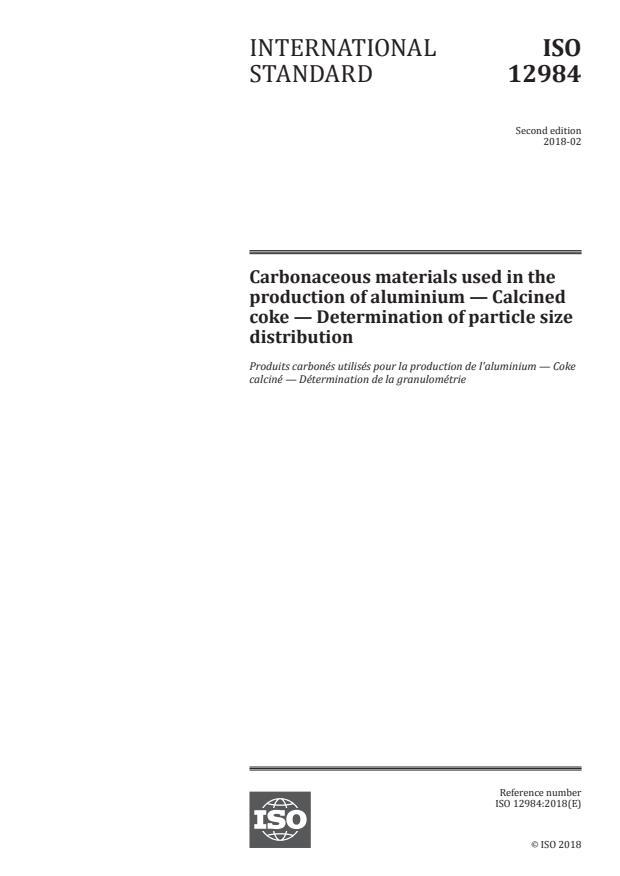
INTERNATIONAL ISO
STANDARD 12984
Second edition
2018-02
Carbonaceous materials used in the
production of aluminium — Calcined
coke — Determination of particle size
distribution
Produits carbonés utilisés pour la production de l'aluminium — Coke
calciné — Détermination de la granulométrie
Reference number
©
ISO 2018
© ISO 2018
All rights reserved. Unless otherwise specified, or required in the context of its implementation, no part of this publication may
be reproduced or utilized otherwise in any form or by any means, electronic or mechanical, including photocopying, or posting
on the internet or an intranet, without prior written permission. Permission can be requested from either ISO at the address
below or ISO’s member body in the country of the requester.
ISO copyright office
CP 401 • Ch. de Blandonnet 8
CH-1214 Vernier, Geneva, Switzerland
Tel. +41 22 749 01 11
Fax +41 22 749 09 47
copyright@iso.org
www.iso.org
Published in Switzerland
ii © ISO 2018 – All rights reserved
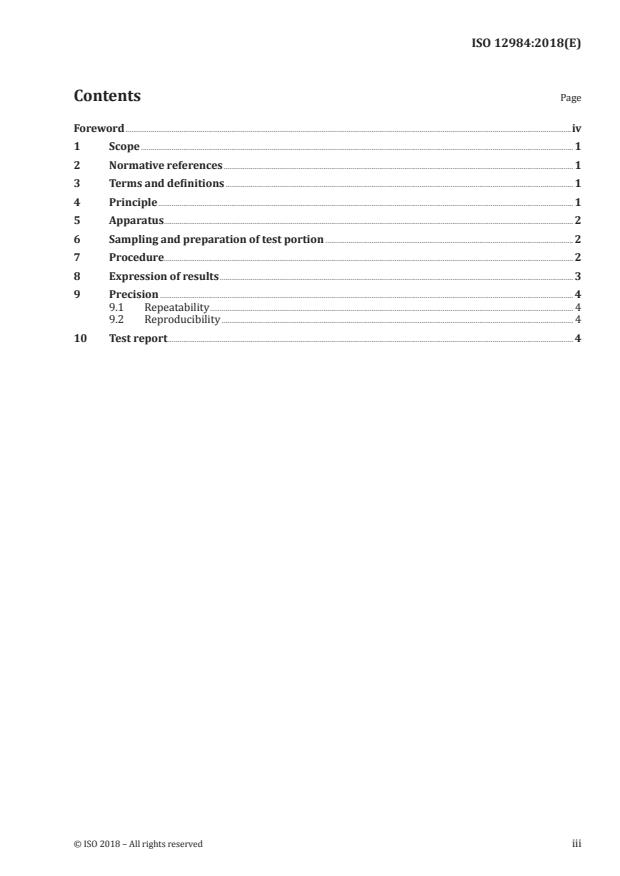
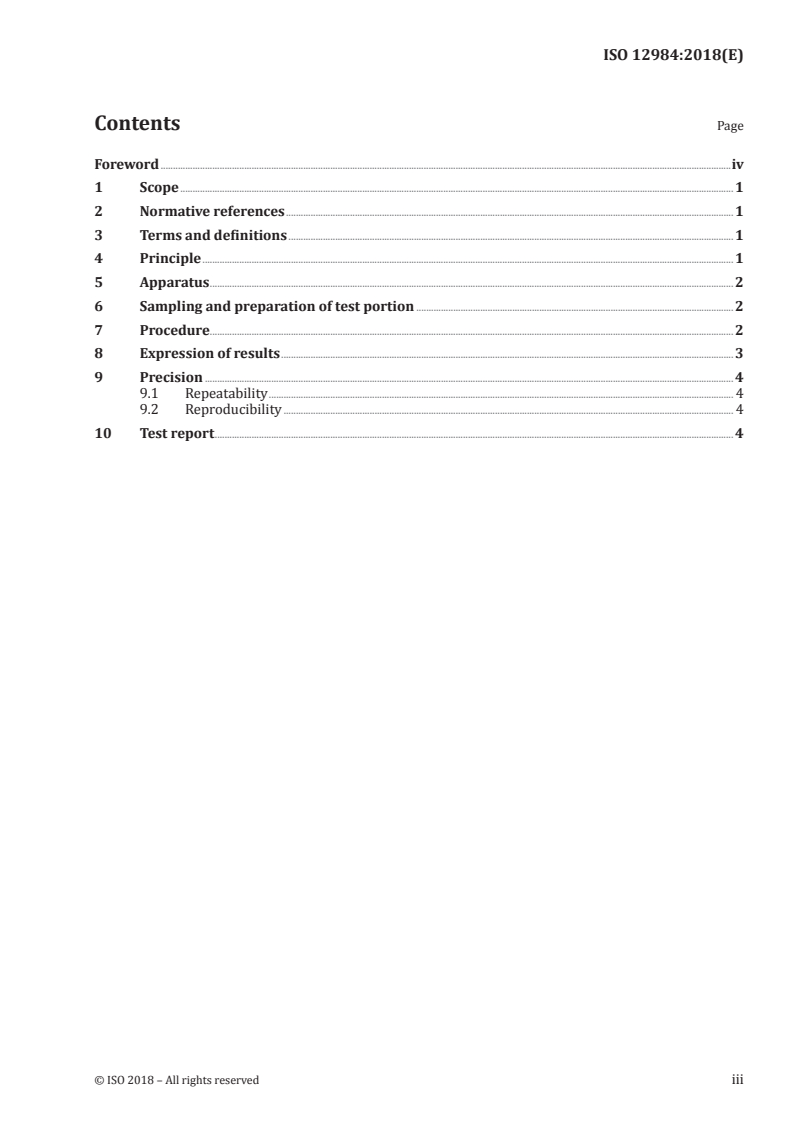
Contents Page
Foreword .iv
1 Scope . 1
2 Normative references . 1
3 Terms and definitions . 1
4 Principle . 1
5 Apparatus . 2
6 Sampling and preparation of test portion . 2
7 Procedure. 2
8 Expression of results . 3
9 Precision . 4
9.1 Repeatability . 4
9.2 Reproducibility . 4
10 Test report . 4
Foreword
ISO (the International Organization for Standardization) is a worldwide federation of national standards
bodies (ISO member bodies). The work of preparing International Standards is normally carried out
through ISO technical committees. Each member body interested in a subject for which a technical
committee has been established has the right to be represented on that committee. International
organizations, governmental and non-governmental, in liaison with ISO, also take part in the work.
ISO collaborates closely with the International Electrotechnical Commission (IEC) on all matters of
electrotechnical standardization.
The procedures used to develop this document and those intended for its further maintenance are
described in the ISO/IEC Directives, Part 1. In particular the different approval criteria needed for the
different types of ISO documents should be noted. This document was drafted in accordance with the
editorial rules of the ISO/IEC Directives, Part 2 (see www .iso .org/ directives).
Attention is drawn to the possibility that some of the elements of this document may be the subject of
patent rights. ISO shall not be held responsible for identifying any or all such patent rights. Details of
any patent rights identified during the development of the document will be in the Introduction and/or
on the ISO list of patent declarations received (see www .iso .org/ patents).
Any trade name used in this document is information given for the convenience of users and does not
constitute an endorsement.
For an explanation on the voluntary nature of standards, the meaning of ISO specific terms and
expressions related to conformity assessment, as well as information about ISO's adherence to the
World Trade Organization (WTO) principles in the Technical Barriers to Trade (TBT) see the following
URL: www .iso .org/ iso/ foreword .html.
This document was prepared by Technical Committee ISO/TC 226, Materials for the production of
primary aluminium.
This second edition cancels and replaces the first edition, ISO 12984:2000, of which it constitutes a
minor revision.
iv © ISO 2018 – All rights reserved
INTERNATIONAL STANDARD ISO 12984:2018(E)
Carbonaceous materials used in the production of
aluminium — Calcined coke — Determination of particle
size distribution
1 Scope
This document specifies a method for the determination of the particle size distribution of a sample of
coke having a typical size distribution as normally produced by calcination of delayed petroleum coke.
The same procedure is applicable to consignments of calcined anthracite. This document does not apply
to fractions of carbon material prepared by sieving and crushing or to filter fines.
This method is applicable to the determination of particle sizes ranging from 0,25 mm to 16 mm, as the
sum of the percentages of the size distribution above and below this range is typical
...
INTERNATIONAL ISO
STANDARD 12984
Second edition
2018-02
Carbonaceous materials used in the
production of aluminium — Calcined
coke — Determination of particle size
distribution
Produits carbonés utilisés pour la production de l'aluminium — Coke
calciné — Détermination de la granulométrie
Reference number
©
ISO 2018
© ISO 2018
All rights reserved. Unless otherwise specified, or required in the context of its implementation, no part of this publication may
be reproduced or utilized otherwise in any form or by any means, electronic or mechanical, including photocopying, or posting
on the internet or an intranet, without prior written permission. Permission can be requested from either ISO at the address
below or ISO’s member body in the country of the requester.
ISO copyright office
CP 401 • Ch. de Blandonnet 8
CH-1214 Vernier, Geneva, Switzerland
Tel. +41 22 749 01 11
Fax +41 22 749 09 47
copyright@iso.org
www.iso.org
Published in Switzerland
ii © ISO 2018 – All rights reserved
Contents Page
Foreword .iv
1 Scope . 1
2 Normative references . 1
3 Terms and definitions . 1
4 Principle . 1
5 Apparatus . 2
6 Sampling and preparation of test portion . 2
7 Procedure. 2
8 Expression of results . 3
9 Precision . 4
9.1 Repeatability . 4
9.2 Reproducibility . 4
10 Test report . 4
Foreword
ISO (the International Organization for Standardization) is a worldwide federation of national standards
bodies (ISO member bodies). The work of preparing International Standards is normally carried out
through ISO technical committees. Each member body interested in a subject for which a technical
committee has been established has the right to be represented on that committee. International
organizations, governmental and non-governmental, in liaison with ISO, also take part in the work.
ISO collaborates closely with the International Electrotechnical Commission (IEC) on all matters of
electrotechnical standardization.
The procedures used to develop this document and those intended for its further maintenance are
described in the ISO/IEC Directives, Part 1. In particular the different approval criteria needed for the
different types of ISO documents should be noted. This document was drafted in accordance with the
editorial rules of the ISO/IEC Directives, Part 2 (see www .iso .org/ directives).
Attention is drawn to the possibility that some of the elements of this document may be the subject of
patent rights. ISO shall not be held responsible for identifying any or all such patent rights. Details of
any patent rights identified during the development of the document will be in the Introduction and/or
on the ISO list of patent declarations received (see www .iso .org/ patents).
Any trade name used in this document is information given for the convenience of users and does not
constitute an endorsement.
For an explanation on the voluntary nature of standards, the meaning of ISO specific terms and
expressions related to conformity assessment, as well as information about ISO's adherence to the
World Trade Organization (WTO) principles in the Technical Barriers to Trade (TBT) see the following
URL: www .iso .org/ iso/ foreword .html.
This document was prepared by Technical Committee ISO/TC 226, Materials for the production of
primary aluminium.
This second edition cancels and replaces the first edition, ISO 12984:2000, of which it constitutes a
minor revision.
iv © ISO 2018 – All rights reserved
INTERNATIONAL STANDARD ISO 12984:2018(E)
Carbonaceous materials used in the production of
aluminium — Calcined coke — Determination of particle
size distribution
1 Scope
This document specifies a method for the determination of the particle size distribution of a sample of
coke having a typical size distribution as normally produced by calcination of delayed petroleum coke.
The same procedure is applicable to consignments of calcined anthracite. This document does not apply
to fractions of carbon material prepared by sieving and crushing or to filter fines.
This method is applicable to the determination of particle sizes ranging from 0,25 mm to 16 mm, as the
sum of the percentages of the size distribution above and below this range is typical
...