

ISO 15638-3:2013
(Main)Intelligent transport systems — Framework for collaborative telematics applications for regulated commercial freight vehicles (TARV) — Part 3: Operating requirements, 'Approval Authority' procedures, and enforcement provisions for the providers of regulated services
General Information
- Abstract
ISO 15638-3:2013 defines provisions to enable monitoring and enforcement of regulated vehicles and approval authority approval procedures, specifically: a) Definition of the roles and responsibilities of key entities: user, service provider, jurisdictions, and 'Approval Authorities' b) Operating requirements ensuring that a cooperative in-vehicle platform can deliver a range of services to both government and industry through open standards and competitive markets c) Basic service requirements for service providers that are generic and independent of a specific application d) Requirements for the approval authority approval of IVSs and service providers e) Legal, regulatory, and enforcement aspects. The scope includes the requirements for the IVS capability in the vehicle, and the definition of the roles of the service provider, 'Communications Service Provider', IVS installer, 'IVS maintainer', approval authority, and the user, for cooperative telematics applications for regulated commercial freight vehicles.
- Status
- Published
- Publication Date
- 02-Jun-2013
- Technical Committee
- ISO/TC 204 - Intelligent transport systems
- Drafting Committee
- ISO/TC 204/WG 7 - General fleet management and commercial/freight
- Current Stage
- 9060 - Close of review
- Completion Date
- 04-Mar-2029
Buy Documents

ISO 15638-3:2013 - Intelligent transport systems — Framework for collaborative telematics applications for regulated commercial freight vehicles (TARV) — Part 3: Operating requirements, 'Approval Authority' procedures, and enforcement provisions for the providers of regulated services Released:6/3/2013
Overview
ISO 15638-3:2013 is an international standard under the framework of intelligent transport systems (ITS), specifically focused on collaborative telematics applications for regulated commercial freight vehicles (TARV). Part 3 of the series defines critical operating requirements, procedures for approval authorities, and enforcement provisions for providers of regulated telematics services. The standard clarifies the roles and responsibilities of all key actors-users, service providers, jurisdictions, approval authorities, and communication service providers-enabling secure, efficient, and compliant operation of in-vehicle telematics systems (IVS) for commercial freight vehicles. ISO 15638-3:2013 is essential for ensuring interoperability, data integrity, regulatory conformance, and competitiveness in the delivery of ITS services to both government and industry stakeholders.
Key Topics
- Roles and responsibilities: Defines explicit functions and obligations for users, service providers, jurisdictions, approval authorities, IVS installers, and maintainers.
- Operating requirements: Ensures the IVS platform supports a wide range of regulated and non-regulated telematics services in an open, competitive market.
- Approval procedures: Outlines the necessary steps and criteria for approval authorities to test, audit, and certify IVS units and telematics service providers.
- Legal and regulatory provisions: Covers privacy, data protection, enforcement mechanisms, and the regulatory obligations for commercial freight telematics solutions.
- Data management: Sets basic requirements for IVS data collection, secure storage, processing, periodic transfer, and deletion, maintaining high levels of integrity and reliability.
- Enforcement and monitoring: Establishes guidelines for monitoring regulated vehicles, auditing service providers, and handling incidents of non-compliance.
- Interoperability: Advocates for open standards to ensure compatibility among various stakeholders and technology platforms within and across jurisdictions.
Applications
ISO 15638-3:2013 applies to a wide range of telematics-enabled commercial freight vehicle operations, including but not limited to:
- Regulated service provision: Supporting government-mandated applications such as electronic logging, vehicle tracking, regulatory compliance monitoring, and electronic manifest management.
- Open-market telematics: Enabling industry-driven services, including fleet management, operational analytics, and enhanced logistical coordination.
- Approval and certification: Guiding the testing and approval process for both in-vehicle systems and service providers, ensuring compliance with technical, operational, and regulatory requirements.
- Cross-jurisdictional enforcement: Facilitating cooperative monitoring and enforcement processes among different regions or countries for commercial freight operations.
- IVS lifecycle management: Addressing installation, maintenance, upgrades, activation, end-of-life, and secure decommissioning of in-vehicle telematics systems.
Related Standards
Implementing ISO 15638-3:2013 often requires alignment with several other relevant international standards:
- ISO 15638 series: A broader suite governing the overall TARV framework for ITS and commercial freight telematics.
- ISO 26262: Functional safety for automotive electronics, relevant for IVS safety requirements.
- ISO/IEC 27001: Information security management systems, supporting the privacy and data integrity provisions outlined in Part 3.
- ISO 24534: Vehicle identification systems, complementary for IVS identification and trailer marking processes.
- Other ITS standards affecting vehicle communications, interoperability, and telematics data management.
ISO 15638-3:2013 is pivotal for stakeholders aiming to ensure regulatory compliance, operational efficiency, and secure service delivery in intelligent transport systems for commercial freight. Adhering to this standard helps organizations build robust, interoperable, and legally compliant telematics infrastructure, facilitating smooth government-industry collaboration across the global freight transport sector.
Buy Documents
ISO 15638-3:2013 - Intelligent transport systems — Framework for collaborative telematics applications for regulated commercial freight vehicles (TARV) — Part 3: Operating requirements, 'Approval Authority' procedures, and enforcement provisions for the providers of regulated services Released:6/3/2013
Get Certified
Connect with accredited certification bodies for this standard

BSI Group
BSI (British Standards Institution) is the business standards company that helps organizations make excellence a habit.

Great Wall Tianjin Quality Assurance Center
Established 1993, first batch to receive national accreditation with IAF recognition.
Hong Kong Quality Assurance Agency (HKQAA)
Hong Kong's leading certification body.
Sponsored listings
Frequently Asked Questions
ISO 15638-3:2013 is a standard published by the International Organization for Standardization (ISO). Its full title is "Intelligent transport systems — Framework for collaborative telematics applications for regulated commercial freight vehicles (TARV) — Part 3: Operating requirements, 'Approval Authority' procedures, and enforcement provisions for the providers of regulated services". This standard covers: ISO 15638-3:2013 defines provisions to enable monitoring and enforcement of regulated vehicles and approval authority approval procedures, specifically: a) Definition of the roles and responsibilities of key entities: user, service provider, jurisdictions, and 'Approval Authorities' b) Operating requirements ensuring that a cooperative in-vehicle platform can deliver a range of services to both government and industry through open standards and competitive markets c) Basic service requirements for service providers that are generic and independent of a specific application d) Requirements for the approval authority approval of IVSs and service providers e) Legal, regulatory, and enforcement aspects. The scope includes the requirements for the IVS capability in the vehicle, and the definition of the roles of the service provider, 'Communications Service Provider', IVS installer, 'IVS maintainer', approval authority, and the user, for cooperative telematics applications for regulated commercial freight vehicles.
ISO 15638-3:2013 defines provisions to enable monitoring and enforcement of regulated vehicles and approval authority approval procedures, specifically: a) Definition of the roles and responsibilities of key entities: user, service provider, jurisdictions, and 'Approval Authorities' b) Operating requirements ensuring that a cooperative in-vehicle platform can deliver a range of services to both government and industry through open standards and competitive markets c) Basic service requirements for service providers that are generic and independent of a specific application d) Requirements for the approval authority approval of IVSs and service providers e) Legal, regulatory, and enforcement aspects. The scope includes the requirements for the IVS capability in the vehicle, and the definition of the roles of the service provider, 'Communications Service Provider', IVS installer, 'IVS maintainer', approval authority, and the user, for cooperative telematics applications for regulated commercial freight vehicles.
ISO 15638-3:2013 is classified under the following ICS (International Classification for Standards) categories: 03.220.20 - Road transport; 35.240.60 - IT applications in transport. The ICS classification helps identify the subject area and facilitates finding related standards.
ISO 15638-3:2013 is available in PDF format for immediate download after purchase. The document can be added to your cart and obtained through the secure checkout process. Digital delivery ensures instant access to the complete standard document.
Standards Content (Sample)
INTERNATIONAL ISO
STANDARD 15638-3
First edition
2013-06-15
Intelligent transport systems —
Framework for collaborative Telematics
Applications for Regulated commercial
freight Vehicles (TARV) —
Part 3:
Operating requirements, “Approval
Authority” procedures, and enforcement
provisions for the providers of regulated
services
Systèmes intelligents de transport — Cadre pour applications
télématiques collaboratives pour véhicules de fret commercial
réglementé (TARV) —
Partie 3: Exigences de fonctionnement, modes opératoires de l'Autorité
d'approbation et dispositions d'exécution pour les fournisseurs de
services réglementés
Reference number
©
ISO 2013
© ISO 2013
All rights reserved. Unless otherwise specified, no part of this publication may be reproduced or utilized otherwise in any form or by any
means, electronic or mechanical, including photocopying, or posting on the internet or an intranet, without prior written permission.
Permission can be requested from either ISO at the address below or ISO’s member body in the country of the requester.
ISO copyright office
Case postale 56 CH-1211 Geneva 20
Tel. + 41 22 749 01 11
Fax + 41 22 749 09 47
E-mail copyright@iso.org
Web www.iso.org
Published in Switzerland
ii © ISO 2013 – All rights reserved
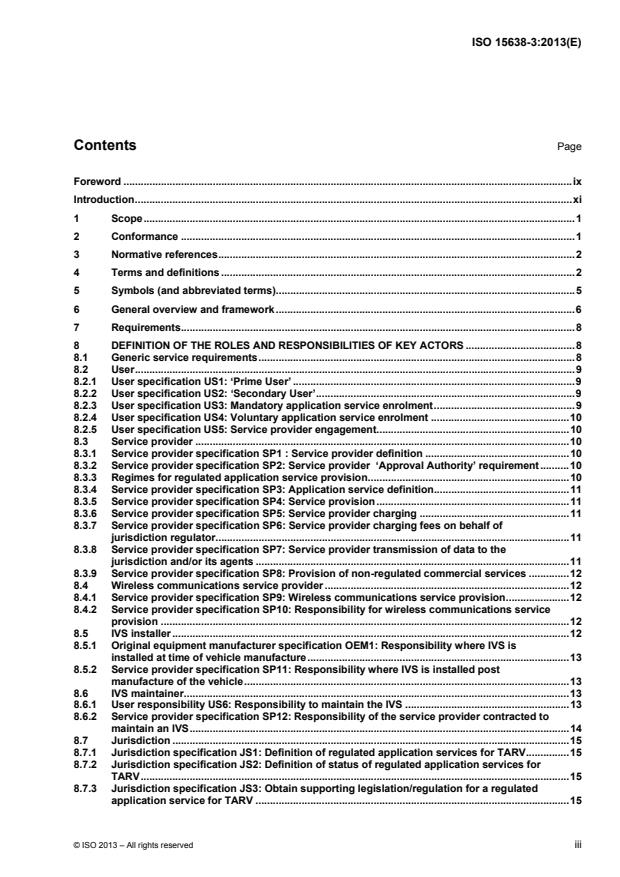
Contents Page
Foreword . ix
Introduction . xi
1 Scope . 1
2 Conformance . 1
3 Normative references . 2
4 Terms and definitions . 2
5 Symbols (and abbreviated terms) . 5
6 General overview and framework . 6
7 Requirements . 8
8 DEFINITION OF THE ROLES AND RESPONSIBILITIES OF KEY ACTORS . 8
8.1 Generic service requirements . 8
8.2 User . 9
8.2.1 User specification US1: ‘Prime User’ . 9
8.2.2 User specification US2: ‘Secondary User’ . 9
8.2.3 User specification US3: Mandatory application service enrolment . 9
8.2.4 User specification US4: Voluntary application service enrolment . 10
8.2.5 User specification US5: Service provider engagement . 10
8.3 Service provider . 10
8.3.1 Service provider specification SP1 : Service provider definition . 10
8.3.2 Service provider specification SP2: Service provider ‘Approval Authority’ requirement . 10
8.3.3 Regimes for regulated application service provision . 10
8.3.4 Service provider specification SP3: Application service definition . 11
8.3.5 Service provider specification SP4: Service provision . 11
8.3.6 Service provider specification SP5: Service provider charging . 11
8.3.7 Service provider specification SP6: Service provider charging fees on behalf of
jurisdiction regulator . 11
8.3.8 Service provider specification SP7: Service provider transmission of data to the
jurisdiction and/or its agents . 11
8.3.9 Service provider specification SP8: Provision of non-regulated commercial services . 12
8.4 Wireless communications service provider . 12
8.4.1 Service provider specification SP9: Wireless communications service provision . 12
8.4.2 Service provider specification SP10: Responsibility for wireless communications service
provision . 12
8.5 IVS installer . 12
8.5.1 Original equipment manufacturer specification OEM1: Responsibility where IVS is
installed at time of vehicle manufacture . 13
8.5.2 Service provider specification SP11: Responsibility where IVS is installed post
manufacture of the vehicle . 13
8.6 IVS maintainer . 13
8.6.1 User responsibility US6: Responsibility to maintain the IVS . 13
8.6.2 Service provider specification SP12: Responsibility of the service provider contracted to
maintain an IVS . 14
8.7 Jurisdiction . 15
8.7.1 Jurisdiction specification JS1: Definition of regulated application services for TARV . 15
8.7.2 Jurisdiction specification JS2: Definition of status of regulated application services for
TARV . 15
8.7.3 Jurisdiction specification JS3: Obtain supporting legislation/regulation for a regulated
application service for TARV . 15
8.7.4 Jurisdiction specification JS4: Manage and regulate the provision of the regulated
application services .15
8.8 ‘Approval Authority’ .15
8.8.1 Jurisdiction specification JS5: create or appoint a ‘Approval Authority’.16
8.8.2 ‘Approval Authority’ specification AA1: Consider and appoint candidates to be service
providers .16
8.8.3 ‘Approval Authority’ specification AA2: Test and approve service providers .16
8.8.4 ‘Approval Authority’ specification AA3: Audit service providers .16
8.8.5 ‘Approval Authority’ specification AA4: Type approve IVS .17
8.8.6 ‘Approval Authority’ specification AA5: Test IVS functionality .17
8.9 Contract options .17
8.9.1 User requirement US6 : ‘Service Provider - User Contract’’ .17
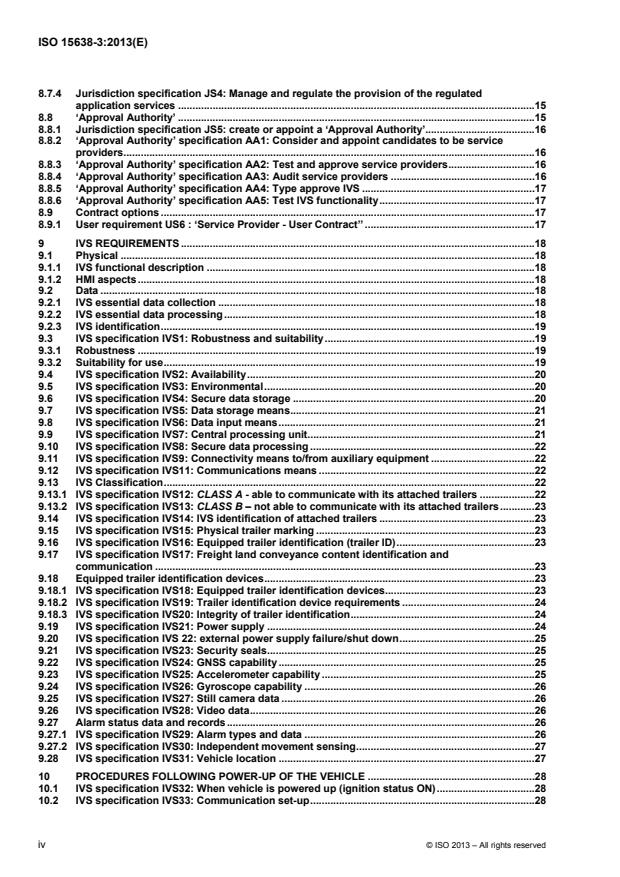
9 IVS REQUIREMENTS .18
9.1 Physical .18
9.1.1 IVS functional description .18
9.1.2 HMI aspects .18
9.2 Data .18
9.2.1 IVS essential data collection .18
9.2.2 IVS essential data processing .18
9.2.3 IVS identification .19
9.3 IVS specification IVS1: Robustness and suitability .19
9.3.1 Robustness .19
9.3.2 Suitability for use .19
9.4 IVS specification IVS2: Availability .20
9.5 IVS specification IVS3: Environmental .20
9.6 IVS specification IVS4: Secure data storage .20
9.7 IVS specification IVS5: Data storage means .21
9.8 IVS specification IVS6: Data input means .21
9.9 IVS specification IVS7: Central processing unit .21
9.10 IVS specification IVS8: Secure data processing .22
9.11 IVS specification IVS9: Connectivity means to/from auxiliary equipment .22
9.12 IVS specification IVS11: Communications means .22
9.13 IVS Classification .22
9.13.1 IVS specification IVS12: CLASS A - able to communicate with its attached trailers .22
9.13.2 IVS specification IVS13: CLASS B – not able to communicate with its attached trailers .23
9.14 IVS specification IVS14: IVS identification of attached trailers .23
9.15 IVS specification IVS15: Physical trailer marking .23
9.16 IVS specification IVS16: Equipped trailer identification (trailer ID) .23
9.17 IVS specification IVS17: Freight land conveyance content identification and
communication .23
9.18 Equipped trailer identification devices .23
9.18.1 IVS specification IVS18: Equipped trailer identification devices .23
9.18.2 IVS specification IVS19: Trailer identification device requirements .24
9.18.3 IVS specification IVS20: Integrity of trailer identification .24
9.19 IVS specification IVS21: Power supply .24
9.20 IVS specification IVS 22: external power supply failure/shut down .25
9.21 IVS specification IVS23: Security seals .25
9.22 IVS specification IVS24: GNSS capability .25
9.23 IVS specification IVS25: Accelerometer capability .25
9.24 IVS specification IVS26: Gyroscope capability .26
9.25 IVS specification IVS27: Still camera data .26
9.26 IVS specification IVS28: Video data .26
9.27 Alarm status data and records .26
9.27.1 IVS specification IVS29: Alarm types and data .26
9.27.2 IVS specification IVS30: Independent movement sensing .27
9.28 IVS specification IVS31: Vehicle location .27
10 PROCEDURES FOLLOWING POWER-UP OF THE VEHICLE .28
10.1 IVS specification IVS32: When vehicle is powered up (ignition status ON) .28
10.2 IVS specification IVS33: Communication set-up .28
iv © ISO 2013 – All rights reserved
10.2.1 Application service provider generates request for ‘Core Application Data’ . 29
10.2.2 IVS generates send of ‘Core Application Data’ (CAD) . 29
10.2.3 Data compression . 29
10.2.4 Data acknowledgement. 29
10.2.5 In the event of failure to receive the ‘DATA-ACK’ . 29
10.3 IVS specification IVS34: Communication session clear-down . 29
10.4 CAD not received correctly . 30
11 RECORDS TRANSFER AND BACKUP PROCEDURES . 30
11.1 Periodicity determined by the jurisdiction. 30
11.2 Frequency of records transfer . 30
11.3 Records to be transferred . 30
11.4 Procedures for transfer of ‘stored data’. 30
11.4.1 IVS specification IVS35: ‘stored data’ Communication set-up . 30
11.4.2 IVS generates send of ‘stored data’ . 30
11.4.3 Data compression . 31
11.4.4 Stored data acknowledgement . 31
11.4.5 In the event of failure to receive the ‘SD-ACK’ . 31
11.5 Deletion of data stored in the non-volatile memory of the IVS . 31
11.5.1 IVS data records deleted only after fulfilment of conditions . 31
11.6 Data testing . 31
11.7 Data backup and archiving . 32
12 IVS - VEHICLE . 32
12.1 ‘Core Application Data’ . 32
12.1.1 Jurisdiction specification JS6: ‘Core Application Data’ . 33
12.2 ‘Basic Vehicle Data’ . 33
12.2.1 Jurisdiction specification JS7: ‘Basic Vehicle Data’ . 33
12.3 OEM installed IVS . 34
12.3.1 Regulation regime . 34
12.3.2 Physical installation aspects . 34
12.3.3 Vehicle data bus . 34
12.3.4 Initial set-up . 34
12.4 Aftermarket installed IVS . 35
12.4.1 Regulation regime . 35
12.4.2 Physical installation aspects . 35
12.4.3 Vehicle data bus . 36
12.4.4 Initial set-up . 36
12.5 Interoperability certificate . 37
12.6 Non-TARV functionality in IVS . 37
12.6.1 Complementary access and use . 37
12.6.2 Reporting to jurisdiction regulator . 37
12.6.3 IVS specification IVS36: Shall not interfere with TARV application service provision . 37
12.6.4 IVS specification IVS37: Shall demonstrate complementariness . 37
12.7 Post installation events . 37
12.7.1 Service provider requirement SP23: Replacement of IVS. 37
12.7.2 Service provider requirement SP24: Upgrade of the IVS . 38
12.7.3 Service provider requirement SP25: Repair of the IVS . 38
12.7.4 Service provider requirement SP26: Service of the IVS . 38
12.8 Change of regulated commercial freight vehicle properties . 38
12.8.1 User responsibility US7: Change of regulated commercial freight vehicle properties . 38
12.8.2 Service provider responsibility SP27: Change of regulated commercial freight vehicle
properties . 38
12.9 Activation . 39
12.9.1 Service provider responsibility SP28: IVS activation . 39
12.10 Maintenance and continuity of application service provider systems . 39
12.10.1 Update and installation of applications . 39
12.10.2 Introduction of new applications . 39
12.10.3 Service provider responsibility SP29: System modifications, upgrades and changes . 39
12.10.4 Service provider responsibility SP30: Minimisation of on board processing and memory
demands . 39
12.10.5 Service provider responsibility SP31: Responsibility for design, development, testing .40
12.10.6 ‘Approval Authority’ specification AA8: Approve new applications .40
12.11 Deactivation .40
12.12 End of life provisions. .40
12.12.1 User responsibility US8: End of life notification .40
12.12.2 Service provider responsibility SP32: End of life notification .40
13 PROVISIONS TO ENABLE MONITORING AND ENFORCEMENT OF REGULATED
COMMERCIAL FREIGHT VEHICLES .41
13.1 Jurisdiction specification JS8: Definition of regulated commercial freight vehicle .41
13.2 Jurisdiction specification JS9: Provision of regulations to monitor and enforce .41
14 ‘Approval Authority’ PROCEDURES .41
14.1 General ‘Approval Authority’ process .41
14.2 Jurisdiction specification JS10: Provision of ‘Approval Authority’ test regime .42
14.3 Jurisdiction specification JS11: Provision of ‘Approval Authority’ test suites .42
14.4 IVS ‘Approval Authority’ .43
14.4.1 IVS specification IVS1: Robustness and suitability .43
14.4.2 IVS specification IVS2: Availability .44
14.4.3 IVS specification IVS3: Environmental .44
14.4.4 IVS specification IVS4: Secure data storage .44
14.4.5 IVS specification IVS6: Data input means .44
14.4.6 IVS specification IVS7: Central processing unit .44
14.4.7 IVS specification IVS8: Secure data processing .45
14.4.8 IVS specification IVS9: Connectivity means to/from auxiliary equipment .45
14.4.9 IVS specification 10: IVS clock .45
14.4.10 IVS specification IVS11: Communications means .45
14.4.11 IVS Classification (IVS12, IVS13, IVS 14) .46
14.4.12 IVS specification IVS21: Power supply .46
14.4.13 IVS specification IVS 22: external power supply failure/shut down .46
14.4.14 IVS specification IVS24: GNSS capability .46
14.4.15 IVS specification IVS25: Accelerometer capability .46
14.4.16 IVS specification IVS26: Gyroscope capability .46
14.4.17 IVS specification IVS27: Still camera data .46
14.4.18 IVS specification IVS28: Video data .46
14.4.19 IVS specification IVS29: Alarm types and data .46
14.4.20 IVS specification IVS30: Independent movement sensing .47
14.4.21 IVS specification IVS31: Vehicle location .47
14.4.22 IVS specification IVS32: When vehicle is powered up (ignition status ON) .47
14.4.23 IVS specification IVS33: Communication set-up (1) .48
14.4.24 IVS specification IVS33: Communication set-up (2) SEND ‘Core Application Data’ .48
14.4.25 IVS specification IVS34: Communication session clear-down .48
14.4.26 IVS specification IVS35: Communication set-up : transfer of ‘stored data’ .49
14.4.27 IVS data records deleted only after fulfilment of conditions .49
14.4.28 IVS unique identification .49
14.4.29 Identification code of the registered commercial freight vehicle .49
14.4.30 Non-TARV functionality in IVS: Complementary access and use .49
14.4.31 Change of regulated commercial freight vehicle properties .50
14.5 IVS ‘Approval Authority’ .50
14.5.1 Unique unambiguous identifier (IVS ID) .50
14.5.2 Affixation .50
14.5.3 Test mechanical capability .50
14.5.4 Test connection to prime mover/rigid truck .50
14.5.5 Test durability .50
14.5.6 Test vibration .51
14.5.7 Test bump/impact/shock .51
14.5.8 Test fall .51
14.5.9 Test humidity .51
14.5.10 Test temperature .51
14.5.11 Test dust and water ingress protection (1) .51
14.5.12 Test dust and water ingress protection (2) .51
vi © ISO 2013 – All rights reserved
14.5.13 Test radio frequency and electrical interference . 51
14.5.14 Electromagnetic emissions . 51
14.5.15 IVS specification IVS9: Connectivity means to/from auxiliary equipment . 51
14.5.16 Equipped trailer identification devices . 52
14.5.17 IVS specification IVS23: Security seals . 53
14.6 Application service provider ‘Approval Authority’ . 53
14.6.1 General requirements . 53
14.6.2 In the event of malfunction . 54
14.6.3 Service provider specification SP4: Service provision . 54
14.6.4 Service provider specification SP5: Service provider charging regime . 55
14.6.5 Service provider specification SP6: Service provider charging fees on behalf of
jurisdiction regulator . 55
14.6.6 Service provider specification SP7: Service provider transmission of data to the
jurisdiction and/or its agents . 55
14.6.7 Service provider specification SP8: Provision of non-regulated commercial services . 55
14.6.8 Service provider specification SP9: Wireless communications service provision . 55
14.6.9 Service provider specification SP12/SP18/SP19/SP20/SP23/SP24/SP25/SP26/SP28:
Responsibility of the service provider contracted to maintain an IVS . 55
14.6.11 Service provider specification SP17/SP22: ‘Core Application Data’ . 55
14.6.13 Service provider responsibility SP27: Change of regulated commercial freight vehicle
properties . 56
14.7 Application service ‘Approval Authority’ . 56
14.7.1 General requirements . 56
14.7.2 Application service ‘Approval Authority’ tests . 56
14.7.2 Service provider specification SP3: Application service definition . 57
14.7.3 HMI aspects . 57
14.7.4 Documentation . 57
14.7.4 Service provider specification SP5: Service provider charging regime . 57
14.8 Maintenance and continuity of application service provider systems . 57
14.8.1 Service provider responsibility SP30: Minimisation of on-board processing and memory
demands . 58
14.8.2 Service provider responsibility SP31: Responsibility for design, development, testing
(continued monitoring of the IVS performance) . 58
15 Auditing . 58
16 Privacy . 58
16.1 Business privacy . 58
16.1.1 General . 58
16.1.2 Explicit and legitimate and must be determined at the time of collection of the data . 58
16.1.3 Not further processed in a way incompatible with the purposes for which it was originally
collected . 59
16.1.4 Not be disclosed without the consent of the data subject . 59
16.2 Driver privacy . 59
17 Interoperability . 59
18 Legal, regulatory and enforcement aspects . 60
19 Quality of service requirements . 60
19.1 General . 60
19.2 IVS and TID type approvals and monitoring . 60
19.3 Application service provider system specifications . 61
20 Marking, labelling and packaging . 61
21 Declaration of patents and intellectual property . 61
A.1 General . 62
A.2 Jurisdiction . 62
A.3 ‘Approval Authority’ . 62
A.4 Service provider . 62
A.5 IVS . 63
A.6 User . 64
A.7 OEM .64
B.1 General .65
B.2 Countries with existing unambiguous vehicle identification schema .65
B.3 Countries without an existing unambiguous vehicle identification schema .65
Bibliography .67
viii © ISO 2013 – All rights reserved
Foreword
ISO (the International Organization for Standardization) is a worldwide federation of national standards bodies
(ISO member bodies). The work of preparing International Standards is normally carried out through ISO
technical committees. Each member body interested in a subject for which a technical committee has been
established has the right to be represented on that committee. International organizations, governmental and
non-governmental, in liaison with ISO, also take part in the work. ISO collaborates closely with the
International Electrotechnical Commission (IEC) on all matters of electrotechnical standardization.
The procedures used to develop this document and those intended for its further maintenance are described
in the ISO/IEC Directives, Part 1. In particular the different approval criteria needed for the different types of
ISO documents should be noted. This document was drafted in accordance with the editorial rules of the
ISO/IEC Directives, Part 2. www.iso.org/directives
Attention is drawn to the possibility that some of the elements of this document may be the subject of patent
rights. ISO shall not be held responsible for identifying any or all such patent rights. Details of any patent
rights identified during the development of the document will be in the Introduction and/or on the ISO list of
patent declarations received. www.iso.org/patents
Any trade name used in this document is information given for the convenience of users and does not
constitute an endorsement.
The committee responsible for this document is ISO/TC 204, Intelligent transport systems
ISO 15638 consists of the following parts, under the general title Intelligent transport systems — Framework
for collaborative Telematics Applications for Regulated commercial freight Vehicles (TARV):
— Part 1 Framework and architecture
— Part 2: Common platform parameters using CALM
— Part 3: Operating requirements, 'Approval Authority' procedures, and enforcement provisions for the
providers of regulated services
— Part 5:Generic vehicle information
— Part 6: Regulated applications [Technical Specification]
— Part 7: Other applications
— Part 8: Vehicle access monitoring (VAM) [Technical Specification]
— Part 9: Remote electronic tachograph monitoring (RTM) [Technical Specification]
— Part 10: Emergency messaging system/eCall (EMS) [Technical Specification]
— Part 11: Driver work records (work and rest hours compliance) (DWR) [Technical Specification]
— Part 12: Vehicle mass monitoring (VMM) [Technical Specification]
— Part 14: Vehicle access control (VAC) [Technical Specification]
— Part 15: Vehicle location monitoring (VLM) [Technical Specification]
— Part 16: Vehicle speed monitoring (VSM) [Technical Specification]
— Part 17: Consignment and location monitoring (CLM) [Technical Specification]
— Part 18: ADR (Dangerous Goods) transport monitoring (ADR) [Technical Specification]
— Part 19: Vehicle parking facilities (VPF) [Technical Specification]
The following parts are under preparation:
— Part 4: System security requirements [Technical Specification]
— Part 13: Mass Penalties and Levies (VMC)
x © ISO 2013 – All rights reserved
...