

ISO 15076-1:2025
(Main)Image technology colour management — Architecture, profile format and data structure — Part 1: Based on ICC.1:2022
General Information
- Abstract
This document specifies a colour profile format and describes the architecture within which it can operate. This architecture supports the exchange of information which specifies the intended colour image processing of digital data. The required reference colour spaces and the data structures (tags) are also specified.
- Status
- Published
- Publication Date
- 16-Oct-2025
- Technical Committee
- ISO/TC 130 - Graphic technology
- Drafting Committee
- ISO/TC 130 - Graphic technology
- Current Stage
- 6060 - International Standard published
- Start Date
- 17-Oct-2025
- Due Date
- 16-Jun-2025
- Completion Date
- 17-Oct-2025



Overview
ISO 15076-1:2025 - "Image technology colour management - Architecture, profile format and data structure - Part 1: Based on ICC.1:2022" defines a standardized colour profile format and the architecture for exchanging colour image processing information. Published as the third edition in 2025 and based on ICC.1:2022, this standard specifies the required reference colour spaces, the profile connection space (PCS), rendering intents, and the internal data structures (tags) that enable reliable, interoperable ICC-compatible colour management across devices and systems.
Key Topics and Technical Requirements
- Profile architecture and format: Defines the overall profile file structure, header, tag table and tag data elements to ensure consistent parsing and interpretation.
- Profile header fields: Specifies header elements such as profile size, preferred CMM type, profile version, profile/device class, data colour space, PCS, date/time, profile signature, primary platform, profile flags, device manufacturer/model, device attributes, rendering intent and PCS illuminant.
- Profile connection space (PCS): Requirements for PCS encodings (PCSXYZ and PCSLAB), chromatic adaptation, and colourimetric specification for consistent conversions.
- Rendering intents: Detailed support for media-relative colorimetric, ICC-absolute colorimetric, perceptual and saturation intents and their role in mapping colours between devices.
- Tag table and tag definitions: Standardized tag count, tag signatures, offsets and sizes; required tags for Input, Display, Output, DeviceLink, ColorSpace, Abstract and NamedColor profile types.
- Basic data types and numeric formats: Defines dateTimeNumber, float32Number, fixed-point formats (e.g., s15Fixed16, u16Fixed16) and XYZNumber types used in tag data.
- Conformance and device encoding: Rules for profile conformance, precedence of tag usage and device-specific encoding requirements.
Applications and Who Uses It
ISO 15076-1:2025 is essential for:
- Colour scientists and engineers developing colour management modules (CMMs) and ICC-compatible toolchains.
- Software developers building image editors, prepress workflows, colour proofing and digital asset management systems.
- Hardware manufacturers (displays, printers, scanners, cameras) creating or consuming ICC profiles for device calibration.
- Print service providers, photographers, and graphic designers ensuring predictable colour reproduction across devices and media. Practical uses include creating and validating ICC profiles, converting between PCS encodings, implementing rendering intents, and ensuring interoperable colour exchange across platforms.
Related Standards
- ICC.1:2022 - foundational ICC profile specification upon which ISO 15076-1:2025 is based.
- Other parts of the ISO 15076 series (Part 1 implies additional parts covering complementary aspects of colour management).
Keywords: ISO 15076-1:2025, colour management, ICC profile, profile format, profile connection space, rendering intents, PCS XYZ, PCS LAB, profile tags, device profiles.
Relations
- Effective Date
- 25-May-2024
Frequently Asked Questions
ISO 15076-1:2025 is a standard published by the International Organization for Standardization (ISO). Its full title is "Image technology colour management — Architecture, profile format and data structure — Part 1: Based on ICC.1:2022". This standard covers: This document specifies a colour profile format and describes the architecture within which it can operate. This architecture supports the exchange of information which specifies the intended colour image processing of digital data. The required reference colour spaces and the data structures (tags) are also specified.
This document specifies a colour profile format and describes the architecture within which it can operate. This architecture supports the exchange of information which specifies the intended colour image processing of digital data. The required reference colour spaces and the data structures (tags) are also specified.
ISO 15076-1:2025 is classified under the following ICS (International Classification for Standards) categories: 37.100.99 - Other standards related to graphic technology. The ICS classification helps identify the subject area and facilitates finding related standards.
ISO 15076-1:2025 has the following relationships with other standards: It is inter standard links to ISO 15076-1:2010. Understanding these relationships helps ensure you are using the most current and applicable version of the standard.
ISO 15076-1:2025 is available in PDF format for immediate download after purchase. The document can be added to your cart and obtained through the secure checkout process. Digital delivery ensures instant access to the complete standard document.
Standards Content (Sample)
SLOVENSKI STANDARD
01-april-2026
Nadomešča:
SIST ISO 15076-1:2011
Upodobitvena tehnologija; barvno upravljanje - Arhitektura, format profila in
podatkovna struktura - 1. del: Utemeljeno na osnovi ICC.1:2022
Image technology colour management - Architecture, profile format and data structure -
Part 1: Based on ICC.1:2022
Gestion de couleur en technologie d'image - Architecture, format de profil et structure de
données - Partie 1: Sur la base de l'ICC.1:2022
Ta slovenski standard je istoveten z: ISO 15076-1:2025
ICS:
01.070 Barvno kodiranje Colour coding
37.100.99 Drugi standardi v zvezi z Other standards related to
grafično tehnologijo graphic technology
2003-01.Slovenski inštitut za standardizacijo. Razmnoževanje celote ali delov tega standarda ni dovoljeno.
International
Standard
ISO 15076-1
Third edition
Image technology colour
2025-10
management — Architecture,
profile format and data structure —
Part 1:
Based on ICC.1:2022
Gestion de couleur en technologie d'image — Architecture,
format de profil et structure de données —
Partie 1: Sur la base de l'ICC.1:2022
Reference number
© ISO 2025
All rights reserved. Unless otherwise specified, or required in the context of its implementation, no part of this publication may
be reproduced or utilized otherwise in any form or by any means, electronic or mechanical, including photocopying, or posting on
the internet or an intranet, without prior written permission. Permission can be requested from either ISO at the address below
or ISO’s member body in the country of the requester.
ISO copyright office
CP 401 • Ch. de Blandonnet 8
CH-1214 Vernier, Geneva
Phone: +41 22 749 01 11
Email: copyright@iso.org
Website: www.iso.org
Published in Switzerland
ii
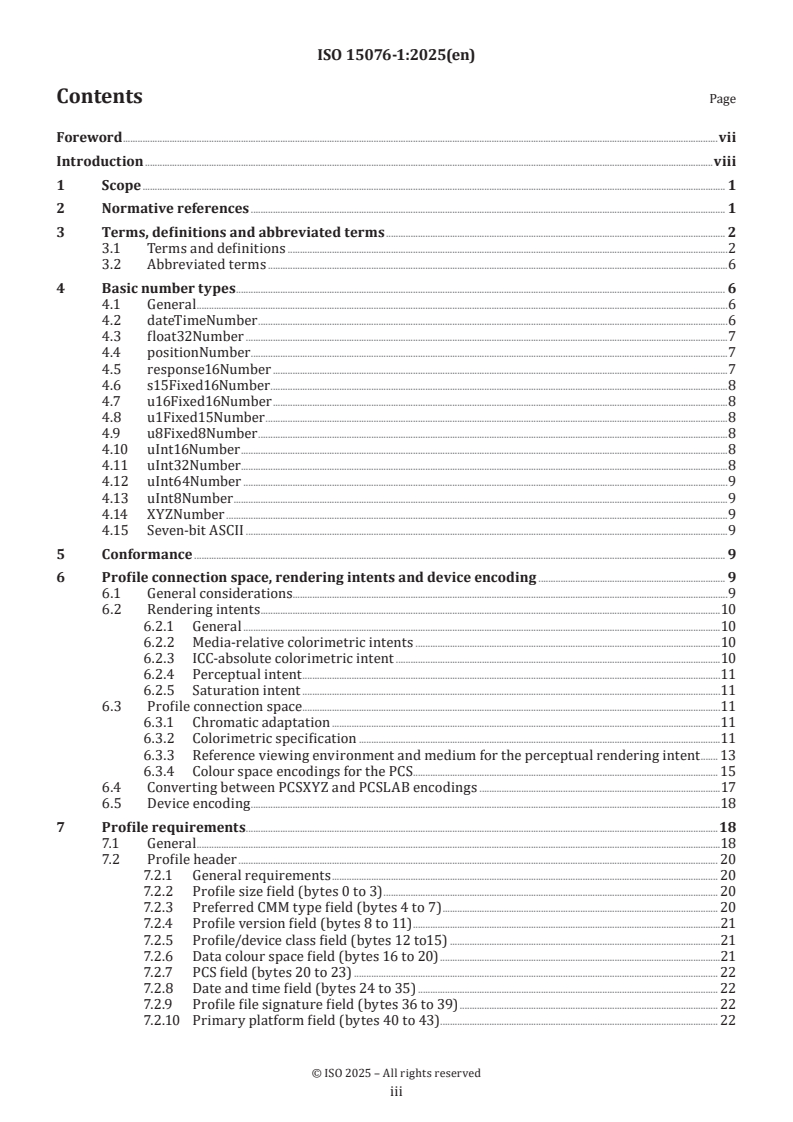
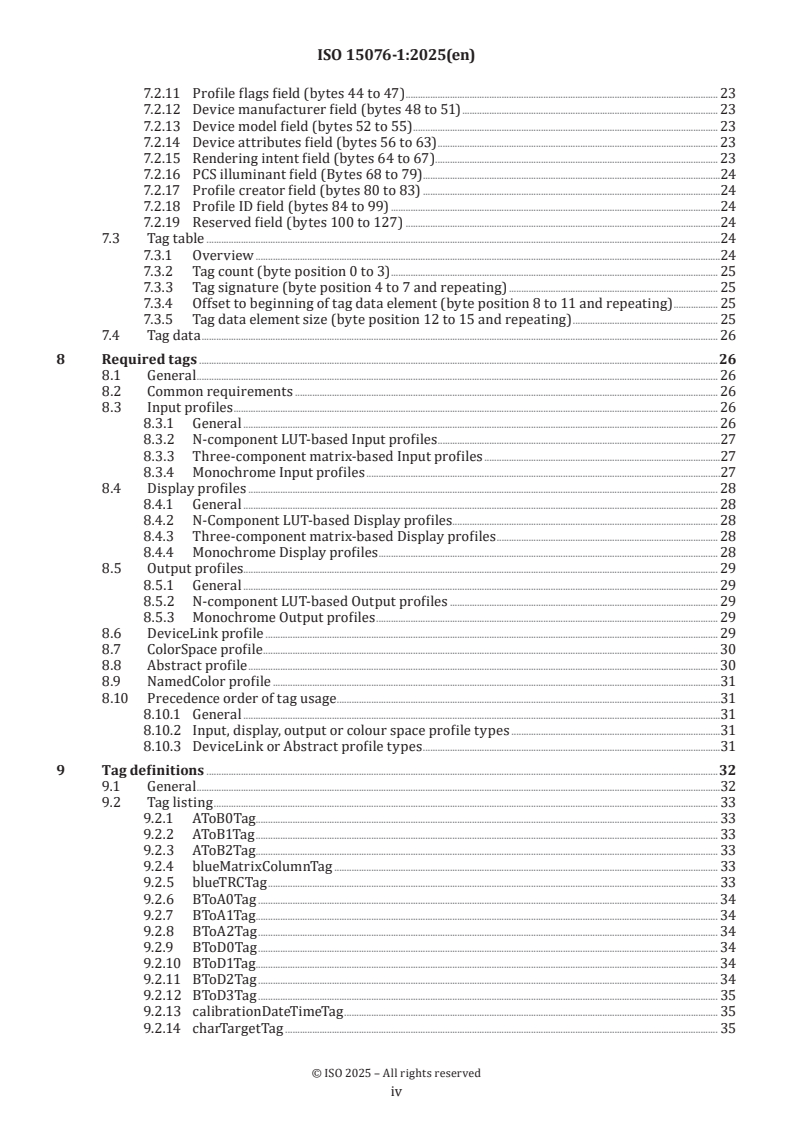
Contents Page
Foreword .vii
Introduction .viii
1 Scope . 1
2 Normative references . 1
3 Terms, definitions and abbreviated terms . 2
3.1 Terms and definitions .2
3.2 Abbreviated terms .6
4 Basic number types . 6
4.1 General .6
4.2 dateTimeNumber .6
4.3 float32Number .7
4.4 positionNumber .7
4.5 response16Number .7
4.6 s15Fixed16Number .8
4.7 u16Fixed16Number .8
4.8 u1Fixed15Number .8
4.9 u8Fixed8Number .8
4.10 uInt16Number .8
4.11 uInt32Number . .8
4.12 uInt64Number .9
4.13 uInt8Number .9
4.14 XYZNumber .9
4.15 Seven-bit ASCII .9
5 Conformance . 9
6 Profile connection space, rendering intents and device encoding . 9
6.1 General considerations.9
6.2 Rendering intents .10
6.2.1 General .10
6.2.2 Media-relative colorimetric intents .10
6.2.3 ICC-absolute colorimetric intent .10
6.2.4 Perceptual intent .11
6.2.5 Saturation intent .11
6.3 Profile connection space .11
6.3.1 Chromatic adaptation .11
6.3.2 Colorimetric specification .11
6.3.3 Reference viewing environment and medium for the perceptual rendering intent . 13
6.3.4 Colour space encodings for the PCS . 15
6.4 Converting between PCSXYZ and PCSLAB encodings .17
6.5 Device encoding .18
7 Profile requirements . .18
7.1 General .18
7.2 Profile header . 20
7.2.1 General requirements . 20
7.2.2 Profile size field (bytes 0 to 3) . 20
7.2.3 Preferred CMM type field (bytes 4 to 7) . 20
7.2.4 Profile version field (bytes 8 to 11) .21
7.2.5 Profile/device class field (bytes 12 to15) .21
7.2.6 Data colour space field (bytes 16 to 20) .21
7.2.7 PCS field (bytes 20 to 23) . 22
7.2.8 Date and time field (bytes 24 to 35) . 22
7.2.9 Profile file signature field (bytes 36 to 39) . 22
7.2.10 Primary platform field (bytes 40 to 43) . 22
iii
7.2.11 Profile flags field (bytes 44 to 47) . 23
7.2.12 Device manufacturer field (bytes 48 to 51) . 23
7.2.13 Device model field (bytes 52 to 55) . 23
7.2.14 Device attributes field (bytes 56 to 63) . 23
7.2.15 Rendering intent field (bytes 64 to 67). 23
7.2.16 PCS illuminant field (Bytes 68 to 79) .24
7.2.17 Profile creator field (bytes 80 to 83) .24
7.2.18 Profile ID field (bytes 84 to 99) .24
7.2.19 Reserved field (bytes 100 to 127) .24
7.3 Tag table .24
7.3.1 Overview .24
7.3.2 Tag count (byte position 0 to 3) . 25
7.3.3 Tag signature (byte position 4 to 7 and repeating) . 25
7.3.4 Offset to beginning of tag data element (byte position 8 to 11 and repeating) . 25
7.3.5 Tag data element size (byte position 12 to 15 and repeating) . 25
7.4 Tag data . 26
8 Required tags .26
8.1 General . 26
8.2 Common requirements . 26
8.3 Input profiles . 26
8.3.1 General . 26
8.3.2 N-component LUT-based Input profiles .27
8.3.3 Three-component matrix-based Input profiles .27
8.3.4 Monochrome Input profiles .27
8.4 Display profiles . 28
8.4.1 General . 28
8.4.2 N-Component LUT-based Display profiles . . 28
8.4.3 Three-component matrix-based Display profiles . 28
8.4.4 Monochrome Display profiles . 28
8.5 Output profiles. 29
8.5.1 General . 29
8.5.2 N-component LUT-based Output profiles . 29
8.5.3 Monochrome Output profiles . 29
8.6 DeviceLink profile . 29
8.7 ColorSpace profile . 30
8.8 Abstract profile . 30
8.9 NamedColor profile .31
8.10 Precedence order of tag usage .31
8.10.1 General .31
8.10.2 Input, display, output or colour space profile types .31
8.10.3 DeviceLink or Abstract profile types .31
9 Tag definitions .32
9.1 General .32
9.2 Tag listing . 33
9.2.1 AToB0Tag. 33
9.2.2 AToB1Tag . 33
9.2.3 AToB2Tag . 33
9.2.4 blueMatrixColumnTag . 33
9.2.5 blueTRCTag . 33
9.2.6 BToA0Tag . 34
9.2.7 BToA1Tag . 34
9.2.8 BToA2Tag . 34
9.2.9 BToD0Tag . 34
9.2.10 BToD1Tag . 34
9.2.11 BToD2Tag . 34
9.2.12 BToD3Tag . 35
9.2.13 calibrationDateTimeTag . 35
9.2.14 charTargetTag . 35
iv
9.2.15 chromaticAdaptationTag . . 35
9.2.16 chromaticityTag . 36
9.2.17 cicpTag . 36
9.2.18 colorantOrderTag . 36
9.2.19 colorantTableTag . 36
9.2.20 colorantTableOutTag .37
9.2.21 colorimetricIntentImageStateTag .37
9.2.22 copyrightTag . 39
9.2.23 deviceMfgDescTag . 39
9.2.24 deviceModelDescTag . 39
9.2.25 DToB0Tag . 39
9.2.26 DToB1Tag. 39
9.2.27 DToB2Tag . 39
9.2.28 DToB3Tag . 40
9.2.29 gamutTag . 40
9.2.30 grayTRCTag . 40
9.2.31 greenMatrixColumnTag . 40
9.2.32 greenTRCTag . 40
9.2.33 luminanceTag . 40
9.2.34 measurementTag . .41
9.2.35 metadataTag .41
9.2.36 mediaWhitePointTag .41
9.2.37 namedColor2Tag .41
9.2.38 outputResponseTag .41
9.2.39 perceptualRenderingIntentGamutTag .42
9.2.40 preview0Tag .42
9.2.41 preview1Tag .42
9.2.42 preview2Tag .42
9.2.43 profileDescriptionTag .43
9.2.44 profileSequenceDescTag .43
9.2.45 profileSequenceIdentifierTag .43
9.2.46 redMatrixColumnTag .43
9.2.47 redTRCTag .43
9.2.48 saturationRenderingIntentGamutTag .43
9.2.49 technologyTag . 44
9.2.50 viewingCondDescTag . . 44
9.2.51 viewingConditionsTag .45
10 Tag type definitions .45
10.1 General .45
10.2 chromaticityType .45
10.3 cicpType . 46
10.4 colorantOrderType .47
10.5 colorantTableType . 48
10.6 curveType . 48
10.7 dataType . 49
10.8 dateTimeType. 49
10.9 dictType . 49
10.10 lut16Type .51
10.11 lut8Type . 55
10.12 lutAToBType.57
10.12.1 General .57
10.12.2 “A” curves . 58
10.12.3 CLUT . 58
10.12.4 “M” curves .59
10.12.5 Matrix .59
10.12.6 “B” curves .59
10.13 lutBToAType . 60
10.13.1 General . 60
v
10.13.2 “B” curves .61
10.13.3 Matrix .61
10.13.4 “M” curves .61
10.13.5 CLUT .61
10.13.6 “A” curves .62
10.14 measurementType.62
10.15 multiLocalizedUnicodeType . 63
10.16 multiProcessElementsType . 64
10.16.1 General . 64
10.16.2 multiProcessElementsType Elements . 65
10.17 namedColor2Type . 69
10.18 parametricCurveType .71
10.19 profileSequenceDescType .71
10.20 profileSequenceIdentifierType . 72
10.20.1 General . 72
10.20.2 Profile ID . . 73
10.20.3 Profile Description . 73
10.21 responseCurveSet16Type . 73
10.22 s15Fixed16ArrayType .76
10.23 signatureType .76
10.24 textType .76
10.25 u16Fixed16ArrayType . .76
10.26 uInt16ArrayType . 77
10.27 uInt32ArrayType . 77
10.28 uInt64ArrayType . 77
10.29 uInt8ArrayType . 78
10.30 viewingConditionsType . 78
10.31 XYZType . 78
Annex A (informative) Data colour encodings and rendering intents .79
Annex B (informative) Embedding profiles .82
Annex C (informative) Relationship between ICC profiles and PostScript CSAs and CRDs .83
Annex D (informative) Profile connection space .85
Annex E (informative) Chromatic adaptation tag .98
Annex F (normative) Profile computational models .101
Annex G (informative) Tables of required tags and tag list .103
Annex H (informative) Relationship to iccMAX .109
Bibliography .110
vi
Foreword
ISO (the International Organization for Standardization) is a worldwide federation of national standards
bodies (ISO member bodies). The work of preparing International Standards is normally carried out through
ISO technical committees. Each member body interested in a subject for which a technical committee
has been established has the right to be represented on that committee. International organizations,
governmental and non-governmental, in liaison with ISO, also take part in the work. ISO collaborates closely
with the International Electrotechnical Commission (IEC) on all matters of electrotechnical standardization.
The procedures used to develop this document and those intended for its further maintenance are described
in the ISO/IEC Directives, Part 1. In particular, the different approval criteria needed for the different types
of ISO document should be noted. This document was drafted in accordance with the editorial rules of the
ISO/IEC Directives, Part 2 (see www.iso.org/directives).
ISO draws attention to the possibility that the implementation of this document may involve the use of (a)
patent(s). ISO takes no position concerning the evidence, validity or applicability of any claimed patent
rights in respect thereof. As of the date of publication of this document, ISO had not received notice of (a)
patent(s) which may be required to implement this document. However, implementers are cautioned that
this may not represent the latest information, which may be obt
...
International
Standard
ISO 15076-1
Third edition
Image technology colour
2025-10
management — Architecture,
profile format and data structure —
Part 1:
Based on ICC.1:2022
Gestion de couleur en technologie d'image — Architecture,
format de profil et structure de données —
Partie 1: Sur la base de l'ICC.1:2022
Reference number
© ISO 2025
All rights reserved. Unless otherwise specified, or required in the context of its implementation, no part of this publication may
be reproduced or utilized otherwise in any form or by any means, electronic or mechanical, including photocopying, or posting on
the internet or an intranet, without prior written permission. Permission can be requested from either ISO at the address below
or ISO’s member body in the country of the requester.
ISO copyright office
CP 401 • Ch. de Blandonnet 8
CH-1214 Vernier, Geneva
Phone: +41 22 749 01 11
Email: copyright@iso.org
Website: www.iso.org
Published in Switzerland
ii
Contents Page
Foreword .vii
Introduction .viii
1 Scope . 1
2 Normative references . 1
3 Terms, definitions and abbreviated terms . 2
3.1 Terms and definitions .2
3.2 Abbreviated terms .6
4 Basic number types . 6
4.1 General .6
4.2 dateTimeNumber .6
4.3 float32Number .7
4.4 positionNumber .7
4.5 response16Number .7
4.6 s15Fixed16Number .8
4.7 u16Fixed16Number .8
4.8 u1Fixed15Number .8
4.9 u8Fixed8Number .8
4.10 uInt16Number .8
4.11 uInt32Number . .8
4.12 uInt64Number .9
4.13 uInt8Number .9
4.14 XYZNumber .9
4.15 Seven-bit ASCII .9
5 Conformance . 9
6 Profile connection space, rendering intents and device encoding . 9
6.1 General considerations.9
6.2 Rendering intents .10
6.2.1 General .10
6.2.2 Media-relative colorimetric intents .10
6.2.3 ICC-absolute colorimetric intent .10
6.2.4 Perceptual intent .11
6.2.5 Saturation intent .11
6.3 Profile connection space .11
6.3.1 Chromatic adaptation .11
6.3.2 Colorimetric specification .11
6.3.3 Reference viewing environment and medium for the perceptual rendering intent . 13
6.3.4 Colour space encodings for the PCS . 15
6.4 Converting between PCSXYZ and PCSLAB encodings .17
6.5 Device encoding .18
7 Profile requirements . .18
7.1 General .18
7.2 Profile header . 20
7.2.1 General requirements . 20
7.2.2 Profile size field (bytes 0 to 3) . 20
7.2.3 Preferred CMM type field (bytes 4 to 7) . 20
7.2.4 Profile version field (bytes 8 to 11) .21
7.2.5 Profile/device class field (bytes 12 to15) .21
7.2.6 Data colour space field (bytes 16 to 20) .21
7.2.7 PCS field (bytes 20 to 23) . 22
7.2.8 Date and time field (bytes 24 to 35) . 22
7.2.9 Profile file signature field (bytes 36 to 39) . 22
7.2.10 Primary platform field (bytes 40 to 43) . 22
iii
7.2.11 Profile flags field (bytes 44 to 47) . 23
7.2.12 Device manufacturer field (bytes 48 to 51) . 23
7.2.13 Device model field (bytes 52 to 55) . 23
7.2.14 Device attributes field (bytes 56 to 63) . 23
7.2.15 Rendering intent field (bytes 64 to 67). 23
7.2.16 PCS illuminant field (Bytes 68 to 79) .24
7.2.17 Profile creator field (bytes 80 to 83) .24
7.2.18 Profile ID field (bytes 84 to 99) .24
7.2.19 Reserved field (bytes 100 to 127) .24
7.3 Tag table .24
7.3.1 Overview .24
7.3.2 Tag count (byte position 0 to 3) . 25
7.3.3 Tag signature (byte position 4 to 7 and repeating) . 25
7.3.4 Offset to beginning of tag data element (byte position 8 to 11 and repeating) . 25
7.3.5 Tag data element size (byte position 12 to 15 and repeating) . 25
7.4 Tag data . 26
8 Required tags .26
8.1 General . 26
8.2 Common requirements . 26
8.3 Input profiles . 26
8.3.1 General . 26
8.3.2 N-component LUT-based Input profiles .27
8.3.3 Three-component matrix-based Input profiles .27
8.3.4 Monochrome Input profiles .27
8.4 Display profiles . 28
8.4.1 General . 28
8.4.2 N-Component LUT-based Display profiles . . 28
8.4.3 Three-component matrix-based Display profiles . 28
8.4.4 Monochrome Display profiles . 28
8.5 Output profiles. 29
8.5.1 General . 29
8.5.2 N-component LUT-based Output profiles . 29
8.5.3 Monochrome Output profiles . 29
8.6 DeviceLink profile . 29
8.7 ColorSpace profile . 30
8.8 Abstract profile . 30
8.9 NamedColor profile .31
8.10 Precedence order of tag usage .31
8.10.1 General .31
8.10.2 Input, display, output or colour space profile types .31
8.10.3 DeviceLink or Abstract profile types .31
9 Tag definitions .32
9.1 General .32
9.2 Tag listing . 33
9.2.1 AToB0Tag. 33
9.2.2 AToB1Tag . 33
9.2.3 AToB2Tag . 33
9.2.4 blueMatrixColumnTag . 33
9.2.5 blueTRCTag . 33
9.2.6 BToA0Tag . 34
9.2.7 BToA1Tag . 34
9.2.8 BToA2Tag . 34
9.2.9 BToD0Tag . 34
9.2.10 BToD1Tag . 34
9.2.11 BToD2Tag . 34
9.2.12 BToD3Tag . 35
9.2.13 calibrationDateTimeTag . 35
9.2.14 charTargetTag . 35
iv
9.2.15 chromaticAdaptationTag . . 35
9.2.16 chromaticityTag . 36
9.2.17 cicpTag . 36
9.2.18 colorantOrderTag . 36
9.2.19 colorantTableTag . 36
9.2.20 colorantTableOutTag .37
9.2.21 colorimetricIntentImageStateTag .37
9.2.22 copyrightTag . 39
9.2.23 deviceMfgDescTag . 39
9.2.24 deviceModelDescTag . 39
9.2.25 DToB0Tag . 39
9.2.26 DToB1Tag. 39
9.2.27 DToB2Tag . 39
9.2.28 DToB3Tag . 40
9.2.29 gamutTag . 40
9.2.30 grayTRCTag . 40
9.2.31 greenMatrixColumnTag . 40
9.2.32 greenTRCTag . 40
9.2.33 luminanceTag . 40
9.2.34 measurementTag . .41
9.2.35 metadataTag .41
9.2.36 mediaWhitePointTag .41
9.2.37 namedColor2Tag .41
9.2.38 outputResponseTag .41
9.2.39 perceptualRenderingIntentGamutTag .42
9.2.40 preview0Tag .42
9.2.41 preview1Tag .42
9.2.42 preview2Tag .42
9.2.43 profileDescriptionTag .43
9.2.44 profileSequenceDescTag .43
9.2.45 profileSequenceIdentifierTag .43
9.2.46 redMatrixColumnTag .43
9.2.47 redTRCTag .43
9.2.48 saturationRenderingIntentGamutTag .43
9.2.49 technologyTag . 44
9.2.50 viewingCondDescTag . . 44
9.2.51 viewingConditionsTag .45
10 Tag type definitions .45
10.1 General .45
10.2 chromaticityType .45
10.3 cicpType . 46
10.4 colorantOrderType .47
10.5 colorantTableType . 48
10.6 curveType . 48
10.7 dataType . 49
10.8 dateTimeType. 49
10.9 dictType . 49
10.10 lut16Type .51
10.11 lut8Type . 55
10.12 lutAToBType.57
10.12.1 General .57
10.12.2 “A” curves . 58
10.12.3 CLUT . 58
10.12.4 “M” curves .59
10.12.5 Matrix .59
10.12.6 “B” curves .59
10.13 lutBToAType . 60
10.13.1 General . 60
v
10.13.2 “B” curves .61
10.13.3 Matrix .61
10.13.4 “M” curves .61
10.13.5 CLUT .61
10.13.6 “A” curves .62
10.14 measurementType.62
10.15 multiLocalizedUnicodeType . 63
10.16 multiProcessElementsType . 64
10.16.1 General . 64
10.16.2 multiProcessElementsType Elements . 65
10.17 namedColor2Type . 69
10.18 parametricCurveType .71
10.19 profileSequenceDescType .71
10.20 profileSequenceIdentifierType . 72
10.20.1 General . 72
10.20.2 Profile ID . . 73
10.20.3 Profile Description . 73
10.21 responseCurveSet16Type . 73
10.22 s15Fixed16ArrayType .76
10.23 signatureType .76
10.24 textType .76
10.25 u16Fixed16ArrayType . .76
10.26 uInt16ArrayType . 77
10.27 uInt32ArrayType . 77
10.28 uInt64ArrayType . 77
10.29 uInt8ArrayType . 78
10.30 viewingConditionsType . 78
10.31 XYZType . 78
Annex A (informative) Data colour encodings and rendering intents .79
Annex B (informative) Embedding profiles .82
Annex C (informative) Relationship between ICC profiles and PostScript CSAs and CRDs .83
Annex D (informative) Profile connection space .85
Annex E (informative) Chromatic adaptation tag .98
Annex F (normative) Profile computational models .101
Annex G (informative) Tables of required tags and tag list .103
Annex H (informative) Relationship to iccMAX .109
Bibliography .110
vi
Foreword
ISO (the International Organization for Standardization) is a worldwide federation of national standards
bodies (ISO member bodies). The work of preparing International Standards is normally carried out through
ISO technical committees. Each member body interested in a subject for which a technical committee
has been established has the right to be represented on that committee. International organizations,
governmental and non-governmental, in liaison with ISO, also take part in the work. ISO collaborates closely
with the International Electrotechnical Commission (IEC) on all matters of electrotechnical standardization.
The procedures used to develop this document and those intended for its further maintenance are described
in the ISO/IEC Directives, Part 1. In particular, the different approval criteria needed for the different types
of ISO document should be noted. This document was drafted in accordance with the editorial rules of the
ISO/IEC Directives, Part 2 (see www.iso.org/directives).
ISO draws attention to the possibility that the implementation of this document may involve the use of (a)
patent(s). ISO takes no position concerning the evidence, validity or applicability of any claimed patent
rights in respect thereof. As of the date of publication of this document, ISO had not received notice of (a)
patent(s) which may be required to implement this document. However, implementers are cautioned that
this may not represent the latest information, which may be obtained from the patent database available at
www.iso.org/patents. ISO shall not be held responsible for identifying any or all such patent rights.
Any trade name used in this document is information given for the convenience of users and does not
constitute an endorsement.
For an explanation of the voluntary nature of standards, the meaning of ISO specific terms and expressions
related to conformity assessment, as well as information about ISO's adherence to the World Trade
Organization (WTO) principles in the Technical Barriers to Trade (TBT), see www.iso.org/iso/foreword.html.
This document was prepared by Technical Committee ISO/TC 130, Graphic technology.
This third edition cancels and replaces the second edition (ISO 15076-1:2010), which has been technically
revised.
The main changes are as follows:
— cicpTag has been added to enable HDR metadata to be carried in the profile;
— metadataTag and dictType have been added to enable flexible definition of additional metadata;
— it has been clarified that PCSXYZ values can be negative;
— Tag tables are now required to define a contiguous sequence
...