


ISO/IEC 19794-4:2005
(Main)Information technology — Biometric data interchange formats — Part 4: Finger image data
Information technology — Biometric data interchange formats — Part 4: Finger image data
ISO/IEC 19794-4:2005 specifies a data record interchange format for storing, recording, and transmitting the information from one or more finger or palm image areas within an ISO/IEC 19785-1 CBEFF data structure. This can be used for the exchange and comparison of finger image data. It defines the content, format, and units of measurement for the exchange of finger image data that may be used in the verification or identification process of a subject. The information consists of a variety of mandatory and optional items, including scanning parameters, compressed or uncompressed images and vendor-specific information. This information is intended for interchange among organizations that rely on automated devices and systems for identification or verification purposes based on the information from finger image areas. Information compiled and formatted in accordance with ISO/IEC 19794-4:2005 can be recorded on machine-readable media or may be transmitted by data communication facilities.
Technologies de l'information — Formats d'échange de données biométriques — Partie 4: Données d'image du doigt
General Information
- Status
- Published
- Publication Date
- 09-Jun-2005
- Technical Committee
- ISO/IEC JTC 1/SC 37 - Biometrics
- Drafting Committee
- ISO/IEC JTC 1/SC 37 - Biometrics
- Current Stage
- 9093 - International Standard confirmed
- Start Date
- 01-Oct-2012
- Completion Date
- 14-Feb-2026
Relations
- Effective Date
- 15-Apr-2008
Overview
ISO/IEC 19794-4:2005 - "Information technology - Biometric data interchange formats - Part 4: Finger image data" defines a standardized data record format for storing, exchanging and transmitting fingerprint and palm image data. The standard specifies the content, structure and units for image-based biometric records (both compressed and uncompressed) within an ISO/IEC 19785-1 CBEFF container so images and acquisition parameters can be interchanged and compared across systems.
Key topics and technical requirements
- Record structure & headers: mandatory and optional fields describing capture device, image counts, image quality, impression type, and record lengths to ensure consistent parsing and interoperability.
- Image acquisition parameters: definitions for scan resolution, image resolution, pixel depth, pixel aspect ratio, grayscale, and dynamic range so receiving systems understand how images were captured.
- Image data support: permits both compressed (e.g., WSQ, JPEG 2000 referenced) and uncompressed finger/palm images, plus vendor-specific data fields.
- Image quality and scanner performance: Annex A defines image quality specifications and metrics such as geometric accuracy, modulation transfer function (MTF), signal-to-noise ratio (SNR), grayscale linearity and uniformity-useful for procurement and conformance testing.
- Conformance requirements: systems claiming conformance must be able to encode/decode finger image records and associated parameter data to support capture, exchange and comparison of interoperable fingerprint images.
- CBEFF integration: designed to be used inside the Common Biometric Exchange Formats Framework (ISO/IEC 19785-1) for consistent biometric packaging.
Applications and who uses it
- Government & law enforcement: AFIS systems, forensic exchanges, national ID and criminal databases.
- Border control & civil ID: enrolment and verification where image-based biometric templates are used on documents or chips.
- Security & access control: enterprise and critical-infrastructure authentication that require image-level interoperability.
- Vendors & system integrators: device manufacturers, software developers and integrators building capture devices, matchers, and middleware to ensure cross-vendor compatibility.
- Test labs & procurers: use the image quality metrics and acquisition requirements to specify and evaluate fingerprint scanners.
Related standards
- ISO/IEC 19794 (other parts: Part 1 framework, Part 2 minutiae, Part 3 pattern spectral, Part 5 face, Part 6 iris)
- ISO/IEC 19785-1 (CBEFF data element specification)
- IAFIS-IC-0110 (WSQ compression) and ISO/IEC 15444 (JPEG 2000) - referenced for image compression formats
Keywords: ISO/IEC 19794-4, finger image data, biometric data interchange format, fingerprint image format, CBEFF, scan resolution, pixel depth, image compression, WSQ, JPEG 2000.


Get Certified
Connect with accredited certification bodies for this standard

BSI Group
BSI (British Standards Institution) is the business standards company that helps organizations make excellence a habit.

NYCE
Mexican standards and certification body.
Sponsored listings
Frequently Asked Questions
ISO/IEC 19794-4:2005 is a standard published by the International Organization for Standardization (ISO). Its full title is "Information technology — Biometric data interchange formats — Part 4: Finger image data". This standard covers: ISO/IEC 19794-4:2005 specifies a data record interchange format for storing, recording, and transmitting the information from one or more finger or palm image areas within an ISO/IEC 19785-1 CBEFF data structure. This can be used for the exchange and comparison of finger image data. It defines the content, format, and units of measurement for the exchange of finger image data that may be used in the verification or identification process of a subject. The information consists of a variety of mandatory and optional items, including scanning parameters, compressed or uncompressed images and vendor-specific information. This information is intended for interchange among organizations that rely on automated devices and systems for identification or verification purposes based on the information from finger image areas. Information compiled and formatted in accordance with ISO/IEC 19794-4:2005 can be recorded on machine-readable media or may be transmitted by data communication facilities.
ISO/IEC 19794-4:2005 specifies a data record interchange format for storing, recording, and transmitting the information from one or more finger or palm image areas within an ISO/IEC 19785-1 CBEFF data structure. This can be used for the exchange and comparison of finger image data. It defines the content, format, and units of measurement for the exchange of finger image data that may be used in the verification or identification process of a subject. The information consists of a variety of mandatory and optional items, including scanning parameters, compressed or uncompressed images and vendor-specific information. This information is intended for interchange among organizations that rely on automated devices and systems for identification or verification purposes based on the information from finger image areas. Information compiled and formatted in accordance with ISO/IEC 19794-4:2005 can be recorded on machine-readable media or may be transmitted by data communication facilities.
ISO/IEC 19794-4:2005 is classified under the following ICS (International Classification for Standards) categories: 35.040 - Information coding; 35.240.15 - Identification cards. Chip cards. Biometrics. The ICS classification helps identify the subject area and facilitates finding related standards.
ISO/IEC 19794-4:2005 has the following relationships with other standards: It is inter standard links to ISO/IEC 19794-4:2011. Understanding these relationships helps ensure you are using the most current and applicable version of the standard.
ISO/IEC 19794-4:2005 is available in PDF format for immediate download after purchase. The document can be added to your cart and obtained through the secure checkout process. Digital delivery ensures instant access to the complete standard document.
Standards Content (Sample)
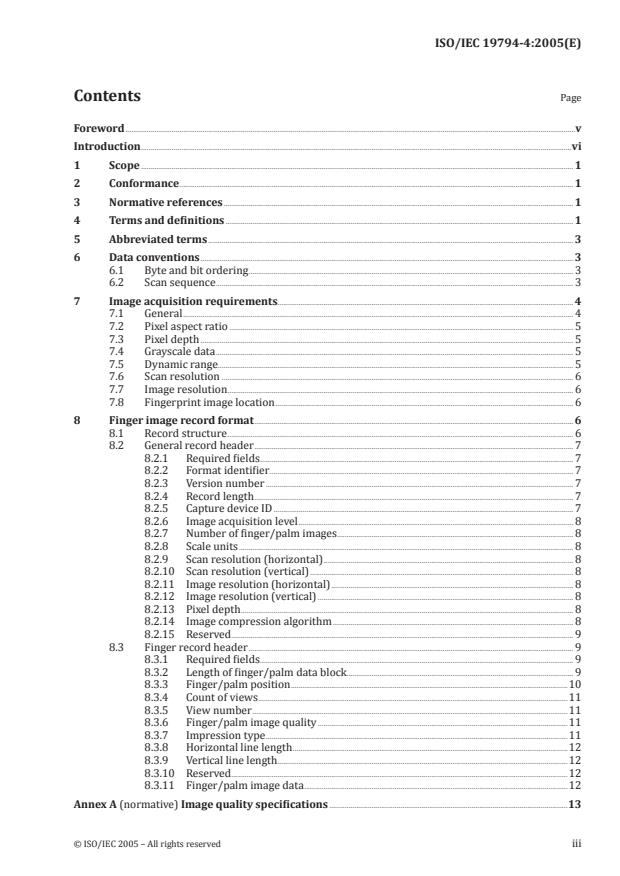
INTERNATIONAL ISO/IEC
STANDARD 19794-4
First edition
2005-06-01
Corrected version
2019-02
Information technology — Biometric
data interchange formats —
Part 4:
Finger image data
Technologies de l'information — Formats d'échange de données
biométriques —
Partie 4: Données d'image du doigt
Reference number
©
ISO/IEC 2005
© ISO/IEC 2005
All rights reserved. Unless otherwise specified, or required in the context of its implementation, no part of this publication may
be reproduced or utilized otherwise in any form or by any means, electronic or mechanical, including photocopying, or posting
on the internet or an intranet, without prior written permission. Permission can be requested from either ISO at the address
below or ISO’s member body in the country of the requester.
ISO copyright office
CP 401 • Ch. de Blandonnet 8
CH-1214 Vernier, Geneva
Phone: +41 22 749 01 11
Fax: +41 22 749 09 47
Email: copyright@iso.org
Website: www.iso.org
Published in Switzerland
ii © ISO/IEC 2005 – All rights reserved
Contents Page
Foreword .v
Introduction .vi
1 Scope . 1
2 Conformance . 1
3 Normative references . 1
4 Terms and definitions . 1
5 Abbreviated terms . 3
6 Data conventions . 3
6.1 Byte and bit ordering . 3
6.2 Scan sequence . 3
7 Image acquisition requirements. 4
7.1 General . 4
7.2 Pixel aspect ratio . 5
7.3 Pixel depth . 5
7.4 Grayscale data . 5
7.5 Dynamic range. 5
7.6 Scan resolution . 6
7.7 Image resolution . 6
7.8 Fingerprint image location . 6
8 Finger image record format . 6
8.1 Record structure . 6
8.2 General record header . 7
8.2.1 Required fields . 7
8.2.2 Format identifier . 7
8.2.3 Version number . 7
8.2.4 Record length . 7
8.2.5 Capture device ID . 7
8.2.6 Image acquisition level . 8
8.2.7 Number of finger/palm images . 8
8.2.8 Scale units . 8
8.2.9 Scan resolution (horizontal) . 8
8.2.10 Scan resolution (vertical) . 8
8.2.11 Image resolution (horizontal) . 8
8.2.12 Image resolution (vertical) . 8
8.2.13 Pixel depth . 8
8.2.14 Image compression algorithm . 8
8.2.15 Reserved . 9
8.3 Finger record header . 9
8.3.1 Required fields . 9
8.3.2 Length of finger/palm data block. 9
8.3.3 Finger/palm position .10
8.3.4 Count of views .11
8.3.5 View number .11
8.3.6 Finger/palm image quality .11
8.3.7 Impression type .11
8.3.8 Horizontal line length .12
8.3.9 Vertical line length . .12
8.3.10 Reserved .12
8.3.11 Finger/palm image data .12
Annex A (normative) Image quality specifications .13
© ISO/IEC 2005 – All rights reserved iii
Annex B (informative) Finger image data record example .18
Bibliography .19
iv © ISO/IEC 2005 – All rights reserved
Foreword
ISO (the International Organization for Standardization) and IEC (the International Electrotechnical
Commission) form the specialized system for worldwide standardization. National Bodies that are
members of ISO or IEC participate in the development of International Standards through technical
committees established by the respective organization to deal with particular fields of technical
activity. ISO and IEC technical committees collaborate in fields of mutual interest. Other international
organizations, governmental and non-governmental, in liaison with ISO and IEC, also take part in the
work. In the field of information technology, ISO and IEC have established a joint technical committee,
ISO/IEC JTC 1.
International Standards are drafted in accordance with the rules given in the ISO/IEC Directives, Part 2.
The main task of the joint technical committee is to prepare International Standards. Draft International
Standards adopted by the joint technical committee are circulated to national bodies for voting.
Publication as an International Standard requires approval by at least 75 % of the member bodies
casting a vote.
Attention is drawn to the possibility that some of the elements of this document may be the subject of
patent rights. ISO shall not be held responsible for identifying any or all such patent rights.
ISO/IEC 19794-4 was prepared by Joint Technical Committee ISO/IEC/JTC 1, Information technology,
Subcommittee SC 37, Biometrics.
ISO/IEC 19794 consists of the following parts, under the general title Information technology —
Biometric data interchange formats:
— Part 1: Framework
— Part 2: Finger Minutiae Data
— Part 3: Finger Pattern Spectral Data
— Part 4: Finger Image Data
— Part 5: Face Image Data
— Part 6: Iris Image Data
— Part 7: Signature/Sign Behavioural Data
— Part 8: Finger Pattern Skeletal Data
— Part 9: Vascular Data
— Part 10: Hand Geometry Silhouette Data
— Part 11: Signature/sign processed dynamic Data
— Part 13: Voice Data
— Part 14: DNA Data
This corrected version of ISO/IEC 19794-4:2005 incorporates the following corrections:
This corrected version contains the original content of ISO/IEC 19794-4:2005 and incorporates the
Technical Corrigendum ISO/IEC 19794-4:2005/Cor 1:2011.
© ISO/IEC 2005 – All rights reserved v
Introduction
In the forensic community, the capture and transmission of fingerprint images has been a common
choice for the exchange of fingerprint information used by Automatic Fingerprint Identification
Systems (AFIS) for the identification of individuals. However, little to no fingerprint information is
being exchanged between equipment from different vendors in the biometric user verification and
access community. This has been due in part to the lack of agreement between vendors on the amount
and type of information to capture, the method of capture, and the information to be exchanged.
This part of the ISO/IEC 19794 standard is intended for those applications requiring the exchange of
raw or processed fingerprint images that may not necessarily be limited by the amount of resources
required for data storage or transmitting time. It can be used for the exchange of scanned fingerprints
containing detailed image pixel information. This part of ISO/IEC 19794 can also be used to exchange
processed fingerprint image data containing considerably fewer pixels per inch and/or a lesser
number of greyscale levels. This is in contrast to other parts of ISO/IEC 19794 used for exchanging
lists of fingerprint characteristics such as minutiae, patterns, or other variants. These formats require
considerably less storage than a fingerprint image. However, by using any of the other parts of ISO/
IEC 19794, information recorded in one standard format cannot be used by algorithms designed to
operate with another type of information. In other words, minutiae data cannot be used by pattern
matching algorithms and pattern data cannot be used by minutiae matching algorithms.
Although the minutiae, pattern, or other approaches produce different intermediate outputs, all must
initially capture a reasonably high quality fingerprint image before reducing the size of the image
(in bytes) or developing a list of characteristic data from the image. Use of the captured or processed
image can provide interoperability among vendors relying on minutiae-based, pattern-based or other
algorithms. As a result, data from the captured finger image offers the developer more freedom in
choosing or combining matching algorithm technology. For example, an enrolment image may be stored
on a contactless chip located on an identification document. This will allow future verification of the
holder of the document with systems that rely on either minutiae based or pattern based algorithms.
Establishment of an image-based representation of fingerprint information will not rely on pre-
established definitions of minutiae, patterns or other types. It will provide implementers with the
flexibility to accommodate images captured from dissimilar devices, varying image sizes, resolutions,
and different grayscale depths. Use of the fingerprint image will allow each vendor to implement their
own algorithms to determine whether two fingerprint records are from the same finger.
vi © ISO/IEC 2005 – All rights reserved
INTERNATIONAL STANDARD ISO/IEC 19794-4:2005(E)
Information technology — Biometric data interchange
formats —
Part 4:
Finger image data
1 Scope
This part of the ISO/IEC 19794 standard specifies a data record interchange format for storing,
recording, and transmitting the information from one or more finger or palm image areas within an
ISO/IEC 19785-1 CBEFF data structure. This can be used for the exchange and comparison of finger
image data. It defines the content, format, and units of measurement for the exchange of finger image
data that may be used in the verification or identification process of a subject. The information
consists of a variety of mandatory and optional items, including scanning parameters, compressed or
uncompressed images and vendor-specific information. This information is intended for interchange
among organizations that rely on automated devices and systems for identification or verification
purposes based on the information from finger image areas. Information compiled and formatted in
accordance with this part of the ISO/IEC 19794 standard can be recorded on machine-readable media
or may be transmitted by data communication facilities.
2 Conformance
Systems claiming conformance with this part of the ISO/IEC 19794 standard shall be capable of
encoding and decoding finger image data and the associated parameter data used in the transmitting
and/or receiving of fingerprint images as defined by this part of the ISO/IEC 19794 standard. At a
minimum, conformance shall require the ability to capture, exchange, and compare interoperable
fingerprint image information.
3 Normative references
The following referenced documents are indispensable for the application of this document. For dated
references, only the edition cited applies. For undated references, the latest edition of the referenced
document (including any amendments) applies.
IAFIS-IC-0110 (V3). WSQ Gray-scale Fingerprint Image Compression Specification 1997
ISO/IEC/CD 19785-3, Common Biometric Exchange Formats Framework (CBEFF) — Part 1: Data Element
Specification
ISO/IEC IS 15444, JPEG 2000, Information Technology — Digital Compression and Coding of Continuous-
Tone Still Images — Part 1: Requirements and Guidelines
MTR 04B0000022 (Mitre Technical Report), Margaret Lepley, Profile for 1000ppi Fingerprint
Compression, Version 1.1, April 2004. Available at: http: //www .mitre .org/work/tech _papers/tech
_papers _04/lepley _fingerprint/lepley _fingerprint .pdf
4 Terms and definitions
For the purpose of this document, the following terms and definitions apply.
© ISO/IEC 2005 – All rights reserved 1
4.1
biometric sample
raw data representing a biometric characteristic of an end-user as captured by a biometric system
EXAMPLE The image of a fingerprint.
4.2
capture
the method of taking a biometric sample from an end user
4.3
core
the approximate center of a fingerprint image area
Note 1 to entry: The exact location of the core is generally placed near the topmost point of the innermost
recurving ridgeline of the fingerprint provided there are no ridges inside the recurving ridge. For those instances
where there are one or more ridges within the recurving ridge, the placement of the core will be dependent upon
the specific combination of ridges.
4.4
fingerprint image area
the area of friction skin on the fleshy surface of a finger located horizontally between the two edges of
the fingernail and vertically between the first joint and the tip of a finger. It contains a unique pattern of
friction ridge and valley information commonly referred to as a “fingerprint”
4.5
friction ridge
the ridges present on the skin of the finger which makes contact with an incident surface under
normal touch
4.6
grayscale
the method used to represent a continuous tone image that has only a single component or variable to
represent each pixel; also referred to as monochrome or black and white
4.7
image resolution
the number of pixels per unit distance in the interchanged image
Note 1 to entry: This may be the result of processing a captured image. The original captured scanned image may
have been subsampled, scaled, interpolated, or otherwise processed to produce a form for representing the ridge
and valley structure areas of the fingerprint.
4.8
latent
an impression of a fingerprint image collected from an intermediate surface, rather than directly via a
live scan capture device or a traditional inked fingerprint card
Note 1 to entry: The term latent print is generally used to describe any type of print found at the scene of a crime
or on evidence associated with a crime.
4.9
live capture
the process of capturing a biometric sample through an interaction between and end user and a
biometric system
4.10
pixel
a picture element – located on an n by m matrix of picture elements, where n is the horizontal component
and m is the vertical component.
2 © ISO/IEC 2005 – All rights reserved
4.11
plain fingerprint image
image captured from a finger placed on a platen without any rolling movement – the center portion of a
rolled image
4.12
rolled fingerprint image
image area captured that is located between the two edges of the fingernail. Acquired using a rolling
motion from one edge of the fingernail to the other
4.13
scan resolution
the number of pixels per unit distance used by a sensor or scanning device to initially capture a
fingerprint or palmprint image
4.14
swipe fingerprint image
a method of fingerprint collection where the finger is manually slid across a one-dimensional sensor
resulting in multiple readings or partial impressions from the same fingerprint. These readings are
then combined to produce an accurate two-dimensional image of the fingerprint
4.15
transaction
a command, message, or input record that explicitly or implicitly calls for a processing action.
Information contained in a transaction shall be applicable to a single subject
4.16
valley
the area surrounding a friction ridge, which does not make contact with an incident surface under
normal touch; the area of the finger image area between two frictions ridges
5 Abbreviated terms
ppcm pixels per centimetre
ppi pixels per inch
ppmm pixels per millimetre
6 Data conventions
6.1 Byte and bit ordering
Each item of information, field, or logical record shall contain one or more bytes of data. Within a record
all multibyte quantities are represented in Big-Endian format. That is, the more significant bytes of any
multibyte quantity are stored at lower addresses in memory than less significant bytes. The order for
transmission shall also be the most significant byte first and least significant byte last. Within a byte,
the order of transmission shall be the most significant bit first and the least significant bit last. All
numeric values are fixed-length unsigned integer quantities.
6.2 Scan sequence
It is not the purpose of this part of the ISO/IEC 19794 standard to specify the orientation of the finger
(or palm), the method of scanning, or the order of scanning used to capture the image. However, each
image as presented in accordance with this format standard shall appear to have been captured in
an upright position and approximately centered horizontally in the field of view. The recorded image
data shall appear to be the result of a scanning of a conventional inked impression of a fingerprint. The
© ISO/IEC 2005 – All rights reserved 3
scanning sequence (and recorded data) shall appear to have been from left-to-right, progressing from
top-to-bottom of the fingerprint or palm print. Figure 1 illustrates the recording order for the scanned
image. For the purpose of describing the position of each pixel within an image to be exchanged, a pair
of reference axes shall be used. The origin of the axes, pixel location (0,0), shall be located at the upper
left-hand corner of each image. The x-coordinate (horizontal) position shall increase positively from
the origin to the right side of the image. The y-coordinate (vertical) position shall increase positively
from the origin to the bottom of the image.
Figure 1 — Order of scanned lines
7 Image acquisition requirements
7.1 General
Image capture requirements are dependent on various factors including the application, the available
amount of raw pixel information to retain or exchange, and targeted performance metrics. As a result
of these factors, numeric values for specific image capture parameters will be associated with one of
several combinations of image acquisition parameters settings. The choice of the image acquisition
settings level should therefore be commensurate with the system and application requirements.
Table 1 lists the minimum requirements for selected image acquisition parameters as a function of the
image acquisition settings level desired. A tolerance of plus or minus 1 % is applicable to the minimum
numeric values stated for the scan resolution and dynamic range parameters. The last column indicates
compliance with established certification procedures. Values for setting levels 40 or 41 are intended
for applications requiring the greatest amount of detailed information. Scanners capable of level 30
and 31 performance are currently available and are being deployed for law enforcement purposes.
Level 30 or 31 applications primarily include law enforcement agencies. Both level 41 and 31 systems
should be certified using these and other requirements contained in Appendix F of the FBI’s Electronic
Fingerprint Transmission Specification (EFTS/F). Annex A lists the requirements from the EFTS/
Appendix F that are pertinent to fingerprint image input devices. The remaining levels are designed for
commercial access control and verification systems. The overall quality level of a biometric system will
be limited to that level at which all of the minimums are met.
NOTE Setting levels not listed are reserved for future definition by SC37, including indication of compliance
with future ISO standards for image capture. Compliance with future certifications will be indicated by additional
entries in the certifications columns.
4 © ISO/IEC 2005 – All rights reserved
7.2 Pixel aspect ratio
For all quality levels, the finger image shall be represented using square pixels, in which the horizontal
and vertical dimensions of the pixels are equal. Any difference between these two dimensions should be
within 1 %. That is, the ratio of horizontal to vertical pixel dimensions should be between .99 and 1. 01.
Table 1 — Image acquisition settings levels
Scan resolution
Scan resolution Pixel depth Dynamic range
Setting level pixels/centimeter Certification
pixels/inch (ppi) (bits) (gray levels)
(ppcm)
10 49 125 1 2 None
20 98 250 3 5 None
30 197 500 8 80 None
31 197 500 8 200 EFTS/F
35 295 750 8 100 None
40 394 1000 8 120 None
41 394 1000 8 200 EFTS/F
NOTE Manufacturers generally express the rated scan resolution of their devices in pixels per inch (ppi).
Table 1 also lists the resolutions in pixels per centimetre (ppcm). These are the rounded values of each ppi
resolution divided by 2.54. The ppi and ppcm values are therefore consistent with, but not exactly equal to, each
other. Either system may be used, but the two should not be intermixed or re-converted.
7.3 Pixel depth
The grayscale precision of the pixel data shall be specified in terms of the pixel depth or the number of
bits used to represent the grayscale value of a pixel. A pixel depth of 3 provides 8 levels of grayscale; a
depth of 8 provides up to 256 levels of gray. For grayscale data, the minimum value that can be assigned
to a "black" pixel shall be zero. The maximum value that can be assigned to a "white" pixel shall be the
grayscale value with all of its bits of precision set to "1". However, the 'blackest" pixel in an image may
have a value greater than "0" and the "whitest" pixel may have a value less than its maximum value.
This implies that the maximum value for a "white" pixel with 5 bits of precision shall be 31 or less. The
maximum value for the "whitest" pixel using 8 bits of precision shall be 255 or less. The pixel depth may
range from 1 to 16 bits.
7.4 Grayscale data
Grayscale finger image data may be stored, recorded, or transmitted in either compressed or
uncompressed form. The image data portion of a record for an uncompressed grayscale image shall
contain a set of raw pixel information. Using a pixel depth of 8 bits (256 grayscale levels) each pixel
shall be contained in a single byte. Pixel values with a depth of less than eight bits can be stored and
transmitted in a packed binary format. Increased precision for pixel values greater than 255 shall
use two unsigned bytes to hold up to sixteen-bit pixels with values in the range of 0 to 65635. The
encoding of a compressed grayscale image shall be the output of the appropriate grayscale compression
algorithm specified. Upon decompression the grayscale value for each pixel shall be represented in the
same manner as pixels in an uncompressed image.
7.5 Dynamic range
The image grayscale shall be encoded using the agreed precision necessary to meet the dynamic range
requirement for a specific application. It is assumed that the precise requirements of the application
are known.
© ISO/IEC 2005 – All rights reserved 5
7.6 Scan resolution
Grayscale fingerprint image areas to be captured shall be acquired by an image capture device operating
at a specific scanning resolution. As the resolution used in the image capture process is increased, more
detailed ridge and structure information for processing becomes available. For minutiae and small
feature based algorithms, use of the higher resolution enhances the detection of more closely spaced
features that may not be detected using the minimum resolution.
7.7 Image resolution
The resolution of the image data formatted and recorded for interchange may be the scan resolution of
the image or it may have been subsampled, scaled, interpolated, or otherwise processed to produce a
form for representing the ridge and valley structure areas of the fingerprint.
7.8 Fingerprint image location
This part of the ISO/IEC 19794 standard is designed to accommodate both plain (flat) or rolled
fingerprint images. Most matching systems perform better if the flat or fleshy part of the finger is
centered in the image capture area. Therefore, when capturing a fingerprint image, the center the
fingerprint image area should be located in the approximate center of the image capture area.
For multiple finger background checking and verification purposes, there are currently fingerprint
scanner devices that will acquire images of multiple fingers during a single capture cycle. These
devices are capable of capturing the plain impressions from four fingers of either hand during a single
scanning. The plain impressions from two thumbs can also be captured at one time. Therefore, with
three placements of the fingers on a device’s scanning surface all ten fingers from an individual can be
acquired in three scans – right four fingers, left four fingers, and two thumbs. For these multi-finger
captures, half of the captured fingers should be located to the left of the image center and the other half
of the fingers to the right of the image center.
8 Finger image record format
8.1 Record structure
This part of the ISO/IEC 19794 standard defines the composition of the finger image record. Each record
sha
...
Questions, Comments and Discussion
Ask us and Technical Secretary will try to provide an answer. You can facilitate discussion about the standard in here.
Loading comments...