


ISO/IEC 19794-4:2011
(Main)Information technology — Biometric data interchange formats — Part 4: Finger image data
Information technology — Biometric data interchange formats — Part 4: Finger image data
ISO/IEC 19794-4:2011 specifies a data record interchange format for storing, recording, and transmitting the information from one or more finger or palm image areas within an ISO/IEC 19785-1 data structure. This can be used for the exchange and comparison of finger image data. It defines the content, format, and units of measurement for the exchange of finger image data that may be used in the verification or identification process of a subject. The information consists of a variety of mandatory and optional items, including scanning parameters, compressed or uncompressed images and vendor-specific information. This information is intended for interchange among organizations that rely on automated devices and systems for identification or verification purposes based on the information from finger image areas. Information compiled and formatted in accordance with ISO/IEC 19794-4:2011 can be recorded on machine-readable media or may be transmitted by data communication facilities.
Technologies de l'information — Formats d'échange de données biométriques — Partie 4: Données d'image du doigt
General Information
- Status
- Published
- Publication Date
- 13-Dec-2011
- Technical Committee
- ISO/IEC JTC 1/SC 37 - Biometrics
- Drafting Committee
- ISO/IEC JTC 1/SC 37 - Biometrics
- Current Stage
- 9093 - International Standard confirmed
- Start Date
- 06-Sep-2024
- Completion Date
- 12-Feb-2026
Relations
- Effective Date
- 09-May-2020
- Effective Date
- 14-Jul-2018
- Effective Date
- 15-Apr-2008
Overview
ISO/IEC 19794-4:2011 - Information technology - Biometric data interchange formats - Part 4: Finger image data - defines a standardized data record interchange format for storing, recording and transmitting finger and palm image areas. The standard specifies the content, structure and units of measurement for exchanging raster finger/palm images (compressed or uncompressed) and associated metadata so that images captured by one system can be used by another for enrolment, verification or identification.
Key Topics and Requirements
- Record structure and conformance: Defines a finger image record format (general header, representation header, extended data) and conformance rules for producers and consumers of records.
- Image content and metadata: Mandatory and optional items include scanning parameters, image spatial sampling rate, capture device spatial sampling rate, bit-depth, grayscale/dynamic range, finger/palm location and impression codes, and vendor-specific information.
- Compression support: Allows both compressed and uncompressed images; Annex E specifies the WSQ gray-scale fingerprint image compression specification.
- Image acquisition guidance: Covers acquisition requirements such as pixel aspect ratio, bit-depth, grayscale levels, dynamic range and scan sequence.
- Extended data and annotations: Support for segmentation, image quality data, annotations and vendor-defined extensions to facilitate interoperability and processing.
- Capture device certification & conformance testing: Annex B contains capture device certifications; Annex A addresses conformance test methodology (under development as noted).
- Interchange formats and identifiers: Registered format type identifiers and codes (compression, finger position, impression type) for consistent parsing across systems.
Applications and Who Uses It
- Law enforcement & AFIS: Exchange of high-quality fingerprint images between agencies and automated fingerprint identification systems.
- Civil ID & border control: Storage and transfer of enrolment images on passports, ID cards, or central identity databases for verification and identification.
- Access control & enterprise biometrics: Interoperable image interchange between hardware vendors and matching systems to allow vendor-neutral verification.
- Biometric solution developers & integrators: Implementers use the standard to ensure their capture devices, encoding, storage and communications are compatible with external systems.
- Forensics and evidence handling: Standardized image records facilitate cross-jurisdictional image comparison and archival.
Related Standards
- ISO/IEC 19794-1:2011 - Framework for biometric data interchange formats (required reading for context and terminology)
- Other parts of the ISO/IEC 19794 series (e.g., Part 2 Finger minutiae, Part 5 Face image, Part 6 Iris image) for exchanging different biometric modalities.
This standard is essential for achieving interoperability in fingerprint image exchange, ensuring consistent image quality metadata, and enabling reliable verification/identification across diverse biometric systems. Keywords: ISO/IEC 19794-4:2011, finger image data, biometric data interchange, fingerprint image, WSQ, AFIS, image compression, capture device spatial sampling rate.

Get Certified
Connect with accredited certification bodies for this standard

BSI Group
BSI (British Standards Institution) is the business standards company that helps organizations make excellence a habit.

NYCE
Mexican standards and certification body.
Sponsored listings
Frequently Asked Questions
ISO/IEC 19794-4:2011 is a standard published by the International Organization for Standardization (ISO). Its full title is "Information technology — Biometric data interchange formats — Part 4: Finger image data". This standard covers: ISO/IEC 19794-4:2011 specifies a data record interchange format for storing, recording, and transmitting the information from one or more finger or palm image areas within an ISO/IEC 19785-1 data structure. This can be used for the exchange and comparison of finger image data. It defines the content, format, and units of measurement for the exchange of finger image data that may be used in the verification or identification process of a subject. The information consists of a variety of mandatory and optional items, including scanning parameters, compressed or uncompressed images and vendor-specific information. This information is intended for interchange among organizations that rely on automated devices and systems for identification or verification purposes based on the information from finger image areas. Information compiled and formatted in accordance with ISO/IEC 19794-4:2011 can be recorded on machine-readable media or may be transmitted by data communication facilities.
ISO/IEC 19794-4:2011 specifies a data record interchange format for storing, recording, and transmitting the information from one or more finger or palm image areas within an ISO/IEC 19785-1 data structure. This can be used for the exchange and comparison of finger image data. It defines the content, format, and units of measurement for the exchange of finger image data that may be used in the verification or identification process of a subject. The information consists of a variety of mandatory and optional items, including scanning parameters, compressed or uncompressed images and vendor-specific information. This information is intended for interchange among organizations that rely on automated devices and systems for identification or verification purposes based on the information from finger image areas. Information compiled and formatted in accordance with ISO/IEC 19794-4:2011 can be recorded on machine-readable media or may be transmitted by data communication facilities.
ISO/IEC 19794-4:2011 is classified under the following ICS (International Classification for Standards) categories: 35.040 - Information coding; 35.240.15 - Identification cards. Chip cards. Biometrics. The ICS classification helps identify the subject area and facilitates finding related standards.
ISO/IEC 19794-4:2011 has the following relationships with other standards: It is inter standard links to ISO/IEC 19794-4:2011/Amd 1:2013, ISO/IEC 19794-4:2011/Amd 2:2015, ISO/IEC 19794-4:2005. Understanding these relationships helps ensure you are using the most current and applicable version of the standard.
ISO/IEC 19794-4:2011 is available in PDF format for immediate download after purchase. The document can be added to your cart and obtained through the secure checkout process. Digital delivery ensures instant access to the complete standard document.
Standards Content (Sample)
INTERNATIONAL ISO/IEC
STANDARD 19794-4
Second edition
2011-12-15
Information technology — Biometric data
interchange formats —
Part 4:
Finger image data
Technologies de l'information — Formats d'échange de données
biométriques —
Partie 4: Données d'image du doigt
Reference number
©
ISO/IEC 2011
© ISO/IEC 2011
All rights reserved. Unless otherwise specified, no part of this publication may be reproduced or utilized in any form or by any means,
electronic or mechanical, including photocopying and microfilm, without permission in writing from either ISO at the address below or
ISO's member body in the country of the requester.
ISO copyright office
Case postale 56 • CH-1211 Geneva 20
Tel. + 41 22 749 01 11
Fax + 41 22 749 09 47
E-mail copyright@iso.org
Web www.iso.org
Published in Switzerland
ii © ISO/IEC 2011 – All rights reserved
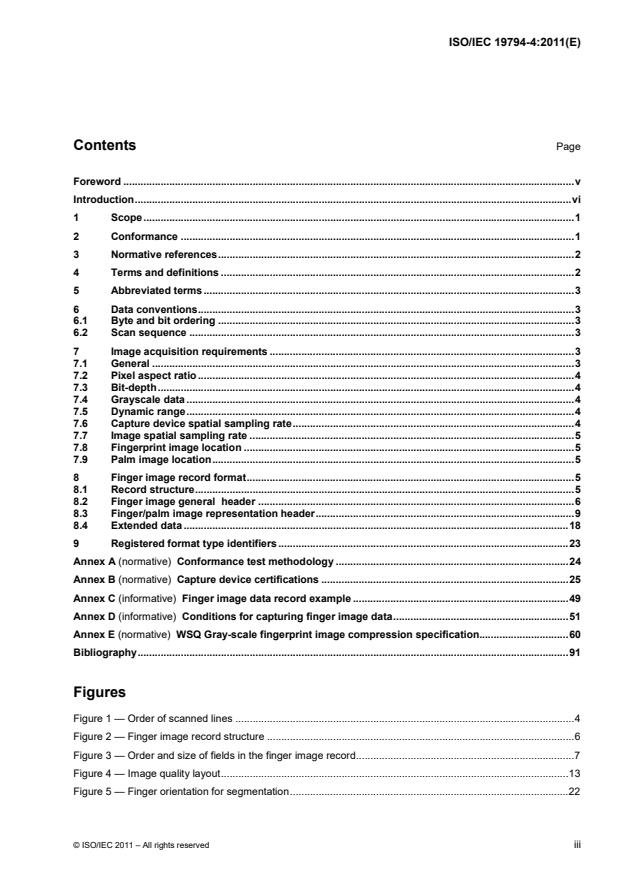
Contents Page
Foreword .v
Introduction.vi
1 Scope.1
2 Conformance .1
3 Normative references.2
4 Terms and definitions .2
5 Abbreviated terms .3
6 Data conventions.3
6.1 Byte and bit ordering .3
6.2 Scan sequence .3
7 Image acquisition requirements .3
7.1 General .3
7.2 Pixel aspect ratio .4
7.3 Bit-depth.4
7.4 Grayscale data .4
7.5 Dynamic range.4
7.6 Capture device spatial sampling rate.4
7.7 Image spatial sampling rate .5
7.8 Fingerprint image location .5
7.9 Palm image location.5
8 Finger image record format.5
8.1 Record structure.5
8.2 Finger image general header .6
8.3 Finger/palm image representation header.9
8.4 Extended data .18
9 Registered format type identifiers .23
Annex A (normative) Conformance test methodology .24
Annex B (normative) Capture device certifications .25
Annex C (informative) Finger image data record example .49
Annex D (informative) Conditions for capturing finger image data.51
Annex E (normative) WSQ Gray-scale fingerprint image compression specification.60
Bibliography.91
Figures
Figure 1 — Order of scanned lines .4
Figure 2 — Finger image record structure .6
Figure 3 — Order and size of fields in the finger image record.7
Figure 4 — Image quality layout.13
Figure 5 — Finger orientation for segmentation.22
© ISO/IEC 2011 – All rights reserved iii
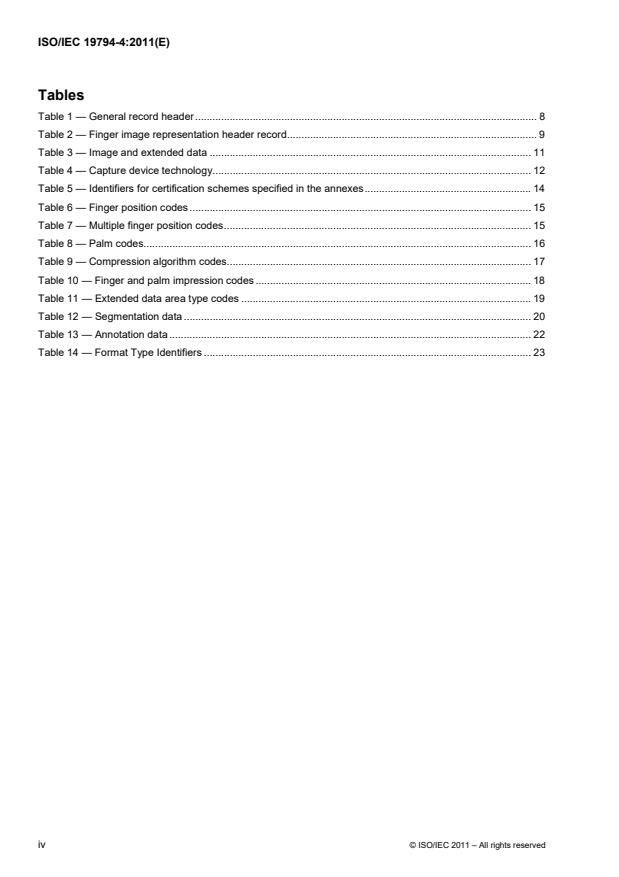
Tables
Table 1 — General record header. 8
Table 2 — Finger image representation header record. 9
Table 3 — Image and extended data . 11
Table 4 — Capture device technology. 12
Table 5 — Identifiers for certification schemes specified in the annexes. 14
Table 6 — Finger position codes . 15
Table 7 — Multiple finger position codes. 15
Table 8 — Palm codes. 16
Table 9 — Compression algorithm codes. 17
Table 10 — Finger and palm impression codes . 18
Table 11 — Extended data area type codes . 19
Table 12 — Segmentation data . 20
Table 13 — Annotation data . 22
Table 14 — Format Type Identifiers . 23
iv © ISO/IEC 2011 – All rights reserved
Foreword
ISO (the International Organization for Standardization) and IEC (the International Electrotechnical
Commission) form the specialized system for worldwide standardization. National bodies that are members of
ISO or IEC participate in the development of International Standards through technical committees
established by the respective organization to deal with particular fields of technical activity. ISO and IEC
technical committees collaborate in fields of mutual interest. Other international organizations, governmental
and non-governmental, in liaison with ISO and IEC, also take part in the work. In the field of information
technology, ISO and IEC have established a joint technical committee, ISO/IEC JTC 1.
International Standards are drafted in accordance with the rules given in the ISO/IEC Directives, Part 2.
The main task of the joint technical committee is to prepare International Standards. Draft International
Standards adopted by the joint technical committee are circulated to national bodies for voting. Publication as
an International Standard requires approval by at least 75% of the national bodies casting a vote.
Attention is drawn to the possibility that some of the elements of this document may be the subject of patent
rights. ISO and IEC shall not be held responsible for identifying any or all such patent rights.
ISO/IEC 19794-4 was prepared by Joint Technical Committee ISO/IEC JTC 1, Information technology,
Subcommittee SC 37, Biometrics.
This second edition cancels and replaces the first edition (ISO/IEC 19794-4:2005). It reflects the
harmonization across the second generation of ISO/IEC 19794. Clause 8 has been technically revised and
contains descriptions of the harmonized general and representation headers. Annex A is under development
and will contain an amendment for conformance testing methodology for this part of ISO/IEC 19794. Annex B
contains capture device certifications for capturing finger image data. Annex B has been technically revised.
Annex D describes conditions for capturing finger image data, and Annex E contains the WSQ Gray-scale
fingerprint image compression specification. The former Annex A “Image Quality Specification” has been
removed.
ISO/IEC 19794 consists of the following parts, under the general title Information technology — Biometric data
interchange formats:
⎯ Part 1: Framework
⎯ Part 2: Finger minutiae data
⎯ Part 3: Finger pattern spectral data
⎯ Part 4: Finger image data
⎯ Part 5: Face image data
⎯ Part 6: Iris image data
⎯ Part 7: Signature/sign time series data
⎯ Part 8: Finger pattern skeletal data
⎯ Part 9: Vascular image data
⎯ Part 10: Hand geometry silhouette data
⎯ Part 11: Signature/sign processed dynamic data
⎯ Part 13: Voice data
⎯ Part 14: DNA data
© ISO/IEC 2011 – All rights reserved v
Introduction
In the forensic community, the capture and transmission of fingerprint images has been a common choice for
the exchange of fingerprint information used by Automatic Fingerprint Identification Systems (AFIS) for the
identification of individuals. However, little to no fingerprint information is being exchanged between
equipment from different vendors in the biometric user verification and access community. This has been due
in part to the lack of agreement between vendors on the amount and type of information to capture, the
method of capture, and the information to be exchanged.
ISO/IEC 19794 is a series of International Standards being developed by ISO/IEC JTC 1/SC 37 that supports
interoperability and data interchange among biometric applications and systems. The series specifies
requirements that solve the complexities of applying biometrics to a wide variety of personal recognition
applications, whether such applications operate in an open systems environment or consist of a single, closed
system. Additional information regarding the series is provided in ISO/IEC 19794-1.
This part of ISO/IEC 19794 is intended for those applications requiring the exchange of raw or processed
fingerprint and palm images that may not necessarily be limited by the amount of resources required for data
storage or transmitting time. It can be used for the exchange of scanned fingerprints containing detailed image
pixel information. This part of ISO/IEC 19794 can also be used to exchange processed fingerprint image data
containing considerably fewer pixels per inch and/or a lesser number of grayscale levels. This is in contrast to
other parts of ISO/IEC 19794 used for exchanging lists of fingerprint characteristics such as minutiae, patterns,
or other variants. These formats require considerably less storage than a fingerprint image. However, by using
any of the other parts of ISO/IEC 19794, information recorded in one standard format cannot be used by
algorithms designed to operate with another type of information. In other words, minutiae data records cannot
be compared with pattern skeletal data comparison subsystems.
Although the minutiae, pattern, or other approaches produce different intermediate outputs, all shall initially
capture a reasonably high quality fingerprint image before reducing the size of the image (in bytes) or
developing a list of characteristic data from the image. Use of the captured or processed image can provide
interoperability among vendors relying on minutiae-based, pattern-based or other algorithms. As a result, data
from the captured finger image offers the developer more freedom in choosing or combining comparison
algorithms. For example, an enrolment image may be stored on a contactless chip located on an identification
document. This will allow future verification of the holder of the document with systems that rely on either
minutiae-based or pattern-based algorithms. Establishment of an image-based representation of fingerprint
information will not rely on pre-established definitions of minutiae, patterns or other types. It will provide
implementers with the flexibility to accommodate images captured from dissimilar devices, varying image
sizes, spatial sampling rates, and different grayscale depths. Use of the fingerprint image will allow each
vendor to implement their own algorithms to determine whether two fingerprint records are from the same
finger.
vi © ISO/IEC 2011 – All rights reserved
INTERNATIONAL STANDARD ISO/IEC 19794-4:2011(E)
Information technology — Biometric data interchange
formats —
Part 4:
Finger image data
1 Scope
This part of ISO/IEC 19794 specifies a data record interchange format for storing, recording, and transmitting
the information from one or more finger or palm image areas. This can be used for the exchange and
comparison of finger image data. It defines the content, format, and units of measurement for the exchange of
finger image data that may be used for enrolment, verification, or identification of a subject. The information
consists of a variety of mandatory and optional items, including scanning parameters, compressed or
uncompressed images and vendor-specific information. This information is intended for interchange among
organizations that rely on automated devices and systems for identification or verification purposes based on
the information from finger image areas. Information compiled and formatted in accordance with this part of
ISO/IEC 19794 can be recorded on machine-readable media or may be transmitted by data communication
facilities.
2 Conformance
A biometric data record conforms to this part of ISO/IEC 19794 if it satisfies all of the normative requirements
related to:
a) its data structure, data values, and the relationships between its data elements, as specified throughout
Clause 8 for the finger image record format of this part of ISO/IEC 19794;
b) the relationship between its data values and the input biometric data from which the biometric data record
was generated, as specified throughout Clause 8 for the finger image record format of this part of
ISO/IEC 19794.
A system that produces biometric data records is conformant to this part of ISO/IEC 19794 if all biometric data
records that it outputs conform to this part of ISO/IEC 19794 (as defined above) as claimed in the
Implementation Conformance Statement (ICS) associated with that system. A system does not need to be
capable of producing biometric data records that cover all possible aspects of this part of ISO/IEC 19794, but
only those that are claimed to be supported by the system in the ICS.
A system that uses biometric data records is conformant to this part of ISO/IEC 19794 if it can read, and use
for the purpose intended by that system, all biometric data records that conform to this part of ISO/IEC 19794
(as defined above) as claimed in the ICS associated with that system. A system does not need to be capable
of using biometric data records that cover all possible aspects of this part of ISO/IEC 19794, but only those
that are claimed to be supported by the system in an ICS.
© ISO/IEC 2011 – All rights reserved 1
3 Normative references
The following referenced documents are indispensable for the application of this document. For dated
references, only the edition cited applies. For undated references, the latest edition of the referenced
document (including any amendments) applies.
ISO/IEC 10918-1, Information technology — Digital compression and coding of continuous-tone still images:
Requirements and guidelines
ISO/IEC 15444 (all parts), Information technology — JPEG 2000 image coding system
ISO/IEC 15948, Information technology — Computer graphics and image processing — Portable Network
Graphics (PNG): Functional specification
ISO/IEC 19794-1:2011, Information technology — Biometric data interchange formats — Part 1: Framework
ISO/IEC 29794-1, Information technology — Biometric sample quality — Part 1: Framework
4 Terms and definitions
For the purposes of this document, the terms and definitions given in ISO/IEC 19794-1 and the following apply.
4.1
capture device spatial sampling rate
number of pixels per unit distance used by a sensor or scanning device to initially capture an image
4.2
fingerprint image
area of friction skin on the fleshy surface of a finger located horizontally between the two edges of the
fingernail and vertically between the first joint and the tip of a finger
NOTE It contains a unique pattern of friction ridge and valley information commonly referred to as a “fingerprint”.
4.3
image spatial sampling rate
number of pixels per unit distance in the image
NOTE This may be the result of processing a captured image. The original captured scanned image may have been
subsampled, scaled, down-sampled, or otherwise processed.
4.4
palm
friction ridge skin on the side and underside of the hand
4.5
plain fingerprint image
image captured from a finger placed on a platen without any rolling movement
4.6
rolled fingerprint image
image captured that is located between the two edges of the fingernail
NOTE This type of image is typically acquired using a rolling motion from one edge of the fingernail to the other.
4.7
vertical rolls
fingerprint images that have been captured by rolling a finger vertically from the slap position over the finger
tip to the nail
NOTE This is in contrast to horizontal rolls, which are captured by horizontal rolling from the nail over the slap
position to the other side of the nail as described in the definition for “rolled fingerprint image”.
2 © ISO/IEC 2011 – All rights reserved
5 Abbreviated terms
For the purposes of this document the following abbreviations and those given in ISO/IEC 19794-1 apply.
ppcm pixels per centimetre
ppi pixels per inch
TIR Total Internal Reflection
6 Data conventions
6.1 Byte and bit ordering
Each item of information, field, or logical record shall contain one or more bytes of data. Within a record all
multibyte quantities are represented in Big-Endian format. That is, the more significant bytes of any multibyte
quantity are stored at lower addresses in memory than less significant bytes. The order for transmission shall
also be the most significant byte first and least significant byte last. Within a byte, the order of transmission
shall be the most significant bit first and the least significant bit last. All numeric values are fixed-length
unsigned integer quantities.
6.2 Scan sequence
It is not the purpose of this part of ISO/IEC 19794 to specify the orientation of the finger (or palm), the method
of scanning, or the order of scanning used to capture the image. However, each image as presented in
accordance with this format standard shall appear to have been captured in an upright position and
approximately centered horizontally in the field of view. The recorded image data shall appear to be the result
of a scanning of an impression of a fingerprint. The scanning sequence (and recorded data) shall appear to
have been captured from left-to-right, progressing from top-to-bottom of the fingerprint or palm print. Figure 1
illustrates the recording order for the scanned image. For the purpose of describing the position of each pixel
within an image to be exchanged, a pair of reference axes shall be used. The origin of the axes, pixel location
(0,0), shall be located at the upper left-hand corner of each image. The x-coordinate (horizontal) position shall
increase positively from the origin to the right side of the image. The y-coordinate (vertical) position shall
increase positively from the origin to the bottom of the image.
7 Image acquisition requirements
7.1 General
Image capture requirements are dependent on various factors including the application, the available amount
of raw pixel information to retain or exchange, and targeted performance metrics. As a result of these factors,
the image capture operation will be associated with a combination of image acquisition parameters settings
described below.
© ISO/IEC 2011 – All rights reserved 3
Figure 1 — Order of scanned lines
7.2 Pixel aspect ratio
The finger image shall be represented using square pixels, in which the horizontal and vertical dimensions of
the pixels are equal. Any difference between these two dimensions should be within 1%. That is, the ratio of
horizontal to vertical pixel dimensions should be between 0,99 and 1,01.
7.3 Bit-depth
The grayscale precision of the pixel data shall be specified in terms of the bit-depth or the number of bits used
to represent the grayscale value of a pixel. A bit-depth of 3 provides 8 levels of grayscale; a depth of 8
provides 256 levels of gray. For grayscale data, the minimum value that can be assigned to a "black" pixel
shall be zero. The maximum value that can be assigned to a "white" pixel shall be the grayscale value with all
of its bits of precision set to "1". However, the “blackest" pixel in an image may have a value greater than "0"
and the "whitest" pixel may have a value less than its maximum value. For example, the range of values for a
"white" pixel with 5 bits of precision shall be 31 or less. The range of values for a “white” pixel using 8 bits of
precision shall be 255 or less. The bit-depth may range from 1 to 16 bits.
7.4 Grayscale data
Grayscale finger image data shall be stored, recorded, or transmitted in either compressed or uncompressed
form. The image data portion of a record for an uncompressed grayscale image shall contain a set of raw
pixel information. Using a bit-depth of 8 bits (256 grayscale levels) each pixel shall be contained in a single
byte. Pixel values with a depth of less than eight bits shall be stored and transmitted in a packed binary format.
Increased precision for pixel values greater than 255 shall use two unsigned bytes to hold up to sixteen-bit
pixels with values in the range of 0-65535. The encoding of a compressed grayscale image shall be the output
of the appropriate grayscale compression algorithm specified in Table 9. Upon decompression the grayscale
value for each pixel shall be represented in the same manner as pixels in an uncompressed image.
7.5 Dynamic range
The image grayscale shall be encoded using the agreed precision necessary to meet the dynamic range
requirement for a specific application. It is assumed that the precise requirements of the application are known.
7.6 Capture device spatial sampling rate
Grayscale fingerprint images to be captured shall be acquired by an image capture device operating at a
specific scanning spatial sampling rate. As the spatial sampling rate used in the image capture process is
increased, more detailed ridge and structure information for processing becomes available. For minutiae and
small feature based algorithms, use of the higher spatial sampling rate enhances the detection of more closely
spaced features that may not be detected using the minimum spatial sampling rate.
4 © ISO/IEC 2011 – All rights reserved
7.7 Image spatial sampling rate
The spatial sampling rate of the image data formatted and recorded for interchange may be the scan spatial
sampling rate of the image or it may have been sub-sampled, scaled, down-sampled, or otherwise processed
to produce a form for representing the ridge and valley structure areas of the fingerprint.
7.8 Fingerprint image location
This part of ISO/IEC 19794 is designed to accommodate both plain (flat) or rolled fingerprint images. Biometric
systems perform better if the volar pad of the finger is centered both horizontally and vertically in the image
capture area. Therefore, when capturing a fingerprint image, the center of the fingerprint image should be
located in the approximate center of the image capture area.
For multiple finger verification and/or identification purposes, there are currently fingerprint scanner devices
that will acquire images of multiple fingers during a single capture cycle. These devices are capable of
capturing the plain impressions from two, three, or four adjacent fingers of either hand during a single
scanning. The plain impressions from the two thumbs or two index fingers can also be captured at one time.
Therefore, with three placements of the fingers on a device’s scanning surface all ten fingers from an
individual shall be acquired in three scans – right four fingers, left four fingers, and two thumbs. For these
multi-finger captures, half of the captured fingers should be located to the left of the image center and the
other half of the fingers to the right of the image center.
7.9 Palm image location
This part of ISO/IEC 19794 is also designed to accommodate images from the palm of the hand or from the
side of the hand opposite the thumb also known as the “writer’s palm”. Most comparison subsystems perform
better if the flat or fleshy part of the palm or writer’s palm is centered both horizontally and vertically in the
image capture area. Therefore, when capturing a palmprint image, the center of the palm or writer’s palm
image area should be located in the approximate center of the image capture area. The palm itself may be
captured as one entity, or various pieces of it can be captured as single images such as the thenar (fleshy part
behind the thumb), hyperthenar (fleshy area opposite the thumb), or interdigital (area of the palm directly
beneath the four fingers).
8 Finger image record format
8.1 Record structure
This part of ISO/IEC 19794 defines the composition of the finger image record. Each record shall pertain to a
single subject and shall contain at least one representation for each of one or more fingers, multiple fingers
(single image records), or palms. Figure 2 illustrates the record structure for the finger image record format.
Figure 3 details the order of fields in the record and the length of each field. The fields in white indicate
mandatory fields. Shaded fields indicate optional information.
© ISO/IEC 2011 – All rights reserved 5
ISO/IEC 19794-4
BDIR
Representation #1 Representation #2 Representation #X
. . .
General Header
(mandatory) (optional) (optional)
Fixed-length
Representation Header
Representation data
Variable-length Variable-length
Figure 2 — Finger image record structure
The organization of the record format is as follows:
• A single fixed-length (16-byte) general record header containing information about the overall record,
including the number of finger/palm images represented and the overall record length in bytes;
• A single finger record for each single finger, multi-finger, or palm image representation consisting of:
o A variable length finger image representation header containing information pertaining to the data for
a single finger, multi-finger, or palm image;
NOTE1 For each quality block of information recorded, the length will be increased by 5 bytes.
NOTE2 If any of the finger image representations contain a device certification block, then the length of each
finger representation header shall be a minimum of a 42-byte header.
NOTE3 For each device certification block of information recorded the length will be increased by 3 bytes.
o A variable-length finger image representation body containing
ƒ Compressed or uncompressed image data representation for a single, multi-finger, or palm
image; and
ƒ Optional extended data describing finger segmentation (in the case of multi-finger images),
annotation, and comments.
Annex C provides an example of the application of this part of ISO/IEC 19794. It illustrates the completion of
required data fields for both the general record header and the finger image record.
8.2 Finger image general header
8.2.1 Required fields
Table 1 lists the fields included in the general record header. As this is a fixed-length header, information shall
be included for each field within the header.
6 © ISO/IEC 2011 – All rights reserved
General Format Version Length of Number of Certification flag Number of distinct
Header identifier number record finger/palm finger/palm
representations positions
4 4 4 2 1 1
Representation Representation Capture Capture device Capture Capture Number of
Header length date & time technology device vendor device type quality blocks
identifier Identifier identifier
4 9 1 2 2 1
Quality Number of Certification Finger/palm Representation Scale units Capture Capture
block data certification block data position number device device
blocks spatial spatial
sampling sampling
rate (horiz) rate (vert)
5x 1 3x 1 1 1 2 2
Image Image Bit-depth Image Impression Horizontal Vertical line Image data
spatial spatial compression type line length length length
sampling sampling algorithm
rate (horiz) rate (vert)
2 2 1 1 1 2 2 4
Quality score
Quality block Quality Quality
data algorithm algorithm ID
vendor ID
1 2 2
Certification Certification Certification
block data authority scheme
identifier identifier
2 1
Representation Image data Extended
Body data blocks
Variable Variable
Data section
Extended Type identification Length of
data block code data
2 2 Variable
Figure 3 — Order and size of fields in the finger image record
8.2.2 Format identifier
The format identifier shall be recorded in four bytes. The format identifier shall consist of three characters
"FIR" followed by a zero byte as a NULL string terminator.
8.2.3 Version number
The number for the version of this part of ISO/IEC 19794 used for constructing the BDIR shall be placed in
four bytes. This version number shall consist of three ASCII numerals followed by a zero byte as a NULL
© ISO/IEC 2011 – All rights reserved 7
Table 1 — General record header
Field Size Valid values Notes
Format identifier 4 bytes 464952 (‘F’ ‘I’ ‘R’ 00 ) “FIR” – Finger Image Record
Hex Hex
Version number 4 bytes 30323000 (‘0’ ’2’ ’0’ 00 ) “020”
Hex Hex
Length of record 4 bytes 57 to (2 -1) Includes all finger/palm
representations, quality
blocks and certification
1)
blocks
Number of finger/palm 2 bytes 1 to 672 [ (14 finger positions) + (11
representations multiple finger positions) +
(17 palm codes) ]* 16 = 672
possible representations
Certification flag 1 byte 0, 1 Indicates the presence of
any device certification
blocks within the
representation headers
Number of distinct 1 byte >=1 Number of fingers or palms
fingers/palm positions represented
string terminator. The first and second character will represent the major version number and the third
character will represent the minor revision number. Upon approval of this specification, the version number
shall be “020” – Version 2 revision 0.
8.2.4 Length of record
The length (in bytes) of the entire BDIR shall be recorded in four bytes. This count shall be the total length of
the BDIR including the general record header and one or more representation records. The length of the
record is dependent on several factors.
8.2.5 Number of finger/palm representations
The total number of representation records contained in the BDIR shall be recorded in two bytes. A minimum
of one representation is required. In cases where there is more than one representation of any finger or palm,
this number will be greater than the number of fingers or palms.
8.2.6 Device certification flag
The one-byte certification flag shall indicate whether each representation header includes a certification record.
A value of 00 shall indicate that none of the representations contains a certification record. A value of 01
Hex Hex
shall indicate that all representations contain a certification record.
NOTE A certification record that is present may contain 0 certifications (in that case the number-of-certifications field
in the certification record has the value 0).
1) If Certification flag (General Header) = 0
Number of
Representations
Length = 16 + ∑ (41+ 5*(#QualityBlocks)+SizeOfImageData+SizeOfExtendedData)
If Device Certification Flag (General Header) = 1
Number of
Representations
Length = 16 + ∑ (42 + 5*(#QualityBlocks) + 3*(#Certification blocks) + SizeOfImageData
1 + SizeOfExtendedData
8 © ISO/IEC 2011 – All rights reserved
8.2.7 Number of distinct finger/palm positions
The number of fingers or palms included in the record shall be recorded in one byte. Multiple fingers acquired
by a single capture and contained in the same image are counted as a single finger image.
EXAMPLE 1 If a record contains two images of a right index finger (position code 2 in Table 6 ) and two images of a left
index finger (position code 7 in Table 6) then the value encoded by this clause would be 2. The number of representations
encoded by clause 8.2.5 would be 4.
EXAMPLE 2 If a record contains two images of a right index finger (position code 2 in Table 6), one image of the left
index and middle fingers (position code 43 in Table 7), and one image of the right four fingers (position code 13 in Table 6)
then the value encoded by this clause would be 3. The number of representations encoded by clause 8.2.5 would be 4.
8.3 Finger/palm image representation header
8.3.1 Required fields
A finger or palm representation header shall start each section of finger data providing information for that
representation of a single finger image, multi-finger image, or palm image. For each such image there shall be
one finger header record accompanying the representation of the image data. The finger header shall occupy
a minimum of 41 or 42 bytes as described below (depending on the certification flag in the general header).
The compressed or uncompressed image data for that image representation shall immediately follow the
header portion. Additional representations (including the header portion) will be concatenated to the end of the
previous representation data. Table 2 is a list of the entries contained in the header preceding each block of
finger/palm image data. Table 3 lists the finger/palm image data and various types of extended data
associated with a finger representation.
Table 2 — Finger image representation header record
Field Size Valid values Notes
Representation length 4 bytes 41 to FFFFFFFF Denotes the length in bytes of the
Hex Hex
representation including the
representation header fields
Capture date and time 9 bytes See ISO/IEC 19794-1 The capture date and time field shall
indicate when the capture of this
representation stated in Coordinated
Universal Time (UTC). The capture date
and time field shall consist of 9 bytes. Its
value shall be encoded in the form given
in ISO/IEC 19794-1.
Capture device technology 1 byte 0 to 20 The capture device technology ID shall
identifier be encoded in one byte. This field shall
indicate the class of capture device
technology used to acquire the captured
biometric sample. A value of 00Hex
indicates unknown or unspecified
technology. See Table 4 for the list of
possible values.
Capture device vendor 2 bytes 0000 to FFFF The capture device vendor identifier shall
Hex Hex
identifier identify the biometric organization that
owns the product that created the BDIR.
The capture device algorithm vendor
identifier shall be encoded in two bytes
carrying a CBEFF biometric organization
identifier (registered by IBIA or other
approved registration authority). A value
of all zeros shall indicate that the capture
device vendor is unreported.
© ISO/IEC 2011 – All rights reserved 9
Field Size Valid values Notes
Capture device type identifier 2 bytes 0000 to FFFF The capture device type identifier shall
Hex Hex
identify the product type that created the
BDIR. It shall be assigned by the
registered product owner or other
approved registration authority. A value
of all zeros shall indicate that the capture
device type is unreported. If the capture
device vendor identifier is 0000 , then
Hex
also the capture device type identifier
shall be 0000 .
Hex
Quality record 1 to 1,276 See Table 5 in A quality record shall consist of a length
bytes ISO/IEC 19794-1:2011 for field followed by zero or more quality
more details blocks. The length field shall consist of
(1 to 1 + (255
one byte. It shall represent the number of
* 5))
quality blocks as an unsigned integer.
Each quality block shall consist of
– a quality score,
– a quality algorithm vendor identifier,
and
– a quality algorithm identifier.
A quality score should express the
predicted comparison performance of a
representation. A quality score shall be
encoded in one byte as an unsigned
integer. Allowed values are
– 0 to 100 with higher values indicating
better quality,
– 255, i.e. ff , for indicating that an
Hex
attempt to calculate a quality score
failed.
The quality algorithm vendor identifier
shall identify the provider of the quality
algorithm. The quality algorithm vendor
identifier shall be encoded in two bytes
carrying a CBEFF biometric organization
identifier (registered by IBIA or other
approved registration authority). A value
of all zeros shall indicate that the value
for this field is unreported.
The quality algorithm identifier shall
identify the vendor’s quality algorithm
that created the quality score. It shall be
assigned by the provider of the quality
algorithm or an approved registration
authority. The quality algorithm identifier
shall be encoded in two bytes. A value of
all zeros shall indicate that the value for
this field is unreported.
0 to 766
Certification record See ISO/IEC 19794-1 The certification record only exists if the
bytes certification flag in the general header
has a value of 1. A certification record
(1 to 1 +
shall consist of a length field followed by
(255 * 3))
zero or more certification blocks. The
length field shall consist of one byte. It
shall represent the number of unique
certification blocks as an unsigned
integer.
10 © ISO/IEC 2011 – All rights reserved
Field Size Valid values Notes
Each certification block shall consist of
– a certification authority identifier and
– a certification scheme identifier.
The certification authority identifier shall
identify a certification authority that has
carried out a certification according to a
certification scheme. The certification
authority identifier shall be encoded in
two bytes carrying a CBEFF biometric
organization identifier (registered by IBIA
or other approved registration authority).
The certification scheme identifier shall
identify a certification scheme according
to which a certification has been carried
out. The certification scheme identifier
shall be encoded in one byte. See
Table 5 for the list of certification scheme
identifiers.
Finger/palm position 1 byte 0 to 10; 13 to 15; 20 to 36; See Table 6 through 9
40 to 50
Representation number 1 byte 0 to 15
Scale units 1 byte 1 to 2 Pixels/Inch or pixels/cm
Scan spatial sampling rate 2 bytes 0 to (2 -1) Dependent upon the scanner
(horiz)
Scan spatial sampling rate 2 bytes 0 to (2 -1) Dependent upon the scanner
(vert)
Image spatial sampling rate 2 bytes <= Scan Spatial sampling Quality level dependent
(horiz) rate (horiz)
Image spatial sampling rate 2 bytes <= Scan Spatial sampling Quality level dependent
(vert) rate (vert)
Bit-depth 1 byte 1 to 16 bits 2 – 65535 gray levels
Image compression Algorithm 1 byte 0 to 5 See Table 9
Impression type 1 byte 0 to 15; 20 to 29 See Table 10
Horizontal line length 2 bytes 0 to (2 -1) Dependent on the sensor used
Vertical line length 2 bytes 0 to (2 -1) Dependent on the sensor used
Image data length 4 bytes 0 to (2 -58) Number of bytes for the
compressed/uncompressed image data
8.3.2 Representation length
The representation-length field denotes the length in bytes of the representation including the representation
header fields.
Table 3 — Image and extended data
Data Type Field Size Valid Values Notes
Finger/palm image data < 2 -1 bytes ___________ Compressed or
uncompressed image data
Type identification code 2 bytes 0001 to FFFF Segmentation, annotation,
Hex Hex
comment, or vendor specific
Length of data 2 bytes 0004 to FFFF
Hex Hex
data
Data section (Length of data)-4 bytes
Values >0100 are vendor
Hex
specific extended data
© ISO/IEC 2011 – All rights reserved 11
Extended Image
Data Blocks Data
8.3.3 Capture date-time
The capture date and time fi
...
Questions, Comments and Discussion
Ask us and Technical Secretary will try to provide an answer. You can facilitate discussion about the standard in here.
Loading comments...