

ISO 10303-52:2011/Cor 1:2014
(Corrigendum)Industrial automation systems and integration — Product data representation and exchange — Part 52: Integrated generic resource: Mesh-based topology — Technical Corrigendum 1
General Information
- Abstract
- Status
- Published
- Publication Date
- 01-Dec-2014
- Technical Committee
- ISO/TC 184/SC 4 - Industrial data
- Drafting Committee
- ISO/TC 184/SC 4/WG 12 - STEP product modelling and resources
- Current Stage
- 6060 - International Standard published
- Start Date
- 02-Dec-2014
- Due Date
- 04-Oct-2016
- Completion Date
- 04-Oct-2016
Buy Documents

ISO 10303-52:2011/Cor 1:2014 - Industrial automation systems and integration — Product data representation and exchange — Part 52: Integrated generic resource: Mesh-based topology — Technical Corrigendum 1 Released:12/2/2014
Overview
ISO 10303-52:2011/Cor 1:2014 is a corrigendum for Part 52 of the ISO 10303 standard, also known as STEP (Standard for the Exchange of Product model data). This part focuses on "Integrated generic resource: Mesh-based topology." The corrigendum, published in 2014 by the International Organization for Standardization (ISO), amends the original 2011 standard by correcting textual errors and addressing several Bugzilla reports (Bug 3439, Bug 4617, and Bug 4813).
The revisions ensure clarity and consistency in the mesh-based topology model definitions, further supporting the reliable exchange and interoperability of product data in industrial automation systems.
Key Topics
Mesh-Based Topology Correction
The technical corrigendum addresses errors concerning the representation of meshes, specifically:
- Correction of an incorrect inclusion of polygon cell shapes not specified in Part 52.
- Updates to the EXPRESS schema definitions for mesh data structures such as
array_based_unstructured_mesh,explicit_unstructured_mesh, andmatched_mesh_connection. - Corrections to function and entity definitions to improve accuracy, especially around the use and definition of vertices, edges, and cells.
- Replacement and modification of key tables (such as Table 2) to accurately reflect supported cell types, including triangles and quadrilaterals, and the relationships between edges and vertices.
Annex and Schema Identification Updates
- Clarified and updated object identifiers for different mesh schemas to ensure unambiguous identification in open information systems, in line with ISO/IEC 8824-1 and ISO 10303-1.
Applications
Industrial Automation Systems
ISO 10303-52 and its corrigendum play a vital role in the field of industrial data automation and product lifecycle management. Typical application areas include:
- Product Data Exchange - Enables consistent and precise sharing of complex mesh-based topological data between different CAD, CAE, and simulation tools.
- Simulation and Analysis - Provides reliable mesh representations for advanced engineering analyses (e.g., finite element analysis, computational fluid dynamics) where mesh topology is fundamental.
- Interoperability - Supports integration between different software environments, allowing for enhanced collaboration and streamlined product development processes.
- Long-Term Data Archiving - Offers a robust framework for storing mesh-based product data, safeguarding against information loss over time.
Manufacturing and Engineering
These corrections enhance the effectiveness and trustworthiness of product data used in:
- Aerospace and automotive design,
- Mechanical engineering,
- Structural analysis,
- Electronics and heavy industry.
Related Standards
For broader context and enhanced utility, users of ISO 10303-52:2011/Cor 1:2014 may also reference:
- ISO 10303 (STEP) family - Comprehensive suite of standards for product data representation and exchange.
- ISO 10303-1: Overview and fundamental principles of STEP.
- ISO 10303-21: STEP file format specification for data exchange.
- ISO 10303-104: Graphical representations associated with mesh topology.
- ISO/IEC 8824-1: ASN.1 notation for specifying object identifiers.
These related standards provide foundational guidance for implementing integrated automation systems, supporting the full lifecycle of industrial products from conception to decommissioning.
By aligning mesh topology data correction and schema definitions, ISO 10303-52:2011/Cor 1:2014 strengthens data integrity and interoperability across industrial automation and engineering domains, maintaining industry confidence in digital product representation and exchange.
Relations
- Effective Date
- 31-Jul-2021
Buy Documents
ISO 10303-52:2011/Cor 1:2014 - Industrial automation systems and integration — Product data representation and exchange — Part 52: Integrated generic resource: Mesh-based topology — Technical Corrigendum 1 Released:12/2/2014
Get Certified
Connect with accredited certification bodies for this standard

DVS-ZERT GmbH
German welding certification society.
CARES (UK Certification Authority for Reinforcing Steels)
UK certification for reinforcing steels and construction.
EWF/IIW (European/International Welding Federation)
International welding personnel certification.
Sponsored listings
Frequently Asked Questions
ISO 10303-52:2011/Cor 1:2014 is a standard published by the International Organization for Standardization (ISO). Its full title is "Industrial automation systems and integration — Product data representation and exchange — Part 52: Integrated generic resource: Mesh-based topology — Technical Corrigendum 1". This standard covers: Industrial automation systems and integration — Product data representation and exchange — Part 52: Integrated generic resource: Mesh-based topology — Technical Corrigendum 1
Industrial automation systems and integration — Product data representation and exchange — Part 52: Integrated generic resource: Mesh-based topology — Technical Corrigendum 1
ISO 10303-52:2011/Cor 1:2014 is classified under the following ICS (International Classification for Standards) categories: 25.040.40 - Industrial process measurement and control. The ICS classification helps identify the subject area and facilitates finding related standards.
ISO 10303-52:2011/Cor 1:2014 has the following relationships with other standards: It is inter standard links to ISO 10303-52:2011. Understanding these relationships helps ensure you are using the most current and applicable version of the standard.
ISO 10303-52:2011/Cor 1:2014 is available in PDF format for immediate download after purchase. The document can be added to your cart and obtained through the secure checkout process. Digital delivery ensures instant access to the complete standard document.
Standards Content (Sample)
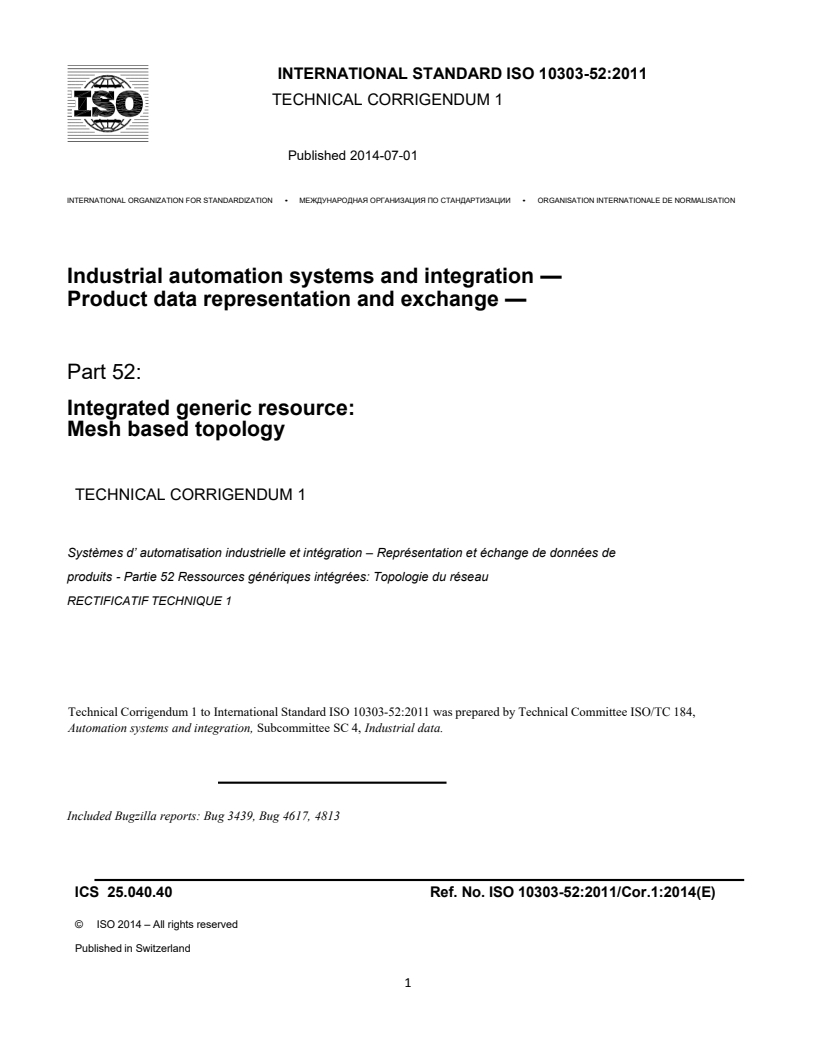
INTERNATIONAL STANDARD ISO 10303-52:2011
TECHNICAL CORRIGENDUM 1
Published 2014-07-01
INTERNATIONAL ORGANIZATION FOR STANDARDIZATION • МЕЖДУНАРОДНАЯ ОРГАНИЗАЦИЯ ПО СТАНДАРТИЗАЦИИ • ORGANISATION INTERNATIONALE DE NORMALISATION
Industrial automation systems and integration —
Product data representation and exchange —
Part 52:
Integrated generic resource:
Mesh based topology
TECHNICAL CORRIGENDUM 1
Systèmes d’ automatisation industrielle et intégration – Représentation et échange de données de
produits - Partie 52 Ressources génériques intégrées: Topologie du réseau
RECTIFICATIF TECHNIQUE 1
Technical Corrigendum 1 to International Standard ISO 10303-52:2011 was prepared by Technical Committee ISO/TC 184,
Automation systems and integration, Subcommittee SC 4, Industrial data.
Included Bugzilla reports: Bug 3439, Bug 4617, 4813
ICS 25.040.40 Ref. No. ISO 10303-52:2011/Cor.1:2014(E)
© ISO 2014 – All rights reserved
Published in Switzerland
ISO 10303-52:2011/Cor.1:2014(E)
Introduction
This Technical Corrigendum applies to ISO 10303-52:2011.
The purpose of the modifications to the text of ISO 10303-52:2001 is to correct errors relating to incorrect
inclusion of a polygon cell shape. Corrections are made to the text, a table, to correct the EXPRESS in 3
entity definitions and to one EXPRESS function, and to update the document identifiers in annex B.
ii °c ISO 2014 — All rights reserved
ISO 10303-52:2011/Cor.1:2014(E)
Modifications to the text of ISO 10303-52:2011
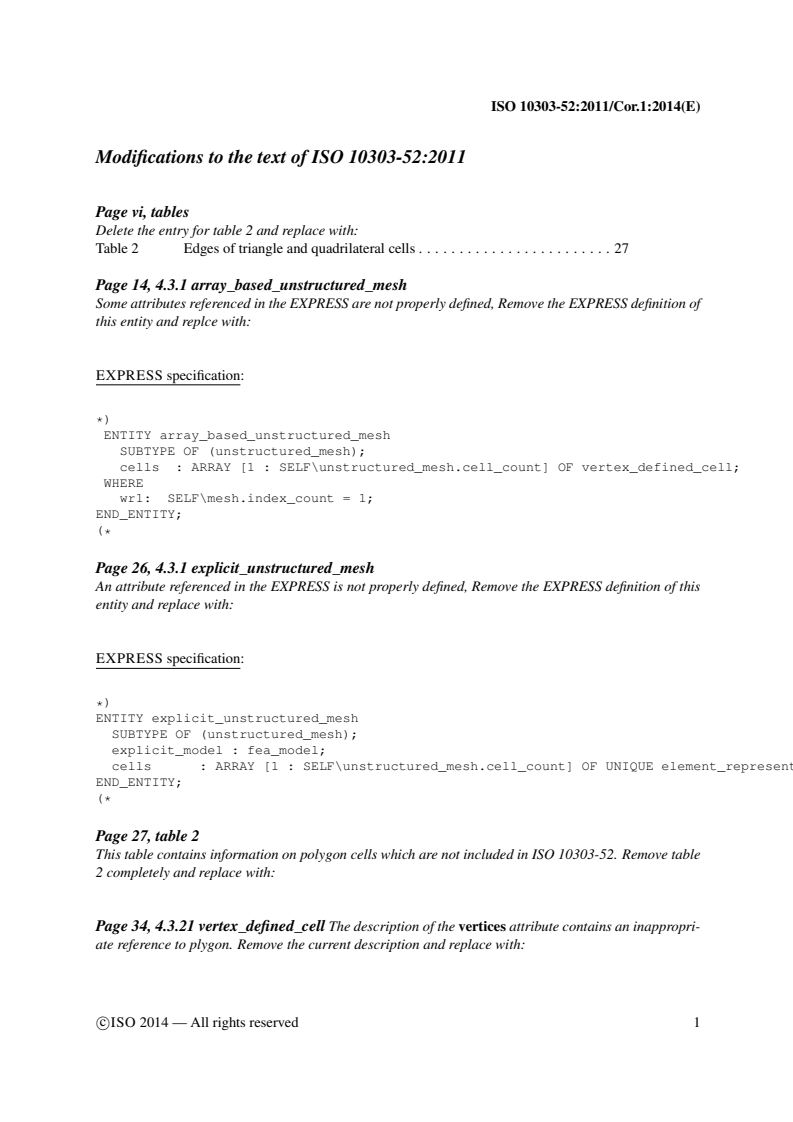
Page vi, tables
Delete the entry for table 2 and replace with:
Table 2 Edges of triangle and quadrilateral cells . . . . . . . . . . . . . . . . . . . . . . . . 27
Page 14, 4.3.1 array_based_unstructured_mesh
Some attributes referenced in the EXPRESS are not properly defined, Remove the EXPRESS definition of
this entity and replce with:
EXPRESS specification:
)
*
ENTITY array_based_unstructured_mesh
SUBTYPE OF (unstructured_mesh);
cells : ARRAY [1 : SELF\unstructured_mesh.cell_count] OF vertex_defined_cell;
WHERE
wr1: SELF\mesh.index_count = 1;
END_ENTITY;
(
*
Page 26, 4.3.1 explicit_unstructured_mesh
An attribute referenced in the EXPRESS is not properly defined, Remove the EXPRESS definition of this
entity and replace with:
EXPRESS specification:
)
*
ENTITY explicit_unstructured_mesh
SUBTYPE OF (unstructured_mesh);
explicit_model : fea_model;
cells : ARRAY [1 : SELF\unstructured_mesh.cell_count] OF UNIQUE element_representation;
END_ENTITY;
(
*
Page 27, table 2
This table contains information on polygon cells which are not included in ISO 10303-52. Remove table
2 completely and replace with:
Page 34, 4.3.21 vertex_defined_cell The description of the vertices attribute contains an inappropri-
ate reference to plygon. Remove the current description and replace with:
°c ISO 2014 — All rights reserved 1
ISO 10303-52:2011/Cor.1:2014(E)
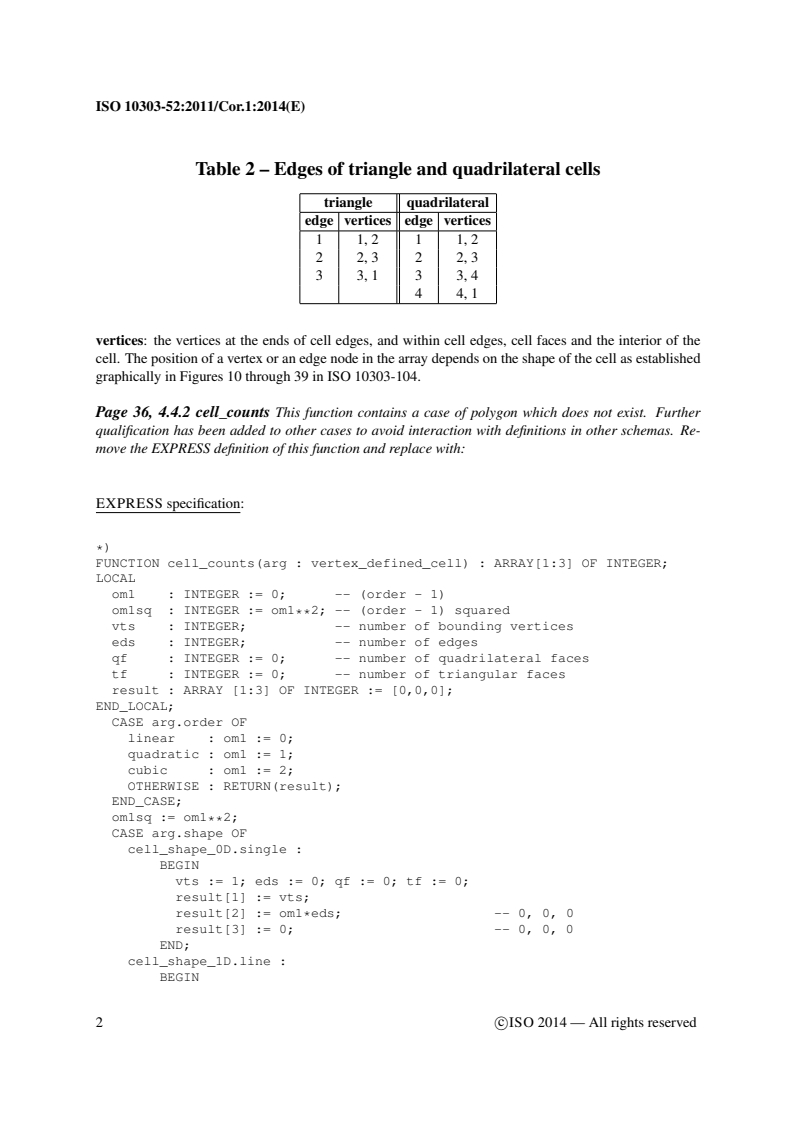
Table 2 – Edges of triangle and quadrilateral cells
triangle quadrilateral
edge vertices edge vertices
1 1, 2 1 1, 2
2 2, 3 2 2, 3
3 3, 1 3 3, 4
4 4, 1
vertices: the vertices at the ends of cell edges, and within cell edges, cell faces and the interior of the
cell. The position of a vertex or an edge node in the array depends on the shape of the cell as established
graphically in Figures 10 through 39 in ISO 10303-104.
Page 36, 4.4.2 cell_counts This function contains a case of polygon which does not exist. Further
qualification has been added to other cases to avoid interaction with definitions in other schemas. Re-
move the EXPRESS definition of this function and replace with:
EXPRESS specification:
)
*
FUNCTION cell_counts(arg : vertex_defined_cell) : ARRAY[1:3] OF INTEGER;
LOCAL
om1 : INTEGER := 0; -- (order - 1)
om1sq : INTEGER := om1 2; -- (order - 1) squared
**
vts : INTEGER; -- number of bounding vertices
eds : INTEGER; -- number of edges
qf : INTEGER := 0; -- number of quadrilateral faces
tf : INTEGER := 0; -- number of triangular faces
result : ARRAY [1:3] OF INTEGER := [0,0,0];
END_LOCAL;
CASE arg.order OF
linear : om1 := 0;
quadratic : om1 := 1;
cubic : om1 := 2;
OTHERWISE : RETURN(result);
END_CASE;
om1sq := om1 2;
**
CASE arg.shape OF
cell_shape_0D.single :
BEGIN
vts :
...