

ISO 25861:2007
(Main)Ships and marine technology — Navigation — Daylight signalling lamps
General Information
- Abstract
ISO 25861:2007 applies to daylight signalling lamps, which are required for certain ships pursuant to Chapter V of the International Convention for the Safety of Life at Sea (SOLAS), 1974, as amended, and Chapter 8 of the International Code of Safety for High-Speed Craft, in force, in accordance with the Performance Standards for Daylight Signalling Lamps [IMO-Resolution MSC.95(72)].
- Status
- Published
- Publication Date
- 19-Nov-2007
- Technical Committee
- ISO/TC 8/SC 6 - Navigation and ship operations
- Drafting Committee
- ISO/TC 8/SC 6 - Navigation and ship operations
- Current Stage
- 9093 - International Standard confirmed
- Start Date
- 29-Sep-2023
- Completion Date
- 29-Aug-2026


Overview
ISO 25861:2007 specifies requirements for daylight signalling lamps used in marine navigation. The standard applies to lamps required under SOLAS Chapter V and the International Code of Safety for High‑Speed Craft (Chapter 8), and it implements the IMO Performance Standards for Daylight Signalling Lamps (MSC.95(72)). ISO 25861:2007 covers functional, photometric, ergonomic, environmental and type‑approval requirements to ensure reliable visual signalling between ship-to-ship and ship-to-shore by day and night.
Key topics and technical requirements
- Required function: Lamps must convey clear, distinguishable light signals both by day and night and indicate operational status.
- Luminous intensity & visibility: Minimum required luminous intensity is 60 000 cd (visibility ≥ 2 nautical miles at atmospheric transmission 0.8). Axial intensity must reach ≥ 90% of peak.
- Beam divergence & shape: Half‑peak divergence ≤ 9°, tenth‑peak divergence ≤ 14°. Effective emission sectors must be circular.
- Chromaticity: White signal chromaticity must fall inside specified CIE chromaticity corner coordinates (x,y): 0.525/0.382, 0.525/0.440, 0.452/0.440, 0.310/0.348, 0.310/0.283, 0.443/0.382.
- Switch times: Sum of switch‑on and switch‑off times shall not exceed 500 ms. Photometric testing requires high‑speed sampling (≥250 readings/s, integration ≤4 ms).
- Power & battery: Lamps must not rely solely on ship power; portable battery ≤ 7.5 kg, capacity ≥ 2 hours. Battery charge level indication required when separate power is used.
- Durability & safety: Minimum protection rating IP56, anti‑magnetic materials, controlled surface temperatures per IEC 60598‑1, resistance to condensation, and compliance with IEC 60945 durability and EMC requirements.
- Maintenance & spares: At least three spare illuminants of type‑tested design must be supplied. Lamps must be serviceable in darkness and operable with heavy gloves.
- Mounting & ergonomics: Pedestal mounting rules (900 mm clear radius, sighting height 1.5 m, guardrail if platform >230 mm) and fixed sighting mechanism aligned with optical axis.
- Type approval tests: Photometric, chromaticity, switch time, environmental, battery capacity, temperature, shock and life‑duration tests are specified for certification.
Applications and users
ISO 25861:2007 is used by:
- Ship designers and naval architects specifying navigation equipment for compliance with SOLAS and high-speed‑craft rules.
- Equipment manufacturers and test labs for product design, type approval and certification.
- Flag administrations, surveyors and maritime safety authorities responsible for approval and inspection.
- Ship operators and procurement teams selecting compliant daylight signalling lamps for safety and communication.
Related standards
- IMO Res. MSC.95(72) - Performance standards for daylight signalling lamps
- ISO 17884 - Searchlights for high‑speed craft
- IEC 60529 (IP Code), IEC 60598‑1, IEC 60945
- IMO Res. A.694(17), A.813(19)
Keywords: ISO 25861:2007, daylight signalling lamps, marine navigation, SOLAS, luminous intensity, chromaticity, type approval, EMC, IP56.
Get Certified
Connect with accredited certification bodies for this standard

DNV
DNV is an independent assurance and risk management provider.

Lloyd's Register
Lloyd's Register is a global professional services organisation specialising in engineering and technology.

FSC International
Forest Stewardship Council certification.
Sponsored listings
Frequently Asked Questions
ISO 25861:2007 is a standard published by the International Organization for Standardization (ISO). Its full title is "Ships and marine technology — Navigation — Daylight signalling lamps". This standard covers: ISO 25861:2007 applies to daylight signalling lamps, which are required for certain ships pursuant to Chapter V of the International Convention for the Safety of Life at Sea (SOLAS), 1974, as amended, and Chapter 8 of the International Code of Safety for High-Speed Craft, in force, in accordance with the Performance Standards for Daylight Signalling Lamps [IMO-Resolution MSC.95(72)].
ISO 25861:2007 applies to daylight signalling lamps, which are required for certain ships pursuant to Chapter V of the International Convention for the Safety of Life at Sea (SOLAS), 1974, as amended, and Chapter 8 of the International Code of Safety for High-Speed Craft, in force, in accordance with the Performance Standards for Daylight Signalling Lamps [IMO-Resolution MSC.95(72)].
ISO 25861:2007 is classified under the following ICS (International Classification for Standards) categories: 47.020.70 - Navigation and control equipment. The ICS classification helps identify the subject area and facilitates finding related standards.
ISO 25861:2007 is available in PDF format for immediate download after purchase. The document can be added to your cart and obtained through the secure checkout process. Digital delivery ensures instant access to the complete standard document.
Standards Content (Sample)
INTERNATIONAL ISO
STANDARD 25861
First edition
2007-12-01
Ships and marine technology —
Navigation — Daylight signalling lamps
Navires et technologie maritime — Navigation — Lampes de
signalisation diurne
Reference number
©
ISO 2007
PDF disclaimer
This PDF file may contain embedded typefaces. In accordance with Adobe's licensing policy, this file may be printed or viewed but
shall not be edited unless the typefaces which are embedded are licensed to and installed on the computer performing the editing. In
downloading this file, parties accept therein the responsibility of not infringing Adobe's licensing policy. The ISO Central Secretariat
accepts no liability in this area.
Adobe is a trademark of Adobe Systems Incorporated.
Details of the software products used to create this PDF file can be found in the General Info relative to the file; the PDF-creation
parameters were optimized for printing. Every care has been taken to ensure that the file is suitable for use by ISO member bodies. In
the unlikely event that a problem relating to it is found, please inform the Central Secretariat at the address given below.
© ISO 2007
All rights reserved. Unless otherwise specified, no part of this publication may be reproduced or utilized in any form or by any means,
electronic or mechanical, including photocopying and microfilm, without permission in writing from either ISO at the address below or
ISO's member body in the country of the requester.
ISO copyright office
Case postale 56 • CH-1211 Geneva 20
Tel. + 41 22 749 01 11
Fax + 41 22 749 09 47
E-mail copyright@iso.org
Web www.iso.org
Published in Switzerland
ii © ISO 2007 – All rights reserved
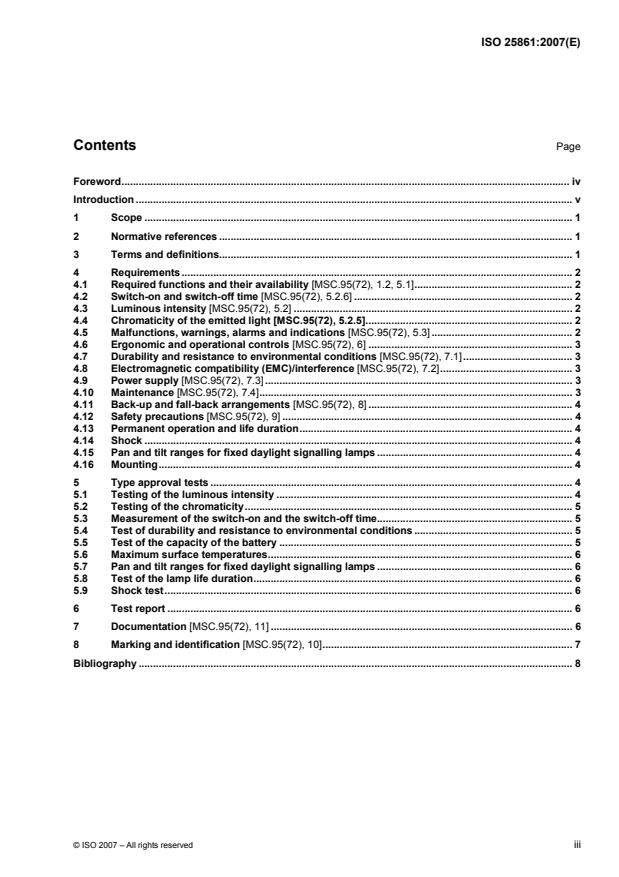
Contents Page
Foreword. iv
Introduction . v
1 Scope. 1
2 Normative references. 1
3 Terms and definitions. 1
4 Requirements. 2
4.1 Required functions and their availability [MSC.95(72), 1.2, 5.1]. 2
4.2 Switch-on and switch-off time [MSC.95(72), 5.2.6] . 2
4.3 Luminous intensity [MSC.95(72), 5.2] . 2
4.4 Chromaticity of the emitted light [MSC.95(72), 5.2.5]. 2
4.5 Malfunctions, warnings, alarms and indications [MSC.95(72), 5.3] . 2
4.6 Ergonomic and operational controls [MSC.95(72), 6] . 3
4.7 Durability and resistance to environmental conditions [MSC.95(72), 7.1]. 3
4.8 Electromagnetic compatibility (EMC)/interference [MSC.95(72), 7.2]. 3
4.9 Power supply [MSC.95(72), 7.3] . 3
4.10 Maintenance [MSC.95(72), 7.4]. 3
4.11 Back-up and fall-back arrangements [MSC.95(72), 8] . 4
4.12 Safety precautions [MSC.95(72), 9] . 4
4.13 Permanent operation and life duration. 4
4.14 Shock. 4
4.15 Pan and tilt ranges for fixed daylight signalling lamps .4
4.16 Mounting. 4
5 Type approval tests . 4
5.1 Testing of the luminous intensity . 4
5.2 Testing of the chromaticity. 5
5.3 Measurement of the switch-on and the switch-off time. 5
5.4 Test of durability and resistance to environmental conditions . 5
5.5 Test of the capacity of the battery . 5
5.6 Maximum surface temperatures. 6
5.7 Pan and tilt ranges for fixed daylight signalling lamps . 6
5.8 Test of the lamp life duration. 6
5.9 Shock test. 6
6 Test report. 6
7 Documentation [MSC.95(72), 11] . 6
8 Marking and identification [MSC.95(72), 10]. 7
Bibliography . 8
Foreword
ISO (the International Organization for Standardization) is a worldwide federation of national standards bodies
(ISO member bodies). The work of preparing International Standards is normally carried out through ISO
technical committees. Each member body interested in a subject for which a technical committee has been
established has the right to be represented on that committee. International organizations, governmental and
non-governmental, in liaison with ISO, also take part in the work. ISO collaborates closely with the
International Electrotechnical Commission (IEC) on all matters of electrotechnical standardization.
International Standards are drafted in accordance with the rules given in the ISO/IEC Directives, Part 2.
The main task of technical committees is to prepare International Standards. Draft International Standards
adopted by the technical committees are circulated to the member bodies for voting. Publication as an
International Standard requires approval by at least 75 % of the member bodies casting a vote.
Attention is drawn to the possibility that some of the elements of this document may be the subject of patent
rights. ISO shall not be held responsible for identifying any or all such patent rights.
ISO 25861 was prepared by Technical Committee ISO/TC 8, Ships and marine technology, Subcommittee
SC 6, Navigation.
iv © ISO 2007 – All rights reserved
Introduction
ISO 17884 “Ships and marine technology — Searchlights for high-speed craft” specifies many requirements
that are also applicable for this International Standard, ISO 25861 “Ships and marine technology —
Navigation — Daylight signalling lamps”. For a clearer structure, it is proposed for the future to merge these
International Standards into one International Standard with a general part and an Annex A for searchlights
and an Annex B for daylight signalling lamps.
INTERNATIONAL STANDARD ISO 25861:2007(E)
Ships and marine technology — Navigation — Daylight
signalling lamps
1 Scope
This International Standard applies to daylight signalling lamps, which are required for certain ships pursuant
to Chapter V of the International Convention for the Safety of Life at Sea (SOLAS), 1974, as amended, and
Chapter 8 of the International Code of Safety for High-Speed Craft, in force, in accordance with the
Performance Standards for Daylight Signalling Lamps [IMO Resolution MSC.95(72)].
Where the wording of this International Standard is identical to that in MSC.95(72), all such text is printed in
italics and the resolution and paragraph numbers are indicated in brackets.
2 Normative references
The following referenced documents are indispensable for the application of this document. For dated
references, only the edition cited applies. For undated references, the latest edition of the referenced
document (including any amendments) applies.
ISO 17884, Ships and marine technology — Searchlights for high-speed craft
IEC 60529, Degrees of protection provided by enclosures (IP Code)
IEC 60598-1, Luminaires — Part 1: General requirements and tests
IEC 60945, Maritime navigation and radiocommunication equipment and systems — General requirements —
Methods of testing and required test results
IMO Resolution A.694(17), General requirements for shipborne radio equipment forming part of the Global
maritime distress and information system (GMDSS) and for electronic navigational aids
IMO Resolution A.813(19), General requirements for electromagnetic compatibility (EMC) for all electrical and
electronic ship's equipment
IMO Resolution MSC.95(72), Performance standards for daylight signalling lamps
3 Terms and definitions
For the purposes of this document, the terms and definitions given in ISO 17884 and the following apply.
NOTE The IMO-used expressions “half angle of divergence” and “tenth angle of divergence” are synonymous to “half
peak divergence” and “tenth peak divergence”.
3.1
daylight signalling lamps
lamps suitable for transmitting white light signals to an observer by focused light beams which may be fixed or
portable
[MSC.95(72), 4]
3.2
switch-off time
the period of time required for luminous intensity to decrease to 5 % of the required luminous intensity after
the daylight signalling lamp has been switched off
[MSC.95(72), 4]
4 Requirements
4.1 Required functions and their availability [MSC.95(72), 1.2, 5.1]
Daylight signalling lamps shall be suitable for conveying information between ships, or between ship and
shore, by means of light signals, both by day and by night.
Daylight signalling lamps shall be suitable for giving light signals, which can be clearly distinguished visually
as separate signals by an observer.
4.2 Switch-on and switch-off time [MSC.95(72), 5.2.6]
The sum of switch-on and switch-off times shall not exceed 500 ms.
4.3 Luminous intensity [MSC.95(72), 5.2]
By day and with an atmospheric transmission of 0,8, the visibility of light signals emitted by daylight signalling
lamps shall be at least 2 nautical miles, equalling a required luminous intensity of 60 000 cd.
The axial luminous intensity of daylight signalling lamps shall reach at least 90 % of the maximum luminous
intensity.
The luminous intensity of daylight signalling lamps shall have its maximum i
...