

ISO 19848:2024
(Main)Ships and marine technology — Standard data for shipboard machinery and equipment
General Information
- Abstract
This document provides requirements and guidance on the capture and processing of data from sensors monitoring: ¾ the structure of the ship; ¾ shipboard machinery and equipment on board the ship; ¾ ship operational information. It is intended for implementers of software used to capture and process such data. This document describes how to name the sensor and required data item, as well as how to describe the data for shipboard machinery and equipment.
- Status
- Published
- Publication Date
- 08-Feb-2024
- Technical Committee
- ISO/TC 8/SC 6 - Navigation and ship operations
- Drafting Committee
- ISO/TC 8/SC 6/WG 16 - Ship Communication Network Systems
- Current Stage
- 6060 - International Standard published
- Start Date
- 09-Feb-2024
- Due Date
- 01-Oct-2023
- Completion Date
- 09-Feb-2024
Overview
ISO 19848:2024 - "Ships and marine technology - Standard data for shipboard machinery and equipment" defines unified requirements and guidance for capturing, naming and processing sensor data from ships. The second edition (2024) updates the 2018 version and standardizes two core concepts: Data Channel (static metadata describing a sensor/data stream) and Time Series Data (timestamped measurements). The standard describes how to construct Data Channel ID values, assemble a Data Channel List (metadata/codebook), and encode time-series measurements in lightweight formats.
Key Topics and Requirements
- Data Channel model: Defines virtual channels representing sensor streams, composed of a unique Data Channel ID and a set of Data Channel Properties (units, ranges, attributes).
- Data Channel ID types: Universal ID, Local ID and Short ID with a hierarchical, slash-delimited naming structure compatible with URL-style identification.
- Data Channel List: A machine- and human-readable metadata file (codebook) that registers channel IDs and properties for on-board data servers.
- Time Series Data format: Lightweight format referencing the Data Channel List for efficient storage and exchange of timestamped measurements and events.
- Encoding and validation: XML and XML Schema are recommended for precise structure and validation; the 2024 edition introduces JSON schemas as an equivalent implementation and supports CSV for convenience (Annex A).
- Naming schemes and examples: Informative annexes provide example codebooks and naming rules (including the updated “dnv-v2” LocalID scheme).
- Interoperability focus: Emphasizes standardized names to reduce labor-intensive mapping and improve data exchange between on-board applications.
Applications and Users
ISO 19848:2024 is intended for implementers of software and systems that capture, aggregate or process shipboard sensor data, including:
- Shipbuilders and ship system integrators
- On-board IT and data platform developers
- Vessel operators and fleet managers implementing monitoring, safety or energy-efficiency applications
- Classification societies and maritime software vendors creating codebooks and naming schemes
Practical uses include condition monitoring, performance analysis, alarm/event reporting, voyage analytics and machine-to-machine data exchange on modern smart ships.
Related Standards
ISO 19848 references and complements:
- ISO 8601-1 (date/time formats)
- ISO 80000 / IEC 80000 (quantities and units)
- IEC 62923-1 (bridge alert management)
- W3C XML Schema (XSD) and RFC 4180 (CSV) These related standards support consistent units, timestamps and data validation for reliable maritime data exchange.
Relations
- Revises
ISO 19848:2018 - Ships and marine technology — Standard data for shipboard machinery and equipment - Effective Date
- 23-Apr-2020
Get Certified
Connect with accredited certification bodies for this standard

DNV
DNV is an independent assurance and risk management provider.

Lloyd's Register
Lloyd's Register is a global professional services organisation specialising in engineering and technology.

FSC International
Forest Stewardship Council certification.
Sponsored listings
Frequently Asked Questions
ISO 19848:2024 is a standard published by the International Organization for Standardization (ISO). Its full title is "Ships and marine technology — Standard data for shipboard machinery and equipment". This standard covers: This document provides requirements and guidance on the capture and processing of data from sensors monitoring: ¾ the structure of the ship; ¾ shipboard machinery and equipment on board the ship; ¾ ship operational information. It is intended for implementers of software used to capture and process such data. This document describes how to name the sensor and required data item, as well as how to describe the data for shipboard machinery and equipment.
This document provides requirements and guidance on the capture and processing of data from sensors monitoring: ¾ the structure of the ship; ¾ shipboard machinery and equipment on board the ship; ¾ ship operational information. It is intended for implementers of software used to capture and process such data. This document describes how to name the sensor and required data item, as well as how to describe the data for shipboard machinery and equipment.
ISO 19848:2024 is classified under the following ICS (International Classification for Standards) categories: 47.020.70 - Navigation and control equipment. The ICS classification helps identify the subject area and facilitates finding related standards.
ISO 19848:2024 has the following relationships with other standards: It is inter standard links to ISO 19848:2018. Understanding these relationships helps ensure you are using the most current and applicable version of the standard.
ISO 19848:2024 is available in PDF format for immediate download after purchase. The document can be added to your cart and obtained through the secure checkout process. Digital delivery ensures instant access to the complete standard document.
Standards Content (Sample)
International
Standard
ISO 19848
Second edition
Ships and marine technology —
2024-02
Standard data for shipboard
machinery and equipment
Navires et technologie maritime — Données normalisées pour les
machines et équipements à bord des navires
Reference number
© ISO 2024
All rights reserved. Unless otherwise specified, or required in the context of its implementation, no part of this publication may
be reproduced or utilized otherwise in any form or by any means, electronic or mechanical, including photocopying, or posting on
the internet or an intranet, without prior written permission. Permission can be requested from either ISO at the address below
or ISO’s member body in the country of the requester.
ISO copyright office
CP 401 • Ch. de Blandonnet 8
CH-1214 Vernier, Geneva
Phone: +41 22 749 01 11
Email: copyright@iso.org
Website: www.iso.org
Published in Switzerland
ii
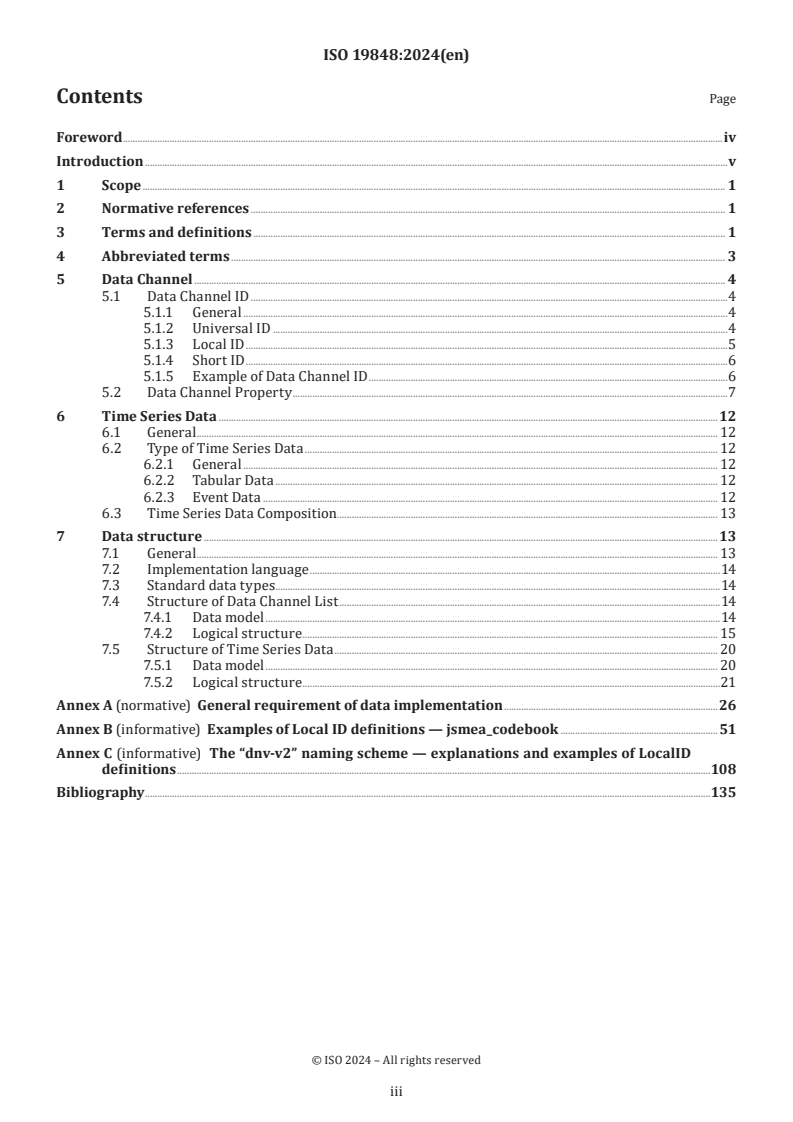
Contents Page
Foreword .iv
Introduction .v
1 Scope . 1
2 Normative references . 1
3 Terms and definitions . 1
4 Abbreviated terms . 3
5 Data Channel . 4
5.1 Data Channel ID .4
5.1.1 General .4
5.1.2 Universal ID .4
5.1.3 Local ID .5
5.1.4 Short ID .6
5.1.5 Example of Data Channel ID .6
5.2 Data Channel Property .7
6 Time Series Data .12
6.1 General . 12
6.2 Type of Time Series Data . 12
6.2.1 General . 12
6.2.2 Tabular Data . 12
6.2.3 Event Data . 12
6.3 Time Series Data Composition . 13
7 Data structure .13
7.1 General . 13
7.2 Implementation language .14
7.3 Standard data types .14
7.4 Structure of Data Channel List .14
7.4.1 Data model .14
7.4.2 Logical structure . 15
7.5 Structure of Time Series Data . 20
7.5.1 Data model . 20
7.5.2 Logical structure .21
Annex A (normative) General requirement of data implementation .26
Annex B (informative) Examples of Local ID definitions — jsmea_codebook .51
Annex C (informative) The “dnv-v2” naming scheme — explanations and examples of LocalID
definitions .108
Bibliography .135
iii
Foreword
ISO (the International Organization for Standardization) is a worldwide federation of national standards
bodies (ISO member bodies). The work of preparing International Standards is normally carried out through
ISO technical committees. Each member body interested in a subject for which a technical committee
has been established has the right to be represented on that committee. International organizations,
governmental and non-governmental, in liaison with ISO, also take part in the work. ISO collaborates closely
with the International Electrotechnical Commission (IEC) on all matters of electrotechnical standardization.
The procedures used to develop this document and those intended for its further maintenance are described
in the ISO/IEC Directives, Part 1. In particular, the different approval criteria needed for the different types
of ISO document should be noted. This document was drafted in accordance with the editorial rules of the
ISO/IEC Directives, Part 2 (see www.iso.org/directives).
ISO draws attention to the possibility that the implementation of this document may involve the use of (a)
patent(s). ISO takes no position concerning the evidence, validity or applicability of any claimed patent
rights in respect thereof. As of the date of publication of this document, ISO had not received notice of (a)
patent(s) which may be required to implement this document. However, implementers are cautioned that
this may not represent the latest information, which may be obtained from the patent database available at
www.iso.org/patents. ISO shall not be held responsible for identifying any or all such patent rights.
Any trade name used in this document is information given for the convenience of users and does not
constitute an endorsement.
For an explanation of the voluntary nature of standards, the meaning of ISO specific terms and expressions
related to conformity assessment, as well as information about ISO's adherence to the World Trade
Organization (WTO) principles in the Technical Barriers to Trade (TBT), see www.iso.org/iso/foreword.html.
This document was prepared by Technical Committee ISO/TC 8, Ships and marine technology, Subcommittee
SC 6, Navigation and ship operations.
This second edition cancels and replaces the first edition (ISO 19848:2018), which has been technically
revised.
The main changes are as follows:
— Annex A has been updated to define JSON as an equivalent implementation alternative to XML for
DataChannelLists and TimeSeriesData. JSON schemas have been introduced to ensure precise definition
and validation.
— The example of the codebook in B.2 has been extended to include navigational information, voyage
information, weather information around the ship, oil property information and ship motion information.
— In B.3, a full set of standard data names has been added as references, to improve usability.
— In Annex C, the naming scheme has been changed from from “dnvgl-vis” to “dnv-v2”, as well as various
updates to the rules for constructing the LocalID.
Any feedback or questions on this document should be directed to the user’s national standards body. A
complete listing of these bodies can be found at www.iso.org/members.html.
iv
Introduction
On-board computer applications for safety and energy-efficient operations have become increasingly
popular. These applications require access to the data of shipboard machinery and equipment.
To access data of navigational equipment, the IEC 61162 series, which covers data exchange, can be used.
However, there are no existing standards covering the access of data from other on-board components and
systems (e.g. machinery, safety equipment, and hull).
Exchanging nonstandardized data between and/or among applications requires name-based aggregation
and format mapping. However, this involves a large amount of labour, which hinders the use of such data.
To improve such situations, this document defines unified requirements and guidelines for developing
machine and human-readable identifiers and data structures for shipboard machinery and equipment, with
the objective of facilitating the exchange and processing of sensor data from ships.
This document defines two concepts and their models for data exchange: one is Data Channel, and the
other is Time Series Data. This document thus defines two distinct data structures and file formats: A Data
Channel List, which contains the necessary meta-data, and a Time Series Data format for measurements.
The time-series format is designed to be lightweight and therefore contains minimal meta-data information,
only in the form of a reference to the channel list.
Data Channel is a concept that represents virtual data transmission channels, and defines time-invariant
properties. Data Channel can be viewed as a static description for the different sensor data streams. Data
Channel is composed of Data Channel ID and Data Channel Property. Data Channel ID uniquely identifies the
logical data channels. Data Channel Property defines attributes of Data Channel.
The purpose of this document is to provide guidance and requirements on exchanging data on board a ship.
However, in the future, it is possible that shipboard machinery and equipment will be connected directly to
the Internet.
Therefore, considering the compatibility between Data Channel ID and URLs, which are used to identify
data on the Internet, Data Channel ID has a hierarchical structure with slashes as delimiters. To represent a
hierarchy, Data Channel is categorized in accordance with the standardized naming scheme, called Naming
Rule, and named by concatenating these category names with slashes.
Annexes B and C provide two types of naming scheme, an example of a codebook and lists of standardized
category names given according to these schemes.
These naming schemes provided in Annexes B and C are not designed to unify Data Channel ID, but it is
assumed that some entities will develop, maintain and manage codebooks and that these codebooks will be
disclosed widely.
Data Channel Property is assumed to be used to automate data processing and help understanding of data.
Data Channel Property should be used because it is considered to be essential to both computer applications
and humans for the reasons mentioned above.
Time Series Data is a concept that represents collection of time-stamped data. Time Series Data is assumed
to be used for sharing latest data and for analysing trends made over time-stamped data.
For reliable data exchange, this document recommends the use of Extensible Markup Language (XML) and
XML Schema for data encoding and data structure definition. Using XML and XML schemas makes it possible
to define data structures precisely and validate data according to such definitions. As a result, data can be
exchanged more reliably between and/or among computer applications.
Furthermore, for convenience and efficiency, this document also defines data structures in JavaScript Object
Notation (JSON) and Comma Separated Values (CSV) format.
v
International Standard ISO 19848:2024(en)
Ships and marine technology — Standard data for shipboard
machinery and equipment
1 Scope
This document provides requirements and guidance on the capture and processing of data from sensors
monitoring:
— the structure of the ship;
— shipboard machinery and equipment on board the ship;
— ship operational information.
It is intended for implementers of software used to capture and process such data.
This document describes how to name the sensor and required data item, as well as how to describe the data
for shipboard machinery and equipment.
2 Normative references
The following documents are referred to in the text in such a way that some or all of their content constitutes
requirements of this document. For dated references, only the edition cited applies. For undated references,
the latest edition of the referenced document (including any amendments) applies.
ISO 8601-1, Data elements and interchange formats — Information interchange — Representation of dates and
times
ISO 80000 (all parts), Quantities and units
IEC 80000 (all parts), Quantities and units
IEC 62923-1:2018, Maritime navigation and radiocommunication equipment and systems — Bridge alert
management — Part 1: Operational and performance requirements, methods of testing and required test results
W3C XML Schema Definition Language (XSD) 1.1 Part 2: Datatypes, W3C Recommendation
RFC 4180, Common Format and MIME Type for Comma-Separated Values (CSV) Files
3 Terms and definitions
For the purposes of this document, the following terms and definitions apply.
ISO and IEC maintain terminology databases for use in standardization at the following addresses:
— ISO Online browsing platform: available at https:// www .iso .org/ obp
— IEC Electropedia: available at https:// www .electropedia .org/
3.1
alert data
information that represents abnormal conditions of shipboard machinery and equipment
3.2
analogue data
numerical information obtained from sensors such as temperature sensors and pressure sensors
Note 1 to entry: Analogue data are a physical value converted from raw electric signals, such as 4 mA –20 mA or 0 V
–5 V.
3.3
codebook
list of standardized names
3.4
data
measurement value from shipboard machinery and equipment to which a time stamp is added
3.5
Data Channel
virtual channel for data transmission from shipboard machinery and equipment to shipboard data server,
defining static properties of data
3.6
Data Channel ID
identifier for a Data Channel (3.5) that identifies Data Channel universally and on-board a ship
Note 1 to entry: There are three types of Data Channel ID: Universal ID, Local ID and Short ID.
3.7
Data Channel List
list of definitions for Data Channel (3.5) that define Data Channel ID (3.6) and Data Channel Property (3.8),
and is shared through the shipboard data server
3.8
Data Channel Property
attributes of Data Channel (3.5), such as units and ranges
3.9
Data Set
set of data (3.4) having the same time stamp
3.10
Extensible Markup Language
XML
text-based data description language used for exchanging data on the Internet
3.11
Hyper Text Transfer Protocol
HTTP
communication protocol used to exchange Hyper Text Markup Language (HTML) or other content on the
Internet
3.12
IMO Number
unique reference number for ships that is given by the International Maritime Organization (IMO)
3.13
logical structure
structure of data (3.4) that is independent of physical implementation
3.14
measurement value
numeric value or a status symbol, produced as a result of measuring, calculating or estimating the state of
various objects
3.15
metadata
data that describes information about other data
3.16
Name Object
building block of Data Channel ID (3.6) used to define the hierarchical structure of Data Channel ID
3.17
namespace
set of names that is used in order to avoid conflicting names
3.18
shipboard data server
information hub of the ship that stores data from shipboard machinery and equipment (3.19), shares data at
sea including machine data, and sends stored data outboard
Note 1 to entry: See ISO 19847 for details.
3.19
shipboard machinery and equipment
various systems located in ships, such as main engine, generator, pumps, fans, valves, pipelines and electric
control systems
3.20
Time Series Data
collection of a Data Set (3.9)
3.21
XML Schema
data definition language used for Extensible Markup Language (XML) (3.10)
4 Abbreviated terms
ABNF augmented Backus-Naur form
AMS alarm monitoring system
BNF Backus-Naur form
CSV Comma Separated Values
IAS integrated automation system
IMO International Maritime Organization
HIN hull identification number
HTML Hyper Text Markup Language
HTTP Hypertext Transfer Protocol
JSON JavaScript Object Notation
RDBMS Relatinal Data Base Management System
RFC Request for Comments
SI the International System of Units
URI Uniform Resource Identifier
UTC Coordinated Universal Time
UTF-8 UCS Transformation Format 8
XML Extensible Markup Language
5 Data Channel
5.1 Data Channel ID
5.1.1 General
There are three types of Data Channel ID:
— Universal ID
— Local ID
— Short ID
Universal ID is intended for identifying an on-board Data Channel universally.
Local ID, meanwhile, is intended for identifying an on-board Data Channel locally. For instance, on-board
computer systems, such as the integrated automation system (IAS) and the alarm monitoring system (AMS),
have their own Data Channel List, which is composed of a unique Channel ID. This Channel ID can correspond
to a Local ID.
Short ID is an optional short alternative identifier of Local ID for usability and data compression. This short
identifier, for instance, can be used as a Data Channel identifier in the Time Series Data format.
Universal ID shall be universally unique, while Local ID and Short ID shall be unique for a ship.
These IDs shall be case-insensitive to avoid mistyping.
NOTE Data channels representing the same type of sensor data on different ships are expected to have the same
Local ID. Conversely, even if the Data Channel has the same meaning, the Short ID can be different for each ship.
5.1.2 Universal ID
Universal ID is an URI conforming to the requirements in this subclause, in addition to the requirement of
the URI specified in RFC 3986. The URI definition allows for many different compositions, but the Universal
ID is a subset of these and shall be in the following format.
The format is defined by using Augmented BNF (ABNF), which is defined in RFC 5234, as follows.
UniversalID = [protocol] “//” NamingEntity ShipID LocalID
NamingEntity = authority
ShipID = path-element
path-element = “/” unreserved
path-elements = path-element | path-element path-elements
The definition of the “Local ID” element is mentioned in 5.1.3.
The “authority” and “unreserved” element is defined in the URI definition specified in RFC 3986. The
“protocol” element is optional.
NOTE Although the path element of URI that is defined in RFC 3986 accepts many more characters, such as
RFC 3986 “sub-delimiters”, “:”, “@”, etc., this document only accepts RFC 3986 “unreserved” characters since these
characters can be used as control character in ISO 19847. The terms sub-delimiters and unreserved are defined in
RFC 3986.
The slash (“/”) is a reserved character for describing hierarchies.
The definition of each element of the Universal ID is as follows.
a) Naming Entity
The Naming Entity element shall be domain owned or controlled by the entity producing the Local ID.
EXAMPLE 1
— data.shipdatacenter.jp
— data.dnv.com
b) Ship ID
Ship ID is for identifying ships universally.
Usually, an IMO number or HIN should be used for the Ship ID.
If ships have no IMO number or HIN, an identifier provided by countries or regions, or other means may
be used instead.
EXAMPLE 2
— /IMO1234567
— /JP-HXAB7A33G293
5.1.3 Local ID
Local ID consists of the Naming Rule and Local Data Name.
Local ID composition is defined by using ABNF as follows.
LocalID = NamingRule LocalDataName
NamingRule = path-element
LocalDataName = path-elements
path-element = “/” unreserved
path-elements = path-element | path-element path-elements
The definition of each element of the Local ID is as follows.
a) Naming Rule
The Naming Rule shall be the designated name for a naming scheme used to name the Data Channel.
This name can be set freely under the supervision of the Naming Entity and shall have a symbol that
represents the Naming Entity in front to eliminate duplications.
The naming scheme is a set of requirements that define an identification scheme for components and
systems on board the ship. The naming scheme shall define how identification strings are composed,
and the method of developing an identification string.
EXAMPLE 1
— /jsmea_mac
— /dnv-v2
The Naming Entity is responsible for defining a methodology for changing the naming scheme and its
codebooks.
Impacts on existing users such as backwards compatibility shall be considered.
Therefore, the Naming Entity shall provide version information and change histories of the naming
scheme and its codebook for each version, e.g. in a Naming Rule or on a website.
b) Local Data Name
The Local Data Name is an identifier for the Data Channel that is named in accordance with the Naming
Rule.
The syntax of the identification string shall be disclosed and precisely defined using ABNF.
EXAMPLE 2
— /MainEngine/Cylinder1/ExhaustGas/Temp
— /vis-3–4a/ 511.11-3/C101/meta/qty-rotational.frequency
5.1.4 Short ID
Short ID is an optional short alternative to Local ID. There shall be a one-to-one correspondence between
Data Channel and Short ID; Short ID shall therefore be unique for a ship.
The definition of Short ID is as follows.
ShortID = unreserved
Short ID shall be as short as practical and represented as machine-friendly symbols, human-friendly short
words, or a combination of those symbols and short words.
EXAMPLE
— 0001
— TAH001
— ME_RPM
5.1.5 Example of Data Channel ID
In the following example, Ship ID, Naming Rule and Local Data Name are understood as the definitions in
5.1.2(b), 5.1.3(a) and 5.1.3(b), respectively, but without the leading slash.
Universal ID ht tp:// data .shipdatacenter .jp/ imo1234567/ jsmea _mac/ MainEngine/ Cylinder1/
ExhaustGas/ Outlet/ Temp
Local ID /jsmea_mac/MainEngine/Cylinder1/ExhaustGas/Outlet/Temp
Short ID 0001
Ship ID imo1234567
Naming Entity data.shipdatacenter.jp
Naming Rule jsmea_mac
Local Data Name MainEngine/Cylinder1/ExhaustGas/Outlet/Temp
Universal ID ht tp:// data .dnv .com/ imo1234567/ dnv -v2/ vis -3 -4a/ 511.11-3/C101/meta/qty-rota-
tional.frequency
Local ID /dnv-v2/vis-3–4a/411.1/ 511.11-3/C101/meta/qty-rotational.frequency
Short ID 0001
Ship ID imo1234567
Naming Entity data.dnv.com
Naming Rule dnv-v2
Local Data Name vis-3–4a/511.11–3/C101/meta/qty-rotational.frequency
(coded)
Local Data Name vis-3–4a/511.11–3/C101/~main.generator.engine.3/meta/qty-rotational.frequency
(verbose)
NOTE It is not a requirement that the Universal ID is a resolvable URI; i.e. the URI is not necessarily a valid URL.
A detailed description of the above two naming schemes are described in Annexes B and C.
5.2 Data Channel Property
Data Channel Property shall be defined to provide the attributes of the Data Channel.
The reserved property types are as follows.
— Data Channel Type
— Format
— Range
— Unit
— Quality Coding
— Name
— Remarks
The properties above shall be described in accordance with the requirements in this subclause.
Properties that are not listed above may be used if these are clearly distinguished from the properties
defined in this document.
Details of each property are as follows.
a) Data Channel Type
Data Channel Type is used to identify the types of Data Channel, such as raw numeric value, average
value, alarms and status. Data Channel Type is composed of the following sub-properties.
— Type
— Update Cycle
— Calculation Period
Type sub-property defines the type of Data Channel and the value of the sub-property shall follow
Table 1.
Table 1 — Type name of Data Channel Type
Type Description
Inst Measuring value at a certain point in time
Average Average of the value within a certain time period;
“Average” does not mean average of values from multiple sensors at the same time
but average of time-series values from a single sensor.
Max Maximum value within a certain time period;
“Maximum” does not mean maximum of values from multiple sensors at the same
time but maximum of time-series values from a single sensor.
Min Minimum value within a certain time period;
“Minimum” does not mean minimum of values from multiple sensors at the same time
but minimum of time-series values from a single sensor.
Median Median value within a certain time period;
“Median” does not mean median of values from multiple sensors at the same time but
median of time-series values from a single sensor.
Mode Mode value (a value that appears most often in a set of data values) within a certain
time period;
“Mode” does not mean mode of values from multiple sensors at the same time but
mode of time-series values from a single sensor.
StandardDeviation Standard deviation of the value within a certain time period;
“StandardDeviation” does not mean standard deviation of values from multiple
sensors at the same time but standard deviation of time-series values from a single
sensor.
Calculated Value obtained from calculation or estimation instead of measurement
SetPoint Target value for automatic control
Command Control order to equipment; e.g. slowdown signal to the engine, run/stop order to the
pump, opening to the position valve
Alert Alarm values that can be obtained are also described.
Status Status values that can be obtained are also described.
ManualInput Value input by crew. Value assumed here is a reading of the indicator.
Update Cycle represents the cycle of updating measurement value. This sub-property shall be used
when the measurement value is updated periodically.
When a value of Data Channel is a result of a calculation that uses a measurement value of specific time
periods, the Calculation Period shall be used to describe the said period.
The Update Cycle and Calculation Period shall be described with a decimal number that is larger than
zero. The unit of Update Cycle and Calculation Period shall be the “second”.
Type sub-property is mandatory and the others are optional.
EXAMPLE 1
— Type Average
— Calculation Period 60
— Update Cycle 1
b) Format
Format is used for describing data formats and defined by the following sub-properties.
— Type
— Restriction
Type sub-property is mandatory and Restriction sub-property is optional. More than one Restriction
sub-property can exist under the Format property.
Available Types are as shown in Table 2. Definitions of these data types shall comply with W3C XML
Schema Definition Language (XSD) 1.1 Part 2: Datatype.
Table 2 — Available Datatype for format property
Type Description
Decimal Decimal represents a subset of the real numbers, which can be represented by deci-
mal numerals. The value space of decimal is the set of numbers that can be obtained
n
by dividing an integer by a non-negative power of 10, i.e. expressible as i / 10 where i
and n are integers and n ≥ 0. Precision is not reflected in this value space; the number
2,0 is not distinct from the number 2,00. The order relation on decimal is the order
relation on real numbers, restricted to this subset.
Integer Integer is derived from the decimal by fixing the value of fraction digits to be 0 and
disallowing the trailing decimal point. This results in the standard mathematical
concept of the integer numbers. The value space of integer is the infinite set {.,-2,-
1,0,1,2,.}. The base type of integer is decimal.
Boolean Boolean represents the values of two-valued logic.
String The string datatype represents character strings in XML.
DateTime Date and time data types are used for values that contain date and time.
Format shall follow ISO 8601-1 “YYYY -MM -DDThh: mm: ssZ” where:
YYYY indicates the year
MM indicates the month
DD indicates the day
T indicates the start of the required time section
hh indicates the hour
mm indicates the minute
ss indicates the second
Z indicates UTC
Table 3 shows restrictions defined in W3C XML Schema Definition Language (XSD) 1.1 Part 2: Datatypes.
These restrictions are available to define acceptable values. Validation requirements and available
constraint for each data types shall follow W3C XML Schema Definition Language (XSD) 1.1 Part 2:
Datatypes.
EXAMPLE 2
— Type Decimal
— Restriction TotalDigits 8, FractionDigits 3
Table 3 — Restrictions for format property
Restriction Description Data Type
Enumeration Defines a list of acceptable values. string
FractionDigits Specifies the maximum number of decimal places allowed. nonNegativeInteger
Shall be equal to or greater than zero.
Length Specifies the exact number of characters or list items allowed. nonNegativeInteger
Shall be equal to or greater than zero.
MaxExclusive Specifies the upper bounds for numeric values (the value shall A value from the ·value space·
be less than this value). of the {base type definition}.
MaxInclusive Specifies the upper bounds for numeric values (the value shall A value from the ·value space·
be less than or equal to this value). of the {base type definition}.
MaxLength Specifies the maximum number of characters or list items nonNegativeInteger
allowed. Shall be equal to or greater than zero.
MinExclusive Specifies the lower bounds for numeric values (the value shall A value from the ·value space·
be greater than this value). of the {base type definition}.
MinInclusive Specifies the lower bounds for numeric values (the value shall A value from the ·value space·
be greater than or equal to this value). of the {base type definition}.
MinLength Specifies the minimum number of characters or list items nonNegativeInteger
allowed. Shall be equal to or greater than zero.
Pattern Defines the exact sequence of characters that are acceptable. string
TotalDigits Specifies the exact number of digits allowed. Shall be greater positiveInteger
than zero.
WhiteSpace Specifies how white space (line feeds, tabs, spaces, and car-
riage returns) is handled.
c) Range
Range is intended for describing Data Range. Range property is composed of the following sub-
properties.
— Low
— High
Low sub-property represents the lower limit of the analogue data, and High sub-property represents its
upper limit.
The value type of these sub-properties is a decimal value or empty. The value of these sub-properties
can be empty only if the lower and/or upper limit cannot be specified.
Furthermore, the high value shall be greater than and not equal to the low value.
Range property is mandatory only with the analogue data.
NOTE Range does not mean upper and lower boundary of the value. The value can exceed the range in case of
sensor failure or other abnormal condition.
EXAMPLE 3
— Low 0
— High 120
d) Unit
Unit defines the unit and quantity applied to the measurement value. Unit property is composed of the
following sub-properties.
— Unit Symbol
— Quantity Name
Unit symbols and quantity names defined in the ISO 80000 series , the IEC 80000 series or Table 4 shall
be used for the Unit Symbol and Quantity Name sub-properties.
The Unit Symbol sub-property represents the unit symbol of the measurement value (e.g. “m” for length
and “kg” for mass). The value of the Unit Symbol sub-property can be empty only for non-dimensional
quantities.
The Quantity Name sub-property may be used to identify the variable that is measured or computed for
the physical item defined by the Data Channel.
The measurement value shall be described in accordance with the unit defined in this property.
NOTE On-board computer applications (Data consumer) can convert units according to the ISO 80000 series
and the IEC 80000 series.
EXAMPLE 4
— Unit Symbol kW
— Quantity Name active power
— Unit Symbol Pa
— Quantity Name pressure
Table 4 — Additional units and quantities of measurement value
Quantity name Unit symbol Remarks
Cargo capacity TEU Twenty-foot equivalent unit
FEU Forty-foot equivalent unit
Number of pieces pcs pieces
Total revolution count rev Total number of rotations
e) Quality Coding
Quality Coding represents a name of data quality evaluation scheme and the scheme shall be able to
distinguish at least between valid and invalid measurement values of the Data Channel.
EXAMPLE 5
— “OPC-QUALITY”
— “IEC 61162-STATUS”
In the case of “IEC 61162-STATUS”, “A” (Data valid) and “V” (Data invalid) are used for the data quality.
Channel state, such as “alert acknowledged”, “alert activated”, ”alert temporarily disabled”, and “sensor
disconnected”, may be included in the quality coding scheme.
f) Alert Priority
In the case in which Data Channel Type is “Alert”, Alert Priority shall be provided. Priority level and
criteria for classification shall be in accordance with IEC 62923-1:2018, 6.2.2.1
g) Name
Name can be used to describe names assigned for on-board control systems and other instruments.
EXAMPLE 6
— “Main Engine Revolution”
h) Remarks
In Remarks, arbitrary complementary information on Data Channel is described.
Remarks should include locations, manufacturers and types of equipment.
EXAMPLE 7
— “Location: ECR, Manufacturer: AAA Company, Type: TYPE-AAA”
6 Time Series Data
6.1 General
Time Series Data are a collection of measurement values in which all the values have a corresponding time
of measurement. Usually such data are arranged and recorded in chronological order.
6.2 Type of Time Series Data
6.2.1 General
For practical purposes (efficient data transport), two distinct representations of Time Series Data are
defined:
— Tabular Data
— Event Data
These representations are used depending on update interval of measurement values.
6.2.2 Tabular Data
Tabular Data is a vector of a fixed number of values expected to be reported at regular intervals. Data
Channel List defines the interval.
Some examples of Tabular Data are:
— multiple raw numeric values from sensors/transmitters sampled at the same time;
— the result of the calculation (e.g. time average, standard deviation, etc.) to be performed regularly.
Measurement values are grouped per time stamp, as shown in Table 5.
Table 5 — Example of Tabular Data
Time stamp Data channel 1 Data channel 2 Data channel 3 Data channel 4
2017–01–01T00:00:00Z 101 3 10 CLOSE
2017–01–01T00:00:01Z 0 3 10 CLOSE
2017–01–01T00:00:02Z 110 2 10 OPEN
6.2.3 Event Data
Event Data is a collection of data for which the number of values at a specific time is not fixed.
Some examples of Event Data include:
— alarm information
— status information
— manually input data
Event Data typically appears in tabular form like Table 6.
Table 6 — Example of Event Data in tabular form
Time Stamp Data Channel 1 Data Channel 2 Data Channel 3 Data Channel 4
2017–01–01T00:00:00Z 101 — — —
2017–01–01T00:00:01Z — — — —
2017–01–01T00:00:02Z 110 2 — OPEN
The tabular form shown in Table 6 is not efficient for Event Data, thus measurement values are grouped per
both time stamp and Data Channel ID, as shown in Table 7:
Table 7 — Example of Event Data
Time Stamp Data Channel ID Value
2017–01–01T00:00:00Z Data Channel 1 101
2017–01–01T00:00:02Z Data Channel 1 110
2017–01–01T00:00:02Z Data Channel 2 2
2017–01–01T00:00:02Z Data Channel 4 OPEN
6.3 Time Series Data Composition
Each row of Tabular/Event Data is called a Data Set.
Tabular Data are composed of a collection of a Data Set without Data Channel IDs, since value can be
identified by its order.
Tabular Data of Table 5 is described as follows.
DataSet(“2017-01-01T00:00:00Z”,”101”,”3”,”10”,”CLOSE”)
DataSet(“2017-01-01T00:00:01Z”,”0”,”3”,”10”,”CLOSE”)
DataSet(“2017-01-01T00:00:02Z”,”110”,”2”, “10”,”OPEN”)
Event Data are composed of a collection of Data Set with Data Channel ID, since a number of values at a
specific time cannot be fixed.
Event Data of Table 7 is described as follows.
DataSet(“2017-01-01T00:00:00Z “, “DataChannel1”, “101”)
DataSet(“2017-01-01T00:00:02Z “, “DataChannel1”, “110”)
DataSet(“2017-01-01T00:00:02Z “, “DataChannel2”, “2”)
DataSet(“2017-01-01T00:00:02Z “, “DataChannel4”, “OPEN”)
7 Data structure
7.1 General
Data structure is the definition of logical structures that are independent from data implementation
languages, such as XML, JSON and others.
This clause defines two types of data structure. One type is for Data Channel List, the list of Data Channel
definitions in Clause 5. The other type is for serialisation and transport of Time Series Data in Clause 6.
These structures can be described by using XML and JSON.
CSV can be used only for DataSet element defined in 7.5 f) without the Quality element.
In addition, standard data type, which is used to define the data structure and also independent of
implementation languages, is defined.
Standard data type can be replaced with the data types defined in the implementation language.
Data implemented in accordance with the data structure can be shared between and/or among computer
applications.
7.2 Implementation language
The data structure defined in this Clause shall be implemented in XML or JSON in accordance with Annex A.
7.3 Standard data types
To define the data structure, the following standard data types derived from UML primitive types listed in
Table 8 shall be used.
Table 8 — Standard data types
Standard data type Primitive type Restriction Remarks
Integer Integer
NonNegativeInteger Integer larger than −1
PositiveInteger Integer larger than 0
Real Real
Boolean Boolean
String String
DateTime String formatted by Refer to RFC 3339 for ABNF expression.
ISO 8601-1
Null Null specifies the lack of a value (can be used for
any data types).
7.4 Structure of Data Channel List
7.4.1 Data model
The Data Channel List shall consist of the following five elements.
a) Package
Package is a data package that is made up of Header, which is a set of metadata, and DataChannel, which
is a main data body.
b) Header
Header indicates when a Data Channel List is created and who creates it.
c) DataChannel
DataChannel consists of Property and DataChannelID, which indicates Data Channel definitions.
d) DataChannelID
DataChannelID is an identifier of Data Channel defined in 5.1.
e) Property
Property defines the attributes of Data Channel defined in 5.2.
These elements are represented in a hierarchical structure as shown in Figure 1 using UML. For more
information on UML notation, refer to ISO/IEC 19505-1 and ISO/IEC 19505-2.
Figure 1 — Model of Data Channel List
7.4.2 Logical structure
The Data Channel List shall have the logical structure shown in Figure 2, using UML. For more information
on UML notation (i.e. [1], [0.*] shown in Figure 2), refer to ISO/IEC 19505-1 and ISO/IEC 19505-2.
The Data Channel List has a Package element. The Package element is composed of a Header and a
DataChannelList element. The DataChannelList element includes one or more DataChannel elements with its
IDs and properties.
Furthermore, the NameObject element can be added to define the structure of the Local ID.
...