

ISO 9875:2023
(Main)Ships and marine technology — Marine echo-sounding equipment
General Information
- Abstract
This document specifies the minimum operational and performance requirements, methods of testing and test results of marine echo-sounding equipment required to comply with the performance standards adopted by the IMO Resolution A.224(VII) as amended by IMO Resolution MSC.74(69), Annex 4. This document is intended to be used in conjunction with IMO Resolution A.694(17) and with IEC 60945. For bridge alert management, IMO Resolution MSC.302(87) supersedes IMO Resolution MSC.74(69), Annex 4. Accordingly, this document incorporates references to IEC 62923-1 and IEC 62923-2 which are associated with Resolution MSC.302(87) for requirements and tests where applicable. In accordance with IMO Resolution MSC.74(69), Annex 4, Articles 1 and 2, the purpose of echo-sounding equipment is to provide reliable information on the depth of water under a ship to aid navigation in particular in shallow water. This document is applicable for ship speeds from 0 kn to 30 kn.
- Status
- Published
- Publication Date
- 15-May-2023
- Technical Committee
- ISO/TC 8/SC 6 - Navigation and ship operations
- Drafting Committee
- ISO/TC 8/SC 6 - Navigation and ship operations
- Current Stage
- 6060 - International Standard published
- Start Date
- 16-May-2023
- Due Date
- 13-Feb-2023
- Completion Date
- 16-May-2023

Overview
ISO 9875:2023 - Ships and marine technology - Marine echo-sounding equipment - defines the minimum operational and performance requirements, together with methods of testing and required test results, for marine echo-sounding equipment. Aligned with IMO performance standards (IMO Resolution A.224(VII) as amended by MSC.74(69)) and intended for use alongside IMO Resolution A.694(17) and IEC 60945, this standard also incorporates bridge alert management references from MSC.302(87) and associated IEC 62923 series. ISO 9875:2023 applies to ship operations at speeds from 0 kn to 30 kn and aims to ensure reliable depth information to aid safe navigation, particularly in shallow water.
Key topics and requirements
ISO 9875:2023 covers technical and functional topics including:
- Performance requirements: minimum operational behavior and accuracy for depth measurement.
- Functionality: range performance, range scales, pulse repetition rate, receiver sensitivity.
- Displays and presentation: main and secondary display requirements, ergonomic criteria for information presentation.
- Alarms and alerts: depth alarm, power-fail alert, system-failure alerts, and bridge alert management per MSC.302(87).
- Accuracy and discrimination: methods to verify measurement accuracy and depth discrimination.
- Environmental and installation: roll and pitch handling, multiple installations, interference and environmental testing.
- Data handling: data storage requirements and test methods.
- Interfaces: digital interfacing requirements (including IEC 61162 series) and Annex C overview of IEC 61162 interfaces.
- Annexes: sound absorption coefficients (Annex A), alerts definitions and identifiers (Annex B), IEC 61162 interface information (Annex C).
Applications and users
ISO 9875:2023 is intended for:
- Manufacturers of echo-sounding equipment to design and certify compliant products.
- Shipyards and integrators installing echo sounders during new builds or retrofits.
- Classification societies and regulators assessing conformity with IMO and ISO performance standards.
- Testing laboratories performing the specified methods of testing and required test results.
- Ship operators and navigators choosing equipment that meets ergonomic, alarm and reliability criteria for safe shallow-water navigation.
Practical uses include ensuring accurate depth measurement, validating alarm behavior for bridge alert management, guiding procurement specifications, and supporting regulatory compliance and certification.
Related standards
- IMO Resolution A.224(VII), A.694(17), MSC.74(69), MSC.302(87)
- IEC 60945 (general maritime equipment testing)
- IEC 61162-1 / IEC 61162-2 / IEC 61162-450 (digital interfaces)
- IEC 62923-1 / IEC 62923-2 (bridge alert management) Keywords: ISO 9875:2023, marine echo-sounding equipment, echo sounding, depth alarm, IMO Resolution, IEC interfaces, maritime navigation.
Relations
- Effective Date
- 21-Oct-2017
Get Certified
Connect with accredited certification bodies for this standard

DNV
DNV is an independent assurance and risk management provider.

Lloyd's Register
Lloyd's Register is a global professional services organisation specialising in engineering and technology.

FSC International
Forest Stewardship Council certification.
Sponsored listings
Frequently Asked Questions
ISO 9875:2023 is a standard published by the International Organization for Standardization (ISO). Its full title is "Ships and marine technology — Marine echo-sounding equipment". This standard covers: This document specifies the minimum operational and performance requirements, methods of testing and test results of marine echo-sounding equipment required to comply with the performance standards adopted by the IMO Resolution A.224(VII) as amended by IMO Resolution MSC.74(69), Annex 4. This document is intended to be used in conjunction with IMO Resolution A.694(17) and with IEC 60945. For bridge alert management, IMO Resolution MSC.302(87) supersedes IMO Resolution MSC.74(69), Annex 4. Accordingly, this document incorporates references to IEC 62923-1 and IEC 62923-2 which are associated with Resolution MSC.302(87) for requirements and tests where applicable. In accordance with IMO Resolution MSC.74(69), Annex 4, Articles 1 and 2, the purpose of echo-sounding equipment is to provide reliable information on the depth of water under a ship to aid navigation in particular in shallow water. This document is applicable for ship speeds from 0 kn to 30 kn.
This document specifies the minimum operational and performance requirements, methods of testing and test results of marine echo-sounding equipment required to comply with the performance standards adopted by the IMO Resolution A.224(VII) as amended by IMO Resolution MSC.74(69), Annex 4. This document is intended to be used in conjunction with IMO Resolution A.694(17) and with IEC 60945. For bridge alert management, IMO Resolution MSC.302(87) supersedes IMO Resolution MSC.74(69), Annex 4. Accordingly, this document incorporates references to IEC 62923-1 and IEC 62923-2 which are associated with Resolution MSC.302(87) for requirements and tests where applicable. In accordance with IMO Resolution MSC.74(69), Annex 4, Articles 1 and 2, the purpose of echo-sounding equipment is to provide reliable information on the depth of water under a ship to aid navigation in particular in shallow water. This document is applicable for ship speeds from 0 kn to 30 kn.
ISO 9875:2023 is classified under the following ICS (International Classification for Standards) categories: 47.020.70 - Navigation and control equipment. The ICS classification helps identify the subject area and facilitates finding related standards.
ISO 9875:2023 has the following relationships with other standards: It is inter standard links to ISO 9875:2000. Understanding these relationships helps ensure you are using the most current and applicable version of the standard.
ISO 9875:2023 is available in PDF format for immediate download after purchase. The document can be added to your cart and obtained through the secure checkout process. Digital delivery ensures instant access to the complete standard document.
Standards Content (Sample)
INTERNATIONAL ISO
STANDARD 9875
Fourth edition
2023-05
Ships and marine technology —
Marine echo-sounding equipment
Navires et technologie maritime — Appareils de sondage par écho
Reference number
© ISO 2023
All rights reserved. Unless otherwise specified, or required in the context of its implementation, no part of this publication may
be reproduced or utilized otherwise in any form or by any means, electronic or mechanical, including photocopying, or posting on
the internet or an intranet, without prior written permission. Permission can be requested from either ISO at the address below
or ISO’s member body in the country of the requester.
ISO copyright office
CP 401 • Ch. de Blandonnet 8
CH-1214 Vernier, Geneva
Phone: +41 22 749 01 11
Email: copyright@iso.org
Website: www.iso.org
Published in Switzerland
ii
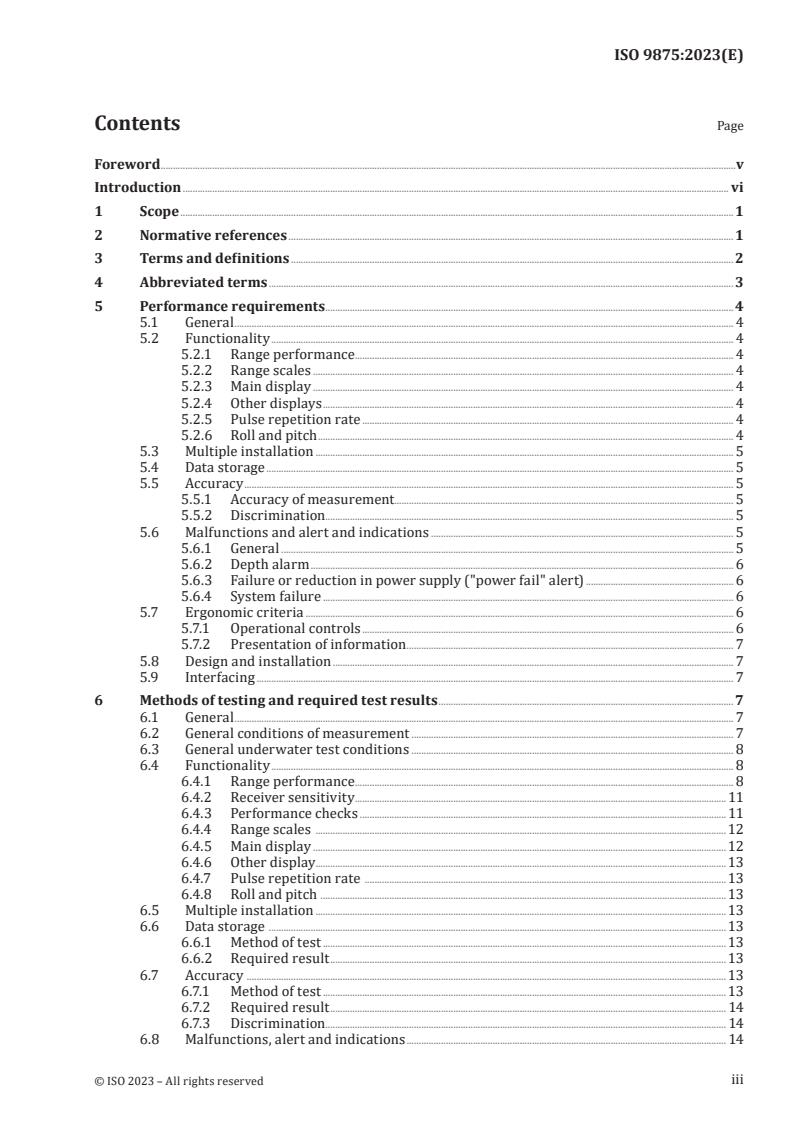
Contents Page
Foreword .v
Introduction . vi
1 Scope . 1
2 Normative references . 1
3 Terms and definitions . 2
4 Abbreviated terms . 3
5 Performance requirements . .4
5.1 General . 4
5.2 Functionality . 4
5.2.1 Range performance . . . 4
5.2.2 Range scales . 4
5.2.3 Main display . 4
5.2.4 Other displays . 4
5.2.5 Pulse repetition rate . 4
5.2.6 Roll and pitch . 4
5.3 Multiple installation . 5
5.4 Data storage . 5
5.5 Accuracy . 5
5.5.1 Accuracy of measurement. 5
5.5.2 Discrimination . . . 5
5.6 Malfunctions and alert and indications . 5
5.6.1 General . 5
5.6.2 Depth alarm . 6
5.6.3 Failure or reduction in power supply ("power fail" alert) . 6
5.6.4 System failure . 6
5.7 Ergonomic criteria . 6
5.7.1 Operational controls . 6
5.7.2 Presentation of information . 7
5.8 Design and installation . 7
5.9 Interfacing . 7
6 Methods of testing and required test results . 7
6.1 General . 7
6.2 General conditions of measurement . 7
6.3 General underwater test conditions . 8
6.4 Functionality . 8
6.4.1 Range performance . . . 8
6.4.2 Receiver sensitivity . . . 11
6.4.3 Performance checks . 11
6.4.4 Range scales . 12
6.4.5 Main display .12
6.4.6 Other display . .13
6.4.7 Pulse repetition rate .13
6.4.8 Roll and pitch . . .13
6.5 Multiple installation .13
6.6 Data storage . 13
6.6.1 Method of test . 13
6.6.2 Required result . 13
6.7 Accuracy . . 13
6.7.1 Method of test . 13
6.7.2 Required result . 14
6.7.3 Discrimination . . 14
6.8 Malfunctions, alert and indications . 14
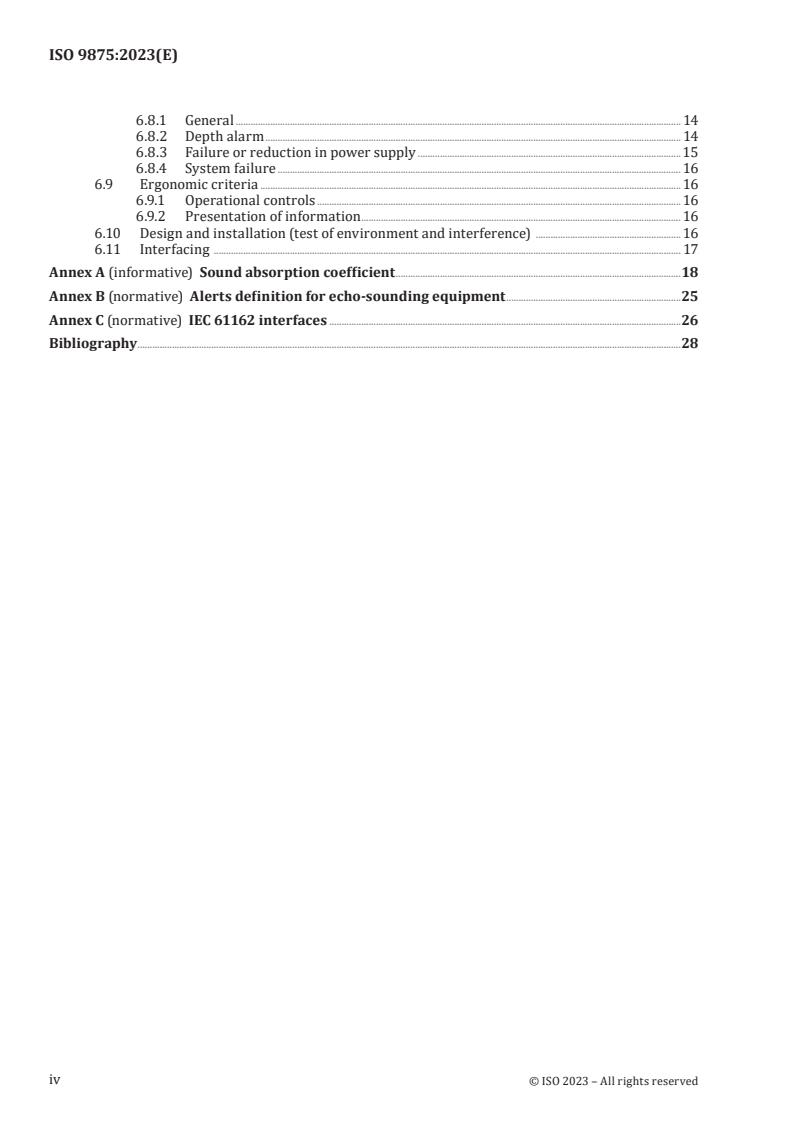
iii
6.8.1 General . 14
6.8.2 Depth alarm . 14
6.8.3 Failure or reduction in power supply . 15
6.8.4 System failure . 16
6.9 Ergonomic criteria . 16
6.9.1 Operational controls . 16
6.9.2 Presentation of information . 16
6.10 Design and installation (test of environment and interference) . 16
6.11 Interfacing . 17
Annex A (informative) Sound absorption coefficient .18
Annex B (normative) Alerts definition for echo-sounding equipment .25
Annex C (normative) IEC 61162 interfaces .26
Bibliography .28
iv
Foreword
ISO (the International Organization for Standardization) is a worldwide federation of national standards
bodies (ISO member bodies). The work of preparing International Standards is normally carried out
through ISO technical committees. Each member body interested in a subject for which a technical
committee has been established has the right to be represented on that committee. International
organizations, governmental and non-governmental, in liaison with ISO, also take part in the work.
ISO collaborates closely with the International Electrotechnical Commission (IEC) on all matters of
electrotechnical standardization.
The procedures used to develop this document and those intended for its further maintenance are
described in the ISO/IEC Directives, Part 1. In particular, the different approval criteria needed for the
different types of ISO document should be noted. This document was drafted in accordance with the
editorial rules of the ISO/IEC Directives, Part 2 (see www.iso.org/directives).
ISO draws attention to the possibility that the implementation of this document may involve the use
of (a) patent(s). ISO takes no position concerning the evidence, validity or applicability of any claimed
patent rights in respect thereof. As of the date of publication of this document, ISO had not received
notice of (a) patent(s) which may be required to implement this document. However, implementers are
cautioned that this may not represent the latest information, which may be obtained from the patent
database available at www.iso.org/patents. ISO shall not be held responsible for identifying any or all
such patent rights.
Any trade name used in this document is information given for the convenience of users and does not
constitute an endorsement.
For an explanation of the voluntary nature of standards, the meaning of ISO specific terms and
expressions related to conformity assessment, as well as information about ISO's adherence to
the World Trade Organization (WTO) principles in the Technical Barriers to Trade (TBT), see
www.iso.org/iso/foreword.html.
This document was prepared by Technical Committee ISO/TC 8, Ships and marine technology,
Subcommittee SC 6, Navigation and ship operations.
This fourth edition cancels and replaces the third edition (ISO 9875:2000), which has been technically
revised. It also incorporates the Technical Corrigendum ISO 9875:2000/Cor 1:2006.
The main changes are as follows:
— the normative references have been updated;
— bridge alert management requirements have been added in 5.6 and the test method in 6.8;
— interface requirements have been added in 5.9;
— Annex B has been replaced with a new Annex on alerts definition, including alert identifiers
— added new Annex C on IEC 61162 interfaces overview.
Any feedback or questions on this document should be directed to the user’s national standards body. A
complete listing of these bodies can be found at www.iso.org/members.html.
v
Introduction
The purpose of echo-sounding equipment is to provide reliable information on the depth of water under
a ship to aid navigation in particular in shallow water.
This document is aligned with IMO Resolutions, in particular IMO Resolution A.694(17), IMO Resolution
A.224(VII), IMO Resolution MSC.74(69) and IMO Resolution MSC.302(87).
Any text in this document which is a citation from the IMO Resolution MSC.74(69), Annex 4, appears in
italics. Within these citations, any changes to the original wording of the IMO Resolution MSC.74(69),
Annex 4, are written in upright font.
In this document, the following verbal forms are used:
— “shall” indicates a requirement;
— “should” indicates a recommendation;
— “may” indicates a permission;
— “can” indicates a possibility or a capability.
vi
INTERNATIONAL STANDARD ISO 9875:2023(E)
Ships and marine technology — Marine echo-sounding
equipment
1 Scope
This document specifies the minimum operational and performance requirements, methods of
testing and test results of marine echo-sounding equipment required to comply with the performance
standards adopted by the IMO Resolution A.224(VII) as amended by IMO Resolution MSC.74(69),
Annex 4.
This document is intended to be used in conjunction with IMO Resolution A.694(17) and with IEC 60945.
For bridge alert management, IMO Resolution MSC.302(87) supersedes IMO Resolution MSC.74(69),
Annex 4. Accordingly, this document incorporates references to IEC 62923-1 and IEC 62923-2 which are
associated with Resolution MSC.302(87) for requirements and tests where applicable.
In accordance with IMO Resolution MSC.74(69), Annex 4, Articles 1 and 2, the purpose of echo-sounding
equipment is to provide reliable information on the depth of water under a ship to aid navigation in
particular in shallow water. This document is applicable for ship speeds from 0 kn to 30 kn.
2 Normative references
The following documents are referred to in the text in such a way that some or all of their content
constitutes requirements of this document. For dated references, only the edition cited applies. For
undated references, the latest edition of the referenced document (including any amendments) applies.
IEC 60945, Maritime navigation and radiocommunication equipment and systems — General requirements
— Methods of testing and required test results
IEC 61162-1, Maritime navigation and radiocommunication equipment and systems — Digital interfaces —
Part 1: Single talker and multiple listeners
IEC 61162-2, Maritime navigation and radiocommunication equipment and systems — Digital interfaces —
Part 2: Single talker and multiple listeners, high-speed transmission
IEC 61162-450, Maritime navigation and radiocommunication equipment and systems — Digital interfaces
— Part 450: Multiple talkers and multiple listeners — Ethernet interconnection
IEC 62288, Maritime navigation and radiocommunication equipment and systems — Presentation of
navigation-related information on shipborne navigational displays — General requirements, methods of
testing and required test results
IEC 62923-1:2018, Maritime navigation and radiocommunication equipment and systems — Bridge alert
management — Part 1: Operational and performance requirements, methods of testing and required test
results
IEC 62923-2, Maritime navigation and radiocommunication equipment and systems — Bridge alert
management — Part 2: Alert and cluster identifiers and other additional features
IMO Resolution MSC 74(69), Adoption of New and Amended Performance Standards, Annex 4, Amendments
to Resolution A.224(VII) — Performance standard for echo sounding equipment, May 1998
IMO Resolution MSC 302(87), Adoption of Performance standards for bridge alert management, May 2010
IMO Resolution A. 694(17), General requirements for shipborne radio equipment forming part of the global
maritime distress and safety system (GMDSS) and for electronic navigational
3 Terms and definitions
For the purposes of this document, the following terms and definitions apply.
ISO and IEC maintain terminology databases for use in standardization at the following addresses:
— ISO Online browsing platform: available at https:// www .iso .org/ obp
— IEC Electropedia: available at https:// www .electropedia .org/
3.1
source level
S
maximum root mean square sound pressure level at a point on the principal axis of the transducer (3.5),
as measured in the far field but referred to the distance of 1 m
Note 1 to entry: This value is expressed in decibels.
3.2
receiving directivity index
D
ratio of the acoustic power density at a distant point on the principal axis of the transducer (3.5), when
used as a transmitter, to that of an omnidirectional transducer, with the same total radiated acoustic
power
Note 1 to entry: This value is expressed in decibels.
3.3
receiving bandwidth
B
bandwidth at which the response of the overall system, measured through water, is 3 dB below the
maximum response of the system
B = 10 lg( f − f )
1 2
where f and f are respectively the upper and lower frequencies, expressed in hertz.
1 2
Note 1 to entry: This value is expressed in decibels.
3.4
minimum detectable signal-to-noise ratio
E
ratio of the signal level, expressed in decibels, to the background noise level, expressed in decibels, in
the bandwidth of the receiver required to give a minimum detectable signal on the display
3.5
transducer
substance or device, such as a piezoelectric element, that converts an input electrical energy into an
acoustic energy and vice versa, installed on the ship’s hull and exposed to the sea water
3.6
performance check
short test to confirm compliance with the essential requirements specified in the equipment standards
Note 1 to entry: In this document, a performance check is a non-quantitative visual check confirming that the
system is still operative for the purpose of IEC 60945.
3.7
inspection
visual check of the equipment or documentation
3.8
pre-conditioning
treatment of a specimen with the objective of removing or partly counteracting the effects of its
previous history
3.9
bridge alert management
BAM
overall concept for management, handling and harmonized presentation of alerts on the bridge
3.10
central alert management
CAM
functionality for the management of the presentation of alerts on the central alert management
human machine interface (CAM-HMI) (3.11), the communication of alert states between CAM-HMI and
navigational systems and sensors
[SOURCE: IMO Resolution MSC.302(87), Appendix 1]
Note 1 to entry: The functions can be centralized or partly centralized in subsystems and interconnected via a
standardized alert-related communication.
3.11
central alert management human machine interface
CAM-HMI
human machine interface for centralized presentation and handling of alerts on the bridge
[SOURCE: IMO Resolution MSC.302(87), Appendix 1]
3.12
central alert management system
CAM system
combined functionality of central alert management (3.10) and central alert management human machine
interface (3.11)
[SOURCE: IEC 62923-1:2018, 3.1.18]
4 Abbreviated terms
DPT depth
ECDIS electronic chart display and information system
ES echo-sounding equipment
EUT equipment under test
BAM bridge alert management
CAM central alert management
CAM-HMI central alert management human machine interface
VDR voyage data recorder
5 Performance requirements
5.1 General
Echo-sounding equipment shall comply with IMO Resolution MSC.74(69), Annex 4 and with the general
requirements of IEC 60945, where applicable.
Echo-sounding equipment shall comply with IEC 62288.
5.2 Functionality
5.2.1 Range performance
In accordance with IMO Resolution MSC.74(69), Annex 4, Article 5.1.1, under normal propagation and
sea bed reflectibility conditions, the equipment shall be capable of measuring any clearance under the
transducer between 2 m and 200 m.
5.2.2 Range scales
In accordance with IMO Resolution MSC.74(69), Annex 4, Article 5.1.2, the equipment shall provide a
minimum of two range scales one of which, the shallow range, shall cover a range of 20 m, and the other, the
deep range, shall cover a range of 200 m.
Where an automatic range is provided, a device to select these ranges manually shall be available to
override the automatic range.
Where phased ranges, not starting from zero, are available, an indication shall be provided to show that
such a range is in use.
Positive indication of the range in use shall be provided in all cases.
Where depth measurement relative to the sea surface is provided, in addition to measurement of the
depth of water under the ship, there shall be a positive indication of a draught value.
5.2.3 Main display
In accordance with IMO Resolution MSC.74(69), Annex 4, Article 5.1.3, the primary presentation shall be
a suitable graphical display which provides the immediate depth and a visible record of soundings.
The displayed record shall show at least 15 min of soundings on the deep range scale.
Multi-colour display may be used. In this case, the colour assignment shall be clearly explained in the
manual.
5.2.4 Other displays
In accordance with IMO Resolution MSC.74(69), Annex 4, Article 5.1.4, other forms of display may be
added, but these shall not affect the normal operation of the main display.
5.2.5 Pulse repetition rate
In accordance with IMO Resolution MSC.74(69), Annex 4, Article 5.1.5, the pulse repetition rate shall not
be slower than 12 pulses per minute on the deep range and 36 pulses per minute on the shallow range.
5.2.6 Roll and pitch
In accordance with IMO Resolution MSC.74(69), Annex 4, Article 5.1.6, the performance of the equipment
shall be such that it will meet the requirements of this document when the ship is rolling ±10° and/or
pitching ±5°.
5.3 Multiple installation
In accordance with IMO Resolution MSC.74(69), Annex 4, Article 5.1.7, more than one transducer and
associated transmitter-receiver may be fitted.
If more than one transducer is used:
— means shall be available to display the depths from the different transducers separately; and
— a clear indication of the transducer(s) in use shall be provided.
5.4 Data storage
In accordance with IMO Resolution MSC.74(69), Annex 4, Article 5.1.8, it shall be possible to record on
paper recording or other means the information about:
— the depth(s), and
— the associated time for 12 h.
There shall be means to retrieve the recorded information. The information may be recorded and
retrieved in the form of graphics or digital readouts at intervals of 1 min.
5.5 Accuracy
5.5.1 Accuracy of measurement
In accordance with IMO Resolution MSC.74(69), Annex 4, Article 5.2.1, based on a sound speed in water of
1 500 m/s, the tolerance of the indicated depth shall be either:
— ±0,5 m on the shallow range scale, respectively ±5 m on the deep range scale; or
— ±2,5 % of the indicated depth,
whichever is the greater.
NOTE These tolerances take no account of the ship’s roll and pitch.
5.5.2 Discrimination
In accordance with IMO Resolution MSC.74(69), Annex 4, Article 5.2.2, the scale of display shall not be
smaller than 5,0 mm per metre depth on the shallow range scale and 0,5 mm per metre depth on the deep
range scale.
5.6 Malfunctions and alert and indications
5.6.1 General
The general presentation, handling and communication for alerts shall comply with the requirements
stated in IMO Resolution MSC.302(87); IEC 62923-1:2018, Module A and Module C; and in IEC 62923-2,
as a minimum.
The alerts with a standard alert identifier for echo-sounding equipment are specified in Table B.1.
NOTE 1 The alert title and alert description texts which are used in Table B.1 and in the body text of this
document are not mandatory but are regarded as guidance. Alert titles and alert description texts used in the
body text of this document are therefore indicated between double quotation marks (" ").
Manufacturers of echo-sounding equipment shall declare the EUT function type for BAM compliance
test.
NOTE 2 According to the EUT function type, the relevant test set-up and test items are specified in BAM test
standards. Refer to the following clauses in IEC 62923-1:2018: 4.2 (EUT function types); Clause 5 (Test methods);
Clause 6 (Module A - Presentation and handling of alerts on the bridge) and Clause 8 (Module C – Interfacing).
All specific audible indication of echo-sounder equipment shall be described in the operational manual
and shall be distinguishable from a BAM alert.
5.6.2 Depth alarm
In accordance with IMO Resolution MSC.74(69), Annex 4, Article 5.3.1, an alarm signal — both visual and
audible with temporary silence function, in accordance with the requirements of IEC 62923-1— shall be
provided when the water depth is below a preset value. If the preset alert depth is not referenced to the
transducer position, there shall be an indication of the reference position.
5.6.3 Failure or reduction in power supply ("power fail" alert)
In accordance with IMO Resolution MSC.74(69), Annex 4, Article 5.3.2, alert signals, both visual and
audible (with temporary silence function) to the navigator on the watch, shall be provided to indicate
failure or a reduction in the power supply to the echo sounder which would affect the safe operation of the
equipment.
When the echo-sounding equipment is able to detect failure or reduction in power supply and thus
remains in operation after failure of one power supply due to the presence of another power supply (e.g.
internal UPS), it shall, upon failure of power supply, activate a "power fail" alert of the priority caution,
as specified in Table B.1.
In case of total power failure to the echo-sounding equipment, it shall provide a status signal (for
instance, by normally closed contact) to enable external equipment to raise the appropriate alert.
This connection with external equipment shall be clearly described in the operator’s manual or
installation manual.
5.6.4 System failure
An alert, both visual and audible with temporary silence function, shall be provided in order to indicate
any malfunction of the echo-sounding equipment which would affect the normal operation of the
equipment.
The echo-sounding equipment shall provide the system failure alert ("Fault") with an appropriate
priority and description as specified in Table B.1.
Where the echo-sounding equipment has a stand-by mode, this alert does not provide during a stand-by
mode.
The echo-sounding equipment shall be fully operation from standby mode with a single action.
5.7 Ergonomic criteria
5.7.1 Operational controls
In accordance with IMO Resolution MSC.74(69), Annex 4, Article 6.1, the function of range scale selection
shall be directly accessible. Other functions shall be directly accessible and immediately effected by
dedicated controls or primary access in an associated menu.
The settings for the following functions shall be recognizable in all light conditions:
— range scale; and
— preset depth alarm.
5.7.2 Presentation of information
5.7.2.1 Marks
In accordance with IMO Resolution MSC.74(69), Annex 4, Article 6.2.1, the graphical display shall be
capable of showing:
— depth marks at intervals not larger than one-tenth of the range/scale in use; and
— time marks at intervals not exceeding 5 min.
5.7.2.2 Paper recording
In accordance with IMO Resolution MSC.74(69), Annex 4, Article 6.2.2, if paper is used for recording
either by marks on the recording paper or by other means, there shall be a clear indication when the paper
remaining is less than 1 m.
5.8 Design and installation
In accordance with IMO Resolution MSC.74(69), Annex 4, Article 7, the equipment shall comply with IMO
resolution A.694(17).
5.9 Interfacing
In accordance with IMO Resolution MSC.74(69), Annex 4, Article 8, output(s) shall be available from
which depth information may be supplied to other equipment such as remote digital displays, voyage data
recorder and a track control system.
These outputs shall include depth under keel, the depth scale currently being displayed, the transducer
in use in multiple installations and other status information where available.
These outputs shall be digital, serial communication, facilities which shall comply with the relevant
International Standards (such as IEC 61162).
Interfaces required in this document shall meet the requirements prescribed in IEC 61162-1, IEC 61162-2
or IEC 61162-450.
6 Methods of testing and required test results
6.1 General
Any requirement in Clause 5, for which no test is specified in this clause or in IEC 60945, shall be
checked by inspection of the equipment, the manufacturer’s drawing or the relevant documents. The
results of the inspection shall be stated in the test report.
Confirm by inspection of documented evidence that the EUT complies with IEC 62288.
6.2 General conditions of measurement
All the general requirements of IEC 60945 shall be carried out before tests to verify whether the
equipment under test (EUT) meets these technical requirements. The equipment shall comply with
those requirements of IEC 60945 appropriate to its category, that is “protected” (from the weather),
“exposed” (to the weather), or “submerged” (in continuous contact with sea water).
The manufacturer shall declare which equipment or units are “protected”, “exposed” or “submerged”.
The manufacturer shall declare the “pre-conditioning” required before environmental checks.
Where pre-conditioning is called for, it is the first process in the test procedure. It may be affected
by subjecting the specimen to climatic, electrical, or any other conditions required by the relevant
specification. This enables the properties of the specimen to be stabilized before measurements and
test.
6.3 General underwater test conditions
The equipment transducer in its housing, complete with acoustic window if provided, shall be attached
underwater to a clamp calibrated in degrees. This enables the transducer to be rotated to any required
angle about the major axis of the face of its element (i.e. about the longer axis, which will run parallel
to the ship fore-and-aft line) and about the minor axis (the athwartships axis) where the element is
rectangular or elliptical, or about any facial axis where the element is circular.
A calibrated hydrophone, which can be replaced by a calibrated projector (or, alternatively, a single
instrument capable of being used in either role as required), shall be mounted under the water at a
suitable known distance, d, from the transducer and directed towards it. Initially, the transducer shall
be directed towards the calibrated hydrophone.
NOTE See IEC 60500 and IEC 60565-1.
Formula (1) shows that, in order to minimize near-field effects, distance, d, in metres, shall not be less
than
12,/5a fc (1)
where
a is the largest active dimension of the transducer element, in metres, appropriate to the mode of
use, that is transmission or reception (usually the same figure for either);
f is the highest operation frequency of the echo-sounding equipment, in hertz;
c is the speed of sound in water, equal to 1 500 m/s, according to IMO Resolution MSC.74(69),
Annex 4, Article 4.
Precautions shall be taken to minimize the effects of reverberation in the water. These precautions
shall include the use of gated pulse measurement techniques. These techniques are essential in the case
of some echo-sounding equipment receivers that operate in a nonlinear mode.
6.4 Functionality
6.4.1 Range performance
6.4.1.1 Minimum depth test method
NOTE See 5.2.1.
The transducer in its housing, complete with an acoustic window if provided, shall be immersed in
water with its axis of maximum response directed towards a test target, such as the bottom or side of
the tank holding the water. It shall be possible to adjust the physical distance between the transducer
and the target.
The test shall be conducted such that no other object or discontinuity shall be capable of affecting the
result significantly.
The equipment shall be set to the shallow scale with the longest pulse length available on that scale, and
the physical distance between the transducer and the test target shall be adjusted until the echo from
the target is displayed separately and distinctly. This physical distance shall be measured and noted as
the minimum depth indication.
6.4.1.2 Result required
The minimum depth shall not be greater than 2 m.
6.4.1.3 Maximum required measurable depth detection using the figure of merit system
The equipment shall be tested by the assessment, under laboratory conditions, of the system figure of
merit, for a water depth of 200 m.
The figure of merit, L’, expressed in decibels, is defined in Formula (2) as:
′
LS=−2rD+−BE− (2)
and shall exceed L as indicated by the following relationship in Formula (3):
LL=+2αRK++Nx++ yz+ (3)
where
S is the source level, in decibels relative to 1 µPa at 1 m;
R is the one-way loss figure due to roll and pitch, in decibels;
D is the receiving directivity index, in decibels;
B is the receiving bandwidth, in decibels relative to 1 Hz;
E is the minimum detectable signal-to-noise ratio, in decibels;
L is the spreading loss due to divergence, equal to 20 lg(2 000R);
R is the depth, in kilometres;
α is the sound absorption coefficient of sea water in decibels per kilometre (see Annex A): combining
R and α gives 2αR, as the total water attenuation loss, in decibels;
K is the bottom reflection loss at normal incidence and is taken to be 25 dB;
N is the background noise level, in decibels relative to 1 µPa in a 1 Hz bandwidth, equal to 82,5 –
(50/3) lgf, f in kHz ;
x is the transmission loss in the case when the transducer is mounted inside the hull, in decibels;
y is a signal excess of 10 dB above the minimum detectable signal-to-noise ratio to provide a prac-
tical working level under all conditions;
z is a manufacturing tolerance of 3 dB.
The value of L’ = S − 2r + D − B − E shall be calculated and shall exceed the value of L calculated for the
appropriate operating frequency, a depth R of 200 m and the value of x declared by the manufacturer.
6.4.1.4 Test methods
6.4.1.4.1 Source level, S
Immerse the transducer in water with its principal axis directed towards a calibrated hydrophone and
lead (also immersed in the water) and situated at a known distance, d, in metres, in the far sound field
from the transducer. Switch on the equipment.
The source level, S, is given by Formula (4):
SV=+()120 −+Md20lg (4)
where
M is the known response of the hydrophone and lead, in decibels relative to 1 µV/µPa;
V is the root mean square output voltage of the hydrophone and lead, in decibels relative to 1 V,
measured during the pulse and averaged over its duration.
6.4.1.4.2 Roll and pitch, r
This test may be waived where suitable transducer beam direction stabilization is provided and can
be demonstrated. Otherwise, the one-way loss figure described below shall be determined to allow for
the roll and pitch criteria specified in 5.2.6. The one-way loss figure, r, shall be the greatest reduction
in response obtained when the source level measurement in 6.4.1.4.1 is repeated with the transducer
element rotated by up to ±10° about its roll axis and at the same time by up to ±5° about its pitch axis.
6.4.1.4.3 Receiving directivity index, D
This test may be carried out, at the discretion of the type test authority, with the transducer used in the
transmitting mode as in 6.4.1.1 and 6.4.1.4.1 but, whenever practicable, the receiving mode described
as follows shall be used.
The transmitter shall be disabled, but the trigger shall be available for external use. With the transducer
and a test projector directed towards each other and the projector energized from a suitable pulsed
signal source, the output voltage of the receiver of the echo-sounding equipment shall be monitored.
The pulse from the pulsed signal source shall be triggered by the echo-sounding equipment and
delayed suitably to correspond with a definite depth within the scale. This pulse shall simulate the
pulse normally transmitted by the equipment with regard to duration. The carrier frequency shall be
adjusted to give maximum response on the echo-sounding equipment.
Using the method of maintaining constant receiver output voltage by varying the signal source voltage
suitably, a pattern shall be plotted of transducer response against positive and negative angles of
rotation of the transducer about each of its appropriate axes. This is done in order to find the angular
beam width θ in degrees, between the two points giving a level 3 dB below maximum response.
The receiving directivity index D shall be calculated using Formulae (5) and (6):
a) for circular transducers,
D=−45,l520 gθ, (5)
b) for rectangular or elliptical transducers,
Dl=−45,l5101g θθ− 0 g , (6)
() ()
where θ and θ are the 3 dB beamwidths about the major and minor axes measured as specified above.
1 2
The type test authority shall take due note of the suitability of this method of calculating D from the
measured beam patterns in the light of the patterns found. As a guide, the above method of calculating
D is suitable, provided that no narrow side lobe exceeds a level of 8 dB below the maximum of the main
lobe. Extended side lobes, even at a much lower level, may render this method unsuitable.
6.4.1.4.4 Receiving bandwidth, B
The equipment shall be set up on the deep range with the transducer in water and with its principal
axis directed towards a calibrated projector fed by a continuous wave signal source. The transmitter of
the equipment shall be disabled, but not the transmitting trigger pulse where this is required to initiate
the display trace.
The carrier frequency of the signal source shall be varied, and the level suitably adjusted and noted,
and weighted by reference to the frequency calibration of the projector, in order to plot the frequency
response of the equipment receiving system by the method of maintaining constant receiver output
level. From the results, the upper and lower frequencies, f and f respectively, in hertz, shall be found
1 2
where the receiver response is 3 dB below maximum, as shown in Formula (7):
B =−10lg()ff . (7)
6.4.1.4.5 Minimum detectable signal-to-noise ratio, E
The transmitter shall be disabled while the trigger shall be available for external use. However, the test
projector is not required, and the transducer is not required to be immersed in water.
A continuous random noise voltage, of bandwidth equal to the bandwidth of the equipment receiving
system and at a level well below saturation, shall be added to a simulated echo pulse of variable
amplitude. This shall be triggered from the equipment delayed suitably to correspond with a definite
depth within the shallow range scale. The combined signal shall be applied from a low-impedance
source in s
...