


ISO/FDIS 16994
(Main)Solid biofuels and pyrogenic biocarbon — Determination of sulfur and chlorine content
Solid biofuels and pyrogenic biocarbon — Determination of sulfur and chlorine content
ISO 16994:2016 describes methods for the determination of the total sulfur and total chlorine content in solid biofuels. It specifies two methods for decomposition of the fuel and different analytical techniques for the quantification of the elements in the decomposition solutions. The use of automatic equipment is also included in ISO 16994:2016, provided that a validation is carried out as specified and that the performance characteristics are similar to those of the method described in ISO 16994:2016.
Biocombustibles solides et biocarbone pyrogène — Détermination de la teneur en soufre et en chlore
L'ISO 16994 :2016 décrit des méthodes de détermination de la teneur totale en soufre et en chlore des biocombustibles solides. Elle spécifie deux méthodes de décomposition du combustible et différentes techniques d'analyse pour la quantification des éléments présents dans les solutions de décomposition. Elle englobe également l'utilisation d'équipements automatiques sous réserve que la validation soit effectuée conformément aux spécifications et que les caractéristiques de performance soient similaires à celles de la méthode décrite dans l'ISO 16994 :2016.
General Information
- Status
- Not Published
- Technical Committee
- ISO/TC 238 - Solid biofuels
- Drafting Committee
- ISO/TC 238/WG 5 - Chemical test methods
- Current Stage
- 5020 - FDIS ballot initiated: 2 months. Proof sent to secretariat
- Start Date
- 24-Feb-2026
- Completion Date
- 24-Feb-2026
Relations
- Effective Date
- 12-Feb-2026
- Effective Date
- 09-Mar-2024
- Effective Date
- 02-Mar-2024
Overview
ISO/FDIS 16994:2026, titled Solid biofuels and pyrogenic biocarbon - Determination of sulfur and chlorine content, is an international standard developed by the International Organization for Standardization (ISO). The document specifies standardized methods to determine the total sulfur and chlorine content in solid biofuels and pyrogenic biocarbon, ensuring consistency and reliability in analytical results. The determination of other halogens, such as fluorine and bromine, using the described procedures is also possible, although performance data for these are not provided in the standard.
This ISO standard is particularly significant given the global shift toward renewable energy and the increasing use of solid biofuels. Precise measurement of sulfur and chlorine contents is crucial, as these elements can affect both combustion performance and environmental emissions.
Key Topics
Sample Decomposition Methods: The standard describes two main decomposition techniques:
- Combustion in a closed combustion vessel (Method A) - Preferable for most solid biofuel samples.
- Acid digestion in a closed vessel (Method B) - Essential for certain materials, although not recommended for chlorine and fluorine.
Analytical Techniques:
- Ion chromatography and Inductively Coupled Plasma (ICP) are recommended for quantification, with ion chromatography suitable for sulfate, chloride, fluoride, and bromide analysis.
- Automatic and alternative equipment: Use of validated automated analyzers is permitted, provided that their performance characteristics match those described in the standard.
Quality Assurance:
- Calibration and Validation: Laboratories must use certified reference materials and participate in validation processes to ensure result accuracy.
- Blank Tests: Regular blank tests are required to monitor potential contamination and maintain data integrity.
Reporting Requirements:
- Specific guidelines are provided for test reporting, including test conditions, analytical methods used, and any deviations from standard procedures.
Applications
ISO/FDIS 16994:2026 offers practical value to several stakeholders in the bioenergy and environmental sectors:
- Biofuel Producers: By applying these methods, manufacturers ensure their products comply with fuel quality standards and emission regulations.
- Testing Laboratories: The standard provides a validated, reproducible framework for routine sulfur and chlorine analysis, supporting laboratory accreditation and quality management.
- Regulatory Bodies: Authorities can reference this standard to set and enforce permissible limits on sulfur and chlorine content in biofuels, supporting pollution control and sustainable energy policies.
- Equipment Manufacturers: Developers of analytical instruments can design and validate automatic systems tailored to comply with the standard.
- Academic and Industrial Researchers: The procedures facilitate reliable data for studies on fuel properties, emissions, and combustion behavior.
Typical applications include evaluating biomass feedstocks, monitoring fuel quality for power plants, or assessing the suitability of waste-derived biofuels.
Related Standards
For comprehensive biofuel analysis and to support implementation of ISO/FDIS 16994, several additional standards are closely associated:
- ISO 10304-1: Water quality - Determination of dissolved anions by liquid chromatography of ions
- ISO 14780: Solid biofuels - Sample preparation
- ISO 16559: Solid biofuels - Vocabulary
- ISO 18125: Solid biofuels - Determination of calorific value
- ISO 18134-3: Solid biofuels - Determination of moisture content
- ISO 16995: Solid biofuels - Determination of water soluble chloride, sodium, and potassium content
- ISO/TS 16996: Solid biofuels - Determination of elemental composition by X-ray fluorescence (XRF)
- ISO 17225-1: Solid biofuels - Fuel specifications and classes
Adhering to ISO/FDIS 16994 helps biofuel industry players meet strict quality and environmental requirements, improve process control, and foster global harmonization in biofuel testing and trade.
Buy Documents
ISO/FDIS 16994 - Solid biofuels and pyrogenic biocarbon — Determination of sulfur and chlorine content/10/2026
REDLINE ISO/FDIS 16994 - Solid biofuels and pyrogenic biocarbon — Determination of sulfur and chlorine content/10/2026
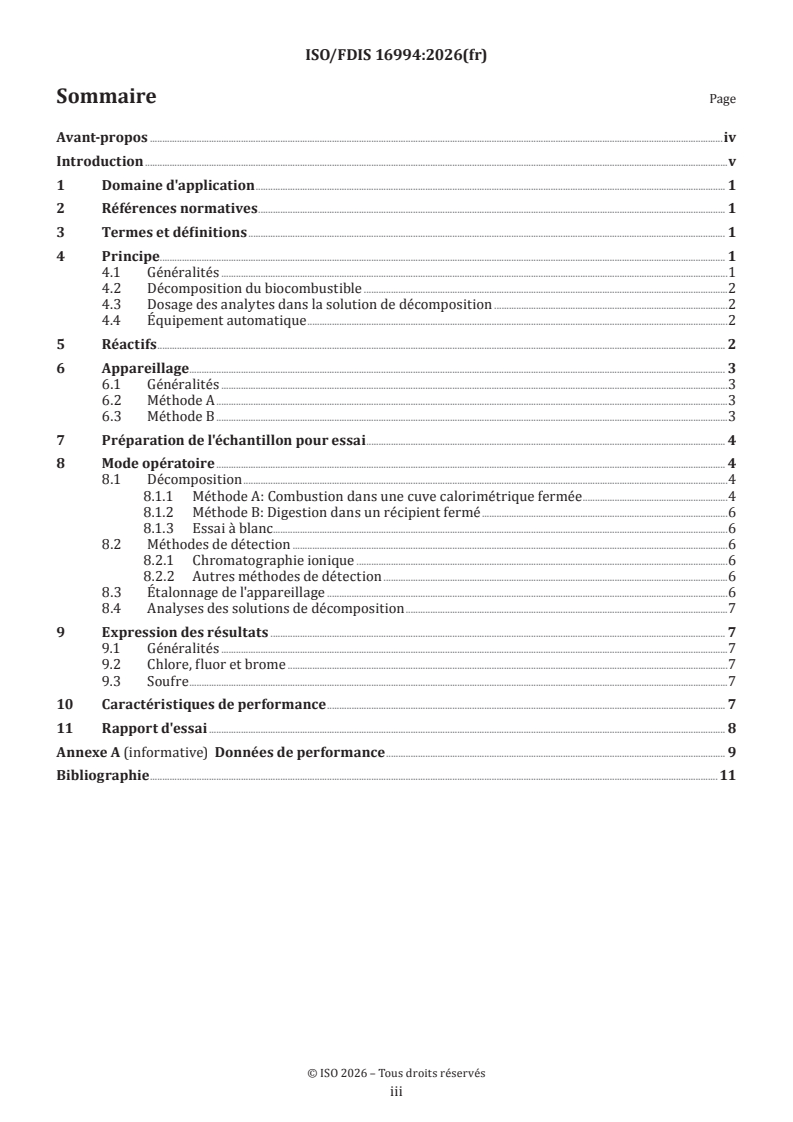
ISO/FDIS 16994 - Biocombustibles solides et biocarbone pyrogène — Détermination de la teneur en soufre et en chlore
Get Certified
Connect with accredited certification bodies for this standard

DNV
DNV is an independent assurance and risk management provider.

Lloyd's Register
Lloyd's Register is a global professional services organisation specialising in engineering and technology.

ABS Quality Evaluations Inc.
American Bureau of Shipping quality certification.
Sponsored listings
Frequently Asked Questions
ISO/FDIS 16994 is a draft published by the International Organization for Standardization (ISO). Its full title is "Solid biofuels and pyrogenic biocarbon — Determination of sulfur and chlorine content". This standard covers: ISO 16994:2016 describes methods for the determination of the total sulfur and total chlorine content in solid biofuels. It specifies two methods for decomposition of the fuel and different analytical techniques for the quantification of the elements in the decomposition solutions. The use of automatic equipment is also included in ISO 16994:2016, provided that a validation is carried out as specified and that the performance characteristics are similar to those of the method described in ISO 16994:2016.
ISO 16994:2016 describes methods for the determination of the total sulfur and total chlorine content in solid biofuels. It specifies two methods for decomposition of the fuel and different analytical techniques for the quantification of the elements in the decomposition solutions. The use of automatic equipment is also included in ISO 16994:2016, provided that a validation is carried out as specified and that the performance characteristics are similar to those of the method described in ISO 16994:2016.
ISO/FDIS 16994 is classified under the following ICS (International Classification for Standards) categories: 27.190 - Biological sources and alternative sources of energy; 75.160.40 - Biofuels. The ICS classification helps identify the subject area and facilitates finding related standards.
ISO/FDIS 16994 has the following relationships with other standards: It is inter standard links to FprEN ISO 16994, ISO 15551:2023, ISO 16994:2016. Understanding these relationships helps ensure you are using the most current and applicable version of the standard.
ISO/FDIS 16994 is available in PDF format for immediate download after purchase. The document can be added to your cart and obtained through the secure checkout process. Digital delivery ensures instant access to the complete standard document.
Standards Content (Sample)
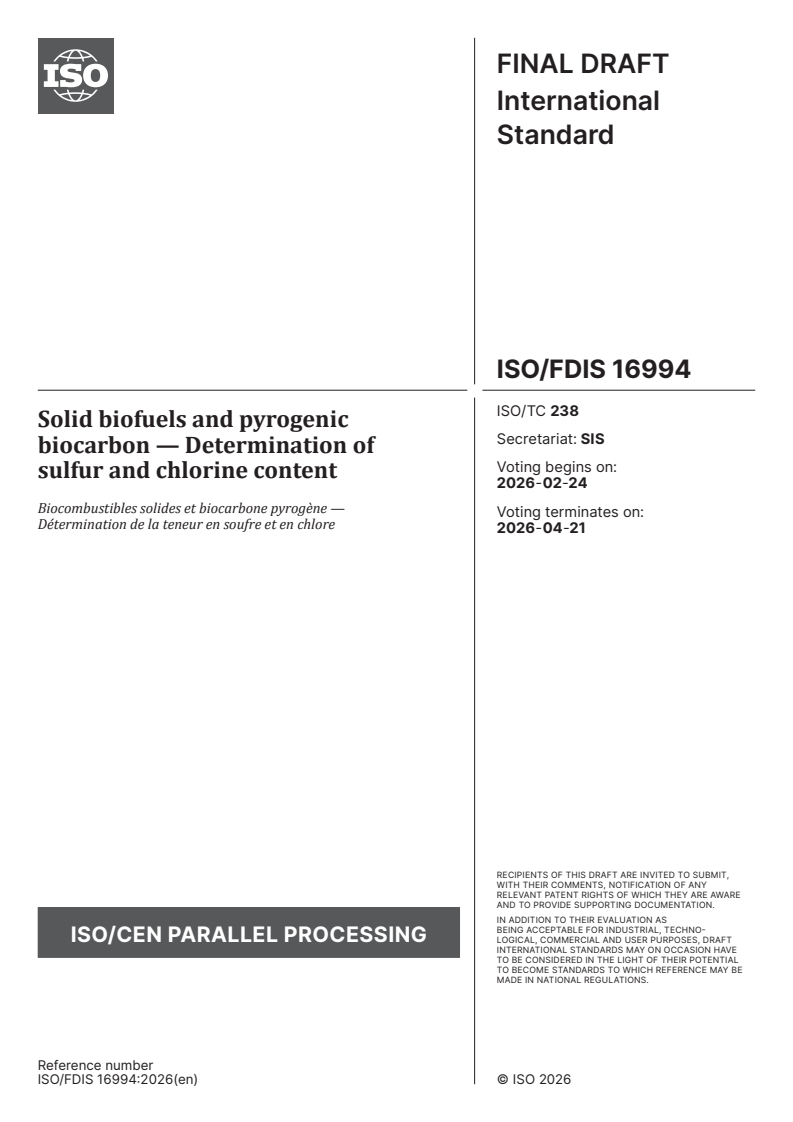
FINAL DRAFT
International
Standard
ISO/TC 238
Solid biofuels and pyrogenic
Secretariat: SIS
biocarbon — Determination of
Voting begins on:
sulfur and chlorine content
2026-02-24
Biocombustibles solides et biocarbone pyrogène —
Voting terminates on:
Détermination de la teneur en soufre et en chlore
2026-04-21
RECIPIENTS OF THIS DRAFT ARE INVITED TO SUBMIT,
WITH THEIR COMMENTS, NOTIFICATION OF ANY
RELEVANT PATENT RIGHTS OF WHICH THEY ARE AWARE
AND TO PROVIDE SUPPOR TING DOCUMENTATION.
IN ADDITION TO THEIR EVALUATION AS
BEING ACCEPTABLE FOR INDUSTRIAL, TECHNO
ISO/CEN PARALLEL PROCESSING LOGICAL, COMMERCIAL AND USER PURPOSES, DRAFT
INTERNATIONAL STANDARDS MAY ON OCCASION HAVE
TO BE CONSIDERED IN THE LIGHT OF THEIR POTENTIAL
TO BECOME STAN DARDS TO WHICH REFERENCE MAY BE
MADE IN NATIONAL REGULATIONS.
Reference number
FINAL DRAFT
International
Standard
ISO/TC 238
Solid biofuels and pyrogenic
Secretariat: SIS
biocarbon — Determination of
Voting begins on:
sulfur and chlorine content
Biocombustibles solides et biocarbone pyrogène —
Voting terminates on:
Détermination de la teneur en soufre et en chlore
RECIPIENTS OF THIS DRAFT ARE INVITED TO SUBMIT,
WITH THEIR COMMENTS, NOTIFICATION OF ANY
RELEVANT PATENT RIGHTS OF WHICH THEY ARE AWARE
AND TO PROVIDE SUPPOR TING DOCUMENTATION.
© ISO 2026
IN ADDITION TO THEIR EVALUATION AS
All rights reserved. Unless otherwise specified, or required in the context of its implementation, no part of this publication may
BEING ACCEPTABLE FOR INDUSTRIAL, TECHNO
ISO/CEN PARALLEL PROCESSING
LOGICAL, COMMERCIAL AND USER PURPOSES, DRAFT
be reproduced or utilized otherwise in any form or by any means, electronic or mechanical, including photocopying, or posting on
INTERNATIONAL STANDARDS MAY ON OCCASION HAVE
the internet or an intranet, without prior written permission. Permission can be requested from either ISO at the address below
TO BE CONSIDERED IN THE LIGHT OF THEIR POTENTIAL
or ISO’s member body in the country of the requester.
TO BECOME STAN DARDS TO WHICH REFERENCE MAY BE
MADE IN NATIONAL REGULATIONS.
ISO copyright office
CP 401 • Ch. de Blandonnet 8
CH-1214 Vernier, Geneva
Phone: +41 22 749 01 11
Email: copyright@iso.org
Website: www.iso.org
Published in Switzerland Reference number
ii
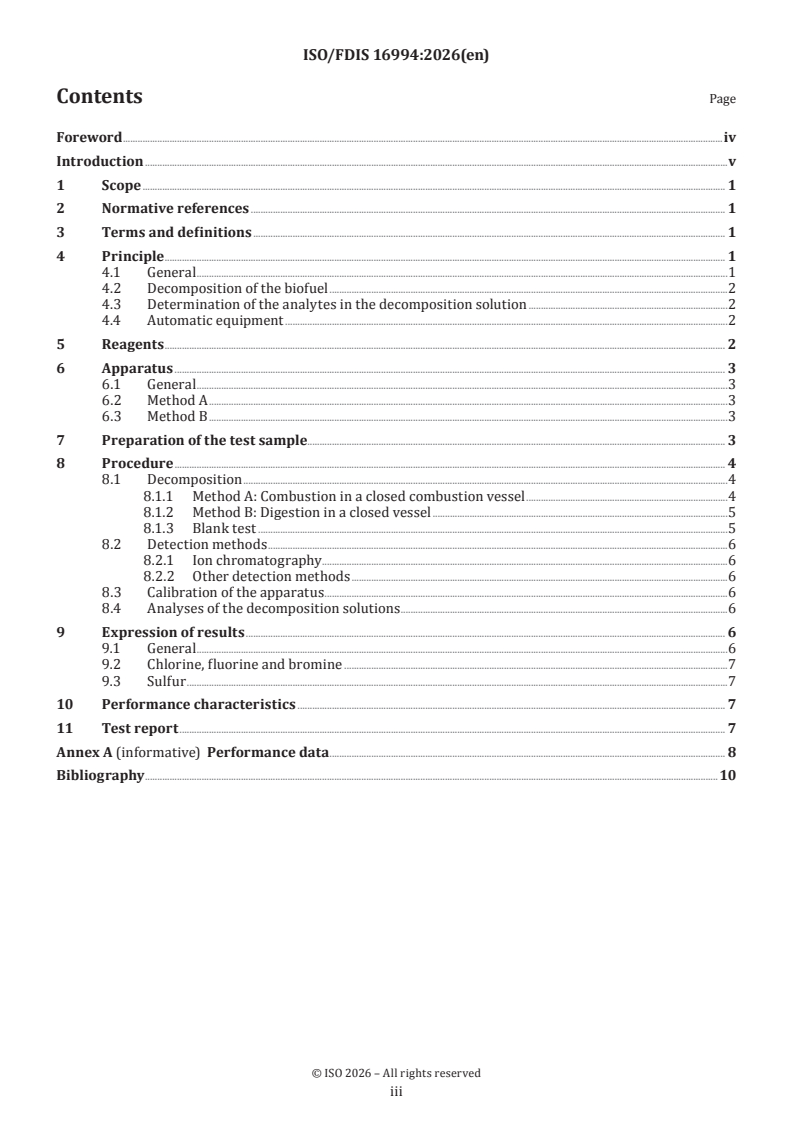
Contents Page
Foreword .iv
Introduction .v
1 Scope . 1
2 Normative references . 1
3 Terms and definitions . 1
4 Principle . 1
4.1 General .1
4.2 Decomposition of the biofuel .2
4.3 Determination of the analytes in the decomposition solution .2
4.4 Automatic equipment .2
5 Reagents . 2
6 Apparatus . 3
6.1 General .3
6.2 Method A .3
6.3 Method B .3
7 Preparation of the test sample. 3
8 Procedure . 4
8.1 Decomposition .4
8.1.1 Method A: Combustion in a closed combustion vessel .4
8.1.2 Method B: Digestion in a closed vessel .5
8.1.3 Blank test .5
8.2 Detection methods .6
8.2.1 Ion chromatography .6
8.2.2 Other detection methods .6
8.3 Calibration of the apparatus .6
8.4 Analyses of the decomposition solutions .6
9 Expression of results . 6
9.1 General .6
9.2 Chlorine, fluorine and bromine .7
9.3 Sulfur .7
10 Performance characteristics . 7
11 Test report . 7
Annex A (informative) Performance data . 8
Bibliography .10
iii
Foreword
ISO (the International Organization for Standardization) is a worldwide federation of national standards
bodies (ISO member bodies). The work of preparing International Standards is normally carried out through
ISO technical committees. Each member body interested in a subject for which a technical committee
has been established has the right to be represented on that committee. International organizations,
governmental and non-governmental, in liaison with ISO, also take part in the work. ISO collaborates closely
with the International Electrotechnical Commission (IEC) on all matters of electrotechnical standardization.
The procedures used to develop this document and those intended for its further maintenance are described
in the ISO/IEC Directives, Part 1. In particular, the different approval criteria needed for the different types
of ISO document should be noted. This document was drafted in accordance with the editorial rules of the
ISO/IEC Directives, Part 2 (see www.iso.org/directives).
ISO draws attention to the possibility that the implementation of this document may involve the use of (a)
patent(s). ISO takes no position concerning the evidence, validity or applicability of any claimed patent
rights in respect thereof. As of the date of publication of this document, ISO had not received notice of (a)
patent(s) which may be required to implement this document. However, implementers are cautioned that
this may not represent the latest information, which may be obtained from the patent database available at
www.iso.org/patents. ISO shall not be held responsible for identifying any or all such patent rights.
Any trade name used in this document is information given for the convenience of users and does not
constitute an endorsement.
For an explanation of the voluntary nature of standards, the meaning of ISO specific terms and expressions
related to conformity assessment, as well as information about ISO's adherence to the World Trade
Organization (WTO) principles in the Technical Barriers to Trade (TBT), see www.iso.org/iso/foreword.html.
This document was prepared by Technical Committee ISO/TC 238, Solid biofuels and pyrogenic biocarbon, in
collaboration with the European Committee for Standardization (CEN) Technical Committee CEN/TC 335,
Solid Biofuels and Pyrogenic Biocarbon, in accordance with the Agreement on technical cooperation between
ISO and CEN (Vienna Agreement).
This third edition cancels and replaces the second edition (ISO 16994:2016), which has been technically
revised.
The main changes are as follows:
— fluorine and bromine added to the scope and calculation in 9.2;
— normative references updated;
— detection methods updated and additional details about the techniques added;
— decomposition method with acid digestion and ICP for chlorine removed.
Any feedback or questions on this document should be directed to the user’s national standards body. A
complete listing of these bodies can be found at www.iso.org/members.html.
iv
Introduction
Sulfur and chlorine are present in solid biofuels and pyrogenic biocarbon in varying concentrations. During
the combustion process, they are usually converted to sulfur-oxides and chlorides. The presence of these
elements and their reaction products can contribute significantly to corrosion and to environmentally
harmful emissions.
Chlorine can be present in different organic and inorganic compounds and can exceed or equal the water-
soluble amount that can be determined by ISO 16995.
Fluorine and bromine can also be present in solid biofuels and pyrogenic biocarbon, but in detectable
concentration only in specific types of biomass, like in aquatic biofuels (Br) or as contamination because
of chemical treatment (F). Both elements can be analysed using the same techniques and equipment as for
chlorine and sulfur described in this document.
Combustion in an oxygen atmosphere in a closed combustion vessel is the preferred method to digest biomass
samples for a determination of sulfur, chlorine, fluorine and bromine content. An advantage of the method
is that the digestion can be carried out in connection with the determination of the calorific value according
to ISO 18125. Other analytical techniques may also be used for selected analytes. The determination of the
resultant chlorine, sulfur, bromine and fluorine compounds can be done by different techniques.
Automatic equipment and alternative methods may also be used for selected analytes.
A list with typical sulfur, chlorine and fluorine contents of solid biofuels can be found in ISO 17225-1:2021,
Annex B.
v
FINAL DRAFT International Standard ISO/FDIS 16994:2026(en)
Solid biofuels and pyrogenic biocarbon — Determination of
sulfur and chlorine content
1 Scope
This document describes methods for the determination of sulfur and chlorine content in solid biofuels
and pyrogenic biocarbon and specifies two methods for decomposition of the fuel and different analytical
techniques for the quantification of the elements in the decomposition solutions. The determination of
other elements such as fluorine and bromine are also possible with the methods in this document, however
performance data for these elements are not provided. The use of automatic equipment is also included in
this document, provided that a validation is carried out as specified and that the performance characteristics
are similar to those of the method described in this document.
2 Normative references
The following documents are referred to in the text in such a way that some or all of their content constitutes
requirements of this document. For dated references, only the edition cited applies. For undated references,
the latest edition of the referenced document (including any amendments) applies.
ISO 10304-1, Water quality — Determination of dissolved anions by liquid chromatography of ions — Part 1:
Determination of bromide, chloride, fluoride, nitrate, nitrite, phosphate and sulfate
ISO 14780, Solid biofuels — Sample preparation
ISO 16559, Solid biofuels — Vocabulary
ISO 18125, Solid biofuels — Determination of calorific value
ISO 18134-3, Solid biofuels — Determination of moisture content — Part 3: Moisture in general analysis sample
CEN Guide 13:2008, Validation of environmental test methods
3 Terms and definitions
For the purposes of this document, the terms and definitions given in ISO 16559 apply.
ISO and IEC maintain terminology databases for use in standardization at the following addresses:
— ISO Online browsing platform: available at https:// www .iso .org/ obp
— IEC Electropedia: available at https:// www .electropedia .org/
4 Principle
4.1 General
The determination of the analytes (sulfur, chlorine, fluorine and bromine) is performed in two steps (4.2 and
4.3) or by using automatic equipment (see 4.4).
4.2 Decomposition of the biofuel
— Combustion in an oxygen atmosphere in a combustion vessel and absorption of the acidic gas components
in an absorption solution (method A).
— Acid digestion in a closed vessel as described in ISO 16967:2015, Part A (method B).
4.3 Determination of the analytes in the decomposition solution
— Ion chromatography, for the determination of sulfate, chloride, fluoride and bromide, in accordance with
the principles of ISO 10304-1.
— ICP, for the determination of sulfur, in accordance with the principles of ISO 11885
4.4 Automatic equipment
Automatic equipment may be used when the method is validated with biomass reference samples of an
adequate biomass type. If automatic equipment is used, sulfur, chlorine and fluorine compounds may be
detected as gaseous components (e.g. by infrared methods). Examples for automatic analysers include
elemental analysers, AOX-analysers, combustion ion chromatography (see EN 17813) and sulfur-analysers.
If automatic equipment or X-ray fluorescence (see ISO/TS 16996) is used, the method shall be validated for
the respective main origin-based biomass group (see ISO 17225-1:2021, Table 1: woody biomass, herbaceous
biomass, fruit biomass or aquatic biomass) in accordance with CEN Guide 13:2008, Clause 3 validation of
alternative methods, with one of the following two approaches:
— full validation as applies to reference methods;
— relative validation in which a comparison is made to the reference method, e.g. by participation in inter-
laboratory comparison tests.
NOTE Equipment validated only with, for example, straw reference materials, is not automatically suitable for
the determination of sulfur and chlorine in, for example, wood samples, because of the usually significant lower
concentrations of the elements in wood and/or the unknown influences of the different matrix.
5 Reagents
5.1 General
The reagents listed below relate to the digestion method specified in 8.1.1 (method A). Reagents for the
digestion method B and the different detection methods according to 8.2 are specified in the corresponding
standards.
All reagents shall be at least of analytical grade and suitable for their specific purpose. Particularly, they
shall contain negligible amounts of chlorine, sulfur, fluorine and bromine, i.e. amounts that do not contribute
significantly to the determination.
5.2 Water, de-ionized water will normally fulfil the requirements of 5.1.
5.3 Oxygen, pure oxygen with an assay of at least 99,5 % (V/V).
5.4 Combustion aid/enhancer, various substances may be used, e.g. benzoic acid, paraffin oil,
acetobutyrate capsules, polyethylene bags.
5.5 Use of certified reference materials or reference materials (CRM or RM).
Use certified reference materials or reference materials to check if the accuracy of the calibration meets the
required performance characteristics.
When, due to matrix effects or concentration range limitations, no good recoveries for the cert
...
ISO/DISFDIS 16994:2025(en)
ISO/TC 238
Secretariat: SIS
Date: 2025-12-302026-02-10
Solid biofuels and pyrogenic biocarbon — Determination of sulfur
and chlorine content
Biocombustibles solides et biocarbone pyrogène — Détermination de la teneur en soufre et en chlore
FDIS stage
TThhiiss draft i draft iss susubmbmitted toitted to a a p parallelarallel vovote te in ISOin ISO,, CEN CEN.
All rights reserved. Unless otherwise specified, or required in the context of its implementation, no part of this publication
may be reproduced or utilized otherwise in any form or by any means, electronic or mechanical, including photocopying,
or posting on the internet or an intranet, without prior written permission. Permission can be requested from either ISO
at the address below or ISO’s member body in the country of the requester.
ISO copyright office
CP 401 • Ch. de Blandonnet 8
CH-1214 Vernier, Geneva
Phone: + 41 22 749 01 11
EmailE-mail: copyright@iso.org
Website: www.iso.orgwww.iso.org
Published in Switzerland
ii
ISO/DISFDIS 16994:20252026(en)
Contents
Foreword . v
Introduction . vi
1 Scope . 1
2 Normative references . 1
3 Terms and definitions . 1
4 Principle . 1
5 Reagents . 2
6 Apparatus . 3
7 Preparation of the test sample . 3
8 Procedure . 4
9 Expression of results . 7
10 Performance characteristics . 8
11 Test report . 8
Annex A (informative) Performance data . 9
Bibliography . 11
Foreword . iv
Introduction . v
1 Scope . 1
2 Normative references . 1
3 Terms and definitions . 1
4 Principle . 2
4.1 General . 2
4.2 Decomposition of the biofuel . 2
4.3 Determination of the analytes in the decomposition solution . 2
4.4 Automatic equipment . 2
5 Reagents . 2
6 Apparatus . 3
6.1 General . 3
6.2 Method A . 3
6.3 Method B . 3
7 Preparation of the test sample . 4
8 Procedure . 4
8.1 Decomposition . 4
8.1.1 Method A: Combustion in a closed combustion vessel . 4
8.1.2 Method B: Digestion in a closed vessel . 5
8.1.3 Blank test . 5
8.2 Detection methods . 6
8.2.1 Ion chromatography . 6
8.2.2 Other detection methods . 6
iii
8.3 Calibration of the apparatus . 6
8.4 Analyses of the decomposition solutions . 6
9 Expression of results . 6
9.1 General . 6
9.2 Chlorine, fluorine and bromine . 7
9.3 Sulfur . 7
10 Performance characteristics . 7
11 Test report . 7
Annex A (informative) Performance data . 9
Bibliography . 11
iv
ISO/DISFDIS 16994:20252026(en)
Foreword
ISO (the International Organization for Standardization) is a worldwide federation of national standards
bodies (ISO member bodies). The work of preparing International Standards is normally carried out through
ISO technical committees. Each member body interested in a subject for which a technical committee has been
established has the right to be represented on that committee. International organizations, governmental and
non-governmental, in liaison with ISO, also take part in the work. ISO collaborates closely with the
International Electrotechnical Commission (IEC) on all matters of electrotechnical standardization.
The procedures used to develop this document and those intended for its further maintenance are described
in the ISO/IEC Directives, Part 1. In particular, the different approval criteria needed for the different types of
ISO document should be noted. This document was drafted in accordance with the editorial rules of the
ISO/IEC Directives, Part 2 (see www.iso.org/directives).
ISO draws attention to the possibility that the implementation of this document may involve the use of (a)
patent(s). ISO takes no position concerning the evidence, validity or applicability of any claimed patent rights
in respect thereof. As of the date of publication of this document, ISO had not received notice of (a) patent(s)
which may be required to implement this document. However, implementers are cautioned that this may not
represent the latest information, which may be obtained from the patent database available at
www.iso.org/patents.www.iso.org/patents. ISO shall not be held responsible for identifying any or all such
patent rights.
Any trade name used in this document is information given for the convenience of users and does not
constitute an endorsement.
For an explanation of the voluntary nature of standards, the meaning of ISO specific terms and expressions
related to conformity assessment, as well as information about ISO's adherence to the World Trade
Organization (WTO) principles in the Technical Barriers to Trade (TBT), see
www.iso.org/iso/foreword.htmlwww.iso.org/iso/foreword.html.
This document was prepared by Technical Committee ISO/TC 238, Solid biofuels and pyrogenic biocarbon, in
collaboration with the European Committee for Standardization (CEN) Technical Committee CEN/TC 335,
Solid Biofuels and Pyrogenic Biocarbon, in accordance with the Agreement on technical cooperation between
ISO and CEN (Vienna Agreement).
This third edition cancels and replaces the second edition (ISO 16994:2016), which has been technically
revised.
The main changes are as follows:
— — fluorine and bromine added to the scope and calculation in 9.2;9.2;
— — normative references updated;
— — detection methods updated and additional details about the techniques added;
— — decomposition method with acid digestion and ICP for chlorine removed.
Any feedback or questions on this document should be directed to the user’s national standards body. A
complete listing of these bodies can be found at www.iso.org/members.htmlwww.iso.org/members.html.
v
Introduction
Sulfur and chlorine are present in solid biofuels and pyrogenic biocarbon in varying concentrations. During
the combustion process, they are usually converted to sulfur-oxides and chlorides. The presence of these
elements and their reaction products can contribute significantly to corrosion and to environmentally harmful
emissions.
Chlorine can be present in different organic and inorganic compounds and can exceed or equal the water -
soluble amount that can be determined by ISO 16995.
Fluorine and bromine can also be present in solid biofuels and pyrogenic biocarbon, but in detectable
concentration only in specific types of biomass, like in aquatic biofuels (Br) or as contamination because of
chemical treatment (F). Both elements can be analysed using the same techniques and equipment as for
chlorine and sulfur described in this document.
Combustion in an oxygen atmosphere in a closed combustion vessel is the preferred method to digest biomass
samples for a determination of sulfur, chlorine, fluorine and bromine content. An advantage of the method is
that the digestion can be carried out in connection with the determination of the calorific value according to
ISO 18125. Other analytical techniques may also be used for selected analytes. The determination of the
resultant chlorine, sulfur, bromine and fluorine compounds can be done by different techniques.
Automatic equipment and alternative methods may also be used for selected analytes.
A list with typical sulfur, chlorine and fluorine contents of solid biofuels can be found in ISO 17225--1:2021,
Annex B.
vi
DRAFT International Standard ISO/DIS 16994:2025(en)
Solid biofuels and pyrogenic biocarbon — Determination of sulfur
and chlorine content
1 Scope
This document describes methods for the determination of sulfur and chlorine content in solid biofuels and
pyrogenic biocarbon and specifies two methods for decomposition of the fuel and different analytical
techniques for the quantification of the elements in the decomposition solutions. The determination of other
elements such as fluorine and bromine isare also possible with the methods in this document, however
performance data for these elements are not provided. The use of automatic equipment is also included in this
document, provided that a validation is carried out as specified and that the performance characteristics are
similar to those of the method described in this document.
2 Normative references
The following documents are referred to in the text in such a way that some or all of their content constitutes
requirements of this document. For dated references, only the edition cited applies. For undated references,
the latest edition of the referenced document (including any amendments) applies.
ISO 10304--1, Water quality — Determination of dissolved anions by liquid chromatography of ions — Part 1:
Determination of bromide, chloride, fluoride, nitrate, nitrite, phosphate and sulfate
ISO 14780, Solid biofuels — Sample preparation
ISO 16559, Solid biofuels — Vocabulary
ISO 18125, Solid biofuels — Determination of calorific value
ISO 18134--3, Solid biofuels — Determination of moisture content — Part 3: Moisture in general analysis sample
CEN Guide 13:2008, Validation of environmental test methods
3 Terms and definitions
For the purposes of this document, the terms and definitions given in ISO 16559 apply.
ISO and IEC maintain terminology databases for use in standardization at the following addresses:
— — ISO Online browsing platform: available at https://www.iso.org/obphttps://www.iso.org/obp
— — IEC Electropedia: available at https://www.electropedia.org/https://www.electropedia.org/
4 Principle
4.1 General
The determination of the analytes (sulfur, chlorine, fluorine and bromine) is performed in two steps (4.2(4.2
and 4.3)4.3) or by using automatic equipment (see 4.4).4.4).
4.2 Decomposition of the biofuel
— — Combustion in an oxygen atmosphere in a combustion vessel and absorption of the acidic gas
components in an absorption solution (method A).
— — Acid digestion in a closed vessel as described in ISO 16967:2015, Part A (method B).
4.3 Determination of the analytes in the decomposition solution
— — Ion chromatography, for the determination of sulfate, chloride, fluoride and bromide, in accordance
with the principles of ISO 10304--1.
— — ICP, for the determination of sulfur, in accordance with the principles of ISO 11885
4.4 Automatic equipment
Automatic equipment may be used when the method is validated with biomass reference samples of an
adequate biomass type. If automatic equipment is used, sulfur, chlorine and fluorine compounds may be
detected as gaseous components (e.g. by infrared methods). Examples for automatic analysers include
elemental analysers, AOX-analysers, combustion ion chromatography (see EN 17813) and sulfur-analysers.
If automatic equipment or X-ray fluorescence (see ISO/TS 16996) is used, the method shall be validated for
the respective main origin-based biomass group (see ISO 17225--1:2021, Table 1: woody biomass,
herbaceous biomass, fruit biomass or aquatic biomass) in accordance with CEN Guide 13:2008, Clause 3
validation of alternative methods, with one of the following two approaches:
— — full validation as applies to reference methods;
— — relative validation in which a comparison is made to the reference method, e.g. by participation in
inter-laboratory comparison tests.
NOTE Equipment validated only with, for example, straw reference materials, is not automatically suitable for the
determination of sulfur and chlorine in, for example, wood samples, because of the usually significant lower
concentrations of the elements in wood and/or the unknown influences of the different matrix.
5 Reagents
5.1 5.1 General
The reagents listed below relate to the digestion method specified in 8.1.18.1.1 (method A). Reagents for the
digestion method B and the different detection methods according to 8.28.2 are specified in the corresponding
standards.
All reagents shall be at least of analytical grade and suitable for their specific purpose. Particularly, they shall
contain negligible amounts of chlorine, sulfur, fluorine and bromine, i.e. amounts that do not contribute
significantly to the determination.
5.2 5.2 Water, de-ionized water will normally fulfil the requirements of 5.1.5.1.
5.3 5.3 Oxygen, pure oxygen with an assay of at least 99,5 % (V/V).
5.4 5.4 Combustion aid/enhancer, various substances may be used, e.g. benzoic acid, paraffin oil,
acetobutyrate capsules, polyethylene bags.
5.5 5.5 Use of certified reference materials or reference materials (CRM or RM).
2 © ISO #### 2026 – All rights reserved
ISO/DISFDIS 16994:20252026(en)
Use certified reference materials or reference materials to check if the accuracy of the calibration meets the
required performance characteristics.
When, due to matrix effects or concentration range limitations, no good recoveries for the certified reference
materials or reference materials can be obtained, calibration with at least two CRM or RM materials, can solve
these problems. In that case, CRM or RM materials other than used for the calibration shall be used for
verification purposes.
NOTE 1 A CRM or RM is prepared and used for the following three main purposes:
a) a) to help develop accurate methods of analysis;
b) b) to calibrate measurement systems used to facilitate exchange of goods, institute quality control,
determine performance characteristics, or measure a property at the state-of-the-art limit;
c) c) to ensure the long-term adequacy and integrity of measurement quality assurance programs.
...
PROJET FINAL
Norme
internationale
ISO/TC 238
Biocombustibles solides
Secrétariat: SIS
et biocarbone pyrogène —
Début de vote:
Détermination de la teneur en
2026-02-24
soufre et en chlore
Vote clos le:
2026-04-21
Solid biofuels and pyrogenic biocarbon — Determination of sulfur
and chlorine content
LES DESTINATAIRES DU PRÉSENT PROJET SONT
INVITÉS À PRÉSENTER, AVEC LEURS OBSERVATIONS,
NOTIFICATION DES DROITS DE PROPRIÉTÉ DONT ILS
AURAIENT ÉVENTUELLEMENT CONNAISSANCE ET À
FOURNIR UNE DOCUMENTATION EXPLICATIVE.
OUTRE LE FAIT D’ÊTRE EXAMINÉS POUR
ÉTABLIR S’ILS SONT ACCEPTABLES À DES FINS
INDUSTRIELLES, TECHNOLOGIQUES ET COM-MERCIALES,
AINSI QUE DU POINT DE VUE DES UTILISATEURS, LES
PROJETS DE NORMES
TRAITEMENT PARALLÈLE ISO/CEN
INTERNATIONALES DOIVENT PARFOIS ÊTRE CONSIDÉRÉS
DU POINT DE VUE DE LEUR POSSI BILITÉ DE DEVENIR DES
NORMES POUVANT
SERVIR DE RÉFÉRENCE DANS LA RÉGLEMENTATION
NATIONALE.
Numéro de référence
PROJET FINAL
Norme
internationale
ISO/TC 238
Biocombustibles solides
Secrétariat: SIS
et biocarbone pyrogène —
Début de vote:
Détermination de la teneur en
2026-02-24
soufre et en chlore
Vote clos le:
2026-04-21
Solid biofuels and pyrogenic biocarbon — Determination of sulfur
and chlorine content
LES DESTINATAIRES DU PRÉSENT PROJET SONT
INVITÉS À PRÉSENTER, AVEC LEURS OBSERVATIONS,
NOTIFICATION DES DROITS DE PROPRIÉTÉ DONT ILS
AURAIENT ÉVENTUELLEMENT CONNAISSANCE ET À
FOURNIR UNE DOCUMENTATION EXPLICATIVE.
DOCUMENT PROTÉGÉ PAR COPYRIGHT
OUTRE LE FAIT D’ÊTRE EXAMINÉS POUR
ÉTABLIR S’ILS SONT ACCEPTABLES À DES FINS
© ISO 2026 INDUSTRIELLES, TECHNOLOGIQUES ET COM-MERCIALES,
AINSI QUE DU POINT DE VUE DES UTILISATEURS, LES
Tous droits réservés. Sauf prescription différente ou nécessité dans le contexte de sa mise en œuvre, aucune partie de cette
PROJETS DE NORMES
TRAITEMENT PARALLÈLE ISO/CEN
INTERNATIONALES DOIVENT PARFOIS ÊTRE CONSIDÉRÉS
publication ne peut être reproduite ni utilisée sous quelque forme que ce soit et par aucun procédé, électronique ou mécanique,
DU POINT DE VUE DE LEUR POSSI BILITÉ DE DEVENIR DES
y compris la photocopie, ou la diffusion sur l’internet ou sur un intranet, sans autorisation écrite préalable. Une autorisation peut
NORMES POUVANT
être demandée à l’ISO à l’adresse ci-après ou au comité membre de l’ISO dans le pays du demandeur.
SERVIR DE RÉFÉRENCE DANS LA RÉGLEMENTATION
NATIONALE.
ISO copyright office
Case postale 401 • Ch. de Blandonnet 8
CH-1214 Vernier, Genève
Tél.: +41 22 749 01 11
E-mail: copyright@iso.org
Web: www.iso.org
Publié en Suisse Numéro de référence
ii
Sommaire Page
Avant-propos .iv
Introduction .v
1 Domaine d'application . 1
2 Références normatives . 1
3 Termes et définitions . 1
4 Principe. 1
4.1 Généralités .1
4.2 Décomposition du biocombustible .2
4.3 Dosage des analytes dans la solution de décomposition .2
4.4 Équipement automatique .2
5 Réactifs . 2
6 Appareillage . 3
6.1 Généralités .3
6.2 Méthode A .3
6.3 Méthode B .3
7 Préparation de l'échantillon pour essai . 4
8 Mode opératoire . 4
8.1 Décomposition .4
8.1.1 Méthode A: Combustion dans une cuve calorimétrique fermée .4
8.1.2 Méthode B: Digestion dans un récipient fermé .6
8.1.3 Essai à blanc.6
8.2 Méthodes de détection .6
8.2.1 Chromatographie ionique .6
8.2.2 Autres méthodes de détection .6
8.3 Étalonnage de l'appareillage .6
8.4 Analyses des solutions de décomposition .7
9 Expression des résultats . 7
9.1 Généralités .7
9.2 Chlore, fluor et brome .7
9.3 Soufre .7
10 Caractéristiques de performance . 7
11 Rapport d'essai . 8
Annexe A (informative) Données de performance . 9
Bibliographie .11
iii
Avant-propos
L'ISO (Organisation internationale de normalisation) est une fédération mondiale d'organismes nationaux
de normalisation (comités membres de l'ISO). L’élaboration des Normes internationales est en général
confiée aux comités techniques de l’ISO. Chaque comité membre intéressé par une étude a le droit de faire
partie du comité technique créé à cet effet. Les organisations internationales, gouvernementales et non
gouvernementales, en liaison avec l’ISO participent également aux travaux. L’ISO collabore étroitement avec
la Commission électrotechnique internationale (IEC) en ce qui concerne la normalisation électrotechnique.
Les procédures utilisées pour élaborer le présent document et celles destinées à sa mise à jour sont
décrites dans les Directives ISO/IEC, Partie 1. Il convient, en particulier, de prendre note des différents
critères d'approbation requis pour les différents types de documents ISO. Le présent document
a été rédigé conformément aux règles de rédaction données dans les Directives ISO/IEC, Partie 2
(voir www.iso.org/directives).
L’ISO attire l’attention sur le fait que la mise en application du présent document peut entraîner l’utilisation
d’un ou de plusieurs brevets. L’ISO ne prend pas position quant à la preuve, à la validité et à l’applicabilité de
tout droit de propriété revendiqué à cet égard. À la date de publication du présent document, l’ISO n'avait pas
reçu notification qu’un ou plusieurs brevets pouvaient être nécessaires à sa mise en application. Toutefois,
il y a lieu d’avertir les responsables de la mise en application du présent document que des informations
plus récentes sont susceptibles de figurer dans la base de données de brevets, disponible à l'adresse
www.iso.org/brevets. L'ISO ne saurait être tenue pour responsable de ne pas avoir identifié tout ou partie de
tels droits de brevet.
Les appellations commerciales éventuellement mentionnées dans le présent document sont données pour
information, par souci de commodité, à l’intention des utilisateurs et ne sauraient constituer un engagement.
Pour une explication de la nature volontaire des normes, la signification des termes et expressions
spécifiques de l’ISO liés à l’évaluation de la conformité, ou pour toute information au sujet de l’adhésion de
l’ISO aux principes de l’Organisation mondiale du commerce (OMC) concernant les obstacles techniques au
commerce (OTC), voir www.iso.org/iso/fr/avant-propos.html.
Le présent document a été élaboré par le comité technique ISO/TC 238, Biocombustibles solides et biocarbone
pyrogène, en collaboration avec le comité technique CEN/TC 335, Biocombustibles solides et biocarbone
pyrogène, du Comité européen de normalisation (CEN), conformément à l'Accord de coopération technique
entre l'ISO et le CEN (Accord de Vienne).
Cette troisième édition annule et remplace la deuxième édition (ISO 16994:2016), qui a fait l'objet d'une
révision technique.
Les principales modifications sont les suivantes:
— le fluor et le brome sont ajoutés au domaine d'application et au calcul en 9.2;
— les références normatives ont été mises à jour;
— mise à jour des méthodes de détection et plus de détails concernant les techniques;
— la méthode de décomposition avec digestion à l'acide et mesure par ICP pour le chlore a été supprimée.
Il convient que l'utilisateur adresse tout retour d'information ou toute question concernant le présent
document à l'organisme national de normalisation de son pays. Une liste exhaustive desdits organismes se
trouve à l'adresse www.iso.org/members.html.
iv
Introduction
Le soufre et le chlore sont présents dans les biocombustibles solides et le biocarbone pyrogène à des
concentrations variables. Au cours du processus de combustion, ils sont généralement transformés en oxydes
de soufre et en chlorures. La présence de ces éléments et de leurs produits de réaction peut contribuer de
manière significative à la corrosion et générer des émissions nuisibles à l'environnement.
Le chlore peut être présent dans différents composés organiques et inorganiques et la teneur totale en chlore
peut être supérieure ou égale à la teneur en chlore soluble dans l'eau, laquelle peut être déterminée avec la
méthode décrite dans l'ISO 16995.
Le fluor et le brome peuvent également être présents dans les biocombustibles solides et le biocarbone
pyrogène, mais à une concentration détectable uniquement dans des types de biomasse spécifiques tels que
les biocombustibles aquatiques (Br) ou en tant que contamination due au traitement chimique (F). Les deux
éléments peuvent être analysés à l'aide des mêmes techniques et équipements que pour le chlore et le soufre
décrits dans le présent document.
La combustion dans une atmosphère d'oxygène dans une cuve calorimétrique fermée est la méthode
privilégiée pour la digestion des échantillons de biomasse en vue de déterminer la teneur en soufre, en
chlore, en fluor et en brome. L'avantage de cette méthode repose sur la possibilité de réaliser la digestion
par rapport au pouvoir calorifique déterminé selon l'ISO 18125. D'autres techniques d'analyse peuvent
également être utilisées pour des analytes sélectionnés. Différentes techniques peuvent être utilisées pour
doser les composés chlorés, soufrés, bromés et fluorés.
Des équipements automatiques et d’autres méthodes peuvent également être utilisés pour des analytes
sélectionnés.
L'Annexe B de l'ISO 17225-1:2021 propose une liste des teneurs en soufre, en chlore et en fluor caractéristiques
des biocombustibles solides.
v
PROJET FINAL Norme internationale ISO/FDIS 16994:2026(fr)
Biocombustibles solides et biocarbone pyrogène —
Détermination de la teneur en soufre et en chlore
1 Domaine d'application
Le présent document décrit les méthodes de détermination de la teneur en soufre et en chlore dans
les biocombustibles solides et le biocarbone pyrogène et spécifie deux méthodes de décomposition du
combustible et différentes techniques d'analyse pour la quantification des éléments dans les solutions de
décomposition. La détermination d'autres éléments tels que le fluor et le brome est également possible
avec les méthodes du présent document, mais les données de performance pour ces éléments ne sont pas
fournies. Le présent document englobe également l'utilisation d'équipements automatiques sous réserve
que la validation soit effectuée conformément aux spécifications et que les caractéristiques de performance
soient similaires à celles de la méthode décrite dans le présent document.
2 Références normatives
Les documents suivants sont cités dans le texte de sorte qu’ils constituent, pour tout ou partie de leur
contenu, des exigences du présent document. Pour les références datées, seule l’édition citée s’applique. Pour
les références non datées, la dernière édition du document de référence s'applique (y compris les éventuels
amendements).
ISO 10304-1, Qualité de l'eau — Dosage des anions dissous par chromatographie des ions en phase liquide —
Partie 1: Dosage du bromure, chlorure, fluorure, nitrate, nitrite, phosphate et sulfate
ISO 14780, Biocombustibles solides — Préparation des échantillons
ISO 16559, Biocombustibles solides — Vocabulaire
ISO 18125, Biocombustibles solides — Détermination du pouvoir calorifique
ISO 18134-3, Biocombustibles solides — Dosage de la teneur en humidité — Partie 3: Humidité de l'échantillon
pour analyse générale
Guide CEN 13:2008, Validation of environmental test methods (disponible en anglais uniquement)
3 Termes et définitions
Pour les besoins du présent document, les termes et les définitions de l'ISO 16559 s'appliquent.
L'ISO et l'IEC tiennent à jour des bases de données terminologiques destinées à être utilisées en normalisation,
consultables aux adresses suivantes:
— ISO Online browsing platform: disponible à l'adresse https:// www .iso .org/ obp
— IEC Electropedia: disponible à l'adresse https:// www .electropedia .org/
4 Principe
4.1 Généralités
La détermination des analytes (soufre, chlore, fluor et brome) s'effectue en deux étapes (4.2 et 4.3) ou en
utilisant un équipement automatique (voir 4.4).
4.2 Décomposition du biocombustible
— Combustion dans une atmosphère d’oxygène dans une cuve calorimétrique et absorption des composants
gazeux acides dans une solution d'absorption (méthode A).
— Digestion à l'acide dans un récipient fermé, conformément à la description fournie dans l’ISO 16967:2015,
Partie A (méthode B).
4.3 Dosage des analytes dans la solution de décomposition
— Chromatographie ionique, pour la détermination du sulfate, du chlorure, du fluorure et du bromure,
conformément aux principes de l'ISO 10304-1.
— Spectrométrie par ICP, pour la détermination du soufre, conformément aux principes de l'ISO 11885.
4.4 Équipement automatique
Des équipements automatiques peuvent être utilisés lorsque la méthode a été validée avec des échantillons
de biomasse de référence d'un type de biomasse approprié. En cas d'utilisation d'un équipement
automatique, les composés soufrés, chlorés et fluorés peuvent être détectés sous la forme de composants
gazeux (par exemple, par des méthodes infrarouges). Les analyseurs élémentaires, les analyseurs AOX, la
chromatographie ionique de combustion (voir l’EN 17813) et les analyseurs de soufre sont des exemples
d’analyseurs automatiques.
En cas d'utilisation d'un équipement automatique ou de la fluorescence X (voir ISO/TS 16996), la
méthode doit être validée pour chaque groupe principal de biomasse d'origine (voir l’ISO 17225-1:2021,
Tableau 1: biomasse ligneuse, biomasse herbacée, biomasse fruitière ou biomasse aquatique), conformément
au Guide CEN 13:2008, Article 3: homologation des autres méthodes avec l'une des deux approches suivantes:
— validation complète applicable aux méthodes de référence;
— validation relative, dans laquelle une comparaison est effectuée par rapport à la méthode de référence en
participant, par exemple, à des essais de comparaison interlaboratoires.
NOTE Les équipements validés avec un seul matériau de référence, de la paille par exemple, ne conviennent pas
systématiquement pour le dosage du soufre et du chlore, par exemple dans des échantillons de bois, car la concentration
des éléments est généralement bien inférieure dans le bois et/ou les influences de la matrice différente sont inconnues.
5 Réactifs
5.1 Généralités
Les réactifs répertoriés ci-dessous se rapportent à la méthode de digestion spécifiée en 8.1.1 (méthode A).
Les réactifs destinés à la méthode de digestion B et les différentes méthodes de détection, conformément à
8.2, sont spécifiés dans les normes correspondantes.
Tous les réactifs doivent être au moins de qualité analytique et adaptés à leur objet spécifique. Ils doivent, en
particulier, contenir des quantités négligeables de chlore, de soufre de fluor et de brome, en d'autres termes:
des quantités qui ne contribuent pas de manière significative au dosage.
5.2 Eau, l'eau déminéralisée est généralement conforme aux exigences de 5.1.
5.3 Oxygène, ayant une pureté d'au moins 99,5 % (V/V).
5.4 Substance auxiliaire favorisant la combustion/accélérateur de combustion, différentes
substances peuvent être utilisées, par exemple: de l'acide benzoïque, de l'huile de paraffine, des capsules
d'acétobutyrate ou des sachets en polyéthylène.
5.5 Utilisation de matériaux de référence certifiés ou de matériaux de référence(MRC ou MR).
Utiliser des matériaux de référence certifiés ou des matériaux de référence pour vérifier si la précision de
l'étalonnage satisfait aux caractéristiques de performance requises.
Si, en raison des effets de la matrice ou des limitations de la plage de concentration, aucune récupération
valable de matériaux de référence certifiés ou de matériaux de référence ne peut être effectuée, l’étalonnage
au moyen d’au moins deux MRC ou MR peuvent résoudre ces problèmes. Dans ce cas, des MRC ou MR autres
que ceux utilisés pour l'étalonnage doivent être utilisés à des fins de vérification.
NOTE 1 Un MRC ou MR est principalement préparé et utilisé pour les trois raisons suivantes:
a) contribuer au développement de méthodes d'analyse précises;
b) étalonner les systèmes de mesure utilisés pour faciliter les échanges de marchandises, le contrôle qualité en
institut, déterminer les caractéristiques de performances ou mesurer une propriété à la limite des connaissances
technologiques;
c) garantir l'adéquation et l'intégrité à long terme des programmes d'assurance de la qualité des mesures.
NOTE 2 Les mat
...
Questions, Comments and Discussion
Ask us and Technical Secretary will try to provide an answer. You can facilitate discussion about the standard in here.
Loading comments...