

ISO 17830:2024
(Main)Solid biofuels — Particle size distribution of disintegrated pellets
General Information
- Abstract
This document specifies the requirements and method used to determine particle size distribution of disintegrated pellets. It is applicable for pellets that fully disintegrate in hot water.
- Status
- Published
- Publication Date
- 23-May-2024
- Technical Committee
- ISO/TC 238 - Solid biofuels
- Drafting Committee
- ISO/TC 238 - Solid biofuels
- Current Stage
- 6060 - International Standard published
- Start Date
- 24-May-2024
- Due Date
- 16-May-2024
- Completion Date
- 24-May-2024
Buy Documents
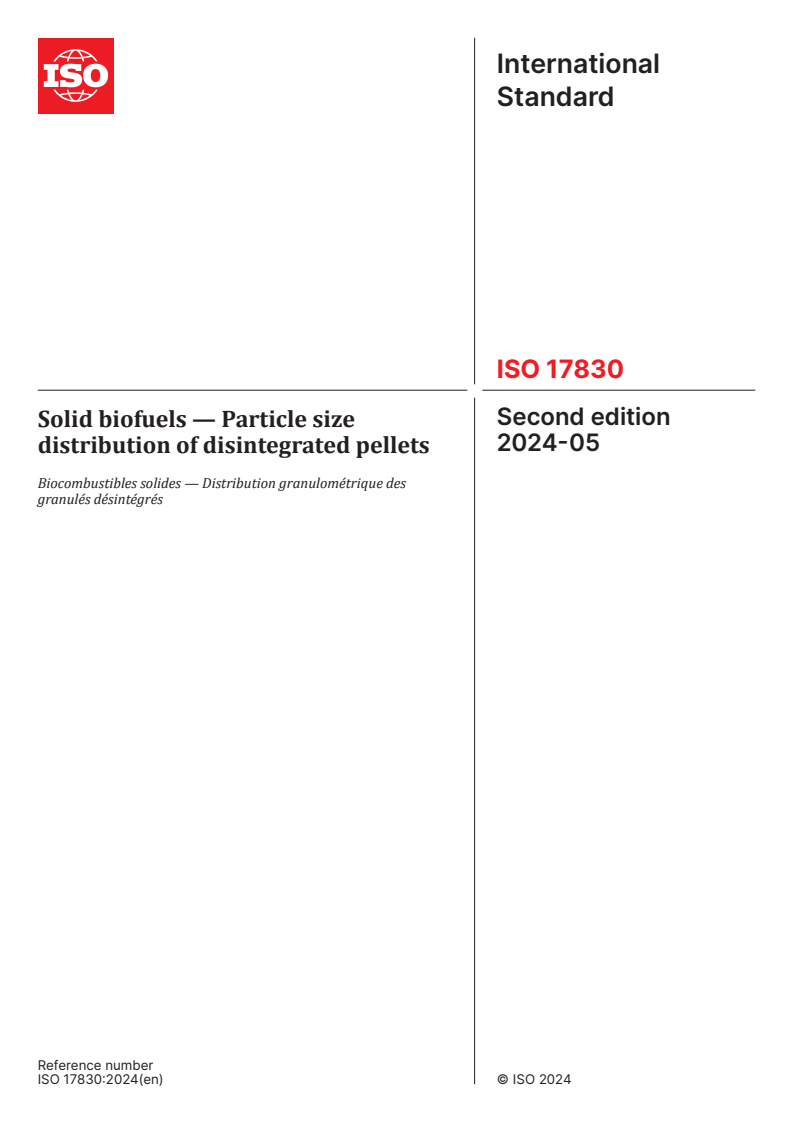
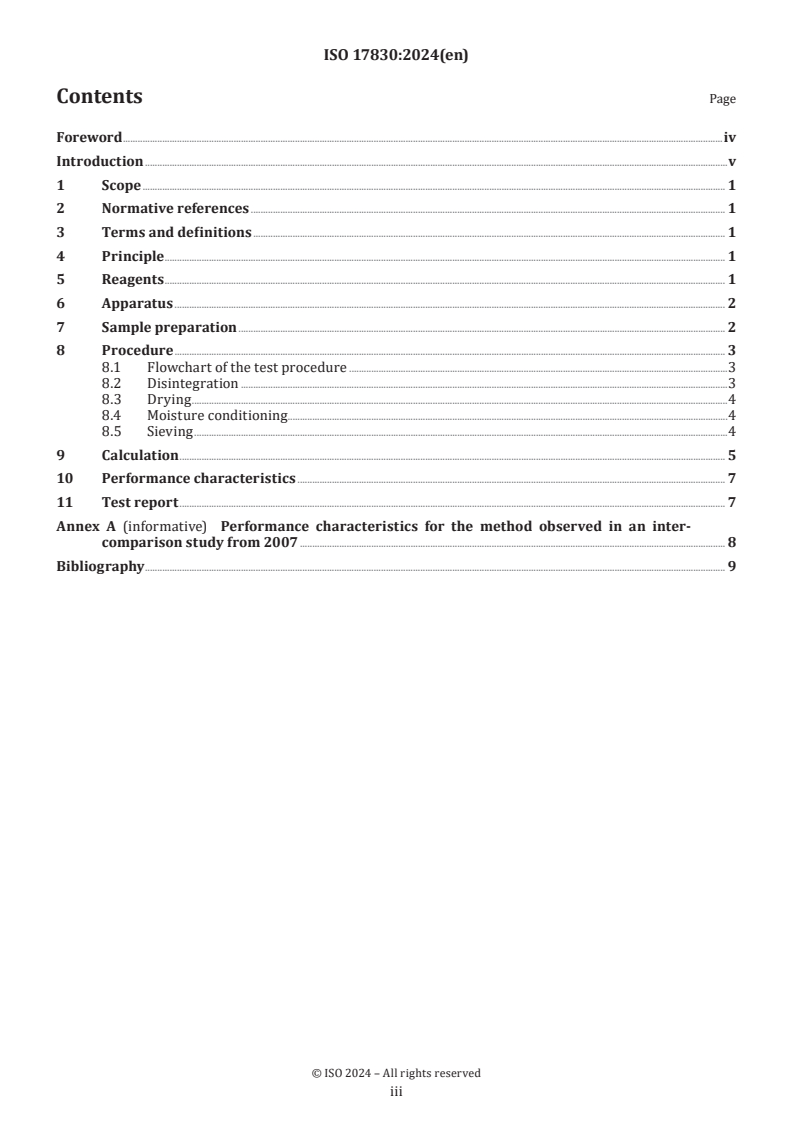
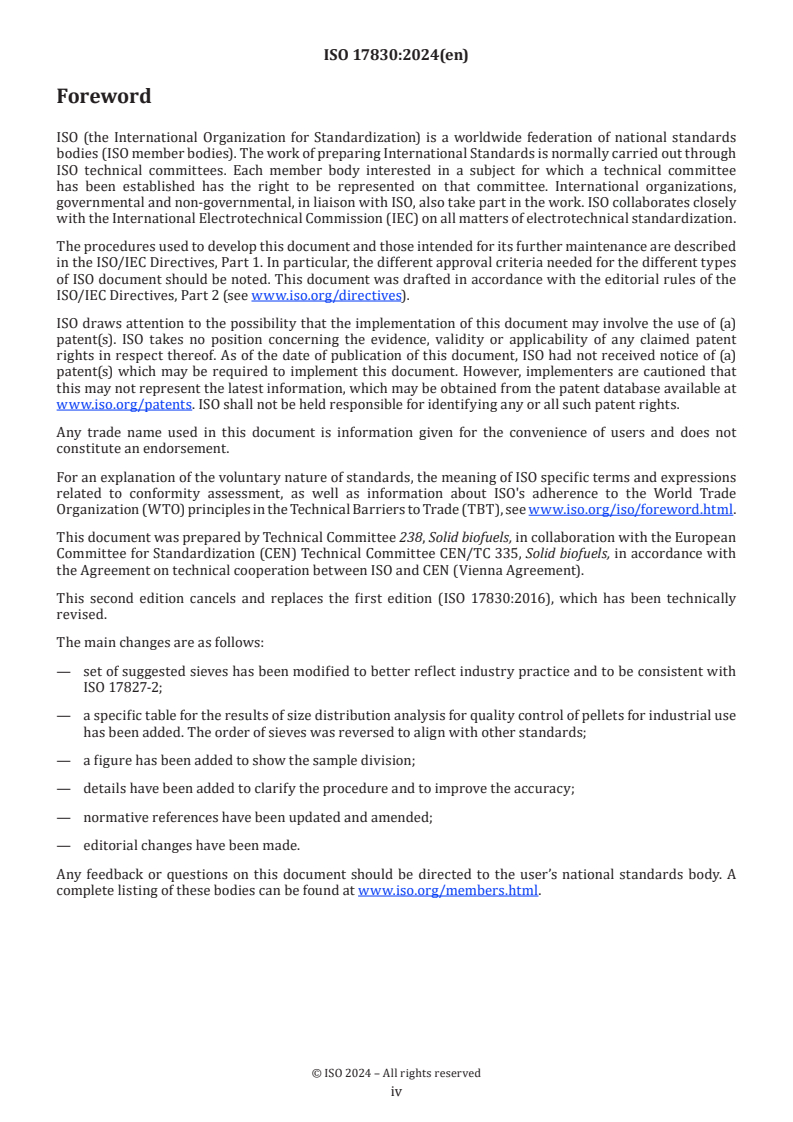
ISO 17830:2024 - Solid biofuels — Particle size distribution of disintegrated pellets Released:24. 05. 2024

ISO 17830:2024 - Biocombustibles solides — Distribution granulométrique des granulés désintégrés Released:24. 05. 2024
Overview
ISO 17830:2024 - "Solid biofuels - Particle size distribution of disintegrated pellets" specifies a laboratory method to determine the particle size distribution of pellets that fully disintegrate in hot water. The standard covers sample preparation, disintegration in deionised hot water, drying and moisture conditioning, mechanical sieving and calculation/reporting requirements. It is intended for pellets made from wood (sawdust, shavings, milled wood), straw and similar feedstocks that break down in water; water-resistant or thermally treated pellets are excluded.
Key topics and technical requirements
- Scope and applicability: Applies only to pellets that fully disintegrate in hot deionised water. Pellets engineered to resist water cannot be characterized using this method.
- Sample size and preparation: Laboratory sample obtained per ISO 18135 or ISO 21945; test portion recommended (300 ± 10) g and reduced by ISO 14780 volume‑reduction methods where required.
- Disintegration: Use a waterproof container (min. 5 L) and at least 2 L deionised water at a temperature just below boiling; stir to separate particles and allow soaking (commonly ≥30 min; some pellets may take 16–24 h).
- Drying & moisture control: Dry in ventilated cabinet/oven at not exceeding 60 °C (recommended (60 ± 5) °C) to a moisture content between 5 % and 15 % (mass). After equilibration in room atmosphere, verify moisture per ISO 18134‑1 or ISO 18134‑2.
- Sieving & analysis: Use mechanical sieving in accordance with ISO 17827‑2 (default sieve set provided); weigh fractions on a balance with 0.01 g readability. For low‑density materials (e.g., straw), further sub‑division (B1/B2 etc.) is specified to avoid sieve overloading.
- Reporting: Record test portion division, sieving parameters (frequency, amplitude, duration or equivalent machine settings) and present sieve fraction mass percentages and calculated particle size distribution.
Practical applications and users
- Power plants & boiler operators: Optimize combustion and particle burnout by understanding pulverised-fuel particle size from crushed pellets.
- Pellet manufacturers and quality control labs: Compare product batches, monitor milling/pulveriser effects and assure feedstock consistency for industrial pellets.
- Testing and certification bodies: Provide standardized, reproducible particle-size data for product specifications and compliance.
- R&D and fuel engineers: Evaluate feedstock formulations and processing methods that affect pellet disintegration and particle distribution.
Relevant SEO keywords: ISO 17830:2024, solid biofuels, particle size distribution, disintegrated pellets, pellet testing, sieving method, moisture conditioning, drying temperature, sample preparation.
Related standards
- ISO 14780 - Solid biofuels - Sample preparation
- ISO 16559 - Solid biofuels - Vocabulary
- ISO 17827‑2 - Particle size distribution for uncompressed fuels - Vibrating screen (sieves ≤ 3.15 mm)
- ISO 18134‑1 / ISO 18134‑2 - Determination of moisture content (reference / simplified)
- ISO 18135 - Solid Biofuels - Sampling
- ISO 21945 - Simplified sampling method for small scale applications
For implementation or procurement, consult the full ISO 17830:2024 text and coordinate test parameters with stakeholders to ensure comparability.
Relations
- Consolidates
EN ISO 17830:2024 - Solid biofuels - Particle size distribution of disintegrated pellets (ISO 17830:2024) - Effective Date
- 12-Feb-2026
- Effective Date
- 06-Jun-2022
- Effective Date
- 06-Jun-2022
Buy Documents
ISO 17830:2024 - Solid biofuels — Particle size distribution of disintegrated pellets Released:24. 05. 2024
ISO 17830:2024 - Biocombustibles solides — Distribution granulométrique des granulés désintégrés Released:24. 05. 2024
Get Certified
Connect with accredited certification bodies for this standard

DNV
DNV is an independent assurance and risk management provider.

Lloyd's Register
Lloyd's Register is a global professional services organisation specialising in engineering and technology.
DNV Energy Systems
Energy and renewable energy certification.
Sponsored listings
Frequently Asked Questions
ISO 17830:2024 is a standard published by the International Organization for Standardization (ISO). Its full title is "Solid biofuels — Particle size distribution of disintegrated pellets". This standard covers: This document specifies the requirements and method used to determine particle size distribution of disintegrated pellets. It is applicable for pellets that fully disintegrate in hot water.
This document specifies the requirements and method used to determine particle size distribution of disintegrated pellets. It is applicable for pellets that fully disintegrate in hot water.
ISO 17830:2024 is classified under the following ICS (International Classification for Standards) categories: 27.190 - Biological sources and alternative sources of energy; 75.160.40 - Biofuels. The ICS classification helps identify the subject area and facilitates finding related standards.
ISO 17830:2024 has the following relationships with other standards: It is inter standard links to EN ISO 17830:2024, ISO 8871-2:2020, ISO 17830:2016. Understanding these relationships helps ensure you are using the most current and applicable version of the standard.
ISO 17830:2024 is available in PDF format for immediate download after purchase. The document can be added to your cart and obtained through the secure checkout process. Digital delivery ensures instant access to the complete standard document.
Standards Content (Sample)
International
Standard
ISO 17830
Second edition
Solid biofuels — Particle size
2024-05
distribution of disintegrated pellets
Biocombustibles solides — Distribution granulométrique des
granulés désintégrés
Reference number
© ISO 2024
All rights reserved. Unless otherwise specified, or required in the context of its implementation, no part of this publication may
be reproduced or utilized otherwise in any form or by any means, electronic or mechanical, including photocopying, or posting on
the internet or an intranet, without prior written permission. Permission can be requested from either ISO at the address below
or ISO’s member body in the country of the requester.
ISO copyright office
CP 401 • Ch. de Blandonnet 8
CH-1214 Vernier, Geneva
Phone: +41 22 749 01 11
Email: copyright@iso.org
Website: www.iso.org
Published in Switzerland
ii
Contents Page
Foreword .iv
Introduction .v
1 Scope . 1
2 Normative references . 1
3 Terms and definitions . 1
4 Principle . 1
5 Reagents . 1
6 Apparatus . 2
7 Sample preparation . 2
8 Procedure . 3
8.1 Flowchart of the test procedure .3
8.2 Disintegration .3
8.3 Drying .4
8.4 Moisture conditioning.4
8.5 Sieving .4
9 Calculation . 5
10 Performance characteristics . 7
11 Test report . 7
Annex A (informative) Performance characteristics for the method observed in an inter-
comparison study from 2007 . 8
Bibliography . 9
iii
Foreword
ISO (the International Organization for Standardization) is a worldwide federation of national standards
bodies (ISO member bodies). The work of preparing International Standards is normally carried out through
ISO technical committees. Each member body interested in a subject for which a technical committee
has been established has the right to be represented on that committee. International organizations,
governmental and non-governmental, in liaison with ISO, also take part in the work. ISO collaborates closely
with the International Electrotechnical Commission (IEC) on all matters of electrotechnical standardization.
The procedures used to develop this document and those intended for its further maintenance are described
in the ISO/IEC Directives, Part 1. In particular, the different approval criteria needed for the different types
of ISO document should be noted. This document was drafted in accordance with the editorial rules of the
ISO/IEC Directives, Part 2 (see www.iso.org/directives).
ISO draws attention to the possibility that the implementation of this document may involve the use of (a)
patent(s). ISO takes no position concerning the evidence, validity or applicability of any claimed patent
rights in respect thereof. As of the date of publication of this document, ISO had not received notice of (a)
patent(s) which may be required to implement this document. However, implementers are cautioned that
this may not represent the latest information, which may be obtained from the patent database available at
www.iso.org/patents. ISO shall not be held responsible for identifying any or all such patent rights.
Any trade name used in this document is information given for the convenience of users and does not
constitute an endorsement.
For an explanation of the voluntary nature of standards, the meaning of ISO specific terms and expressions
related to conformity assessment, as well as information about ISO's adherence to the World Trade
Organization (WTO) principles in the Technical Barriers to Trade (TBT), see www.iso.org/iso/foreword.html.
This document was prepared by Technical Committee 238, Solid biofuels, in collaboration with the European
Committee for Standardization (CEN) Technical Committee CEN/TC 335, Solid biofuels, in accordance with
the Agreement on technical cooperation between ISO and CEN (Vienna Agreement).
This second edition cancels and replaces the first edition (ISO 17830:2016), which has been technically
revised.
The main changes are as follows:
— set of suggested sieves has been modified to better reflect industry practice and to be consistent with
ISO 17827-2;
— a specific table for the results of size distribution analysis for quality control of pellets for industrial use
has been added. The order of sieves was reversed to align with other standards;
— a figure has been added to show the sample division;
— details have been added to clarify the procedure and to improve the accuracy;
— normative references have been updated and amended;
— editorial changes have been made.
Any feedback or questions on this document should be directed to the user’s national standards body. A
complete listing of these bodies can be found at www.iso.org/members.html.
iv
Introduction
In power plants with powder fuel burners for energy production, operators need information about the
particle size distribution of the fuel for optimising particle burnout during combustion. Fuel preparation
equipment, such as pulverisers, are used for crushing pellets into the original particle sizes before the
material is pressed into pellets. The method described in this document is intended to characterize particle
size distribution of the material contained within fuel pellets and also allows for a relative comparison of
pellets of different manufacturing.
This method is based on experience with pellets made from sawdust, wood shavings and milled wood, as
well as straw. The method may also be applicable for pellets produced from other solid biofuel materials
provided that they can be disintegrated into its constituents in water.
Pellets that are engineered to resist water, e.g. pellets from materials which have undergone some thermal
treatments, cannot be characterised by this method.
v
International Standard ISO 17830:2024(en)
Solid biofuels — Particle size distribution of disintegrated pellets
1 Scope
This document specifies the requirements and method used to determine particle size distribution of
disintegrated pellets. It is applicable for pellets that fully disintegrate in hot water.
2 Normative references
The following documents are referred to in the text in such a way that some or all of their content constitutes
requirements of this document. For dated references, only the edition cited applies. For undated references,
the latest edition of the referenced document (including any amendments) applies.
ISO 14780, Solid biofuels — Sample preparation
ISO 16559, Solid biofuels — Vocabulary
ISO 17827-2, Solid biofuels — Determination of particle size distribution for uncompressed fuels — Part 2:
Vibrating screen using sieves for classification of samples with apertures of 3,15 mm and below
ISO 18134-1, Solid biofuels — Determination of moisture content — Part 1: Reference method
ISO 18134-2, Solid biofuels — Determination of moisture content —Part 2: Simplified method
ISO 18135, Solid Biofuels — Sampling
ISO 21945, Solid biofuels — Simplified sampling method for small scale applications
3 Terms and definitions
For the purposes of this document, the terms and definitions given in ISO 16559 and the following apply.
ISO and IEC maintain terminology databases for use in standardization at the following addresses:
— ISO Online browsing platform: available at https:// www .iso .org/ obp
— IEC Electropedia: available at https:// www .electropedia .org/
3.1
sieve fraction
mass fraction of test portion or sub-portion collected on a sieve after particle separation through the sieving
process.
4 Principle
The particle size distribution is determined after the sample pellets have been disintegrated in hot deionised
water and dried in a drying cabinet or oven. The determination is performed by sieving the dried material
in accordance with ISO 17827-2.
5 Reagents
5.1 Deionised water.
6 Apparatus
6.1 Disintegration container, shall be a waterproof container made of material such as stainless steel
capable of withstanding a temperature of 100 °C. The container shall have a minimum volume of 5 l in order
that 2 l of deionised water and the entire test portion can be accommodated without spilling over during
stirring.
A rigid lid should be used to cover the container to minimize evaporation, contamination and cooling during
the disintegration of the pellets in water.
6.2 Electric kettle, or other suitable equipment for water heating shall be capable of heating at least 2 l
of water.
6.3 Ventilated drying cabinet or ovens, shall be capable of maintaining a temperature of (60 ± 5) °C with
fresh air ventilation which allows moderate air exchange. The air velocity shall be such that the test sample
particles are not dislodged from the drying container(s).
6.4 Drying containers, shall consist of non-corrodible heat-resistant material such as metal, glass or
porcelain and be able to hold sufficient volume to accommodate the slurry from the disintegration container.
6.5 Balance, shall be capable of reading to the nearest 0,01 g.
6.6 Sieves, set of sieves as described in ISO 17827-2 and as listed in Table 2 shall be considered the default
sieve set. However, other sieve sets can be used based on the specific requirements as agreed upon by the
interested parties.
6.7 Weighing containers, an adequate number of weighing containers is required.
The weighing of the sieved particle fractions can be performed either by weighing the remaining material
directly on the tared weighed sieves or
...
Norme
internationale
ISO 17830
Deuxième édition
Biocombustibles solides —
2024-05
Distribution granulométrique des
granulés désintégrés
Solid biofuels — Particle size distribution of disintegrated pellets
Numéro de référence
DOCUMENT PROTÉGÉ PAR COPYRIGHT
© ISO 2024
Tous droits réservés. Sauf prescription différente ou nécessité dans le contexte de sa mise en œuvre, aucune partie de cette
publication ne peut être reproduite ni utilisée sous quelque forme que ce soit et par aucun procédé, électronique ou mécanique,
y compris la photocopie, ou la diffusion sur l’internet ou sur un intranet, sans autorisation écrite préalable. Une autorisation peut
être demandée à l’ISO à l’adresse ci-après ou au comité membre de l’ISO dans le pays du demandeur.
ISO copyright office
Case postale 401 • Ch. de Blandonnet 8
CH-1214 Vernier, Genève
Tél.: +41 22 749 01 11
E-mail: copyright@iso.org
Web: www.iso.org
Publié en Suisse
ii
Sommaire Page
Avant-propos .iv
Introduction .v
1 Domaine d’application . 1
2 Références normatives . 1
3 Termes et définitions . 1
4 Principe. 1
5 Réactifs . 2
6 Appareillage . 2
7 Préparation des échantillons . 3
8 Mode opératoire . 3
8.1 Diagramme du mode opératoire d’essai .3
8.2 Désintégration .4
8.3 Séchage .4
8.4 Maîtrise de l'humidité .4
8.5 Tamisage .4
9 Calcul . 5
10 Caractéristiques de performance . 7
11 Rapport d’essai . 7
Annexe A (informative) Caractéristiques de performance de la méthode observées dans une
étude interlaboratoires de 2007 . 8
Bibliographie . 9
iii
Avant-propos
L'ISO (Organisation internationale de normalisation) est une fédération mondiale d'organismes nationaux
de normalisation (comités membres de l'ISO). L'élaboration des Normes internationales est en général
confiée aux comités techniques de l'ISO. Chaque comité membre intéressé par une étude a le droit de faire
partie du comité technique créé à cet effet. Les organisations internationales, gouvernementales et non
gouvernementales, en liaison avec l'ISO participent également aux travaux. L'ISO collabore étroitement avec
la Commission électrotechnique internationale (IEC) en ce qui concerne la normalisation électrotechnique.
Les procédures utilisées pour élaborer le présent document et celles destinées à sa mise à jour sont
décrites dans les Directives ISO/IEC, Partie 1. Il convient, en particulier, de prendre note des différents
critères d'approbation requis pour les différents types de documents ISO. Le présent document
a été rédigé conformément aux règles de rédaction données dans les Directives ISO/IEC, Partie 2
(voir www.iso.org/directives).
L’ISO attire l’attention sur le fait que la mise en application du présent document peut entraîner l’utilisation
d’un ou de plusieurs brevets. L’ISO ne prend pas position quant à la preuve, à la validité et à l’applicabilité de
tout droit de brevet revendiqué à cet égard. À la date de publication du présent document, l’ISO n'avait pas
reçu notification qu’un ou plusieurs brevets pouvaient être nécessaires à sa mise en application. Toutefois,
il y a lieu d’avertir les responsables de la mise en application du présent document que des informations
plus récentes sont susceptibles de figurer dans la base de données de brevets, disponible à l'adresse
www.iso.org/brevets. L'ISO ne saurait être tenue pour responsable de ne pas avoir identifié de tels droits de
brevets.
Les appellations commerciales éventuellement mentionnées dans le présent document sont données pour
information, par souci de commodité, à l'intention des utilisateurs et ne sauraient constituer un engagement.
Pour une explication de la nature volontaire des normes, la signification des termes et expressions
spécifiques de l'ISO liés à l'évaluation de la conformité, ou pour toute information au sujet de l'adhésion de
l'ISO aux principes de l’Organisation mondiale du commerce (OMC) concernant les obstacles techniques au
commerce (OTC), voir le lien suivant : www.iso.org/iso/fr/avant-propos.html.
Le présent document a été élaboré par le comité technique 238, Biocombustibles solides, en collaboration
avec le comité technique CEN/TC 335, Biocombustibles solides, du Comité européen de normalisation (CEN),
conformément à l’Accord de coopération technique entre l’ISO et le CEN (Accord de Vienne).
Cette seconde édition annule et remplace la première édition (ISO 17830:2016) qui a fait l'objet d'une
révision technique.
Les principales modifications sont les suivantes :
— Le jeu de tamis conseillé a été modifié pour mieux refléter les pratiques de l’industrie et pour être
cohérent avec l’ISO 17827-2 ;
— un tableau spécifique pour les résultats de l’analyse de distribution granulométrique pour le contrôle
qualité des granulés destinés à un usage industriel a été ajouté. L’ordre des tamis a été inversé pour
s’aligner sur les autres normes
— une figure a été ajoutée pour présenter la division de l’échantillon ;
— des détails ont été ajoutés pour clarifier le mode opératoire et améliorer l’exactitude ;
— les références normatives ont été mises à jour et modifiées ;
— des modifications rédactionnelles ont été apportées.
Il convient que l’utilisateur adresse tout retour d’information ou toute question concernant le présent
document à l’organisme national de normalisation de son pays. Une liste exhaustive desdits organismes se
trouve à l’adresse www.iso.org/fr/members.html.
iv
Introduction
Dans les centrales électriques qui utilisent des brûleurs à combustible en poudre pour la production
d'énergie, les opérateurs ont besoin de connaître la distribution granulométrique du combustible pour
optimiser la combustion des particules. Des dispositifs de préparation du combustible, par exemple des
broyeurs, sont utilisés pour réduire le matériau des granulés à la granulométrie d'origine. La méthode
décrite dans le présent document est destinée à caractériser la distribution granulométrique du matériau
contenu dans les granulés de combustible ; elle permet également de comparer les granulés de différentes
fabrications.
Cette méthode est fondée sur l'expérience acquise avec des granulés constitués de sciure, de copeaux,
de bois broyé ou de paille. Elle peut également s'appliquer aux granulés constitués d'autres matériaux
biocombustibles solides, à condition qu'ils puissent être désintégrés dans l'eau.
Les granulés conçus de façon à résister à l'eau, tels que les granulés constitués de matériaux qui ont subi des
traitements thermiques, ne peuvent pas être caractérisés suivant cette méthode.
v
Norme internationale ISO 17830:2024(fr)
Biocombustibles solides — Distribution granulométrique des
granulés désintégrés
1 Domaine d’application
Le présent document spécifie les exigences qui s'appliquent et la méthode utilisée pour déterminer la
distribution granulométrique des granulés désintégrés. Elle est applicable aux granulés qui se désintègrent
entièrement dans l'eau chaude.
2 Références normatives
Les documents suivants sont cités dans le texte de sorte qu’ils constituent, pour tout ou partie de leur
contenu, des exigences du présent document. Pour les références datées, seule l’édition citée s’applique. Pour
les références non datées, la dernière édition du document de référence s'applique (y compris les éventuels
amendements).
ISO 14780, Biocombustibles solides — Préparation des échantillons
ISO 16559, Biocombustibles solides — Vocabulaire
ISO 17827-2, Biocombustibles solides — Détermination de la distribution granulométrique des combustibles non
comprimés — Partie 2 : Méthode au tamis vibrant d’ouverture de maille inférieure ou égale à 3,15 mm
ISO 18134-1, Biocombustibles solides — Dosage de la teneur en humidité — Partie 1: Méthode de référence
ISO 18134-2, Biocombustibles solides — Dosage de la teneur en humidité — Partie 1 : Méthode simplifiée
ISO 18135, Biocarburants solides — Échantillonnage
ISO 21945, Biocombustibles solides — Méthode d'échantillonnage simplifiée pour les applications à petite échelle
3 Termes et définitions
Pour les besoins du présent document, les termes et définitions de l’ISO 16559 ainsi que les suivants
s'appliquent.
L'ISO et l’IEC tiennent à jour des bases de données terminologiques destinées à être utilisées en normalisation,
consultables à l’adresse suivante :
— ISO Online browsing platform : disponible à l'adresse https:// www .iso .org/ obp
— IEC Electropedia : disponible à l'adresse https:// www .electropedia .org/
3.1
fraction granulométrique
fraction massique de la prise ou de la sous-prise d’essai recueillie sur un tamis après la séparation
particulaire par le processus de tamisage
4 Principe
La distribution granulométrique est déterminée après désintégration des granulés-échantillons dans de
l’eau chaude désionisée et séchage dans une étuve ventilée. La détermination est effectuée par tamisage du
matériau séché, conformément à l'ISO 17827-2.
5 Réactifs
5.1 Eau désionisée.
6 Appareillage
6.1 Récipient de désintégration, qui doit être un récipient étanche constitué d’un matériau résistant à
une température de 100 °C, par exemple de l'acier inoxydable. Le récipient doit avoir un volume minimal
de 5 l pour pouvoir contenir au moins 2 l d'eau désionisée et l'intégralité de la prise d'essai de granulés sans
risque de débordement lorsque ceux-ci sont agités.
Il convient qu’un couvercle rigide soit utilisé pour recouvrir le récipient afin de réduire au minimum
l’évaporation, la contamination et le refroidissement pendant la désintégration des granulés dans l’eau.
6.2 Bouilloire électrique, ou autre système de chauffage de l'eau, qui doit permettre de chauffer
au moins 2 l d'eau.
6.3 Étuve ventilée, qui doit pouvoir maintenir une température de (60 ± 5) °C, avec une ventilation d’air
neuf qui permet un renouvellement d’air modéré. La vitesse de l’air doit être réglée de façon à éviter que les
particules de l’échantillon pour essai ne s’échappent du ou des supports de séchage.
6.4 Supports de séchage, qui doivent être constitués d'un matériau résistant à la corrosion et à la chaleur,
comme le métal, le verre ou la porcelaine ; ils doivent en outre avoir un volume suffisant pour pouvoir
contenir le coulis provenant du récipient de désintégration.
6.5 Balance, qui doit permettre d'effectuer des pesées à 0,01 g près.
6.6 Tamis, le jeu de tamis tel que décrit dans l'ISO 17827-2 et tel qu’indiqué dans le Tableau 2 doit être
considéré comme le jeu de tamis par défaut. Toutefois, d'autres jeux de tamis peuvent être utilisés, en
fonction des exigences spécifiques et selon accord entre les parties intéressées.
6.7 Récipients de pesée, un nombre adéquat de récipients de pesée est requis.
La pesée des fractions de particules tamisées peut être effectuée soit par pesée du résidu directement sur
les tamis tarés, soit par collecte et pesée du matériau dans les récipients de pesée.
6.8 Spatule, qui doit être constituée d'un matériau résistant à la corrosion et servant à agiter le coulis de
désintégration.
6.9 Dispositif de tamisage mécanique, conforme à l'ISO 17827-2, qui doit être utilisé pour déterminer la
distribution granulométriqu
...