

ISO/TS 26048-1:2025
(Main)Intelligent transport systems — Field device Simple Network Management Protocol (SNMP) data interface — Part 1: Global objects
General Information
- Abstract
Field devices are a key component in intelligent transport systems (ITS). Field devices include traffic signals, message signs, weather stations, traffic sensors, roadside equipment for connected ITS environments, etc. The ISO 26048 series defines data that can be used to manage field devices, including device configuration, control and monitoring. Field devices can be quite complex, necessitating the standardization of many data concepts for exchange. As such, the ISO 26048 series is divided into several individual parts. This document (ISO/TS 26048-1) introduces the ISO 26048 series, provides content that is normatively referenced in subsequent parts, and defines data that is applicable to the management of a wide range of field devices. The scope of the ISO 26048 series does not define the logic used by the management station, the underlying protocols used to exchange the defined data elements, or internal design of the field device. However, the ISO 26048 series does define functional requirements on the interface and assumes an interface based on an SNMPv3 environment as specified by ISO 15784-2. NOTE Many of the concepts defined in this document were derived from NTCIP 1103[ REF Reference_ref_11 \r \h 1 08D0C9EA79F9BACE118C8200AA004BA90B0200000008000000110000005200650066006500720065006E00630065005F007200650066005F00310031000000 ] and NTCIP 1201[ REF Reference_ref_12 \r \h 2 08D0C9EA79F9BACE118C8200AA004BA90B0200000008000000110000005200650066006500720065006E00630065005F007200650066005F00310032000000 ], however, the design has been updated to better address security concerns. It is expected that future versions of NTCIP will migrate to the design defined in this document.
- Status
- Published
- Publication Date
- 17-Jul-2025
- Technical Committee
- ISO/TC 204 - Intelligent transport systems
- Drafting Committee
- ISO/TC 204 - Intelligent transport systems
- Current Stage
- 6060 - International Standard published
- Start Date
- 18-Jul-2025
- Due Date
- 08-Nov-2025
- Completion Date
- 18-Jul-2025

Overview
ISO/TS 26048-1:2025 - "Intelligent transport systems - Field device Simple Network Management Protocol (SNMP) data interface - Part 1: Global objects" defines the global data model and normative content for managing ITS field devices using an SNMP-based interface. The technical specification introduces the ISO 26048 series, provides common objects and definitions referenced by later parts, and establishes functional requirements for a management interface in an SNMPv3 environment. It does not prescribe management-station logic, lower-layer transport protocols, or internal device design.
Key topics and technical requirements
- SNMP/SNMPv3 environment: Assumes an SNMPv3-based interface (security and management features) and defines terminology, MIB format conventions and access patterns.
- Global objects and MIBs: Specifies global Management Information Base (MIB) structure, ASN.1 usage and MIB filenames/maintenance practices for consistent device data exchange.
- Security & access control: Functional requirements for authentication, user access control, and monitoring of failed access attempts aligned with SNMPv3 security features.
- Device management features: Definitions and requirements for features such as clock management (UTC/local/daylight saving), commands, actions, controllers, and conditional triggers.
- Monitoring & logging: Requirements for monitoring device components (power, enclosure, environment), event logging, user-defined snapshots, and series of snapshots for diagnostics and auditing.
- Notifications and triggers: Models for triggers (scheduled, day-plan, condition-based), notification channels and a notification factory to configure and deliver alerts.
- Conformance and constraints: Table design and access constraints, conformance patterns and expectations for implementers to ensure interoperability.
- Efficiency and scalability: Design considerations for efficient data exchange and handling of complex device configurations.
Applications and who uses it
ISO/TS 26048-1:2025 is intended for:
- Traffic authorities and ITS operators who need standardized management of traffic signals, dynamic message signs, weather stations, traffic sensors and roadside connected equipment.
- Field device manufacturers implementing SNMP MIBs to expose configuration, status and control interfaces.
- System integrators and network managers building management systems, NMS tools or cloud platforms that monitor and control ITS field devices.
- Software developers and OEMs creating management station software, telemetry collectors or event/notification services.
Practical applications include remote configuration, alarm/notification handling, preventive maintenance, device health monitoring, firmware/update orchestration (future parts) and secure operational control.
Related standards
- ISO 15784-2 (assumed SNMPv3 environment reference)
- NTCIP 1103 and NTCIP 1201 (source concepts; ISO/TS 26048-1 updates design to improve security and interoperability)
Keywords: ISO/TS 26048-1:2025, intelligent transport systems, ITS, SNMP, SNMPv3, field device management, MIB, ASN.1, device monitoring, ITS standards.
Get Certified
Connect with accredited certification bodies for this standard

BSI Group
BSI (British Standards Institution) is the business standards company that helps organizations make excellence a habit.

NYCE
Mexican standards and certification body.
Sponsored listings
Frequently Asked Questions
ISO/TS 26048-1:2025 is a technical specification published by the International Organization for Standardization (ISO). Its full title is "Intelligent transport systems — Field device Simple Network Management Protocol (SNMP) data interface — Part 1: Global objects". This standard covers: Field devices are a key component in intelligent transport systems (ITS). Field devices include traffic signals, message signs, weather stations, traffic sensors, roadside equipment for connected ITS environments, etc. The ISO 26048 series defines data that can be used to manage field devices, including device configuration, control and monitoring. Field devices can be quite complex, necessitating the standardization of many data concepts for exchange. As such, the ISO 26048 series is divided into several individual parts. This document (ISO/TS 26048-1) introduces the ISO 26048 series, provides content that is normatively referenced in subsequent parts, and defines data that is applicable to the management of a wide range of field devices. The scope of the ISO 26048 series does not define the logic used by the management station, the underlying protocols used to exchange the defined data elements, or internal design of the field device. However, the ISO 26048 series does define functional requirements on the interface and assumes an interface based on an SNMPv3 environment as specified by ISO 15784-2. NOTE Many of the concepts defined in this document were derived from NTCIP 1103[ REF Reference_ref_11 \r \h 1 08D0C9EA79F9BACE118C8200AA004BA90B0200000008000000110000005200650066006500720065006E00630065005F007200650066005F00310031000000 ] and NTCIP 1201[ REF Reference_ref_12 \r \h 2 08D0C9EA79F9BACE118C8200AA004BA90B0200000008000000110000005200650066006500720065006E00630065005F007200650066005F00310032000000 ], however, the design has been updated to better address security concerns. It is expected that future versions of NTCIP will migrate to the design defined in this document.
Field devices are a key component in intelligent transport systems (ITS). Field devices include traffic signals, message signs, weather stations, traffic sensors, roadside equipment for connected ITS environments, etc. The ISO 26048 series defines data that can be used to manage field devices, including device configuration, control and monitoring. Field devices can be quite complex, necessitating the standardization of many data concepts for exchange. As such, the ISO 26048 series is divided into several individual parts. This document (ISO/TS 26048-1) introduces the ISO 26048 series, provides content that is normatively referenced in subsequent parts, and defines data that is applicable to the management of a wide range of field devices. The scope of the ISO 26048 series does not define the logic used by the management station, the underlying protocols used to exchange the defined data elements, or internal design of the field device. However, the ISO 26048 series does define functional requirements on the interface and assumes an interface based on an SNMPv3 environment as specified by ISO 15784-2. NOTE Many of the concepts defined in this document were derived from NTCIP 1103[ REF Reference_ref_11 \r \h 1 08D0C9EA79F9BACE118C8200AA004BA90B0200000008000000110000005200650066006500720065006E00630065005F007200650066005F00310031000000 ] and NTCIP 1201[ REF Reference_ref_12 \r \h 2 08D0C9EA79F9BACE118C8200AA004BA90B0200000008000000110000005200650066006500720065006E00630065005F007200650066005F00310032000000 ], however, the design has been updated to better address security concerns. It is expected that future versions of NTCIP will migrate to the design defined in this document.
ISO/TS 26048-1:2025 is classified under the following ICS (International Classification for Standards) categories: 35.240.60 - IT applications in transport. The ICS classification helps identify the subject area and facilitates finding related standards.
ISO/TS 26048-1:2025 is available in PDF format for immediate download after purchase. The document can be added to your cart and obtained through the secure checkout process. Digital delivery ensures instant access to the complete standard document.
Standards Content (Sample)
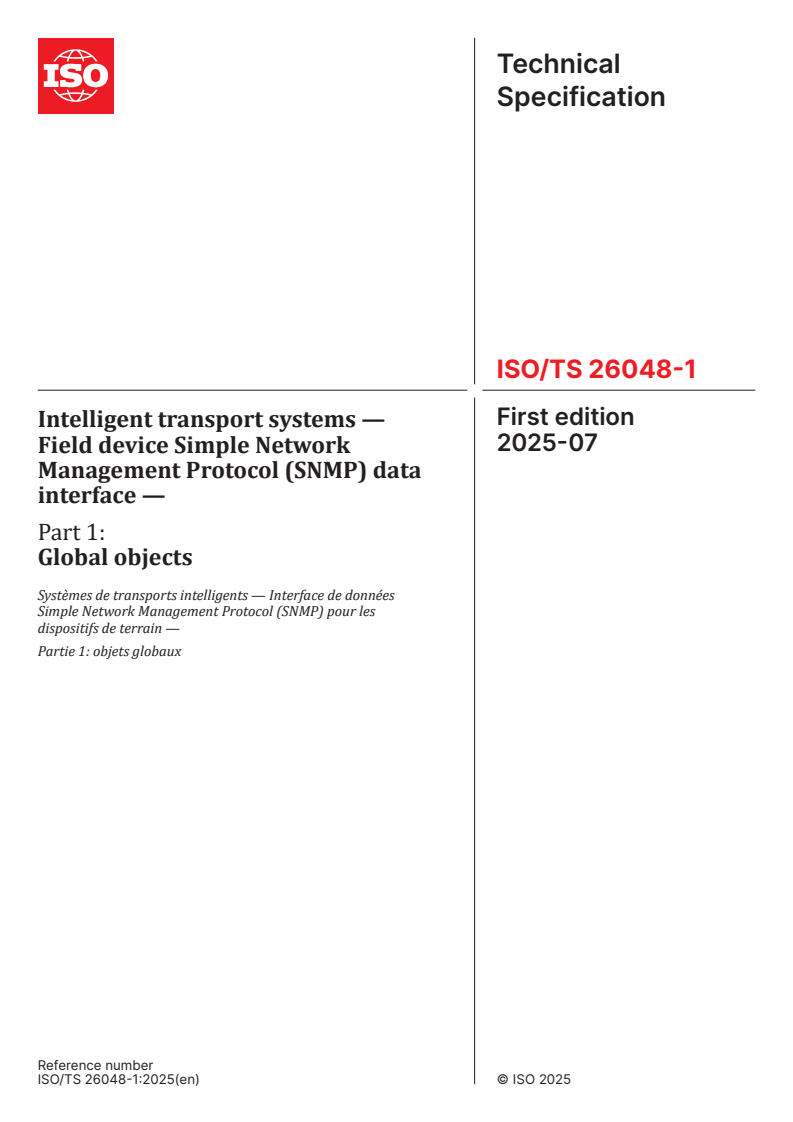
Technical
Specification
ISO/TS 26048-1
First edition
Intelligent transport systems —
2025-07
Field device Simple Network
Management Protocol (SNMP) data
interface —
Part 1:
Global objects
Systèmes de transports intelligents — Interface de données
Simple Network Management Protocol (SNMP) pour les
dispositifs de terrain —
Partie 1: objets globaux
Reference number
© ISO 2025
All rights reserved. Unless otherwise specified, or required in the context of its implementation, no part of this publication may
be reproduced or utilized otherwise in any form or by any means, electronic or mechanical, including photocopying, or posting on
the internet or an intranet, without prior written permission. Permission can be requested from either ISO at the address below
or ISO’s member body in the country of the requester.
ISO copyright office
CP 401 • Ch. de Blandonnet 8
CH-1214 Vernier, Geneva
Phone: +41 22 749 01 11
Email: copyright@iso.org
Website: www.iso.org
Published in Switzerland
ii
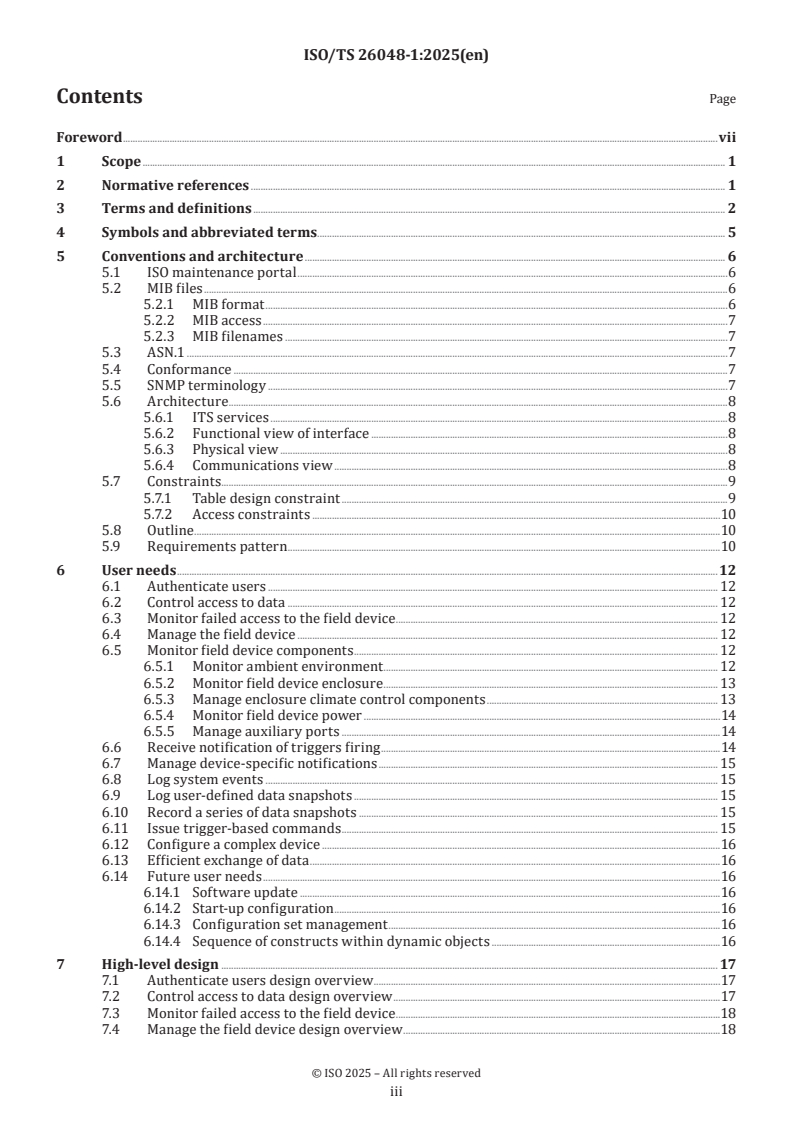
Contents Page
Foreword .vii
1 Scope . 1
2 Normative references . 1
3 Terms and definitions . 2
4 Symbols and abbreviated terms. 5
5 Conventions and architecture . 6
5.1 ISO maintenance portal .6
5.2 MIB files .6
5.2.1 MIB format .6
5.2.2 MIB access .7
5.2.3 MIB filenames .7
5.3 ASN.1 .7
5.4 Conformance .7
5.5 SNMP terminology .7
5.6 Architecture .8
5.6.1 ITS services .8
5.6.2 Functional view of interface .8
5.6.3 Physical view .8
5.6.4 Communications view .8
5.7 Constraints.9
5.7.1 Table design constraint .9
5.7.2 Access constraints .10
5.8 Outline .10
5.9 Requirements pattern .10
6 User needs .12
6.1 Authenticate users . 12
6.2 Control access to data . 12
6.3 Monitor failed access to the field device . 12
6.4 Manage the field device . 12
6.5 Monitor field device components . 12
6.5.1 Monitor ambient environment . 12
6.5.2 Monitor field device enclosure . 13
6.5.3 Manage enclosure climate control components . 13
6.5.4 Monitor field device power .14
6.5.5 Manage auxiliary ports .14
6.6 Receive notification of triggers firing .14
6.7 Manage device-specific notifications . 15
6.8 Log system events . 15
6.9 Log user-defined data snapshots . 15
6.10 Record a series of data snapshots . 15
6.11 Issue trigger-based commands . 15
6.12 Configure a complex device .16
6.13 Efficient exchange of data .16
6.14 Future user needs .16
6.14.1 Software update .16
6.14.2 Start-up configuration .16
6.14.3 Configuration set management .16
6.14.4 Sequence of constructs within dynamic objects .16
7 High-level design . 17
7.1 Authenticate users design overview .17
7.2 Control access to data design overview .17
7.3 Monitor failed access to the field device .18
7.4 Manage the field device design overview .18
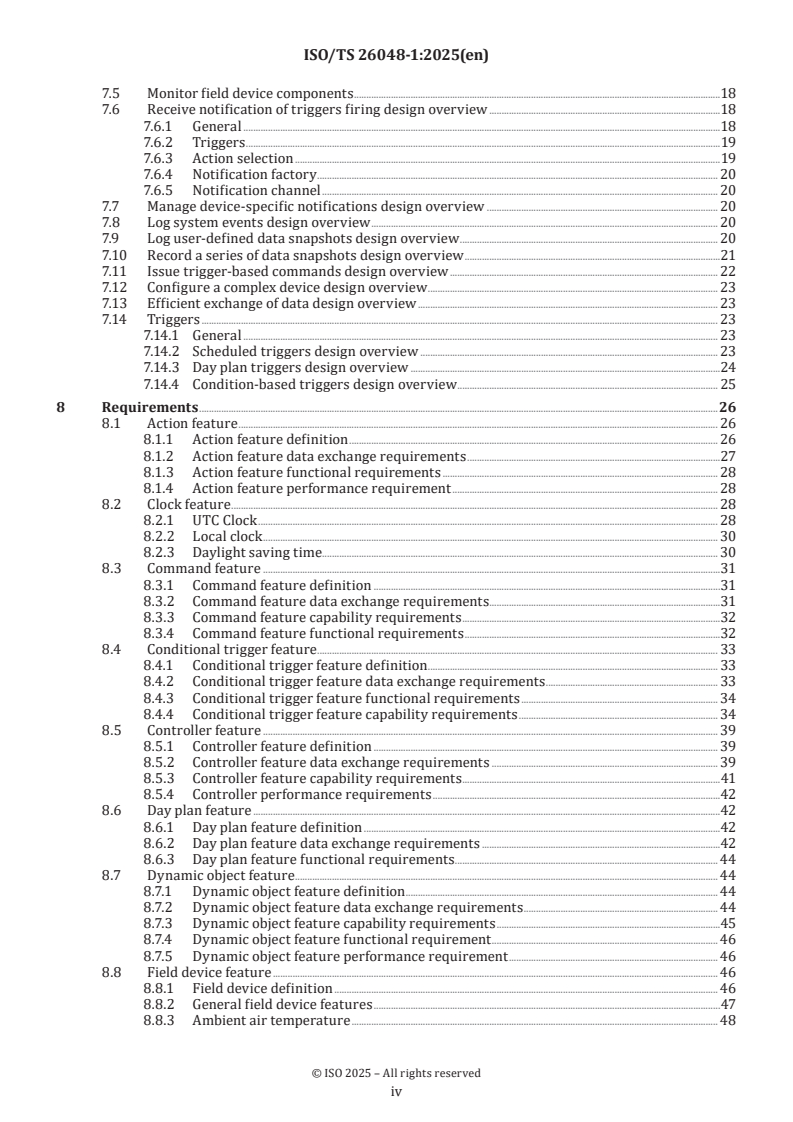
iii
7.5 Monitor field device components .18
7.6 Receive notification of triggers firing design overview .18
7.6.1 General .18
7.6.2 Triggers .19
7.6.3 Action selection .19
7.6.4 Notification factory . 20
7.6.5 Notification channel . 20
7.7 Manage device-specific notifications design overview . 20
7.8 Log system events design overview . 20
7.9 Log user-defined data snapshots design overview . 20
7.10 Record a series of data snapshots design overview .21
7.11 Issue trigger-based commands design overview . 22
7.12 Configure a complex device design overview . 23
7.13 Efficient exchange of data design overview . 23
7.14 Triggers . 23
7.14.1 General . 23
7.14.2 Scheduled triggers design overview . 23
7.14.3 Day plan triggers design overview .24
7.14.4 Condition-based triggers design overview . 25
8 Requirements .26
8.1 Action feature . 26
8.1.1 Action feature definition . 26
8.1.2 Action feature data exchange requirements .27
8.1.3 Action feature functional requirements . 28
8.1.4 Action feature performance requirement . 28
8.2 Clock feature . 28
8.2.1 UTC Clock . 28
8.2.2 Local clock . 30
8.2.3 Daylight saving time. 30
8.3 Command feature .31
8.3.1 Command feature definition .31
8.3.2 Command feature data exchange requirements . .31
8.3.3 Command feature capability requirements .32
8.3.4 Command feature functional requirements .32
8.4 Conditional trigger feature . 33
8.4.1 Conditional trigger feature definition . 33
8.4.2 Conditional trigger feature data exchange requirements . 33
8.4.3 Conditional trigger feature functional requirements . 34
8.4.4 Conditional trigger feature capability requirements . 34
8.5 Controller feature . 39
8.5.1 Controller feature definition . 39
8.5.2 Controller feature data exchange requirements . 39
8.5.3 Controller feature capability requirements .41
8.5.4 Controller performance requirements .42
8.6 Day plan feature .42
8.6.1 Day plan feature definition .42
8.6.2 Day plan feature data exchange requirements .42
8.6.3 Day plan feature functional requirements . 44
8.7 Dynamic object feature . 44
8.7.1 Dynamic object feature definition . 44
8.7.2 Dynamic object feature data exchange requirements . 44
8.7.3 Dynamic object feature capability requirements .45
8.7.4 Dynamic object feature functional requirement . 46
8.7.5 Dynamic object feature performance requirement . 46
8.8 Field device feature . 46
8.8.1 Field device definition . 46
8.8.2 General field device features .47
8.8.3 Ambient air temperature . 48
iv
8.8.4 Ambient light . 48
8.8.5 Ambient relative humidity . 49
8.8.6 Auxiliary bi-directional port . 49
8.8.7 Auxiliary input port . 49
8.8.8 Auxiliary output port . 49
8.8.9 Field device air conditioner . 49
8.8.10 Field device battery . 50
8.8.11 Field device dehumidifier . 50
8.8.12 Field device doors .51
8.8.13 Field device fans.51
8.8.14 Field device generator .51
8.8.15 Field device heaters .52
8.8.16 Field device humidity .52
8.8.17 Field device mains power .52
8.8.18 Field device power supply . 53
8.8.19 Field device processor temperature . 53
8.8.20 Field device solar power . 53
8.8.21 Field device temperature . 54
8.8.22 Field device thermostat . 54
8.8.23 Field device wind power . 54
8.9 File feature . 55
8.9.1 File feature definition . 55
8.9.2 File feature data exchange requirements . 55
8.10 Logging feature . 55
8.10.1 Logging feature definition . 55
8.10.2 Logging feature data exchange requirements . 55
8.10.3 Logging feature functional requirements .57
8.10.4 Logging feature capability requirements .57
8.11 Notification feature .57
8.11.1 Notification channel .57
8.11.2 Notification factory . 65
8.11.3 Independent notification .67
8.11.4 Notification aggregator . 68
8.12 Owner feature .70
8.12.1 Owner feature definition .70
8.12.2 Owner feature data exchange requirements .70
8.13 Recording feature .71
8.13.1 Recording feature definition .71
8.13.2 Recording feature data exchange requirements .71
8.13.3 Recording feature capability requirements. 73
8.13.4 Recording feature functional requirement . 73
8.14 Scheduled trigger feature . 73
8.14.1 Scheduled trigger feature definition . 73
8.14.2 Scheduled trigger feature data exchange requirements . 73
8.14.3 Scheduled trigger feature functional requirements .74
8.14.4 Scheduled trigger feature capability requirements .74
8.15 Secure communications feature .74
8.15.1 Secure communications feature definition .74
8.15.2 Secure communications protocol requirements . 75
8.15.3 Secure communications conformance requirements . 75
8.16 SNMP target feature . 75
8.16.1 SNMP target feature definition . 75
8.16.2 SNMP target feature data exchange requirements . 75
8.16.3 SNMP target feature capability requirements.76
8.17 Start-up feature . .76
8.17.1 Start-up feature definition . . .76
8.17.2 Start-up feature data exchange requirements . 77
8.18 Supplemental roadside sensors and actuators (SRSA) feature . 77
8.18.1 SRSA feature definition . 77
v
8.18.2 SRSA feature data exchange requirements . 77
8.18.3 SRSA feature capability requirements . 78
8.18.4 SRSA feature performance requirements. 79
8.18.5 SRSA feature supplemental requirements . 79
8.19 System log feature . 79
8.19.1 System log feature definition . 79
8.19.2 System log feature data exchange requirements . 80
8.19.3 System log feature capability requirements . 80
8.20 Transaction feature . 80
8.20.1 Transaction feature definition . 80
8.20.2 Transaction feature data exchange requirements . 81
8.20.3 Transaction feature functional requirements . 81
8.21 View-based access control model (VACM) feature . 81
8.21.1 VACM feature definition . . 81
8.21.2 VACM feature data exchange requirements . 81
9 Dialogues .82
9.1 General dialogue rules . 82
9.1.1 Management station initiated . 82
9.1.2 SNMP agent performance requirements . 82
9.1.3 Generic and custom dialogues . 82
9.2 Generic dialogues . 83
9.2.1 Get elemental data . 83
9.2.2 Set elemental data . 83
9.2.3 Walk data . 83
9.2.4 Get bulk data . 83
9.2.5 Get tabular data . . 83
9.2.6 Set tabular data . 83
9.2.7 Get data column . 84
9.2.8 Get counters . 84
9.2.9 Get data from dynamic table entry . 84
9.2.10 Get row status of dynamic table entry . 84
9.2.11 Configure entry of a dynamic table . 85
9.2.12 Configure entry of a dynamic table with TestAndIncr. 86
9.2.13 Toggle active status of a dynamic table entry . 86
9.2.14 Delete entry from a dynamic table . 87
9.2.15 Send a notification . 87
9.2.16 Retrieve dynamic object data . 87
9.2.17 Set dynamic object data . 87
9.2.18 Retrieve a file . . 88
9.2.19 Generate a file . 88
10 Security .88
10.1 Vulnerabilities . 88
10.2 Authentication and access control . 88
10.3 Encryption . 89
10.4 Security recommendations . 89
Annex A (informative) Conformance .90
Annex B (informative) Management information base (MIB) summary.93
Bibliography .95
vi
Foreword
ISO (the International Organization for Standardization) is a worldwide federation of national standards
bodies (ISO member bodies). The work of preparing International Standards is normally carried out through
ISO technical committees. Each member body interested in a subject for which a technical committee
has been established has the right to be represented on that committee. International organizations,
governmental and non-governmental, in liaison with ISO, also take part in the work. ISO collaborates closely
with the International Electrotechnical Commission (IEC) on all matters of electrotechnical standardization.
The procedures used to develop this document and those intended for its further maintenance are described
in the ISO/IEC Directives, Part 1. In particular, the different approval criteria needed for the different types
of ISO document should be noted. This document was drafted in accordance with the editorial rules of the
ISO/IEC Directives, Part 2 (see www.iso.org/directives).
ISO draws attention to the possibility that the implementation of this document may involve the use of (a)
patent(s). ISO takes no position concerning the evidence, validity or applicability of any claimed patent
rights in respect thereof. As of the date of publication of this document, ISO had not received notice of (a)
patent(s) which may be required to implement this document. However, implementers are cautioned that
this may not represent the latest information, which may be obtained from the patent database available at
www.iso.org/patents. ISO shall not be held responsible for identifying any or all such patent rights.
Any trade name used in this document is information given for the convenience of users and does not
constitute an endorsement.
For an explanation of the voluntary nature of standards, the meaning of ISO specific terms and expressions
related to conformity assessment, as well as information about ISO's adherence to the World Trade
Organization (WTO) principles in the Technical Barriers to Trade (TBT), see www.iso.org/iso/foreword.html.
This document was prepared by Technical Committee ISO/TC 204, Intelligent transport systems.
A list of all parts in the ISO 26048 series can be found on the ISO website.
Any feedback or questions on this document should be directed to the user’s national standards body. A
complete listing of these bodies can be found at www.iso.org/members.html.
vii
Technical Specification ISO/TS 26048-1:2025(en)
Intelligent transport systems — Field device Simple Network
Management Protocol (SNMP) data interface —
Part 1:
Global objects
1 Scope
Field devices are a key component in intelligent transport systems (ITS). Field devices include traffic signals,
message signs, weathe
...