


ISO 2631-4:2001
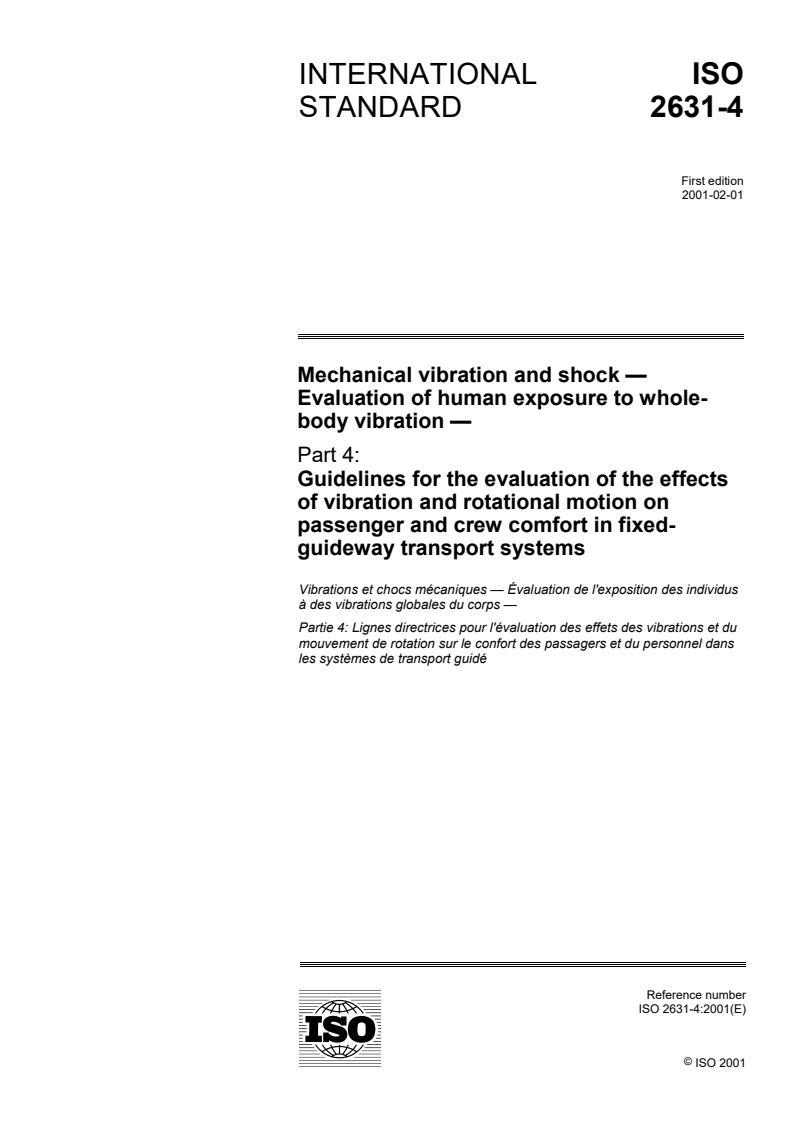
(Main)Mechanical vibration and shock — Evaluation of human exposure to whole-body vibration — Part 4: Guidelines for the evaluation of the effects of vibration and rotational motion on passenger and crew comfort in fixed-guideway transport systems
Mechanical vibration and shock — Evaluation of human exposure to whole-body vibration — Part 4: Guidelines for the evaluation of the effects of vibration and rotational motion on passenger and crew comfort in fixed-guideway transport systems
This part of ISO 2631 provides guidance on the application of ISO 2631-1 to the evaluation of the effects of mechanical vibration on the comfort of passengers and crew in fixed-guideway systems. It is intended to be used by organizations which purchase, specify or use fixed-guideway systems, to help them to understand the relationship between the design of the guideway as well as other features of the system and the comfort of passengers and crew. These guidelines establish methods for the evaluation of relative comfort between systems, as opposed to absolute levels of comfort. This part of ISO 2631 is applicable to people in normal health exposed to rectilinear vibration along their x-, y- and z-axes, as well as rotational vibration about these (body-centred) axes. It is intended to provide guidance on the assessment of comfort as a function of motions along and about vehicle axes that produce the body motions. This part of ISO 2631 is not applicable to high-amplitude single transients which may cause trauma, such as those resulting from vehicle accidents or "run-ins" produced by "longitudinal slack action", nor is it applicable to highamplitude vibration which may affect health. For the purposes of this part of ISO 2631, fixed-guideway passenger systems include rail systems (heavy and light rail), magnetically levitated (MAGLEV) systems and rubber tyre metro-type systems, as well as any of the system types listed above that incorporate a tilt capability to compensate for lateral acceleration when traversing curves. This part of ISO 2631 provides guidance on the effects of very low-frequency accelerations (0,1 Hz to 0,5 Hz) experienced as vertical forces that may cause kinetosis. These forces may be caused by combinations of curve transition, super-elevation and tilt-body technology. However, this part of ISO 2631 is not intended to give guidance on comfort implications of very low-frequency accelerations (below 0,5 Hz) experienced as lateral or longitudinal forces. Such accelerations can be generated by guideway geometry (horizontal alignment and cant). This part of ISO 2631 gives guidance on the evaluation of ride comfort based on motion environment only.
Vibrations et chocs mécaniques — Évaluation de l'exposition des individus à des vibrations globales du corps — Partie 4: Lignes directrices pour l'évaluation des effets des vibrations et du mouvement de rotation sur le confort des passagers et du personnel dans les systèmes de transport guidé
La présente partie de l'ISO 2631 donne des lignes directrices concernant l'application de l'ISO 2631-1 à l'évaluation des effets des vibrations mécaniques sur le confort des passagers et du personnel dans les systèmes guidés. Elle est destinée à servir aux organismes qui achètent, spécifient ou utilisent des systèmes guidés et à éclairer la relation qui existe entre la conception de systèmes de guidage et autres caractéristiques du système d'une part, et le confort des passagers et du personnel d'autre part. Ces lignes directrices établissent des méthodes pour évaluer le confort relatif entre ces systèmes, par opposition aux niveaux absolus de confort. La présente partie de l'ISO 2631 est applicable à des individus en bonne santé exposés à des vibrations de translation le long des axes x, y et z ainsi qu'à des vibrations de rotation autour de ces axes (centrés sur le corps). Elle est destinée à donner des indications pour l'estimation du confort en fonction des mouvements suivant et autour des axes des véhicules, qui produisent les mouvements du corps. Elle n'est pas applicable aux chocs uniques de grande intensité qui peuvent provoquer des traumatismes, tels qu'il s'en produit lors des accidents ou des «réactions d'attelage» provoqués par un «effet d'accordéon», pas plus qu'elle n'est applicable aux vibrations de grande intensité qui peuvent affecter la santé. Pour les besoins de la présente partie de l'ISO 2631, les systèmes de transport guidé incluent les systèmes ferroviaires (rail lourd et léger), les systèmes à sustentation magnétique (MAGLEV) et les systèmes sur pneumatiques de type métro, ainsi que tous types de systèmes indiqués ci-dessus qui comportent une possibilité d'inclinaison pour compenser l'accélération latérale lors du passage en courbes. La présente partie de l'ISO 2631 donne des lignes directrices concernant les accélérations à très basse fréquence (0,1 Hz à 0,5 Hz) subies comme des forces verticales qui peuvent causer une cinétose. Ces forces peuvent être provoquées par des combinaisons de transition de courbe, de dévers et de technologie pendulaire. Toutefois, la présente partie de l'ISO 2631 n'est pas destinée à donner des lignes directrices relatives aux implications pour le confort des accélérations à très basse fréquence (inférieures à 0,5 Hz) subies comme des forces latérales ou longitudinales. Ces accélérations peuvent être générées par la géométrie du système de guidage (alignement horizontal et dévers). La présente partie de l'ISO 2631 donne des lignes directrices quant à l'évaluation du confort du trajet uniquement sur la base de l'environnement vibratoire.
General Information
- Status
- Published
- Publication Date
- 31-Jan-2001
- Technical Committee
- ISO/TC 108/SC 4 - Human exposure to mechanical vibration and shock
- Drafting Committee
- ISO/TC 108/SC 4/WG 9 - Whole-body vibration in railbound vehicles
- Current Stage
- 9093 - International Standard confirmed
- Start Date
- 12-Jun-2026
- Completion Date
- 13-Jun-2026
Buy Documents
ISO 2631-4:2001 - Mechanical vibration and shock -- Evaluation of human exposure to whole-body vibration
ISO 2631-4:2001 - Mechanical vibration and shock — Evaluation of human exposure to whole-body vibration — Part 4: Guidelines for the evaluation of the effects of vibration and rotational motion on passenger and crew comfort in fixed-guideway transport systems/1/2001
ISO 2631-4:2001 - Vibrations et chocs mécaniques -- Évaluation de l'exposition des individus a des vibrations globales du corps
ISO 2631-4:2001 - Vibrations et chocs mécaniques — Évaluation de l'exposition des individus à des vibrations globales du corps — Partie 4: Lignes directrices pour l'évaluation des effets des vibrations et du mouvement de rotation sur le confort des passagers et du personnel dans les systèmes de transport guidé/1/2001
Relations
- Effective Date
- 06-Jun-2022
- Effective Date
- 18-Dec-2008
Overview
ISO 2631-4:2001 is part of the ISO 2631 series on mechanical vibration and shock and gives guidelines for evaluating passenger and crew comfort in fixed-guideway transport systems (rail, light rail, MAGLEV, rubber-tyred metros and tilt-capable vehicles). It explains how to apply ISO 2631-1 (general whole‑body vibration evaluation) to the multi-axis motion environment of fixed‑guideway vehicles, focusing on relative ride comfort (comparisons between systems) rather than absolute comfort limits. The standard covers rectilinear accelerations (x, y, z) and rotational motion about body‑centred axes, and addresses very low‑frequency vertical motions (0.1–0.5 Hz) that can cause kinetosis (motion sickness).
Key topics and technical requirements
- Scope and applicability
- Applies to people in normal health exposed to translational and rotational vibrations in fixed‑guideway systems.
- Not intended for high‑amplitude single transients (accidents) or health‑affecting vibration.
- Motion characteristics
- Describes semi‑random, periodic and quasi‑static motions produced by guideway, vehicle suspension and vehicle dynamics.
- Notes frequency bands relevant to comfort (e.g., 0.1–2 Hz for curve transitions/roll; 0.5–10 Hz lateral/longitudinal; 0.5–20 Hz vertical).
- Measurement guidance
- Preference for measurements at the seat/berth‑body interface but allows structural measurements when appropriate.
- Use a human body‑centred coordinate system or basicentric axes per ISO 2631-1.
- Measure at vehicle ends and middle (except longitudinal x-axis where one point may suffice); double‑deck vehicles require multiple locations.
- Roll rate measurement: preferred via a rate gyroscope. Alternatively, roll acceleration (rad/s²) can be approximated by two vertical accelerometers spaced laterally: roll_accel = (a_z_left − a_z_right) / d.
- Analysis
- Recommends appropriate weighting curves from ISO 2631-1 when evaluating vertical and other axes; highlights differences between weighting curves used in rail practice.
- Test conditions
- Tests should document track/guideway and suspension condition, wheel wear, vehicle loading (empty and fully laden) and car position/direction.
Applications and who uses it
- Rail vehicle designers and vehicle‑system engineers assessing ride and suspension designs
- Transit agencies and operators specifying passenger comfort requirements
- Guideway/track engineers evaluating alignment, super‑elevation and transitions
- System procurers comparing comfort between vehicles or routes
- Vibration and human factors consultants performing ride comfort assessments and motion sickness analysis
Practical outcomes include better guideway geometry design, improved suspension and tilt strategies, and more informed procurement/specification decisions based on objective motion comparisons.
Related standards
- ISO 2631-1:1997 - General requirements for whole‑body vibration evaluation (normative reference)
- ISO 2631-2 - Vibration in buildings (related series)
- IEC 61260 - Octave‑band and fractional‑octave‑band filters (measurement filtering)
Keywords: ISO 2631-4, whole‑body vibration, fixed‑guideway transport, passenger comfort, rotational motion, ride comfort, kinetosis, rail vibration measurement.
Buy Documents
ISO 2631-4:2001 - Mechanical vibration and shock -- Evaluation of human exposure to whole-body vibration
ISO 2631-4:2001 - Mechanical vibration and shock — Evaluation of human exposure to whole-body vibration — Part 4: Guidelines for the evaluation of the effects of vibration and rotational motion on passenger and crew comfort in fixed-guideway transport systems/1/2001
ISO 2631-4:2001 - Vibrations et chocs mécaniques -- Évaluation de l'exposition des individus a des vibrations globales du corps
ISO 2631-4:2001 - Vibrations et chocs mécaniques — Évaluation de l'exposition des individus à des vibrations globales du corps — Partie 4: Lignes directrices pour l'évaluation des effets des vibrations et du mouvement de rotation sur le confort des passagers et du personnel dans les systèmes de transport guidé/1/2001
Get Certified
Connect with accredited certification bodies for this standard

CIS Institut d.o.o.
Personal Protective Equipment (PPE) certification body. Notified Body NB-2890 for EU Regulation 2016/425 PPE.

Kiwa BDA Testing
Building and construction product certification.
Kmetijski inštitut Slovenije
Agricultural Institute of Slovenia. Soil testing, plant health, agricultural product analysis.
Sponsored listings
Frequently Asked Questions
ISO 2631-4:2001 is a standard published by the International Organization for Standardization (ISO). Its full title is "Mechanical vibration and shock — Evaluation of human exposure to whole-body vibration — Part 4: Guidelines for the evaluation of the effects of vibration and rotational motion on passenger and crew comfort in fixed-guideway transport systems". This standard covers: This part of ISO 2631 provides guidance on the application of ISO 2631-1 to the evaluation of the effects of mechanical vibration on the comfort of passengers and crew in fixed-guideway systems. It is intended to be used by organizations which purchase, specify or use fixed-guideway systems, to help them to understand the relationship between the design of the guideway as well as other features of the system and the comfort of passengers and crew. These guidelines establish methods for the evaluation of relative comfort between systems, as opposed to absolute levels of comfort. This part of ISO 2631 is applicable to people in normal health exposed to rectilinear vibration along their x-, y- and z-axes, as well as rotational vibration about these (body-centred) axes. It is intended to provide guidance on the assessment of comfort as a function of motions along and about vehicle axes that produce the body motions. This part of ISO 2631 is not applicable to high-amplitude single transients which may cause trauma, such as those resulting from vehicle accidents or "run-ins" produced by "longitudinal slack action", nor is it applicable to highamplitude vibration which may affect health. For the purposes of this part of ISO 2631, fixed-guideway passenger systems include rail systems (heavy and light rail), magnetically levitated (MAGLEV) systems and rubber tyre metro-type systems, as well as any of the system types listed above that incorporate a tilt capability to compensate for lateral acceleration when traversing curves. This part of ISO 2631 provides guidance on the effects of very low-frequency accelerations (0,1 Hz to 0,5 Hz) experienced as vertical forces that may cause kinetosis. These forces may be caused by combinations of curve transition, super-elevation and tilt-body technology. However, this part of ISO 2631 is not intended to give guidance on comfort implications of very low-frequency accelerations (below 0,5 Hz) experienced as lateral or longitudinal forces. Such accelerations can be generated by guideway geometry (horizontal alignment and cant). This part of ISO 2631 gives guidance on the evaluation of ride comfort based on motion environment only.
This part of ISO 2631 provides guidance on the application of ISO 2631-1 to the evaluation of the effects of mechanical vibration on the comfort of passengers and crew in fixed-guideway systems. It is intended to be used by organizations which purchase, specify or use fixed-guideway systems, to help them to understand the relationship between the design of the guideway as well as other features of the system and the comfort of passengers and crew. These guidelines establish methods for the evaluation of relative comfort between systems, as opposed to absolute levels of comfort. This part of ISO 2631 is applicable to people in normal health exposed to rectilinear vibration along their x-, y- and z-axes, as well as rotational vibration about these (body-centred) axes. It is intended to provide guidance on the assessment of comfort as a function of motions along and about vehicle axes that produce the body motions. This part of ISO 2631 is not applicable to high-amplitude single transients which may cause trauma, such as those resulting from vehicle accidents or "run-ins" produced by "longitudinal slack action", nor is it applicable to highamplitude vibration which may affect health. For the purposes of this part of ISO 2631, fixed-guideway passenger systems include rail systems (heavy and light rail), magnetically levitated (MAGLEV) systems and rubber tyre metro-type systems, as well as any of the system types listed above that incorporate a tilt capability to compensate for lateral acceleration when traversing curves. This part of ISO 2631 provides guidance on the effects of very low-frequency accelerations (0,1 Hz to 0,5 Hz) experienced as vertical forces that may cause kinetosis. These forces may be caused by combinations of curve transition, super-elevation and tilt-body technology. However, this part of ISO 2631 is not intended to give guidance on comfort implications of very low-frequency accelerations (below 0,5 Hz) experienced as lateral or longitudinal forces. Such accelerations can be generated by guideway geometry (horizontal alignment and cant). This part of ISO 2631 gives guidance on the evaluation of ride comfort based on motion environment only.
ISO 2631-4:2001 is classified under the following ICS (International Classification for Standards) categories: 13.160 - Vibration and shock with respect to human beings. The ICS classification helps identify the subject area and facilitates finding related standards.
ISO 2631-4:2001 has the following relationships with other standards: It is inter standard links to ISO 2631-4:2001/Amd 1:2010; is excused to ISO 2631-4:2001/Amd 1:2010. Understanding these relationships helps ensure you are using the most current and applicable version of the standard.
ISO 2631-4:2001 is available in PDF format for immediate download after purchase. The document can be added to your cart and obtained through the secure checkout process. Digital delivery ensures instant access to the complete standard document.
Standards Content (Sample)
INTERNATIONAL ISO
STANDARD 2631-4
First edition
2001-02-01
Mechanical vibration and shock —
Evaluation of human exposure to whole-
body vibration —
Part 4:
Guidelines for the evaluation of the effects
of vibration and rotational motion on
passenger and crew comfort in fixed-
guideway transport systems
Vibrations et chocs mécaniques — Évaluation de l'exposition des individus
à des vibrations globales du corps —
Partie 4: Lignes directrices pour l'évaluation des effets des vibrations et du
mouvement de rotation sur le confort des passagers et du personnel dans
les systèmes de transport guidé
Reference number
©
ISO 2001
PDF disclaimer
This PDF file may contain embedded typefaces. In accordance with Adobe's licensing policy, this file may be printed or viewed but shall not
be edited unless the typefaces which are embedded are licensed to and installed on the computer performing the editing. In downloading this
file, parties accept therein the responsibility of not infringing Adobe's licensing policy. The ISO Central Secretariat accepts no liability in this
area.
Adobe is a trademark of Adobe Systems Incorporated.
Details of the software products used to create this PDF file can be found in the General Info relative to the file; the PDF-creation parameters
were optimized for printing. Every care has been taken to ensure that the file is suitable for use by ISO member bodies. In the unlikely event
that a problem relating to it is found, please inform the Central Secretariat at the address given below.
All rights reserved. Unless otherwise specified, no part of this publication may be reproduced or utilized in any form or by any means, electronic
or mechanical, including photocopying and microfilm, without permission in writing from either ISO at the address below or ISO's member body
in the country of the requester.
ISO copyright office
Case postale 56 � CH-1211 Geneva 20
Tel. + 41 22 749 01 11
Fax + 41 22 749 09 47
E-mail copyright@iso.ch
Web www.iso.ch
Printed in Switzerland
ii © ISO 2001 – All rights reserved
Foreword
ISO (the International Organization for Standardization) is a worldwide federation of national standards bodies (ISO
member bodies). The work of preparing International Standards is normally carried out through ISO technical
committees. Each member body interested in a subject for which a technical committee has been established has
the right to be represented on that committee. International organizations, governmental and non-governmental, in
liaison with ISO, also take part in the work. ISO collaborates closely with the International Electrotechnical
Commission (IEC) on all matters of electrotechnical standardization.
International Standards are drafted in accordance with the rules given in the ISO/IEC Directives, Part 3.
Draft International Standards adopted by the technical committees are circulated to the member bodies for voting.
Publication as an International Standard requires approval by at least 75 % of the member bodies casting a vote.
Attention is drawn to the possibility that some of the elements of this part of ISO 2631 may be the subject of patent
rights. ISO shall not be held responsible for identifying any or all such patent rights.
International Standard ISO 2631-4 was prepared by Technical Committee ISO/TC 108, Mechanical vibration and
shock, Subcommittee SC 4, Human exposure to mechanical vibration and shock.
ISO 2631 consists of the following parts, under the general title Mechanical vibration and shock — Evaluation of
human exposure to whole-body vibration:
� Part 1: General requirements
� Part 2: Vibration in buildings (1 Hz to 80 Hz)
� Part 4: Guidelines for the evaluation of the effects of vibration and rotational motion on passenger and crew
comfort in fixed-guideway transport systems
Annex A forms a normative part of this part of ISO 2631.
Introduction
The purpose of this part of ISO 2631 is to help in the design and evaluation of fixed-guideway passenger systems,
with regard to the impact of vibration and repetitive motions on passenger comfort. This information is required
because of the following.
Fixed-guideway vehicles provide a predictable but complex multi-axis motion environment that is a function of the
guideway, vehicle and seat or berth. Passengers evaluate ride comfort not only based on motion but also on their
expectations with regard to the class of service that they have purchased. The duration of the trip has not been
demonstrated to be a direct factor in predicting comfort (with the possible exception of kinetosis), but the
anticipated duration of the trip is related to the types of activities passengers expect to accomplish while on board.
Passengers on trips of more than a few minutes may expect to read, write, eat and drink; on trips of longer duration
they will expect to sleep. To the extent that ride-induced vibration interferes with these activities, passengers may
rate differently the comfort of vehicles with the same motion environment but different expected levels of service or
different trip durations. Passengers are likely to judge comfort based on the interaction of vibration with factors such
as acoustic noise, temperature, humidity, air quality and seat design.
iv © ISO 2001 – All rights reserved
INTERNATIONAL STANDARD ISO 2631-4:2001(E)
Mechanical vibration and shock — Evaluation of human exposure
to whole-body vibration —
Part 4:
Guidelines for the evaluation of the effects of vibration and
rotational motion on passenger and crew comfort in fixed-
guideway transport systems
1 Scope
This part of ISO 2631 provides guidance on the application of ISO 2631-1 to the evaluation of the effects of
mechanical vibration on the comfort of passengers and crew in fixed-guideway systems. It is intended to be used
by organizations which purchase, specify or use fixed-guideway systems, to help them to understand the
relationship between the design of the guideway as well as other features of the system and the comfort of
passengers and crew. These guidelines establish methods for the evaluation of relative comfort between systems,
as opposed to absolute levels of comfort.
This part of ISO 2631 is applicable to people in normal health exposed to rectilinear vibration along their x-, y- and
z-axes, as well as rotational vibration about these (body-centred) axes. It is intended to provide guidance on the
assessment of comfort as a function of motions along and about vehicle axes that produce the body motions. This
part of ISO 2631 is not applicable to high-amplitude single transients which may cause trauma, such as those
resulting from vehicle accidents or “run-ins” produced by “longitudinal slack action”, nor is it applicable to high-
amplitude vibration which may affect health.
For the purposes of this part of ISO 2631, fixed-guideway passenger systems include rail systems (heavy and light
rail), magnetically levitated (MAGLEV) systems and rubber tyre metro-type systems, as well as any of the system
types listed above that incorporate a tilt capability to compensate for lateral acceleration when traversing curves.
This part of ISO 2631 provides guidance on the effects of very low-frequency accelerations (0,1 Hz to 0,5 Hz)
experienced as vertical forces that may cause kinetosis. These forces may be caused by combinations of curve
transition, super-elevation and tilt-body technology. However, this part of ISO 2631 is not intended to give guidance
on comfort implications of very low-frequency accelerations (below 0,5 Hz) experienced as lateral or longitudinal
forces. Such accelerations can be generated by guideway geometry (horizontal alignment and cant).
This part of ISO 2631 gives guidance on the evaluation of ride comfort based on motion environment only.
2 Normative references
The following normative documents contain provisions which, through reference in this text, constitute provisions of
this part of ISO 2631. For dated references, subsequent amendments to, or revisions of, any of these publications
do not apply. However, parties to agreements based on this part of ISO 2631 are encouraged to investigate the
possibility of applying the most recent editions of the normative documents indicated below. For undated
references, the latest edition of the normative document referred to applies. Members of ISO and IEC maintain
registers of currently valid International Standards.
ISO 2631-1:1997, Mechanical vibration and shock — Evaluation of human exposure to whole-body vibration —
Part 1: General requirements.
IEC 61260, Electroacoustics — Octave-band and fractional-octave-band filters.
3 Special considerations for fixed-guideway transport systems
Fixed-guideway systems can produce significant repetitive and/or vibratory motions that are known to affect
passenger comfort. The motions of interest are translational motion along, and rotational motion around, each of
three mutually perpendicular axes of the vehicle. There is evidence that vertical, lateral and roll motions also play
important roles in passenger comfort in rail vehicles. The influence of lateral and longitudinal motions could be most
important for passengers or crew in a standing position.
Factors including acoustic noise level, visual stimuli, temperature and humidity interact with vibration in the
passenger's perception of comfort. The effect of these non-motion factors should be considered when using the
results of vehicle motion tests to assess comfort. As an example, acoustic noise has been found to be correlated
with judgements of ride comfort in passenger rail cars.
A human body-centred coordinate system is not always well suited for characterizing the comfort/motion
relationship for fixed-guideway systems. Passengers may stand, sit or lie down in various orientations relative to
the vehicle body. Where practical, measurement at the seat/body interface can give a more complete
understanding of the comfort environment provided by the ride motions. Where measurements are taken at the
person/seat interface, the guidance provided in ISO 2631-1:1997, Figure 1, on basicentric axes shall be used.
Measurement at the seat/body interface is the preferred method in ISO 2631-1 but it may not always be appropriate
for the evaluation of fixed-guideway systems. These measurements are also problematical because of the inherent
variability resulting from subjects assuming varying postures and making voluntary movements. The ride
environment produced by a fixed-guideway system is made up of contributions from the guideway, vehicle
suspension, vehicle body and seats or berths. Seats and berths are not permanent parts of the vehicle and are
likely to be replaced a number of times during the life of the vehicle.
Assessing the impact of measured ride motion on passenger comfort is further complicated by passenger
expectations and trip duration. The length of a trip can vary from minutes to days; passengers can expect to
engage in a wide variety of activities including walking, reading, writing, typing, eating, drinking or sleeping. Not
only can certain motions interfere with some of these activities, but involvement in activities requiring visual
concentration, particularly reading or writing, can increase the passenger's likelihood of developing kinetosis
(motion sickness).
The condition of the test vehicle's suspensions and the conditions of the track or guideway sections used shall be
described in order to permit meaningful comparisons between vehicles or systems. In general, tests should be
conducted along representative sections of straight and curved track. These sections should include the full range
of track/guideway quality appropriate to the car being tested. Similarly, vehicles should be tested when equipped
with new wheels and, where practical, also with wheels worn to the maintenance limits.
Tests should be conducted with empty cars and, where practical, also with fully laden cars. Other load conditions
may also be examined. The position of the car in the train and, in some cases, the direction of travel can affect the
outcome of the tests. Vehicles adjacent to the test car can also influence the tests. The position of the test vehicle
in the train or made-up train and the direction of travel should be recorded and reported.
4 Motion characteristics of fixed-guideway vehicles
Motion in a fixed-guideway vehicle is characterized by
a) semi-random translational accelerations (in all three axes) and semi-random angular accelerations (about all
three axes) due to imperfections in track/wheel surfaces, track alignment errors, etc.,
b) more or less periodic motions due to instability problems (swaying), motions in suspension, long-wave track
irregularities, periodic distances between joints, staggered track, etc.,
2 © ISO 2001 – All rights reserved
c) quasi-static magnitudes of acceleration along both lateral and vertical axes and roll (bank) and yaw motion due
to alignment and cant (super-elevation) and quasi-static magnitudes of acceleration along the longitudinal axis
due to acceleration or braking of the vehicle, and
d) sudden motions due to large imperfections in track or switches, or changes of quasi-static levels (jerk) due to
changes in curve radii with or without transition curves.
The frequency range of motions expected to impact ride comfort significantly in conventional rail vehicles includes
0,1 Hz to 2 Hz on curve transitions (roll), 0,5 Hz to 10 Hz in the lateral and longitudinal directions, and 0,5 Hz to
20 Hz in the vertical direction.
For ultra-high-speed vehicles (250 km/h and faster) and for tilting trains, vertical accelerations in the frequency
range 0,1 Hz to 0,5 Hz can occur. Such low-frequency vertical accelerations can induce kinetosis (motion
sickness). ISO 2631-1:1997, annex D, provides guidance on a method of calculating a motion sickness dose value
based on accelerations in this frequency range.
Two types of rolling motion can occur:
� relatively high-amplitude, very low-frequency rolling motions which happen when entering and leaving a super-
elevated section of curved track or guideway; and
� repetitive side-to-side rocking motions resulting from suspension/guideway interactions.
For systems that incorporate significant levels of guideway super-elevation and/or tilt suspension mechanisms, roll
(bank) angle and roll velocity (roll rate) should be considered in assessing the effects of motion on comfort.
Sustained bank angles occurring during coordinated turns considerably greater than 24° are commonly
encountered in air travel. When such bank angles are achieved gradually and are sustained, they do not appear to
cause passenger discomfort. However, repeated exposure to the high roll rates required to reach and return quickly
from such roll angles can cause kinetosis. Such high roll rates can occur when using transition curves (curve entry
and return transitions). At very high speeds, transition curves of a practical length are a potential source of
passenger discomfort and kinetosis.
5 Measurement
The guideway, wheels, suspension, car body structure and interior fittings (seats and berths) all contribute to the
vibration experienced by passengers and crew.
When the contribution to comfort of the seat or berth is the primary concern, it is vital to take measurements at the
seat/body or berth/body interface. These are the direct contact points between the vehicle structure and the person
and have the function of sustaining and guiding the person and of transmitting the weight o
...
INTERNATIONAL ISO
STANDARD 2631-4
First edition
2001-02-01
Mechanical vibration and shock —
Evaluation of human exposure to whole-
body vibration —
Part 4:
Guidelines for the evaluation of the effects
of vibration and rotational motion on
passenger and crew comfort in fixed-
guideway transport systems
Vibrations et chocs mécaniques — Évaluation de l'exposition des individus
à des vibrations globales du corps —
Partie 4: Lignes directrices pour l'évaluation des effets des vibrations et du
mouvement de rotation sur le confort des passagers et du personnel dans
les systèmes de transport guidé
Reference number
©
ISO 2001
PDF disclaimer
This PDF file may contain embedded typefaces. In accordance with Adobe's licensing policy, this file may be printed or viewed but shall not
be edited unless the typefaces which are embedded are licensed to and installed on the computer performing the editing. In downloading this
file, parties accept therein the responsibility of not infringing Adobe's licensing policy. The ISO Central Secretariat accepts no liability in this
area.
Adobe is a trademark of Adobe Systems Incorporated.
Details of the software products used to create this PDF file can be found in the General Info relative to the file; the PDF-creation parameters
were optimized for printing. Every care has been taken to ensure that the file is suitable for use by ISO member bodies. In the unlikely event
that a problem relating to it is found, please inform the Central Secretariat at the address given below.
All rights reserved. Unless otherwise specified, no part of this publication may be reproduced or utilized in any form or by any means, electronic
or mechanical, including photocopying and microfilm, without permission in writing from either ISO at the address below or ISO's member body
in the country of the requester.
ISO copyright office
Case postale 56 � CH-1211 Geneva 20
Tel. + 41 22 749 01 11
Fax + 41 22 749 09 47
E-mail copyright@iso.ch
Web www.iso.ch
Printed in Switzerland
ii © ISO 2001 – All rights reserved
Foreword
ISO (the International Organization for Standardization) is a worldwide federation of national standards bodies (ISO
member bodies). The work of preparing International Standards is normally carried out through ISO technical
committees. Each member body interested in a subject for which a technical committee has been established has
the right to be represented on that committee. International organizations, governmental and non-governmental, in
liaison with ISO, also take part in the work. ISO collaborates closely with the International Electrotechnical
Commission (IEC) on all matters of electrotechnical standardization.
International Standards are drafted in accordance with the rules given in the ISO/IEC Directives, Part 3.
Draft International Standards adopted by the technical committees are circulated to the member bodies for voting.
Publication as an International Standard requires approval by at least 75 % of the member bodies casting a vote.
Attention is drawn to the possibility that some of the elements of this part of ISO 2631 may be the subject of patent
rights. ISO shall not be held responsible for identifying any or all such patent rights.
International Standard ISO 2631-4 was prepared by Technical Committee ISO/TC 108, Mechanical vibration and
shock, Subcommittee SC 4, Human exposure to mechanical vibration and shock.
ISO 2631 consists of the following parts, under the general title Mechanical vibration and shock — Evaluation of
human exposure to whole-body vibration:
� Part 1: General requirements
� Part 2: Vibration in buildings (1 Hz to 80 Hz)
� Part 4: Guidelines for the evaluation of the effects of vibration and rotational motion on passenger and crew
comfort in fixed-guideway transport systems
Annex A forms a normative part of this part of ISO 2631.
Introduction
The purpose of this part of ISO 2631 is to help in the design and evaluation of fixed-guideway passenger systems,
with regard to the impact of vibration and repetitive motions on passenger comfort. This information is required
because of the following.
Fixed-guideway vehicles provide a predictable but complex multi-axis motion environment that is a function of the
guideway, vehicle and seat or berth. Passengers evaluate ride comfort not only based on motion but also on their
expectations with regard to the class of service that they have purchased. The duration of the trip has not been
demonstrated to be a direct factor in predicting comfort (with the possible exception of kinetosis), but the
anticipated duration of the trip is related to the types of activities passengers expect to accomplish while on board.
Passengers on trips of more than a few minutes may expect to read, write, eat and drink; on trips of longer duration
they will expect to sleep. To the extent that ride-induced vibration interferes with these activities, passengers may
rate differently the comfort of vehicles with the same motion environment but different expected levels of service or
different trip durations. Passengers are likely to judge comfort based on the interaction of vibration with factors such
as acoustic noise, temperature, humidity, air quality and seat design.
iv © ISO 2001 – All rights reserved
INTERNATIONAL STANDARD ISO 2631-4:2001(E)
Mechanical vibration and shock — Evaluation of human exposure
to whole-body vibration —
Part 4:
Guidelines for the evaluation of the effects of vibration and
rotational motion on passenger and crew comfort in fixed-
guideway transport systems
1 Scope
This part of ISO 2631 provides guidance on the application of ISO 2631-1 to the evaluation of the effects of
mechanical vibration on the comfort of passengers and crew in fixed-guideway systems. It is intended to be used
by organizations which purchase, specify or use fixed-guideway systems, to help them to understand the
relationship between the design of the guideway as well as other features of the system and the comfort of
passengers and crew. These guidelines establish methods for the evaluation of relative comfort between systems,
as opposed to absolute levels of comfort.
This part of ISO 2631 is applicable to people in normal health exposed to rectilinear vibration along their x-, y- and
z-axes, as well as rotational vibration about these (body-centred) axes. It is intended to provide guidance on the
assessment of comfort as a function of motions along and about vehicle axes that produce the body motions. This
part of ISO 2631 is not applicable to high-amplitude single transients which may cause trauma, such as those
resulting from vehicle accidents or “run-ins” produced by “longitudinal slack action”, nor is it applicable to high-
amplitude vibration which may affect health.
For the purposes of this part of ISO 2631, fixed-guideway passenger systems include rail systems (heavy and light
rail), magnetically levitated (MAGLEV) systems and rubber tyre metro-type systems, as well as any of the system
types listed above that incorporate a tilt capability to compensate for lateral acceleration when traversing curves.
This part of ISO 2631 provides guidance on the effects of very low-frequency accelerations (0,1 Hz to 0,5 Hz)
experienced as vertical forces that may cause kinetosis. These forces may be caused by combinations of curve
transition, super-elevation and tilt-body technology. However, this part of ISO 2631 is not intended to give guidance
on comfort implications of very low-frequency accelerations (below 0,5 Hz) experienced as lateral or longitudinal
forces. Such accelerations can be generated by guideway geometry (horizontal alignment and cant).
This part of ISO 2631 gives guidance on the evaluation of ride comfort based on motion environment only.
2 Normative references
The following normative documents contain provisions which, through reference in this text, constitute provisions of
this part of ISO 2631. For dated references, subsequent amendments to, or revisions of, any of these publications
do not apply. However, parties to agreements based on this part of ISO 2631 are encouraged to investigate the
possibility of applying the most recent editions of the normative documents indicated below. For undated
references, the latest edition of the normative document referred to applies. Members of ISO and IEC maintain
registers of currently valid International Standards.
ISO 2631-1:1997, Mechanical vibration and shock — Evaluation of human exposure to whole-body vibration —
Part 1: General requirements.
IEC 61260, Electroacoustics — Octave-band and fractional-octave-band filters.
3 Special considerations for fixed-guideway transport systems
Fixed-guideway systems can produce significant repetitive and/or vibratory motions that are known to affect
passenger comfort. The motions of interest are translational motion along, and rotational motion around, each of
three mutually perpendicular axes of the vehicle. There is evidence that vertical, lateral and roll motions also play
important roles in passenger comfort in rail vehicles. The influence of lateral and longitudinal motions could be most
important for passengers or crew in a standing position.
Factors including acoustic noise level, visual stimuli, temperature and humidity interact with vibration in the
passenger's perception of comfort. The effect of these non-motion factors should be considered when using the
results of vehicle motion tests to assess comfort. As an example, acoustic noise has been found to be correlated
with judgements of ride comfort in passenger rail cars.
A human body-centred coordinate system is not always well suited for characterizing the comfort/motion
relationship for fixed-guideway systems. Passengers may stand, sit or lie down in various orientations relative to
the vehicle body. Where practical, measurement at the seat/body interface can give a more complete
understanding of the comfort environment provided by the ride motions. Where measurements are taken at the
person/seat interface, the guidance provided in ISO 2631-1:1997, Figure 1, on basicentric axes shall be used.
Measurement at the seat/body interface is the preferred method in ISO 2631-1 but it may not always be appropriate
for the evaluation of fixed-guideway systems. These measurements are also problematical because of the inherent
variability resulting from subjects assuming varying postures and making voluntary movements. The ride
environment produced by a fixed-guideway system is made up of contributions from the guideway, vehicle
suspension, vehicle body and seats or berths. Seats and berths are not permanent parts of the vehicle and are
likely to be replaced a number of times during the life of the vehicle.
Assessing the impact of measured ride motion on passenger comfort is further complicated by passenger
expectations and trip duration. The length of a trip can vary from minutes to days; passengers can expect to
engage in a wide variety of activities including walking, reading, writing, typing, eating, drinking or sleeping. Not
only can certain motions interfere with some of these activities, but involvement in activities requiring visual
concentration, particularly reading or writing, can increase the passenger's likelihood of developing kinetosis
(motion sickness).
The condition of the test vehicle's suspensions and the conditions of the track or guideway sections used shall be
described in order to permit meaningful comparisons between vehicles or systems. In general, tests should be
conducted along representative sections of straight and curved track. These sections should include the full range
of track/guideway quality appropriate to the car being tested. Similarly, vehicles should be tested when equipped
with new wheels and, where practical, also with wheels worn to the maintenance limits.
Tests should be conducted with empty cars and, where practical, also with fully laden cars. Other load conditions
may also be examined. The position of the car in the train and, in some cases, the direction of travel can affect the
outcome of the tests. Vehicles adjacent to the test car can also influence the tests. The position of the test vehicle
in the train or made-up train and the direction of travel should be recorded and reported.
4 Motion characteristics of fixed-guideway vehicles
Motion in a fixed-guideway vehicle is characterized by
a) semi-random translational accelerations (in all three axes) and semi-random angular accelerations (about all
three axes) due to imperfections in track/wheel surfaces, track alignment errors, etc.,
b) more or less periodic motions due to instability problems (swaying), motions in suspension, long-wave track
irregularities, periodic distances between joints, staggered track, etc.,
2 © ISO 2001 – All rights reserved
c) quasi-static magnitudes of acceleration along both lateral and vertical axes and roll (bank) and yaw motion due
to alignment and cant (super-elevation) and quasi-static magnitudes of acceleration along the longitudinal axis
due to acceleration or braking of the vehicle, and
d) sudden motions due to large imperfections in track or switches, or changes of quasi-static levels (jerk) due to
changes in curve radii with or without transition curves.
The frequency range of motions expected to impact ride comfort significantly in conventional rail vehicles includes
0,1 Hz to 2 Hz on curve transitions (roll), 0,5 Hz to 10 Hz in the lateral and longitudinal directions, and 0,5 Hz to
20 Hz in the vertical direction.
For ultra-high-speed vehicles (250 km/h and faster) and for tilting trains, vertical accelerations in the frequency
range 0,1 Hz to 0,5 Hz can occur. Such low-frequency vertical accelerations can induce kinetosis (motion
sickness). ISO 2631-1:1997, annex D, provides guidance on a method of calculating a motion sickness dose value
based on accelerations in this frequency range.
Two types of rolling motion can occur:
� relatively high-amplitude, very low-frequency rolling motions which happen when entering and leaving a super-
elevated section of curved track or guideway; and
� repetitive side-to-side rocking motions resulting from suspension/guideway interactions.
For systems that incorporate significant levels of guideway super-elevation and/or tilt suspension mechanisms, roll
(bank) angle and roll velocity (roll rate) should be considered in assessing the effects of motion on comfort.
Sustained bank angles occurring during coordinated turns considerably greater than 24° are commonly
encountered in air travel. When such bank angles are achieved gradually and are sustained, they do not appear to
cause passenger discomfort. However, repeated exposure to the high roll rates required to reach and return quickly
from such roll angles can cause kinetosis. Such high roll rates can occur when using transition curves (curve entry
and return transitions). At very high speeds, transition curves of a practical length are a potential source of
passenger discomfort and kinetosis.
5 Measurement
The guideway, wheels, suspension, car body structure and interior fittings (seats and berths) all contribute to the
vibration experienced by passengers and crew.
When the contribution to comfort of the seat or berth is the primary concern, it is vital to take measurements at the
seat/body or berth/body interface. These are the direct contact points between the vehicle structure and the person
and have the function of sustaining and guiding the person and of transmitting the weight o
...
NORME ISO
INTERNATIONALE 2631-4
Première édition
2001-02-01
Vibrations et chocs mécaniques —
Évaluation de l'exposition des individus à
des vibrations globales du corps —
Partie 4:
Lignes directrices pour l'évaluation des
effets des vibrations et du mouvement de
rotation sur le confort des passagers et du
personnel dans les systèmes de transport
guidé
Mechanical vibration and shock — Evaluation of human exposure to whole-
body vibration —
Part 4: Guidelines for the evaluation of the effects of vibration and
rotational motion on passenger and crew comfort in fixed-guideway
transport systems
Numéro de référence
©
ISO 2001
PDF – Exonération de responsabilité
Le présent fichier PDF peut contenir des polices de caractères intégrées. Conformément aux conditions de licence d'Adobe, ce fichier peut
être imprimé ou visualisé, mais ne doit pas être modifiéà moins que l'ordinateur employéà cet effet ne bénéficie d'une licence autorisant
l'utilisation de ces polices et que celles-ci y soient installées. Lors du téléchargement de ce fichier, les parties concernées acceptent de fait la
responsabilité de ne pas enfreindre les conditions de licence d'Adobe. Le Secrétariat central de l'ISO décline toute responsabilité en la
matière.
Adobe est une marque déposée d'Adobe Systems Incorporated.
Les détails relatifs aux produits logiciels utilisés pour la créationduprésent fichier PDF sont disponibles dans la rubrique General Info du
fichier; les paramètres de création PDF ont été optimisés pour l'impression. Toutes les mesures ont été prises pour garantir l'exploitation de
ce fichier par les comités membres de l'ISO. Dans le cas peu probable où surviendrait un problème d'utilisation, veuillez en informer le
Secrétariat central à l'adresse donnée ci-dessous.
Droits de reproduction réservés. Sauf prescription différente, aucune partie de cette publication ne peut être reproduite ni utilisée sous quelque
forme que ce soit et par aucun procédé, électronique ou mécanique, y compris la photocopie et les microfilms, sans l'accord écrit de l’ISO à
l’adresse ci-aprèsouducomité membre de l’ISO dans le pays du demandeur.
ISO copyright office
Case postale 56 � CH-1211 Geneva 20
Tel. + 41 22 749 01 11
Fax. + 41 22 749 09 47
E-mail copyright@iso.ch
Web www.iso.ch
Imprimé en Suisse
ii © ISO 2001 – Tous droits réservés
Avant-propos
L'ISO (Organisation internationale de normalisation) est une fédération mondiale d'organismes nationaux de
normalisation (comités membres de l'ISO). L'élaboration des Normes internationales est en général confiéeaux
comités techniques de l'ISO. Chaque comité membre intéressé par une étude aledroit de fairepartie ducomité
technique créé à cet effet. Les organisations internationales, gouvernementales et non gouvernementales, en
liaison avec l'ISO participent également aux travaux. L'ISO collabore étroitement avec la Commission
électrotechnique internationale (CEI) en ce qui concerne la normalisation électrotechnique.
Les Normes internationales sont rédigées conformément aux règles données dans les Directives ISO/CEI, Partie 3.
Les projets de Normes internationales adoptés par les comités techniques sont soumis aux comités membres pour
vote. Leur publication comme Normes internationales requiert l'approbation de 75 % au moins des comités
membres votants.
L’attention est appelée sur le fait que certains des éléments delaprésente partie de l’ISO 2631 peuvent faire
l’objet de droits de propriété intellectuelle ou de droits analogues. L’ISO ne saurait être tenue pour responsable de
ne pas avoir identifié de tels droits de propriété et averti de leur existence.
La Norme internationale ISO 2631-4 a étéélaboréepar le comité technique ISO/TC 108, Vibrations et chocs
mécaniques, sous-comité SC 4, Exposition des individus aux vibrations et chocs mécaniques.
L'ISO 2631 comprend les parties suivantes, présentées sous le titre général Vibrations et chocs mécaniques —
Évaluation de l'exposition des individus à des vibrations globales du corps:
� Partie 1: Spécifications générales
� Partie 2: Vibrations dans les bâtiments (1 Hz à 80 Hz)
� Partie 4: Lignes directrices pour l'évaluation des effets des vibrations et du mouvement de rotation sur le
confort des passagers et du personnel dans les systèmes de transport guidé
L’annexe A constitue un élément normatif de la présentepartiedel’ISO 2631.
Introduction
L'objet de la présente partie de l'ISO 2631 est d'apporter une aide à la conception et à l'évaluation des systèmes
de transport guidé en ce qui concerne l'influence des vibrations et des mouvements répétitifs sur le confort des
passagers. Ces informations sont requises pour les raisons suivantes.
Les véhicules guidés engendrent un ensemble de mouvements suivant plusieurs axes, prévisible mais complexe,
qui est fonction du système de guidage, du véhicule et du siège ou de la couchette. Les passagers évaluent le
confort de marche non seulement sur la base du mouvement mais également en fonction de leurs attentes
concernant la catégorie du service qu'ils ont acheté.Il n'a pas été démontré que la duréedu trajet était un
paramètre influant la prévision du confort (à la possible exception de cinétose), mais la duréeprévue du trajet est
liée aux types d'activités que les passagers prévoient de réaliser à bord. Les passagers de trajets supérieurs à
quelques minutes peuvent prévoir de lire, écrire, manger et boire; sur des trajets plus longs, ils espèrent dormir.
Dans la mesure où les vibrations induites par la marche interfèrent avec ces activités, les passagers peuvent avoir
une perception différente du confort des véhicules avec le même environnement vibratoire mais des niveaux de
service attendus différents ou des durées de trajet différentes. Les passagers sont susceptibles de juger le confort
sur la base de l'interaction des vibrations avec des facteurs tels que le bruit, la température, l'humidité, la qualité de
l'air et la conception des sièges.
iv © ISO 2001 – Tous droits réservés
NORME INTERNATIONALE ISO 2631-4:2001(F)
Vibrations et chocs mécaniques—Évaluation de l'exposition des
individus à des vibrations globales du corps —
Partie 4:
Lignes directrices pour l'évaluation des effets des vibrations et du
mouvement de rotation sur le confort des passagers et du
personnel dans les systèmes de transport guidé
1 Domaine d'application
La présente partie de l'ISO 2631 donne des lignes directrices concernant l'application de l'ISO 2631-1 à l'évaluation
des effets des vibrations mécaniques sur le confort des passagers et du personnel dans les systèmes guidés. Elle
est destinée à servir aux organismes qui achètent, spécifient ou utilisent des systèmes guidéset àéclairer la
relation qui existe entre la conception de systèmes de guidage et autres caractéristiques du système d’une part, et
le confort des passagers et du personnel d’autre part. Ces lignes directrices établissent des méthodes pour évaluer
le confort relatif entre ces systèmes, par opposition aux niveaux absolus de confort.
La présente partie de l'ISO 2631 est applicable à des individus en bonne santé exposés à des vibrations de
translation le long des axes x, y et z ainsi qu'à des vibrations de rotation autour de ces axes (centrés sur le corps).
Elle est destinée à donner des indications pour l'estimation du confort en fonction des mouvements suivant et
autour des axes des véhicules, qui produisent les mouvements du corps. Elle n’est pas applicable aux chocs
uniques de grande intensité qui peuvent provoquer des traumatismes, tels qu’il s’en produit lors des accidents ou
des «réactions d’attelage» provoqués par un «effet d'accordéon», pas plus qu'elle n’est applicable aux vibrations
de grande intensité qui peuvent affecter la santé.
Pour les besoins de la présente partie de l'ISO 2631, les systèmes de transport guidé incluent les systèmes
ferroviaires (rail lourd et léger), les systèmes à sustentation magnétique (MAGLEV) et les systèmes sur
pneumatiques de type métro, ainsi que tous types de systèmes indiqués ci-dessus qui comportent une possibilité
d'inclinaison pour compenser l'accélération latérale lors du passage en courbes.
La présente partie de l'ISO 2631 donne des lignes directrices concernant les accélérations à très basse fréquence
(0,1 Hz à 0,5 Hz) subies comme des forces verticales qui peuvent causer une cinétose. Ces forces peuvent être
provoquées par des combinaisons de transition de courbe, de dévers et de technologie pendulaire. Toutefois, la
présente partie de l'ISO 2631 n'est pas destinée à donner des lignes directrices relatives aux implications pour le
confort des accélérations à très basse fréquence (inférieures à 0,5 Hz) subies comme des forces latérales ou
longitudinales. Ces accélérations peuvent être générées par la géométrie du système de guidage (alignement
horizontal et dévers).
La présente partie de l'ISO 2631 donne des lignes directrices quant à l'évaluation du confort du trajet uniquement
sur la base de l'environnement vibratoire.
2Références normatives
Les documents normatifs suivants contiennent des dispositions qui, par suite de la référence qui y est faite,
constituent des dispositions valables pour la présente partie de l'ISO 2631. Pour les références datées, les
amendements ultérieurs ou les révisions de ces publications ne s’appliquent pas. Toutefois, les parties prenantes
aux accords fondés sur la présentepartiedel'ISO2631sont invitées à rechercher la possibilité d'appliquer les
éditions les plus récentes des documents normatifs indiqués ci-après. Pour les références non datées, la dernière
édition du document normatif en référence s’applique. Les membres de l'ISO et de la CEI possèdent le registre des
Normes internationales en vigueur.
ISO 2631-1:1997, Vibrations et chocs mécaniques —Évaluation de l'exposition des individus à des vibrations
globales du corps — Partie 1: Spécifications générales.
CEI 61260, Électroacoustique — Filtres de bande d'octave et de bande d’unefractiond'octave.
3 Considérations particulières pour les systèmes de transport guidé
Les systèmes guidés peuvent entraîner des mouvements répétitifs et/ou vibratoires importants, qui nuisent au
confort des passagers. Les mouvements concernés sont, d’une part, le mouvement de translation le long de
chacun des trois axes mutuellement perpendiculaires du véhicule et, d’autre part, le mouvement de rotation autour
de ces mêmes axes. Il est manifeste que les mouvements verticaux, latéraux et de roulis jouent également un rôle
important dans le confort des passagers pour les véhicules ferroviaires. C’est pour les passagers et le personnel
en position debout que l'influence des mouvements latéraux et longitudinaux peut être la plus importante.
Les facteurs incluant le niveau de bruit, les stimuli visuels, la température et l'humidité interagissent avec les
vibrations dans la perception du confort par les passagers. Il convient de tenir compte de l'effet de ces facteurs
extérieurs au mouvement lorsqu'on utilise les résultats d'essais de mouvement de véhicule pour estimer le confort.
À titre d'exemple, il s'est avéré quelebruit était corrélé aux jugements relatifs au confort du trajet dans les
véhicules ferroviaires de passagers.
Un système de coordonnées centré sur le corps de l'individu n'est pas toujours bien adapté pour caractériser la
relation confort/mouvement pour les systèmes guidés. Les passagers peuvent se trouver en position debout,
assise ou couchée dans diverses orientations par rapport à la caisse du véhicule. Lorsque cela est possible, des
mesurages à l'interface corps/siège peuvent permettre une appréhension plus complète de l'environnement de
confort fourni par les mouvements de la marche. Lorsque les mesurages sont effectués à l'interface corps/siège,
les indications fournies par l'ISO 2631-1:1997, Figure 1, sur les axes basicentriques doivent être utilisées.
Le mesurage à l'interface corps/siège est la méthode privilégiée dans l'ISO 2631-1, mais elle n’est pas toujours
appropriéepour l'évaluationdesystèmes guidés. Ces mesurages sont également problématiques en raison de la
variabilité inhérente aux diverses postures ou mouvements volontaires des sujets. L'environnement vibratoire
produit par un système guidé est composé des contributions du système de guidage, de la suspension du véhicule,
de la caisse du véhicule et des sièges ou des couchettes. Les sièges et les couchettes ne sont pas des pièces
permanentes du véhicule et sont susceptibles d'être remplacés plusieurs fois pendant la duréedevieduvéhicule.
L’estimation de l'impact des vibrations sur le confort des passagers est rendue plus complexe par les attentes des
passagers et la durée du trajet. La longueur du trajet peut aller de quelques minutes à plusieurs jours; les
passagers peuvent espérer avoir un large éventail d'activités, notamment marcher, lire, écrire, taper sur un clavier,
manger, boire ou dormir. Non seulement certains mouvements peuvent interférer avec certaines de ces activités,
mais l'implication dans des activitésrequérant une concentration visuelle, comme la lecture ou l'écriture, est
susceptible d'augmenter la probabilité que le passager développelacinétose (mal des transports).
L'état des suspensions des véhicules d'essai et l'état de la voie ou des sections de voie utilisées doit être décrit de
façon à permettre des comparaisons significatives entre les véhicules ou les systèmes. En général, il convient de
réaliser les essais le long de sections représentatives de voie en alignement ou de courbe. Il convient que ces
sections incluent la gamme totale de qualité voie/guidage appropriée à la voiture soumise à essai. De même, il
convient de soumettre à l’essai les véhicules lorsqu’ils sont équipés de roues neuves et, si possible, aussi avec des
roues usées jusqu’aux limites de maintenance.
Il convient de réaliser les essais avec des voitures vides et, si possible, aussi avec des voitures entièrement
chargées. D'autres conditions de charge peuvent également être examinées. La position de la voiture dans le train
et, dans certains cas, le sens de déplacement peuvent affecter le résultat des essais. Des véhicules contigus à la
voiture soumise à l'essai peuvent aussi influer sur les résultats. Il convient d'enregistrer et de consigner la position
des voitures d'essai dans le train ou la rame et le sens de déplacement.
2 © ISO 2001 – Tous droits réservés
4 Caractéristiques de mouvement des véhicules guidés
Les mouvements dans un véhicule guidé se caractérisent par
a) des accélérations de translation semi-aléatoires (dans les trois axes) et des accélérations de rotation semi-
aléatoires (autour des trois axes) en raison des imperfections des surfaces de contact voie-roue, des défauts
d'alignement de la voie, etc.;
b) des mouvements plus ou moins périodiques dus à des problèmes d'instabilité (lacet), à des mouvements de la
suspension, à des défauts de voie de grande longueur d'onde, à la périodicité des joints d’infrastructure, à une
voie décalée, etc.;
c) des amplitudes quasi statiques d'accélération suivant les axes latéral et vertical et de roulis (inclinaison
latérale) et mouvements de lacets dus à l'alignement et au dévers (surélévation), et des amplitudes quasi
statiques d'accélération le long de l'axe longitudinal dues à l'accélération ou au freinage du véhicule;
d) des mouvements soudains dus à des défauts importants des voies ou aiguillages, ou des modifications des
niveaux quasi statiques (jerk) dues à des changements des rayons de courbes avec ou sans raccordement de
courbes.
La gammedefréquences des mouvements qui a normalement un impact important sur le confort de marche dans
les véhicules ferroviaires classiques va de 0,1 Hz à 2 Hz lors des passages en courbe (roulis), de 0,5 Hz à 10 Hz
dans les directions latérale et longitudinale, et de 0,5 Hz à 20 Hz dans le sens vertical.
Pour les véhicules à très grande vitesse (250 km/h et plus) et pour les trains pendulaires, des accélérations
verticales dans la gamme de fréquences de 0,1 Hz à 0,5 Hz peuvent se produire. Ces accélérations verticales à
basse fréquence peuvent induire une cinétose (mal des transports). L'ISO 2631-1:1997, annexe D, donne des
indications sur la méthode de calcul d'une valeur dose cinétose baséesur les accélérations dans cette gamme de
fréquences.
Deux types de mouvements de roulis peuvent se produire:
� des mouvements de roulis à amplitude relativement élevée, à très basse fréquence, qui se produisent lors de
l'entréeoudelasortied'unesectionendévers d'une voie ou d’un système de guidage en courbe;
� des mouvements de balancement répétitifs d'un côté sur l'autre, résultant des interactions du système de
guidage et de la suspension.
Pour les systèmes qui comportent des niveaux importants de dévers du système de guidage et/ou des
mécanismes de suspension pendulaires, il convient de tenir compte de l'angle de roulis (inclinaison latérale) et de
la vitesse de roulis (degré d’inclinaison latérale) dans l'estimation des effets du mouvement sur le confort.
Des angles importants d’inclinaison latérale survenant pendant des virages coordonnés nettement supérieurs à 24°
se rencontrent couramment dans les voyages aériens. Lorsque ces angles d’inclinaison latérale sont obtenus
progressivement et qu’ils sont prolongés, ils ne semblent pas provoquer un inconfort des passagers. Mais une
exposition répétée à des degrés élevésd’inclinaison latérale nécessaires pour rapidement atteindre ces angles et
revenir à la normale peut provoquer le mal des transports. Ces taux de roulis élevés peuvent se produire lors de
l'utilisation de courbes de raccordement (raccordement entre entrée et sortie de courbe). À de très grandes
vitesses, les courbes de raccordement d'une longueur pratique sont une source potentielle d'inconfort des
passagers et de mal des transports.
5 Mesurage
Le système de guidage, les roues, la suspension, la structure de la caisse et les garnissages intérieurs (sièges et
couchettes) contribuent tous aux vibrations subies par les
...
NORME ISO
INTERNATIONALE 2631-4
Première édition
2001-02-01
Vibrations et chocs mécaniques —
Évaluation de l'exposition des individus à
des vibrations globales du corps —
Partie 4:
Lignes directrices pour l'évaluation des
effets des vibrations et du mouvement de
rotation sur le confort des passagers et du
personnel dans les systèmes de transport
guidé
Mechanical vibration and shock — Evaluation of human exposure to whole-
body vibration —
Part 4: Guidelines for the evaluation of the effects of vibration and
rotational motion on passenger and crew comfort in fixed-guideway
transport systems
Numéro de référence
©
ISO 2001
PDF – Exonération de responsabilité
Le présent fichier PDF peut contenir des polices de caractères intégrées. Conformément aux conditions de licence d'Adobe, ce fichier peut
être imprimé ou visualisé, mais ne doit pas être modifiéà moins que l'ordinateur employéà cet effet ne bénéficie d'une licence autorisant
l'utilisation de ces polices et que celles-ci y soient installées. Lors du téléchargement de ce fichier, les parties concernées acceptent de fait la
responsabilité de ne pas enfreindre les conditions de licence d'Adobe. Le Secrétariat central de l'ISO décline toute responsabilité en la
matière.
Adobe est une marque déposée d'Adobe Systems Incorporated.
Les détails relatifs aux produits logiciels utilisés pour la créationduprésent fichier PDF sont disponibles dans la rubrique General Info du
fichier; les paramètres de création PDF ont été optimisés pour l'impression. Toutes les mesures ont été prises pour garantir l'exploitation de
ce fichier par les comités membres de l'ISO. Dans le cas peu probable où surviendrait un problème d'utilisation, veuillez en informer le
Secrétariat central à l'adresse donnée ci-dessous.
Droits de reproduction réservés. Sauf prescription différente, aucune partie de cette publication ne peut être reproduite ni utilisée sous quelque
forme que ce soit et par aucun procédé, électronique ou mécanique, y compris la photocopie et les microfilms, sans l'accord écrit de l’ISO à
l’adresse ci-aprèsouducomité membre de l’ISO dans le pays du demandeur.
ISO copyright office
Case postale 56 � CH-1211 Geneva 20
Tel. + 41 22 749 01 11
Fax. + 41 22 749 09 47
E-mail copyright@iso.ch
Web www.iso.ch
Imprimé en Suisse
ii © ISO 2001 – Tous droits réservés
Avant-propos
L'ISO (Organisation internationale de normalisation) est une fédération mondiale d'organismes nationaux de
normalisation (comités membres de l'ISO). L'élaboration des Normes internationales est en général confiéeaux
comités techniques de l'ISO. Chaque comité membre intéressé par une étude aledroit de fairepartie ducomité
technique créé à cet effet. Les organisations internationales, gouvernementales et non gouvernementales, en
liaison avec l'ISO participent également aux travaux. L'ISO collabore étroitement avec la Commission
électrotechnique internationale (CEI) en ce qui concerne la normalisation électrotechnique.
Les Normes internationales sont rédigées conformément aux règles données dans les Directives ISO/CEI, Partie 3.
Les projets de Normes internationales adoptés par les comités techniques sont soumis aux comités membres pour
vote. Leur publication comme Normes internationales requiert l'approbation de 75 % au moins des comités
membres votants.
L’attention est appelée sur le fait que certains des éléments delaprésente partie de l’ISO 2631 peuvent faire
l’objet de droits de propriété intellectuelle ou de droits analogues. L’ISO ne saurait être tenue pour responsable de
ne pas avoir identifié de tels droits de propriété et averti de leur existence.
La Norme internationale ISO 2631-4 a étéélaboréepar le comité technique ISO/TC 108, Vibrations et chocs
mécaniques, sous-comité SC 4, Exposition des individus aux vibrations et chocs mécaniques.
L'ISO 2631 comprend les parties suivantes, présentées sous le titre général Vibrations et chocs mécaniques —
Évaluation de l'exposition des individus à des vibrations globales du corps:
� Partie 1: Spécifications générales
� Partie 2: Vibrations dans les bâtiments (1 Hz à 80 Hz)
� Partie 4: Lignes directrices pour l'évaluation des effets des vibrations et du mouvement de rotation sur le
confort des passagers et du personnel dans les systèmes de transport guidé
L’annexe A constitue un élément normatif de la présentepartiedel’ISO 2631.
Introduction
L'objet de la présente partie de l'ISO 2631 est d'apporter une aide à la conception et à l'évaluation des systèmes
de transport guidé en ce qui concerne l'influence des vibrations et des mouvements répétitifs sur le confort des
passagers. Ces informations sont requises pour les raisons suivantes.
Les véhicules guidés engendrent un ensemble de mouvements suivant plusieurs axes, prévisible mais complexe,
qui est fonction du système de guidage, du véhicule et du siège ou de la couchette. Les passagers évaluent le
confort de marche non seulement sur la base du mouvement mais également en fonction de leurs attentes
concernant la catégorie du service qu'ils ont acheté.Il n'a pas été démontré que la duréedu trajet était un
paramètre influant la prévision du confort (à la possible exception de cinétose), mais la duréeprévue du trajet est
liée aux types d'activités que les passagers prévoient de réaliser à bord. Les passagers de trajets supérieurs à
quelques minutes peuvent prévoir de lire, écrire, manger et boire; sur des trajets plus longs, ils espèrent dormir.
Dans la mesure où les vibrations induites par la marche interfèrent avec ces activités, les passagers peuvent avoir
une perception différente du confort des véhicules avec le même environnement vibratoire mais des niveaux de
service attendus différents ou des durées de trajet différentes. Les passagers sont susceptibles de juger le confort
sur la base de l'interaction des vibrations avec des facteurs tels que le bruit, la température, l'humidité, la qualité de
l'air et la conception des sièges.
iv © ISO 2001 – Tous droits réservés
NORME INTERNATIONALE ISO 2631-4:2001(F)
Vibrations et chocs mécaniques—Évaluation de l'exposition des
individus à des vibrations globales du corps —
Partie 4:
Lignes directrices pour l'évaluation des effets des vibrations et du
mouvement de rotation sur le confort des passagers et du
personnel dans les systèmes de transport guidé
1 Domaine d'application
La présente partie de l'ISO 2631 donne des lignes directrices concernant l'application de l'ISO 2631-1 à l'évaluation
des effets des vibrations mécaniques sur le confort des passagers et du personnel dans les systèmes guidés. Elle
est destinée à servir aux organismes qui achètent, spécifient ou utilisent des systèmes guidéset àéclairer la
relation qui existe entre la conception de systèmes de guidage et autres caractéristiques du système d’une part, et
le confort des passagers et du personnel d’autre part. Ces lignes directrices établissent des méthodes pour évaluer
le confort relatif entre ces systèmes, par opposition aux niveaux absolus de confort.
La présente partie de l'ISO 2631 est applicable à des individus en bonne santé exposés à des vibrations de
translation le long des axes x, y et z ainsi qu'à des vibrations de rotation autour de ces axes (centrés sur le corps).
Elle est destinée à donner des indications pour l'estimation du confort en fonction des mouvements suivant et
autour des axes des véhicules, qui produisent les mouvements du corps. Elle n’est pas applicable aux chocs
uniques de grande intensité qui peuvent provoquer des traumatismes, tels qu’il s’en produit lors des accidents ou
des «réactions d’attelage» provoqués par un «effet d'accordéon», pas plus qu'elle n’est applicable aux vibrations
de grande intensité qui peuvent affecter la santé.
Pour les besoins de la présente partie de l'ISO 2631, les systèmes de transport guidé incluent les systèmes
ferroviaires (rail lourd et léger), les systèmes à sustentation magnétique (MAGLEV) et les systèmes sur
pneumatiques de type métro, ainsi que tous types de systèmes indiqués ci-dessus qui comportent une possibilité
d'inclinaison pour compenser l'accélération latérale lors du passage en courbes.
La présente partie de l'ISO 2631 donne des lignes directrices concernant les accélérations à très basse fréquence
(0,1 Hz à 0,5 Hz) subies comme des forces verticales qui peuvent causer une cinétose. Ces forces peuvent être
provoquées par des combinaisons de transition de courbe, de dévers et de technologie pendulaire. Toutefois, la
présente partie de l'ISO 2631 n'est pas destinée à donner des lignes directrices relatives aux implications pour le
confort des accélérations à très basse fréquence (inférieures à 0,5 Hz) subies comme des forces latérales ou
longitudinales. Ces accélérations peuvent être générées par la géométrie du système de guidage (alignement
horizontal et dévers).
La présente partie de l'ISO 2631 donne des lignes directrices quant à l'évaluation du confort du trajet uniquement
sur la base de l'environnement vibratoire.
2Références normatives
Les documents normatifs suivants contiennent des dispositions qui, par suite de la référence qui y est faite,
constituent des dispositions valables pour la présente partie de l'ISO 2631. Pour les références datées, les
amendements ultérieurs ou les révisions de ces publications ne s’appliquent pas. Toutefois, les parties prenantes
aux accords fondés sur la présentepartiedel'ISO2631sont invitées à rechercher la possibilité d'appliquer les
éditions les plus récentes des documents normatifs indiqués ci-après. Pour les références non datées, la dernière
édition du document normatif en référence s’applique. Les membres de l'ISO et de la CEI possèdent le registre des
Normes internationales en vigueur.
ISO 2631-1:1997, Vibrations et chocs mécaniques —Évaluation de l'exposition des individus à des vibrations
globales du corps — Partie 1: Spécifications générales.
CEI 61260, Électroacoustique — Filtres de bande d'octave et de bande d’unefractiond'octave.
3 Considérations particulières pour les systèmes de transport guidé
Les systèmes guidés peuvent entraîner des mouvements répétitifs et/ou vibratoires importants, qui nuisent au
confort des passagers. Les mouvements concernés sont, d’une part, le mouvement de translation le long de
chacun des trois axes mutuellement perpendiculaires du véhicule et, d’autre part, le mouvement de rotation autour
de ces mêmes axes. Il est manifeste que les mouvements verticaux, latéraux et de roulis jouent également un rôle
important dans le confort des passagers pour les véhicules ferroviaires. C’est pour les passagers et le personnel
en position debout que l'influence des mouvements latéraux et longitudinaux peut être la plus importante.
Les facteurs incluant le niveau de bruit, les stimuli visuels, la température et l'humidité interagissent avec les
vibrations dans la perception du confort par les passagers. Il convient de tenir compte de l'effet de ces facteurs
extérieurs au mouvement lorsqu'on utilise les résultats d'essais de mouvement de véhicule pour estimer le confort.
À titre d'exemple, il s'est avéré quelebruit était corrélé aux jugements relatifs au confort du trajet dans les
véhicules ferroviaires de passagers.
Un système de coordonnées centré sur le corps de l'individu n'est pas toujours bien adapté pour caractériser la
relation confort/mouvement pour les systèmes guidés. Les passagers peuvent se trouver en position debout,
assise ou couchée dans diverses orientations par rapport à la caisse du véhicule. Lorsque cela est possible, des
mesurages à l'interface corps/siège peuvent permettre une appréhension plus complète de l'environnement de
confort fourni par les mouvements de la marche. Lorsque les mesurages sont effectués à l'interface corps/siège,
les indications fournies par l'ISO 2631-1:1997, Figure 1, sur les axes basicentriques doivent être utilisées.
Le mesurage à l'interface corps/siège est la méthode privilégiée dans l'ISO 2631-1, mais elle n’est pas toujours
appropriéepour l'évaluationdesystèmes guidés. Ces mesurages sont également problématiques en raison de la
variabilité inhérente aux diverses postures ou mouvements volontaires des sujets. L'environnement vibratoire
produit par un système guidé est composé des contributions du système de guidage, de la suspension du véhicule,
de la caisse du véhicule et des sièges ou des couchettes. Les sièges et les couchettes ne sont pas des pièces
permanentes du véhicule et sont susceptibles d'être remplacés plusieurs fois pendant la duréedevieduvéhicule.
L’estimation de l'impact des vibrations sur le confort des passagers est rendue plus complexe par les attentes des
passagers et la durée du trajet. La longueur du trajet peut aller de quelques minutes à plusieurs jours; les
passagers peuvent espérer avoir un large éventail d'activités, notamment marcher, lire, écrire, taper sur un clavier,
manger, boire ou dormir. Non seulement certains mouvements peuvent interférer avec certaines de ces activités,
mais l'implication dans des activitésrequérant une concentration visuelle, comme la lecture ou l'écriture, est
susceptible d'augmenter la probabilité que le passager développelacinétose (mal des transports).
L'état des suspensions des véhicules d'essai et l'état de la voie ou des sections de voie utilisées doit être décrit de
façon à permettre des comparaisons significatives entre les véhicules ou les systèmes. En général, il convient de
réaliser les essais le long de sections représentatives de voie en alignement ou de courbe. Il convient que ces
sections incluent la gamme totale de qualité voie/guidage appropriée à la voiture soumise à essai. De même, il
convient de soumettre à l’essai les véhicules lorsqu’ils sont équipés de roues neuves et, si possible, aussi avec des
roues usées jusqu’aux limites de maintenance.
Il convient de réaliser les essais avec des voitures vides et, si possible, aussi avec des voitures entièrement
chargées. D'autres conditions de charge peuvent également être examinées. La position de la voiture dans le train
et, dans certains cas, le sens de déplacement peuvent affecter le résultat des essais. Des véhicules contigus à la
voiture soumise à l'essai peuvent aussi influer sur les résultats. Il convient d'enregistrer et de consigner la position
des voitures d'essai dans le train ou la rame et le sens de déplacement.
2 © ISO 2001 – Tous droits réservés
4 Caractéristiques de mouvement des véhicules guidés
Les mouvements dans un véhicule guidé se caractérisent par
a) des accélérations de translation semi-aléatoires (dans les trois axes) et des accélérations de rotation semi-
aléatoires (autour des trois axes) en raison des imperfections des surfaces de contact voie-roue, des défauts
d'alignement de la voie, etc.;
b) des mouvements plus ou moins périodiques dus à des problèmes d'instabilité (lacet), à des mouvements de la
suspension, à des défauts de voie de grande longueur d'onde, à la périodicité des joints d’infrastructure, à une
voie décalée, etc.;
c) des amplitudes quasi statiques d'accélération suivant les axes latéral et vertical et de roulis (inclinaison
latérale) et mouvements de lacets dus à l'alignement et au dévers (surélévation), et des amplitudes quasi
statiques d'accélération le long de l'axe longitudinal dues à l'accélération ou au freinage du véhicule;
d) des mouvements soudains dus à des défauts importants des voies ou aiguillages, ou des modifications des
niveaux quasi statiques (jerk) dues à des changements des rayons de courbes avec ou sans raccordement de
courbes.
La gammedefréquences des mouvements qui a normalement un impact important sur le confort de marche dans
les véhicules ferroviaires classiques va de 0,1 Hz à 2 Hz lors des passages en courbe (roulis), de 0,5 Hz à 10 Hz
dans les directions latérale et longitudinale, et de 0,5 Hz à 20 Hz dans le sens vertical.
Pour les véhicules à très grande vitesse (250 km/h et plus) et pour les trains pendulaires, des accélérations
verticales dans la gamme de fréquences de 0,1 Hz à 0,5 Hz peuvent se produire. Ces accélérations verticales à
basse fréquence peuvent induire une cinétose (mal des transports). L'ISO 2631-1:1997, annexe D, donne des
indications sur la méthode de calcul d'une valeur dose cinétose baséesur les accélérations dans cette gamme de
fréquences.
Deux types de mouvements de roulis peuvent se produire:
� des mouvements de roulis à amplitude relativement élevée, à très basse fréquence, qui se produisent lors de
l'entréeoudelasortied'unesectionendévers d'une voie ou d’un système de guidage en courbe;
� des mouvements de balancement répétitifs d'un côté sur l'autre, résultant des interactions du système de
guidage et de la suspension.
Pour les systèmes qui comportent des niveaux importants de dévers du système de guidage et/ou des
mécanismes de suspension pendulaires, il convient de tenir compte de l'angle de roulis (inclinaison latérale) et de
la vitesse de roulis (degré d’inclinaison latérale) dans l'estimation des effets du mouvement sur le confort.
Des angles importants d’inclinaison latérale survenant pendant des virages coordonnés nettement supérieurs à 24°
se rencontrent couramment dans les voyages aériens. Lorsque ces angles d’inclinaison latérale sont obtenus
progressivement et qu’ils sont prolongés, ils ne semblent pas provoquer un inconfort des passagers. Mais une
exposition répétée à des degrés élevésd’inclinaison latérale nécessaires pour rapidement atteindre ces angles et
revenir à la normale peut provoquer le mal des transports. Ces taux de roulis élevés peuvent se produire lors de
l'utilisation de courbes de raccordement (raccordement entre entrée et sortie de courbe). À de très grandes
vitesses, les courbes de raccordement d'une longueur pratique sont une source potentielle d'inconfort des
passagers et de mal des transports.
5 Mesurage
Le système de guidage, les roues, la suspension, la structure de la caisse et les garnissages intérieurs (sièges et
couchettes) contribuent tous aux vibrations subies par les
...