

ISO 13091-1:2001/Amd 2:2021
(Amendment)Mechanical vibration — Vibrotactile perception thresholds for the assessment of nerve dysfunction — Part 1: Methods of measurement at the fingertips — Amendment 2
General Information
- Abstract
- Status
- Published
- Publication Date
- 25-Jul-2021
- Technical Committee
- ISO/TC 108/SC 4 - Human exposure to mechanical vibration and shock
- Drafting Committee
- ISO/TC 108/SC 4 - Human exposure to mechanical vibration and shock
- Current Stage
- 6060 - International Standard published
- Start Date
- 26-Jul-2021
- Due Date
- 21-Jun-2021
- Completion Date
- 26-Jul-2021
Buy Documents

ISO 13091-1:2001/Amd 2:2021 - Mechanical vibration — Vibrotactile perception thresholds for the assessment of nerve dysfunction — Part 1: Methods of measurement at the fingertips — Amendment 2 Released:7/26/2021

ISO 13091-1:2001/Amd 2:2021 - Vibrations mécaniques — Seuils de perception vibrotactile pour l'évaluation des troubles neurologiques — Partie 1: Méthodes de mesure a la pulpe des doigts — Amendement 2 Released:8/11/2021
Overview
ISO 13091-1:2001/Amd 2:2021 is an amendment to the international standard titled "Mechanical vibration - Vibrotactile perception thresholds for the assessment of nerve dysfunction - Part 1: Methods of measurement at the fingertips." Developed by the International Organization for Standardization (ISO), this document focuses on standardized methods to measure vibrotactile perception thresholds (VPT) at the fingertips. These thresholds are critical indicators used in the evaluation of nerve dysfunction, especially related to mechanical vibration exposure and neurological disorders.
This 2021 amendment revises and supplements the original 2001 standard, ensuring the measurement methods remain precise and reflect current scientific understanding. It is part of the ISO/TC 108 technical committee work, which specializes in vibrations and mechanical shocks and their impact on humans.
Key Topics
- Vibrotactile Perception Thresholds (VPT): The standard defines procedures for measuring the minimum vibration amplitude perceivable at the fingertips, essential for neurological function assessment.
- Methods of Measurement: Updated methodological guidance on different hand orientations, probe positioning, and subject interaction during measurements to ensure consistency and reliability.
- Amendment Highlights: Adds notes clarifying observed differences in threshold results stemming from variations in hand orientation or measurement method, emphasizing strict control of contact force and subject attention.
- Neurological Assessment: Focuses on using VPT data to detect and gauge nerve dysfunction, supporting occupational health monitoring and clinical diagnostics.
- Measurement Conditions: Instructions for appropriate environmental and procedural conditions to minimize variability and enhance reproducibility in vibration sensitivity testing.
Applications
- Medical Diagnostics: Used by clinicians and neurologists to detect peripheral neuropathies, monitor progression of nerve dysfunction, and evaluate treatment response in patients exposed to mechanical vibrations or those with neurological conditions.
- Occupational Health: Vital tool in occupational safety for workers exposed to hand-transmitted vibration (HTV) to assess early signs of vibration-induced nerve damage.
- Research: Employed in scientific studies investigating the relationship between mechanical vibration exposure and sensory nerve health.
- Ergonomics: Helps in designing workplace interventions and safety equipment to reduce vibration exposure and prevent nerve-related disorders.
- Standardized Testing: Provides a uniform, internationally recognized protocol enabling consistent testing across different laboratories and clinical settings.
Related Standards
- ISO 13091 Series: This amendment is part of a broader set of standards dealing with vibrotactile perception thresholds and nerve dysfunction assessment, including additional parts covering other anatomical sites.
- ISO/TC 108 Standards: Related standards concerning human exposure to mechanical vibrations and shocks that provide complementary guidance on measurement and evaluation.
- ISO/IEC Directives: Guidelines for the development and revision of ISO standards ensure that the amendment aligns with international best practices for document structure and conformity assessment.
Keywords: ISO 13091-1, mechanical vibration, vibrotactile perception thresholds, nerve dysfunction assessment, fingertip measurement, neurological evaluation, hand-transmitted vibration, occupational health, vibration standards, sensory nerve testing
Relations
- Effective Date
- 14-Oct-2020
Buy Documents
ISO 13091-1:2001/Amd 2:2021 - Mechanical vibration — Vibrotactile perception thresholds for the assessment of nerve dysfunction — Part 1: Methods of measurement at the fingertips — Amendment 2 Released:7/26/2021
ISO 13091-1:2001/Amd 2:2021 - Vibrations mécaniques — Seuils de perception vibrotactile pour l'évaluation des troubles neurologiques — Partie 1: Méthodes de mesure a la pulpe des doigts — Amendement 2 Released:8/11/2021
Get Certified
Connect with accredited certification bodies for this standard

CIS Institut d.o.o.
Personal Protective Equipment (PPE) certification body. Notified Body NB-2890 for EU Regulation 2016/425 PPE.

Kiwa BDA Testing
Building and construction product certification.
Kmetijski inštitut Slovenije
Agricultural Institute of Slovenia. Soil testing, plant health, agricultural product analysis.
Sponsored listings
Frequently Asked Questions
ISO 13091-1:2001/Amd 2:2021 is a standard published by the International Organization for Standardization (ISO). Its full title is "Mechanical vibration — Vibrotactile perception thresholds for the assessment of nerve dysfunction — Part 1: Methods of measurement at the fingertips — Amendment 2". This standard covers: Mechanical vibration — Vibrotactile perception thresholds for the assessment of nerve dysfunction — Part 1: Methods of measurement at the fingertips — Amendment 2
Mechanical vibration — Vibrotactile perception thresholds for the assessment of nerve dysfunction — Part 1: Methods of measurement at the fingertips — Amendment 2
ISO 13091-1:2001/Amd 2:2021 is classified under the following ICS (International Classification for Standards) categories: 13.160 - Vibration and shock with respect to human beings. The ICS classification helps identify the subject area and facilitates finding related standards.
ISO 13091-1:2001/Amd 2:2021 has the following relationships with other standards: It is inter standard links to ISO 13091-1:2001. Understanding these relationships helps ensure you are using the most current and applicable version of the standard.
ISO 13091-1:2001/Amd 2:2021 is available in PDF format for immediate download after purchase. The document can be added to your cart and obtained through the secure checkout process. Digital delivery ensures instant access to the complete standard document.
Standards Content (Sample)
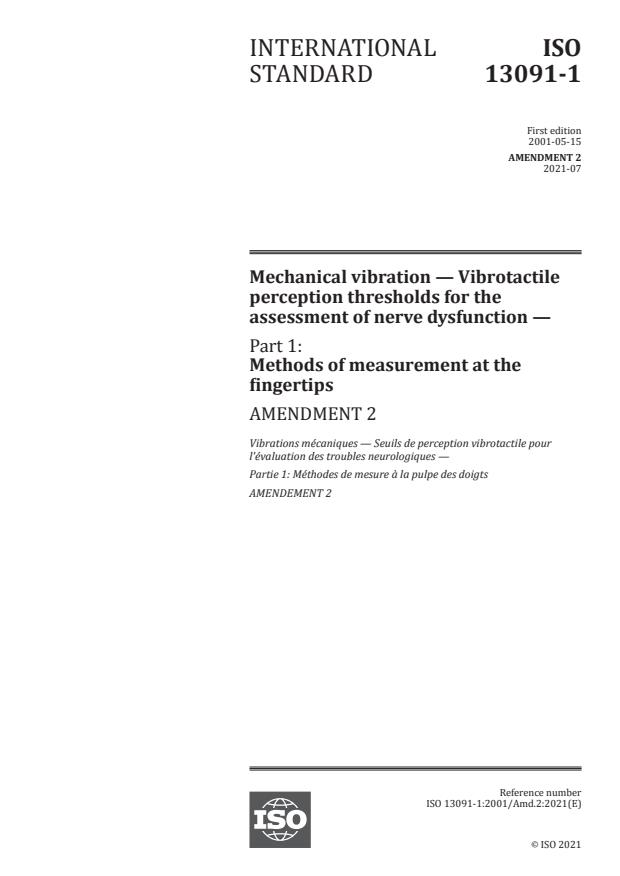
INTERNATIONAL ISO
STANDARD 13091-1
First edition
2001-05-15
AMENDMENT 2
2021-07
Mechanical vibration — Vibrotactile
perception thresholds for the
assessment of nerve dysfunction —
Part 1:
Methods of measurement at the
fingertips
AMENDMENT 2
Vibrations mécaniques — Seuils de perception vibrotactile pour
l'évaluation des troubles neurologiques —
Partie 1: Méthodes de mesure à la pulpe des doigts
AMENDEMENT 2
Reference number
ISO 13091-1:2001/Amd.2:2021(E)
©
ISO 2021
ISO 13091-1:2001/Amd.2:2021(E)
© ISO 2021
All rights reserved. Unless otherwise specified, or required in the context of its implementation, no part of this publication may
be reproduced or utilized otherwise in any form or by any means, electronic or mechanical, including photocopying, or posting
on the internet or an intranet, without prior written permission. Permission can be requested from either ISO at the address
below or ISO’s member body in the country of the requester.
ISO copyright office
CP 401 • Ch. de Blandonnet 8
CH-1214 Vernier, Geneva
Phone: +41 22 749 01 11
Email: copyright@iso.org
Website: www.iso.org
Published in Switzerland
ii © ISO 2021 – All rights reserved
ISO 13091-1:2001/Amd.2:2021(E)
Foreword
ISO (the International Organization for Standardization) is a worldwide federation of national standards
bodies (ISO member bodies). The work of preparing International Standards is normally carried out
through ISO technical committees. Each member body interested in a subject for which a technical
committee has been established has the right to be represented on that committee. International
organizations, governmental and non-governmental, in liaison with ISO, also take part in the work.
ISO collaborates closely with the International Electrotechnical Commission (IEC) on all matters of
electrotechnical standardization.
The procedures used to develop this document and those intended for its further maintenance are
described in the ISO/IEC Directives, Part 1. In particular, the different approval criteria needed for the
different types of ISO documents should be noted. This document was drafted in accordance with the
editorial rules of the ISO/IEC Directives, Part 2 (see www .iso .org/ directives).
Attention is drawn to the possibility that some of the elemen
...
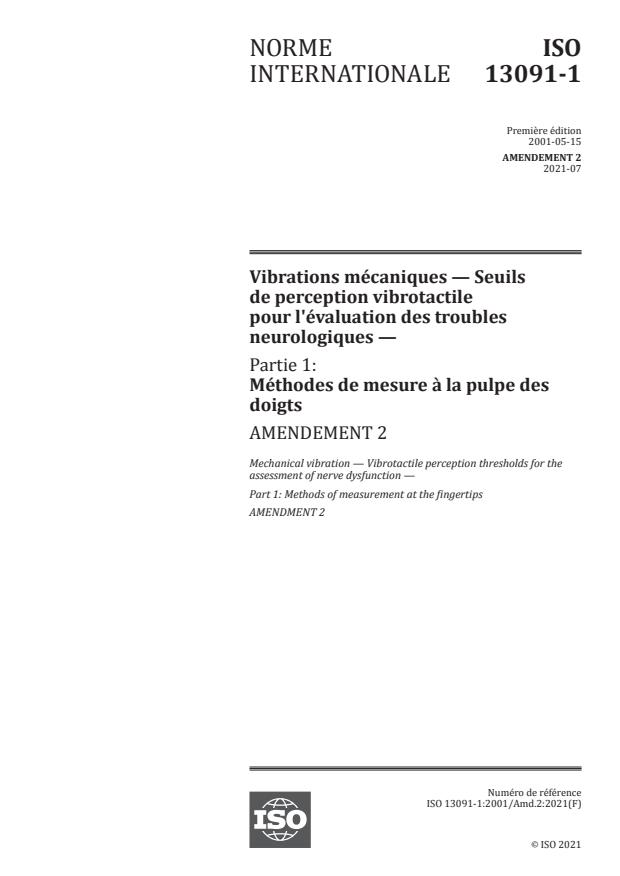
NORME ISO
INTERNATIONALE 13091-1
Première édition
2001-05-15
AMENDEMENT 2
2021-07
Vibrations mécaniques — Seuils
de perception vibrotactile
pour l'évaluation des troubles
neurologiques —
Partie 1:
Méthodes de mesure à la pulpe des
doigts
AMENDEMENT 2
Mechanical vibration — Vibrotactile perception thresholds for the
assessment of nerve dysfunction —
Part 1: Methods of measurement at the fingertips
AMENDMENT 2
Numéro de référence
ISO 13091-1:2001/Amd.2:2021(F)
©
ISO 2021
ISO 13091-1:2001/Amd.2:2021(F)
DOCUMENT PROTÉGÉ PAR COPYRIGHT
© ISO 2021
Tous droits réservés. Sauf prescription différente ou nécessité dans le contexte de sa mise en œuvre, aucune partie de cette
publication ne peut être reproduite ni utilisée sous quelque forme que ce soit et par aucun procédé, électronique ou mécanique,
y compris la photocopie, ou la diffusion sur l’internet ou sur un intranet, sans autorisation écrite préalable. Une autorisation peut
être demandée à l’ISO à l’adresse ci-après ou au comité membre de l’ISO dans le pays du demandeur.
ISO copyright office
Case postale 401 • Ch. de Blandonnet 8
CH-1214 Vernier, Genève
Tél.: +41 22 749 01 11
E-mail: copyright@iso.org
Web: www.iso.org
Publié en Suisse
ii © ISO 2021 – Tous droits réservés
ISO 13091-1:2001/Amd.2:2021(F)
Avant-propos
L'ISO (Organisation internationale de normalisation) est une fédération mondiale d'organismes
nationaux de normalisation (comités membres de l'ISO). L'élaboration des Normes internationales est
en général confiée aux comités techniques de l'ISO. Chaque comité membre intéressé par une étude
a le droit de faire partie du comité technique créé à cet effet. Les organisations internationales,
gouvernementales et non gouvernementales, en liaison avec l'ISO participent également aux travaux.
L'ISO collabore étroitement avec la Commission électrotechnique internationale (IEC) en ce qui
concerne la normalisation électrotechnique.
Les procédures utilisées pour élaborer le présent document et celles destinées à sa mise à jour sont
décrites dans les Directives ISO/IEC, Partie 1. Il convient, en particulier, de prendre note des différents
critères d'approbation requis pour les différents types de documents ISO. Le présent document a été
rédigé conformément aux règles de rédaction données dans les Directives ISO/IEC, Partie 2 (voir www
.iso .org/ directives).
L'attention est attirée sur le fait que certains des éléments du présent document peuvent faire l'objet de
droits de propriété intellectuelle ou de droits analogues. L'ISO ne saurait être tenue pour responsable
de ne pas avoir identifié de tels droits de propriété et averti de leur e
...