


ISO 15784-2:2024
(Main)Intelligent transport systems — Data exchange involving roadside modules communication — Part 2: Centre to field device communications using Simple Network Management Protocol (SNMP)
Intelligent transport systems — Data exchange involving roadside modules communication — Part 2: Centre to field device communications using Simple Network Management Protocol (SNMP)
This document specifies a mechanism for exchanging data and messages in the following cases: a) exchange between a traffic management centre and ITS roadside equipment for traffic management; b) exchange between ITS roadside equipment used for traffic management. This document is not applicable to: — communication between traffic management centres and in-vehicle units; — communication between ITS roadside equipment and in-vehicle units; — in-vehicle communication; — in-cabinet communication; — motion video transmission from a camera or recorded media. This document is suitable for use when both of the following conditions apply: 1) The data to be exchanged can be defined as one or more elements that can be retrieved or stored – SNMP can support a wide variety of devices and has adopted the concept of a management information base (MIB), which identifies the configuration, control and monitoring parameters for ITS roadside equipment. This standardized approach is commonly used for network management applications for devices such as routers, switches, bridges and firewalls. It is also used in many regions to control devices such as dynamic message signs. 2) Guaranteed, deterministic, real-time exchange of data is not critical – SNMP operations typically require less than 100 ms, but the underlying network can cause multi-second delays in delivering messages or even lost messages; thus, SNMP is not intended for applications that require reliable sub-second communications. This document can be used for: — intermittent exchange of any defined data (normal SNMP operations allow messages to be structured by combining any group of elements into a retrieval or storage request); — repeated, frequent exchanges of the same message structure (with potentially different values), even on relatively low-bandwidth links; NOTE 1 The dynamic object feature, defined in ISO/TS 26048-1, can be used to eliminate a considerable amount of overhead that is normally associated with SNMP communications to make it more suitable for low-bandwidth links. — allowing ITS roadside equipment to issue exception reports when special conditions arise. NOTE 2 Exception reporting uses SNMP notifications in combination with the notification management features defined in ISO/TS 26048-1.
Systèmes intelligents de transport (SIT) — Échange de données impliquant la communication de modules en bordure de route — Partie 2: Communications par dispositif du centre au terrain en utilisant le protocole simple de gestion de réseau (SNMP)
General Information
- Status
- Published
- Publication Date
- 25-Jun-2024
- Technical Committee
- ISO/TC 204 - Intelligent transport systems
- Drafting Committee
- ISO/TC 204 - Intelligent transport systems
- Current Stage
- 6060 - International Standard published
- Start Date
- 26-Jun-2024
- Due Date
- 06-May-2025
- Completion Date
- 26-Jun-2024
Relations
- Effective Date
- 06-Jun-2022
- Effective Date
- 06-Jun-2022
Overview - ISO 15784-2:2024 (SNMP for ITS roadside communications)
ISO 15784-2:2024 defines a standardized method for centre-to-field device communications in Intelligent Transport Systems (ITS) using Simple Network Management Protocol (SNMP). The standard targets data exchange between traffic management centres and roadside equipment, and between roadside devices themselves, for traffic management functions. It mandates SNMPv3 for security and updates the security stack to support Transport Layer Security (TLS) 1.3 for secure transports.
The document is not applicable to in-vehicle, in-cabinet, camera motion video, or centre-to-in-vehicle communications. It is suitable when exchanged data can be modelled as retrievable/storable elements (MIB objects) and where deterministic sub-second real-time performance is not required.
Key technical topics and requirements
- SNMPv3 requirement: Uses SNMP version 3 for authenticated and encrypted management operations.
- Management Information Base (MIB): Data is defined in MIBs (including ISO/TS 26048 series and project/vendor MIBs) to represent configuration, control and monitoring parameters for roadside equipment.
- Security models: Supports user-based security and transport-level security; encourages best practices for authentication, authorization and confidentiality.
- Transport mappings: Defines mappings over UDP/TCP with IPv4/IPv6 and secure transport options (TLS).
- Access control: View-based access control and notification management for exception reporting.
- Performance expectations: Typical SNMP operations take <100 ms, but network variability can incur multi-second delays; not intended for applications requiring guaranteed sub-second latency.
- Support features: Dynamic object features (per ISO/TS 26048-1) to reduce SNMP overhead on low-bandwidth links; SNMP notifications for exception reports.
Practical applications
- Remote monitoring and configuration of roadside ITS equipment (traffic signals, dynamic message signs, environmental sensors).
- Periodic status polling, bulk retrieval/storage of device parameters, and exception/event reporting from field devices to centres.
- Use on heterogeneous networks where open, interoperable device management reduces vendor lock-in and deployment cost.
- Suitable for intermittent or frequent non-deterministic exchanges and for low-bandwidth links when using dynamic object optimizations.
Who should use this standard
- Traffic management agencies and municipal ITS operators
- System integrators and solution vendors building roadside device management systems
- Network architects and cybersecurity teams defining ITS device communication and access control
- Procurement officers specifying open, interoperable ITS field-management interfaces
Related standards and resources
- ISO 15784 series (other parts) and ISO/TS 26048-1 for dynamic object and notification management features
- SNMP standards (IETF) and secure transport guidelines (TLS 1.3)
- Electronic profile and MIB artefacts available from the ISO standards portal for implementation guidance
Adopting ISO 15784-2:2024 helps achieve interoperable, secure, and maintainable ITS field device management using widely adopted SNMP practices.
Buy Documents

ISO 15784-2:2024 - Intelligent transport systems — Data exchange involving roadside modules communication — Part 2: Centre to field device communications using Simple Network Management Protocol (SNMP) Released:26. 06. 2024
Get Certified
Connect with accredited certification bodies for this standard

BSI Group
BSI (British Standards Institution) is the business standards company that helps organizations make excellence a habit.

Great Wall Tianjin Quality Assurance Center
Established 1993, first batch to receive national accreditation with IAF recognition.
Hong Kong Quality Assurance Agency (HKQAA)
Hong Kong's leading certification body.
Sponsored listings
Frequently Asked Questions
ISO 15784-2:2024 is a standard published by the International Organization for Standardization (ISO). Its full title is "Intelligent transport systems — Data exchange involving roadside modules communication — Part 2: Centre to field device communications using Simple Network Management Protocol (SNMP)". This standard covers: This document specifies a mechanism for exchanging data and messages in the following cases: a) exchange between a traffic management centre and ITS roadside equipment for traffic management; b) exchange between ITS roadside equipment used for traffic management. This document is not applicable to: — communication between traffic management centres and in-vehicle units; — communication between ITS roadside equipment and in-vehicle units; — in-vehicle communication; — in-cabinet communication; — motion video transmission from a camera or recorded media. This document is suitable for use when both of the following conditions apply: 1) The data to be exchanged can be defined as one or more elements that can be retrieved or stored – SNMP can support a wide variety of devices and has adopted the concept of a management information base (MIB), which identifies the configuration, control and monitoring parameters for ITS roadside equipment. This standardized approach is commonly used for network management applications for devices such as routers, switches, bridges and firewalls. It is also used in many regions to control devices such as dynamic message signs. 2) Guaranteed, deterministic, real-time exchange of data is not critical – SNMP operations typically require less than 100 ms, but the underlying network can cause multi-second delays in delivering messages or even lost messages; thus, SNMP is not intended for applications that require reliable sub-second communications. This document can be used for: — intermittent exchange of any defined data (normal SNMP operations allow messages to be structured by combining any group of elements into a retrieval or storage request); — repeated, frequent exchanges of the same message structure (with potentially different values), even on relatively low-bandwidth links; NOTE 1 The dynamic object feature, defined in ISO/TS 26048-1, can be used to eliminate a considerable amount of overhead that is normally associated with SNMP communications to make it more suitable for low-bandwidth links. — allowing ITS roadside equipment to issue exception reports when special conditions arise. NOTE 2 Exception reporting uses SNMP notifications in combination with the notification management features defined in ISO/TS 26048-1.
This document specifies a mechanism for exchanging data and messages in the following cases: a) exchange between a traffic management centre and ITS roadside equipment for traffic management; b) exchange between ITS roadside equipment used for traffic management. This document is not applicable to: — communication between traffic management centres and in-vehicle units; — communication between ITS roadside equipment and in-vehicle units; — in-vehicle communication; — in-cabinet communication; — motion video transmission from a camera or recorded media. This document is suitable for use when both of the following conditions apply: 1) The data to be exchanged can be defined as one or more elements that can be retrieved or stored – SNMP can support a wide variety of devices and has adopted the concept of a management information base (MIB), which identifies the configuration, control and monitoring parameters for ITS roadside equipment. This standardized approach is commonly used for network management applications for devices such as routers, switches, bridges and firewalls. It is also used in many regions to control devices such as dynamic message signs. 2) Guaranteed, deterministic, real-time exchange of data is not critical – SNMP operations typically require less than 100 ms, but the underlying network can cause multi-second delays in delivering messages or even lost messages; thus, SNMP is not intended for applications that require reliable sub-second communications. This document can be used for: — intermittent exchange of any defined data (normal SNMP operations allow messages to be structured by combining any group of elements into a retrieval or storage request); — repeated, frequent exchanges of the same message structure (with potentially different values), even on relatively low-bandwidth links; NOTE 1 The dynamic object feature, defined in ISO/TS 26048-1, can be used to eliminate a considerable amount of overhead that is normally associated with SNMP communications to make it more suitable for low-bandwidth links. — allowing ITS roadside equipment to issue exception reports when special conditions arise. NOTE 2 Exception reporting uses SNMP notifications in combination with the notification management features defined in ISO/TS 26048-1.
ISO 15784-2:2024 is classified under the following ICS (International Classification for Standards) categories: 03.220.20 - Road transport; 35.240.60 - IT applications in transport. The ICS classification helps identify the subject area and facilitates finding related standards.
ISO 15784-2:2024 has the following relationships with other standards: It is inter standard links to ISO 15784-2:2015, ISO 15784-2:2015/Amd 1:2020. Understanding these relationships helps ensure you are using the most current and applicable version of the standard.
ISO 15784-2:2024 is available in PDF format for immediate download after purchase. The document can be added to your cart and obtained through the secure checkout process. Digital delivery ensures instant access to the complete standard document.
Standards Content (Sample)
International
Standard
ISO 15784-2
Second edition
Intelligent transport systems —
2024-06
Data exchange involving roadside
modules communication —
Part 2:
Centre to field device communications
using Simple Network Management
Protocol (SNMP)
Systèmes intelligents de transport (SIT) — Échange de données
impliquant la communication de modules en bordure de route —
Partie 2: Communications par dispositif du centre au terrain en
utilisant le protocole simple de gestion de réseau (SNMP)
Reference number
© ISO 2024
All rights reserved. Unless otherwise specified, or required in the context of its implementation, no part of this publication may
be reproduced or utilized otherwise in any form or by any means, electronic or mechanical, including photocopying, or posting on
the internet or an intranet, without prior written permission. Permission can be requested from either ISO at the address below
or ISO’s member body in the country of the requester.
ISO copyright office
CP 401 • Ch. de Blandonnet 8
CH-1214 Vernier, Geneva
Phone: +41 22 749 01 11
Email: copyright@iso.org
Website: www.iso.org
Published in Switzerland
ii
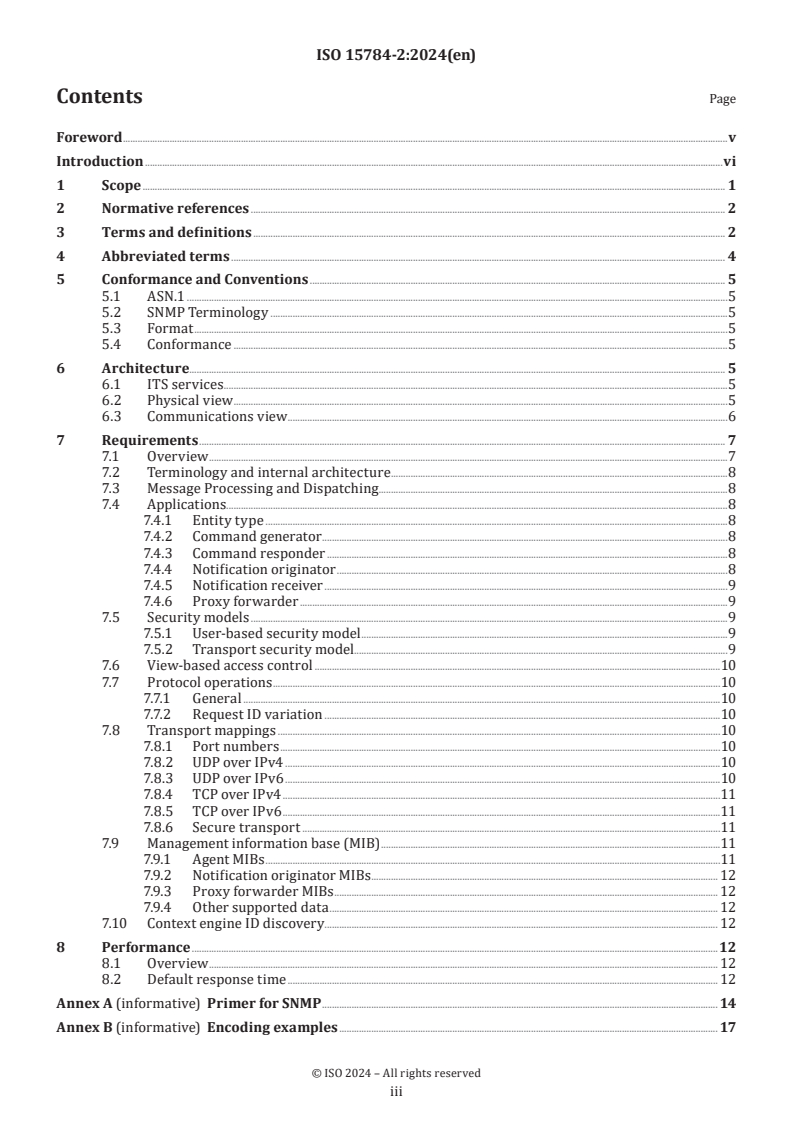
Contents Page
Foreword .v
Introduction .vi
1 Scope . 1
2 Normative references . 2
3 Terms and definitions . 2
4 Abbreviated terms . 4
5 Conformance and Conventions . 5
5.1 ASN.1 .5
5.2 SNMP Terminology .5
5.3 Format .5
5.4 Conformance .5
6 Architecture. 5
6.1 ITS services . .5
6.2 Physical view .5
6.3 Communications view .6
7 Requirements . 7
7.1 Overview .7
7.2 Terminology and internal architecture .8
7.3 Message Processing and Dispatching.8
7.4 Applications.8
7.4.1 Entity type .8
7.4.2 Command generator .8
7.4.3 Command responder .8
7.4.4 Notification originator .8
7.4.5 Notification receiver .9
7.4.6 Proxy forwarder .9
7.5 Security models .9
7.5.1 User-based security model .9
7.5.2 Transport security model.9
7.6 View-based access control .10
7.7 Protocol operations .10
7.7.1 General .10
7.7.2 Request ID variation .10
7.8 Transport mappings .10
7.8.1 Port numbers .10
7.8.2 UDP over IPv4 .10
7.8.3 UDP over IPv6 .10
7.8.4 TCP over IPv4 .11
7.8.5 TCP over IPv6 .11
7.8.6 Secure transport .11
7.9 Management information base (MIB) .11
7.9.1 Agent MIBs .11
7.9.2 Notification originator MIBs . 12
7.9.3 Proxy forwarder MIBs . 12
7.9.4 Other supported data . 12
7.10 Context engine ID discovery . 12
8 Performance .12
8.1 Overview . 12
8.2 Default response time . 12
Annex A (informative) Primer for SNMP . 14
Annex B (informative) Encoding examples . 17
iii
Bibliography . 19
iv
Foreword
ISO (the International Organization for Standardization) is a worldwide federation of national standards
bodies (ISO member bodies). The work of preparing International Standards is normally carried out through
ISO technical committees. Each member body interested in a subject for which a technical committee
has been established has the right to be represented on that committee. International organizations,
governmental and non-governmental, in liaison with ISO, also take part in the work. ISO collaborates closely
with the International Electrotechnical Commission (IEC) on all matters of electrotechnical standardization.
The procedures used to develop this document and those intended for its further maintenance are described
in the ISO/IEC Directives, Part 1. In particular, the different approval criteria needed for the different types
of ISO document should be noted. This document was drafted in accordance with the editorial rules of the
ISO/IEC Directives, Part 2 (see www.iso.org/directives).
ISO draws attention to the possibility that the implementation of this document may involve the use of (a)
patent(s). ISO takes no position concerning the evidence, validity or applicability of any claimed patent
rights in respect thereof. As of the date of publication of this document, ISO had not received notice of (a)
patent(s) which may be required to implement this document. However, implementers are cautioned that
this may not represent the latest information, which may be obtained from the patent database available at
www.iso.org/patents. ISO shall not be held responsible for identifying any or all such patent rights.
Any trade name used in this document is information given for the convenience of users and does not
constitute an endorsement.
For an explanation of the voluntary nature of standards, the meaning of ISO specific terms and expressions
related to conformity assessment, as well as information about ISO's adherence to the World Trade
Organization (WTO) principles in the Technical Barriers to Trade (TBT), see www.iso.org/iso/foreword.html.
This document was prepared by Technical Committee ISO/TC 204, Intelligent transport systems.
This second edition cancels and replaces the first edition (ISO 15784-2:2015), which has been technically
revised. It also incorporates the Amendment ISO 15784-2:2015/Amd 1:2020.
The main changes are as follows:
— support for Simple Network Management Protocol (SNMP) versions other than SNMP version 3 have
been removed;
— support for the Simple Transportation Management Protocol (STMP) has been removed;
— the security stack has been updated to support Transport Layer Security (TLS) version 1.3.
A list of all parts in the ISO 15784 series can be found on the ISO website.
Any feedback or questions on this document should be directed to the user’s national standards body. A
complete listing of these bodies can be found at www.iso.org/members.html.
v
Introduction
0.1 Background
The need for standardized communication with intelligent transport system (ITS) field devices is growing
around the world. A number of countries base their field device communications on the Simple Network
Management Protocol (SNMP).
There is a growing view and empirical evidence that standardizing this activity will result in improved ITS
performance, reduced cost, reduced deployment time and improved maintainability. This document creates
a standard for ITS field device communications based on several simple concepts:
a) maximization of the use of the SNMP standards, which are widely used in the management of network
devices;
b) provision of a consistent definition of the transport and networking layers;
c) promotion of the adoption of recommended security features; and
d) promotion of the use of interoperable data definitions for the management of field devices, such as
those defined in the ISO 26048 series and regional standards while also supporting vendor and project-
specific data.
By using this approach, agencies can specify open procurement and systems can be expanded geographically
in an open and non-proprietary manner which reduces costs, accelerates deployment and simplifies
integration.
0.2 Overview
SNMP is a collection of planned and proven concepts and principles. SNMP employs the principles of
abstraction and standardization. This has led to SNMP being widely adopted for communication between
management systems and devices on the internet, and other communications networks.
This document requires the use of SNMP version 3 (SNMPv3), as defined by the Internet Engineering Task
Force (IETF). SNMP versions prior to SNMPv3 did not include adequate security. Even if the network itself is
secure, previous versions of SNMP permit access control based on the unauthenticated contents of the SNMP
message, rather than using the authenticated identity from the lower layers.
This document does not specify any requirements that contradict or cause non-conformance to the
standards listed in the normative references section of this document.
The data to be exchanged by SNMP is defined in Management Information Bases (MIBs), which are defined
separately in the firewall MIB, RFCs, the ISO 26048 series, regional standards, vendor specifications and
project specifications.
0.3 Document approach and layout
This document provides:
a) an overview of the content of SNMP, including conformance and conventions (Clause 5);
b) a description of the reference architecture for systems that implement this document (Clause 6);
c) technical requirements for entities claiming conformance to this document (Clause 7);
d) performance requirements for entities claiming conformance to this document (Clause 8);
e) a primer for understanding the protocol defined in this document (see Annex A);
f) example encodings of messages conforming to this document (see Annex B);
g) an electronic profile requirements list for implementations to use (available at:
https://standards.iso.org/iso/15784/-2/ed-2/en/);
vi
h) an electronic management information base (MIB) that defines the firewall objects (available at:
https://standards.iso.org/iso/15784/-2/ed-2/en/).
vii
International Standard ISO 15784-2:2024(en)
Intelligent transport systems — Data exchange involving
roadside modules communication —
Part 2:
Centre to field device communications using Simple Network
Management Protocol (SNMP)
1 Scope
This document specifies a mechanism for exchanging data and messages in the following cases:
a) exchange between a traffic management centre and ITS roadside equipment for traffic management;
b) exchange between ITS roadside equipment used for traffic management.
This document is not applicable to:
— communication between traffic management centres and in-vehicle units;
— communication between ITS roadside equipment and in-vehicle units;
— in-vehicle communication;
— in-cabinet communication;
— motion video transmission from a camera or recorded media.
This document is suitable for use when both of the following conditions apply:
1) The data to be exchanged can be defined as one or more elements that can be retrieved or stored –
SNMP can support a wide variety of devices and has adopted the concept of a management information
base (MIB), which identifies the configuration, control and monitoring parameters for ITS roadside
equipment. This standardized approach is commonly used for network management applications for
devices such as routers, switches, bridges and firewalls. It is also used in many regions to control devices
such as dynamic message signs.
2) Guaranteed, deterministic, real-time exchange of data is not critical – SNMP operations typically require
less than 100 ms, but the underlying network can cause multi-second delays in delivering messages
or even lost messages; thus, SNMP is not intended for applications that require reliable sub-second
communications.
This document can be used for:
— intermittent exchange of any defined data (normal SNMP operations allow messages to be structured by
combining any group of elements into a retrieval or storage request);
— repeated, frequent exchanges of the same message structure (with potentially different values), even on
relatively low-bandwidth links;
NOTE 1 The dynamic object feature, defined in ISO/TS 26048-1, can be used to eliminate a considerable
amount of overhead that is normally associated with SNMP communications to make it more suitable for low-
bandwidth links.
— allowing ITS roadside equipment to issue exception reports when special conditions arise.
NOTE 2 Exception reporting uses SNMP notifications in combination with the notification management
features defined in ISO/TS 26048-1.
2 Normative references
The following documents are referred to in the text in such a way that some or all of their content constitutes
requirements of this document. For dated references, only the edition cited applies. For undated references,
the latest edition of the referenced document (including any amendments) applies.
ISO/TS 14812, Intelligent transport systems — Vocabulary
ISO/TS 26048-1, Intelligent transport systems — Field device SNMP data interface — Part 1: Global objects
RFC 2578, Structure of Management Information Version 2 (SMIv2), April 1999
RFC 2579, Textual Conventions for SMIv2, April 1999
RFC 2580, Conformance Statements for SMIv2, April 1999
RFC 3411, An Architecture for Describing SNMP Management Frameworks, December 2002
RFC 3412, Message Processing and Dispatching, December 2002
RFC 3413, SNMP Applications, December 2002
RFC 3414, User-based Security Model, December 2002
RFC 3415, View-based Access Control Model, December 2002
RFC 3416Version 2, of SNMP Protocol Operations, December 2002
RFC 3417, Transport Mappings, December 2002
RFC 3418, Management Information Base (MIB) for the Simple Network Management Protocol (SNMP),
December 2002
RFC 3430, Simple Network Management Protocol (SNMP) over Transmission Control Protocol (TCP) Transport
Mapping, December 2002
RFC 3826, The Advanced Encryption Standard (AES) Cipher Algorithm in the SNMP User-based Security Model,
June 2004
RFC 4001, Textual Conventions for Internet Network Addresses, February 2005
RFC 5590, Transport Subsystem for the Simple Network Management Protocol (SNMP), June 2009
RFC 5591, Transport Security Model for the Simple Network Management Protocol (SNMP), June 2009
RFC 6353, Transport Layer Security (TLS) Transport Model for the Simple Network Management Protocol
(SNMP), July 2011
RFC 7860, HMAC-SHA-2 Authentication Protocols in User-Based Security Model (USM) for SNMPv3, April 2016
RFC 8446, The Transport Layer Security (TLS) Protocol Version 1.3, August 2018
RFC 9147, The Datagram Transport Layer Security (DTLS) Protocol Version 1.3, April 2022
RFC 9456, Updates to the TLS Transport Model for SNMP, November 2023
3 Terms and definitions
For the purposes of this document, the terms and definitions given in ISO/TS 14812 and the following apply.
ISO and IEC maintain terminology databases for use in standardization at the following addresses:
— ISO Online browsing platform: available at https:// www .iso .org/ obp
— IEC Electropedia: available at https:// www .electropedia .org/
3.1
agent
Simple Network Management Protocol (SNMP) entity that can respond to SNMP get and set requests
Note 1 to entry: An agent may also issue report, trap and/or inform messages.
3.2
datagram
self-contained unit of data transmitted independently of other units of data
3.3
deprecated
still valid, but not to be used for new designs
Note 1 to entry: This is a term that is used in the STATUS field of management information bases (MIBs) to indicate
that the associated object type no longer represents the preferred design, but the object type can still be useful for
backwards compatibility with legacy implementations. A deprecated object type can be made obsolete with the next,
or subsequent, release of the standard.
3.4
encoding
complete sequence of octets used to represent a data value
3.5
field device
infrastructure-based ITS component located outside of a data centre that is designed to provide local
processing or routing services while stationary
Note 1 to entry: This concept is described in ISO/TS 14812 using the term “field system”. However, this document uses
the term “field device” due to the use of the latter term in management information base (MIB) modules that pre-date
the ISO/TS 14812 definition.
3.6
manager
Simple Network Management Protocol (SNMP) entity that can generate SNMP get and set requests and/or
can receive report, trap and/or inform messages
3.7
object identifier
ordered list of primary integer values from the root of the international object identifier tree to a node,
which unambiguously identifies that node
[SOURCE: ISO/IEC 9834-1:2012, 3.5.11]
3.8
object type
specific, defined piece of data, registered for public use on the international object identifier tree
3.9
protocol
set of message formats (semantic, syntactic and symbolic rules) and the rules for message exchange between
peer layer entities (which messages are valid when)
[SOURCE: ISO/IEC 16500-1:1999, 3.56]
3.10
protocol data unit
unit of information communicated between network peers
[SOURCE: ISO/IEC 24791-5:2012, 4.10]
3.11
proxy forwarder
agent that acts on behalf of a target entity
Note 1 to entry: A proxy forwarder is typically used as a translator to allow a device that does not conform with the
network protocol to participate on the network.
3.12
SNMP entity
implementation of the Simple Network Management Protocol (SNMP) that resides in an entity
3.13
SNMP object
instance of an object type
4 Abbreviated terms
AES Advanced Encryption Standard
ASN.1 Abstract Syntax Notation One
BER Basic Encoding Rules
DTLS Datagram Transport Layer Security
HMAC hash-based message authentication code
IANA Internet Assigned Numbers Authority
Ipv4 Internet Protocol – version 4
Ipv6 Internet Protocol – version 6
ITS intelligent transport systems
MIB management information base
PDU protocol data unit
PRL profile requirements list
SHA secure hash algorithm
SNMP Simple Network Management Protocol
SNMPv3 Simple Network Management Protocol version 3, as defined by IAB STD 62
NOTE The term “SNMP” is used in informal statements or when referring to the general con-
cepts of the protocol; “SNMPv3” is used in formal requirements and other statements where
the version needs to be emphasized.
TLS Transport Layer Security
TSM Transport Security Model
UDP User Datagram Protocol
USM User-based Security Model
UTMC Urban Traffic Management and Control
5 Conformance and Conventions
5.1 ASN.1
This document contains references to ASN.1 data concepts and explanations of ASN.1 data concepts within
its text. In all cases, the ASN.1 terms are presented in a fixed width font (e.g. such as this) to distinguish
these terms from normal English.
5.2 SNMP Terminology
Terminology between the different versions of SNMP is slightly different. This document uses the
terminology of SNMPv3.
5.3 Format
This document conforms to ISO 15784-1.
5.4 Conformance
Conformance to this document is defined by the requirements contained in Clauses 7 and 8. The profile
requirements list, available at https:// standards .iso .org/ iso/ 15784/ -2/ ed -2/ en/ , summarizes these
requirements in a table format that can be used to document the conformance of implementations. In case
of conflict between the PRL and the main body of this document, the main body of this document shall take
precedence.
This document explicitly identifies a number of options that an implementation may support. These are
options that are likely to be encountered in deployments and are listed in this document for convenience.
The omission of a feature in this document shall not be interpreted as a prohibition of its use.
6 Architecture
6.1 ITS services
This document defines the underlying mechanisms by which ITS field devices can be monitored, configured
and controlled. ITS field devices may be used to support almost any ITS service defined in ISO 14813-1, with
a roadside component.
6.2 Physical view
Figure 1 depicts the physical view of this interface using the graphical conventions defined by the
architecture reference for cooperative and intelligent transportation (ARC-IT, http:// arc -it .net) and also
documented in ISO 14813-5:2020, Annex B.
Figure 1 — Physical view of interface
The manager of the field device is shown in grey indicating that it can be any type of physical object, such as
a central system, another field device, a maintenance laptop or any other device that supports the defined
interface.
The field device is shown in orange, indicating that it is located in the field (e.g. along the roadside). This
document addresses the information flows exchanged between these two components over a connection. A
field device can have any number of connections to other ITS stations or external systems.
The figure indicates two information transfers between these physical objects. The first is the
“configuration and commands” information flow from the manager to the field device. The second is “status
and notifications” information flow from the field device to the manager. Both flows are shown in green
indicating that authentication is required, and both are shown with a single arrowhead indicating a unicast
transfer.
This document specifies the requirements for the underlying SNMP interface. ISO/TS 26048-1 defines a core
set of data that can be managed using this SNMP interface. Other documents containing MIBs (e.g. RFCs, the
remainder of the ISO 26048 series, regional standards, vendor specifications or project specifications) can
specify additional data that can be managed using the SNMP interface.
NOTE SNMP uses a get/set paradigm where there is a manager and an agent. However, a single field device can
act as both a manager (e.g. sending requests to other field devices) and as an agent (e.g. responding to requests from a
ce
...
Questions, Comments and Discussion
Ask us and Technical Secretary will try to provide an answer. You can facilitate discussion about the standard in here.
Loading comments...