


ISO/ASTM 51707:2002
(Main)Guide for estimating uncertainties in dosimetry for radiation processing
Guide for estimating uncertainties in dosimetry for radiation processing
ISO/ASTM 51707 defines possible sources of error in dosimetry performed in gamma, X-ray (bremsstrahlung) and electron irradiation facilities and offers procedures for estimating the resulting magnitude of the uncertainties in the measurement results. Basic concepts of measurement, estimate of the measured value of a quantity, 'true' value, error and uncertainty are defined and discussed. Components of uncertainty are discussed and methods are given for evaluating and estimating their values. How these contribute to the standard uncertainty in the reported values of absorbed doses are considered and methods are given for calculating the combined standard uncertainty and an estimate of overall (expanded) uncertainty. The methodology for evaluating components of uncertainty follows ISO procedures. The traditional concepts of precision and bias are not used. Examples are given in five annexes. This International Standard assumes a working knowledge of statistics and several statistical texts are included in the references.
Guide pour l'estimation des incertitudes en dosimétrie pour le traitement par irradiation
General Information
- Status
- Withdrawn
- Publication Date
- 17-Apr-2002
- Withdrawal Date
- 17-Apr-2002
- Current Stage
- 9599 - Withdrawal of International Standard
- Start Date
- 20-Jul-2005
- Completion Date
- 14-Feb-2026
Relations
- Effective Date
- 15-Apr-2008
- Revised
ISO/ASTM 51707:2005 - Guide for estimating uncertainties in dosimetry for radiation processing - Effective Date
- 15-Apr-2008
Get Certified
Connect with accredited certification bodies for this standard

BSMI (Bureau of Standards, Metrology and Inspection)
Taiwan's standards and inspection authority.
Sponsored listings
Frequently Asked Questions
ISO/ASTM 51707:2002 is a standard published by the International Organization for Standardization (ISO). Its full title is "Guide for estimating uncertainties in dosimetry for radiation processing". This standard covers: ISO/ASTM 51707 defines possible sources of error in dosimetry performed in gamma, X-ray (bremsstrahlung) and electron irradiation facilities and offers procedures for estimating the resulting magnitude of the uncertainties in the measurement results. Basic concepts of measurement, estimate of the measured value of a quantity, 'true' value, error and uncertainty are defined and discussed. Components of uncertainty are discussed and methods are given for evaluating and estimating their values. How these contribute to the standard uncertainty in the reported values of absorbed doses are considered and methods are given for calculating the combined standard uncertainty and an estimate of overall (expanded) uncertainty. The methodology for evaluating components of uncertainty follows ISO procedures. The traditional concepts of precision and bias are not used. Examples are given in five annexes. This International Standard assumes a working knowledge of statistics and several statistical texts are included in the references.
ISO/ASTM 51707 defines possible sources of error in dosimetry performed in gamma, X-ray (bremsstrahlung) and electron irradiation facilities and offers procedures for estimating the resulting magnitude of the uncertainties in the measurement results. Basic concepts of measurement, estimate of the measured value of a quantity, 'true' value, error and uncertainty are defined and discussed. Components of uncertainty are discussed and methods are given for evaluating and estimating their values. How these contribute to the standard uncertainty in the reported values of absorbed doses are considered and methods are given for calculating the combined standard uncertainty and an estimate of overall (expanded) uncertainty. The methodology for evaluating components of uncertainty follows ISO procedures. The traditional concepts of precision and bias are not used. Examples are given in five annexes. This International Standard assumes a working knowledge of statistics and several statistical texts are included in the references.
ISO/ASTM 51707:2002 is classified under the following ICS (International Classification for Standards) categories: 17.240 - Radiation measurements. The ICS classification helps identify the subject area and facilitates finding related standards.
ISO/ASTM 51707:2002 has the following relationships with other standards: It is inter standard links to ISO 15572:1998, ISO/ASTM 51707:2005. Understanding these relationships helps ensure you are using the most current and applicable version of the standard.
ISO/ASTM 51707:2002 is available in PDF format for immediate download after purchase. The document can be added to your cart and obtained through the secure checkout process. Digital delivery ensures instant access to the complete standard document.
Standards Content (Sample)
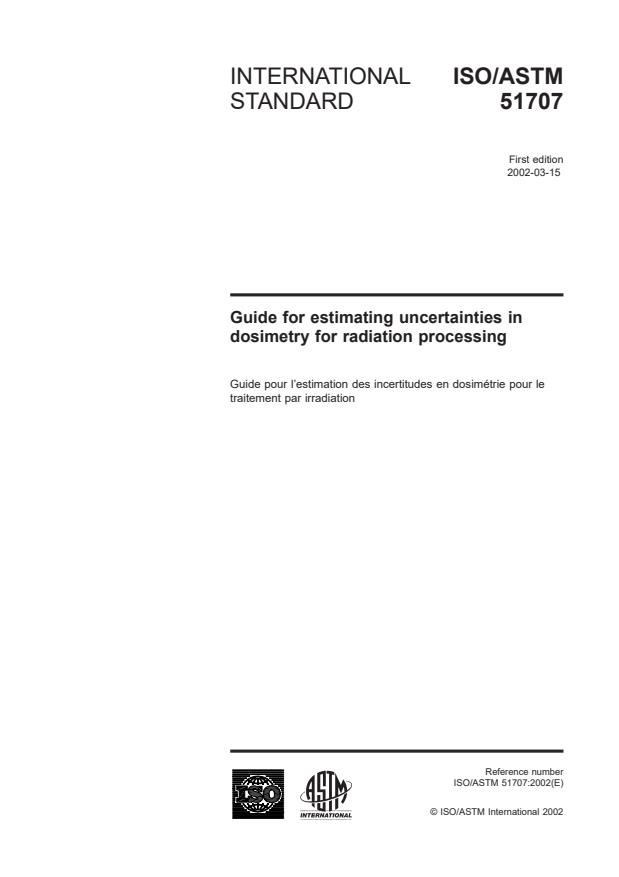
INTERNATIONAL ISO/ASTM
STANDARD 51707
First edition
2002-03-15
Guide for estimating uncertainties in
dosimetry for radiation processing
Guide pour l’estimation des incertitudes en dosimétrie pour le
traitement par irradiation
Reference number
© ISO/ASTM International 2002
PDF disclaimer
This PDF file may contain embedded typefaces. In accordance with Adobe’s licensing policy, this file may be printed or viewed but shall
not be edited unless the typefaces which are embedded are licensed to and installed on the computer performing the editing. In
downloading this file, parties accept therein the responsibility of not infringing Adobe’s licensing policy. Neither the ISO Central
Secretariat nor ASTM International accepts any liability in this area.
Adobe is a trademark of Adobe Systems Incorporated.
Details of the software products used to create this PDF file can be found in the General Info relative to the file; the PDF-creation
parameters were optimized for printing. Every care has been taken to ensure that the file is suitable for use by ISO member bodies
and ASTM members. In the unlikely event that a problem relating to it is found, please inform the ISO Central Secretariat or ASTM
International at the addresses given below.
© ISO/ASTM International 2002
All rights reserved. Unless otherwise specified, no part of this publication may be reproduced or utilized in any form or by any means, electronic or mechanical,
including photocopying and microfilm, without permission in writing from either ISO at the address below or ISO’s member body in the country of the
requester. In the United States, such requests should be sent to ASTM International.
ISO copyright office ASTM International, 100 Barr Harbor Drive, PO Box C700,
Case postale 56 • CH-1211 Geneva 20 West Conshohocken, PA 19428-2959, USA
Tel. +41 22 749 01 11 Tel. +610 832 9634
Fax +41 22 749 09 47 Fax +610 832 9635
E-mail copyright@iso.ch E-mail khooper@astm.org
Web www.iso.ch Web www.astm.org
Printed in the United States
ii © ISO/ASTM International 2002 – All rights reserved
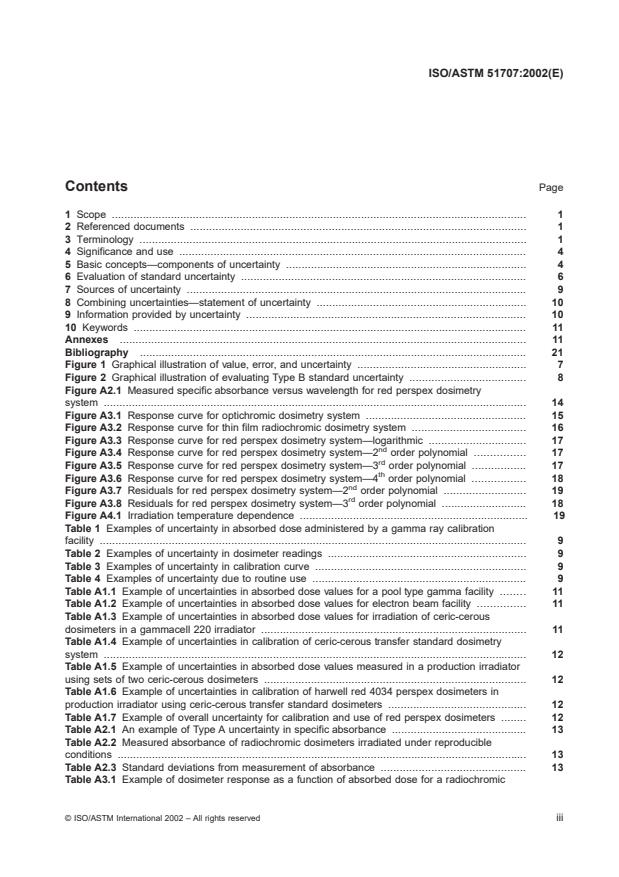
Contents Page
1 Scope . 1
2 Referenced documents . 1
3 Terminology . 1
4 Significance and use . 4
5 Basic concepts—components of uncertainty . 4
6 Evaluation of standard uncertainty . 6
7 Sources of uncertainty . 9
8 Combining uncertainties—statement of uncertainty . 10
9 Information provided by uncertainty . 10
10 Keywords . 11
Annexes . 11
Bibliography . 21
Figure 1 Graphical illustration of value, error, and uncertainty . 7
Figure 2 Graphical illustration of evaluating Type B standard uncertainty . 8
Figure A2.1 Measured specific absorbance versus wavelength for red perspex dosimetry
system . 14
Figure A3.1 Response curve for optichromic dosimetry system . 15
Figure A3.2 Response curve for thin film radiochromic dosimetry system . 16
Figure A3.3 Response curve for red perspex dosimetry system—logarithmic . 17
nd
Figure A3.4 Response curve for red perspex dosimetry system—2 order polynomial . 17
rd
Figure A3.5 Response curve for red perspex dosimetry system—3 order polynomial . 17
th
Figure A3.6 Response curve for red perspex dosimetry system—4 order polynomial . 18
nd
Figure A3.7 Residuals for red perspex dosimetry system—2 order polynomial . 19
rd
Figure A3.8 Residuals for red perspex dosimetry system—3 order polynomial . 18
Figure A4.1 Irradiation t emperature dependence . 19
Table 1 Examples of uncertainty in absorbed dose administered by a gamma ray calibration
facility . 9
Table 2 Examples of uncertainty in dosimeter readings . 9
Table 3 Examples of uncertainty in calibration curve . 9
Table 4 Examples of uncertainty due to routine use . 9
Table A1.1 Example of uncertainties in absorbed dose values for a pool type gamma facility . 11
Table A1.2 Example of uncertainties in absorbed dose values for electron beam facility . 11
Table A1.3 Example of uncertainties in absorbed dose values for irradiation of ceric-cerous
dosimeters in a gammacell 220 irradiator . 11
Table A1.4 Example of uncertainties in calibration of ceric-cerous transfer standard dosimetry
system . 12
Table A1.5 Example of uncertainties in absorbed dose values measured in a production irradiator
using sets of two ceric-cerous dosimeters . 12
Table A1.6 Example of uncertainties in calibration of harwell red 4034 perspex dosimeters in
production irradiator using ceric-cerous transfer standard dosimeters . 12
Table A1.7 Example of overall uncertainty for calibration and use of red perspex dosimeters . 12
Table A2.1 An example of Type A uncertainty in specific absorbance . 13
Table A2.2 Measured absorbance of radiochromic dosimeters irradiated under reproducible
conditions . 13
Table A2.3 Standard deviations from measurement of absorbance . 13
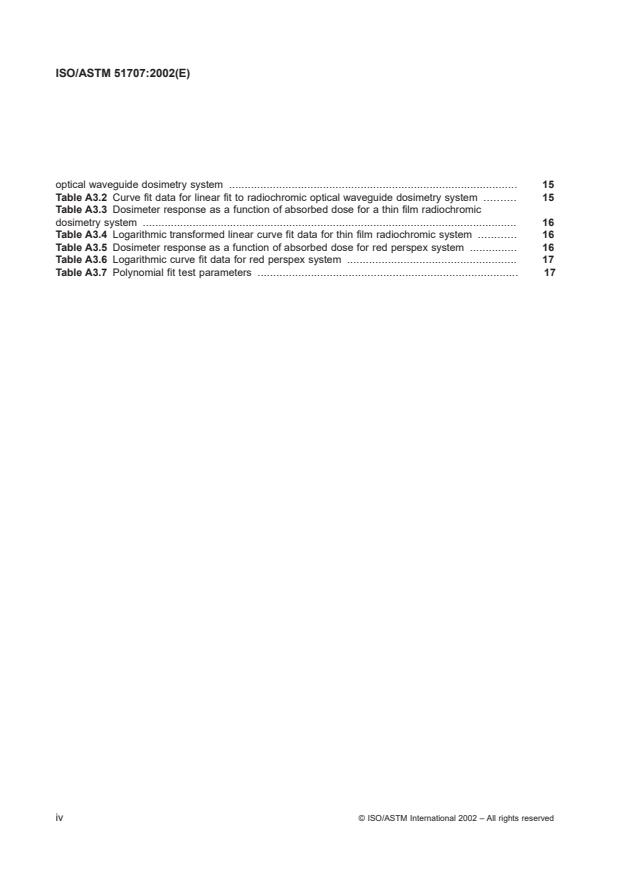
Table A3.1 Example of dosimeter response as a function of absorbed dose for a radiochromic
© ISO/ASTM International 2002 – All rights reserved iii
optical waveguide dosimetry system . 15
Table A3.2 Curve fit data for linear fit to radiochromic optical waveguide dosimetry system . 15
Table A3.3 Dosimeter response as a function of absorbed dose for a thin film radiochromic
dosimetry system . 16
Table A3.4 Logarithmic transformed linear curve fit data for thin film radiochromic system . 16
Table A3.5 Dosimeter response as a function of absorbed dose for red perspex system . 16
Table A3.6 Logarithmic curve fit data for red perspex system . 17
Table A3.7 Polynomial fit t est parameters . 17
iv © ISO/ASTM International 2002 – All rights reserved
Foreword
ISO (the International Organization for Standardization) is a worldwide federation of national standards bodies
(ISO member bodies). The work of preparing International Standards is normally carried out through ISO
technical committees. Each member body interested in a subject for which a technical committee has been
established has the right to be represented on that committee. International organizations, governmental and
non-governmental, in liaison with ISO, also take part in the work. ISO collaborates closely with the
International Electrotechnical Commission (IEC) on all matters of electrotechnical standardization.
Draft International Standards adopted by the technical committees are circulated to the member bodies for
voting. Publication as an International Standard requires approval by at least 75% of the member bodies
casting a vote.
ASTM International is one of the world’s largest voluntary standards development organizations with global
participation from affected stakeholders. ASTM technical committees follow rigorous due process balloting
procedures.
A pilot project between ISO and ASTM International has been formed to develop and maintain a group of
ISO/ASTM radiation processing dosimetry standards. Under this pilot project, ASTM Subcommittee E10.01,
Dosimetry for Radiation Processing, is responsible for the development and maintenance of these dosimetry
standards with unrestricted participation and input from appropriate ISO member bodies.
Attention is drawn to the possibility that some of the elements of this International Standard may be the subject
of patent rights. Neither ISO nor ASTM International shall be held responsible for identifying any or all such
patent rights.
International Standard ISO/ASTM 51707 was developed by ASTM Committee E10, Nuclear Technology and
Applications, through Subcommittee E10.01, and by Technical Committee ISO/TC 85, Nuclear Energy.
Annexes A1, A2, A3, A4 and A5 of this International Standard are for information only.
© ISO/ASTM International 2002 – All rights reserved v
Standard Guide for
Estimating Uncertainties in Dosimetry for Radiation
Processing
This standard is issued under the fixed designation ISO/ASTM 51707; the number immediately following the designation indicates the
year of original adoption or, in the case of revision, the year of last revision.
1. Scope E 876 Practice for Use of Statistics In the Evaluation of
Spectrometric Data
1.1 This guide defines possible sources of error in dosimetry
E 1026 Practice for Using the Fricke Reference Standard
performed in gamma, x-ray (bremsstrahlung) and electron
Dosimetry System
irradiation facilities and offers procedures for estimating the
E 1249 Practice for Minimizing Dosimetry Errors in Radia-
resulting magnitude of the uncertainties in the measurement
tion Hardness Testing of Silicon Electronic Devices Using
results. Basic concepts of measurement, estimate of the mea-
Co-60 Sources
sured value of a quantity, “true” value, error and uncertainty
2.2 ISO/ASTM Standards:
are defined and discussed. Components of uncertainty are
51204 Practice for Dosimetry in Gamma Irradiation Facili-
discussed and methods are given for evaluating and estimating
ties for Food Processing
their values. How these contribute to the standard uncertainty
51205 Practice for Use of a Ceric-Cerous Sulfate Dosimetry
in the reported values of absorbed dose are considered and
System
methods are given for calculating the combined standard
51261 Guide for Selection and Calibration of Dosimetry
uncertainty and an estimate of overall (expanded) uncertainty.
Systems for Radiation Processing
The methodology for evaluating components of uncertainty
51275 Practice for Use of a Radiochromic Film Dosimetry
follows ISO procedures (see section 2.3). The traditional
System
concepts of precision and bias are not used. Examples are
51276 Practice for Use of a Polymethylmethacrylate Do-
given in five annexes.
simetry System
1.2 This guide assumes a working knowledge of statistics.
51310 Practice for the Use of a Radiochromic Optical
Several statistical texts are included in the references (1, 2, 3,
2 Waveguide Dosimetry System
4).
51401 Practice for Use of a Dichromate Dosimetry System
1.3 This standard does not purport to address all of the
51431 Practice for Dosimetry in Electron and Bremsstrahl-
safety concerns, if any, associated with its use. It is the
ung Irradiation Facilities for Food Processing
responsibility of the user of this standard to establish appro-
51607 Practice for Use of the Alanine-EPR Dosimetry
priate safety and health practices and determine the applica-
System
bility of regulatory limitations prior to use.
2.3 ICRU Reports:
2. Referenced Documents
ICRU Report 14 Radiation Dosimetry: X-Rays and Gamma
Rays with Maximum Photon Energies Between 0.6 and 50
2.1 ASTM Standards:
MeV
E 170 Terminology Relating to Radiation Measurements
ICRU Report 17 Radiation Dosimetry: X-Rays Generated at
and Dosimetry
Potentials of 5 to 150 kV
E 177 Practice for Use of the Terms Precision and Accuracy
ICRU Report 34 The Dosimetry of Pulsed Radiation
as Applied to Measurement of a Property of a Material
ICRU Report 35 Radiation Dosimetry: Electron Beams with
E 178 Practice for Dealing With Outlying Observations
Energies Between 1 and 50 MeV
E 456 Terminology Relating to Quality and Statistics
ICRU Report 37 Stopping Powers for Electrons and
E 666 Practice for Calculating Absorbed Dose from Gamma
Positrons
or X Radiation
ICRU Report 60 Radiation Quantities and Units
This guide is under the jurisdiction of ASTM Committee E10 on Nuclear
3. Terminology
Technology and Applications and is the direct responsibility of Subcommittee
3.1 Definitions:
E10.01 on Dosimetry for Radiation Processing, and is also under the jurisdiction of
ISO/TC 85/WG 3. 3.1.1 absorbed dose, D—quantity of radiation energy im-
Current edition approved Jan. 22, 2002. Published March 15, 2002. Originally
parted per unit mass of a specified material. The unit of
e1
published as ASTM E 1707–95. Last previous ASTM edition E 1707–95 . ASTM
absorbed dose is the gray (Gy) where 1 gray is equivalent to the
e1
E 1707–95 was adopted by ISO in 1998 with the intermediate designation ISO
15572:1998(E). The present International Standard ISO/ASTM 51707:2002(E) is a
revision of ISO 15572.
The boldface numbers in parentheses refer to the bibliography at the end of this
guide. Annual Book of ASTM Standards, Vol 03.06.
3 6
Annual Book of ASTM Standards, Vol 12.02. Available from International Commission on Radiation Units and Measure-
ments, 7910 Woodmont Ave., Suite 800 Bethesda, MD 20814, U.S.A.
Annual Book of ASTM Standards, Vol 14.02.
© ISO/ASTM International 2002 – All rights reserved
absorption of 1 joule per kilogram ( = 100 rad). The math- minus a true value of the measurand.
ematical relationship is the quotient of de¯ by dm, where de¯ is
3.1.14.1 Discussion—Since a true value cannot be deter-
the mean energy imparted by ionizing radiation to matter of mined, in practice a conventional true value is used. The
mass dm (see ICRU 60).
quantity is sometimes called“ absolute error of measurement”
when it is necessary to distinguish it from relative error. If the
D 5 de¯/dm (1)
result of a measurement depends on the values of quantities
3.1.2 accuracy of measurement—closeness of the agree-
other than the measurand, the errors of the measured values of
ment between the result of a measurement and the true value of
these quantities contribute to the error of the result of the
the measurand.
measurement.
3.1.3 calibration curve—graphical representation of the
3.1.15 expected value—sum of possible values of a variable
relationship between dosimeter response and absorbed dose for
weighted by the probability of the value occurring. It is found
a given dosimetry system. For a mathematical representation,
from the expression:
see response function.
E~v! 5 ( P V (3)
i i i
3.1.4 coeffıcient of variation—sample standard deviation
expressed as a percentage of sample mean value (see 3.1.38
where:
and 3.1.39). th
V = i value, and
i
th
~CV! 5 S /x¯ 3 100 % (2) P = probability of i value.
n21 i
3.1.16 influence quantity—quantity that is not included in
3.1.5 combined standard uncertainty—standard uncertainty
the specification of the measurand but that nonetheless affects
of the result of a measurement when that result is obtained
the result of the measurement.
from the values of a number of other quantities, equal to the
3.1.16.1 Discussion—This quantity is understood to include
positive square root of a sum of terms, the terms being the
values associated with measurement reference standards, ref-
variances or covariances of these other quantities weighted
erence materials, and reference data upon which the result of
according to how the measurement result varies with changes
the measurement may depend, as well as phenomena such as
in these quantities.
short-term instrument fluctuations and parameters such as
3.1.6 confidence interval—an interval estimate that contains
temperature, time, and humidity.
the mean value of a parameter with a given probability.
3.1.17 (measurable) quantity—attribute of a phenomenon,
3.1.7 confidence level—the probability that a confidence
body or substance that may be distinguished qualitatively and
interval estimate contains the value of a parameter.
determined quantitatively; for example, the specific quantity of
3.1.8 corrected result—result of a measurement after cor-
interest in this guide is absorbed dose.
rection for the best estimate of systematic error.
3.1.18 measurand—specific quantity subject to measure-
3.1.9 correction—value that, added algebraically to the
ment.
uncorrected result of a measurement, compensates for system-
3.1.18.1 Discussion—A specification of a measurand may
atic error.
include statements about other quantities such as time, humid-
3.1.9.1 Discussion—The correction is equal to the negative
ity, or temperature. For example, equilibrium absorbed dose in
of the systematic error. Some systematic errors may be
water at 25°C.
estimated and compensated by applying appropriate correc-
3.1.19 measurement—set of operations having the object of
tions. However, since the systematic error cannot be known
determining a value of a quantity.
perfectly, the compensation cannot be complete.
3.1.20 measurement procedure—set of operations, in spe-
3.1.10 correction factor—numerical factor by which the
cific terms, used in the performance of particular measure-
uncorrected result of a measurement is multiplied to compen-
ments according to a given method.
sate for a systematic error.
3.1.21 measurement system—system used for evaluating the
3.1.10.1 Discussion—Since the systematic error cannot be
known perfectly, the compensation cannot be complete. measurand.
3.1.11 coverage factor—numerical factor used as a multi- 3.1.22 measurement traceability—The ability to demon-
strate and document on a continuing basis that the measure-
plier of the combined standard uncertainty in order to obtain an
overall uncertainty. ment results from a particular measurement system are in
agreement with comparable measurement results obtained with
3.1.11.1 Discussion—A coverage factor, k, is typically in
a national standard (or some identifiable and accepted stan-
the range of 2 to 3 (see 8.3).
dard) to a specified uncertainty.
3.1.12 dosimeter batch—quantity of dosimeters made from
a specific mass of material with uniform composition, fabri- 3.1.23 method of measurement—logical sequence of opera-
tions used in the performance of measurements according to a
cated in a single production run under controlled, consistent
conditions and having a unique identification code. given principle.
3.1.13 dosimetry system—a system used for determining 3.1.23.1 Discussion—Methods of measurement may be
qualified in various ways such as: substitution method, differ-
absorbed dose, consisting of dosimeters, measurement instru-
ments and their associated reference standards, and procedures ential method, and null method.
for the system’s use.
3.1.24 outlier—a measurement result that deviates mark-
3.1.14 error (of measurement)—result of a measurement edly from others within a set of measurement results.
© ISO/ASTM International 2002 – All rights reserved
3.1.25 overall uncertainty—quantity defining the interval measurements of the same measurand carried out subject to all
about the result of a measurement within which the values that of the following conditions: the same measurement procedure,
could reasonably be attributed to the measurand may be the same observer, the same measuring instrument, used under
expected to lie with a high level of confidence. the same conditions, the same location, and repetition over a
3.1.25.1 Discussion—Overall uncertainty is referred to as short period of time.
“expanded uncertainty” (see Guide to the Expression of 3.1.33.1 Discussion—These conditions are called “repeat-
Uncertainty in Measurement) (5). To associate a specific level ability conditions.” Repeatability may be expressed quantita-
of confidence with the interval defined by the overall uncer- tively in terms of the dispersion characteristics of the results.
tainty requires explicit or implicit assumptions regarding the
3.1.34 reproducibility (of results of measurements)—
probability distribution characterized by the measurement closeness of agreement between the results of measurements of
result and its combined standard uncertainty. The level of
the same measurand, where the measurements are carried out
confidence that may be attributed to this interval can be known under changed conditions such as differing: principle or
only to the extent to which such assumptions may be justified.
method of measurement, observer, measuring instrument, lo-
3.1.26 primary–standard dosimeter—a dosimeter of the cation, conditions of use, and time.
highest metrological quality, established and maintained as an
3.1.34.1 Discussion—A valid statement of reproducibility
absorbed dose standard by a national or international standards requires specification of the conditions changed. Reproducibil-
organization.
ity may be expressed quantitatively in terms of the dispersion
3.1.27 principle of measurement—scientific basis of a characteristics of the results. In this context, results of mea-
method of measurement.
surement are understood to be corrected results.
3.1.28 quadrature—a method of estimating overall uncer-
3.1.35 response function—mathematical representation of
tainty from independent sources by taking the square root of
the relationship between dosimeter response and absorbed dose
the sum of the squares of individual components of uncertainty
for a given dosimetry system.
(for example, coefficient of variation).
3.1.36 result of a measurement—value attributed to a mea-
3.1.29 random error—result of a measurement minus the
surand, obtained by measurement.
mean result of a large number of measurements of the same
3.1.36.1 Discussion—When the term “result of a measure-
measurand that are made under repeatable or reproducible
ment” is used, it should be made clear whether it refers to: the
conditions (see 3.1.33 and 3.1.34).
indication, the uncorrected result, the corrected result, and
3.1.29.1 Discussion—In these definitions (and that for sys-
whether several values are averaged. A complete statement of
tematic error), the term“ mean result of a large number of
the result of the measurement includes information about the
measurements of the same measurand” is understood to mean
uncertainty of the measurement.
“the expected value or mean of all possible measured values of
3.1.37 routine dosimeter—dosimeter calibrated against a
the measurand obtained under conditions of repeatability or
primary-, reference-, or transfer-standard dosimeter and used
reproducibility.” This ensures that the definition cannot be
for routine dosimetry measurement.
misinterpreted to imply that for a series of observations, the
3.1.38 sample mean—a measure of the average value of a
random error of an individual observation is known and can be
data set which is representative of the population. It is
eliminated by applying a correction. The view of this guide is
determined by summing all the values in the data set and
that error is an idealized concept and that errors cannot be
dividing by the number of items (n) in the data set. It is found
known exactly.
from the expression:
3.1.30 reference–standard dosimeter—a dosimeter of high
metrological quality, used as a standard to provide measure- x¯ 5 x , i 5 1, 2, 3 . n (4)
( i
n
i
ments traceable to and consistent with measurements made
3.1.39 sample standard deviation, S —measure of disper-
using primary–standard dosimeters. n−1
sion of values expressed as the positive square root of the
3.1.31 reference value (of a quantity)—value attributed to a
sample variance.
specific quantity and accepted, sometimes by convention, as
3.1.40 sample variance—the sum of the squared deviations
having an uncertainty appropriate for a given purpose; for
from the sample mean divided by (n−1), given by the expres-
example, the value assigned to the quantity realized by a
sion:
reference standard.
3.1.31.1 Discussion—This is sometimes called “assigned
( ~x 2 x¯!
2 i
S 5 (5)
value,” or “assigned reference value.” n21
~n 2 1!
3.1.32 relative error (of measurement)—error of measure-
where:
ment divided by a true value of the measurand.
x = individual value of parameter with i = 1, 2.n, and
3.1.32.1 Discussion—Since a true value cannot be deter- i
x¯ = mean of n values of parameter (see 3.1.38).
mined, in practice a reference value is used.
3.1.41 standard uncertainty—uncertainty of the results of a
3.1.33 repeatability (of results of measurements)—
measurement expressed as a standard deviation.
closeness of the agreement between the results of successive
3.1.42 systematic error—mean result of a large number of
7 repeated measurements of the same measurand minus a true
Available from International Organization for Standardization, Case Postal 56,
value of the measurand.
CH-1211 Geneva 20 Switzerland.
© ISO/ASTM International 2002 – All rights reserved
3.1.42.1 Discussion—The repeated measurements are car- Accurate dosimetry is essential in process control (see ISO/
ried out under the conditions of the term “repeatability”. Like ASTM Guide 51261). For absorbed dose measurements to be
true value, systematic error and its causes cannot be completely meaningful, the overall uncertainty associated with these
known. The error of the result of a measurement may often be measurements must be estimated and its magnitude quantified.
considered as arising from a number of random and systematic
NOTE 1—For a comprehensive discussion of various dosimetry meth-
effects that contribute individual components of error to the
ods applicable to the radiation types and energies discussed in this guide,
error of the result (see Terminologies E 170 and E 456, and
see ICRU Reports 14, 17, 34, 35 and Reference (9).
ASTM Practice E 177).
4.2 This guide uses the methodology adopted by the Inter-
3.1.43 traceability—see measurement traceability.
national Organization for Standardization for estimating uncer-
3.1.44 transfer–standard dosimeter—a dosimeter, often a
tainties in dosimetry for radiation processing (see section 2.3).
reference–standard dosimeter, suitable for transport between
ASTM traditionally expresses uncertainty in terms of precision
different locations for use as an intermediary to compare
and bias where precision is a measure of the extent to which
absorbed dose measurements.
replicate measurements made under specified conditions are in
3.1.45 true value—value of measurand that would be ob-
agreement and bias is a systematic error (see ASTM Termi-
tained by a perfect measurement.
nologies E 170 and E 456, and Practice E 177). As seen from
3.1.45.1 Discussion—True values are by nature indetermi-
this standard, sources of uncertainty are evaluated as either
nate and only an idealized concept. In this guide the terms “true
Type A or Type B rather than in terms of precision and bias.
value of a measurand” and“ value of a measurand” are viewed
Both random and systematic error clearly are differentiated
as equivalent (see 5.1.1).
from components of uncertainty. The methodology for treat-
3.1.46 Type A evaluation (of standard uncertainty)—
ment of uncertainties is in conformance with current interna-
method of evaluation of a standard uncertainty by the statistical
tionally accepted practice. (See Guide to the Expression of
analysis of a series of observations.
Uncertainty in Measurement (5).)
3.1.47 Type B evaluation (of standard uncertainty)—
4.3 Although this guide provides a framework for assessing
method of evaluation of a standard uncertainty by means other
uncertainty, it cannot substitute for critical thinking, intellec-
than the statistical analysis of a series of observations.
tual honesty, and professional skill. The evaluation of uncer-
3.1.48 uncertainty (of measurement)—a parameter, associ-
tainty is neither a routine task nor a purely mathematical one;
ated with a measurand or derived quantity, that characterizes
it depends on detailed knowledge of the nature of the measur-
the distribution of the values that could reasonably be attrib-
and and of the measurement method and procedure used. The
uted to the measurand or derived quantity.
quality and utility of the uncertainty quoted for the result of a
3.1.48.1 Discussion—For example, uncertainty may be a
measurement therefore ultimately depends on the understand-
standard deviation (or a given multiple of it), or the width of a
ing, critical analysis, and integrity of those who contribute to
confidence interval. Uncertainty of measurement comprises, in
the assignment of its value.
general, many components. Some of these components may be
evaluated from the statistical distribution of the results of series
5. Basic Concepts—Components of Uncertainty
of measurements and can be characterized by experimental
5.1 Measurement:
standard deviations. The other components, which can also be
5.1.1 The objective of a measurement is to determine the
characterized by standard deviations, are evaluated from as-
value of the measurand, that is, the value of the specific
sumed probability distributions based on experience or other
quantity to be measured. A measurement therefore begins with
information. It is understood that all components of uncertainty
an appropriate specification of the measurand, the method of
contribute to the distribution.
measurement, and the measurement procedure.
3.1.49 uncorrected result—result of a measurement before
5.1.2 In general, the result of a measurement is only an
correction for the assumed systematic error.
approximation or estimate of the value of the measurand and
3.1.50 value (of a quantity)—magnitude of a specific quan-
thus is complete only when accompanied by a statement of the
tity generally expressed as a number with a unit of measure-
uncertainty of that estimate.
ment, for example, 25 kGy.
5.1.3 In practice, the specification or definition of the
measurand depends on the required accuracy of the measure-
4. Significance and Use
ment. The measurand should be defined with sufficient exact-
4.1 Gamma, electron and x-ray (bremsstrahlung) facilities
ness relative to the required accuracy so that for all practical
routinely irradiate a variety of products such as food, medical
purposes the measurand value is unique.
devices, aseptic packaging and commodities (see ISO/ASTM
NOTE 2—Incomplete definition of the measurand can give rise to a
Practices 51204 and 51431). Process parameters for the prod-
component of uncertainty sufficiently large that it must be included in the
ucts must be carefully controlled to ensure that these products
evaluation of the uncertainty of the measurement result.
are processed within specifications (see ANSI/AAMI ST31-
5.1.3.1 Although a measurand should be defined in suffi-
1990, ANSI/AAMI ST32-1991 and ISO 11137 (6, 7, 8).
cient detail that any uncertainty arising from its incomplete
definition is negligible in comparison with the required accu-
racy of the measurement, it must be recognized that this may
Available from Association for the Advancement of Medical Instrumentation,
3330 Washington Boulevard, Suite 400, Arlington, VA 22201-4598, U.S.A.
not always be practicable. The definition may, for example, be
© ISO/ASTM International 2002 – All rights reserved
effects; however, the uncertainties associated with these standards must
incomplete because it does not specify parameters that may
still be taken into account.
have been assumed, unjustifiably, to have negligible effect; or
it may imply conditions that can never fully be met and whose
5.3 Uncertainty:
imperfect realization is difficult to take into account.
5.3.1 The uncertainty of the result of a measurement reflects
5.1.4 In many cases, the result of a measurement is deter-
the lack of exact knowledge of the value of the measurand. The
mined on the basis of repeated observations. Variations in
result of a measurement after correction for recognized sys-
repeated observations are assumed to arise from not being able
tematic effects is still only an estimate of the value of the
to hold completely constant each influence quantity that can
measurand because of the uncertainty arising from random
affect the measurement result.
effects and from imperfect correction of the result for system-
5.1.5 The mathematical model of the measurement proce-
atic effects.
dure that transforms the set of repeated observations into the
NOTE 6—The result of a measurement (after correction) can unknow-
measurement result is of critical importance since, in addition
ingly be very close to the value of the measurand (and hence have a
to the observations, it generally includes various influence
negligible error) even though it may have a large uncertainty. Thus the
quantities that are inexactly known. This lack of knowledge
uncertainty of the result of a measurement should not be interpreted as
contributes to the uncertainty of the measurement result along
representing the remaining unknown error.
with the variations of the repeated observations and any
5.3.2 In practice there are many possible sources of uncer-
uncertainty associated with the mathematical model itself.
tainty in a measurement, including:
5.2 Errors, Effects, and Corrections:
5.3.2.1 incomplete definition of the measurand;
5.2.1 In general, a measurement procedure has imperfec-
5.3.2.2 imperfect realization of the definition of the measur-
tions that give rise to an error in the measurement result.
and;
Traditionally, an error is viewed as having two components,
5.3.2.3 sampling—the sample measured may not represent
namely, a random component and a systematic component.
the defined measurand;
5.2.2 Random error presumably arises from unpredictable
5.3.2.4 inadequate knowledge of the effects of environmen-
or stochastic temporal and spatial variations of influence
tal conditions on the measurement procedure or imperfect
quantities. The effects of such variations, hereafter referred to
measurement of environmental conditions;
as random effects, give rise to variations in repeated observa-
5.3.2.5 personal bias in reading analog instruments;
tions of the measurand. The random error of a measurement
5.3.2.6 instrument resolution or discrimination threshold;
result cannot be compensated by correction but it can usually
5.3.2.7 values assigned to measurement standards;
be reduced by increasing the number of observations; its
5.3.2.8 values of constants and other parameters obtained
expectation or expected value is zero.
from external sources and used in the data reduction algorithm;
NOTE 3—The experimental standard deviation of the arithmetic mean 5.3.2.9 approximations and assumptions incorporated in the
or average of a series of observations is not the random error of the mean,
measurement method and procedure; and
although it is so referred to in some publications on uncertainty. It is
5.3.2.10 variations in repeated observations of the measur-
instead a measure of the uncertainty of the mean due to random effects.
and under apparently identical conditions.
The exact value of the error in the mean arising from these effects cannot
be known. In this guide great care is taken to distinguish between the NOTE 7—These sources are not necessarily independent and some may
terms “error” and “uncertainty;” they are not synonyms but represent contribute to 5.3.2.10. Of course, an unrecognized systematic effect
completely different concepts; they should not be confused with one cannot be taken into account in the evaluation of the uncertainty of the
another or misused. result of a measurement but contributes to its error.
5.2.3 Systematic error, like random error, cannot be elimi-
5.3.3 Uncertainty components are classified into two cat-
nated but it too can often be reduced. If a systematic error
egories based on their method of evaluation, “Type A” and
arises from a recognized effect of an influence quantity on a
“Type B” (see Section 3). These categories apply to uncertainty
measurement result, hereafter referred to as a systematic effect,
and are not substitutes for the words “random” and “system-
the effect can be quantified and, if significant in size relative to
atic”. The uncertainty of a correction for a known systematic
the required accuracy of the measurement, an estimated cor-
effect may be obtained by either a Type A or Type B evaluation,
rection or correction factor can be applied. It is assumed that
as may be the uncertainty characterizing a random effect.
after correction, the expectation or expected value of the error
5.3.4 The purpose of the Type A and Type B classification is
arising from a systematic effect is zero.
to indicate the two different ways of evaluating uncertainty
components. Both types of evaluation are based on probability
NOTE 4—The uncertainty of an estimated correction applied to a
measurement result to compensate for a systematic effect is not the distributions and the uncertainty components resulting from
systematic error. It is instead a measure of the uncertainty of the result due
each type are quantified by a standard deviation or a variance.
to incomplete knowledge of the value of the correction. In general, the
5.3.5 The population variance u characterizing an uncer-
error arising from imperfect compensation of a systematic effect cannot be
tainty component obtained from a Type A evaluation is
exactly known.
estimated from a series of repeated observations. The best
2 2
5.2.4 It is assumed that the result of a measurement has been
estimate of u is the sample variance s (see 3.1.40). The
corrected for all recognized significant systematic effects.
population standard deviation u, the positive square root of u ,
is thus estimated by s and for convenience is sometimes
NOTE 5—Often, measuring instruments and systems are adjusted or
referred to as a Type A standard uncertainty. For an uncertainty
calibrated using measurement reference standards to eliminate systematic
© ISO/ASTM International 2002 – All rights reserved
component obtained from a Type B evaluation, the population observed output values, only those components (whether
variance u is evaluated using available knowledge and the obtained from Type A or Type B evaluations) that could
estimated standard deviation u is sometimes referred to as a contribute to the observed variability of these values should be
Type B standard uncertainty. considered.
5.3.5.1 Thus a Type A standard uncertainty is obtained from
NOTE 10—Such an analysis may be facilitated by gathering those
a probability density function derived from an observed
components that contribute to the variability and those that do not into two
frequency distribution, while a Type B standard uncertainty is
separate and appropriately labeled groups. The evaluation of overall
obtained from an assumed probability density function based
uncertainty must take both groups into consideration.
on the degree of belief that an event will occur. The two
5.4.4 An apparent outlier (see 3.1.24) in a set of measure-
approaches are both valid interpretations of probability.
ment results may be merely an extreme manifestation of the
random variability inherent in the data. If this is true, then the
NOTE 8—A Type B evaluation of an uncertainty component is often
based on a pool of comparatively reliable information.
value should be retained and processed in the same manner as
the other measurements in the set. On the other hand, the
5.3.6 The total uncertainty of the result of a measurement,
outlying measurement may be the result of gross deviation
termed combined standard uncertainty and denoted by u ,isan
c
from prescribed experimental procedure or an error in calcu-
estimated standard deviation equal to the positive square root
lating or recording the numerical value. In subsequent data
of the total variance obtained by summing all variance and
analysis the outlier will be recognized as unlikely to be from
covariance components, however evaluated, using the law of
the same population as that of the others in the measurement
propagation of uncertainty (see Annex A5).
set. An investigation shall be undertaken to determine the
5.3.7 To meet the needs of some industrial and commercial
reason for the aberrant value and whether it should be rejected
applications, as well as requirements in the areas of health and
(see ASTM Practice E 178 for methods of testing for outliers).
safety, an overall uncertainty U, whose purpose is to provide an
5.5 Graphical Representation of Concepts:
interval about the result of a measurement within which the
5.5.1 Fig. 1 depicts some of the ideas discussed in this
values that could reasonably be attributed to the measurand
Section. It illustrates why the focus of this guide is uncertainty
may be expected to lie with a high level of confidence, is
and not error. The exact error of a result of a measurement is,
obtained by multiplying the combined standard uncertainty u
c
in general, unknown and unknowable. All one can do is
by a coverage factor k (see 8.3).
estimate the values of input quantities, including corrections
NOTE 9—The coverage factor k is always to be stated so that the
for recognized systematic effects, together with their standard
standard uncertainty of the measured quantity can be recovered for use in
uncertainties (estimated standard deviations), either from un-
calculating the overall standard uncertainty of other measurement results
known probability distributions that are sampled by means of
that may depend on that quantity.
repeated observations, or from subjective or a priori distribu-
5.4 Practical Considerations:
tions based on the pool of available information; and then
5.4.1 By varying all parameters on which the result of a
calculate the measurement result from the estimated values of
measurement depends, its uncertainty could be evaluated by
the input quantities and the combined standard uncertainty of
statistical means. However, because this is rarely possible in
that result from the standard uncertainties of those estimated
practice due to limited time and resources, the uncertainty is
values. Only if there is a sound basis for believing that all of
usually evaluated using a mathematical model of the measure-
this has been done properly, with no significant systematic
ment procedure and the law of propagation of uncertainty. Thus
effects having been overlooke
...
Questions, Comments and Discussion
Ask us and Technical Secretary will try to provide an answer. You can facilitate discussion about the standard in here.
Loading comments...