

ISO 23835:2022
(Main)Space Systems — Mechanism design and verification
General Information
- Abstract
This document establishes requirements for the design, material selection and characterization, fabrication, testing and inspection of all space mechanisms on spacecraft and payloads to meet the mission performance requirements. This document does not cover the requirements for mechanisms on expendable and reusable launch vehicles. Applicability of the requirements contained in this document to launch vehicle mechanisms is a decision left to the individual launch vehicle project. This document applies specifically to all moving mechanisms used in spacecraft during all phases of the mission, with the exception of engines and thermal protection systems.
- Status
- Published
- Publication Date
- 19-Apr-2022
- Technical Committee
- ISO/TC 20/SC 14 - Space systems and operations
- Drafting Committee
- ISO/TC 20/SC 14/WG 1 - Design engineering and production
- Current Stage
- 6060 - International Standard published
- Start Date
- 20-Apr-2022
- Due Date
- 24-Jan-2022
- Completion Date
- 20-Apr-2022


Overview
ISO 23835:2022 - Space Systems - Mechanism design and verification - defines uniform requirements for the design, material selection, fabrication, testing and inspection of spacecraft mechanisms and payload moving parts. The standard applies to mechanisms used throughout all mission phases (except engines and thermal protection systems) and supports safe, dependable operation by prescribing design practices and verification methods for space mechanism design and verification. Applicability to launch vehicle mechanisms is left to individual projects.
Key topics and technical requirements
ISO 23835:2022 organizes requirements across design and verification disciplines. Major technical topics include:
- Fundamental requirements: system performance, mission and functional allocation.
- Design requirements:
- Interfaces and integration constraints between mechanism and spacecraft.
- Environmental design addressing ground, launch vehicle flight, and orbital environments.
- Parts and materials: selection, characterization and allowable mechanical properties.
- Mechanism design features: accuracy control, driving capability (torque/force margin), design life, tribology (lubrication and wear), and major mechanical components.
- Structural, thermal and electrical design: stiffness, margins of safety, wiring, connectors and grounding.
- General engineering topics: safety, dependability, quality assurance, configuration control, redundancy, maintainability and fool-proof design.
- Verification:
- Verification by analysis (thermal, structural, life, lubrication, magnetic/electromagnetic, radiation, torque/force margin and worst‑case identification).
- Verification by test: development, qualification, acceptance and life testing (including recommended durations and practices).
- Informative annexes: guidance on driving capability design, life test duration factors and best practices for modeling & simulation.
Applications
ISO 23835:2022 is practical for:
- Designing and verifying solar array drive mechanisms, hinges, latches, rotating machinery and other moving payload mechanisms.
- Defining procurement and inspection criteria for mechanism suppliers and subcontractors.
- Developing verification plans: specifying required analyses, qualification and acceptance test programs and life testing.
- Managing risk areas such as tribology, thermal‑structural interactions and torque/force margins.
Who should use it
- Spacecraft mechanism designers and systems engineers
- Payload developers and integration teams
- Test laboratories and qualification engineers
- Quality assurance, reliability and safety managers
- Suppliers of flight mechanisms and materials
Related standards and context
ISO 23835:2022 was developed by ISO/TC 20/SC 14 (Aircraft and space vehicles - Space systems) and aligns with ISO/IEC directives for standards development. It complements other space system standards for avionics, structural and environmental testing used in spacecraft development.
Using ISO 23835:2022 helps teams standardize mechanism design and verification processes, reduce rework, and improve mission confidence for spacecraft moving mechanisms.
Get Certified
Connect with accredited certification bodies for this standard

BUREAU VERITAS Certification Germany
Bureau Veritas certification in Germany.

Element Materials Technology
Materials testing and product certification.

AQMS Ltd.
AQMS provides ISO certification to SMEs across the UK.
Sponsored listings
Frequently Asked Questions
ISO 23835:2022 is a standard published by the International Organization for Standardization (ISO). Its full title is "Space Systems — Mechanism design and verification". This standard covers: This document establishes requirements for the design, material selection and characterization, fabrication, testing and inspection of all space mechanisms on spacecraft and payloads to meet the mission performance requirements. This document does not cover the requirements for mechanisms on expendable and reusable launch vehicles. Applicability of the requirements contained in this document to launch vehicle mechanisms is a decision left to the individual launch vehicle project. This document applies specifically to all moving mechanisms used in spacecraft during all phases of the mission, with the exception of engines and thermal protection systems.
This document establishes requirements for the design, material selection and characterization, fabrication, testing and inspection of all space mechanisms on spacecraft and payloads to meet the mission performance requirements. This document does not cover the requirements for mechanisms on expendable and reusable launch vehicles. Applicability of the requirements contained in this document to launch vehicle mechanisms is a decision left to the individual launch vehicle project. This document applies specifically to all moving mechanisms used in spacecraft during all phases of the mission, with the exception of engines and thermal protection systems.
ISO 23835:2022 is classified under the following ICS (International Classification for Standards) categories: 49.140 - Space systems and operations. The ICS classification helps identify the subject area and facilitates finding related standards.
ISO 23835:2022 is available in PDF format for immediate download after purchase. The document can be added to your cart and obtained through the secure checkout process. Digital delivery ensures instant access to the complete standard document.
Standards Content (Sample)
INTERNATIONAL ISO
STANDARD 23835
First edition
2022-04
Space Systems — Mechanism design
and verification
Systèmes spacieux — Conception et vérification des mécanismes
Reference number
© ISO 2022
All rights reserved. Unless otherwise specified, or required in the context of its implementation, no part of this publication may
be reproduced or utilized otherwise in any form or by any means, electronic or mechanical, including photocopying, or posting on
the internet or an intranet, without prior written permission. Permission can be requested from either ISO at the address below
or ISO’s member body in the country of the requester.
ISO copyright office
CP 401 • Ch. de Blandonnet 8
CH-1214 Vernier, Geneva
Phone: +41 22 749 01 11
Email: copyright@iso.org
Website: www.iso.org
Published in Switzerland
ii
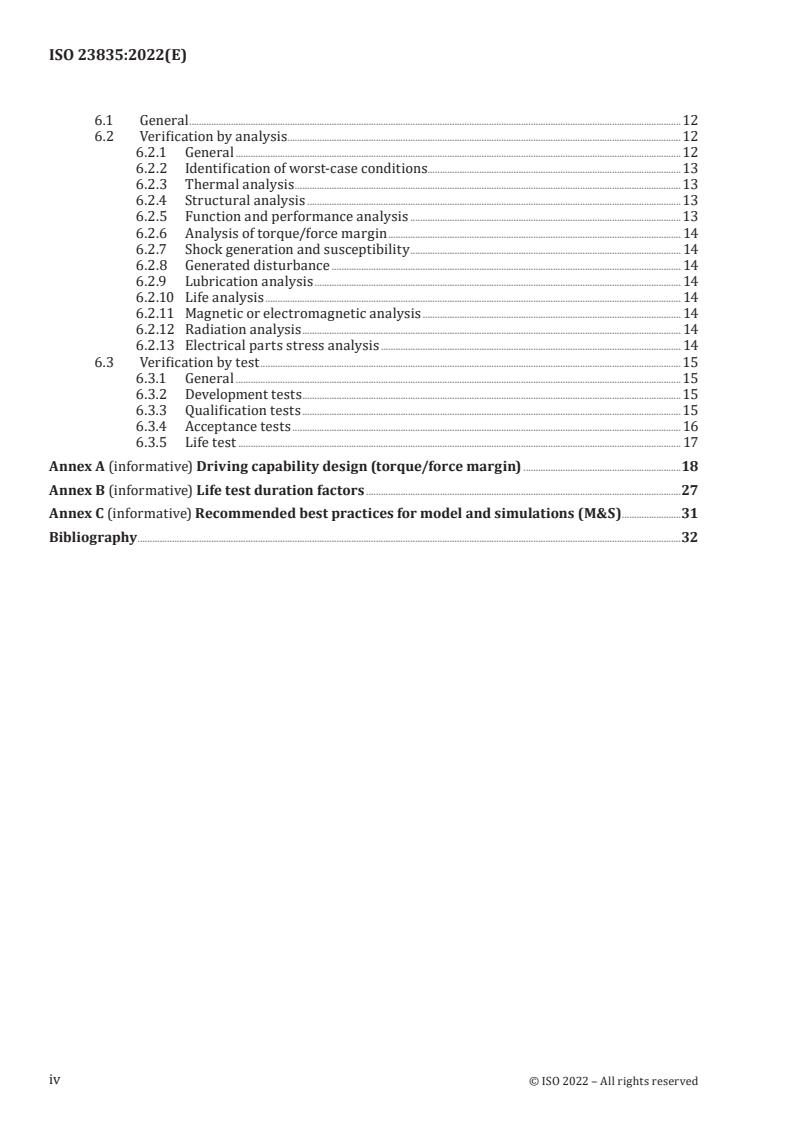
Contents Page
Foreword .v
Introduction . vi
1 Scope . 1
2 Normative references . 1
3 Terms and definitions . 1
4 Fundamental requirements . 4
4.1 System performance . 4
4.2 Mission . 4
4.3 Function . 4
5 Design requirements .4
5.1 Interfaces . 4
5.2 Environmental design . 5
5.2.1 General . 5
5.2.2 Ground environment . 5
5.2.3 Launch vehicle flight environment . 5
5.2.4 Orbital environment. 5
5.3 Parts and materials . 5
5.3.1 General . 5
5.3.2 Requirements for parts . 6
5.3.3 Requirements for materials . 6
5.4 Mechanism design . 6
5.4.1 Accuracy control design . 6
5.4.2 Driving capability design . 7
5.4.3 Design life . 7
5.4.4 Tribology . 7
5.4.5 Major mechanical components . 8
5.4.6 Other requirements . 8
5.5 Structural design . 9
5.5.1 General requirements related to structural design . 9
5.5.2 Allowable mechanical properties of structural materials . 9
5.5.3 Margin of safety . 9
5.5.4 Stiffness design . 9
5.6 Thermal design . 9
5.7 Electrical design . 9
5.7.1 Electrical design . 9
5.7.2 Electrical wires . . 10
5.7.3 Electric connectors . 10
5.7.4 Insulation . 10
5.7.5 Grounding . 10
5.7.6 Deformation of wiring . 10
5.8 General requirements . 10
5.8.1 Safety . 10
5.8.2 Dependability . 10
5.8.3 Quality assurance . 11
5.8.4 Configuration . 11
5.8.5 Redundancy . 11
5.8.6 Operability . 11
5.8.7 Maintainability . 11
5.8.8 Interchangeability . 11
5.8.9 Fool-proof design . 11
5.8.10 Other requirements .12
6 Verification .12
iii
6.1 General .12
6.2 Verification by analysis . 12
6.2.1 General .12
6.2.2 Identification of worst-case conditions . .13
6.2.3 Thermal analysis . 13
6.2.4 Structural analysis .13
6.2.5 Function and performance analysis . 13
6.2.6 Analysis of torque/force margin . 14
6.2.7 Shock generation and susceptibility . 14
6.2.8 Generated disturbance . 14
6.2.9 Lubrication analysis . 14
6.2.10 Life analysis . 14
6.2.11 Magnetic or electromagnetic analysis . 14
6.2.12 Radiation analysis . 14
6.2.13 Electrical parts stress analysis . 14
6.3 Verification by test . 15
6.3.1 General .15
6.3.2 Development tests .15
6.3.3 Qualification tests . 15
6.3.4 Acceptance tests . 16
6.3.5 Life test . 17
Annex A (informative) Driving capability design (torque/force margin) .18
Annex B (informative) Life test duration factors .27
Annex C (informative) Recommended best practices for model and simulations (M&S) .31
Bibliography .32
iv
Foreword
ISO (the International Organization for Standardization) is a worldwide federation of national standards
bodies (ISO member bodies). The work of preparing International Standards is normally carried out
through ISO technical committees. Each member body interested in a subject for which a technical
committee has been established has the right to be represented on that committee. International
organizations, governmental and non-governmental, in liaison with ISO, also take part in the work.
ISO collaborates closely with the International Electrotechnical Commission (IEC) on all matters of
electrotechnical standardization.
The procedures used to develop this document and those intended for its further maintenance are
described in the ISO/IEC Directives, Part 1. In particular, the different approval criteria needed for the
different types of ISO documents should be noted. This document was drafted in accordance with the
editorial rules of the ISO/IEC Directives, Part 2 (see www.iso.org/directives).
Attention is drawn to the possibility that some of the elements of this document may be the subject of
patent rights. ISO shall not be held responsible for identifying any or all such patent rights. Details of
any patent rights identified during the development of the document will be in the Introduction and/or
on the ISO list of patent declarations received (see www.iso.org/patents).
Any trade name used in this document is information given for the convenience of users and does not
constitute an endorsement.
For an explanation of the voluntary nature of standards, the meaning of ISO specific terms and
expressions related to conformity assessment, as well as information about ISO's adherence to
the World Trade Organization (WTO) principles in the Technical Barriers to Trade (TBT), see
www.iso.org/iso/foreword.html.
This document was prepared by Technical Committee ISO/TC 20, Aircraft and space vehicles,
Subcommittee SC 14, Space systems and operations.
Any feedback or questions on this document should be directed to the user’s national standards body. A
complete listing of these bodies can be found at www.iso.org/members.html.
v
Introduction
Mechanisms are important elements of spacecraft and its payloads. A mechanism failure can cause the
loss of human lives for manned space systems or jeopardize the intended mission for unmanned space
systems.
Currently, there is no international standard that covers all the aspects that can be used for space
flight moving mechanisms such as rotating machineries, solar array drive mechanism, paddle hinge
mechanism, latch mechanism.
The purpose of this document is to establish general requirements for mechanisms. It provides
the uniform requirements necessary to minimize the duplication of effort for resolving technical
barrier, considering the differences between approaches taken by the participating nations and
their commercial space communities in developing mechanisms. In addition, the use of agreed-upon
standards will facilitate cooperation and communication among space programmes.
This document, when implemented for a particular space system, ensures high confidence in achieving
safe and dependable operation in all phases of its planned mission.
vi
INTERNATIONAL STANDARD ISO 23835:2022(E)
Space Systems — Mechanism design and verification
1 Scope
This document establishes requirements for the design, material selection and characterization,
fabrication, testing and inspection of all space mechanisms on spacecraft and payloads to meet the
mission performance requirements. This document does not cover the requirements for mechanisms on
expendable and reusable launch vehicles. Applicability of the requirements contained in this document
to launch vehicle mechanisms is a decision left to the individual launch vehicle project.
This document applies specifically to all moving mechanisms used in spacecraft during all phases of
the mission, with the exception of engines and thermal protection systems.
2 Normative references
The following documents are referred to in the text in such a way that some or all of their content
constitutes requirements of this document. For dated references, only the edition cited applies. For
undated references, the latest edition of the referenced document (including any amendments) applies.
ISO 10786, Space systems — Structural components and assemblies
ISO 14302, Space systems — Electromagnetic compatibility requirements
ISO 15864, Space systems — General test methods for spacecraft, subsystems and units
ISO 21886, Space systems — Configuration management
ISO 23135, Space systems — Verification program and management process
ISO 23460, Space projects — Programme management — Dependability assurance requirements
ISO 24113, Space systems — Space debris mitigation requirements
ISO 27025, Space systems — Programme management — Quality assurance requirements
3 Terms and definitions
For the purposes of this document, the following terms and definitions apply.
ISO and IEC maintain terminology databases for use in standardization at the following addresses:
— ISO Online browsing platform: available at https:// www .iso .org/ obp
— IEC Electropedia: available at https:// www .electropedia .org/
3.1
mechanism
assembly of parts that are linked together to enable a relative motion
3.2
outgassing
evolution of gaseous species from a material, usually in a vacuum
Note 1 to entry: Outgassing also occurs in higher-pressure environments.
[SOURCE: ISO 15388:2012, 3.1.34]
3.3
interface
mechanical, thermal, electrical, or operational common boundary between two elements of a system
[SOURCE: ISO 10795:2019, 3.132]
3.4
acceptance test
required formal test conducted on flight hardware to ascertain that the materials, manufacturing
processes, and workmanship meet specifications and that the hardware is acceptable for intended
usage
[SOURCE: ISO 10786:2011, 3.2]
3.5
contamination
introduction of any undesirable molecular or particulate matter (including microbiological matter) into
an item or into the environment of interest
[SOURCE: ISO 10795:2019, 3.62]
3.6
lubrication
use of specific material surface properties or an applied material between two contacting or moving
surfaces in order to reduce friction, wear or adhesion
3.7
redundancy
〈design property of a system〉 existence of more than one means for performing a function
Note 1 to entry: The additional means of performing the function may be intentionally different (diverse) to
reduce the potential for common mode failures.
[SOURCE: ISO 10795:2019, 3.196]
3.8
debris
fragment such as abrasion powders produced by the operation of mechanism (3.1) parts
Note 1 to entry: See also space debris (3.18).
3.9
tribology
discipline that deals with the design, friction, wear and lubrication (3.6) of interacting surfaces in
relative motion to each other
3.10
qualification test
required formal contractual test used to demonstrate that the design, manufacturing, and assembly
have resulted in hardware designs conforming to specification requirements
[SOURCE: ISO 10795:2019, 3.187]
3.11
maintainability
〈of an item〉 ability to be retained in, or restored to a state in which it can perform as required, under
given conditions of use and maintenance
Note 1 to entry: Given conditions of use may include storage.
Note 2 to entry: Given conditions of maintenance include the procedures and resources for use.
Note 3 to entry: Maintainability may be quantified using such measures as mean time to restoration, or the
probability of restoration within a specified period of time.
[SOURCE: ISO 10795:2019, 3.144]
3.12
misalignment
geometric position error between machine elements and parts
EXAMPLE Translational displacement, inclination, torsion.
3.13
mission
set of tasks, duties or functions to be accomplished by an element
[SOURCE: ISO 10795:2019, 3.154]
3.14
latching
locking
intentional constraining of one or more previously unconstrained degrees of freedom which cannot be
released without specific action
3.15
model
physical or abstract representation of relevant aspects of an item or process that is put forward as a
basis for calculations, predictions, or further assessment
Note 1 to entry: The term “model” can also be used to identify particular instances of the product, e.g. flight
model.
[SOURCE: ISO 10795:2019, 3.155]
3.16
modelling
act of creating a model (3.15), i.e. act of creating a representation of a system
3.17
simulation
imitation of the behavioural characteristics of a system, entity, phenomenon, or process
Note 1 to entry: The term “simulation” can be also used for the production of a computer (or physical) model
(3.15) of something, especially the purpose of study.
3.18
space debris
objects of human origin in Earth orbit or re-entering the atmosphere, including fragments and elements
thereof, that no longer serve a useful purpose
[SOURCE: ISO 24113:2019, 3.23, modified — The deprecated term and note 1 to entry have been
removed.]
3.19
dependability
ability to perform as and when required
Note 1 to entry: Its main components are reliability, availability and maintainability (3.11).
Note 2 to entry: The extent to which the fulfilment of a required function can be justifiably trusted.
Note 3 to entry: Dependability shall be considered in conjunction with safety.
Note 4 to entry: Dependability is used as a collective term for the time-related quality characteristics of an item.
[SOURCE: IEC 60050-192:2015, 192-01-22, modified — The original note 1 to entry has been replaced
by Notes 1 to 3 to entry.]
3.20
electromagnetic compatibility
EMC
ability of a space equipment or system to function satisfactorily in its electromagnetic environment
without introducing intolerable electromagnetic disturbances to anything in that environment
[SOURCE: ISO 14302:2002, 3.1.4]
4 Fundamental requirements
4.1 System performance
The mechanism functional performance shall conform to the system performance requirements
allocated to the mechanism.
4.2 Mission
Design of the mechanism shall meet the requirements applied throughout the entire period of the
mission specified in individual programs. Design of the mechanism shall meet all requirements and
encountered environmental conditions in each phase of the mission.
4.3 Function
a) The kinematic requirements applicable to each position change shall be specified.
NOTE 1 For example, position over time, velocity and acceleration.
b) Mechanical interface, position accuracy or velocity tolerances shall be specified and verified that
they meet the functional needs.
NOTE 2 Mechanical interfaces include assembly and test rigging and other installation and integration
conditions.
c) The envelope of movement for each moving part shall be defined.
d) It shall be ensured that there is no mechanical interference between the movement of each part
with any other part of the mechanism, the spacecraft, the payload or the launch vehicle.
5 Design requirements
5.1 Interfaces
a) Structural interfaces
Mechanisms shall conform to the structural interface conditions and requirements defined in the
specification.
b) Thermal interfaces
Mechanisms shall conform to the thermal interface conditions and requirements defined in the
specification.
c) Thermo-mechanical interfaces
Mechanisms shall be designed in consideration of thermal stress induced between the mechanism
and its installation points.
d) Electrical interfaces
Mechanisms shall conform to the electrical interface conditions and requirements defined in the
specification.
e) Physical interfaces
The mass of a mechanism shall conform to the requirements defined in the specification.
f) Other interfaces
Mechanisms shall conform to the interface conditions of optical (visual field), mounting alignment,
accessibility during operation, envelope area, clearance with other equipment and ground-based
equipment defined in the specification.
5.2 Environmental design
5.2.1 General
Mechanisms shall conform to the environmental condition requirements defined in the specification.
5.2.2 Ground environment
a) Mechanisms shall meet the required performance even under ground handling environment
conditions such as ground test, assembly, storage and transportation.
b) Mechanisms shall be designed to take into account the ground test environment including
temperature, vibration, sound, shock, different atmospheric gases, pressure, humidity, cleanness
and corrosive environment.
5.2.3 Launch vehicle flight environment
a) Mechanisms shall meet the required performance after being exposed to launch vehicle flight
environment conditions.
b) As to the launching environment, mechanisms shall be designed to take into account changes in the
parameters such as temperature, vibration, sound, shock, pressure and humidity.
5.2.4 Orbital environment
a) Mechanisms shall meet the required performance under orbital environment conditions until the
end of their required operating life is reached.
b) As to the orbital environment, mechanisms shall be designed to take into account environmental
factors such as vacuum, temperature cycle, vibration, shock, radiation, ultraviolet and atomic
oxygen. Mechanisms shall be designed to take into account the environmental effects in outer
space on the materials used in the mechanism.
5.3 Parts and materials
5.3.1 General
The parts, materials and processes of the mechanism shall be selected to meet the requirements about
function, performance, environmental conditions, quality, reliability, and other properties specified in
the mechanism specification.
5.3.2 Requirements for parts
a) Parts used in mechanisms shall be selected from customer approved standard parts or registered
parts for project use if possible and proper.
2) Parts used in mechanisms shall be selected to conform to the mechanism requirements.
3) Parts used in mechanisms shall be standardized to the possible and proper level.
5.3.3 Requirements for materials
a) Mechanism materials shall be selected to conform to the mechanism requirements specification,
referring to material outgassing data, metallic materials mechanical properties data, and non-
metallic materials mechanical properties data for aerospace use.
NOTE MMPDS Handbook Metallic Materials Properties Development and Standardization Handbook,
MIL-HDBK-17 Composite Materials Handbook, and Aerospace Structure Metals Handbook are known as
popular mechanical properties data for metallic or non-metallic materials used in aerospace industries.
b) In addition to physical and mechanical properties, corrosion resistance, galvanic corrosion
resistance, susceptibility for stress corrosion cracking, and surface modification treatment (as
needed) shall be taken into account in metallic materials selection.
c) Mechanism materials which are to be exposed to the outer space environment shall be selected to
conform to the applicable mission requirements, to have durability for radiation, ultraviolet, atomic
oxygen, and space debris, and to have low outgassing characteristics.
d) Materials shall be selected so that material property change due to temperature change and
temperature cycle conforms to the mechanism requirement specification.
e) If environmental factors such as radiation, ultraviolet, atomic oxygen and temperature environment
can have combined effects on the materials, materials shall be selected so that the combined
effects on the materials under such complex environment conform to the mechanism requirements
specification.
f) When using hygroscopic or swellable materials, materials shall be selected so that the material
property change due to moisture absorption and swelling conform to the mechanism requirements
specification.
5.4 Mechanism design
5.4.1 Accuracy control design
For mechanisms used in pointing application where accuracy control is necessary, the performance
error due to the following factors shall be properly considered in determining the error budget:
a) machining and assembly tolerances, misalignment;
b) bending (deflection), torsion;
c) dynamic loads;
d) thermal distortion;
e) mechanical interference (movable envelope);
f) friction, friction noise (friction or torque variations), and friction hysteresis;
g) variation in driving force (driving motor ripple, spring, electromagnetic solenoid);
h) control system transient (resonance, overshoot);
i) steady-state errors;
j) other error variations (Structural and mechanical hysteresis, backlash, drive motor ripple,
quantization errors in command and feedback sensors, and any other defined error source).
5.4.2 Driving capability design
A proper margin (allowance) shall be provided to mechanisms with a driven section. The following
items shall be considered at the driving capability design of mechanisms:
a) For frictional forces, not only dynamic friction force during steady drive but also to static friction
force and hysteresis during activation and inverse driving shall be considered.
b) For motor driving, each motor shall have a torque (or force) margin which meets the requirements
for expected changes in operational temperature and speed. The driving current shall be in
agreement with the power resource.
c) In reviewing (calculating) the required driving force (drive resistance), the worst-case combination
of operationally expected changes in temperature and speed shall be reviewed with respect to
each resistance element (such as bearing, gears, harness cables, latches and dampers). If necessary,
the calculated values shall be checked for validity through testing at the element and subassembly
level.
d) For drive mechanism elements using a redundant system, a proper torque (or force) margin shall
be ensured in case an element fails under the worst-case conditions.
e) For deteriorated drive mechanism elements with a redundant system, the margin of other
mechanism elements shall be evaluated in consideration of the possibility that the deteriorated
mechanism will develop resistance force.
NOTE See Annex A for additional notes.
5.4.3 Design life
The design life of a mechanism shall correspond to the expected sum total of nominal ground test
and orbital operation. Mechanism shall be designed to meet the specified life requirements under the
expected environment conditions.
NOTE The specified life requirements include the margins specifically to address assembly, integration,
test, and number required cycles in the life cycle of mechanisms.
5.4.4 Tribology
a) Mechanisms shall be designed to allocate dimension and dimensional tolerance to each element
properly. Material and lubricant of mechanisms shall be selected to prevent adhesion, seizing, and
biting and to reduce wear at the sliding surface and the rolling surface to conform to the mechanism
performance requirements throughout the required lifetime.
b) Requirements to the design, storage, handling and operation of the mechanism shall be clarified in
order to maintain the integrity such as prevention of the lubricating surface contamination of the
mechanism.
c) The outgassing rate of the lubricant used to lubricate the mechanism shall be measured in
accordance with a predetermined measurement method. Allowable outgas limit shall be
determined by the applied contamination and cleanliness control requirements for space systems.
NOTE 1 See ASTM E 595 - 15.
NOTE 2 Specific requirements for mission involving advanced optical instruments are covered by the specific
mechanism specification.
5.4.5 Major mechanical components
When designing mechanisms that use bearings, gears, pyrotechnic devices, springs, and so on, the
appropriate design guidelines regarding these components should be referenced.
For the mechanism design that use pyrotechnic devices, ISO 26871 can be referenced to design the
mechanisms.
5.4.6 Other requirements
5.4.6.1 Replaceable mechanism
Replaceable mechanisms shall be designed to ensure they can only be installed in the correct direction
with consideration to mitigate human error.
5.4.6.2 Latching
Latching mechanisms shall be designed properly to prevent accidental release caused by vibration or
shock generated during mission.
5.4.6.3 End stops
Mechanisms with restricted travel or rotation shall be provided with regular or emergency mechanical
end stops to limit their motion and travel extremes to maximum position specified in the mechanism
requirements specification.
End stops shall be provided to prevent interference with interfacing equipment.
5.4.6.4 Separable contact surface
a) Separable contact surfaces shall be designed to maintain adhesive forces between bonding surfaces
below the specified limit.
b) The contact between the mating surfaces shall be designed considering surface roughness,
hardness, material properties, and contact geometry.
5.4.6.5 Clearance
The proximity of the moving mechanism shall be designed without thermal blankets, tape, and
electrical harnesses that may reduce or eliminate clearances, impeding the motion of mechanism. If
the use of those materials is indispensable to the mechanism due to functional requirements, sufficient
clearance shall be provided to prevent movable and actuating element from contacting with thermal
blankets, tape, and electrical harnesses.
5.4.6.6 Venting
a) Unless the mechanism is hermetically sealed or sized in all its functions and performances for
internal pressure build-up, all closed cavities shall be provided with a venting hole sized according
to the launch ascent depressurisation profile.
b) The method and design of venting shall prevent particles contamination of bearings, optics and
external sensitive components agreed by the customer.
c) If venting to the outside of a lubricated enclosure is implemented, the lubricant shall have
compatibility with the other spacecraft materials used and conform to contamination requirements
specified in the mechanism requirements specification.
5.4.6.7 Retention and release devices with pyrotechnic or other actuators
The operation of retention and release devices shall conform to the cleanness requirements applied to
the individual space programs and space debris mitigation requirements specified in ISO 24113. The
retention and release device shall be designed with a proper method for trapping debris.
5.5 Structural design
5.5.1 General requirements related to structural design
The structural design of a mechanism shall conform to the applicable requirements for the individual
space program.
Mechanisms shall be provided with the required functions and performance under the expected
thermal environment conditions throughout their entire operating life. Transitional conditions shall be
included in the thermal environment conditions.
5.5.2 Allowable mechanical properties of structural materials
a) Acceptable criteria for metallic material strength allowable properties shall be based on the
requirements stated in ISO 10786.
NOTE Allowable mechanical properties for structural metallic materials are generally specified in
MMPDS, Metallic Materials Properties Development and Standardization Handbook.
b) In special circumstances where design data at the required statistical level are not established,
engineering evaluation or limited data acquisition tests to establish design allowable properties
may be conducted per specified requirements.
5.5.3 Margin of safety
a) Mechanisms shall meet the mechanical interface and performance requirements and withstand
the expected loading conditions induced by the encountered environments during handling,
transportation, test, storage, launch and orbital operations without damage or deterioration.
b) Mechanisms shall have a positive margin of safety for all environmental and operational loading
conditions.
5.5.4 Stiffness design
Mechanisms shall possess adequate stiffness to conform the mechanism requirements specification,
especially for the case that there are requirements for natural frequencies of the mechanisms to prevent
dynamic coupling with major excitation frequencies of the launch vehicle, and/or to avoid dynamic
coupling of flexible modes with the spacecraft during in-orbit operations.
5.6 Thermal design
Mechanisms shall possess the required functions and performance under the expected thermal
environment conditions throughout the entire lifetime. Transients shall be included in the thermal
environment conditions.
5.7 Electrical design
5.7.1 Electrical design
Mechanisms shall be designed to meet the requirements for electrical performance and have stable
electrical characteristics throughout the lifetime. In general, the standards specified in the mechanism
specification is applied to the electric design.
5.7.2 Electrical wires
a) Wire clamps shall be used for portions where electrical wires are likely to be affected by bending.
b) Cables and electric wires shall be formed, arranged and supported considering the following items.
1) No electric wires, electric wire terminals or connectors shall be subject to mechanical stress
exceeding allowable limit.
2) Wiring shall provide a safe distance from sharp edges or liquid pipelines.
3) Damages and failures of cables and electric wires shall be prevented in vibration environments.
5.7.3 Electric connectors
Connector types and shapes (e.g. number of pins) shall be selected to avoid damage or connector mis-
mating.
5.7.4 Insulation
The insulation of electric wires shall be designed in accordance with the standards specified in the
mechanism specification.
5.7.5 Grounding
Mechanisms shall be grounded at a mechanical interface point specified in the interface control
document. Any components insulated from mechanical interface points shall be grounded separately
as needed.
5.7.6 Deformation of wiring
For electric wires which deform at movable portions, special consideration shall be given to possess
repeatability of the shape change and reaction force of electrical wires.
5.8 General requirements
5.8.1 Safety
a) In designing a mechanism, adequate consideration should be given to safety to prevent mishaps to
personnel and peripheral equipment in all phases including manufacturing, assembly, testing and
transportation. Adequate consideration should be given to prevent damage to the mechanism in all
the phases.
b) Safety design shall be implemented in accordance with the standards specified in the mechanism
specification.
5.8.2 Dependability
a) Mechanisms are significant components which may become a single point of failure in many cases.
Adequate consideration should be given to their dependability.
b) The dependability of mechanisms can be increased by providing a large design margin, decreasing
the sensitivity to each parameter, or designing single points of failure with redundancy.
c) For mechanisms that are indispensable to the mission success of the space system, the required
dependability shall be demonstrated by analysis or testing, according to the mechanism
specification.
d) For parts with a limited operating life, the operating life shall be verified through testing or
analysis.
e) A single part failure shall not cause non-conformance of other equipment or mechanisms.
f) Dependability analysis shall be performed in accordance with ISO 23460 or the standards specified
in the mechanism specification.
5.8.3 Quality assurance
Documentation and data control shall be performed in accordance with ISO 27025.
5.8.4 Configuration
Parts and materials which consist of a mechanism shall be identified by function and characteristics
and shall be listed. Documentation of listed parts and materials shall be maintained up to date in
accordance with ISO 21886.
5.8.5 Redundancy
a) All single points of failure in the mechanism shall be identified in the design phase. To minimize the
number of single points of failure and meet the reliability requirem
...