

ISO 18669-1:2021
(Main)Internal combustion engines — Piston pins — Part 1: General specifications
General Information
- Abstract
This document specifies the essential dimensional characteristics of piston pins with a nominal outer diameter from 8 mm up to and including 100 mm, for reciprocating internal combustion engines for road vehicles and other applications. In certain applications, except road vehicles, and provided that mutual agreement is made between the customer and the manufacturer, this document can be used with suitable modifications. In addition, it establishes a vocabulary, a pin-type classification, material description based on mechanical properties, common features and quality requirements. The use of this document can require a manufacturer and customer statistical process control agreement.
- Status
- Published
- Publication Date
- 11-Aug-2021
- Technical Committee
- ISO/TC 22/SC 34 - Propulsion, powertrain and powertrain fluids
- Drafting Committee
- ISO/TC 22/SC 34/WG 9 - Piston Pins
- Current Stage
- 9092 - International Standard to be revised
- Start Date
- 28-Oct-2024
- Completion Date
- 29-Aug-2026
Buy Documents
ISO 18669-1:2021 - Internal combustion engines -- Piston pins
ISO 18669-1:2021 - Internal combustion engines — Piston pins — Part 1: General specifications/12/2021
Overview
ISO 18669-1:2021 - Internal combustion engines - Piston pins - Part 1: General specifications defines the essential dimensional, material and quality characteristics for piston pins used in reciprocating internal combustion engines. The standard covers piston pins with a nominal outer diameter from 8 mm up to and including 100 mm for road vehicles and other applications (with possible modifications by mutual agreement between customer and manufacturer). It also establishes a common vocabulary, pin-type classification, designation codes and inspection/quality requirements.
Key topics and technical requirements
- Dimensional characteristics and tolerances: definitions and requirements for outside diameter, inside diameter (including cylindrical, tapered and centre-web bores), length, gauge length and related form/location tolerances.
- Bore and manufacturing types: descriptions of cylindrical bore, tapered bore, centre web, end web, machined bore and seamless drawn tube.
- Outside-edge and chamfer configurations: chamfered, double-chamfered, radiused and locking chamfer forms; gauge point definitions and drop-off features.
- Material and heat treatment: material descriptions referenced by mechanical properties (core hardness/strength), carburised and nitrided case depth, surface hardness and allowable volume change after thermal exposure.
- Surface finish and common features: roughness requirements for machined, coated, extruded or seamless drawn bore surfaces; marking, cleanliness, corrosion protection, residual magnetism and packaging.
- Quality and inspection: definitions of material defects (e.g., cracks, forming streaks, slag lines), visual defect criteria, and potential requirements for a manufacturer–customer statistical process control (SPC) agreement.
- Nomenclature, symbols and designation: standardized naming, codes and designation examples to ensure interchangeability and clear procurement specifications.
Practical applications and target users
ISO 18669-1:2021 is intended for:
- Engine designers and OEMs specifying piston pins for road-vehicle and industrial reciprocating engines.
- Piston-pin manufacturers and suppliers for production, heat treatment and finishing controls.
- Quality engineers and metrology labs conducting inspection, acceptance testing and SPC.
- Purchasing and supply-chain teams creating clear procurement specifications to ensure interchangeability and conformity.
Practical uses include drawing/specification development, supplier agreements, incoming inspection criteria, and setting machining, heat-treatment and coating controls for reliable piston-pin performance.
Related standards
ISO 18669-1 is part of the ISO 18669 series covering piston pins; consult the ISO website for other parts in the series and for complementary standards on engine components, materials testing and surface-finish measurement.
Keywords: ISO 18669-1:2021, piston pins, piston pin specifications, piston pin tolerances, internal combustion engines, pin bore types, surface roughness, material and heat treatment, engine OEM standards.
Relations
- Revises
ISO 18669-1:2013 - Internal combustion engines — Piston pins — Part 1: General specifications - Effective Date
- 15-Dec-2017
Buy Documents
ISO 18669-1:2021 - Internal combustion engines -- Piston pins
ISO 18669-1:2021 - Internal combustion engines — Piston pins — Part 1: General specifications/12/2021
Get Certified
Connect with accredited certification bodies for this standard

TÜV Rheinland
TÜV Rheinland is a leading international provider of technical services.

TÜV SÜD
TÜV SÜD is a trusted partner of choice for safety, security and sustainability solutions.

DEKRA Certification Inc.
DEKRA US certification services.
Sponsored listings
Frequently Asked Questions
ISO 18669-1:2021 is a standard published by the International Organization for Standardization (ISO). Its full title is "Internal combustion engines — Piston pins — Part 1: General specifications". This standard covers: This document specifies the essential dimensional characteristics of piston pins with a nominal outer diameter from 8 mm up to and including 100 mm, for reciprocating internal combustion engines for road vehicles and other applications. In certain applications, except road vehicles, and provided that mutual agreement is made between the customer and the manufacturer, this document can be used with suitable modifications. In addition, it establishes a vocabulary, a pin-type classification, material description based on mechanical properties, common features and quality requirements. The use of this document can require a manufacturer and customer statistical process control agreement.
This document specifies the essential dimensional characteristics of piston pins with a nominal outer diameter from 8 mm up to and including 100 mm, for reciprocating internal combustion engines for road vehicles and other applications. In certain applications, except road vehicles, and provided that mutual agreement is made between the customer and the manufacturer, this document can be used with suitable modifications. In addition, it establishes a vocabulary, a pin-type classification, material description based on mechanical properties, common features and quality requirements. The use of this document can require a manufacturer and customer statistical process control agreement.
ISO 18669-1:2021 is classified under the following ICS (International Classification for Standards) categories: 43.060.10 - Engine block and internal components. The ICS classification helps identify the subject area and facilitates finding related standards.
ISO 18669-1:2021 has the following relationships with other standards: It is inter standard links to ISO 18669-1:2013. Understanding these relationships helps ensure you are using the most current and applicable version of the standard.
ISO 18669-1:2021 is available in PDF format for immediate download after purchase. The document can be added to your cart and obtained through the secure checkout process. Digital delivery ensures instant access to the complete standard document.
Standards Content (Sample)
INTERNATIONAL ISO
STANDARD 18669-1
Third edition
2021-08
Internal combustion engines — Piston
pins —
Part 1:
General specifications
Moteurs à combustion interne — Axes de pistons —
Partie 1: Spécifications générales
Reference number
©
ISO 2021
© ISO 2021
All rights reserved. Unless otherwise specified, or required in the context of its implementation, no part of this publication may
be reproduced or utilized otherwise in any form or by any means, electronic or mechanical, including photocopying, or posting
on the internet or an intranet, without prior written permission. Permission can be requested from either ISO at the address
below or ISO’s member body in the country of the requester.
ISO copyright office
CP 401 • Ch. de Blandonnet 8
CH-1214 Vernier, Geneva
Phone: +41 22 749 01 11
Email: copyright@iso.org
Website: www.iso.org
Published in Switzerland
ii © ISO 2021 – All rights reserved
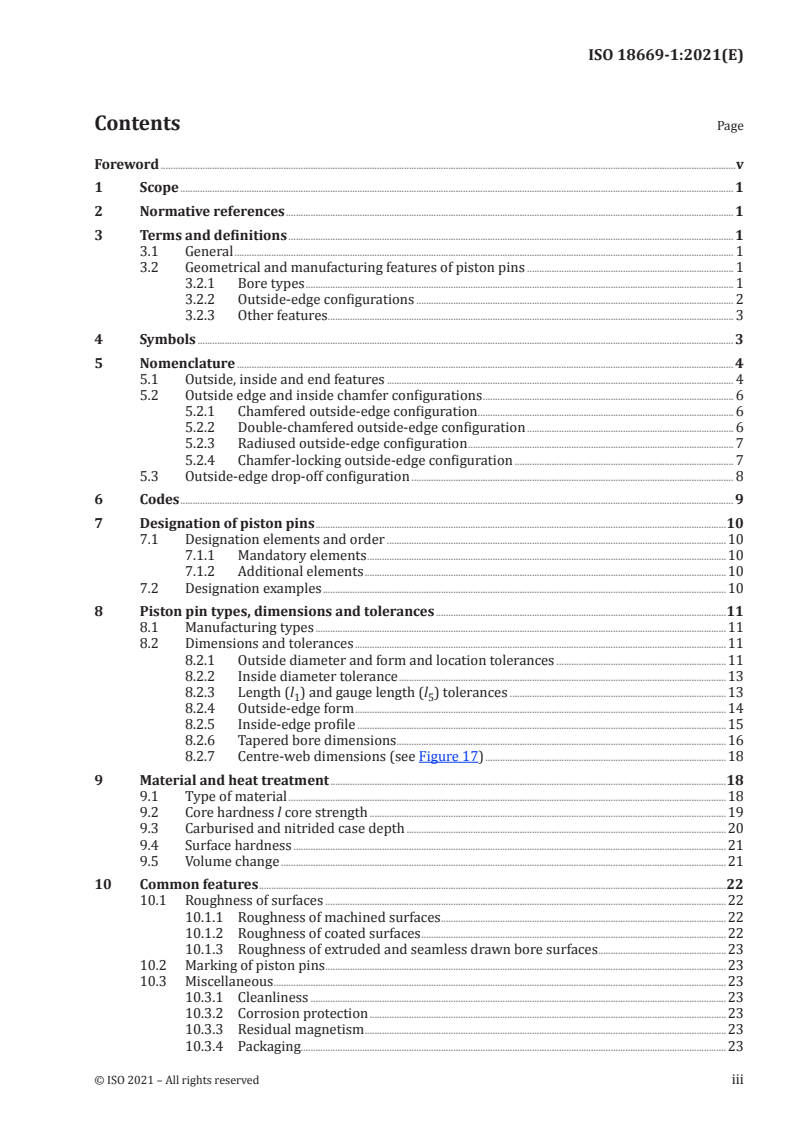
Contents Page
Foreword .v
1 Scope . 1
2 Normative references . 1
3 Terms and definitions . 1
3.1 General . 1
3.2 Geometrical and manufacturing features of piston pins . 1
3.2.1 Bore types . 1
3.2.2 Outside-edge configurations . 2
3.2.3 Other features . 3
4 Symbols . 3
5 Nomenclature . 4
5.1 Outside, inside and end features . 4
5.2 Outside edge and inside chamfer configurations . 6
5.2.1 Chamfered outside-edge configuration . 6
5.2.2 Double-chamfered outside-edge configuration . 6
5.2.3 Radiused outside-edge configuration . 7
5.2.4 Chamfer-locking outside-edge configuration . 7
5.3 Outside-edge drop-off configuration . 8
6 Codes . 9
7 Designation of piston pins .10
7.1 Designation elements and order .10
7.1.1 Mandatory elements .10
7.1.2 Additional elements .10
7.2 Designation examples .10
8 Piston pin types, dimensions and tolerances .11
8.1 Manufacturing types .11
8.2 Dimensions and tolerances .11
8.2.1 Outside diameter and form and location tolerances .11
8.2.2 Inside diameter tolerance .13
8.2.3 Length (l ) and gauge length (l ) tolerances .13
1 5
8.2.4 Outside-edge form .14
8.2.5 Inside-edge profile .15
8.2.6 Tapered bore dimensions .16
8.2.7 Centre-web dimensions (see Figure 17) .18
9 Material and heat treatment .18
9.1 Type of material .18
9.2 Core hardness l core strength .19
9.3 Carburised and nitrided case depth .20
9.4 Surface hardness .21
9.5 Volume change .21
10 Common features .22
10.1 Roughness of surfaces .22
10.1.1 Roughness of machined surfaces .22
10.1.2 Roughness of coated surfaces .22
10.1.3 Roughness of extruded and seamless drawn bore surfaces .23
10.2 Marking of piston pins .23
10.3 Miscellaneous .23
10.3.1 Cleanliness .23
10.3.2 Corrosion protection .23
10.3.3 Residual magnetism .23
10.3.4 Packaging.23
11 Quality requirements .24
11.1 Material characteristics .24
11.1.1 Decarburisation .24
11.1.2 Cementite network .24
11.1.3 Nitride coating .24
11.1.4 Grinder burn .24
11.2 Material defects .24
11.2.1 Cracks .24
11.2.2 Forming streaks .24
11.3 Visual defects .25
Bibliography .26
iv © ISO 2021 – All rights reserved
Foreword
ISO (the International Organization for Standardization) is a worldwide federation of national standards
bodies (ISO member bodies). The work of preparing International Standards is normally carried out
through ISO technical committees. Each member body interested in a subject for which a technical
committee has been established has the right to be represented on that committee. International
organizations, governmental and non-governmental, in liaison with ISO, also take part in the work.
ISO collaborates closely with the International Electrotechnical Commission (IEC) on all matters of
electrotechnical standardization.
The procedures used to develop this document and those intended for its further maintenance are
described in the ISO/IEC Directives, Part 1. In particular, the different approval criteria needed for the
different types of ISO documents should be noted. This document was drafted in accordance with the
editorial rules of the ISO/IEC Directives, Part 2 (see www .iso .org/ directives).
Attention is drawn to the possibility that some of the elements of this document may be the subject of
patent rights. ISO shall not be held responsible for identifying any or all such patent rights. Details of
any patent rights identified during the development of the document will be in the Introduction and/or
on the ISO list of patent declarations received (see www .iso .org/ patents).
Any trade name used in this document is information given for the convenience of users and does not
constitute an endorsement.
For an explanation of the voluntary nature of standards, the meaning of ISO specific terms and
expressions related to conformity assessment, as well as information about ISO's adherence to the
World Trade Organization (WTO) principles in the Technical Barriers to Trade (TBT), see www .iso .org/
iso/ foreword .html.
This document was prepared by Technical Committee ISO/TC 22, Road vehicles, Subcommittee SC 34,
Propulsion, powertrain and powertrain fluids.
This third edition cancels and replaces the second edition (ISO 18669-1:2013), which has been
technically revised.
The main changes compared to the previous edition are as follows:
— Clause 2 added,
— Table 4 “Waviness” added,
— Table 18 “Roughness machined surfaces” changed,
— Subclause 10.1.2 “Roughness of coated surfaces” added,
— Table 20 “Material defects” changed,
— Table 21 “Visual defects” changed,
— editorial changes.
A list of all parts in the ISO 18669 series can be found on the ISO website.
Any feedback or questions on this document should be directed to the user’s national standards body. A
complete listing of these bodies can be found at www .iso .org/ members .html.
INTERNATIONAL STANDARD ISO 18669-1:2021(E)
Internal combustion engines — Piston pins —
Part 1:
General specifications
1 Scope
This document specifies the essential dimensional characteristics of piston pins with a nominal outer
diameter from 8 mm up to and including 100 mm, for reciprocating internal combustion engines for
road vehicles and other applications. In certain applications, except road vehicles, and provided that
mutual agreement is made between the customer and the manufacturer, this document can be used
with suitable modifications.
In addition, it establishes a vocabulary, a pin-type classification, material description based on
mechanical properties, common features and quality requirements.
The use of this document can require a manufacturer and customer statistical process control
agreement.
2 Normative references
There are no normative references in this document.
3 Terms and definitions
For the purposes of this document, the following terms and definitions apply.
ISO and IEC maintain terminological databases for use in standardization at the following addresses:
— ISO Online browsing platform: available at https:// www .iso .org/ obp
— IEC Electropedia: available at https:// www .electropedia .org/
3.1 General
3.1.1
piston pin
precision cylindrical component that connects the piston to the connecting rod and has a smooth hard
peripheral surface
3.2 Geometrical and manufacturing features of piston pins
3.2.1 Bore types
3.2.1.1
cylindrical bore
pin having a straight cylindrical bore
3.2.1.2
centre web
pin bore with centre web
pin inside diameter formed symmetrically from each end leaving a web in the pin centre
Note 1 to entry: The web is subsequently removed leaving a step as shown in Figure 3.
3.2.1.3
tapered bore
pin with conical-shaped inside diameter near the ends that reduces the weight of the piston pin (3.1.1)
3.2.1.4
machined bore
pin with inside diameter produced solely by machining
3.2.1.5
seamless drawn tube
hollow steel product which does not contain any line junctures resulting from the method of
manufacture
3.2.1.6
end web
pin bore with end web
pin inner diameter formed from one end leaving a web near the opposite end
Note 1 to entry: The web is punched out. The pin is then drawn over a mandrel and a forming line may result as
shown in Figure 4.
3.2.2 Outside-edge configurations
3.2.2.1
chamfer
outside-edge bevelled feature that is sometimes used to mate with a round retainer ring
Note 1 to entry: Referred to as “locking chamfer” when a round wire retainer ring is located on the chamfer angle
and used to secure the pin in the piston.
3.2.2.2
outside-edge form angle
δ
region of outside-edge form that provides a smooth transition to the peripheral surface to facilitate
ease of assembly
3.2.2.3
outside-edge form angle end face
γ
region of outside-edge form that provides a smooth transition to the end face
3.2.2.4
drop-off
non-functional machining feature that creates a transition between the outside edge and the peripheral
surface
Note 1 to entry: See Figure 12.
3.2.2.5
inside-edge chamfer
bevelled edge between the bore surface and the end faces of the piston pin (3.1.1)
2 © ISO 2021 – All rights reserved
3.2.2.6
gauge point
locating point on the pin outside-edge chamfer (3.2.2.1) from where the gauge diameter (d ) and gauge
length (l ) are measured
3.2.3 Other features
3.2.3.1
volume change
change detected as a permanent outside-diameter dimensional deviation at reference temperature
after being heated to a test temperature for a specified period of time
3.2.3.2
slag line
linear flaw of non-metallic inclusions
4 Symbols
Symbol Description
a Wall thickness
b Outside-edge drop-off length
c Outside-edge drop-off height
d Outside diameter
d Inside diameter
d Tapered bore diameter
d Centre-web diameter
d Gauge diameter
d End face diameter
e Tapered bore runout
f Outside-edge length
g Outside-edge chamfer length
H Limit hardness
s
h End face concavity
h End face step
k Tapered bore relief
l Length
l Tapered bore length
l Centre-web length
l Gauge length
r Outside-edge radius
R Core strength
m
s End face runout
t Inside-edge chamfer length
t Outside-edge form length
α Tapered bore angle
β Outside-edge chamfer angle
γ Outside-edge form angle end face
δ Outside-edge form angle
5 Nomenclature
5.1 Outside, inside and end features
Terms commonly used to describe pins with a cylindrical bore are shown in Figure 1.
Key
1 end face
2 bore surface
3 peripheral surface
d outside diameter
d inside diameter
l length
a wall thickness
a
For detail W see Figure 2.
Figure 1 — Pin with cylindrical bore
Terms commonly used to describe end face concavity are shown in Figure 2a).
Terms commonly used to describe end face step are shown in Figure 2b).
a) End face concavity b) End face step
Key
h end face concavity
h end face step
d end face diameter
End face concavity and end face step are not recommended for end face locking.
Figure 2 — Detail W of Figure 1
4 © ISO 2021 – All rights reserved
Terms commonly used to describe pins with a centre web are shown in Figure 3.
Key
1 centre-web radius
l centre-web length
d centre-web diameter
Figure 3 — Pin with cold-formed centre web
Terms commonly used to describe pins with a cold-formed end web are shown in Figure 4.
Key
1 end-web forming line
Figure 4 — Pin with cold-formed end web
Terms commonly used to describe pins with a tapered bore are shown in Figure 5.
Key
1 tapered bore surface
α tapered bore angle
d tapered bore diameter
l tapered bore length
Figure 5 — Pin with tapered bore
5.2 Outside edge and inside chamfer configurations
Terms commonly used to describe the outside edge and inside chamfer configurations are shown in
Figure 6.
Key
1 outside-edge chamfer or radius
2 inside-edge chamfer
t inside-edge chamfer length
a
For detail X see Figures 7 and 8.
b
For detail Y see Figure 9.
NOTE This can be used with either a round or rectangular retainer ring.
Figure 6 — Outside-edge configuration (detail X: chamfered; detail Y: radiused)
5.2.1 Chamfered outside-edge configuration
Terms commonly used to describe the chamfered outside-edge configuration are shown in Figure 7.
Key
f outside-edge length
β outside-edge chamfer angle
Figure 7 — Chamfered configuration (detail X of Figure 6)
5.2.2 Double-chamfered outside-edge configuration
Terms commonly used to describe double-chamfered outside-edge configurations are shown in
Figure 8. The double chamfer is for assembly improvements of the piston pin.
6 © ISO 2021 – All rights reserved
Key
f outside-edge length
g outside-edge chamfer length
δ outside-edge form angle
β outside-edge chamfer angle
Figure 8 — Double-chamfered configuration (detail X of Figure 6)
5.2.3 Radiused outside-edge configuration
Terms commonly used to describe radiused outside-edge configurations are shown in Figure 9.
Key
r outside-edge radius
f outside-edge length
δ outside-edge form angle
Figure 9 — Radiused configuration (detail Y of Figure 6)
5.2.4 Chamfer-locking outside-edge configuration
Terms commonly used to describe chamfer-locking outside-edge configurations are shown in Figures 10
and 11.
Key
1 gauge points
l gauge length
d gauge diameter
a
For detail Z see Figure 11.
Figure 10 — Chamfer-locking outside-edge for round retainer ring
Key
1 gauge point
g outside-edge chamfer length
f outside-edge length
l gauge length
d gauge diameter
δ outside-edge form angle
β outside-edge chamfer angle
Figure 11 — Detail Z of Figure 10
5.3 Outside-edge drop-off configuration
Terms commonly used to describe outside-edge drop-off configurations are shown in Figure 12 a),
12 b) and 12 c).
The outside-edge drop-off is for manufacturing purposes and is therefore a chamfer that is very small
in height but long in length.
8 © ISO 2021 – All rights reserved
a) Chamfered edge and drop-off b) Double-chamfered edge and c) Radiused edge and drop-
drop-off off
Key
b outside-edge drop-off length
c outside-edge drop-off height
g outside-edge chamfer length
f outside-edge length
δ outside-edge form angle
β outside-edge chamfer angle
Figure 12 — Drop-off configurations (detail X and Y of Figure 6)
6 Codes
Codes used for piston pins shall be as given in Table 1 with their explanatory descriptions.
Table 1 — Codes and descriptions
Relevant sub-
Code Description clause of this
document
P1…P6 Pin-type classification according to manufacturing method of the pin centre hole 8.1
X Piston pins in combination with needle bearing 9.3
F1, F2, F3 Outside-edge configuration to
...
INTERNATIONAL ISO
STANDARD 18669-1
Third edition
2021-08
Internal combustion engines — Piston
pins —
Part 1:
General specifications
Moteurs à combustion interne — Axes de pistons —
Partie 1: Spécifications générales
Reference number
©
ISO 2021
© ISO 2021
All rights reserved. Unless otherwise specified, or required in the context of its implementation, no part of this publication may
be reproduced or utilized otherwise in any form or by any means, electronic or mechanical, including photocopying, or posting
on the internet or an intranet, without prior written permission. Permission can be requested from either ISO at the address
below or ISO’s member body in the country of the requester.
ISO copyright office
CP 401 • Ch. de Blandonnet 8
CH-1214 Vernier, Geneva
Phone: +41 22 749 01 11
Email: copyright@iso.org
Website: www.iso.org
Published in Switzerland
ii © ISO 2021 – All rights reserved
Contents Page
Foreword .v
1 Scope . 1
2 Normative references . 1
3 Terms and definitions . 1
3.1 General . 1
3.2 Geometrical and manufacturing features of piston pins . 1
3.2.1 Bore types . 1
3.2.2 Outside-edge configurations . 2
3.2.3 Other features . 3
4 Symbols . 3
5 Nomenclature . 4
5.1 Outside, inside and end features . 4
5.2 Outside edge and inside chamfer configurations . 6
5.2.1 Chamfered outside-edge configuration . 6
5.2.2 Double-chamfered outside-edge configuration . 6
5.2.3 Radiused outside-edge configuration . 7
5.2.4 Chamfer-locking outside-edge configuration . 7
5.3 Outside-edge drop-off configuration . 8
6 Codes . 9
7 Designation of piston pins .10
7.1 Designation elements and order .10
7.1.1 Mandatory elements .10
7.1.2 Additional elements .10
7.2 Designation examples .10
8 Piston pin types, dimensions and tolerances .11
8.1 Manufacturing types .11
8.2 Dimensions and tolerances .11
8.2.1 Outside diameter and form and location tolerances .11
8.2.2 Inside diameter tolerance .13
8.2.3 Length (l ) and gauge length (l ) tolerances .13
1 5
8.2.4 Outside-edge form .14
8.2.5 Inside-edge profile .15
8.2.6 Tapered bore dimensions .16
8.2.7 Centre-web dimensions (see Figure 17) .18
9 Material and heat treatment .18
9.1 Type of material .18
9.2 Core hardness l core strength .19
9.3 Carburised and nitrided case depth .20
9.4 Surface hardness .21
9.5 Volume change .21
10 Common features .22
10.1 Roughness of surfaces .22
10.1.1 Roughness of machined surfaces .22
10.1.2 Roughness of coated surfaces .22
10.1.3 Roughness of extruded and seamless drawn bore surfaces .23
10.2 Marking of piston pins .23
10.3 Miscellaneous .23
10.3.1 Cleanliness .23
10.3.2 Corrosion protection .23
10.3.3 Residual magnetism .23
10.3.4 Packaging.23
11 Quality requirements .24
11.1 Material characteristics .24
11.1.1 Decarburisation .24
11.1.2 Cementite network .24
11.1.3 Nitride coating .24
11.1.4 Grinder burn .24
11.2 Material defects .24
11.2.1 Cracks .24
11.2.2 Forming streaks .24
11.3 Visual defects .25
Bibliography .26
iv © ISO 2021 – All rights reserved
Foreword
ISO (the International Organization for Standardization) is a worldwide federation of national standards
bodies (ISO member bodies). The work of preparing International Standards is normally carried out
through ISO technical committees. Each member body interested in a subject for which a technical
committee has been established has the right to be represented on that committee. International
organizations, governmental and non-governmental, in liaison with ISO, also take part in the work.
ISO collaborates closely with the International Electrotechnical Commission (IEC) on all matters of
electrotechnical standardization.
The procedures used to develop this document and those intended for its further maintenance are
described in the ISO/IEC Directives, Part 1. In particular, the different approval criteria needed for the
different types of ISO documents should be noted. This document was drafted in accordance with the
editorial rules of the ISO/IEC Directives, Part 2 (see www .iso .org/ directives).
Attention is drawn to the possibility that some of the elements of this document may be the subject of
patent rights. ISO shall not be held responsible for identifying any or all such patent rights. Details of
any patent rights identified during the development of the document will be in the Introduction and/or
on the ISO list of patent declarations received (see www .iso .org/ patents).
Any trade name used in this document is information given for the convenience of users and does not
constitute an endorsement.
For an explanation of the voluntary nature of standards, the meaning of ISO specific terms and
expressions related to conformity assessment, as well as information about ISO's adherence to the
World Trade Organization (WTO) principles in the Technical Barriers to Trade (TBT), see www .iso .org/
iso/ foreword .html.
This document was prepared by Technical Committee ISO/TC 22, Road vehicles, Subcommittee SC 34,
Propulsion, powertrain and powertrain fluids.
This third edition cancels and replaces the second edition (ISO 18669-1:2013), which has been
technically revised.
The main changes compared to the previous edition are as follows:
— Clause 2 added,
— Table 4 “Waviness” added,
— Table 18 “Roughness machined surfaces” changed,
— Subclause 10.1.2 “Roughness of coated surfaces” added,
— Table 20 “Material defects” changed,
— Table 21 “Visual defects” changed,
— editorial changes.
A list of all parts in the ISO 18669 series can be found on the ISO website.
Any feedback or questions on this document should be directed to the user’s national standards body. A
complete listing of these bodies can be found at www .iso .org/ members .html.
INTERNATIONAL STANDARD ISO 18669-1:2021(E)
Internal combustion engines — Piston pins —
Part 1:
General specifications
1 Scope
This document specifies the essential dimensional characteristics of piston pins with a nominal outer
diameter from 8 mm up to and including 100 mm, for reciprocating internal combustion engines for
road vehicles and other applications. In certain applications, except road vehicles, and provided that
mutual agreement is made between the customer and the manufacturer, this document can be used
with suitable modifications.
In addition, it establishes a vocabulary, a pin-type classification, material description based on
mechanical properties, common features and quality requirements.
The use of this document can require a manufacturer and customer statistical process control
agreement.
2 Normative references
There are no normative references in this document.
3 Terms and definitions
For the purposes of this document, the following terms and definitions apply.
ISO and IEC maintain terminological databases for use in standardization at the following addresses:
— ISO Online browsing platform: available at https:// www .iso .org/ obp
— IEC Electropedia: available at https:// www .electropedia .org/
3.1 General
3.1.1
piston pin
precision cylindrical component that connects the piston to the connecting rod and has a smooth hard
peripheral surface
3.2 Geometrical and manufacturing features of piston pins
3.2.1 Bore types
3.2.1.1
cylindrical bore
pin having a straight cylindrical bore
3.2.1.2
centre web
pin bore with centre web
pin inside diameter formed symmetrically from each end leaving a web in the pin centre
Note 1 to entry: The web is subsequently removed leaving a step as shown in Figure 3.
3.2.1.3
tapered bore
pin with conical-shaped inside diameter near the ends that reduces the weight of the piston pin (3.1.1)
3.2.1.4
machined bore
pin with inside diameter produced solely by machining
3.2.1.5
seamless drawn tube
hollow steel product which does not contain any line junctures resulting from the method of
manufacture
3.2.1.6
end web
pin bore with end web
pin inner diameter formed from one end leaving a web near the opposite end
Note 1 to entry: The web is punched out. The pin is then drawn over a mandrel and a forming line may result as
shown in Figure 4.
3.2.2 Outside-edge configurations
3.2.2.1
chamfer
outside-edge bevelled feature that is sometimes used to mate with a round retainer ring
Note 1 to entry: Referred to as “locking chamfer” when a round wire retainer ring is located on the chamfer angle
and used to secure the pin in the piston.
3.2.2.2
outside-edge form angle
δ
region of outside-edge form that provides a smooth transition to the peripheral surface to facilitate
ease of assembly
3.2.2.3
outside-edge form angle end face
γ
region of outside-edge form that provides a smooth transition to the end face
3.2.2.4
drop-off
non-functional machining feature that creates a transition between the outside edge and the peripheral
surface
Note 1 to entry: See Figure 12.
3.2.2.5
inside-edge chamfer
bevelled edge between the bore surface and the end faces of the piston pin (3.1.1)
2 © ISO 2021 – All rights reserved
3.2.2.6
gauge point
locating point on the pin outside-edge chamfer (3.2.2.1) from where the gauge diameter (d ) and gauge
length (l ) are measured
3.2.3 Other features
3.2.3.1
volume change
change detected as a permanent outside-diameter dimensional deviation at reference temperature
after being heated to a test temperature for a specified period of time
3.2.3.2
slag line
linear flaw of non-metallic inclusions
4 Symbols
Symbol Description
a Wall thickness
b Outside-edge drop-off length
c Outside-edge drop-off height
d Outside diameter
d Inside diameter
d Tapered bore diameter
d Centre-web diameter
d Gauge diameter
d End face diameter
e Tapered bore runout
f Outside-edge length
g Outside-edge chamfer length
H Limit hardness
s
h End face concavity
h End face step
k Tapered bore relief
l Length
l Tapered bore length
l Centre-web length
l Gauge length
r Outside-edge radius
R Core strength
m
s End face runout
t Inside-edge chamfer length
t Outside-edge form length
α Tapered bore angle
β Outside-edge chamfer angle
γ Outside-edge form angle end face
δ Outside-edge form angle
5 Nomenclature
5.1 Outside, inside and end features
Terms commonly used to describe pins with a cylindrical bore are shown in Figure 1.
Key
1 end face
2 bore surface
3 peripheral surface
d outside diameter
d inside diameter
l length
a wall thickness
a
For detail W see Figure 2.
Figure 1 — Pin with cylindrical bore
Terms commonly used to describe end face concavity are shown in Figure 2a).
Terms commonly used to describe end face step are shown in Figure 2b).
a) End face concavity b) End face step
Key
h end face concavity
h end face step
d end face diameter
End face concavity and end face step are not recommended for end face locking.
Figure 2 — Detail W of Figure 1
4 © ISO 2021 – All rights reserved
Terms commonly used to describe pins with a centre web are shown in Figure 3.
Key
1 centre-web radius
l centre-web length
d centre-web diameter
Figure 3 — Pin with cold-formed centre web
Terms commonly used to describe pins with a cold-formed end web are shown in Figure 4.
Key
1 end-web forming line
Figure 4 — Pin with cold-formed end web
Terms commonly used to describe pins with a tapered bore are shown in Figure 5.
Key
1 tapered bore surface
α tapered bore angle
d tapered bore diameter
l tapered bore length
Figure 5 — Pin with tapered bore
5.2 Outside edge and inside chamfer configurations
Terms commonly used to describe the outside edge and inside chamfer configurations are shown in
Figure 6.
Key
1 outside-edge chamfer or radius
2 inside-edge chamfer
t inside-edge chamfer length
a
For detail X see Figures 7 and 8.
b
For detail Y see Figure 9.
NOTE This can be used with either a round or rectangular retainer ring.
Figure 6 — Outside-edge configuration (detail X: chamfered; detail Y: radiused)
5.2.1 Chamfered outside-edge configuration
Terms commonly used to describe the chamfered outside-edge configuration are shown in Figure 7.
Key
f outside-edge length
β outside-edge chamfer angle
Figure 7 — Chamfered configuration (detail X of Figure 6)
5.2.2 Double-chamfered outside-edge configuration
Terms commonly used to describe double-chamfered outside-edge configurations are shown in
Figure 8. The double chamfer is for assembly improvements of the piston pin.
6 © ISO 2021 – All rights reserved
Key
f outside-edge length
g outside-edge chamfer length
δ outside-edge form angle
β outside-edge chamfer angle
Figure 8 — Double-chamfered configuration (detail X of Figure 6)
5.2.3 Radiused outside-edge configuration
Terms commonly used to describe radiused outside-edge configurations are shown in Figure 9.
Key
r outside-edge radius
f outside-edge length
δ outside-edge form angle
Figure 9 — Radiused configuration (detail Y of Figure 6)
5.2.4 Chamfer-locking outside-edge configuration
Terms commonly used to describe chamfer-locking outside-edge configurations are shown in Figures 10
and 11.
Key
1 gauge points
l gauge length
d gauge diameter
a
For detail Z see Figure 11.
Figure 10 — Chamfer-locking outside-edge for round retainer ring
Key
1 gauge point
g outside-edge chamfer length
f outside-edge length
l gauge length
d gauge diameter
δ outside-edge form angle
β outside-edge chamfer angle
Figure 11 — Detail Z of Figure 10
5.3 Outside-edge drop-off configuration
Terms commonly used to describe outside-edge drop-off configurations are shown in Figure 12 a),
12 b) and 12 c).
The outside-edge drop-off is for manufacturing purposes and is therefore a chamfer that is very small
in height but long in length.
8 © ISO 2021 – All rights reserved
a) Chamfered edge and drop-off b) Double-chamfered edge and c) Radiused edge and drop-
drop-off off
Key
b outside-edge drop-off length
c outside-edge drop-off height
g outside-edge chamfer length
f outside-edge length
δ outside-edge form angle
β outside-edge chamfer angle
Figure 12 — Drop-off configurations (detail X and Y of Figure 6)
6 Codes
Codes used for piston pins shall be as given in Table 1 with their explanatory descriptions.
Table 1 — Codes and descriptions
Relevant sub-
Code Description clause of this
document
P1…P6 Pin-type classification according to manufacturing method of the pin centre hole 8.1
X Piston pins in combination with needle bearing 9.3
F1, F2, F3 Outside-edge configuration to
...