

ISO 6621-5:2020
(Main)Internal combustion engines — Piston rings — Part 5: Quality requirements
General Information
- Abstract
This document specifies quality aspects that can be defined but that are not normally found on a drawing specification. It covers the following: — single‑piece piston rings of grey cast iron or steel; — multi‑piece piston rings (oil control rings) consisting of cast iron parts and spring components; and — single‑piece and multi‑piece oil control rings of steel, i.e. oil control rings in the form of strip steel components or steel segments (rails) with spring expander components. In addition to specifying some of the limits of acceptance relating to inspection measuring principles (covered by ISO 6621‑2), this document also covers those features for which no recognized quantitative measurement procedures exist and which are only checked visually with normal eyesight (glasses if worn normally) and without magnification. Such features (superficial defects) are additional to the standard tolerances of ring width, radial wall thickness and closed gap. This document does not establish acceptable quality levels (AQL), it being left to manufacturer and customer to decide the appropriate levels jointly. In this case, the recommendations of ISO 2859‑1 are followed. This document specifies the quality requirements of piston rings for reciprocating internal combustion engines for road vehicles and other applications. It is applicable to all such rings of a nominal diameter from 30 mm up to and including 200 mm.
- Status
- Published
- Publication Date
- 26-Jan-2020
- Technical Committee
- ISO/TC 22/SC 34 - Propulsion, powertrain and powertrain fluids
- Drafting Committee
- ISO/TC 22/SC 34/WG 4 - Piston rings
- Current Stage
- 9093 - International Standard confirmed
- Start Date
- 08-Jan-2026
- Completion Date
- 29-Aug-2026
Buy Documents




ISO 6621-5:2020 - Internal combustion engines -- Piston rings


ISO 6621-5:2020 - Internal combustion engines — Piston rings — Part 5: Quality requirements/27/2020
Overview - ISO 6621-5:2020 (Piston rings - Quality requirements)
ISO 6621-5:2020 defines quality requirements for piston rings used in reciprocating internal combustion engines (road vehicles and other applications). It covers visual and measurable quality aspects that are typically not detailed on engineering drawings. The standard applies to single‑piece piston rings (grey cast iron or steel), multi‑piece oil control rings (cast iron parts with spring components), and steel oil control rings (strip steel components or rails with expander springs) with nominal diameters from 30 mm to 200 mm.
Key technical topics and requirements
- Scope of defects: Specifies permissible visible and superficial defects (porosity, sand inclusions, pores, scratches, indentations, depressions, chipping, burrs and cracks) and classifies them for inspection.
- Visual inspection rules: Visual checks are performed without magnification by inspectors with normal eyesight (glasses allowed). Many features covered are assessed only visually because no standardized quantitative measurement exists.
- Material and ring types: Applies to grey cast iron and steel single‑piece rings, multi‑piece oil control rings, and steel segment/rail oil control rings with expander springs.
- Limits and acceptance: Quantifies commonly encountered casting and machining defects, permissible sizes/depths and spacing for many defect types (see clauses on pores, scratches, indentations and burrs). No cracks are permissible in base material.
- Edge and burr control: Defines acceptable burr size/orientation and permitted material removal during deburring.
- Coatings and surface treatments: Notes special considerations for plated, nitrided and PVD‑coated surfaces (e.g., restrictions on indentations and cracking).
- Sampling and AQL: The standard does not set Acceptable Quality Levels (AQL). Manufacturer and customer must agree on AQL (recommendation: ISO 2859-1 sampling procedures).
- Related inspection measurements: Some inspection measuring principles are handled in ISO 6621‑2.
Practical applications and who uses ISO 6621-5
- Piston ring manufacturers - define internal quality control limits and production acceptance criteria.
- OEMs and suppliers - include as a contractual reference for incoming inspection, supplier approvals and disputes.
- Quality engineers and inspectors - apply visual acceptance and sampling rules during production and incoming goods inspections.
- Design and application engineers - use the standard alongside ISO 6621‑3/‑4 when selecting ring types and understanding manufacturing tolerances.
- Laboratories and auditors - reference for audit checks, failure analysis and coating/heat‑treatment verification.
Related standards
- ISO 6621‑1 - Vocabulary
- ISO 6621‑2 - Inspection measuring principles
- ISO 6621 series (Parts 3, 4, etc.) - ring selection and dimensional data
- ISO 2859‑1 - Sampling procedures and AQL
Keywords: ISO 6621-5, piston rings quality requirements, visible defects, oil control rings, casting defects, inspection, AQL, piston ring inspection.
Relations
- Effective Date
- 05-Nov-2015
Buy Documents
ISO 6621-5:2020 - Internal combustion engines -- Piston rings
ISO 6621-5:2020 - Internal combustion engines — Piston rings — Part 5: Quality requirements/27/2020
Get Certified
Connect with accredited certification bodies for this standard

TÜV Rheinland
TÜV Rheinland is a leading international provider of technical services.

TÜV SÜD
TÜV SÜD is a trusted partner of choice for safety, security and sustainability solutions.

DEKRA Certification Inc.
DEKRA US certification services.
Sponsored listings
Frequently Asked Questions
ISO 6621-5:2020 is a standard published by the International Organization for Standardization (ISO). Its full title is "Internal combustion engines — Piston rings — Part 5: Quality requirements". This standard covers: This document specifies quality aspects that can be defined but that are not normally found on a drawing specification. It covers the following: — single‑piece piston rings of grey cast iron or steel; — multi‑piece piston rings (oil control rings) consisting of cast iron parts and spring components; and — single‑piece and multi‑piece oil control rings of steel, i.e. oil control rings in the form of strip steel components or steel segments (rails) with spring expander components. In addition to specifying some of the limits of acceptance relating to inspection measuring principles (covered by ISO 6621‑2), this document also covers those features for which no recognized quantitative measurement procedures exist and which are only checked visually with normal eyesight (glasses if worn normally) and without magnification. Such features (superficial defects) are additional to the standard tolerances of ring width, radial wall thickness and closed gap. This document does not establish acceptable quality levels (AQL), it being left to manufacturer and customer to decide the appropriate levels jointly. In this case, the recommendations of ISO 2859‑1 are followed. This document specifies the quality requirements of piston rings for reciprocating internal combustion engines for road vehicles and other applications. It is applicable to all such rings of a nominal diameter from 30 mm up to and including 200 mm.
This document specifies quality aspects that can be defined but that are not normally found on a drawing specification. It covers the following: — single‑piece piston rings of grey cast iron or steel; — multi‑piece piston rings (oil control rings) consisting of cast iron parts and spring components; and — single‑piece and multi‑piece oil control rings of steel, i.e. oil control rings in the form of strip steel components or steel segments (rails) with spring expander components. In addition to specifying some of the limits of acceptance relating to inspection measuring principles (covered by ISO 6621‑2), this document also covers those features for which no recognized quantitative measurement procedures exist and which are only checked visually with normal eyesight (glasses if worn normally) and without magnification. Such features (superficial defects) are additional to the standard tolerances of ring width, radial wall thickness and closed gap. This document does not establish acceptable quality levels (AQL), it being left to manufacturer and customer to decide the appropriate levels jointly. In this case, the recommendations of ISO 2859‑1 are followed. This document specifies the quality requirements of piston rings for reciprocating internal combustion engines for road vehicles and other applications. It is applicable to all such rings of a nominal diameter from 30 mm up to and including 200 mm.
ISO 6621-5:2020 is classified under the following ICS (International Classification for Standards) categories: 43.060.10 - Engine block and internal components. The ICS classification helps identify the subject area and facilitates finding related standards.
ISO 6621-5:2020 has the following relationships with other standards: It is inter standard links to ISO 6621-5:2013. Understanding these relationships helps ensure you are using the most current and applicable version of the standard.
ISO 6621-5:2020 is available in PDF format for immediate download after purchase. The document can be added to your cart and obtained through the secure checkout process. Digital delivery ensures instant access to the complete standard document.
Standards Content (Sample)
INTERNATIONAL ISO
STANDARD 6621-5
Fourth edition
2020-01
Internal combustion engines —
Piston rings —
Part 5:
Quality requirements
Moteurs à combustion interne — Segments de piston —
Partie 5: Exigences de qualité
Reference number
©
ISO 2020
© ISO 2020
All rights reserved. Unless otherwise specified, or required in the context of its implementation, no part of this publication may
be reproduced or utilized otherwise in any form or by any means, electronic or mechanical, including photocopying, or posting
on the internet or an intranet, without prior written permission. Permission can be requested from either ISO at the address
below or ISO’s member body in the country of the requester.
ISO copyright office
CP 401 • Ch. de Blandonnet 8
CH-1214 Vernier, Geneva
Phone: +41 22 749 01 11
Fax: +41 22 749 09 47
Email: copyright@iso.org
Website: www.iso.org
Published in Switzerland
ii © ISO 2020 – All rights reserved
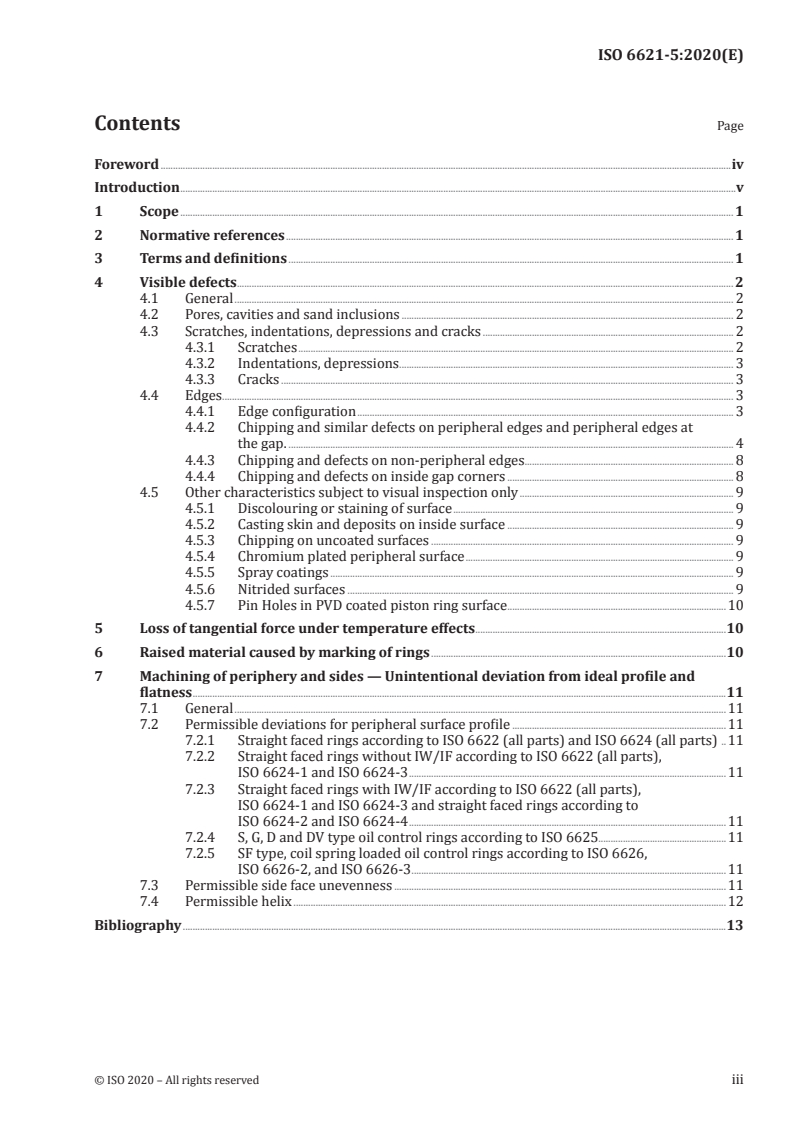
Contents Page
Foreword .iv
Introduction .v
1 Scope . 1
2 Normative references . 1
3 Terms and definitions . 1
4 Visible defects. 2
4.1 General . 2
4.2 Pores, cavities and sand inclusions . 2
4.3 Scratches, indentations, depressions and cracks . 2
4.3.1 Scratches . 2
4.3.2 Indentations, depressions . 3
4.3.3 Cracks . 3
4.4 Edges . 3
4.4.1 Edge configuration . 3
4.4.2 Chipping and similar defects on peripheral edges and peripheral edges at
the gap. . 4
4.4.3 Chipping and defects on non-peripheral edges. 8
4.4.4 Chipping and defects on inside gap corners . 8
4.5 Other characteristics subject to visual inspection only . 9
4.5.1 Discolouring or staining of surface . 9
4.5.2 Casting skin and deposits on inside surface . 9
4.5.3 Chipping on uncoated surfaces . 9
4.5.4 Chromium plated peripheral surface . 9
4.5.5 Spray coatings . 9
4.5.6 Nitrided surfaces . 9
4.5.7 Pin Holes in PVD coated piston ring surface .10
5 Loss of tangential force under temperature effects .10
6 Raised material caused by marking of rings .10
7 Machining of periphery and sides — Unintentional deviation from ideal profile and
flatness .11
7.1 General .11
7.2 Permissible deviations for peripheral surface profile .11
7.2.1 Straight faced rings according to ISO 6622 (all parts) and ISO 6624 (all parts) .11
7.2.2 Straight faced rings without IW/IF according to ISO 6622 (all parts),
ISO 6624-1 and ISO 6624-3 .11
7.2.3 Straight faced rings with IW/IF according to ISO 6622 (all parts),
ISO 6624-1 and ISO 6624-3 and straight faced rings according to
ISO 6624-2 and ISO 6624-4 .11
7.2.4 S, G, D and DV type oil control rings according to ISO 6625.11
7.2.5 SF type, coil spring loaded oil control rings according to ISO 6626,
ISO 6626-2, and ISO 6626-3 .11
7.3 Permissible side face unevenness .11
7.4 Permissible helix .12
Bibliography .13
Foreword
ISO (the International Organization for Standardization) is a worldwide federation of national standards
bodies (ISO member bodies). The work of preparing International Standards is normally carried out
through ISO technical committees. Each member body interested in a subject for which a technical
committee has been established has the right to be represented on that committee. International
organizations, governmental and non-governmental, in liaison with ISO, also take part in the work.
ISO collaborates closely with the International Electrotechnical Commission (IEC) on all matters of
electrotechnical standardization.
The procedures used to develop this document and those intended for its further maintenance are
described in the ISO/IEC Directives, Part 1. In particular, the different approval criteria needed for the
different types of ISO documents should be noted. This document was drafted in accordance with the
editorial rules of the ISO/IEC Directives, Part 2 (see www .iso .org/ directives).
Attention is drawn to the possibility that some of the elements of this document may be the subject of
patent rights. ISO shall not be held responsible for identifying any or all such patent rights. Details of
any patent rights identified during the development of the document will be in the Introduction and/or
on the ISO list of patent declarations received (see www .iso .org/ patents).
Any trade name used in this document is information given for the convenience of users and does not
constitute an endorsement.
For an explanation of the voluntary nature of standards, the meaning of ISO specific terms and
expressions related to conformity assessment, as well as information about ISO's adherence to the
World Trade Organization (WTO) principles in the Technical Barriers to Trade (TBT) see www .iso .org/
iso/ foreword .html.
This document was prepared by Technical Committee ISO/TC 22, Road vehicles, Subcommittee SC 34,
Propulsion, powertrain and powertrain fluids.
This fourth edition cancels and replaces the third edition (ISO 6621-5:2013), which has been technically
revised.
The main changes compared to the previous edition are as follows:
— changed procedure for counting defects.
A list of all parts in the ISO 6621 series can be found on the ISO website.
Any feedback or questions on this document should be directed to the user’s national standards body. A
complete listing of these bodies can be found at www .iso .org/ members .html.
iv © ISO 2020 – All rights reserved
Introduction
This document is one of a number of series of International Standards dealing with piston rings for
reciprocating internal combustion engines.
The common features and dimensional tables presented in this document constitute a broad range
of variables, and the designer, in selecting a particular ring type, should bear in mind the conditions
under which it will be required to operate. The designer should also refer to the specifications and
requirements of ISO 6621-3 and ISO 6621-4 before completing his selection.
The difficulty of trying to define in absolute terms the quality attainable in normal commercial
manufacture of piston rings is well known. In this document, the commonly encountered aspects of
quality in terms of casting defects and other departures from ideal are quantified. Many minor defects
are clearly quite acceptable; other defects because of size or number are inadmissible.
INTERNATIONAL STANDARD ISO 6621-5:2020(E)
Internal combustion engines — Piston rings —
Part 5:
Quality requirements
1 Scope
This document specifies quality aspects that can be defined but that are not normally found on a
drawing specification.
It covers the following:
— single-piece piston rings of grey cast iron or steel;
— multi-piece piston rings (oil control rings) consisting of cast iron parts and spring components; and
— single-piece and multi-piece oil control rings of steel, i.e. oil control rings in the form of strip steel
components or steel segments (rails) with spring expander components.
In addition to specifying some of the limits of acceptance relating to inspection measuring principles
(covered by ISO 6621-2), this document also covers those features for which no recognized quantitative
measurement procedures exist and which are only checked visually with normal eyesight (glasses if
worn normally) and without magnification. Such features (superficial defects) are additional to the
standard tolerances of ring width, radial wall thickness and closed gap.
This document does not establish acceptable quality levels (AQL), it being left to manufacturer and
customer to decide the appropriate levels jointly. In this case, the recommendations of ISO 2859-1 are
followed.
This document specifies the quality requirements of piston rings for reciprocating internal combustion
engines for road vehicles and other applications. It is applicable to all such rings of a nominal diameter
from 30 mm up to and including 200 mm.
2 Normative references
The following documents are referred to in the text in such a way that some or all of their content
constitutes requirements of this document. For dated references, only the edition cited applies. For
undated references, the latest edition of the referenced document (including any amendments) applies.
ISO 6621-1, Internal combustion engines — Piston rings — Part 1: Vocabulary
3 Terms and definitions
For the purposes of this document, the terms and definitions given in ISO 6621-1 apply.
ISO and IEC maintain terminological databases for use in standardization at the following addresses:
— ISO Online browsing platform: available at https:// www .iso .org/ obp
— IEC Electropedia: available at http:// www .electropedia .org/
4 Visible defects
4.1 General
Visible defects are divided into two principle classes as described in 4.2 to 4.5.
The first class covers those defects frequently found in castings and includes such defects as porosity,
sand inclusions, cavities, etc.
The second class of defect covers mechanical abrasions which may occur during forming, machining or
handling of the rings, and includes scratches, dents, chipping, burrs and cracks.
Inspection of piston rings for such defects is generally carried out visually, without magnification, by
inspectors having normal eyesight, corrected if necessary.
It is not intended that every ring be rigorously inspected for size and distribution of defects, but rather
that the values given in the tables and text be used as a general guide. However, in case of doubt, the
values given should be used as the means of judging the quality of the rings.
4.2 Pores, cavities and sand inclusions
Such defects are permissible on uncoated surfaces and edges provided that the values given in Table 1
for size, number and spacing are not exceeded.
Table 1 — Permissible values of size, number and spacing of pores, cavities and sand inclusions
Dimensions in millimetres
Nominal Defect size Number of Spacing of
c
diameter defects per ring defects
max.
d max. min.
on on other on on other
a b
peripheral surfaces peripheral edges
a
surface edges
30 ≤ d < 60 0,1 0,3 0,1 0,1 2 4
60 ≤ d < 100 0,15 0,5 0,1 0,2 4 4
100 ≤ d < 150 0,2 0,5 0,1 0,3 6 8
150 ≤ d ≤ 200 0,2 0,8 0,1 0,4 8 8
a
The defects should not be closer to an edge than one-half of the maximum permissible size of the defect, with a
minimum of 0,2 mm.
b
Does not apply to inside gap edges of piston rings with internal notch.
c
Spacing includes defects on adjacent or opposite surfaces.
4.3 Scratches, indentations, depressions and cracks
4.3.1 Scratches
Isolated scratches are permissible provided that:
— no burrs are produced exceeding the permissible values given in 4.4.1.1;
— on turned peripheral surfaces, they are not deeper than the tool marks;
— on non-turned peripheral surfaces, they are not deeper than 0,004 mm;
— on the side faces, they are not deeper than 0,01 mm; and
— on other surfaces, they are not deeper than 0,06 mm.
2 © ISO 2020 – All rights reserved
4.3.2 Indentations, depressions
Indentations and depressions are permissible provided that:
— the values given in Table 1 for number and spacing of defects are met;
— no burrs are produced exceeding the permissible values given in 4.4.1.1; and
— they do not exceed the values for size and depth given in Table 2.
Rings of a plated/coated/nitrided type shall not have indentations or depressions on the periphery.
NOTE Indentations arising from hardness measurements on the side faces are acceptable provided that they
do not exceed the limits given in Tables 2 and 11.
4.3.3 Cracks
No cracks are permissible in the base material.
See also 4.5.4 for chromium-plated peripheral surfaces and 4.5.6 for nitrided surfaces.
Table 2 — Permissible size of indentations and depressions
Dimensions in millimetres
Nominal diameter Defect size Depth
d max. max.
on peripheral surface on side face
30 ≤ d < 100 0,3 0,6
1 10 % of corresponding max.
defect size
100 ≤ d ≤ 200 0,5 1
4.4 Edges
4.4.1 Edge configuration
All edges of the piston ring shall be sharp; ideally, they should be free from burrs and from ragged edges,
whether arising from crumbling of material or from deburring. Such conditions are almost impossible
to achieve regularly in volume production and hence both burrs and removal of edge material is
permitted up to the maximum sizes given in 4.4.1.1 and 4.4.1.2.
4.4.1.1 Burrs
Burrs are permitted up to the maximum values given in Table 3. The orientation and direction of burrs
shall relate to the functional surfaces of the piston ring; any burr present should point in the direction
of sliding motion of the ring and not normal to the direction of sliding.
Any burrs r
...
INTERNATIONAL ISO
STANDARD 6621-5
Fourth edition
2020-01
Internal combustion engines —
Piston rings —
Part 5:
Quality requirements
Moteurs à combustion interne — Segments de piston —
Partie 5: Exigences de qualité
Reference number
©
ISO 2020
© ISO 2020
All rights reserved. Unless otherwise specified, or required in the context of its implementation, no part of this publication may
be reproduced or utilized otherwise in any form or by any means, electronic or mechanical, including photocopying, or posting
on the internet or an intranet, without prior written permission. Permission can be requested from either ISO at the address
below or ISO’s member body in the country of the requester.
ISO copyright office
CP 401 • Ch. de Blandonnet 8
CH-1214 Vernier, Geneva
Phone: +41 22 749 01 11
Fax: +41 22 749 09 47
Email: copyright@iso.org
Website: www.iso.org
Published in Switzerland
ii © ISO 2020 – All rights reserved
Contents Page
Foreword .iv
Introduction .v
1 Scope . 1
2 Normative references . 1
3 Terms and definitions . 1
4 Visible defects. 2
4.1 General . 2
4.2 Pores, cavities and sand inclusions . 2
4.3 Scratches, indentations, depressions and cracks . 2
4.3.1 Scratches . 2
4.3.2 Indentations, depressions . 3
4.3.3 Cracks . 3
4.4 Edges . 3
4.4.1 Edge configuration . 3
4.4.2 Chipping and similar defects on peripheral edges and peripheral edges at
the gap. . 4
4.4.3 Chipping and defects on non-peripheral edges. 8
4.4.4 Chipping and defects on inside gap corners . 8
4.5 Other characteristics subject to visual inspection only . 9
4.5.1 Discolouring or staining of surface . 9
4.5.2 Casting skin and deposits on inside surface . 9
4.5.3 Chipping on uncoated surfaces . 9
4.5.4 Chromium plated peripheral surface . 9
4.5.5 Spray coatings . 9
4.5.6 Nitrided surfaces . 9
4.5.7 Pin Holes in PVD coated piston ring surface .10
5 Loss of tangential force under temperature effects .10
6 Raised material caused by marking of rings .10
7 Machining of periphery and sides — Unintentional deviation from ideal profile and
flatness .11
7.1 General .11
7.2 Permissible deviations for peripheral surface profile .11
7.2.1 Straight faced rings according to ISO 6622 (all parts) and ISO 6624 (all parts) .11
7.2.2 Straight faced rings without IW/IF according to ISO 6622 (all parts),
ISO 6624-1 and ISO 6624-3 .11
7.2.3 Straight faced rings with IW/IF according to ISO 6622 (all parts),
ISO 6624-1 and ISO 6624-3 and straight faced rings according to
ISO 6624-2 and ISO 6624-4 .11
7.2.4 S, G, D and DV type oil control rings according to ISO 6625.11
7.2.5 SF type, coil spring loaded oil control rings according to ISO 6626,
ISO 6626-2, and ISO 6626-3 .11
7.3 Permissible side face unevenness .11
7.4 Permissible helix .12
Bibliography .13
Foreword
ISO (the International Organization for Standardization) is a worldwide federation of national standards
bodies (ISO member bodies). The work of preparing International Standards is normally carried out
through ISO technical committees. Each member body interested in a subject for which a technical
committee has been established has the right to be represented on that committee. International
organizations, governmental and non-governmental, in liaison with ISO, also take part in the work.
ISO collaborates closely with the International Electrotechnical Commission (IEC) on all matters of
electrotechnical standardization.
The procedures used to develop this document and those intended for its further maintenance are
described in the ISO/IEC Directives, Part 1. In particular, the different approval criteria needed for the
different types of ISO documents should be noted. This document was drafted in accordance with the
editorial rules of the ISO/IEC Directives, Part 2 (see www .iso .org/ directives).
Attention is drawn to the possibility that some of the elements of this document may be the subject of
patent rights. ISO shall not be held responsible for identifying any or all such patent rights. Details of
any patent rights identified during the development of the document will be in the Introduction and/or
on the ISO list of patent declarations received (see www .iso .org/ patents).
Any trade name used in this document is information given for the convenience of users and does not
constitute an endorsement.
For an explanation of the voluntary nature of standards, the meaning of ISO specific terms and
expressions related to conformity assessment, as well as information about ISO's adherence to the
World Trade Organization (WTO) principles in the Technical Barriers to Trade (TBT) see www .iso .org/
iso/ foreword .html.
This document was prepared by Technical Committee ISO/TC 22, Road vehicles, Subcommittee SC 34,
Propulsion, powertrain and powertrain fluids.
This fourth edition cancels and replaces the third edition (ISO 6621-5:2013), which has been technically
revised.
The main changes compared to the previous edition are as follows:
— changed procedure for counting defects.
A list of all parts in the ISO 6621 series can be found on the ISO website.
Any feedback or questions on this document should be directed to the user’s national standards body. A
complete listing of these bodies can be found at www .iso .org/ members .html.
iv © ISO 2020 – All rights reserved
Introduction
This document is one of a number of series of International Standards dealing with piston rings for
reciprocating internal combustion engines.
The common features and dimensional tables presented in this document constitute a broad range
of variables, and the designer, in selecting a particular ring type, should bear in mind the conditions
under which it will be required to operate. The designer should also refer to the specifications and
requirements of ISO 6621-3 and ISO 6621-4 before completing his selection.
The difficulty of trying to define in absolute terms the quality attainable in normal commercial
manufacture of piston rings is well known. In this document, the commonly encountered aspects of
quality in terms of casting defects and other departures from ideal are quantified. Many minor defects
are clearly quite acceptable; other defects because of size or number are inadmissible.
INTERNATIONAL STANDARD ISO 6621-5:2020(E)
Internal combustion engines — Piston rings —
Part 5:
Quality requirements
1 Scope
This document specifies quality aspects that can be defined but that are not normally found on a
drawing specification.
It covers the following:
— single-piece piston rings of grey cast iron or steel;
— multi-piece piston rings (oil control rings) consisting of cast iron parts and spring components; and
— single-piece and multi-piece oil control rings of steel, i.e. oil control rings in the form of strip steel
components or steel segments (rails) with spring expander components.
In addition to specifying some of the limits of acceptance relating to inspection measuring principles
(covered by ISO 6621-2), this document also covers those features for which no recognized quantitative
measurement procedures exist and which are only checked visually with normal eyesight (glasses if
worn normally) and without magnification. Such features (superficial defects) are additional to the
standard tolerances of ring width, radial wall thickness and closed gap.
This document does not establish acceptable quality levels (AQL), it being left to manufacturer and
customer to decide the appropriate levels jointly. In this case, the recommendations of ISO 2859-1 are
followed.
This document specifies the quality requirements of piston rings for reciprocating internal combustion
engines for road vehicles and other applications. It is applicable to all such rings of a nominal diameter
from 30 mm up to and including 200 mm.
2 Normative references
The following documents are referred to in the text in such a way that some or all of their content
constitutes requirements of this document. For dated references, only the edition cited applies. For
undated references, the latest edition of the referenced document (including any amendments) applies.
ISO 6621-1, Internal combustion engines — Piston rings — Part 1: Vocabulary
3 Terms and definitions
For the purposes of this document, the terms and definitions given in ISO 6621-1 apply.
ISO and IEC maintain terminological databases for use in standardization at the following addresses:
— ISO Online browsing platform: available at https:// www .iso .org/ obp
— IEC Electropedia: available at http:// www .electropedia .org/
4 Visible defects
4.1 General
Visible defects are divided into two principle classes as described in 4.2 to 4.5.
The first class covers those defects frequently found in castings and includes such defects as porosity,
sand inclusions, cavities, etc.
The second class of defect covers mechanical abrasions which may occur during forming, machining or
handling of the rings, and includes scratches, dents, chipping, burrs and cracks.
Inspection of piston rings for such defects is generally carried out visually, without magnification, by
inspectors having normal eyesight, corrected if necessary.
It is not intended that every ring be rigorously inspected for size and distribution of defects, but rather
that the values given in the tables and text be used as a general guide. However, in case of doubt, the
values given should be used as the means of judging the quality of the rings.
4.2 Pores, cavities and sand inclusions
Such defects are permissible on uncoated surfaces and edges provided that the values given in Table 1
for size, number and spacing are not exceeded.
Table 1 — Permissible values of size, number and spacing of pores, cavities and sand inclusions
Dimensions in millimetres
Nominal Defect size Number of Spacing of
c
diameter defects per ring defects
max.
d max. min.
on on other on on other
a b
peripheral surfaces peripheral edges
a
surface edges
30 ≤ d < 60 0,1 0,3 0,1 0,1 2 4
60 ≤ d < 100 0,15 0,5 0,1 0,2 4 4
100 ≤ d < 150 0,2 0,5 0,1 0,3 6 8
150 ≤ d ≤ 200 0,2 0,8 0,1 0,4 8 8
a
The defects should not be closer to an edge than one-half of the maximum permissible size of the defect, with a
minimum of 0,2 mm.
b
Does not apply to inside gap edges of piston rings with internal notch.
c
Spacing includes defects on adjacent or opposite surfaces.
4.3 Scratches, indentations, depressions and cracks
4.3.1 Scratches
Isolated scratches are permissible provided that:
— no burrs are produced exceeding the permissible values given in 4.4.1.1;
— on turned peripheral surfaces, they are not deeper than the tool marks;
— on non-turned peripheral surfaces, they are not deeper than 0,004 mm;
— on the side faces, they are not deeper than 0,01 mm; and
— on other surfaces, they are not deeper than 0,06 mm.
2 © ISO 2020 – All rights reserved
4.3.2 Indentations, depressions
Indentations and depressions are permissible provided that:
— the values given in Table 1 for number and spacing of defects are met;
— no burrs are produced exceeding the permissible values given in 4.4.1.1; and
— they do not exceed the values for size and depth given in Table 2.
Rings of a plated/coated/nitrided type shall not have indentations or depressions on the periphery.
NOTE Indentations arising from hardness measurements on the side faces are acceptable provided that they
do not exceed the limits given in Tables 2 and 11.
4.3.3 Cracks
No cracks are permissible in the base material.
See also 4.5.4 for chromium-plated peripheral surfaces and 4.5.6 for nitrided surfaces.
Table 2 — Permissible size of indentations and depressions
Dimensions in millimetres
Nominal diameter Defect size Depth
d max. max.
on peripheral surface on side face
30 ≤ d < 100 0,3 0,6
1 10 % of corresponding max.
defect size
100 ≤ d ≤ 200 0,5 1
4.4 Edges
4.4.1 Edge configuration
All edges of the piston ring shall be sharp; ideally, they should be free from burrs and from ragged edges,
whether arising from crumbling of material or from deburring. Such conditions are almost impossible
to achieve regularly in volume production and hence both burrs and removal of edge material is
permitted up to the maximum sizes given in 4.4.1.1 and 4.4.1.2.
4.4.1.1 Burrs
Burrs are permitted up to the maximum values given in Table 3. The orientation and direction of burrs
shall relate to the functional surfaces of the piston ring; any burr present should point in the direction
of sliding motion of the ring and not normal to the direction of sliding.
Any burrs r
...