

ISO 6626-1:2024
(Main)Internal combustion engines — Piston rings — Part 1: Coil spring loaded oil control rings made of cast iron
General Information
- Abstract
This document specifies the essential dimensional features of coil-spring loaded oil control rings made of cast iron, types DSF-C, DSF-CNP, SSF, GSF, DSF, DSF-NG and SSF-L. It is applicable to piston rings in sizes from 60 mm up to and including 200 mm for reciprocating internal combustion engines for road vehicles and other applications.
- Status
- Published
- Publication Date
- 21-Jul-2024
- Technical Committee
- ISO/TC 22/SC 34 - Propulsion, powertrain and powertrain fluids
- Drafting Committee
- ISO/TC 22/SC 34/WG 4 - Piston rings
- Current Stage
- 6060 - International Standard published
- Start Date
- 22-Jul-2024
- Due Date
- 18-Nov-2024
- Completion Date
- 22-Jul-2024

Overview - ISO 6626-1:2024 (Piston rings, Part 1)
ISO 6626-1:2024 specifies the essential dimensional features and related requirements for coil‑spring loaded oil control piston rings made of cast iron. It covers the common ring types (DSF‑C, DSF‑CNP, SSF, GSF, DSF, DSF‑NG and SSF‑L) for reciprocating internal combustion engines used in road vehicles and other applications. The standard applies to ring diameters from 60 mm to 200 mm and addresses typical axial widths (3 mm–8 mm, with specific tables for 4.75 mm / 3/16 in).
Key SEO keywords: ISO 6626-1:2024, piston rings, coil spring loaded oil control rings, cast iron piston rings, oil control ring dimensions.
Key technical topics and requirements
- Types and designations: Defines cross‑sectional types (DSF‑C, DSF‑CNP, SSF, GSF, DSF, DSF‑NG, SSF‑L) and example designation formats.
- Dimensional tables and figures: Comprehensive tables (Tables 8–25) and figures (1–11) specifying geometry, ring widths, land widths and reference planes.
- Materials: Recommends cast iron material classes (Class 10 per ISO 6621‑3 as baseline; Classes 20–50 for special uses).
- Coil spring features: Essential coil spring geometry, latch pin locations, excursion (extended gap), material and fixing methods (Figures 12–16).
- Oil drainage: Slot and hole arrangements, lengths, diameters and numbers to control oil evacuation from the cylinder wall.
- Surface treatments: Chromium plating details for types DSF‑C and DSF‑CNP, including plating thickness and peripheral edge treatment at ring gaps.
- Contact mechanics: Tangential force, normalized tangential force, and nominal contact pressure classes (historical classes moved to Annex A); specified tolerances and force factors.
- Common features: Spring groove and land offsets, assembly and gap management (selected closed gap examples appear).
Practical applications and typical users
Who uses ISO 6626-1:2024:
- Engine designers specifying oil control ring geometry for new engines
- Piston ring manufacturers and suppliers ensuring interchangeability and compliance
- OEMs and Tier‑1 suppliers validating component tolerances and surface finishes
- Quality engineers and test labs performing dimensional and force verification
- Aftermarket and remanufacturing operations matching replacement ring specifications
Practical benefits:
- Ensures consistent oil control performance and reduced oil consumption
- Facilitates interchangeability across suppliers and engine platforms
- Provides clear bases for specifying plating, spring forces and drainage features
Related standards
- ISO 6621‑1 (Piston rings - Vocabulary)
- ISO 6621‑4 (Piston rings - General specifications)
- Other parts of the ISO 6626 series and the broader ISO 6621–6627 piston ring family
For designers and manufacturers working with cast iron coil‑spring oil control rings, ISO 6626‑1:2024 is a primary reference for dimensional conformity, spring specification, plating requirements and oil drainage design.
Relations
- Revises
ISO 6626:1989 - Internal combustion engines — Piston rings — Coil-spring-loaded oil control rings - Effective Date
- 26-Nov-2021
Get Certified
Connect with accredited certification bodies for this standard

TÜV Rheinland
TÜV Rheinland is a leading international provider of technical services.

TÜV SÜD
TÜV SÜD is a trusted partner of choice for safety, security and sustainability solutions.

DEKRA Certification Inc.
DEKRA US certification services.
Sponsored listings
Frequently Asked Questions
ISO 6626-1:2024 is a standard published by the International Organization for Standardization (ISO). Its full title is "Internal combustion engines — Piston rings — Part 1: Coil spring loaded oil control rings made of cast iron". This standard covers: This document specifies the essential dimensional features of coil-spring loaded oil control rings made of cast iron, types DSF-C, DSF-CNP, SSF, GSF, DSF, DSF-NG and SSF-L. It is applicable to piston rings in sizes from 60 mm up to and including 200 mm for reciprocating internal combustion engines for road vehicles and other applications.
This document specifies the essential dimensional features of coil-spring loaded oil control rings made of cast iron, types DSF-C, DSF-CNP, SSF, GSF, DSF, DSF-NG and SSF-L. It is applicable to piston rings in sizes from 60 mm up to and including 200 mm for reciprocating internal combustion engines for road vehicles and other applications.
ISO 6626-1:2024 is classified under the following ICS (International Classification for Standards) categories: 43.060.10 - Engine block and internal components. The ICS classification helps identify the subject area and facilitates finding related standards.
ISO 6626-1:2024 has the following relationships with other standards: It is inter standard links to ISO 6626:1989. Understanding these relationships helps ensure you are using the most current and applicable version of the standard.
ISO 6626-1:2024 is available in PDF format for immediate download after purchase. The document can be added to your cart and obtained through the secure checkout process. Digital delivery ensures instant access to the complete standard document.
Standards Content (Sample)
International
Standard
ISO 6626-1
First edition
Internal combustion engines —
2024-07
Piston rings —
Part 1:
Coil spring loaded oil control rings
made of cast iron
Moteurs à combustion interne — Segments de piston —
Partie 1: Anneaux de contrôle de l'huile à ressort hélicoïdal en fonte
Reference number
© ISO 2024
All rights reserved. Unless otherwise specified, or required in the context of its implementation, no part of this publication may
be reproduced or utilized otherwise in any form or by any means, electronic or mechanical, including photocopying, or posting on
the internet or an intranet, without prior written permission. Permission can be requested from either ISO at the address below
or ISO’s member body in the country of the requester.
ISO copyright office
CP 401 • Ch. de Blandonnet 8
CH-1214 Vernier, Geneva
Phone: +41 22 749 01 11
Email: copyright@iso.org
Website: www.iso.org
Published in Switzerland
ii
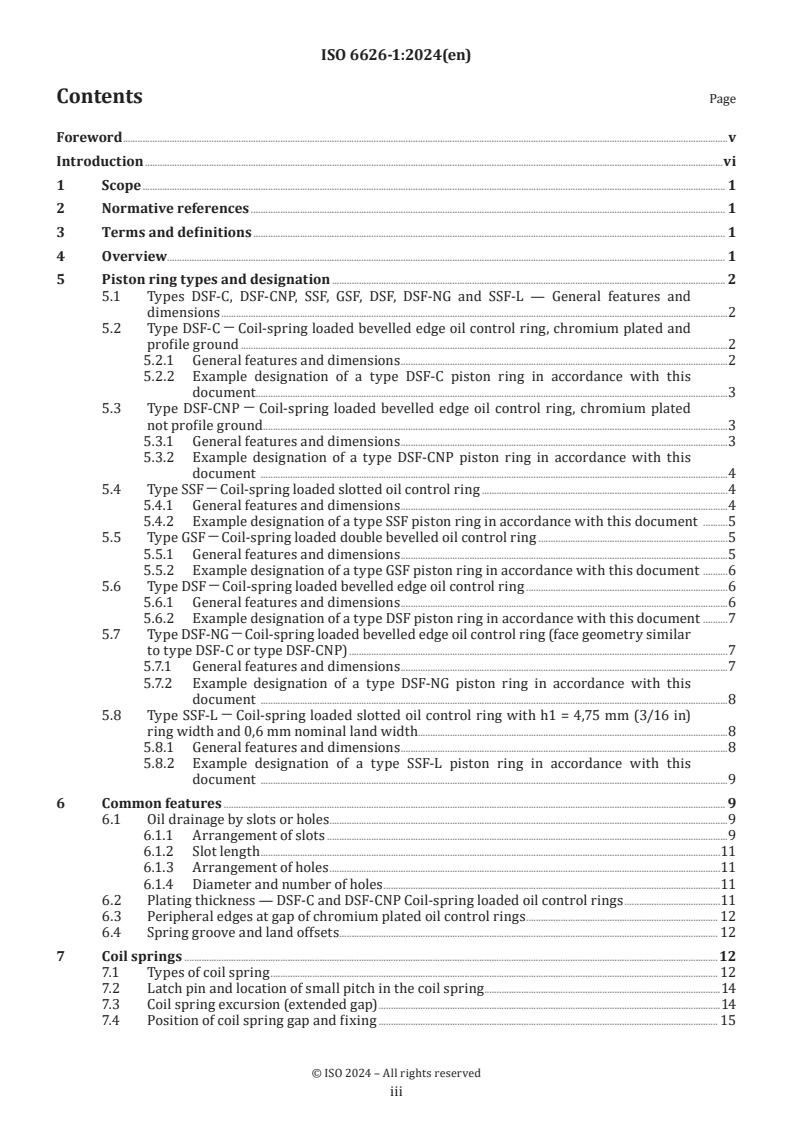
Contents Page
Foreword .v
Introduction .vi
1 Scope . 1
2 Normative references . 1
3 Terms and definitions . 1
4 Overview . 1
5 Piston ring types and designation . 2
5.1 Types DSF-C, DSF-CNP, SSF, GSF, DSF, DSF-NG and SSF-L — General features and
dimensions .2
5.2 Type DSF-C ─ Coil-spring loaded bevelled edge oil control ring, chromium plated and
profile ground .2
5.2.1 General features and dimensions .2
5.2.2 Example designation of a type DSF-C piston ring in accordance with this
document .3
5.3 Type DSF-CNP ─ Coil-spring loaded bevelled edge oil control ring, chromium plated
not profile ground .3
5.3.1 General features and dimensions .3
5.3.2 Example designation of a type DSF-CNP piston ring in accordance with this
document .4
5.4 Type SSF ─ Coil-spring loaded slotted oil control ring .4
5.4.1 General features and dimensions .4
5.4.2 Example designation of a type SSF piston ring in accordance with this document .5
5.5 Type GSF ─ Coil-spring loaded double bevelled oil control ring .5
5.5.1 General features and dimensions .5
5.5.2 Example designation of a type GSF piston ring in accordance with this document .6
5.6 Type DSF ─ Coil-spring loaded bevelled edge oil control ring .6
5.6.1 General features and dimensions .6
5.6.2 Example designation of a type DSF piston ring in accordance with this document .7
5.7 Type DSF-NG ─ Coil-spring loaded bevelled edge oil control ring (face geometry similar
to type DSF-C or type DSF-CNP) .7
5.7.1 General features and dimensions .7
5.7.2 Example designation of a type DSF-NG piston ring in accordance with this
document .8
5.8 Type SSF-L ─ Coil-spring loaded slotted oil control ring with h1 = 4,75 mm (3/16 in)
ring width and 0,6 mm nominal land width.8
5.8.1 General features and dimensions .8
5.8.2 Example designation of a type SSF-L piston ring in accordance with this
document .9
6 Common features . 9
6.1 Oil drainage by slots or holes .9
6.1.1 Arrangement of slots .9
6.1.2 Slot length .11
6.1.3 Arrangement of holes .11
6.1.4 Diameter and number of holes .11
6.2 Plating thickness — DSF-C and DSF-CNP Coil-spring loaded oil control rings .11
6.3 Peripheral edges at gap of chromium plated oil control rings . 12
6.4 Spring groove and land offsets. 12
7 Coil springs .12
7.1 Types of coil spring . 12
7.2 Latch pin and location of small pitch in the coil spring .14
7.3 Coil spring excursion (extended gap) .14
7.4 Position of coil spring gap and fixing . 15
iii
7.5 Material . 15
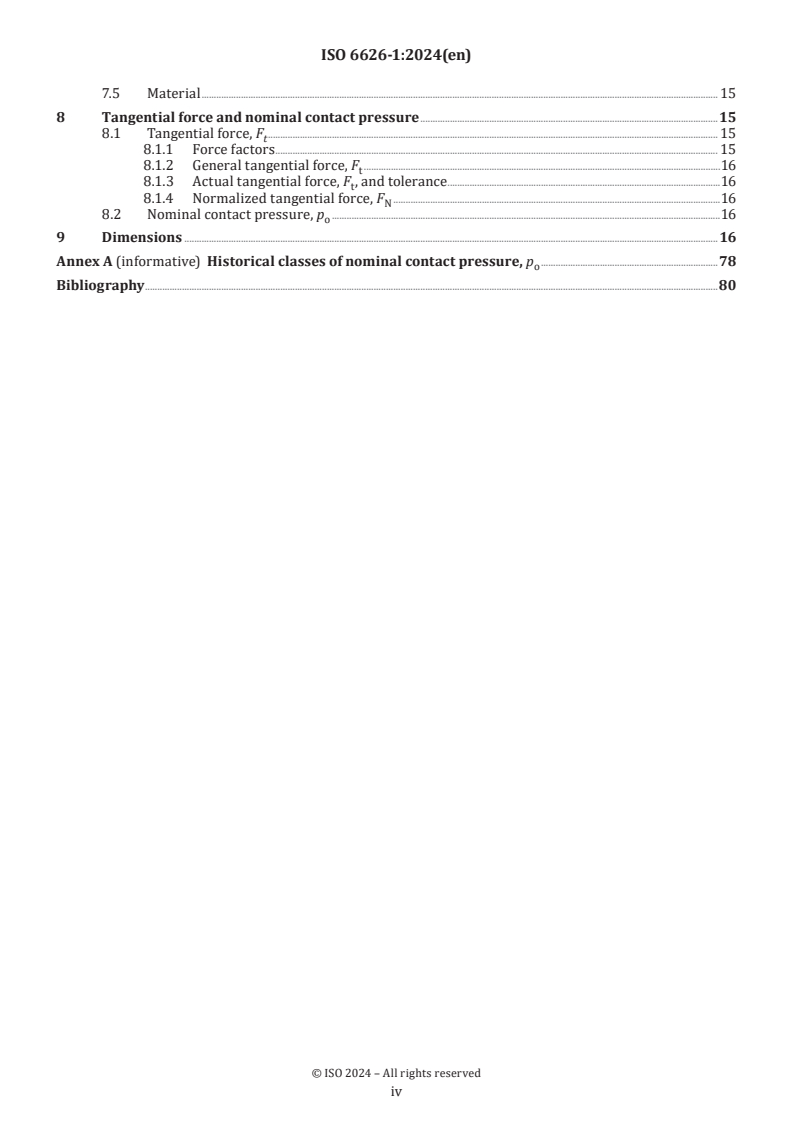
8 Tangential force and nominal contact pressure .15
8.1 Tangential force, F . 15
t
8.1.1 Force factors . 15
8.1.2 General tangential force, F .16
t
8.1.3 Actual tangential force, F , and tolerance .16
t
8.1.4 Normalized tangential force, F .16
N
8.2 Nominal contact pressure, p .16
o
9 Dimensions .16
Annex A (informative) Historical classes of nominal contact pressure, p .78
o
Bibliography .80
iv
Foreword
ISO (the International Organization for Standardization) is a worldwide federation of national standards
bodies (ISO member bodies). The work of preparing International Standards is normally carried out through
ISO technical committees. Each member body interested in a subject for which a technical committee
has been established has the right to be represented on that committee. International organizations,
governmental and non-governmental, in liaison with ISO, also take part in the work. ISO collaborates closely
with the International Electrotechnical Commission (IEC) on all matters of electrotechnical standardization.
The procedures used to develop this document and those intended for its further maintenance are described
in the ISO/IEC Directives, Part 1. In particular, the different approval criteria needed for the different types
of ISO documents should be noted. This document was drafted in accordance with the editorial rules of the
ISO/IEC Directives, Part 2 (see www.iso.org/directives).
ISO draws attention to the possibility that the implementation of this document may involve the use of (a)
patent(s). ISO takes no position concerning the evidence, validity or applicability of any claimed patent
rights in respect thereof. As of the date of publication of this document, ISO had not received notice of (a)
patent(s) which may be required to implement this document. However, implementers are cautioned that
this may not represent the latest information, which may be obtained from the patent database available at
www.iso.org/patents. ISO shall not be held responsible for identifying any or all such patent rights.
Any trade name used in this document is information given for the convenience of users and does not
constitute an endorsement.
For an explanation of the voluntary nature of standards, the meaning of ISO specific terms and expressions
related to conformity assessment, as well as information about ISO's adherence to the World Trade
Organization (WTO) principles in the Technical Barriers to Trade (TBT), see www.iso.org/iso/foreword.html.
This document was prepared by Technical Committee ISO/TC 22, Road vehicles, Subcommittee SC 34,
Propulsion, powertrain and powertrain fluids.
This first edition cancels and replaces ISO 6626:1989, which has been technically revised.
The main changes are as follows:
— classes of nominal contact pressure were moved to Annex A and the normalized tangential force was
introduced;
— verification and correction of figures;
— update of dimension Tables 8 to 25.
A list of all parts in the ISO 6626 series can be found on the ISO website.
Any feedback or questions on this document should be directed to the user’s national standards body. A
complete listing of these bodies can be found at www.iso.org/members.html.
v
Introduction
The ISO 6626 series is one of a set of International Standards dealing with piston rings for reciprocating
internal combustion engines. Others are the ISO 6621 series, ISO 6622, ISO 6623, ISO 6624, ISO 6625, the
ISO 6626 series, and ISO 6627.
The common features and dimensional tables presented in this document constitute a broad range of
variables. When selecting a particular ring type, the designer should bear in mind the conditions under
which it will be required to operate.
It is also important that the designer refer to the specifications and requirements of ISO 6621-3 and
ISO 6621-4 before completing selection.
vi
International Standard ISO 6626-1:2024(en)
Internal combustion engines — Piston rings —
Part 1:
Coil spring loaded oil control rings made of cast iron
1 Scope
This document specifies the essential dimensional features of coil-spring loaded oil control rings made of
cast iron, types DSF-C, DSF-CNP, SSF, GSF, DSF, DSF-NG and SSF-L. It is applicable to piston rings in sizes from
60 mm up to and including 200 mm for reciprocating internal combustion engines for road vehicles and
other applications.
2 Normative references
The following documents are referred to in the text in such a way that some or all their content constitutes
requirements of this document. For dated references, only the edition cited applies. For undated references,
the latest edition of the referenced document (including any amendments) applies.
ISO 6621-1, Internal combustion engines — Piston rings — Part 1: Vocabulary
ISO 6621-4, Internal combustion engines — Piston rings — Part 4: General specifications
3 Terms and definitions
For the purposes of this document, the terms and definitions given in ISO 6621-1 apply.
ISO and IEC maintain terminology databases for use in standardization at the following addresses:
— ISO Online browsing platform: available at https:// www .iso .org/ obp
— IEC Electropedia: available at https:// www .electropedia .org/
4 Overview
Coil-spring loaded oil control ring types are specified in Figures 1 to 8. Their common features and the
features' dimensions are specified in Tables 1 to 5 and shown in Figures 9 to 11. Essential features of coil
springs are shown in Figures 12 to 16. Table 7 specifies different classes of contact pressure. Tables 8 to 19
give the dimensions and forces of coil-spring loaded oil control rings.
The normal range for axial width of coil-spring loaded oil control rings (3 mm to 8 mm inclusive) is divided
into 0,5 mm or 1,0 mm increments. In Tables 20 to 25, dimensions are given for coil-spring loaded oil control
rings with an axial width of 4,75 mm (i.e. 3/16 inch) for existing applications in inch units.
For the cast iron part, the recommended material is Class 10 in accordance with ISO 6621-3. For special
applications, material Classes 20 to 50 may be used.
Variation from these in face design and spring groove may be used, as recommended by individual
manufacturers, in plain or chromed versions.
5 Piston ring types and designation
5.1 Types DSF-C, DSF-CNP, SSF, GSF, DSF, DSF-NG and SSF-L — General features and
dimensions
See Figure 1 and Tables 8 to 25. Figure 1 is applicable to Figures 2 to 8. Figures 2 to 8 show detailed cross
sections corresponding to Figure 1.
Figure 1 — Types DSF-C, DSF-CNP, SSF, GSF, DSF, DSF-NG and SSF-L
NOTE Gap chamfer s3 is for coated rings only.
5.2 Type DSF-C ─ Coil-spring loaded bevelled edge oil control ring, chromium plated and
profile ground
5.2.1 General features and dimensions
See Figure 2 and Tables 8, 9 and 20.
Dimensions in millimetres
Key
1 reference plane
a
See Table 3.
b
See Table 4.
c
See Table 5.
d
Angles α and β to be agreed between manufacturer and customer. Angles can be different (historical value is 35°).
Figure 2 — Type DSF-C
5.2.2 Example designation of a type DSF-C piston ring in accordance with this document
EXAMPLE Coil-spring loaded bevelled edge oil control ring, chromium plated and profile ground (DSF-C), of
nominal diameter d = 124 mm (124), nominal ring width h = 3,5 mm (3,5), a land width h =0,25 mm (0,25), made of
1 1 5
grey cast iron, non-heat treated, material subclass 11 (MC11), having a selected closed gap of 0,20 mm min. (S020), a
chromium layer thickness on the lands of 0,15 mm (CR3), phosphated on all cast iron surfaces to depth of 0,002 mm
min. (PO), reduced slot length (WK), a coil-spring with reduced heat set (WF), and a variable pitch with coil-diameter
d ground (CSE), with tangential force F in accordance with the nominal contact pressure of 1,5 N/mm (PN1,5) and
7 t
the ring marked with the manufacturer's mark (MM). Parameters in parenthesis are used in the ISO ring designation:
Piston ring ISO 6626-1 DSF-C - 124 × 3,5 × 0,25 - MC11 / S020 CR3 PO WK WF CSE PN1,5 MM
5.3 Type DSF-CNP ─ Coil-spring loaded bevelled edge oil control ring, chromium plated not
profile ground
5.3.1 General features and dimensions
See Figure 3 and Tables 10, 11 and 21.
Dimensions in millimetres
Key
1 reference plane
a
See Table 3.
b
See Table 4.
c
See Table 5.
d
Angles α and β to be agreed between manufacturer and customer. Angles can be different (historical value is 35°).
e
Before plating.
Figure 3 — Type DSF-CNP
5.3.2 Example designation of a type DSF-CNP piston ring in accordance with this document
EXAMPLE Coil-spring loaded bevelled edge oil control ring, chromium plated, not profile ground (DSF-CNP) of
nominal diameter d = 100 mm (100), nominal ring width h = 4,0 mm (4,0), a land width h =0,40 mm (0,40), made of
1 1 5
grey cast iron, non-heat treated, material subclass 12 (MC12), constant spring pitch (CSN) and tangential force F in
t
accordance with the nominal contact pressure of P0=1,0 N/mm (PN1,0). Parameters in parenthesis are used in the
ISO ring designation:
Piston ring ISO 6626-1 DSF-CNP - 100 × 4 × 0,40 - MC12 / CSN PN1,0
5.4 Type SSF ─ Coil-spring loaded slotted oil control ring
5.4.1 General features and dimensions
See Figure 4 and Table 12, 13 and 22.
Dimensions in millimetres
Key
1 reference plane
a
See Table 4.
b
See Table 5.
Figure 4 — Type SSF
5.4.2 Example designation of a type SSF piston ring in accordance with this document
EXAMPLE Coil-spring loaded slotted oil control ring with rectangular groove (SSF) of nominal diameter
d = 80 mm (80), nominal ring width h = 4 mm (4,0), a land width h =0,70 mm (0,70),made of grey cast iron, non-
1 1 5
heat treated, material subclass 12 (MC12), constant spring pitch (CSN) and tangential force F in accordance with the
t
nominal contact pressure of P0=1,0 N/mm (PN1,0). Parameters in parenthesis are used in the ISO ring designation:
Piston ring ISO 6626-1 SSF- 80 × 4,0 × 0,70 - MC12 / CSN PN1,0
5.5 Type GSF ─ Coil-spring loaded double bevelled oil control ring
5.5.1 General features and dimensions
See Figure 5 and Tables 14, 15 and 23. Top side marking is mandatory and shall be performed in accordance
with ISO 6621-4.
Dimensions in millimetres
Key
1 reference plane
2 top side identification mark
a
See Table 4.
b
See Table 5.
Figure 5 — Type GSF
5.5.2 Example designation of a type GSF piston ring in accordance with this document
EXAMPLE Coil-spring loaded double bevelled oil control ring (GSF) of nominal diameter d = 75 mm (75), nominal
ring width h = 3,5 mm (3,5), a land width h =0,35 mm (0,35), made of grey cast iron, non-heat treated, material
1 5
subclass 12 (MC12), with constant spring pitch (CSN) and tangential force F in accordance with the nominal contact
t
pressure of P0=1,0 N/mm (PN1,0). Parameters in parenthesis are used in the ISO ring designation:
Piston ring ISO 6626-1 GSF- 75 × 3,5 × 0,35 - MC12 / CSN PN1,0
5.6 Type DSF ─ Coil-spring loaded bevelled edge oil control ring
5.6.1 General features and dimensions
See Figure 6 and Tables 14, 15 and 23.
Dimensions in millimetres
Key
1 reference plane
a
See Table 4.
b
See Table 5.
Figure 6 — Type DSF
5.6.2 Example designation of a type DSF piston ring in accordance with this document
EXAMPLE Coil-spring loaded bevelled edge oil control ring (DSF) of nominal diameter d = 90 mm (90), nominal
ring width h = 3,5 mm (3,5), a land width h =0,35 mm (0,35), made of grey cast iron, non-heat treated, material
1 5
subclass 12 (MC12), with constant spring pitch (CSN) and tangential force F in accordance with the nominal contact
t
pressure of P0=1,0 N/mm (PN1,0). Parameters in parenthesis are used in the ISO ring designation:
Piston ring ISO 6626-1 DSF- 90 × 3,5 × 0,35 - MC12 / CSN PN1,0
5.7 Type DSF-NG ─ Coil-spring loaded bevelled edge oil control ring (face geometry similar
to type DSF-C or type DSF-CNP)
5.7.1 General features and dimensions
See Figure 7 and Tables 16, 17 and 24.
Dimensions in millimetres
Key
1 reference plane
a
See Table 4.
b
See Table 5.
c
Angles α and β to be agreed between manufacturer and customer. Angles can be different (historical value is 35°).
Figure 7 — Type DSF-NG
5.7.2 Example designation of a type DSF-NG piston ring in accordance with this document
EXAMPLE Coil-spring loaded bevelled edge oil control ring (DSF-NG, face geometry similar to type DSF-C or type
DSF-CNP) of nominal diameter d = 140 mm (140), nominal ring width h = 4,5 mm (4,5), a land width h =0,40 mm
1 1 5
(0,40), made of grey cast iron, non-heat treated, material subclass 12 (MC12), constant spring pitch (CSN) and
tangential force F in accordance with the nominal contact pressure of P0=1,0 N/mm (PN1,0). Parameters in
t
parenthesis are used in the ISO ring designation:
Piston ring ISO 6626-1 DSF-NG - 140 × 4,5 × 0,40 - MC12 / CSN PN1,0
5.8 Type SSF-L ─ Coil-spring loaded slotted oil control ring with h1 = 4,75 mm (3/16 in)
ring width and 0,6 mm nominal land width
5.8.1 General features and dimensions
See Figure 8 and Tables 18, 19 and 25.
Dimensions in millimetres
Key
1 reference plane
a
See Table 4.
b
See Table 5.
c
Angles α and β to be agreed between manufacturer and customer. Angles can be different (historical value is 35°).
Figure 8 — Type SSF-L
5.8.2 Example designation of a type SSF-L piston ring in accordance with this document
EXAMPLE Coil-spring loaded slotted oil control ring with rectangular groove at periphery and V-shaped groove
beneath (SSF-L) of nominal diameter d = 80 mm (80), nominal ring width h = 4,75 mm (4,75), made of grey cast
1 1
iron, non-heat treated, material subclass 12 (MC12), constant spring pitch (CSN) and tangential force F in accordance
t
with the nominal contact pressure of P0=1,0 N/mm (PN1,0). Parameters in parenthesis are used in the ISO ring
designation:
Piston ring ISO 6626-1 SSF-L - 80 × 4,75 - MC12 / CSN PN1,0
6 Common features
6.1 Oil drainage by slots or holes
6.1.1 Arrangement of slots
Figure 9 shows the arrangement of oil drainage slots and Table 1 gives the cutter diameter.
a) 8 slots for 60 mm ≤ d < 80 mm b) 10 slots for 80 mm ≤ d < 115 mm
1 1
c) 12 slots for 115 mm ≤ d < 150 mm d) 14 slots for 150 mm ≤ d ≤ 200 mm
1 1
Figure 9 — Arrangement of slots
Table 1 — Cutter diameter
Dimensions in millimeters
Cutter diameter
Nominal diameter
d
d
max.
60 ≤ d < 150 60
150 ≤ d ≤ 200 75
6.1.2 Slot length
6.1.2.1 Standard slot length
Slot length, w , shall be equal to bridge length, w .
1 2
The maximum difference between w and w shall be 4 mm.
1 2
6.1.2.2 Reduced slot length — Code WK
Oil control rings with reduced slot length will retain the same number of slots and the same angular spacing.
The maximum difference between w and w for the standard slot length does not apply.
1 2
See Table 2.
Table 2 — Reduced slot length
Dimensions in millimeters
d w (range of nominal values)
1 1
60 ≤ d < 80 6 . 11
80 ≤ d < 115 8 . 13
115 ≤ d < 150 10 . 15
150 ≤ d ≤ 200 12 . 18
6.1.3 Arrangement of holes
Arrangement of holes is shown in Figure 10. Deviating arrangements shall be agreed between manufacturer
and customer.
Figure 10 — Arrangement of holes
6.1.4 Diameter and number of holes
The diameter, d , and number, n, of holes shall be agreed between manufacturer and customer.
6.2 Plating thickness — DSF-C and DSF-CNP Coil-spring loaded oil control rings
See Figure 11 and Table 3.
Figure 11 — Plating thickness
Table 3 — Plating thickness
Dimensions in millimeters
a
Thickness
Code
min.
CR1 0,05
CR2 0,10
CR3 0,15
a
For plating thickness tolerances, see ISO 6621-4.
6.3 Peripheral edges at gap of chromium plated oil control rings
For features and their dimensions, see ISO 6621-4.
6.4 Spring groove and land offsets
See Figures 2 to 8 and Tables 4 and 5.
Table 4 — Permitted land offset
Dimensions in millimetres
Ring width
t
h
3 ≤ h < 5 0,015
5 ≤ h ≤ 8 0,025
Table 5 — Permitted spring groove offset
Dimensions in millimetres
Ring width
v
h
h < 3,5 0,3
h ≥ 3,5 0,4
7 Coil springs
7.1 Types of coil spring
All values in the dimensional tables of Clause 9 are based on cylindrical coil-springs made of round wire.
The three designs shown in Figures 12 to 14 are common. The use of different spring designs may be agreed
between manufacturer and customer. Changed spring groove configurations and dimensions can then be
necessary.
Figure 12 — Type CSN coil spring with constant pitch
Key
1 approximately 0,8 × d
Figure 13 — Type CSG coil spring with constant pitch (coil diameter, d , ground)
Key
1 approximately 0,8 × d
Figure 14 — Type CSE coil spring with variable pitch (coil diameter, d , ground)
7.2 Latch pin and location of small pitch in the coil spring
Figure 15 illustrates the location of the small pitch area of the coil spring relative to the spring gap.
Dimensions in millimeters
Key
1 spring gap
2 area with small pitch
a
Latch pin free length.
b
Latch pin fixed length.
Figure 15 — Position of area with small pitch
7.3 Coil spring excursion (extended gap)
Coil spring excursion, f , is the distance between the ends of the ring gap, with unstressed ring, measured in
the middle of the spring groove (see Figure 16). The maximum value of f is given in Table 6.
Figure 16 — Coil spring excursion
Table 6 — Coil spring excursion
Dimensions in millimeters
Nominal diameter f
d max.
60 ≤ d < 125 0,13 x d
1 1
125 ≤ d ≤ 200 0,12 x d
1 1
7.4 Position of coil spring gap and fixing
The spring gap shall be approximately 180° from the gap and the spring gap ends fixed with a connecting or
latch pin.
7.5 Material
Coil springs are made of materials as shown in ISO 6621-3, subclasses MC62 (valve spring wire), MC64
(Chromium-Silicon steel), MC67 (stainless steel) and MC68 (piano wire).
Springs are available with two different heat set resistance levels (loss of tangential force under load and
temperature):
— standard heat resistance;
— reduced heat set, code WF.
For test conditions and the permissible loss of tangential forces, see ISO 6621-5.
8 Tangential force and nominal contact pressure
8.1 Tangential force, F
t
The tangential force, F , of coil-spring loaded oil control rings is mainly determined by the force of the
t
spring. The cast iron part itself has a very small tangential force due to its low radial wall thickness and the
decreased ratio “total free gap/nominal diameter”.
Only the tangential force measurement method can be used because of the flexible design of the cast iron
part of the coil-spring loaded oil control rings.
8.1.1 Force factors
Because of the small contribution of the cast iron part in the tangential force, force factors are not necessary
when additional features, materials, or both (other than grey cast iron with modulus of elasticity of 100 GN/
2)
m are being used.
8.1.2 General tangential force, F
t
The tangential force, F , of a spring loaded oil control ring is determined by:
t
a) nominal diameter, d , in millimetres,
b) land width, h , in millimeters,
c) required nominal contact pressure, p , in N/mm , calculated using the formula:
o
Fd= ··2··hp
t 15 0
The land width, h , depends on the ring type, nominal diameter, and ring width. Recommended values
for land width, h , are mentioned for every ring type in Clause 9. Other values may be agreed between
manufacturer and customer.
8.1.3 Actual tangential force, F , and tolerance
t
The actual tangential force of a spring-loaded oil control ring can be calculated with the tabulated normalized
tangential force, F /d , given in Table 7, according to the required nominal contact pressure, p , using the
t 1 0
formula:
FF=()·d
tN 1
The tolerance on F is the actual value F ±20 %. Actual values of tangential force shall be rounded up or
t t
down in accordance with ISO 6621-4.
8.1.4 Normalized tangential force, F
N
The normalized tangential forces, F (=F /d ), for different nominal contact pressure, p , are given in Table 7.
N t 1 0
Table 7 — Normalized tangential forces, F
N
P
O
Code 0,2 0,25 0,28 0,30 0,35 0,40 0,50 0,60 0,70 0,80 0,90 1,10 1,30 1,60
[N/mm ]
PN2,5 2,5 0,50 0,63 0,70 0,75 0,88 1,00 1,25 1,50 1,75 2,00 2,25 2,75 3,25 4,00
PN2,0 2,0 0,40 0,50 0,56 0,60 0,70 0,80 1,00 1,20 1,40 1,60 1,80 2,20 2,60 3,20
PN1,5 1,5 0,30 0,38 0,42 0,45 0,53 0,60 0,75 0,90 1,05 1,20 1,35 1,65 1,95 2,40
PN1,0 1,0 0,20 0,25 0,28 0,30 0,35 0,40 0,50 0,60 0,70 0,80 0,90 1,10 1,30 1,60
PN0,5 0,5 0,10 0,13 0,14 0,15 0,18 0,20 0,25 0,30 0,35 0,40 0,45 0,55 0,65 0,80
8.2 Nominal contact pressure, p
o
New contact pressure classes are introduced and have replaced the classes of nominal contact pressure used
in ISO 6626:1989, which are shown in Annex A for reference.
The nominal contact pressure, p , must be chosen to suit the application and requirements regarding oil
o
consumption and friction losses. The range of the usual nominal contact pressure, p , is given in Table 7.
o
Varying values may be agreed between manufacturer and customer.
9 Dimensions
The dimensions are shown in Tables 8 to 25. Land spacing B shall be agreed between manufacturer and
customer.
Table 8 — Width dimensions of DSF-C oil control rings
Dimensions in millimeters
Radial thickness over
coil spring
Radial wall thickness
Ring width Land width
a h h
a
Nominal 12 1 Closed 5
Tolerance
diameter gap
for h for h
1 1
column for all h
shown in column shown in column
Recommended
d 1 2 3 4 1 2 3 4 Tolerance s 1 2 3 4 Tolerance
1 1
range
−0,010
−0,030
3,5 3,5 3,7 For
±0,15
0,2
0 0 0 phosphated 0,20−0,4
60 ≤ d within a
− − 3 3,5 4 +0,2 − 2,4 2,4 2,5
< 65
− − − PO ±0,07
ring
0,15 max.
0,25 0,25 0,25 surface:
−0,005
−0,030
−0,010
−0,030
3,6 3,7 3,7 For
±0,15
0,2
0 0 0 phosphated 0,20−0,4
65 ≤ d within a
− − 3 3,5 4 +0,2 − 2,45 2,5 2,5
< 70
− − − PO ±0,07
ring
0,15 max.
0,25 0,25 0,25 surface:
−0,005
−0,030
−0,010
−0,030
3,6 3,8 3,9 For ±0,15
0,2
0 0 0 phosphated within a 0,20−0,4
70 ≤ d
− − 3 3,5 4 +0,2 − 2,55 2,6 2,6
< 75
− − − PO ring ±0,07
0,25 0,25 0,25 surface: 0,15 max.
−0,005
−0,030
−0,010
−0,030
3,7 3,9 4 For ±0,15
0,25
0 0 0 phosphated within a 0,20−0,4
75 ≤ d <
− − 3 3,5 4 +0,25 − 2,6 2,7 2,7
− − − PO ring ±0,07
0,25 0,25 0,25 surface: 0,15 max.
−0,005
−0,030
−0,010
−0,030
For
3,8 4 4,1 4,1 ±0,15
0,25
phosphated
0 0 0 0 within a 0,25−0,4
80 ≤ d
3 3,5 4 4,5 +0,25 2,7 2,7 2,8 2,8
< 85 PO
− − − − ring ±0,07
surface:
0,25 0,25 0,25 0,25 0,15 max.
−0,005
−0,030
−0,010
−0,030
For
3,9 4 4,1 4,1 ±0,15
phosphated 0,25
0 0 0 0 within a 0,25−0,4
85 ≤ d
3 3,5 4 4,5 PO +0,25 2,8 2,8 2,9 2,9
< 90
− − − − ring ±0,07
surface: 0
0,25 0,25 0,25 0,25 0,15 max.
−0,005
−0,030
NOTE For intermediate sizes (e.g. repair sizes), the radial thickness of the next smaller nominal diameter applies.
TTabablele 8 8 ((ccoonnttiinnueuedd))
Radial thickness over
coil spring
Radial wall thickness
Ring width Land width
a h h
a
Nominal 12 1 Closed 5
Tolerance
diameter gap
for h for h
1 1
column for all h
shown in column shown in column
Recommended
d 1 2 3 4 1 2 3 4 Tolerance s 1 2 3 4 Tolerance
1 1
range
−0,010
−0,030
For
3,9 4,1 4,2 4,2 ±0,15
phosphated 0,3
90 ≤ d < 0 0 0 0 within a 0,25−0,4
3 3,5 4 4,5 PO +0,25 2,85 2,9 2,95 3
95 − − − − ring ±0,07
surface: 0
0,25 0,25 0,25 0,25 0,15 max.
−0,005
−0,030
−0,010
−0,030
4 4,1 4,2 4,2
For phosphat- ±0,15
0,3
ed
0 0 0 0
95 ≤ d < within a 0,25−0,4
3 3,5 4 4,5 +0,25 2,95 3 3,05 3,1
100 PO ±0,07
− − − −
ring
surface: 0,15 max.
0,25 0,25 0,25 0,25
−0,005
−0,030
−0,010
−0,030
4,2 4,4 4,5 4,7
For phosphat- ±0,20
0,3
ed
0 0 0 0
100 ≤ d < within a 0,25−0,4
3,5 4 4,5 5 +0,25 3,05 3,1 3,15 3,2
105 PO ±0,07
− − − −
ring
surface: 0,2 max.
0,25 0,25 0,25 0,25
−0,005
−0,030
−0,010
−0,030
4,2 4,4 4,5 4,7
For phosphat- ±0,20
0,3
ed
0 0 0 0
105 ≤ d within a 0,25−0,4
3,5 4 4,5 5 +0,25 3,1 3,15 3,2 3,3
<110 PO ±0,07
− − − −
ring
surface: 0,2 max.
0,25 0,25 0,25 0,25
−0,005
−0,030
−0,010
−0,030
4,3 4,5 4,6 4,8
For phosphat- ±0,20
0,35
ed
0 0 0 0
110 ≤ d < within a 0,25−0,4
3,5 4 4,5 5 +0,30 3,2 3,25 3,3 3,4
115 PO ±0,07
− − − −
ring
surface: 0,2 max.
0,25 0,25 0,25 0,25
−0,005
−0,030
−0,010
−0,030
4,4 4,6 4,7 4,9
For phosphat- ±0,20
0,35
ed
0 0 0 0
115 ≤ d < within a 0,25–0,4
3,5 4 4,5 5 +0,30 3,3 3,35 3,4 3,5
120 PO ±0,07
− − − −
ring
surface: 0,2 max.
0,25 0,25 0,25 0,25
−0,005
−0,030
NOTE For intermediate sizes (e.g. repair sizes), the radial thickness of the next smaller nominal diameter applies.
TTabablele 8 8 ((ccoonnttiinnueuedd))
Radial thickness over
coil spring
Radial wall thickness
Ring width Land width
a h h
a
Nominal 12 1 Closed 5
Tolerance
diameter gap
for h for h
1 1
column for all h
shown in column shown in column
Recommended
d 1 2 3 4 1 2 3 4 Tolerance s 1 2 3 4 Tolerance
1 1
range
−0,010
−0,030
4,4 4,6 4,8 5
For phosphat- ±0,20
0,35
ed
0 0 0 0
120 ≤ d < within a 0,25−0,4
3,5 4 4,5 5 +0,30 3,4 3,45 3,5 3,6
125 PO ±0,07
− − − −
ring
surface: 0,2 max.
0,25 0,25 0,25 0,25
−0,005
−0,030
−0,010
−0,030
4,7 4,9 5 5,2 For ±0,15
0,4
0 0 0 0 phosphated within a 0,25−0,5
125 ≤ d <
4 4,5 5 6 +0,3 3,5 3,6 3,7 3,8
− − − − PO ring ±0,07
0,25 0,25 0,25 0,25 surface: 0,15 max.
−0,005
−0,030
−0,010
−0,030
For
4,7 4,9 ±0,15
5,1 5,3
0,4
phosphated
0 0 0 0 within a 0,25−0,5
130 ≤ d <
4 4,5 5 6 +0,3 3,5 3,6 3,7 3,8
135 PO
− − − − ring ±0,07
0,25 0,25
surface:
0,25 0,25 0,15 max.
−0,005
−0,030
−0,010
−0,030
For
4,9 5,1 5,3 5,5 ±0,20
0,4
phosphated
0 0 0 0 within a 0,25−0,5
135 ≤ d <
4 4,5 5 6 +0,3 3,6 3,7 3,8 3,9
140 PO
− − − − ring 0,2 ±0,07
surface:
0,25 0,25 0,25 0,25 max.
−0,005
−0,030
−0,010
−0,030
For
4,9 5,1 5,3 5,5 ±0,20
0,4
phosphated
0 0 0 0 within a 0,25−0,5
140 ≤ d <
4 4,5 5 6 +0,3 3,7 3,8 3,9 4
145 PO
− − − ring 0,2 ±0,07
surface:
0,25 0,25 0,25 0,25 max.
−0,005
−0,030
−0,010
−0,030
For
4,9 5,1 5,3 5,5 ±0,20
0,4
phosphated
0 0 0 0 within a 0,25−0,5
145 ≤ d <
4 4,5 5 6 +0,3 3,8 3,9 4 4,1
150 PO
− − − − ring 0,2 ±0,07
surface:
0,25 0,25 0,25 0,25 max.
−0,005
−0,030
NOTE For intermediate sizes (e.g. repair sizes), the radial thickness of the next smaller nominal diameter applies.
TTabablele 8 8 ((ccoonnttiinnueuedd))
Radial thickness over
coil spring
Radial wall thickness
Ring width Land width
a h h
a
Nominal 12 1 Closed 5
Tolerance
diameter gap
for h for h
1 1
column for all h
shown in column shown in column
Recommended
d 1 2 3 4 1 2 3 4 Tolerance s 1 2 3 4 Tolerance
1 1
range
−0,010
−0,035
0,25−0,5
For
5,4 5,4 5,5 5,5 ±0,20
0,45 ±0,07
phosphated
0 0 0 0 within a
150 ≤ d <
4,5 5 6 7 +0,35 3,9 4 4,1 4,2
155 PO
− − − − ring 0,2
0 0,6
surface:
0,25 0,25 0,25 0,25 max.
±0,09
−0,005
−0,035
−0,010
−0,035
0,25−0,5
5,4 5,4 5,5 5,5 ±0,20
For
0,45 ±0,07
0 0 0 0 within a
155 ≤ d <
phosphated
4,5 5 6 7 +0,35 3,9 4 4,1 4,2
− − − − ring 0,2
PO surface:
0 0,6
0,25 0,25 0,25 0,25 max.
−0,005
±0,09
−0,035
−0,010
−0,035
0,25−0,5
For
5,4 5,6 5,8 6 ±0,20
0,45 ±0,07
phosphated
0 0 0 0 within a
160 ≤ d <
4,5 5 6 7 +0,35 4 4,2 4,3 4,4
165 PO
− − − − ring 0,2
0 0,6
surface:
0,25 0,25 0,25 0,25 max.
±0,09
−0,005
−0,035
−0,010
−0,035
0,25−0,5
For
5,4 5,6 5,8 6 ±0,20
0,45 ±0,07
phosphated
0 0 0 0 within a
165 ≤ d <
4,5 5 6 7 +0,35 4 4,2 4,3 4,4
170 PO
− − − − ring 0,2
0 0,6
surface:
0,25 0,25 0,25 0,25 max.
±0,09
−0,005
−0,035
−0,010
−0,035
0,25−0,5
For
5,4 5,6 5,8 6 ±0,20
0,45 ±0,07
phosphated
0 0 0 0 within a
170 ≤ d <
4,5 5 6 7 +0,35 4 4,2 4,3 4,4
175 PO
− − − − ring 0,2
0 0,6
surface:
0,25 0,25 0,25 0,25 max.
±0,09
−0,005
−0,035
−0,010
−0,035
0,3−0,5
±0,20
For
5,8 6 6,3 6,7 0,55 ±0,07
within a
175 ≤ d <
phosphated
0 0 0 0 5 6 7 8 +0,40 4,6 4,7 4,8 5
ring 0,2
PO surface:
−0,35 −0,35 −0,35 −0,35 0 0,6
max.
−0,005
±0,09
−0,035
−0,010
−0,035
0,3−0,5
±0,20
For
5,8 6 6,3 6,7 0,55 ±0,07
within a
180 ≤ d <
phosphated
0 0 0 0 5 6 7 8 +0,40 4,6 4,7 4,8 5
ring 0,2
PO surface:
−0,35 −0,35 −0,35 −0,35 0 0,6
max.
−0,005
±0,09
−0,035
NOTE For intermediate sizes (e.g. repair sizes), the radial thickness of the next smaller nominal diameter applies.
TTabablele 8 8 ((ccoonnttiinnueuedd))
Radial thickness over
coil spring
Radial wall thickness
Ring width Land width
a h h
a
Nominal 12 1 Closed 5
Tolerance
diameter gap
for h for h
1 1
column for all h
shown in column shown in column
Recommended
d 1 2 3 4 1 2 3 4 Tolerance s 1 2 3 4 Tolerance
1 1
range
−0,010
−0,035
0,3−0,5
±0,20
For
6,2 6,5 6,7 7,1 0,55 ±0,07
within a
185 ≤ d <
phosphated
0 0 0 0 5 6 7 8 +0,40 4,9 5 5,1 5,3
ring 0,2
PO surface:
−0,4 −0,4 −0,4 −0,4 0 0,6
max.
−0,005
±0,09
−0,035
−0,010
−0,035
0,3−0,5
±0,20
For
6,2 6,5 6,7 7,1 0,55 ±0,07
within a
190 ≤ d <
phosphated
0 0 0 0 5 6 7 8 +0,40 4,9 5 5,1 5,3
ring 0,2
PO surface:
−0,4 −0,4 −0,4 −0,4 0 0,6
max.
−0,005
±0,09
−0,035
−0,010
−0,035
0,3−0,5
±0,20
For
6,2 6,5 6,7 7,1 0,55 ±0,07
within a
195 ≤ d ≤
phosphated
0 0 0 0 5 6 7 8 +0,40 4,9 5 5,1 5,3
ring 0,2
PO surface:
−0,4 −0,4 −0,4 −0,4 0 0,6
max.
−0,005
±0,09
−0,035
NOTE For intermediate sizes (e.g. repair sizes), the radial thickness of the next smaller nominal diameter applies.
Table 9 — Groove and spring dimensions of DSF-C oil control rings
Dimensions in millimetres
Coil spring groove Coil spring
Groove depth Groove depth and bridge
diameter diameter
a a
4 13
Nominal
d d
14 7
diameter
for h for h for h for h
1 1 1 1
shown in column shown in column shown in column shown in column
d 1 2 3 4 1 2 3 4 1 2 3 4 1 2 3 4
1,5 1,5 1,5 2,1 2,1 2,3 2 2 2,2
0,45 0,45 0,5
60 ≤ d
− − 0 0 0 − +0,1 +0,1 +0,1 − −0,1 −0,1 −0,1
< 65
±0,1 ±0,1 ±0,1
−0,15 −0,15 −0,15 0 0 0 0 0 0
1,6 1,5 1,5 2,1 2,3 2,3 2 2,2 2,2
0,45 0,45 0,5
65 ≤ d
− − 0 0 0 − +0,1 +0,1 +0,1 − −0,1 −0,1 −0,1
< 70
±0,1 ±0,1 ±0,1
−0,15 −0,15 −0,15 0 0 0 0 0 0
1,6 1,6 1,5 2,1 2,3 2,5 2 2,2 2,4
0,45 0,45 0,5
70 ≤ d
− − 0 0 0 − +0,1 +0,1 +0,1 − −0,1 −0,1 −0,1
< 75
±0,1 ±0,1 ±0,1
−0,15 −0,15 −0,15 0 0 0 0 0 0
1,7 1,7 1,6 2,1 2,3 2,5 2 2,2 2,4
0,45 0,45 0,5
75 ≤ d
− − 0 0 0 − +0,1 +0,1 +0,1 − −0,1 −0,1 −0,1
< 80
±0,1 ±0,1 ±0,1
−0,15 −0,15 −0,15 0 0 0 0 0 0
1,8 1,8 1,7 1,7 2,1 2,3 2,5 2,5 2 2,2 2,4 2,4
0,45 0,5 0,5 0,5
80 ≤ d
0 0 0 0 +0,1 +0,1 +0,1 +0,1 −0,1 −0,1 −0,1 −0,1
< 85
±0,1 ±0,1 ±0,1 ±0,1
−0,15 −0,15 −0,15 −0,15 0 0 0 0 0 0 0 0
1,9 1,8 1,7 1,7 2,1 2,3 2,5 2,5 2 2,2 2,4 2,4
0,45 0,5 0,5 0,5
85 ≤ d
0 0 0 0 +0,1 +0,1 +0,1 +0,1 −0,1 −0,1 −0,1 −0,1
< 90
±0,1 ±0,1 ±0,1 ±0,1
−0,15 −0,15 −0,15 −0,15 0 0 0 0 0 0 0 0
1,9 1,9 1,8 1,8 2,1 2,3 2,5 2,5 2 2,2 2,4 2,4
0,45 0,5 0,5 0,5
90 ≤ d
0 0 0 0 +0,1 +0,1 +0,1
...