

ISO 14939:2001
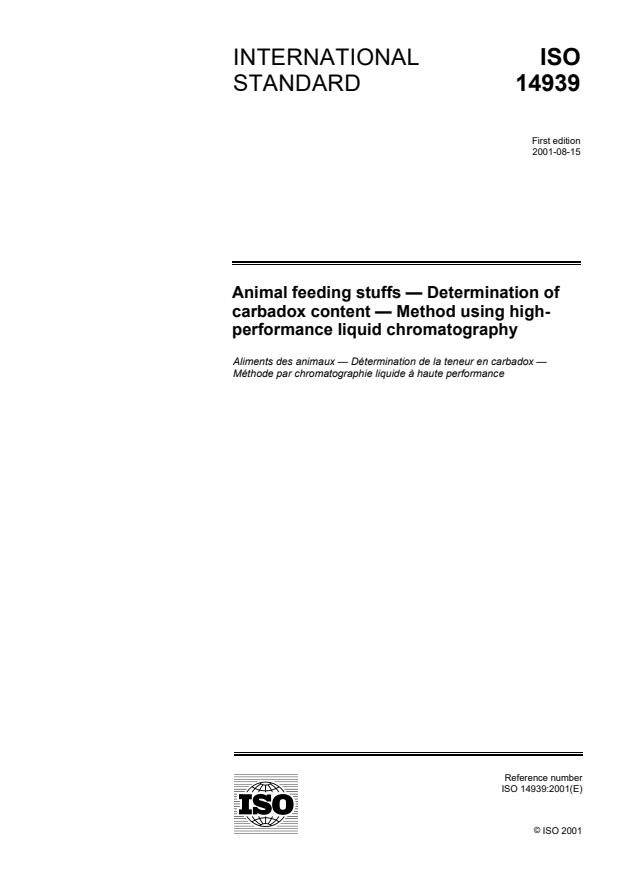
(Main)Animal feeding stuffs — Determination of carbadox content — Method using high-performance liquid chromatography
General Information
- Abstract
This International Standard specifies a high-performance liquid chromatographic (HPLC) method for the determination of the carbadox content in premixtures and animal feeding stuffs. The method is applicable to animal feeding stuffs with a mass fraction of carbadox of 0,5 mg/kg (limit of quantification) to 100 mg/kg, and to premixtures with a mass fraction of carbadox up to 10 %. The lower limit of detection is 0,1 mg/kg. NOTE 1 For animal feeding stuffs the mass fraction of carbadox is expressed in milligrams per kilogram, and for premixtures as a percentage by mass. NOTE 2 Carbadox is a chemotherapeuticum belonging to the quinoxaline group. Carbadox is used as a growth-promoting feed additive for piglets.
- Status
- Published
- Publication Date
- 29-Aug-2001
- Technical Committee
- ISO/TC 34/SC 10 - Animal feeding stuffs
- Drafting Committee
- ISO/TC 34/SC 10 - Animal feeding stuffs
- Current Stage
- 9093 - International Standard confirmed
- Start Date
- 13-Aug-2026
- Completion Date
- 29-Aug-2026
Overview - ISO 14939:2001 (Carbadox determination by HPLC)
ISO 14939:2001 specifies a laboratory method for the determination of carbadox in animal feeding stuffs and premixtures using high-performance liquid chromatography (HPLC). The standard covers sample preparation, extraction, cleanup, chromatographic conditions and detection. It applies to:
- animal feeding stuffs with carbadox mass fractions from 0.5 mg/kg (LOQ) up to 100 mg/kg, and
- premixtures with carbadox up to 10 %.
The limit of detection (LOD) is 0.1 mg/kg. Carbadox is identified by reverse‑phase HPLC with UV detection at 365 nm (or optionally by post‑column derivatization with NaOH, detection at 420 nm).
Key topics and technical requirements
- Scope and ranges: LOQ 0.5 mg/kg (feeds), LOD 0.1 mg/kg; premixtures up to 10% carbadox.
- Analytical principle: Extraction with a 1:1 acetonitrile:methanol solvent; feeds are pre‑wetted with water; extracts from feeds are cleaned on a short aluminium oxide column; final analysis by reverse‑phase HPLC with UV detection.
- Mobile phase & reagents: Mobile phase prepared from a sodium acetate solution mixed with acetonitrile; detailed reagent and standard preparation steps (stock and working solutions) are specified.
- Chromatography & detection: Requirements for guard and analytical columns (C18 bonded phases), flow rates, injection volumes and capacity factor (K’) ≥ 1.0 for carbadox retention. UV detection at 365 nm is primary; diode array detector or post‑column derivatization (NaOH, 420 nm) are provided for confirmation.
- Interferences & confirmation: Potential interferences include dimetridazole, nitrofurazone and sulfadimidine sodium; the standard describes co‑chromatography and detector/derivatization options for confirmation.
- Safety & handling: Carbadox and several reagents are light‑sensitive and toxic; operations should be done in reduced light and under appropriate laboratory controls (fume hood, PPE).
- Quality / performance: Clauses on precision, repeatability, reproducibility and interlaboratory testing are included.
Applications and users
ISO 14939:2001 is intended for:
- Feed testing laboratories performing quantitative residue analysis.
- Feed and premixture manufacturers for quality control of medicated feeds.
- Regulatory and inspection bodies monitoring compliance with feed additive regulations.
- Veterinary diagnostic labs assessing carbadox levels in piglet growth‑promoting feeds.
Keywords: ISO 14939:2001, carbadox, HPLC method, animal feeding stuffs, premixtures, limit of detection, reverse-phase HPLC, feed testing, analytical standard.
Related standards
- ISO 6498:1998 - Preparation of test samples (referenced normative document).
- ISO 6497 (referenced for recommended sampling methods).
Relations
- Effective Date
- 12-Feb-2026
Get Certified
Connect with accredited certification bodies for this standard

Control Union Certifications
Global certification for agriculture and sustainability.

ECOCERT
Organic and sustainability certification.

FSC International
Forest Stewardship Council certification.
Sponsored listings
Frequently Asked Questions
ISO 14939:2001 is a standard published by the International Organization for Standardization (ISO). Its full title is "Animal feeding stuffs — Determination of carbadox content — Method using high-performance liquid chromatography". This standard covers: This International Standard specifies a high-performance liquid chromatographic (HPLC) method for the determination of the carbadox content in premixtures and animal feeding stuffs. The method is applicable to animal feeding stuffs with a mass fraction of carbadox of 0,5 mg/kg (limit of quantification) to 100 mg/kg, and to premixtures with a mass fraction of carbadox up to 10 %. The lower limit of detection is 0,1 mg/kg. NOTE 1 For animal feeding stuffs the mass fraction of carbadox is expressed in milligrams per kilogram, and for premixtures as a percentage by mass. NOTE 2 Carbadox is a chemotherapeuticum belonging to the quinoxaline group. Carbadox is used as a growth-promoting feed additive for piglets.
This International Standard specifies a high-performance liquid chromatographic (HPLC) method for the determination of the carbadox content in premixtures and animal feeding stuffs. The method is applicable to animal feeding stuffs with a mass fraction of carbadox of 0,5 mg/kg (limit of quantification) to 100 mg/kg, and to premixtures with a mass fraction of carbadox up to 10 %. The lower limit of detection is 0,1 mg/kg. NOTE 1 For animal feeding stuffs the mass fraction of carbadox is expressed in milligrams per kilogram, and for premixtures as a percentage by mass. NOTE 2 Carbadox is a chemotherapeuticum belonging to the quinoxaline group. Carbadox is used as a growth-promoting feed additive for piglets.
ISO 14939:2001 is classified under the following ICS (International Classification for Standards) categories: 65.120 - Animal feeding stuffs. The ICS classification helps identify the subject area and facilitates finding related standards.
ISO 14939:2001 has the following relationships with other standards: It is inter standard links to EN ISO 14939:2001. Understanding these relationships helps ensure you are using the most current and applicable version of the standard.
ISO 14939:2001 is available in PDF format for immediate download after purchase. The document can be added to your cart and obtained through the secure checkout process. Digital delivery ensures instant access to the complete standard document.
Standards Content (Sample)
INTERNATIONAL ISO
STANDARD 14939
First edition
2001-08-15
Animal feeding stuffs — Determination of
carbadox content — Method using high-
performance liquid chromatography
Aliments des animaux — Détermination de la teneur en carbadox —
Méthode par chromatographie liquide à haute performance
Reference number
©
ISO 2001
PDF disclaimer
This PDF file may contain embedded typefaces. In accordance with Adobe's licensing policy, this file may be printed or viewed but shall not
be edited unless the typefaces which are embedded are licensed to and installed on the computer performing the editing. In downloading this
file, parties accept therein the responsibility of not infringing Adobe's licensing policy. The ISO Central Secretariat accepts no liability in this
area.
Adobe is a trademark of Adobe Systems Incorporated.
Details of the software products used to create this PDF file can be found in the General Info relative to the file; the PDF-creation parameters
were optimized for printing. Every care has been taken to ensure that the file is suitable for use by ISO member bodies. In the unlikely event
that a problem relating to it is found, please inform the Central Secretariat at the address given below.
All rights reserved. Unless otherwise specified, no part of this publication may be reproduced or utilized in any form or by any means, electronic
or mechanical, including photocopying and microfilm, without permission in writing from either ISO at the address below or ISO's member body
in the country of the requester.
ISO copyright office
Case postale 56 � CH-1211 Geneva 20
Tel. + 41 22 749 01 11
Fax + 41 22 749 09 47
E-mail copyright@iso.ch
Web www.iso.ch
Printed in Switzerland
ii © ISO 2001 – All rights reserved
Contents Page
Foreword.iv
1 Scope .1
2 Normative reference .1
3 Principle.1
4 Reagents.2
5 Apparatus .4
6 Sampling.5
7 Preparation of test sample.5
8 Procedure .5
8.1 General.5
8.2 Preparation of spiked sample.5
8.3 Extraction .6
8.4 Column chromatography.7
8.5 HPLC analysis.7
9 Confirmation.8
9.1 General.8
9.2 Co-chromatography.8
9.3 Diode array detector.9
9.4 Post-column derivatization.10
10 Calculation of results .10
10.1 General.10
10.2 Feeding stuffs containing 0,1 mg/kg to 10 mg/kg of carbadox.10
10.3 Feeding stuffs containing 10 mg/kg to 100 mg/kg of carbadox.11
10.4 Premixtures containing up to 10 % of carbadox .11
11 Precision.11
11.1 Interlaboratory test .11
11.2 Repeatability.11
11.3 Reproducibility.12
12 Test report .12
Annex A (informative) Flow chart .13
Annex B (informative) Results of interlaboratory test.14
Bibliography.16
Foreword
ISO (the International Organization for Standardization) is a worldwide federation of national standards bodies (ISO
member bodies). The work of preparing International Standards is normally carried out through ISO technical
committees. Each member body interested in a subject for which a technical committee has been established has
the right to be represented on that committee. International organizations, governmental and non-governmental, in
liaison with ISO, also take part in the work. ISO collaborates closely with the International Electrotechnical
Commission (IEC) on all matters of electrotechnical standardization.
International Standards are drafted in accordance with the rules given in the ISO/IEC Directives, Part 3.
Draft International Standards adopted by the technical committees are circulated to the member bodies for voting.
Publication as an International Standard requires approval by at least 75 % of the member bodies casting a vote.
Attention is drawn to the possibility that some of the elements of this International Standard may be the subject of
patent rights. ISO shall not be held responsible for identifying any or all such patent rights.
International Standard ISO 14939 was prepared by Technical Committee ISO/TC 34, Food products,
Subcommittee SC 10, Animal feeding stuffs.
Annexes A and B of this International Standard are for information only.
iv © ISO 2001 – All rights reserved
INTERNATIONAL STANDARD ISO 14939:2001(E)
Animal feeding stuffs — Determination of carbadox content —
Method using high-performance liquid chromatography
1 Scope
This International Standard specifies a high-performance liquid chromatographic (HPLC) method for the
determination of the carbadox content in premixtures and animal feeding stuffs.
The method is applicable to animal feeding stuffs with a mass fraction of carbadox of 0,5 mg/kg (limit of
quantification) to 100 mg/kg, and to premixtures with a mass fraction of carbadox up to 10 %.
The lower limit of detection is 0,1 mg/kg.
NOTE 1 For animal feeding stuffs the mass fraction of carbadox is expressed in milligrams per kilogram, and for premixtures
as a percentage by mass.
NOTE 2 Carbadox is a chemotherapeuticum belonging to the quinoxaline group. Carbadox is used as a growth-promoting
feed additive for piglets.
2 Normative reference
The following normative document contains provisions which, through reference in this text, constitute provisions of
this International Standard. For dated references, subsequent amendments to, or revisions of, any of these
publications do not apply. However, parties to agreements based on this International Standard are encouraged to
investigate the possibility of applying the most recent editions of the normative documents indicated below. For
undated references, the latest edition of the normative document referred to applies. Members of IEC and ISO
maintain registers of currently valid International Standards.
ISO 6498:1998, Animal feeding stuffs — Preparation of test samples.
3Principle
Carbadox is extracted from the sample with a mixture of acetonitrile and methanol. Animal feeds are prewetted with
water. The extract of animal feeds is purified through a short aluminium oxide column. The extract of premixtures is
directly diluted with a mixture of water, acetonitrile and methanol. The final extract is analysed by reverse-phase
HPLC with UV detection at a wavelength of 365 nm (see references [1] to [3]).
The presence of dimetridazole, nitrofurazone or sulfadimidine sodium can interfere with the determination of
carbadox.
Alternatively, carbadox may be determined after post-column derivatization with sodium hydroxide with detection at
a wavelength of 420 nm.
4 Reagents
Use only reagents of recognized analytical grade.
4.1 Water, demineralized or deionized, with resistivity of at least 10 M��cm, or water of at least equivalent purity.
4.2 Extraction solvent: mixture of acetonitrile and methanol (1:1 by volume).
Combine equal volumes of acetonitrile and methanol. Mix well and allow to adjust to room temperature before use.
4.3 Dilution solvent: mixture of extraction solvent (4.2) and water (4.1) (70:30 by volume).
Mix 70mlof extractionsolvent (4.2) with30mlof water (4.1).
4.4 Acetic acid, volume fraction, w(CH CO H) = 10 %.
3 2
Dilute 10 ml of glacial acetic acid to 100 ml with water.
4.5 Sodium acetate solution, c(C H NaO ) = 0,01 mol/l, pH = 6,0.
2 3 2
Weigh 0,82 g of water-free sodium acetate into a 1 000 ml one-mark volumetric flask. Dissolve in 700 ml of water.
Adjust the pH to pH = 6,0 with acetic acid (4.4). Dilute to the mark with water and mix.
4.6 Mobile phase for HPLC.
Combine 825 ml of sodium acetate solution (4.5) and 175 ml of acetonitrile and mix. Filter the eluent through a
0,22µm filter using a solvent filtration system (5.2), and degas for 10 min in an ultrasonic bath (5.3) before use.
4.7 Carbadox standard material, 3-(2-quinoxalinyl methylene) carbazic acid methy ester N, N� -dioxide (CAS
number 6804-07-5).
WARNING — Because of the sensitivity of carbadox to light, conduct all operations in the absence of
daylight or artificial white light. Avoid inhalation of and exposure to the toxic carbadox standard material
and solutions thereof. Work in a fume cupboard when handling the solvents and solutions. Wear safety
glasses and protective clothing.
4.8 Carbadox stock solution (approximately 100µg/ml).
Weigh 10 mg� 1 mg of carbadox (4.7), to the nearest 0,1 mg, into a 100 ml one-mark volumetric flask. Dissolve in
extraction solvent (4. 2), dilute to the mark and mix. Calculate the concentration taking into account the purity of the
standard material. Prepare fresh every month. Store in the dark at 0 °Cto8 °C.
4.9 Carbadox working solutions (approximately 2µg/ml and 10µg/ml).
Pipette 1,0 ml and 5,0 ml of the carbadox stock solution (4.8) into separate 50 ml one-mark volumetric flasks. Dilute
to the mark with dilution solvent (4.3) and mix. Prepare fresh for each series of samples.
4.10 Carbadox working solutions (approximately 0,4µg/ml and 2µg/ml).
Pipette 1,0 ml of the carbadox stock solution (4.8) into a 50 ml one-mark volumetric flask, dilute to the mark with
mobile phase (4.6) and mix. Pipette 10 ml of this solution (2µg/ml) into a 50 ml one-mark volumetric flask, dilute to
the mark with mobile phase (4.6) and mix. Prepare fresh for each series of samples.
4.11 Dimetridazole standard material, 1,2-dimethyl-5-nitro-1H-imidazole (CAS number 551-92-8).
WARNING — Because of the sensitivity of dimetridazole to light, conduct all operations in the absence of
daylight or artificial white light. Avoid inhalation of and exposure to the toxic dimetridazole standard
2 © ISO 2001 – All rights reserved
material and solutions thereof. Work in a fume cupboard when handling the solvents and solutions. Wear
safety glasses and protective clothing.
4.12 Dimetridazole stock solution (approximately 100µg/ml).
Weigh 10 mg� 1 mg of dimetridazole (4.11), to the nearest 0,1 mg, into a 100 ml one-mark volumetric flask. Dilute
to the mark with methanol and mix. Calculate the concentration taking into account the purity of the standard
material. Prepare fresh every month. Store in the dark at 0 °Cto 8 °C.
4.13 Dimetridazole working solution (approximately 20µg/ml).
Pipette 2,0 ml of the dimetridazole stock solution (4.12) into a 10 ml one-mark volumetric flask. Dilute to the mark
with water and mix. Prepare fresh for each series of samples.
4.14 Sulfadimidine standard material, sodium salt of 4-amino-N-(4,6-dimethyl-2-pyrimidinyl) benzene
sulfonamide (CAS number 1981-58-4).
WARNING — Avoid inhalation of and exposure to the toxic sulfadimidine standard material and solutions
thereof. Work in a fume cupboard when handling the solvents and solutions. Wear safety glasses and
protective clothing.
4.15 Sulfadimidine stock solution (approximately 200µg/ml).
Weigh 10 mg� 1 mg of sulfadimidine standard material (4.14), to the nearest 0,1 mg, into a 50 ml one-mark
volumetric flask. Dilute to the mark with methanol and mix. Calculate the concentration taking into account the
purity of the standard material. Prepare fresh every month. Store in the dark at 0 °Cto8 °C.
4.16 Sulfadimidine working solution (approximately 20µg/ml).
Pipette 1,0 ml of sulfadimidine stock solution (4.15) into a 10 ml one-mark volumetric flask. Dilute to the mark with
water and mix. Prepare fresh for each series of samples.
4.17 Nitrofurazone standard material, 5-nitro-2-furaldehyde semicarbazone (CAS number 59-87-0).
WARNING — Because of the sensitivity of nitrofurazone to light, conduct all operations in the absence of
daylight or artificial white light. Avoid inhalation of and exposure to the toxic nitrofurazone standard
material and solutions thereof. Work in a fume cupboard when handling the solvents and solutions. Wear
safety glasses and protective clothing.
4.18 Nitrofurazone stock solution (approximately 100µg/ml).
Weigh 10 mg� 1 mg of nitrofurazone (4.17), to the nearest 0,1 mg, into a 100 ml one-mark volumetric flask. Dilute
to the mark with methanol and mix. Calculate the concentration taking into account the purity of the standard
material. Prepare fresh every month. Store in the dark at 0 °Cto 8 °C.
4.19 Nitrofurazone working solution (approximately 20µg/ml).
Pipette 2,0 ml of nitrofurazone stock solution (4.18) into a 10 ml one-mark volumetric flask. Dilute to the mark with
water and mix. Prepare fresh for each series of samples.
4.20 Neutral aluminium oxide,activity1.
For total de-activation 0 % to 1 % of water is necessary.
4.21 Sodium hydroxide solution, c(NaOH) = 0,5 mol/l.
Weigh 20 g of sodium hydroxide into a 1 litre one-mark volumetric flask and dissolve in 10 ml of water. Dilute to the
mark with water and mix.
5 Apparatus
Usual laboratory apparatus and, in particular, the following.
5.1 pH-meter.
5.2 Solvent filtration system, all glass apparatus suitable for 0,22µm filters.
5.3 Ultrasonic bath.
�1 �1
5.4 Rotary shaker, horizontal rotation, rotation frequency 250 min to 300 min .
5.5 Glass microfibre filter, diameter 15 cm.
5.6 Glass wool.
5.7 Glass column for chromatography, length 30 cm, internal diameter 10 mm, restricted at the end and fitted
with a wad of glass wool (5.6), or an equivalent column with an internal diameter of 10 mm.
5.8 Filtration system, equipped with polyvinylidene difluoride (PVDF) filters or polytetrafluorethylene (PTFE)
filters of pore size 0,45µm.
5.9 Water bath, capable of being heated to 50 °C, or heating module, equipped with a supply of nitrogen.
5.10 HPLC system, comprising the following.
5.10.1 Pump, pulse free, capable of maintaining a volume flow rate of 0,5 ml/min to 1,5 ml/min.
5.10.2 Injection system, with loop suitable for 20µl to 100µl injections.
5.10.3 UV detector, suitable for measurements at a wavelength of 365 nm.
If available, a diode array detector may be used for confirmation purposes.
5.10.4 Recorder.
5.10.5 Guard column: silica-bonded C packing withparticlesizeof ca. 30µm, length 20 mm, internal diameter
3,9 mm, or a guard column of equivalent quality.
5.10.6 Analytical column.
For mass fractions of carbadox less than 10 mg/kg (feeding stuffs), use silica-bonded C packing with particle size
5µm, length 200 mm, internal diameter 3,0 mm, or an analytical column of equivalent quality.
For mass fractions of carbadox greater than or equal to 10 mg/kg (feeding stuffs and premixtures), use silica-
bonded C packing with particle size 5µm, length 300 mm, internal diameter 3,0 mm, or an analytical column of
equivalent quality.
For carbadox, a capacity factor (K �) of at least 1,0 shall be obtained.
The capacity factor is defined as:
tt�
R0
K� �
t
4 © ISO 2001 – All rights reserved
where
K � is the capacity factor;
t is the retention time, in minutes, of carbadox;
R
t is the retention time, in minutes, of the unretained peak.
5.10.7 Peristaltic pump (for post-column derivatization).
5.10.8 Spiral reaction coil (for post-column derivatization), polytetrafluorethylene (PTFE), length 2 m, internal
diameter 0,5 mm.
5.10.9 UV/Vis detector, suitable for measurements at a wavelength of 420 nm (for post-column derivatization).
5.11 Disposable syringe, of capacity 5 ml.
6 Sampling
Sampling is not part of the method specified in this International Standard. A recommended sampling method is
given in ISO 6497 [5].
It is important that the laboratory receive a sample which is truly representative and has not been damaged or
changed during transport or storage.
7 Preparation of test sample
Prepare the test sample in accordance with ISO 6498.
Grind the laboratory sample (usually 500 g) so that it passes completely through a sieve with 1 mm apertures. Mix
thoroughly.
8 Procedure
8.1 General
In conjunction with the analysis of the test sample (or a series of test samples), analyse a blank sample and a
spiked blank sample. If available, a reference sample may be analysed to check the performance of the method.
Annex A shows a flow chart of the procedure.
For blank samples, use homogenates of comparable feeds with a mass fraction of carbadox of less than 0,1 mg/kg.
For spiked blank samples, use blank feed samples to which carbadox is added. Blank samples and reference
sampl
...