


ISO 22621-3:2007
(Main)Plastics piping systems for the supply of gaseous fuels for maximum operating pressures up to and including 2 MPa (20 bar) — Polyamide (PA) — Part 3: Fittings
Plastics piping systems for the supply of gaseous fuels for maximum operating pressures up to and including 2 MPa (20 bar) — Polyamide (PA) — Part 3: Fittings
ISO 22621 specifies the physical and mechanical properties of fittings made from polyamide (PA) in accordance with ISO 22621-1, intended to be buried and used for the supply of gaseous fuels at maximum operating pressures (MOP) up to and including 2 MPa (20 bar). It also specifies the test parameters for the test methods to which it refers. In addition, it lays down dimensional characteristics and requirements for the marking of fittings. In conjunction with the other parts of ISO 22621, it is applicable to PA fittings, their joints, to joints with components of PA and to joints with mechanical fittings of other materials, and to the following fitting types: fusion fittings (electrofusion and butt fusion fittings); transition fittings.
Systèmes de canalisations en matières plastiques pour la distribution de combustibles gazeux pour des pressions maximales de service inférieures ou égales à 2 MPa (20 bar) — Polyamide (PA) — Partie 3: Raccords
General Information
- Status
- Withdrawn
- Publication Date
- 31-Oct-2007
- Withdrawal Date
- 31-Oct-2007
- Current Stage
- 9599 - Withdrawal of International Standard
- Start Date
- 04-Jun-2012
- Completion Date
- 14-Feb-2026
Relations
- Effective Date
- 26-Jun-2010
Get Certified
Connect with accredited certification bodies for this standard

ABS Quality Evaluations Inc.
American Bureau of Shipping quality certification.

Element Materials Technology
Materials testing and product certification.

Smithers Quality Assessments
US management systems and product certification.
Sponsored listings
Frequently Asked Questions
ISO 22621-3:2007 is a standard published by the International Organization for Standardization (ISO). Its full title is "Plastics piping systems for the supply of gaseous fuels for maximum operating pressures up to and including 2 MPa (20 bar) — Polyamide (PA) — Part 3: Fittings". This standard covers: ISO 22621 specifies the physical and mechanical properties of fittings made from polyamide (PA) in accordance with ISO 22621-1, intended to be buried and used for the supply of gaseous fuels at maximum operating pressures (MOP) up to and including 2 MPa (20 bar). It also specifies the test parameters for the test methods to which it refers. In addition, it lays down dimensional characteristics and requirements for the marking of fittings. In conjunction with the other parts of ISO 22621, it is applicable to PA fittings, their joints, to joints with components of PA and to joints with mechanical fittings of other materials, and to the following fitting types: fusion fittings (electrofusion and butt fusion fittings); transition fittings.
ISO 22621 specifies the physical and mechanical properties of fittings made from polyamide (PA) in accordance with ISO 22621-1, intended to be buried and used for the supply of gaseous fuels at maximum operating pressures (MOP) up to and including 2 MPa (20 bar). It also specifies the test parameters for the test methods to which it refers. In addition, it lays down dimensional characteristics and requirements for the marking of fittings. In conjunction with the other parts of ISO 22621, it is applicable to PA fittings, their joints, to joints with components of PA and to joints with mechanical fittings of other materials, and to the following fitting types: fusion fittings (electrofusion and butt fusion fittings); transition fittings.
ISO 22621-3:2007 is classified under the following ICS (International Classification for Standards) categories: 75.200 - Petroleum products and natural gas handling equipment; 83.140.30 - Plastics pipes and fittings for non fluid use. The ICS classification helps identify the subject area and facilitates finding related standards.
ISO 22621-3:2007 has the following relationships with other standards: It is inter standard links to ISO 16486-3:2012. Understanding these relationships helps ensure you are using the most current and applicable version of the standard.
ISO 22621-3:2007 is available in PDF format for immediate download after purchase. The document can be added to your cart and obtained through the secure checkout process. Digital delivery ensures instant access to the complete standard document.
Standards Content (Sample)
INTERNATIONAL ISO
STANDARD 22621-3
First edition
2007-11-15
Plastics piping systems for the supply
of gaseous fuels for maximum
operating pressures up to and
including 2 MPa (20 bar) —
Polyamide (PA) —
Part 3:
Fittings
Systèmes de canalisations en matières plastiques pour la distribution
de combustibles gazeux pour des pressions maximales de service
inférieures ou égales à 2 MPa (20 bar) — Polyamide (PA) —
Partie 3: Raccords
Reference number
©
ISO 2007
PDF disclaimer
This PDF file may contain embedded typefaces. In accordance with Adobe's licensing policy, this file may be printed or viewed but
shall not be edited unless the typefaces which are embedded are licensed to and installed on the computer performing the editing. In
downloading this file, parties accept therein the responsibility of not infringing Adobe's licensing policy. The ISO Central Secretariat
accepts no liability in this area.
Adobe is a trademark of Adobe Systems Incorporated.
Details of the software products used to create this PDF file can be found in the General Info relative to the file; the PDF-creation
parameters were optimized for printing. Every care has been taken to ensure that the file is suitable for use by ISO member bodies. In
the unlikely event that a problem relating to it is found, please inform the Central Secretariat at the address given below.
© ISO 2007
All rights reserved. Unless otherwise specified, no part of this publication may be reproduced or utilized in any form or by any means,
electronic or mechanical, including photocopying and microfilm, without permission in writing from either ISO at the address below or
ISO's member body in the country of the requester.
ISO copyright office
Case postale 56 • CH-1211 Geneva 20
Tel. + 41 22 749 01 11
Fax + 41 22 749 09 47
E-mail copyright@iso.org
Web www.iso.org
Published in Switzerland
ii © ISO 2007 – All rights reserved
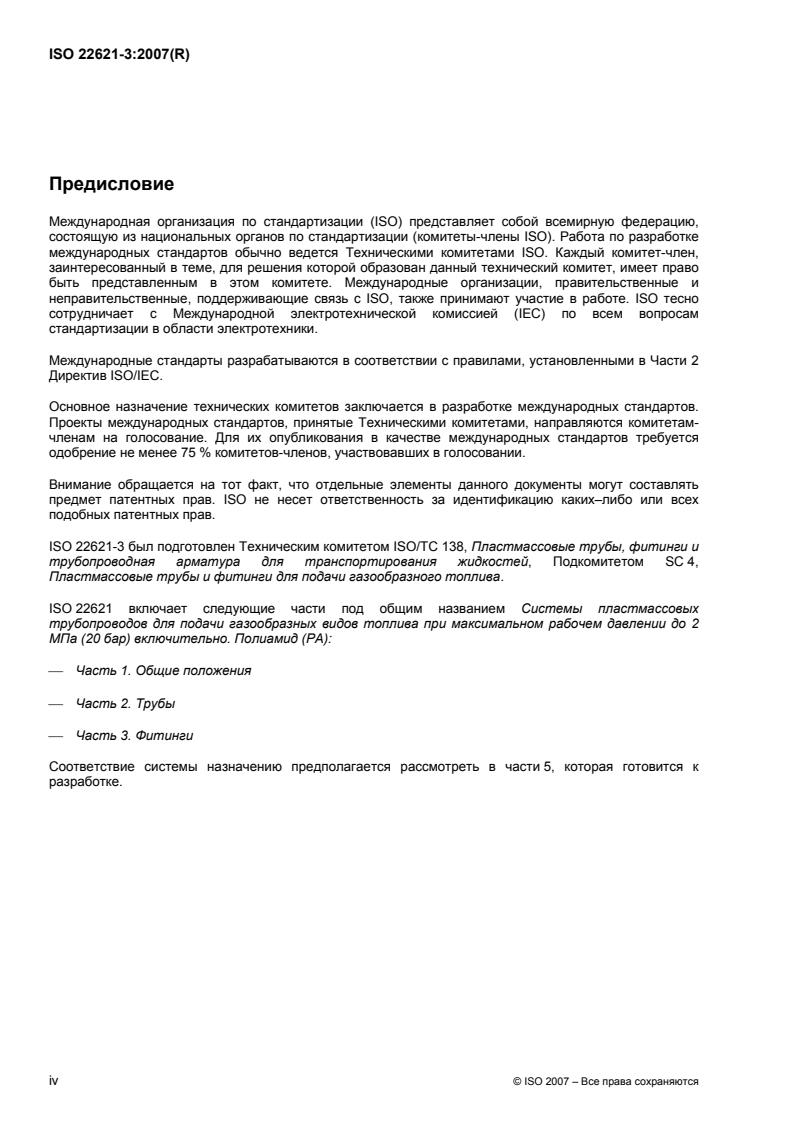
Contents Page
Foreword. iv
Introduction . v
1 Scope .1
2 Normative references .1
3 Terms, definitions, symbols and abbreviated terms.2
4 Material .3
5 General characteristics .4
6 Geometrical characteristics.5
7 Mechanical characteristics .10
8 Physical characteristics.12
9 Chemical resistance of fittings in contact with chemicals.12
10 Marking .12
11 Packaging .13
Annex A (informative) Examples of typical terminal connections for electrofusion fittings .14
Annex B (normative) Short-term pressure test method.16
Annex C (normative) Tensile test fitting/pipe assemblies .18
Annex D (normative) Tear test for saddles assemblies .19
Bibliography .22
Foreword
ISO (the International Organization for Standardization) is a worldwide federation of national standards bodies
(ISO member bodies). The work of preparing International Standards is normally carried out through
ISO technical committees. Each member body interested in a subject for which a technical committee has
been established has the right to be represented on that committee. International organizations, governmental
and non-governmental, in liaison with ISO, also take part in the work. ISO collaborates closely with the
International Electrotechnical Commission (IEC) on all matters of electrotechnical standardization.
International Standards are drafted in accordance with the rules given in the ISO/IEC Directives, Part 2.
The main task of technical committees is to prepare International Standards. Draft International Standards
adopted by the technical committees are circulated to the member bodies for voting. Publication as an
International Standard requires approval by at least 75 % of the member bodies casting a vote.
Attention is drawn to the possibility that some of the elements of this document may be the subject of patent
rights. ISO shall not be held responsible for identifying any or all such patent rights.
ISO 22621-3 was prepared by Technical Committee ISO/TC 138, Plastics pipes, fittings and valves for the
transport of fluids, Subcommittee SC 4, Plastics pipes and fittings for the supply of gaseous fuels.
ISO 22621 consists of the following parts, under the general title Plastics piping systems for the supply of
gaseous fuels for maximum operating pressures up to and including 2 MPa (20 bar) — Polyamide (PA):
⎯ Part 1: General
⎯ Part 2: Pipes
⎯ Part 3: Fittings
Fitness for purpose of the system is to form the subject of a future part 5.
iv © ISO 2007 – All rights reserved
Introduction
As polyamide material is used for piping systems for the supply of gaseous fuels both at low and high
pressure, ISO/TC 138/SC 4 experts decided to split the standardization programme into two series of
International Standards, with one series covering low pressures up to 0,4 MPa (4 bar), and ISO 22621 high
pressures up to 2 MPa (20 bar).
Thin wall thickness pipes and solvent cement joints are used typically for pressures up to 0,4 MPa (4 bar),
while thicker wall thickness pipes and butt fusion, electrofusion and mechanical joints are typically used for
pressures up to 2 MPa (20 bar). For technical and safety reasons, it is not possible to mix the components of
the two types of piping system (thin wall thickness pipes cannot be jointed by butt fusion or mechanical joints
and vice versa). In particular, solvent cement joints must not be used for jointing for high pressure piping
systems.
NOTE With the publication of ISO 22621-5, performance requirements for joints are to be added to this part of
ISO 22621.
INTERNATIONAL STANDARD ISO 22621-3:2007(E)
Plastics piping systems for the supply of gaseous fuels for
maximum operating pressures up to and including 2 MPa
(20 bar) — Polyamide (PA) —
Part 3:
Fittings
1 Scope
This part of ISO 22621 specifies the physical and mechanical properties of fittings made from polyamide (PA)
in accordance with ISO 22621-1, intended to be buried and used for the supply of gaseous fuels at maximum
1)
operating pressures (MOP) up to and including 20 bar .
It also specifies the test parameters for the test methods to which it refers.
In addition, it lays down dimensional characteristics and requirements for the marking of fittings.
In conjunction with the other parts of ISO 22621, it is applicable to PA fittings, their joints, to joints with
components of PA and to joints with mechanical fittings of other materials, and to the following fitting types:
⎯ fusion fittings — electrofusion fittings and butt fusion fittings;
⎯ transition fittings.
2 Normative references
The following referenced documents are indispensable for the application of this document. For dated
references, only the edition cited applies. For undated references, the latest edition of the referenced
document (including any amendments) applies.
ISO 291, Plastics — Standard atmospheres for conditioning and testing
ISO 307, Plastics — Polyamides — Determination of viscosity number
ISO 1167-1, Thermoplastics pipes, fittings and assemblies for the conveyance of fluids — Determination of
the resistance to internal pressure — Part 1: General method
ISO 1167-4, Thermoplastics pipes, fittings and assemblies for the conveyance of fluids — Determination of
2)
the resistance to internal pressure — Part 4: Preparation of assemblies
ISO 3126, Plastics piping systems — Plastics components — Determination of dimensions
5 2
1) 1 bar = 0,1 MPa = 10 Pa; 1 MPa = 1 N/mm
2) To be published.
ISO 4433-1:1997, Thermoplastics pipes — Resistance to liquid chemicals — Classification —
Part 1: Immersion test method
ISO 11922-1:1997, Thermoplastic pipes for the conveyance of fluids — Dimensions and tolerances — Part 1:
Metric series
ISO 13951:2001, Plastics piping systems — Test method for the resistance of polyolefin pipe/pipe or
pipe/fitting assemblies to tensile loading
ISO 13953:2001, Polyethylene (PE) pipes and fittings — Determination of the tensile strength and failure
mode of test pieces from a butt-fused joint
ISO 13954, Plastics pipes and fittings — Peel decohesion test for polyethylene (PE) electrofusion assemblies
of nominal outside diameter greater than or equal to 90 mm
ISO 13955:1997, Plastics pipes and fittings — Crushing decohesion test for polyethylene (PE) electrofusion
assemblies
ISO 13957:1997, Plastics pipes and fittings — Polyethylene (PE) tapping tees — Test method for impact
resistance
ISO 22621-1:2007, Plastics piping systems for the supply of gaseous fuels for maximum operating pressures
up to 2 MPa (20 bar) — Polyamide (PA) — Part 1: General
ISO 22621-2, Plastics piping systems for the supply of gaseous fuels for maximum operating pressures up to
2 MPa (20 bar) — Polyamide (PA) — Part 2: Pipes
EN 682, Elastomeric seals — Materials requirements for seals used in pipes and fittings carrying gas and
hydrocarbon fluids
IEC 60529:2001, Degree of protection provided by enclosures (IP Code)
3 Terms, definitions, symbols and abbreviated terms
For the purposes of this document, the terms, definitions, symbols and abbreviated terms given in
ISO 22621-1 and the following apply.
3.1
electrofusion socket fitting
polyamide (PA) fitting which contains one or more integral heating elements that are capable of transforming
electrical energy into heat to realise a fusion joint with a spigot end and/or a pipe
3.2
electrofusion saddle fitting
polyamide (PA) fitting which contains one or more integral heating elements that are capable of transforming
electrical energy into heat to realize fusion onto a pipe
3.3
tapping tee
electrofusion saddle fitting (top loading or wraparound) comprised of one or more integral heating elements
and an integral cutter, used to cut through the wall of the main pipe, and holds the coupon inside the cutter
NOTE The cutter remains in the body of the saddle after installation.
3.4
branch saddle
electrofusion saddle fitting (top loading or wraparound) comprised of one or more integral heating elements,
which requires an ancillary cutting tool for drilling the hole in the main pipe
2 © ISO 2007 – All rights reserved
3.5
spigot end fitting
polyamide (PA) fitting where the outside diameter of the spigot length is equal to the nominal outside
diameter, d , of the corresponding pipe
n
3.6
mechanical fitting
fitting for assembling a polyamide (PA) pipe to another PA pipe or any other element of the piping system
NOTE 1 The mechanical fitting can be supplied for field assembly or pre-assembled by the manufacturer and generally
includes a compression part to provide pressure integrity, leak-tightness and resistance to end loads. A support sleeve
inserted into the pipe bore provides a permanent support for the PA pipe to prevent creep in the pipe wall under radial
compressive forces.
NOTE 2 The metallic parts of the fitting may be assembled to metallic pipes by screw threads, compression joints,
welded or flanged connections. The fitting can allow for either a dismountable or permanently assembled joint. In some
cases, the supporting ring may also act as a grip ring.
3.7
voltage regulation
control of energy supplied, during the fusion process of an electrofusion fitting, by means of the voltage
parameter
4 Material
4.1 PA compound
The fittings shall be made from virgin material.
The compound from which the fittings are made shall be in accordance with ISO 22621-1.
4.2 Material for non-polyamide parts
4.2.1 General
The materials and constituent elements used in making the fitting shall be resistant to the external and internal
environments in which they are intended to be used:
a) during storage;
b) under the effect of the fluids being conveyed;
c) taking account of the service environment and operating conditions.
Fittings materials, including elastomers, greases and lubricants in contact with the PA pipe, shall not adversely
affect pipe performance or initiate stress cracking.
4.2.2 Metal parts
All parts susceptible to corrosion shall be adequately protected.
When dissimilar metallic materials are used which may be in contact with moisture, steps shall be taken to
avoid galvanic corrosion.
Metals and materials produced by corrosion shall not affect the long-term performance of the pipe/fitting.
4.2.3 Elastomers
Elastomeric materials used for the manufacture of seals shall be in accordance with EN 682.
4.2.4 Other materials
Greases or lubricants shall not exude on to the fusion areas, and shall not affect the long-term performance of
the pipe/fitting.
5 General characteristics
5.1 Appearance
When viewed without magnification, the internal and external surfaces of the fitting shall be smooth, clean and
free from scoring, cavities and other surface defects such as would prevent conformity of the fitting to this part
of ISO 22621.
5.2 Design
The design of the fitting shall be such that, when assembling the fitting onto the pipe, spigot ends or other
components, the electrical coils and/or seals and other functional parts (e.g. grippers) are not displaced.
5.3 Colour
The fitting shall be either black or yellow.
5.4 Electrical characteristics for electrofusion fittings
The electrical protection to be provided by the system depends on the voltage and the current used and on
the characteristics of the electric power.
For voltages greater than 25 V, direct human contact with the energized parts shall not be possible when the
fitting is in the fusion cycle during assembly in accordance with the instructions of the manufacturer of the
fittings and the assembly equipment, as applicable.
NOTE 1 This type of fitting is part of an electrical system as defined in IEC 60335-1, IEC 60364-1 and IEC 60449.
Protection against direct contact with active parts (live conductors) is required for conformity with IEC 60529. This
protection is a function of the work site conditions.
NOTE 2 See Annex A for examples of typical electrofusion terminal connectors.
The surface finish of the terminal pins shall allow a minimum contact resistance in order to satisfy the
resistance tolerance requirements (nominal value ± 10 %).
5.5 Appearance of factory-made joints
The following requirements apply only to joints and fittings made or assembled in the factory.
The internal and external surfaces of the pipe and fitting after fusion jointing, examined visually without
magnification, shall be free from melt exudation outside the confines of the fitting apart from that which may be
declared acceptable by the fitting manufacturer or used as a fusion marker.
Any melt exudation shall not cause wire movement in electrofusion fittings leading to short circuiting when
jointed in accordance with the manufacturer’s instructions. There shall be no excessive creasing of the internal
surfaces of the adjoining pipes.
4 © ISO 2007 – All rights reserved
The interface of the butt fusion joints shall be perpendicular to the pipe and/or spigot end axis.
5.6 Fusion compatibility
Components made from PA 11 shall be heat fusion jointed only to components made from PA 11.
Components made from PA 12 shall be heat fusion jointed only to components made from PA 12.
Components made from polyamide are not fusion compatible with components made from other polymers.
6 Geometrical characteristics
6.1 Measurement of dimensions
The dimensions of the fittings shall be measured in accordance with ISO 3126. In case of dispute, the
measurement of dimensions shall be made not less than 24 h after manufacture and after conditioning for at
least 4 h at (23 ± 2) °C.
6.2 Dimensions of electrofusion sockets
6.2.1 Diameters and lengths of electrofusion sockets
When measured in accordance with 6.1, the diameters and lengths of electrofusion sockets (see Figure 1)
shall be in accordance with Table 1.
The mean inside diameter of the fitting in the middle of the fusion zone, D , shown in Figure 1, shall not be
less than d . The manufacturer shall declare the actual maximum and minimum values of D and L for
n 1 1
determining suitability for clamping and joint assembly.
In the case of a fitting having sockets of differing sizes, each socket shall conform to the requirements for the
corresponding nominal diameter.
6.2.2 Wall thickness
In order to prevent stress concentrations, any changes in wall thickness of the fitting body shall be gradual.
a) The wall thickness of the body of the fitting at any point, E, shall be greater than or equal to e for the
min
corresponding pipe at any part of the fitting located at a distance beyond a maximum of 2L /3 from all
entrance faces if the fitting and the corresponding pipe are made from a polyamide having the same
MRS.
If the fitting is produced from a polyamide having an MRS that is different from that of the corresponding
pipe, the relationship between the wall thickness of the fitting, E, and the pipe, e , shall be in
min
accordance with Table 2.
b) In the case of a wall thickness design different from that according to a), fittings and associated fusion
joints shall additionally meet the performance requirements given in Table 3.
Key
a
D mean inside diameter in fusion zone
b
D bore that is minimum diameter of flow channel through body of fitting
c
L depth of penetration of pipe or male end of spigot fitting
d
L heated length within socket
e
L distance between mouth of fitting and start of fusion zone
a
D is measured in a plane parallel to the plane of the mouth at a distance of L + 0,5L .
1 3 2
b
D W (d − 2e ).
2 n min
c
In the case of a coupling without a stop, it is not greater than half the total length of the fitting.
d
As declared by the manufacturer to be the nominal length of the fusion zone.
e
As declared by the manufacturer to be the nominal unheated entrance length of the fitting, L shall be W 5 mm.
Figure 1 — Dimensions of electrofusion sockets
Table 1 — Electrofusion socket dimensions
Dimensions in millimetres
Voltage regulation
Intensity regulation Fusion zone
L
d
2,min
n L L
1,min 1,max
20 25 41 10
25 25 41 10
32 25 44 10
40 25 49 12
50 28 55 15
63 31 63 19
75 35 70 22
90 40 79 26
110 53 82 32
125 58 87 36
140 62 92 40
160 68 98 46
180 74 105 52
200 80 112 57
225 88 120 64
250 95 129 71
6 © ISO 2007 – All rights reserved
Table 2 — Relationship between pipe and fitting wall thickness
a
Material
Relationship between fitting wall thickness, E,
and pipe wall thickness, e
min
Pipe Fitting
PA 180 PA 160 E W 1,12e
min
PA 160 PA 180 E W 0,9e
min
a
For material classification and designation, see ISO 22621-1:2007, 5.4.
Table 3 — Performance requirements
Test parameters
Test
Characteristic Requirement
method
Parameter Value
End caps Type A
Orientation Free
Failure pressure
Conditioning period 16 h
shall be greater than
pressure equivalent Type of test Water-in-water
Short-term
of 2,00 × MRS
internal pressure Annex B
Test temperature 20 °C
calculated for
resistance
thickest-walled pipe
Pressure increase rate 5 bar/min
for which the fitting
Minimum pressure:
has been designed.
a b
PA 11 160 and PA 12 160 72 bar
a b
PA 11 180 and PA 12 180 64 bar
Fitting shall not yield
Resistance to before pipe or until
Test temperature 23 °C Annex C
tensile load 25% elongation is
reached
a
For material classification and designation, see ISO 22621-1:2007, 5.4.
b 5 2
1 bar = 0,1 MPa = 10 Pa; 1 MPa = 1 N/mm .
6.3 Dim
...
МЕЖДУНАРОДНЫЙ ISO
СТАНДАРТ 22621-3
Первое издание
2007-11-15
Системы пластмассовых
трубопроводов для подачи
газообразных видов топлива при
максимальном рабочем давлении до
2 МПа (20 бар) включительно.
Полиамид (РА).
Часть 3.
Фитинги
Plastics piping systems for the supply of gaseous fuels for maximum
operating pressures up to and including 2 MPa (20 bar) ― Polyamide
(PA) ―
Part 3: Fittings
Ответственность за подготовку русской версии несёт GOST R
(Российская Федерация) в соответствии со статьёй 18.1 Устава ISO
Ссылочный номер
©
ISO 2007
ДОКУМЕНТ ЗАЩИЩЕН АВТОРСКИМ ПРАВОМ
© ISO 2007
Все права сохраняются. Если не указано иное, никакую часть настоящей публикации нельзя копировать или использовать в
какой-либо форме или каким-либо электронным или механическим способом, включая фотокопии и микрофильмы, без
предварительного письменного согласия ISO, которое должно быть получено после запроса о разрешении, направленного по
адресу, приведенному ниже, или в комитет-член ISO в стране запрашивающей стороны.
ISO copyright office
Case postale 56 • CH-1211 Geneva 20
Tel. + 41 22 749 01 11
Fax + 41 22 734 09 47
E-mail copyright @ iso.org
Web www.iso.org
Опубликовано в Швейцарии
ii © ISO 2007 – Все права сохраняются
Содержание Страница
Предисловие . iv
Введение . v
1 Область применения . 1
2 Нормативные ссылки . 1
3 Термины, определения, символы и сокращения . 2
4 Материал . 3
5 Общие характеристики . 4
6 Геометрические характеристики . 5
7 Механические характеристики . 10
8 Физические характеристики . 12
9 Стойкость к химическому воздействию фитингов, находящихся в контакте с
химическими веществами . 12
10 Маркировка . 12
11 Упаковка . 13
Приложение A (информативное) Примеры типичных концевых соединений для
электрофузионных фитингов . 14
Приложение B (нормативное) Краткосрочный метод испытания под давлением . 16
Приложение C (нормативное) Испытание на растяжение узлов фитинг /труба . 18
Приложение D (нормативное) Испытание на отрыв седельных соединений . 19
Библиография . 22
Предисловие
Международная организация по стандартизации (ISO) представляет собой всемирную федерацию,
состоящую из национальных органов по стандартизации (комитеты-члены ISO). Работа по разработке
международных стандартов обычно ведется Техническими комитетами ISO. Каждый комитет-член,
заинтересованный в теме, для решения которой образован данный технический комитет, имеет право
быть представленным в этом комитете. Международные организации, правительственные и
неправительственные, поддерживающие связь с ISO, также принимают участие в работе. ISO тесно
сотрудничает с Международной электротехнической комиссией (IEC) по всем вопросам
стандартизации в области электротехники.
Международные стандарты разрабатываются в соответствии с правилами, установленными в Части 2
Директив ISO/IEC.
Основное назначение технических комитетов заключается в разработке международных стандартов.
Проекты международных стандартов, принятые Техническими комитетами, направляются комитетам-
членам на голосование. Для их опубликования в качестве международных стандартов требуется
одобрение не менее 75 % комитетов-членов, участвовавших в голосовании.
Внимание обращается на тот факт, что отдельные элементы данного документы могут составлять
предмет патентных прав. ISO не несет ответственность за идентификацию каких–либо или всех
подобных патентных прав.
ISO 22621-3 был подготовлен Техническим комитетом ISO/TC 138, Пластмассовые трубы, фитинги и
трубопроводная арматура для транспортирования жидкостей, Подкомитетом SC 4,
Пластмассовые трубы и фитинги для подачи газообразного топлива.
ISO 22621 включает следующие части под общим названием Системы пластмассовых
трубопроводов для подачи газообразных видов топлива при максимальном рабочем давлении до 2
МПа (20 бар) включительно. Полиамид (PА):
Часть 1. Общие положения
Часть 2. Трубы
Часть 3. Фитинги
Соответствие системы назначению предполагается рассмотреть в части 5, которая готовится к
разработке.
iv © ISO 2007 – Все права сохраняются
Введение
Поскольку полиамид используется в трубопроводных системах подачи газообразного топлива как при
низком, так и при высоком давлении, эксперты ISO/TC 138/SC 4 решили разделить программу
стандартизации на две серии международных стандартов: одна серия (ISO 15439) для низкого
давления до 0,4 МПa (4 бар), а другая (ISO 22621) для высокого давления до 2 МПa (20 бар).
Тонкостенные трубы и тепловую сварку (склеивание) используют обычно для давлений до 0,4 МПa
(4 бар), тогда как толстостенные трубы и соединения сваркой встык, электроплавлением и
механические соединения обычно используются для давлений до 2 МПa (20 бар). По техническим
причинам и по технике безопасности, нельзя смешивать компоненты двух типов трубопроводных
систем (тонкостенные трубы не допускается соединять стыковой сваркой или механическими
соединениями и наоборот). В частности, тепловую сварку (склеивание) нельзя использовать для
соединения труб в системах высокого давления.
ПРИМЕЧАНИЕ После публикации ISO 22621-5, требования к характеристикам соединений будут добавлены к
данной части ISO 22621.
МЕЖДУНАРОДНЫЙ СТАНДАРТ ISO 22621-3:2007(R)
Системы пластмассовых трубопроводов для подачи
газообразных видов топлива при максимальном
рабочем давлении до 2 МПа (20 бар) включительно.
Полиамид (РА).
Часть 3.
Фитинги
1 Область применения
Настоящая часть ISO 22621 задает физические и механические характеристики фитингов, сделанных
из полиамида в соответствии с ISO 22621-1, предназначенных для заглубления в землю, чтобы
1)
обеспечивать подачу газообразных топлив под максимальным рабочим давлением до 20 бар
включительно.
Здесь также задаются испытательные параметры для методов испытаний, на которые есть ссылки в
этом стандарте.
Кроме того, настоящая часть ISO 22621 учреждает размерные характеристики и требования к
нанесению маркировки фитингов.
Наряду с другими частями ISO 22621, настоящая часть применяется для PA–фитингов, их соединений
и к соединениям с компонентами из полиамида (PA) и к соединениям с механическими фитингами из
других материалов, а также к следующим типам фитингов:
приплавленные фитинги — электрофузионные фитинги и фитинги, приваренные встык;
переходные фитинги.
2 Нормативные ссылки
Нижеследующие документы являются обязательными для применения данного документа. Для
датированных ссылок действительно только указанное издание. В случае недатированных ссылок
используется последняя редакция документа, на который дается ссылка (включая все изменения).
ISO 291, Пластмассы. Стандартные атмосферы для кондиционирования и проведения испытания
ISO 307, Пластмассы. Полиамиды. Определение показателя вязкости
ISO 1167-1, Трубы, фитинги и узлы из термопласта для перемещения флюидов. Определение
сопротивления внутреннему давлению. Часть 1. Общий метод
5 2
1) 1 бар = 0,1 МПa = 10 Пa; 1 МПa = 1 Н/мм
ISO 1167-4, Трубы, фитинги и узлы из термопласта для перемещения флюидов. Определение
сопротивления внутреннему давлению. Часть 4. Приготовление сборочных узлов.
ISO 3126, Системы пластмассовых труб. Пластмассовые компоненты. Определение размеров
ISO 4433-1:1997, Трубы из термопластов. Устойчивость к воздействию жидких химикатов.
Классификация. Часть 1. Метод испытания погружением
ISO 11922-1:1997, Трубы из термопластичных материалов для транспортировки текучих сред.
Размеры и допуски. Часть 1. Метрическая серия
ISO 13951:2001, Системы пластмассовых трубопроводов. Метод определения сопротивления
растягивающей нагрузке сборок труба/труба или труба/фитинг из полиолефина
ISO 13953:2001, Трубы и фитинги полиэтиленовые. Определение предела прочности на
растяжение и вид повреждения образцов для испытания, отобранных из соединения, сваренного
встык
ISO 13954, Пластмассовые трубы и фитинги. Испытание на отслаивание полиэтиленовых (ПЭ)
электросварочных узлов с номинальным наружным диаметром, большим или равным 90мм
ISO 13955:1997, Пластмассовые трубы и фитинги. Испытание на отрыв под действием сжатия
полиэтиленовых (ПЭ) электросварочных узлов
ISO 13957:1997, Трубы и фитинги пластмассовые. Полиэтиленовые тройники для выпуска
жидкости. Метод испытания для определения ударной прочности
ISO 22621-1:2007, Системы пластмассовых трубопроводов для подачи газообразных видов топлива
при максимальном рабочем давлении до 2 МПа (20 бар) включительно. Полиамид (РА). Часть 1.
Общие положения
ISO 22621-2, Системы пластмассовых трубопроводов для подачи газообразных видов топлива при
максимальном рабочем давлении до 2 МПа (20 бар) включительно. Полиамид (РА). Часть 2. Трубы
EN 682, Уплотнения из эластомеров. Требования к материалам для уплотнений трубопроводов для
транспортировки газа жидких углеводородов и их фитингов
IEC 60529:2001, Степени защиты, обеспечиваемые корпусами (Код IP)
3 Термины, определения, символы и сокращения
Применительно к данному документу используются термины и определения, приведенные в
ISO 22621-1, а также следующие.
3.1
электрофузионный раструбный фитинг
electrofusion socket fitting
полиамидный (PA) фитинг, который включает один или несколько интегральных нагревательных
элементов, способных преобразовывать электрическую энергию в теплоту, чтобы получить сварное
соединение с глухим концом и/или трубой
3.2
электрофузионный врезаемый в трубу фитинг
electrofusion saddle fitting
полиамидный (PA) фитинг, который включает один или несколько интегральных нагревательных
элементов, способных преобразовывать электрическую энергию в теплоту, чтобы осуществить
наплавку на трубу
2 © ISO 2007 – Все права сохраняются
3.3
Т-образный фитинг (тройник)
tapping tee
электрофузионный врезной фитинг (врезанный сверху или огибающий), который включает один или
несколько интегральных нагревательных элементов и интегральный резец, используемый для врезки в
стенку главной трубы, с контрольной пластинкой внутри резца
ПРИМЕЧАНИЕ Резец остается в теле седла после установки.
3.4
врезной патрубок
branch saddle
электрофузионный врезной патрубок (врезанный сверху или огибающий), который включает один или
несколько интегральных нагревательных элементов и для которого требуется вспомогательный
режущий инструмент для высверливания отверстия в главной трубе
3.5
фитинг с раструбным концом
spigot end fitting
полиамидный (PA) фитинг, в котором наружный диаметр раструба равен номинальному наружному
диаметру, d , соответствующей трубы
n
3.6
механический фитинг
mechanical fitting
фитинг для соединения полиамидной (PA) трубы с другой PA -трубой или любым другим элементом
трубопроводной системы
ПРИМЕЧАНИЕ 1 Механический фитинг может поставляться для сборки в полевых условиях или для
предварительной сборки изготовителем и обычно включает элемент, присоединяемый обжатием, для
обеспечения герметичности, отсутствие утечек и сопротивление концевым нагрузкам. Поддерживающий рукав,
вставленный в отверстие трубы, обеспечивает постоянную опору для трубы PA, чтобы предотвратить ползучесть
стенки трубы под действием радиальных сжимающих сил.
ПРИМЕЧАНИЕ 2 Металлические части фитинга могут прикрепляться к металлической трубе с помощью резьбы,
соединения обжатием, сваркой или фланцевым соединением. Такой фитинг позволяет осуществить разъемное
или постоянное соединение. В некоторых случаях опорное кольцо может также действовать как зажимное кольцо.
3.7
регулировка напряжения
voltage regulation
контроль подаваемой энергии в процессе сварки плавлением или электроплавления на фитинг
посредством параметра напряжения
4 Материал
4.1 Полимерная композиция PA
Фитинги должны изготавливаться из первичного материала.
Полимерная композиция, из которой изготавливают фитинги, должна соответствовать требованиям
ISO 22621-1.
4.2 Материалы для неполиамидных частей
4.2.1 Общие положения
Материалы и составляющие компоненты, используемые при изготовлении фитингов, должны быть
стойкими к внешним и внутренним воздействиям, которым они будут подвергаться в процессе
эксплуатации:
a) во время хранения;
b) под действием транспортируемых сред;
c) принимая во внимание рабочие условия и окружающую среду.
Материалы фитингов, включая эластомеры, консистентные смазки и смазочные материалы,
контактирующие с трубой PA, не должны оказывать неблагоприятного воздействия на характеристики
трубы или вызывать растрескивание под действием напряжений.
4.2.2 Металлические части
Все части, подверженные действию коррозии, должны быть защищены соответствующим образом.
Если используются разные металлические материалы, на которые может попадать влага, необходимо
принимать меры против гальванической коррозии.
Металлы и материалы под действием коррозии не должны влиять на длительную прочность
трубы/фитинга.
4.2.3 Эластомеры
Эластомерные материалы, используемые в производстве уплотнений, должны соответствовать
требованиям EN 682.
4.2.4 Другие материалы
Консистентные смазки или смазочные материалы не должны проступать в зонах сплавления и влиять
на длительную прочность трубы/фитинга.
5 Общие характеристики
5.1 Внешний вид
При осмотре без кратного увеличения внутренние и наружные поверхности фитинга должны быть
гладкими, чистыми и свободными от царапин, углублений и других поверхностных дефектов такой
степени, что они могут препятствовать соответствию фитинга требованиям настоящей части
ISO 22621.
5.2 Конструкция
Конструкция фитинга должна быть такой, чтобы при сборке фитинга на трубе раструбы или другие
компоненты, электрические катушкии и/или уплотнения и другие функциональные части (например,
захваты) не смещались.
5.3 Цвет
Фитинг должен быть черного или желтого цвета.
5.4 Электрические характеристики для электрофузионных фитингов
Электрическая защита, которую необходимо обеспечить системе, зависит от используемого
напряжения и тока и от характеристик электропитания.
4 © ISO 2007 – Все права сохраняются
Для напряжений выше 25 В, прямой контакт человека с деталями под напряжением невозможен, когда
фитинг приплавляют к трубе в процессе сборки в соответствии с инструкциями изготовителя фитингов
и сборочного оборудования, которые применяются.
ПРИМЕЧАНИЕ 1 Фитинг такого типа является частью электрической системы, определенной в IEC 60335-1,
IEC 60364-1 и IEC 60449. Защита от прямого контакта с активными частями ( элементами под напряжением)
требуется для соответствия требованиям IEC 60529. такая защита является функцией условий на месте
эксплуатации.
ПРИМЕЧАНИЕ 2 См. Приложение A в отношении примеров типичных электрофузионных концевых
соединителей.
Отделка поверхности концевых штырьковых выводов должна допускать минимальное сопротивление
контактов, чтобы удовлетворять требования к допустимому сопротивлению (номинальное значение
± 10 %).
5.5 Внешний вид выполненных в заводских условиях соединений
Следующие требования применяются только к соединениям и фитингам, изготовленным на
предприятии.
Внутренние и наружные поверхности трубы и фитинга после соединения плавлением при визуальном
обследовании без увеличительной оптики не должны содержать расплавленного экссудата вне
фитинга, кроме случаев, специально оговоренных изготовителем фитинга, или используемого как
маркер.
Расплавленный экссудат не должен вызывать перемещения проводов в электрофузионных фитингах,
приводя к короткому замыканию при соединении в соответствии с инструкциями изготовителя. Не
должно возникать избыточного коробления внутренних поверхностей присоединяемых труб.
Граница раздела стыка должна быть перпендикулярна трубе и/или оси раструбного конца.
5.6 Пригодность к сварке плавлением
Компоненты, изготовленные из PA 11 должны соединяться посредством тепловой сварки плавлением
только с компонентами, изготовленными из PA 11.
Компоненты, изготовленные из PA 12 должны соединяться посредством тепловой сварки плавлением
только с компонентами, изготовленными из PA 12.
Компоненты, изготовленные из полиамида, не пригодны к сварке плавлением с компонентами,
изготовленными из других полимеров.
6 Геометрические характеристики
6.1 Измерение размеров
Размеры фитингов должны быть измерены в соответствии с ISO 3126. В случае разногласия,
измерение размеров должно быть сделано не менее чем через 24 ч с момента изготовления, а также
после кондиционирования при температуре (23 ± 2) °C в течение, по меньшей мере, 4 ч
6.2 Размеры электрофузионных раструбных фитингов (муфт)
6.2.1 Диаметры и длины электрофузионных раструбных фитингов (муфт)
При измерении в соответствии с 6.1, диаметры и длины электрофузионных раструбных фитингов
(муфт) (см. Рисунок 1) должны соответствовать Таблице 1.
Средний внутренний диаметр фитинга в середине зоны сплавления, D , показанный на Рисунке 1,
должен быть не меньше d . Изготовитель должен заявить фактические максимальные и минимальные
n
значения D и L для определения пригодности к обжиму и узлу сочленения.
1 1
В случае фитинга, имеющего раструбы разного размера, каждый раструб должен соответствовать
требованиям соответствующего номинального диаметра.
6.2.2 Толщина стенки
Чтобы предотвратить концентрацию напряжений, любые изменения толщины стенки тела фитинга
должны быть постепенными.
a) Толщина стенки тела фитинга в любой точке, E, должна быть больше или равна e для
min
соответствующей трубы в любой точке фитинга, расположенной на расстоянии меньше максимума
2L /3 от всех входных поверхностей, если фитинг и соответствующая труба изготовлены из
полиамида, имеющего одинаковую MRS.
Если фитинг изготовлен из полиамида, имеющего MRS, отличающуюся от MRS соответствующей
трубы, то взаимосвязь между толщиной стенки фитинга, E, и трубы, e , должна соответствовать
min
данным Таблицы 2.
b) В случае расчета толщины стенки, отличной от a), фитинги и соответствующие соединения
плавлением должны дополнительно выполнять требования к характеристикам, приведенные в
Таблице 3.
Обозначение
a
D средний внутренний диаметр в зоне сплавления
b
D отверстие, которое имеет минимальный диаметр протока через тело фитинга
c
L глубина захода трубы или входящий конец раструбного фитинга
d
L нагреваемый отрезок в пределах раструба
e
L расстояние между входным отверстием фитинга и началом зоны сплавления
a
D измеряют в плоскости, параллельной плоскости входного отверстия на расстоянии L + 0,5L .
1 3 2
b
D W (d − 2e ).
2 n min
c
В случае соединения без стопора (глубина захода) составляет не больше половины общей длины фитинга.
d
В соответствии с заявлением изготовителя номинальная длина зоны сплавления.
e
В соответствии с заявлением изготовителя номинальная ненагреваемая входная длина фитинга, L должна
быть W 5 мм.
Рисунок 1 — Размеры электрофузионных раструбных фитингов (муфт)
6 © ISO 2007 – Все права сохраняются
Таблица 1 — Размеры электрофузионных раструбных фитингов (муфт)
Размеры в миллиметрах
Регулятор напряжения
Регулятор
Зона сплавления
интенсивности
L L
1,min 1,max L
2,min
d
n
20 25 41 10
25 25 41 10
32 25 44 10
40 25 49 12
50 28 55 15
63 31 63 19
75 35 70 22
90 40 79 26
110 53 82 32
125 58 87 36
140 62 92 40
160 68 98 46
180 74 105 52
200 80 112 57
225 88 120 64
250 95 129 71
Таблица 2 — Взаимосвязь между толщиной стенки трубы и фитинга
a
Материал
Взаимосвязь между толщиной стенки фитинга, E,
и толщиной стенки трубы, e
min
Труба Фитинг
PA 180 PA 160 E W 1,12e
min
PA 160 PA 180 E W 0,9e
min
a
В отношении классификации и обозначения материала см. ISO 22621-1:2007, 5.4.
Таблица 3 — Требования к рабочим характеристикам
Параметры испытания
Метод
Характеристика Требование
испытания
Параметр Значение
Концевые заглушки Тип A
Разрушающее
Ориентация Свободная
давление должно
быть больше, чем
Период кондиционирования 16 h
давление
Сопротивление
Тип испытания Вода в воде
равное2,00 × MRS,
краткосрочному Приложение
рассчитанное для Температура испытания 20 °C
внутреннему B
самой
Скорость увеличения давления 5 бар/мин
давлению
толстостенной
Минимальное давление:
трубы, для которой
a b
предназначен
PA 11 160 и PA 12 160 72 бар
данный фитинг.
a b
PA 11 180 и PA 12 180 64 бар
Фитинг не должен
растягиваться
Сопротивление
раньше, чем труба, Приложение
растягивающей Температура испытания 23 °C
или пока не будет C
нагрузке
достигнуто 25 %-
ное удлинение
a
В отношении классификации и обозначения материала см. ISO 22621-1:2007, 5.4.
b 5 2
1 бар = 0,1 МПa = 10 Пa; 1 МПa = 1 Н/мм .
6.3 Размеры фитингов с раструбными концами
При измерении
...
Questions, Comments and Discussion
Ask us and Technical Secretary will try to provide an answer. You can facilitate discussion about the standard in here.
Loading comments...