


ISO 10303-41:1994
(Main)Industrial automation systems and integration — Product data representation and exchange — Part 41: Integrated generic resources: Fundamentals of product description and support
Industrial automation systems and integration — Product data representation and exchange — Part 41: Integrated generic resources: Fundamentals of product description and support
La présente partie de l'ISO 10303 spécifie les éléments suivants : ressources génériques de description de produits (section 2) ; ressources génériques de gestion (section 3) ; ressources de support (section 4). Les schémas spécifiés dans la présente partie de l'ISO 10303 sont organisés en fonction de ces sections.
Systèmes d'automatisation industrielle et intégration — Représentation et échange de données de produits — Partie 41: Ressources génériques intégrées: Principes de description et de support de produits
General Information
- Status
- Withdrawn
- Publication Date
- 21-Dec-1994
- Withdrawal Date
- 21-Dec-1994
- Technical Committee
- ISO/TC 184/SC 4 - Industrial data
- Drafting Committee
- ISO/TC 184/SC 4/WG 12 - STEP product modelling and resources
- Current Stage
- 9599 - Withdrawal of International Standard
- Start Date
- 02-Apr-2012
- Completion Date
- 14-Feb-2026
Relations
- Effective Date
- 06-Jun-2022
- Effective Date
- 15-Apr-2008
- Effective Date
- 15-Apr-2008
Get Certified
Connect with accredited certification bodies for this standard

National Aerospace and Defense Contractors Accreditation Program (NADCAP)
Global cooperative program for special process quality in aerospace.
CARES (UK Certification Authority for Reinforcing Steels)
UK certification for reinforcing steels and construction.
DVS-ZERT GmbH
German welding certification society.
Sponsored listings
Frequently Asked Questions
ISO 10303-41:1994 is a standard published by the International Organization for Standardization (ISO). Its full title is "Industrial automation systems and integration — Product data representation and exchange — Part 41: Integrated generic resources: Fundamentals of product description and support". This standard covers: La présente partie de l'ISO 10303 spécifie les éléments suivants : ressources génériques de description de produits (section 2) ; ressources génériques de gestion (section 3) ; ressources de support (section 4). Les schémas spécifiés dans la présente partie de l'ISO 10303 sont organisés en fonction de ces sections.
La présente partie de l'ISO 10303 spécifie les éléments suivants : ressources génériques de description de produits (section 2) ; ressources génériques de gestion (section 3) ; ressources de support (section 4). Les schémas spécifiés dans la présente partie de l'ISO 10303 sont organisés en fonction de ces sections.
ISO 10303-41:1994 is classified under the following ICS (International Classification for Standards) categories: 25.040.40 - Industrial process measurement and control. The ICS classification helps identify the subject area and facilitates finding related standards.
ISO 10303-41:1994 has the following relationships with other standards: It is inter standard links to ISO 10303-41:1994/Cor 1:1999, ISO 10303-41:2000; is excused to ISO 10303-41:1994/Cor 1:1999. Understanding these relationships helps ensure you are using the most current and applicable version of the standard.
ISO 10303-41:1994 is available in PDF format for immediate download after purchase. The document can be added to your cart and obtained through the secure checkout process. Digital delivery ensures instant access to the complete standard document.
Standards Content (Sample)
INTERNATIONAL ISO
STANDARD
10303-41
First edition
1994-12-15
Industrial automation Systems and
- Product data representation
integration
and exchange -
Part 41:
Integrated generic resources: Fundamentals
of product description and support
Sys tkmes d ‘au toma tisa tion industrielle et in tkgra tion - Represen ta tion
et behange de donnkes de produits -
Partie 4 7: ßessources g&Griques in t6gr6es: Principes de description et
de support de produits
Reference number
ISO 10303-41 :1994(E)
ISO 10303=41:1994(E)
Page
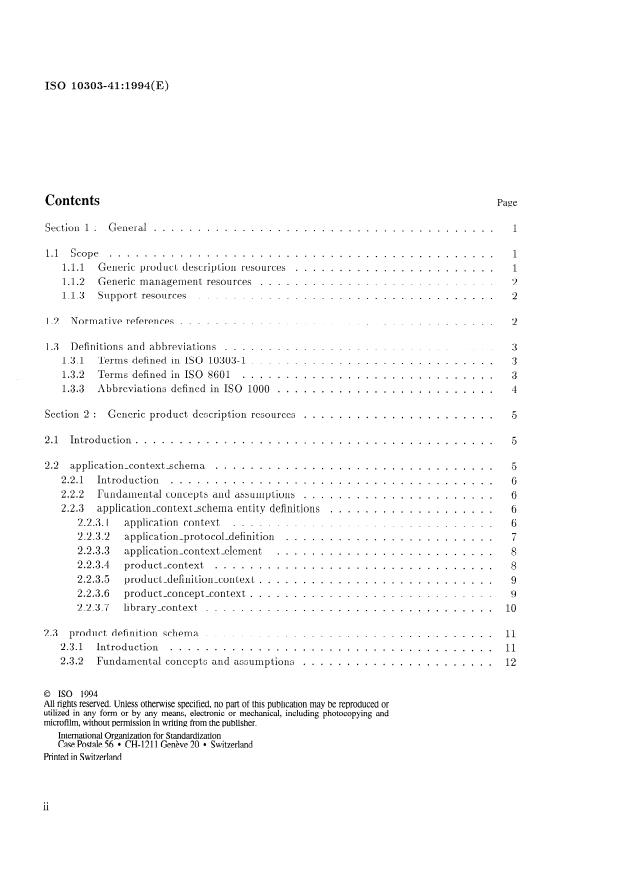
Contents
General
Section 1 : .
1.1 Scope .
1.1.1 Generic product description resources .
1.1.2 Generic management resources .
1.1.3 Support resources .
c
1.2 Normative references .
1.3 Definitions and abbreviations .
1.3.1 Terms defined in ISO 10303-1 .
1.3.2 Terms defined in ISO 8601 .
1.3.3 Abbreviations defined in ISO 1000 .
Section 2 : Generic product description resources .
2.1 Introduction .
2.2 application-context schema . 5
>
2.2.1 Introduction .
2.2.2 Fundamental concepts and assumptions . 6
L
................... 6
2.2.3 application-context schema entitv definitions
s
,
2.2.3.1 applicationcontext . 6
2.2.3.2 application-protocol-definition .
2.2.3.3 application-context -element .
2.2.3.4 product -context . 8
2.2.3.5 product -definition-context . 9
2.2.3.6 product -concept-context . 9
2.2.3.7 library-context 10
.................................
2.3 product -definitionschema .
2.3.1 Introduction 11
.....................................
2.3.2 Fundamental concepts and assumptions .
0 ISO 1994
All rights reserved. Unless otherwise specified, no part of this publication may be reproduced or
utilized in any form or by any means, electronie or mechanical, including photocopying and
microfilm, without permission in writing from the publisher.
International Organization for S tandardization
Case PostaIe 56 l CH-121 1 Geneve 20 l Switzerland
Printed in Switzerland
ISO 1030%41:1994(E)
@ISO
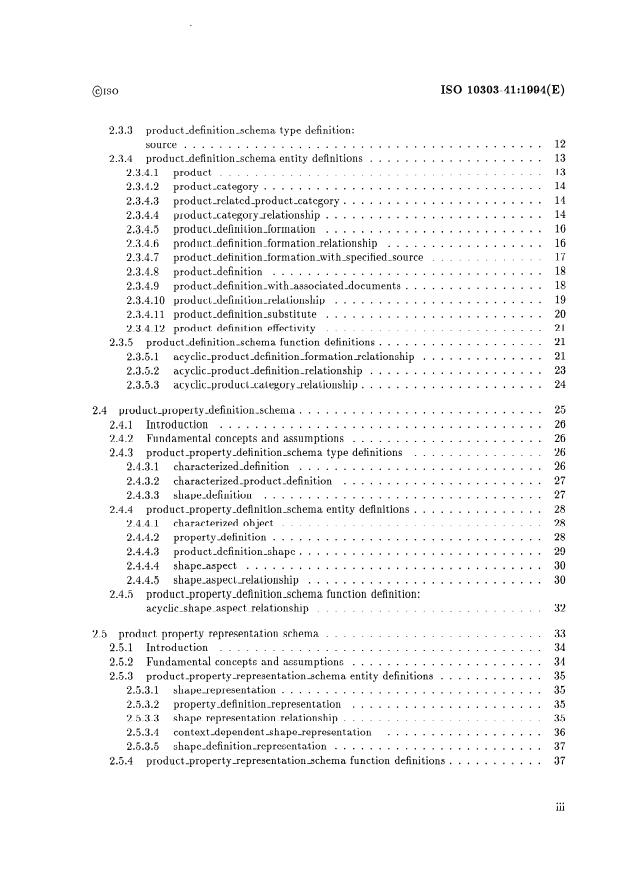
product -definitionschema type definition:
2.3.3
Source. .
.................... 13
2.3.4 product-definitionschema entity definitions
..................................... 13
2.3.4.1 product
................................ 14
2.3.4.2 product -category
2.3.4.3 product -related-product -category . 14
......................... 14
2.3.4.4 product-categoryselationship
......................... 16
2.3.4.5 product -definition-formation
.................. 16
2.3.4.6 product -definition-formationselationship
............. 17
2.3.4.7 product-definition-formation-with-specified_source
............................... 18
2.3.4.8 product-definition
................ 18
2.3.4.9 product-definition-with-associated-documents
........................ 19
2.3.4.10 product -definition-relationship
2.3.4.11 product-definition-Substitute .
......................... 21
2.3.4.12 product-definition-effectivity
2.3.5 product -definitionschema function definitions . 21
.............. 21
2.3.5.1 acyclic-product -definition-formationrelationship
.................... 23
2.3.5.2 acyclic-product -definition-relationship
..................... 24
2.3.5.3 acyclic-product -categoryselationship
............................ 25
2.4 product-property-definition-Schema
2.4.1 Introduction .
2.4.2 Fundamental concepts and assumptions . 26
2.4.3 product -property-definition-schema type definitions .
............................ 26
2.4.3.1 characterized-definition
2.4.3.2 characterized-product -definition .
................................ 27
2.4.3.3 shape-definition
............... 28
2.4.4 product -property-definitionschema entity definitions
2.4.4.1 characterized-Object .
2.4.4.2 property-definition . 28
2.4.4.3 product-definition-shape .
2.4.4.4 shape-aspect .
2.4.4.5 shape-aspectselationship . 30
2.4.5 product -property-definition-Schema function definition:
acyclic-shape-aspect selationship . 32
2.5 product -propertyrepresentation-Schema .
2.5.1 Introduction . 34
......................
2.5.2 Fundamental concepts and assumptions 34
2.5.3 product -property-representationschema entity definitions . 35
2.5.3.1 shape-represent ation .
...................... 35
2.5.3.2 property-definition-representation
....................... 35
2.5.3.3 shape-representationrelationship
.................. 36
2.5.3.4 tontext-dependent-shape-representation
2.5.3.5 shape-definition-representation .
........... 37
2.5.4 product-property-representationschema function definitions
. . .
ISO 10303=41:1994(E) c ISO
2.5.4.1 relatives-of-product -definitions
........................
2.5.4.2 relatives-ofshape-representations
....................... 39
Section 3 :
Management resources . . a . . a . e . l . . . l . . . (I . . . . . . . . . . . . . 41
3.1 Introduction . . . . . . . . . . . . . . . . . . . . . . . . . . . . . . . . . . . . * . . . . 41
3.2 managementresources-Schema
.............................. 41
3.2.1 Introduction
.....................................
3.2.2 Fundamental concepts and assumptions
...................... 42
3.2.3 management resourcesschema entity definitions
.................
3.2.3.1 name-assignment
................................ 42
3.2.3.2 external-referent -assignment
.........................
3.2.3.3 library-assignment
...............................
32.34 document-reference
..............................
3.2.3.5 actionrequest-assignment
..........................
3.2.3.6 action-assignment
...............................
3.2.3.7 certification-assignment
............................
3.2.3.8 approval-assignment
.............................
3.2.3.9 contractassignment
..............................
3.2.3.10 security-classification-assignment
......................
3.2.3.11 person-assignment
...............................
3.2.3.12 organkation-assignment
........................... 47
3.2.3.13 person-and-organkation-assignment
.....................
3.2.3.14 date-assignment
................................
3.2.3.15 time-assignment
................................
3.2.3.16 date-and-time-assignment
.......................... ..
3.2.3.17 group-assignment
...............................
3.2.3.18 effectivity-assignment
.............................
Section 4 : Support resources . . . . . . . . . . . . . . . . . . . . . . . . . . . . . . . . . 51
4.1 Introduction . . . . . . . . . . . . . . . . . . . . . . . . . . . . . . . . . . . . . . . . . 51
4.2 documentschema
......................................
42.1 Introduction
.....................................
4.2.2 Fundamental concepts and assumptions
......................
4.2.3 document Schema entity definitions
.........................
4.2.3.1 document-type
.................................
4.2.3.2 document
....................................
4.2.3.3 document -with-class
..............................
4.2.3.4 document usage-constraint
..........................
4.2.3.5 document _relationship
.............................
4.2.4
document schema function definitiono
acyclic-documentrelationship n 0 D n 0 0 0 0 e . e 0 o 0 0 e D 0 e I . e e o 0 0 D 56
4.3 actionschema. . . l . . l . . . . . . . . l l . . . . e o . . . 0 . . . o ., e J 0 . 0 . ,, c 57
iv
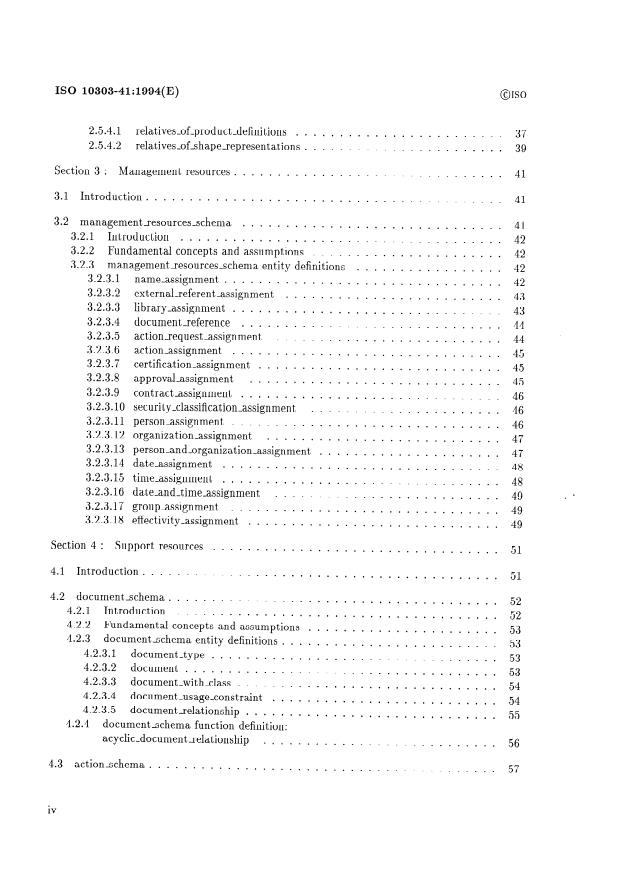
ISO 10303041:1994(E)
@ISO
.....................................
4.3.1 Introduction
......................
4.3.2 Fundamental concepts and assumptions
4.3.3 actionschema type definition:
....................................
supporteditem
4.3.4 actionschema entity definitions .
4.3.4.1 action .
4.3.4.2 executed-action .
.................................
4.3.4.3 directed-action
..................................
4.3.4.4 actionstatus
4.3.4.5 actionsequest -Status .
...............................
4.3.4.6 actionrelationship
4.3.4.7 actionmethod .
.............................
4.3.4.8 actionsequest-Solution
..........................
4.3.4.9 actionmethod-relationship
4.3.4.10 versioned-actionrequest .
.................................
4.3.4.11 action-directive
4.3.4.12 action-resource .
..........................
4.3.4.13 actionsesource-relationship
.............................. 64
4.3.4.14 actionsesource-type
.........................
4.3.5 actionschema function definitions
4.3.5.1 acyclic-action-relationship .
......................
4.3.5.2 acyclic-actionsesourcerelationship
......................
4.3.5.3 acyclic-actionmethod-relationship
....................................
4.4 certificationschema
.....................................
4.4.1 Introduction
......................
4.4.2 Fundamental concepts and assumptions
.......................
4.4.3 certificationschema entity definitions
4.4.3.1 certificationtype .
...................................
4.4.3.2 certification
4.5 approvalschema .
4.5.1 Introduction .
...................... 71
4.5.2 Fundamental concepts and assumptions
.........................
4.5.3 approvalschema entity definitions
................................
4.5.3.1 approvalstatus
4.5.3.2 approval. .
..............................
4.5.3.3 approval-datefirne
......................... 72
4.5.3.4 approval-person-Organkation
..................................
4.5.3.5 approvalrole
.............................
4.5.3.6 approval-relationship
4.5.4 approvalschema function definition:
acyclic-approvalselationship e o e D e 0 0 0 0 0 . D . e o . e o D b o o cI ., 0 0 0 b 73
......................................
4.6 contractschema
.....................................
4.6.1 Introduction
...................... 75
4.6.2 Fundamental concepts and assumptions
V
ISO 10303=41:1994(E)
c ISO
4.63 contractschema entity definitions
.........................
4.6.3.1 contract-type
.................................. 76
4.6.3.2 contract
..................................... 76
4.7 security-classificationschema
............................... 76
4.7.1 Introduction
..................................... 77
4.7.2 Fundamental concepts and assumptions
......................
4.7.3 security-classification-Schema entity definitions
..................
4.7.3.1 security-classificationlevel
.......................... 77
4.7.3.2 security-classification
............................. 78
4.8 person-organizationschema
................................
4.8.1 Introduction
..................................... 79
4.8.2 Fundamental concepts and assumptions
...................... 79
4.8.3 person-organizationschema type definition:
person-organizationselect
............................. 79
4.8.4 personorganization-Schema entity definitions
................... 80
4.8.4.1 address
..................................... 80
4.8.4.2 personal-address
................................ 81
4.8.4.3 organizational-address
............................ 81
4.8.4.4 person
..................................... 82
4.8.4.5 organization
.................................. 82
4.8.4.6 organizational-project
............................. 83
4.8.4.7 person-and-organization
........................... 83
4.8.4.8 organizationselationship
........................... 84
4.8.4.9 person-and-organization-role
......................... 84
4.8.4.10 person-role
...................................
4.8.4.11 organizationrole
............................... 85
4.8.5 person-organization-Schema function definition:
acyclic-organizationrelationship
.......................... 85
4.9 date-time-Schema
...................................... 87
4.9.1 Introduction
..................................... 87
4.9.2 Fundamental concepts and assumptions
...................... 87
4.93 date-time-Schema type definitions
......................... 87
4.9.3.1 date-time-select
................................
4.9.3.2 yearaumber
.................................. 88
4.9.3.3 monthin-yearaumber
............................ 88
4.9.3.4 weekin-yearnumber
.............................. 88
4.9.3.5 dayin-weeknumber
.............................. 89
4.9.3.6 dayin-monthnumber
............................. 89
4.9.3.7 dayin-yearnumber
.............................. 90
4.9.3.8 ahead-or-behind
................................
4.9.3.9 hourin-day
.................................. 90
4.9.3.10 minutein-hour
................................
4.9.3.11 secondinminute
................................................... 91
4.94 date-time-Schema entity definitions
vi
ISO 10303=41:1994(E)
@ISO
.......................................
4.9.4.1 date
.................................
4.9.4.2 calendar-date
.................................. 92
4.9.4.3 ordinal-date
..........................
4.9.4.4 weck-of-year-and-day-date
...................... 93
4.9.4.5 coordinated-universal-time-offset
...................................
4.9.4.6 local-time
.................................
4.9.4.7 date-and-time
.................................
4.9.4.8 date-time-role
....................................
4.9.4.9 dateIole
....................................
4.9.4.10 time_role
.......................
4.9.5 date-time-Schema function definitions
....................................
4.9.5.1 leap-year
.............................. 96
4.9.5.2 valid-calendar-date
...................................
4.9.5.3 valid-time
.......................................
4.10 groupschema
.....................................
4.10.1 Introduction
...................... 99
4.10.2 Fundamental concepts and assumptions
...........................
4.10.3 groupschema entity definitions
......................................
4.10.3.1 group
...............................
4.10.3.2 groupselationship
4.10.4 groupschema function definition:
..............................
acyclic-group-relationship
.....................................
4.11 effectivity-Schema
.....................................
4.11.1 Introduction
...................... 103
4.11.2 Fundamental concepts and assumptions
.........................
4.11.3 effectivityschema entity definitions
.................................... 103
4.11.3.1 effectivity
..........................
4.11.3.2 serialnumbered-effectivity
4.11.3.3 dated-effectivity .
..................................
4.11.3.4 lot-effectivity
................................ 105
4.12 externalseference-Schema
.....................................
4.12.1 Introduction
......................
4.12.2 Fundamental concepts and assumptions
..................... 106
4.12.3 externaLreference_schema type definitions
.....................................
4.12.3.1 message
4.12.3.2 reference .
.................... 107
4.12.4 external-reference-Schema entity definitions
................................. 107
4.12.4.1 extemal-Source
..........................
4.12.4.2 extemal-source-relationship
4.12.4.3 pre-defineditem .
............................ 108
4.12.4.4 externally-defined-item
4.12.5 external-reference-Schema function definition:
........................ 109
acyclic-extemalsource-relationship
..............................
4.12.6 End of Schema declaration
vii
c ISO
ISO 1030%41:1994(E)
4.13 support-resourceschema 110
.................................
4.13.1 Introduction 111
.....................................
4.132 Fundamental concepts and assumptions 111
......................
4.13.3 supportsesource-Schema type definitions . 111
4.13.3.1 identifier 111
....................................
4.13.3.2 label 111
.......................................
4.13.3.3 text
.......................................
4.13.4 support sesource-Schema function definition:
bag-toset
.......................................
4.14 measure-Schema
......................................
4.14.1 Introduction
..................................... 113
4.14.2 Fundamental concepts and assumptions
...................... 114
4.14.3 measureschema type definitions
..........................
4.14.3.1 measure-value
.................................
4.14.3.2 length-measure
................................. 115
4.14.3.3 massmeasure.
.................................
4.14.3.4 timemeasure
.................................. 115
4.14.3.5 electric-current measure
............................
4.14.3.6 thermodynamic-temperaturemeasure
.................... 116
4.14.3.7 amount-ofsubstance-measure
......................... 116
4.14.3.8 luminousintensity-measure
.......................... 116
4.14.3.9 plane-angle.-measure
..............................
4.14.3.10 solid-angle-measure
.............................. 116
4.14.3.11area~neasure
.................................. 117
4.14.3.12voIume-measure
................................ 117
4.14.3.13 ratio-measure
.................................. 117
4.14.3.14 parametervalue
................................ 117
4.14.3.15 numericmeasure
................................ 118
4.14.3.16 positivelength-measure
............................
4.14.3.17 positive-plane-anglezneasure
......................... 118
4.14.3.18 positive-ratiomeasure
.............................
4.14.3.19 context -dependent -measure
.......................... 119
4.14.3.20 descriptive-measure
..............................
4.14.3.21 countmeasure
.................................
4.14.3.22unit
.......................................
4.14.3.23 si-unit-name
..................................
4.14.3.24 si-prefix
.....................................
4.14.4 measureschema entity definitions
.........................
4.14.4.1 named-unit
...................................
4.14.4.2 si-unit
......................................
4.14.4.3 conversion-based-unit
.............................
4.14.4.4 tontext-dependent-unit
............................
4.14.4.5 length-unit
...................................
4.14.4.6 mass-unit
....................................
4.14.4.7 time-unit ,,
.............. 126
......................
0.
Vlll
ISO 10303=41:1994(E)
c ISO
4.14.4.8 electric-current-unit .
......................
4.14.4.9 thermodynamic-temperature-unit
4.14.4.10 amount-ofsubstance-unit .
4.14.4.11 luminousintensity-unit .
4.14.4.12 plane-angle-unit .
4.14.4.13 solid-angleunit .
4.14.4.14 area-unit .
4.14.4. 5 volume-unit .
....................................
4.14.4. 6ratiounit
4.14.4. 7 dimensional-exponents .
4.14.4. 8 derived-unit-element .
4.14.4. 9 derived-unit . . . . . . . . . . . . . . . . . . . . . . . . . . . . . . . . . . . 132
......................... 133
4.14.4.20 global-unit -assigned-context
...............................
4.14.4.21 measure-with-unit
4.14.4.22 length-measure-with-unit .
............................
4.14.4.23 massmeasure-with-unit
4.14.4.24 timemeasure-with-unit .
......................
4.14.4.25 electric-currentmeasure-with-unit
4.14.4.26 thermodynamic-temperaturemeasure-with-unit .
................... 136
4.14.4.27 amount -ofsubstance-measure-with-unit
....................
4.14.4.28 luminous-intensitymeasure-with-unit
4.14.4.29 plane-angle-measure-with-unit .
.........................
4.14.4.30 solid-angle-measure-with-unit
4.14.4.31 areameasure-with-unit .
...........................
4.14.4.32 volume-measure-with-unit
4.14.4.33 ratiomeasure-with-unit .
4.14.5 measureschema function definitions .
4.14.5.1 dimensions-forsi-unit .
4.14.5.2 derive-dimensional-exponent s .
4.14.5.3 valid-units .
Annexes
A Short names of entities . . . . . . . . . . . . . . . . . . . . . . . . . . . . . . . . . . . 145
B Information Object registration .
Bl . Document identification .
Schema identification .
B2 .
.................. 151
B.2.1 application-context schema identification
product-definition-schema identification .
B.2.2
..............
B.2.3 product-property-definitionschema identification
...........
B.2.4 product-property-representationschema identification
................ 152
managementresourcesschema identification
B.2.5
........................
B.2.6 document-Schema identification
actionschema identification .
B.2.7
......................
B.2.8 certification-Schema identification
approvalschema identification .
B.2.9
1x
c ISO
ISO loxw41:1994(E)
B.2.10 contract Schema identification .
security-classification-Schema identification . 152
B.2.11
person-organizationschema identification .
B.2.12
date-time-Schema identification 153
B.2.13 .
groupschema identification . 153
B.2.14
B.2.15 effectivity-Schema identification . . . . . . . . . . . . . . . . . . . . . . . . 153
external-reference-Schema identification 153
B.2.16 .
support sesourceschema identification 153
B.2.17 .
measureschema identification 153
B.2.18 .
Computer-interpretable listings . . . . . . . . . . . . . . . . . . . . . . . . . . . . . . 154
C
Technical discussions 155
D .
D.l Generic product description resource structure . 155
Acyclicity avoidance function template
D.2 . 155
D.2.1 acyclic-Object relationship 155
...........................
D.3 Relationship template 157
................................
ob ject selationship 157
D.3.1 .
E Examples . . . . . . . . . . . . . . . . . . . . . . . . . . . . . . . . . . . . . . . . . . 159
El . Use sf the product-definition-Schema . . . . . . . . . . . . . . . . . . . . . 159
E2 . Use of the generic management resource constructs . . . . . . . . . . . . . . . . 159
EXPRESS-G diagrams . . . . . . . . . . . . . . . w . . . . . . . . . . . . . . . . . . . 161
F
G Bibliography . . . . . . . . . . . . . . . . . . . m .” . . . . . . . . . . . . . ., . . . . . 177
Figures
1 The groupings of resource Schemas into generic product description resources, generic
management resources, and support resources . . . . . . . . . . . . . . . . . . . . . . xv
D.l The structure of the generic product description resource . . . . . . . . . . . . . . . 156
F.l application-contextschema - EXPRESS-G diagram 1 of 1 . . . . . . . . . . . . . . . 162
F.2 product-definitionschema - EXPRESS-G diagram 1 of 1 . . . . . . . . . . . . . . . . 163
F.3 product-property-definitionschema - EXPRESS-G diagram 1 of 1 . . . . . . . . . . 164
F.4 product-propertyrepresentationSchema - EXPRESS-G diagram 1 of 1 . . . . . . . . 165
F.5 managementresources-Schema - EXPRESS-G diagram 1 of 1 . . . . . . . . . . . . . 166
F.6 documentschema - EXPRESS-G diagram 1 of 1 . . . . . . . . . . . . . . . . . . . . 167
F.7 actionschema - EXPRESS-G diagram 1 of 1 . . . . . . . . . . . . . . . . . . . . . . 168
F.8 certification-Schema - EXPRESS-G diagram 1 of 1
................... 168
F.9 approvalschema -
EXPRESS-G diagram 1 of 1
..................... 169
F.10 contractschema - EXPRESS-G diagram 1 of 1 . . . . . . . . . . . . . . . . . . . . . 169
X
ISO 10303=41:1994(E)
c ISO
F.ll security-classification Schema - EXPRESS-G diagram 1 of 1 . 170
F.12 person-organizationschema - EXPRESS-G diagram 1 of 1 . 170
F.13 date-time-Schema - EXPRESS-G diagram 1 of 1 . 171
F.14 groupschema . EXPRESS-G diagram 1 of 1. . 172
F.15 effectivityschema - EXPRESS-G diagram 1 of 1 . 173
F.16 externabeference-Schema . EXPRESS-G diagram 1 of 1 . 174
F.17 support-resource-Schema - EXPRESS-G diagram 1 of 1 . . . . . . . . . . . . . . . . 175
F.18 measureschema - EXPRESS-G diagram 1 of 3 . 175
F.19 measure-schema - EXPRESS-G diagram 2 of 3 . 176
F.20 measureschema - EXPRESS-G diagram 3 of 3 .
Tables
A.1 Short names of entities . . . . . . . . . . . . . . . . . . . . . . . . . . . . . . . . . . . 145
xl
c ISO
ISO lomb4:1994(E)
Foreword
is a worldwide federation of national
The International Organization for Standardization (ISO)
Standards bodies (ISO member bodies). The work of preparing International Standards is nor-
Esch member body interested in a subject
mally carried out through ISO technical committees.
for which a technical committee has been established has the right to be represented on that
committee. International organizations, governmental and non-governmental, in liaison with
ISO, also take part in the work. ISO collaborates closely with the International. Electrotechnical
Commission (IEC) on all matters of electrotechnical standardization.
Draft International Standards adopted by technical committees are circulated to the member
bodies for voting. Publication as an International Standard requires approval bv at least 75%
c
of the member bodies casting a vote.
International Standard ISO 10303-41 was prepared by Technical Committee ISO/TC 184, In-
Subcommittee SC4, Industrial data and global
dustrial automation Systems and integration,
manufacturing programming Eanguages.
ISO 10303 consists of the following Parts under the general title Industrial automation Systems
and integration - Product data representation and exchange:
- Part 1, Overview and fundamental principles;
- Part 11, Description methods: The EXPRESS language reference manual;
- Part 21, Implementation methods: Clear text encoding of the exchange structure;
Part 22, Implementation methods: Standard data access interface specification;
Part 31, Conformance testing methodology and framework: General concepts;
- Part 32, Conformance testing methodology and framework: Requirements on testing
laborat ories and client s;
- Part 41, Integrated generic resources: Fundamentals of product description and support;
-
Part 42, Integrated generic resources:
Geometrie and topological representation;
- Part 43, Integrated generic resources: Representation structures;
Part 44, Integrated generic resources: Product structure configuration;
Part 45, Integrated generic resources: Materials;
-
Part 46, Integrated generic resources: VisuaP presentation;
I
Part 47, Integrated generic resources: Shape Variation tolerantes;
- Part 49, Integrated generic resources: Process structure and properties;
xii
c ISO
- Part 101, Integrated application resources: Draughting;
- Part 104, Integrated application resources: Finite element analysis;
- Part 105, Integrated application resources: Kinematics;
- Part 201, Application protocol: Explicit draughting;
- Part 202, Application protocol: Associative draughting;
- Part 203, Application protocol: Configuration controlled design;
- Part 207, Application protocol: Sheet metal die planning and design;
Part 210, Application protocol: Printed circuit assembly product design data;
-
- Part 213, Application protocol: Numerital control process Plans for machined Parts.
The structure of this International Standard is described in ISO 10303-1. The numbering of the
Parts of this International Standard reflects its structure:
- Part 11 specifies the description methods;
- Parts 21 and 22 specify the implementation methods;
- Parts 31 and 32 specify the conformance testing methodology and framework;
- Parts 41 to 49 specify the integrated generic resources;
- Parts 101 to 105 specify the integrated application resources;
- Parts 201 to 213 specify the application protocols.
Should further Parts be published, they will follow the same numbering Pattern.
Annexes A and B form an integral part of this part of ISO 10303. Annexes C, D, E and F are
for information only.
Diskette
Users should note that this part of ISO 10303 comprises a diskette:
- the short names of entities given in annex A are also included on the diskette;
- the EXPRESS listings (annex C) are provided on the diskette only;
a method to enable users to report errors in the documentation is given. Full details are
provided in the file.
. . .
Xlll
c ISO
Introduction
ISO 10303 is an International Standard for the computer-interpretable representation and ex-
Change of product data. The objective is to provide a neutral mechanism capable of describing
product data throughout the life cycle of a product independent from any particular System.
The nature of this description makes it suitable not only for neutral file exchange, but also as a
basis for implementing and sharing product databases and archiving.
This International Standard is organized as a series of Parts, each published separately. The
Parts of ISO 10303 fall into one of the following series: description methods, integrated resources,
application protocols, abstract test suites, implementation methods, and conformance testing.
The series are described in ISO 103034. This part of ISO 10303 is a member of the integrated
resources series. Major subdivisions of this International Standard are:
- generic product description resources;
- generic management resources;
-
support resources.
The groupings of resource Schemas into these major subdivisions are shown in figure 1.
The generic product description resources provide an Overall organization for the integrated
resources that are documented in other Parts of ISO 10303. They support the description of
application-independent facts that are common to all products. In this part the combination
of the generic product description resources and the ISO 10303 integrated resources that are
defined in the other Parts that belong to the integrated resources class is referred to as the
“integrated product description resources” .
The generic management resources support the description of information that is used to man-
age and control product data. Together, the integrated product description resources and the
generic management resources are the foundations upon which application interpreted models,
the normative conceptual Schemas of application protocols, are built. Application interpreted
models apply selected generic management resources to elements of the integrated product de-
scription resources to satisfy the requirements that are specified in the appropriate application
reference model.
The support resources are a set of sh ared resour ‘ce cons tructs that
are used by the ISO 10303
integrated resources. They provi de an underlying consist ency across the resources of ISO
10303.
xiv
c ISO ISO 10303-41:1994(E)
Generic product
Support resources
description resources
applicationxontextschema
productdefinitionschema
product-property-
1 certificationschema 1 : measureschema 1
definitionschema
product-property-
representationschema
security-
date-timeschema
classificationschema
l 1 I 1
supportresource-
documentschema
Schema
/ I
Management resources
l I L 1
managementresources-
effectivityschema
Schema
I
- The groupings of resource Schemas into generic product description
Figure 1
resources, generic management resources, and support resources
xv
This page intentionally left blank
INTERNATIONAL STANDARD @ISO ISO 10303041:1994(E)
Industrial automation Systems and integration -
Product data representation and exchange -
Part 41 :
Integrated generic resources:
Fundamentals of product description and support
Section 1 : General
1.1 Scope
This part of ISO 10303 specifies the following:
- generic product description resources (section 2);
- generic management resources (section 3);
\
- support resources (section 4).
The Schemas which are specified in this part of ISO 10303 are organized according to these
sections.
1 .l .l Generic product description resources
This section of ISO 10303-41 specifies the resource constructs for the high level structure for
the representation of products and their properties. It also specifies ISO 10303 integrated re-
sources for the description of generic aspects of product usage, categorization of products and
associations between products.
The following are within scope in this section:
- the identification of a product;
-
the categorization of products;
- the specification of definitions of, relationships among, and allowable Substitutions for
a product ;
- the specification of the representation of the shape of a product;
- the specification of the representation of the properties of a product;
- the description of the application context for which product data is defined.
c ISO
ISO 10303=41:1994(E) 0
Generic management resources
1 .1.2
This section of ISO 10303-41 specifies the resource constructs for the structures that are used
to associate administrative data with product data.
The following are within scope in this section:
-
the structure for connecting product data within an application context to related ad-
ministrative data.
1.1.3 Support resources
This section of ISO 10303-41 specifies the resource constructs for administrative data, physical
quantities and their units, and basic data types.
The following are within scope in this section:
-
the description of references to documents;
-
the descriptions of actions, action requests, and the Status of actions;
-
the descriptions of certification, approvals, security classifications, and effectivities;
-
the identification of contracts;
-
the identification of People and Organkations;
-
the specification of dates and times;
-
that is
t he Provision of mechanisms for grouping items and referring t 0 informat ion
defined outside an exchange;
- the definition of physical quantities and their units.
1.2 Normative references
The following Standards contain provisions which, through reference in this text, constitute
provisions of this part of ISO 10303. At the time of publication, the editions indicated were
valid. All Standards are subject to revision, and Parties to agreements based on this part of
ISO 10303. are encouraged to investigate the possibility of applying the most recent editions of
the Standards indicated below. Members of IEC and ISO maintain registers of currently valid
International Standards.
ISO 31-0:1992, Q uantities and units.
ISO 1000:1981, SI units and recommendations for the use of their multipkes and of certain other
units.
ISO 10303941:1994(E)
c ISO
ISO 8601:1988, Date elements and interchange formats - Information interchange - Represen-
tations of dates and times.
ISO 8824-l:- 1J , Information Technology - Open Systems Interconnection - Abstract Syntax No-
tation One (ASN.1) - Part 1: Specification of Basic Notation.
- Product data representation
ISO 10303-lA994, Industrial automation Systems and integration
and exchange - Part 1: Overview and fundamental principles.
ISO 1030311:1994, Industrial automation Systems and integration - Product data representa-
tion and exchange - Part 11: EXPRESS language reference manual.
ISO 10303-43:1994, Industrial automation Systems and integration - Product data representa-
tion and exchange - Part 43: Integrated resources: Representation structures.
ISO 10303-44:1994, Industrial automation Systems and integration - Product data representa-
tion and exchange - Part 44: Integrated resources: Product structure configuration.
I .3 Definitions and abbreviations
1.3.1 Terms defined in ISO 10303-1
This Part of ISO 10303 makes use of the following terms defined in ISO 10303-1:
-
application;
cation context ;
aPPfi
-
application interpreted model;
application protocol;
application reference model;
interpretation;
-
product.
1.3.2 Terms defined in ISO 8601
This part of ISO 10303 makes use of the following terms defined in ISO 8601:
-
calendar date;
l)To be published.
-
ordinal date;
second;
-
minute;
- hour;
-
daY ;
-
week;
-
calendar week;
-
month;
- year;
-
calendar year;
-
common year;
- leap year;
- local time;
- Coordinated Universal Time;
- Gregorian Calendar.
1.3.3 Abbreviations defined in ISO 1000
This part of ISO 10303 makes use of the following abbreviation defined in ISO 1000:
- SI International System of Units.
1st) 10303-41:1994(E)
c ISO
Section 2 : Generic product description resources
2.1 Introduction
This section specifies the ISO 10303 integrated resources used for the high-level description of a
product. The following Schemas are included:
-
application-contextschema;
- product-definition-Schema;
-
product erty-definitionschema;
-ProP
-
product-propertyrepresentation-Schema.
The application-tontext-Schema supports the description of the applicable usage of product
data.
The product-definitionschema supports the description of the identification of products,
the categorization of products, and the relationships among the definitions of products.
The product-property-definition-Schema supports the description of the characteristics of
a product.
The product-propertyrepresentationschema describes the structure for representing the
shape characteristics of a product.
NOTE 1 - This part is not limited to the domain of a specific application context. The reader
should not be misled by the deliberately limited scope of the examples.
NOTE 2 - The way in which the support resources are associated with the generic product descrip-
tion resources is described in annex E.
2.2 application-contextschema
The following EXPRESS declaration begins the application-tontext-Schema and identifies
the necessary external references.
EXPRESS specification:
*l
SCHEMA application-tontext-Schema;
REFERENCE FROM support-resource-Schema
(label,
text);
c ISO
REFERENCE FROM date-time-Schema
(year-number);
(*
NOTES
1 - The Schemas referenced above tan be found in the following Parts of ISO 10303:
clause 4.13 of this part of ISO 10303
support resourceschema
clause 4.9 of this part of ISO 10303
date-timeschema
2- See annex F, figure F.l, for a graphical presentation of this Schema.
3 - This Schema is one of the generic product description resource Schemas. The relationships
between the generic product description resource Schemas are given in annex D.
2.2.1 Introduction
This clause defines requirements for the application-tontext-Schema. This Schema defines
a mechanism for application protocols to define a frame of reference or context that applies to
particular sets of product data. An Overall application context has several context elements.
Esch context element may be referenced by a different aspect of product data.
A means is provided for users of product data to identify the application interpreted model in
terms of which that product data is defined.
2.2.2 Fundamental concepts and assumptions
The meaningful exchange of product data requires the identification of the application context
in which that product data is defined. One element of an application context is the application
interpreted model which is used. Esch application interpreted model belongs to one, and only
one, application protocol. Since all application interpreted models in ISO 10303 have unique
names, identification of an application interpreted model Schema name also uniquely identifies
an application protocol. Applications which use product data require information that identifies
the application interpreted model that defines the content and logical structure of the product
data.
2.2.3 application-contextschema entity definitions
2.2.3.1 application-context
An application-context is a context in which product data is defined. An application--
context represents various types of information which relate to product data and may affect
the meaning and usage of that data.
EXPRESS specification:
*>
ENTITY application-context;
c ISO ISO 10303~41:1994(E)
application : text;
INVERSE
tontext-elements : SET [I:?] OF applicationrcontext-element
FOR frame-of-reference;
END-ENTITY;
(*
Attribute definitions:
applicat ion: a description of the usage of the product data.
tontext-elements: there shall be at least one application-tontext-element associated with
the application-context.
2.2.3.2 application-protocol-definition
An application-protocol-definition is a definition of an application protocol.
EXPRESS specification:
*)
ENTITY application-protocolrdefinition;
Status : label;
applicationrinterpreted-modelrschemarname : label;
application~protocol~year : year-number;
application : ap
...
Questions, Comments and Discussion
Ask us and Technical Secretary will try to provide an answer. You can facilitate discussion about the standard in here.
Loading comments...