


ISO/IEC 15457-3:2002
(Main)Identification cards — Thin flexible cards — Part 3: Test methods
Identification cards — Thin flexible cards — Part 3: Test methods
Thin flexible cards, the subject of this International Standard, are used to automate the controls for access to goods or services such as mass transit, highway toll systems, car parks, vouchers, stored value, etc. For these applications, data can be written and/or read by machines using various recording techniques such as magnetic stripe, optical character recognition (OCR), bar code, etc. This part of ISO/IEC 15457 specifies the test methods and procedures required to carry out measurements of the magnetic stripe and encoding characteristics of thin flexible cards. Many of the standard methods available for checking physical properties of base materials are intended to be applied to samples cut from continuous material or large sheets. However, all test methods given herein, unless explicitly stated otherwise, apply to finished cards. The test methods described are to be performed on separate samples. It is not intended that any individual card should pass through more than one test procedure, unless explicitly stated. Acceptance criteria do not form part of this standard.
Cartes d'identification — Cartes flexibles fines — Partie 3: Méthodes d'essai
General Information
- Status
- Withdrawn
- Publication Date
- 05-Jun-2002
- Withdrawal Date
- 05-Jun-2002
- Technical Committee
- ISO/IEC JTC 1/SC 17 - Cards and security devices for personal identification
- Current Stage
- 9599 - Withdrawal of International Standard
- Start Date
- 18-Feb-2008
- Completion Date
- 14-Feb-2026
Relations
- Effective Date
- 15-Apr-2008
Get Certified
Connect with accredited certification bodies for this standard

BSI Group
BSI (British Standards Institution) is the business standards company that helps organizations make excellence a habit.

NYCE
Mexican standards and certification body.
Sponsored listings
Frequently Asked Questions
ISO/IEC 15457-3:2002 is a standard published by the International Organization for Standardization (ISO). Its full title is "Identification cards — Thin flexible cards — Part 3: Test methods". This standard covers: Thin flexible cards, the subject of this International Standard, are used to automate the controls for access to goods or services such as mass transit, highway toll systems, car parks, vouchers, stored value, etc. For these applications, data can be written and/or read by machines using various recording techniques such as magnetic stripe, optical character recognition (OCR), bar code, etc. This part of ISO/IEC 15457 specifies the test methods and procedures required to carry out measurements of the magnetic stripe and encoding characteristics of thin flexible cards. Many of the standard methods available for checking physical properties of base materials are intended to be applied to samples cut from continuous material or large sheets. However, all test methods given herein, unless explicitly stated otherwise, apply to finished cards. The test methods described are to be performed on separate samples. It is not intended that any individual card should pass through more than one test procedure, unless explicitly stated. Acceptance criteria do not form part of this standard.
Thin flexible cards, the subject of this International Standard, are used to automate the controls for access to goods or services such as mass transit, highway toll systems, car parks, vouchers, stored value, etc. For these applications, data can be written and/or read by machines using various recording techniques such as magnetic stripe, optical character recognition (OCR), bar code, etc. This part of ISO/IEC 15457 specifies the test methods and procedures required to carry out measurements of the magnetic stripe and encoding characteristics of thin flexible cards. Many of the standard methods available for checking physical properties of base materials are intended to be applied to samples cut from continuous material or large sheets. However, all test methods given herein, unless explicitly stated otherwise, apply to finished cards. The test methods described are to be performed on separate samples. It is not intended that any individual card should pass through more than one test procedure, unless explicitly stated. Acceptance criteria do not form part of this standard.
ISO/IEC 15457-3:2002 is classified under the following ICS (International Classification for Standards) categories: 35.240.15 - Identification cards. Chip cards. Biometrics. The ICS classification helps identify the subject area and facilitates finding related standards.
ISO/IEC 15457-3:2002 has the following relationships with other standards: It is inter standard links to ISO/IEC 15457-3:2008. Understanding these relationships helps ensure you are using the most current and applicable version of the standard.
ISO/IEC 15457-3:2002 is available in PDF format for immediate download after purchase. The document can be added to your cart and obtained through the secure checkout process. Digital delivery ensures instant access to the complete standard document.
Standards Content (Sample)
INTERNATIONAL ISO/IEC
STANDARD 15457-3
First edition
2002-06-01
Identification cards — Thin flexible cards —
Part 3:
Test methods
Cartes d'identification — Cartes flexibles fines —
Partie 3: Méthodes d'essai
Reference number
©
ISO/IEC 2002
PDF disclaimer
This PDF file may contain embedded typefaces. In accordance with Adobe's licensing policy, this file may be printed or viewed but shall not
be edited unless the typefaces which are embedded are licensed to and installed on the computer performing the editing. In downloading this
file, parties accept therein the responsibility of not infringing Adobe's licensing policy. The ISO Central Secretariat accepts no liability in this
area.
Adobe is a trademark of Adobe Systems Incorporated.
Details of the software products used to create this PDF file can be found in the General Info relative to the file; the PDF-creation parameters
were optimized for printing. Every care has been taken to ensure that the file is suitable for use by ISO member bodies. In the unlikely event
that a problem relating to it is found, please inform the Central Secretariat at the address given below.
© ISO/IEC 2002
All rights reserved. Unless otherwise specified, no part of this publication may be reproduced or utilized in any form or by any means, electronic
or mechanical, including photocopying and microfilm, without permission in writing from either ISO at the address below or ISO's member body
in the country of the requester.
ISO copyright office
Case postale 56 • CH-1211 Geneva 20
Tel. + 41 22 749 01 11
Fax + 41 22 749 09 47
E-mail copyright@iso.ch
Web www.iso.ch
Printed in Switzerland
ii © ISO/IEC 2002 – All rights reserved
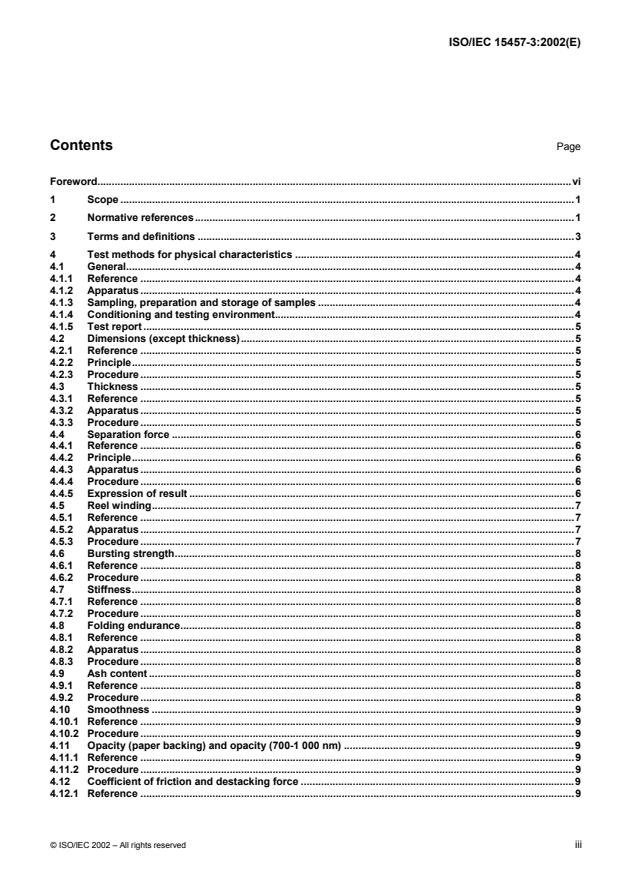
Contents Page
Foreword.vi
1 Scope .1
2 Normative references.1
3 Terms and definitions .3
4 Test methods for physical characteristics .4
4.1 General.4
4.1.1 Reference .4
4.1.2 Apparatus .4
4.1.3 Sampling, preparation and storage of samples .4
4.1.4 Conditioning and testing environment.4
4.1.5 Test report .5
4.2 Dimensions (except thickness).5
4.2.1 Reference .5
4.2.2 Principle.5
4.2.3 Procedure .5
4.3 Thickness .5
4.3.1 Reference .5
4.3.2 Apparatus .5
4.3.3 Procedure .5
4.4 Separation force .6
4.4.1 Reference .6
4.4.2 Principle.6
4.4.3 Apparatus .6
4.4.4 Procedure .6
4.4.5 Expression of result .6
4.5 Reel winding.7
4.5.1 Reference .7
4.5.2 Apparatus .7
4.5.3 Procedure .7
4.6 Bursting strength.8
4.6.1 Reference .8
4.6.2 Procedure .8
4.7 Stiffness.8
4.7.1 Reference .8
4.7.2 Procedure .8
4.8 Folding endurance.8
4.8.1 Reference .8
4.8.2 Apparatus .8
4.8.3 Procedure .8
4.9 Ash content .8
4.9.1 Reference .8
4.9.2 Procedure .8
4.10 Smoothness .9
4.10.1 Reference .9
4.10.2 Procedure .9
4.11 Opacity (paper backing) and opacity (700-1 000 nm) .9
4.11.1 Reference .9
4.11.2 Procedure .9
4.12 Coefficient of friction and destacking force .9
4.12.1 Reference .9
© ISO/IEC 2002 – All rights reserved iii
4.12.2 Procedure .9
4.13 Reflectance factor.10
4.13.1 Reference.10
4.13.2 Procedure .10
4.14 Air permeance.10
4.14.1 Reference.10
4.14.2 Procedure .10
4.15 Sizing and pen-writing factor .11
4.15.1 Reference.11
4.15.2 Principle.11
4.15.3 Apparatus and reagents.11
4.15.4 Preparation of test pieces.12
4.15.5 Procedure .12
4.15.6 Expression of results .13
4.16 Tear resistance.13
4.16.1 Reference.13
4.16.2 Procedure .13
4.17 Delamination resistance .13
4.17.1 Reference.13
4.17.2 Principle.14
4.17.3 Apparatus .14
4.17.4 Preparation for test.15
4.17.5 Procedure .15
4.17.6 Expression of results .16
4.17.7 Test report .16
4.18 Cold-crack temperature (brittleness).18
4.18.1 Reference.18
4.18.2 Procedure .18
4.18.3 Expression of results .18
5 Test methods for magnetic stripe physical characteristics.19
5.1 Preparation and storage of samples.19
5.2 Conditioning and test environments .19
5.3 Protrusion.19
5.3.1 Reference.19
5.3.2 Principle.19
5.3.3 Apparatus .19
5.3.4 Procedure .20
5.4 Profile deviation.20
5.4.1 Reference.20
5.4.2 Principle.20
5.4.3 Procedure .20
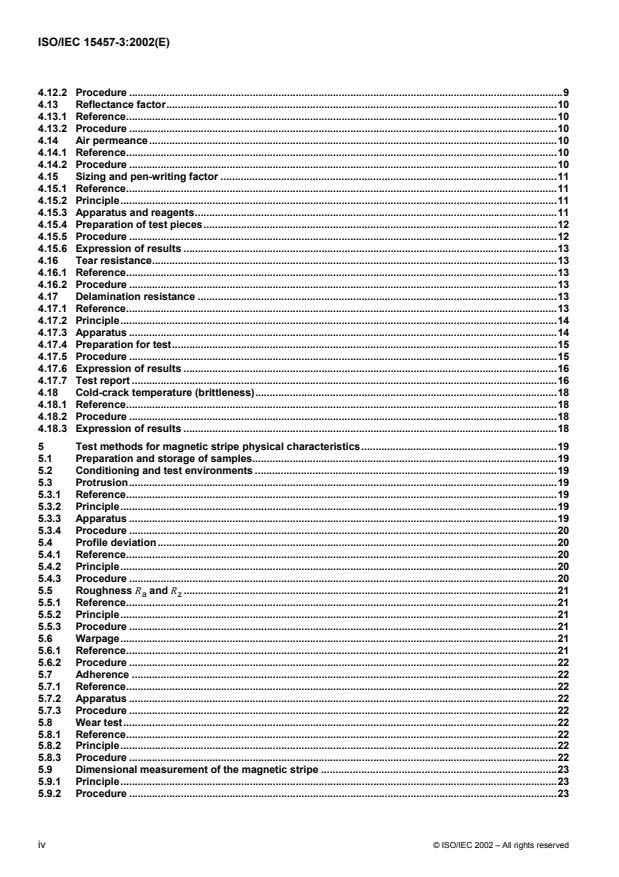
5.5 Roughness R and R .21
a z
5.5.1 Reference.21
5.5.2 Principle.21
5.5.3 Procedure .21
5.6 Warpage.21
5.6.1 Reference.21
5.6.2 Procedure .22
5.7 Adherence .22
5.7.1 Reference.22
5.7.2 Apparatus .22
5.7.3 Procedure .22
5.8 Wear test.22
5.8.1 Reference.22
5.8.2 Principle.22
5.8.3 Procedure .22
5.9 Dimensional measurement of the magnetic stripe .23
5.9.1 Principle.23
5.9.2 Procedure .23
iv © ISO/IEC 2002 – All rights reserved
6 Test methods for static magnetic characteristics.23
6.1 Principle.23
6.2 Apparatus .23
6.3 Preparation and storage of sample .24
6.3.1 Preparation.24
6.3.2 Storage.24
6.3.3 Conditioning and testing environment.24
6.4 Procedure .24
6.4.1 VSM .24
6.4.2 HM .25
6.5 Expression of results .25
6.6 Coercivity, H .26
cM
6.6.1 Reference .26
6.6.2 Procedure .26
6.7 Squareness, SQ .27
6.7.1 Reference .27
6.7.2 Procedure .27
6.8 Switching field distribution, (SF ) .27
D
6.8.1 Reference .27
6.8.2 Procedure .27
6.9 Test report .27
7 Test method for dynamic magnetic characteristics .28
7.1 Principle.28
7.2 Reference cards.28
7.3 Apparatus .28
7.3.1 Measuring instrument for classes L and S .28
7.3.2 Measuring instrument for class H.28
7.4 Preparation and preservation of test samples .28
7.4.1 Preparation.29
7.4.2 Preservation .29
7.4.3 Conditioning and testing environment.29
7.5 Test procedure.29
7.5.1 Test densities (D and D ).29
max min
7.6 Expression of results .29
7.6.1 Resolution .29
7.6.2 Modulation.30
7.7 Test report .30
Bibliography.31
© ISO/IEC 2002 – All rights reserved v
Foreword
ISO (the International Organization for Standardization) and IEC (the International Electrotechnical Commission)
form the specialized system for worldwide standardization. National bodies that are members of ISO or IEC
participate in the development of International Standards through technical committees established by the
respective organization to deal with particular fields of technical activity. ISO and IEC technical committees
collaborate in fields of mutual interest. Other international organizations, governmental and non-governmental, in
liaison with ISO and IEC, also take part in the work. In the field of information technology, ISO and IEC have
established a joint technical committee, ISO/IEC JTC 1.
International Standards are drafted in accordance with the rules given in the ISO/IEC Directives, Part 3.
The main task of the joint technical committee is to prepare International Standards. Draft International Standards
adopted by the joint technical committee are circulated to national bodies for voting. Publication as an International
Standard requires approval by at least 75 % of the national bodies casting a vote.
Attention is drawn to the possibility that some of the elements of this part of ISO/IEC 15457 may be the subject of
patent rights. ISO and IEC shall not be held responsible for identifying any or all such patent rights.
ISO/IEC 15457-3 was prepared by Joint Technical Committee ISO/IEC JTC 1, Information technology,
Subcommittee SC 17, Identification cards and related devices.
ISO/IEC 15457 consists of the following parts, under the general title Identification cards — Thin flexible cards:
Part 1: Physical characteristics
Part 2: Magnetic recording techniques
Part 3: Test methods
vi © ISO/IEC 2002 – All rights reserved
INTERNATIONAL STANDARD ISO/IEC 15457-3:2002(E)
Identification cards — Thin flexible cards —
Part 3:
Test methods
1 Scope
Thin flexible cards, the subject of this International Standard, are used to automate the controls for access to goods
or services such as mass transit, highway toll systems, car parks, vouchers, stored value, etc.
For these applications, data can be written and/or read by machines using various recording techniques such as
magnetic stripe, optical character recognition (OCR), bar code, etc.
This part of ISO/IEC 15457 specifies the test methods and procedures required to carry out measurements of the
magnetic stripe and encoding characteristics of thin flexible cards.
Many of the standard methods available for checking physical properties of base materials are intended to be
applied to samples cut from continuous material or large sheets. However, all test methods given herein, unless
explicitly stated otherwise, apply to finished cards.
The test methods described are to be performed on separate samples. It is not intended that any individual card
should pass through more than one test procedure, unless explicitly stated.
Acceptance criteria do not form part of this standard.
2 Normative references
The following normative documents contain provisions which, through reference in this text, constitute provisions of
this part of ISO/IEC 15457. For dated references, subsequent amendments to, or revisions of, any of these
publications do not apply. However, parties to agreements based on this part of ISO/IEC 15457 are encouraged to
investigate the possibility of applying the most recent editions of the normative documents indicated below. For
undated references, the latest edition of the normative document referred to applies. Members of ISO and IEC
maintain registers of currently valid International Standards.
ISO 186, Paper and board — Sampling to determine average quality
ISO 187, Paper, board and pulps — Standard atmosphere for conditioning and testing and procedure for
monitoring the atmosphere and conditioning of samples
ISO 284, Conveyor belts — Electrical conductivity — Specification and method of test
ISO 291, Plastics — Standard atmospheres for conditioning and testing
ISO 527-3, Plastics — Determination of tensile properties — Part 3: Test conditions for films and sheets
ISO 534, Paper and board — Determination of thickness and apparent bulk density or apparent sheet density
ISO 1831, Printing specifications for optical character recognition
© ISO/IEC 2002 – All rights reserved 1
ISO 1924-2, Paper and board — Determination of tensile properties — Part 2: Constant rate of elongation method
ISO 2144, Paper, board and pulps — Determination of residue (ash) on ignition at 900 °C
ISO 2409, Paints and varnishes — Cross-cut test
ISO 2471, Paper and board — Determination of opacity (paper backing) — Diffuse reflectance method
ISO 2758, Paper — Determination of bursting strength
ISO 3274, Geometrical Product Specifications (GPS) — Surface texture: Profile method — Nominal characteristics
of contact (stylus) instruments
ISO 4094, Paper, board and pulps — International calibration of testing apparatus — Nomination and acceptance
of standardizing and authorized laboratories
ISO 4287-1, Surface roughness — Terminology — Part 1: Surface and its parameters
ISO 4593, Plastics — Film and sheeting — Determination of thickness by mechanical scanning
ISO 5626, Paper — Determination of folding endurance
ISO 5627, Paper and board — Determination of smoothness (Bekk method)
ISO 5629, Paper and board — Determination of bending stiffness — Resonance method
ISO 5636-3, Paper and board — Determination of air permeance (medium range) — Part 3: Bendtsen method
ISO 6383-2, Plastics — Film and sheeting — Determination of tear resistance — Part 2: Elmendorf method
ISO 8226-2, Paper and board — Measurement of hygroexpansivity — Part 2: Hygroexpansivity up to a maximum
relative humidity of 86 %
ISO 8295, Plastics — Film and sheeting — Determination of coefficients of friction
ISO 8570, Plastics — Film and sheeting — Determination of cold-crack temperature
ISO/IEC 7811-2, Identification cards — Recording technique — Part 2: Magnetic stripe — Low coercivity
ISO/IEC 7811-6, Identification cards — Recording technique — Part 6: Magnetic stripe — High coercivity
ISO/IEC 10373-1, Identification cards — Test methods — Part 1: General characteristics tests
ISO/IEC 10373-2, Identification cards — Test methods — Part 2: Cards with magnetic stripes
ISO/IEC 15457-1, Identification cards — Thin flexible cards — Part 1: Physical characteristics
ISO/IEC 15457-2, Identification cards — Thin flexible cards — Part 2: Magnetic recording technique
IEC 60050-221, International Electrotechnical Vocabulary — Chapter 221: Magnetic materials and components
IEC 60454-2, Specifications for pressure-sensitive adhesive tapes for electrical purposes — Part 2: Methods of test
2 © ISO/IEC 2002 – All rights reserved
3 Terms and definitions
For the purposes of this part of ISO/IEC 15457, the terms and definitions given in ISO/IEC 15457-1,
ISO/IEC 15457-2 and the following apply.
3.1
substrate
material of which the TFC is made without any recording media
3.2
composite
material made from at least two layers of different material, one of which is paper
3.3
reference signal amplitude
U
R
primary standard read back signal amplitude; the maximum value of the average signal amplitude of the reference
card, corrected to the primary standard
3.4
reference write current
I
R
primary standard write current, obtained from the secondary reference card by measurement
3.5
reference flux
F
R
flux in the test write head when the write current is I
R
3.6
test piece
part of the sample or test sample on which the test is conducted
3.7
uncertainty of measurement
an estimate characterising the range of values within which the true value of a measurand lies
[International vocabulary of basic and general terms in metrology]
3.8
〈〈〈〈optical〉〉〉〉 transmittance factor
T
ratio of the measured 〈optical〉 flux transmitted by a specimen to the measured flux when the specimen is removed
from the sampling aperture of the measuring device:
T = Φ /Φ
τ j
where
T is the transmittance factor;
Φ is the transmitted 〈optical〉 flux;
τ
Φ is the aperture flux.
j
[ISO 5-2:1991]
© ISO/IEC 2002 – All rights reserved 3
3.9
opacity
〈〈〈〈optical〉〉〉〉 transmission density
D
T
logarithm to the base 10 of the reciprocal of the transmittance factor:
D = log 1/T = log Φ /Φ
T 10 10 j τ
[ISO 5-2:1991]
4 Test methods for physical characteristics
4.1 General
4.1.1 Reference
ISO/IEC 15457-1, Physical characteristics.
4.1.2 Apparatus
In order to obtain consistent and reproducible results, the apparatus and test devices used to carry out the tests
shall comply with ISO 4094, wherever applicable.
4.1.3 Sampling, preparation and storage of samples
4.1.3.1 Sampling
The sampling shall be in accordance with Table 1.
In certain cases samples may be taken from the base material before card manufacture if it can be demonstrated
that no significant change in the property to be tested can arise during subsequent processing.
The samples used to prepare a set of test pieces shall be taken from the same batch of TFC base material.
4.1.3.2 Preparation
Test samples shall wherever possible be either finished cards or prepared from finished cards. They shall be
conditioned in accordance with 4.1.4.
Test pieces shall, as necessary, be prepared from the test samples in the particular form required by the test
apparatus used.
4.1.3.3 Storage
Any test samples or test pieces retained for reference shall be stored under the environmental conditions specified
in 5.3.2 of ISO/IEC 15457-1 in such a manner that degradation due to moisture, light, physical distortion,
plasticisers and other contamination shall not occur.
All such samples shall be clearly cross-referenced to the test report and any relevant supplementary
documentation.
4.1.4 Conditioning and testing environment
Unless otherwise specified, the conditioning of test samples, and environment for the tests specified in this
standard shall be in accordance with Table 1.
4 © ISO/IEC 2002 – All rights reserved
Table 1 — Sampling, conditioning and test environment parameters
Conditioning and testing Conditioning and testing
Card material Sampling
a
environment standard environment atmosphere
Paper ISO 186 ISO 187 23 °C/50 °C ordinary tolerances
Composite ISO 186 ISO 187 23 °C/50 °C ordinary tolerances
Plastic ISO 186 ISO 291 normal atmosphere 23 °C/50 °C
a
“Ordinary tolerances” and “normal atmosphere” are explicit terms taken from the referenced standards.
4.1.5 Test report
The test report shall be accurate, clear and ensure full traceability.
4.2 Dimensions (except thickness)
4.2.1 Reference
ISO/IEC 15457-1, Geometry.
ISO/IEC 15457-1, Positioning features.
4.2.2 Principle
The principle is direct linear measurement. The dimensions shall be measured with an accuracy appropriate to the
tolerance of the prescribed value of the characteristics of ISO/IEC 15457-1.
4.2.3 Procedure
Measure TFC dimensions using a method and apparatus that ensures a total measurement uncertainty equal to or
less than 25 % of the absolute value of the tolerance of the dimension to be checked.
EXAMPLE Value = d mm ± 0,2 mm; total uncertainty u 0,05 mm.
During the performance of the measurement, ensure that any mechanical force applied to the edge of the card
during measurement does not exceed 6 N per 10 mm length.
NOTE An optical method may be used.
4.3 Thickness
4.3.1 Reference
ISO/IEC 15457-1, Annex A or B.
4.3.2 Apparatus
Dead weight micrometer.
4.3.3 Procedure
Determine the thickness of paper or composite TFCs in accordance with ISO 534, using a pressure of 100 kPa,
outside the data recording area. Thickness shall be the average measurement of three different measurements
taken on the same card in three different locations.
© ISO/IEC 2002 – All rights reserved 5
4.4 Separation force
4.4.1 Reference
ISO/IEC 15457-1, Separation force.
ISO/IEC 15457-1, Perforations.
4.4.2 Principle
To measure, in the direction of the width of the samples, the force needed to break the bridges of the perforated
line between two parts of a card or between two cards.
4.4.3 Apparatus
A tensile tester, including a dynamometer able to apply a force of at least 500 N with a speed of 100 mm/min.
Figure 1 shows the arrangement of the test piece in the apparatus.
Figure 1 — Test arrangement for separation force
4.4.4 Procedure
Take sufficient samples to prepare ten test pieces which include the perforation line to be tested and prepare the
test pieces such that the test is carried out on the full height of the card.
Carefully open out any test pieces which are folded. Keep five test pieces unfolded and fold all the other test pieces
5 times through an angle of 180° (i.e. from the fully open state to the fully closed state).
Measure the separation force for each test piece at a speed of 100 mm/min.
4.4.5 Expression of result
For each test, before or after folding, express the result as the average value of the individual values.
6 © ISO/IEC 2002 – All rights reserved
4.5 Reel winding
4.5.1 Reference
ISO/IEC 15457-1, Reel.
4.5.2 Apparatus
The apparatus shall have the following characteristics:
a flat level surface;
two bars made of a non-ferrous metal with the following dimensions:
width: 9 mm ± 1 mm,
height: 15 mm ± 0,1 mm,
length: 150 mm minimum;
an appropriate device such as rule, calibrated gauge or micrometer with an accuracy better than 0,2 mm.
4.5.3 Procedure
Place a complete reel of cards (maximum diameter 300 mm) onto two bars as indicated in Figure 2.
Position the bars parallel to each other with the 9 mm face in contact with a flat surface and spaced apart from
each other such that the edge of the reel coincides with the outside face of the bar.
For the purpose of this test only, secure the outside end of the reel to the remainder of the reel but ensure that the
means employed does not damage the card material when removed. Do not hold the reel together with an elastic
band, shrink-wrap or similar means.
NOTE If the reel is too tight this may cause concavity on the stripe or distortion of the material.
After 24 hours, measure the distance (D) between the underside of the reel and the level surface.
The deflection is calculated as (15 – D) mm (see Figure 2).
roll
bar
level surface
D
bar
Figure 2 — Tightness of reel winding
© ISO/IEC 2002 – All rights reserved 7
4.6 Bursting strength
4.6.1 Reference
ISO/IEC 15457-1, Annex A.
4.6.2 Procedure
Determine the bursting strength of paper TFCs in accordance with ISO 2758.
4.7 Stiffness
4.7.1 Reference
ISO/IEC 15457-1, Annex A, B or C.
4.7.2 Procedure
Cut test pieces from samples that conform to the flatness requirements of the appropriate TFC format.
Determine the bending stiffness, in accordance with ISO 5629 or ISO 2493 as required by the base standard, in the
direction of the width of the card.
4.8 Folding endurance
4.8.1 Reference
ISO/IEC 15457-1, Annex A.
4.8.2 Apparatus
Schopper apparatus, or Lhomargy apparatus with a force of 8,68 N.
NOTE When the Lhomargy equipment is used with a force of 8,68 N then, in accordance with ISO 5626, the results are
comparable with those obtained using the Schopper equipment.
4.8.3 Procedure
Determine folding endurance in both machine and cross directions, outside the data recording area, in accordance
with ISO 5626.
Take the test pieces from the same batch of base material or TFCs.
Express the result as Log (N), where N is the number of double foldings.
4.9 Ash content
4.9.1 Reference
ISO/IEC 15457-1, Annex A.
4.9.2 Procedure
Determine the ash content of paper TFC in accordance with ISO 2144. Take the test piece from outside any data
recording area and preferably from unprinted areas.
8 © ISO/IEC 2002 – All rights reserved
4.10 Smoothness
4.10.1 Reference
ISO/IEC 15457-1, Annex A, B or C
4.10.2 Procedure
Determine smoothness — Bekk method — in accordance with ISO 5627, on both faces, outside the data recording
area.
Where the dimensions of test pieces are required to be greater than the available area outside the data recording
area, it is permissible to sample TFC material just before conversion into cards or reels.
An electronic Bekk type smoothness tester may be used if it provides an accuracy equal to or better than those
prescribed in ISO 5627.
4.11 Opacity (paper backing) and opacity (700-1 000 nm)
4.11.1 Reference
ISO/IEC 15457-1, Annex A, B or C.
4.11.2 Procedure
Determine the opacity (paper backing) in accordance with ISO 2471 and/or opacity (700-1 000 nm) in accordance
with ISO/IEC 10373-1. Ensure that the opacity requirements of the base standard are met over the entire area of
the card.
NOTE 1 Anomalous results may be obtained from areas having photoluminescent properties such as phosphorescence or
fluorescence.
NOTE 2 The opacity (700-1 000 nm) test is required for applications in which the presence of a card is detected by its
attenuation of light transmitted between a source and a sensor.
4.12 Coefficient of friction and destacking force
4.12.1 Reference
ISO/IEC 15457-1, Annex A, B or C.
4.12.2 Procedure
Determine the dynamic coefficient of friction (substrate/stainless steel), in accordance with ISO 8295, and/or
destacking force, in accordance with ISO 1681, in the machine direction using the following parameters, as
applicable:
friction sledge size:
for TFC.0 = 25 mm × 25 mm;
for TFC.1 = 50 mm × 50 mm;
for TFC.5 = 63 mm × 63 mm;
© ISO/IEC 2002 – All rights reserved 9
...
Questions, Comments and Discussion
Ask us and Technical Secretary will try to provide an answer. You can facilitate discussion about the standard in here.
Loading comments...