

ISO/IEC 7811-9:2015
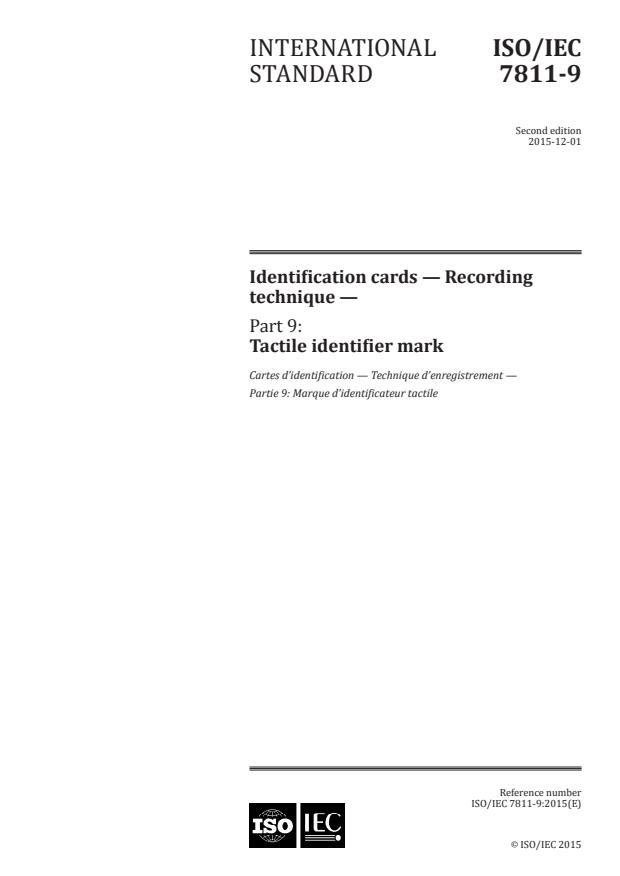
(Main)Identification cards — Recording technique — Part 9: Tactile identifier mark
- Abstract
ISO 7811-9:2015 specifies the physical characteristics of a tactile identifier mark used by visually impaired card holders to distinguish their cards. It defines the area on the card for the TIM and the layout of Braille style embossed dots arranged in patterns to enable easy tactile recognition.
- Status
- Published
- Publication Date
- 01-Dec-2015
- Technical Committee
- ISO/IEC JTC 1/SC 17 - Cards and security devices for personal identification
- Current Stage
- 9093 - International Standard confirmed
- Start Date
- 05-Oct-2026
- Completion Date
- 10-Oct-2026
Buy Documents
ISO/IEC 7811-9:2015 - Identification cards -- Recording technique
ISO/IEC 7811-9:2015 - Identification cards — Recording technique — Part 9: Tactile identifier mark/2/2015
Overview
ISO/IEC 7811-9:2015 is an international standard that specifies the physical characteristics and layout of the Tactile Identifier Mark (TIM) on identification cards. This standard facilitates the accessibility of ID cards by visually impaired cardholders, enabling them to distinguish their cards through tactile means. The TIM consists of Braille-style embossed dots arranged in specific patterns on the card's front surface. ISO/IEC 7811-9 ensures the tactile markings are standardized for consistent, easy recognition across different cards and issuers.
Key Topics
TIM Location: The tactile identifier mark must be positioned within the name and address area as defined by ISO/IEC 7811-1. It can be placed in the default area or an alternate area that avoids interference with embedded components such as ICs or antennas. A minimum clearance of 1 mm from other raised areas and 3 mm from electronic components is recommended to maintain card integrity.
Dot Arrangement: The TIM consists of up to three groups of six dots (maximum 18 dots in total). These dots are arranged precisely according to the standard’s dimensional specifications, ensuring tactile recognition and consistency on all compliant cards.
Dot Dimensions: Each embossed dot must have a relief height between 0.3 mm and 0.48 mm above the card surface. The shape of dots is flexible but must provide sufficient tactile feedback when touched.
Sign Design: The cardholder can select which dots are raised, ranging from a minimum of one dot to a maximum of eighteen. This flexibility accommodates individual differences in tactile perception, ensuring the TIM is practical and user-friendly.
Applications
ISO/IEC 7811-9:2015 applies widely to all forms of physical identification cards, including:
Bank and Payment Cards: Enhancing usability for visually impaired customers by allowing easy card identification without visual inspection.
Government-issued IDs: Passports, driver’s licenses, and national identity cards benefit from tactile marks to support accessibility.
Access Control Cards: Employee or member ID cards with contactless or embedded technologies can incorporate TIMs without interfering with internal components.
Transport and Loyalty Cards: Daily-use cards can be equipped with TIMs to empower the visually impaired community.
The tactile identifier mark plays a crucial role in promoting inclusivity and independence for visually impaired users, supporting compliance with accessibility regulations and best practices.
Related Standards
ISO/IEC 7811-9:2015 is part of the broader ISO/IEC 7811 series covering identification card recording techniques including:
- ISO/IEC 7811-1: Embossing standard, which defines general embossing techniques on cards.
- ISO/IEC 7811-2 to 8: Various magnetic stripe standards (low to high coercivity and density) relevant for card data encoding.
These standards collectively ensure interoperability, durability, and functionality of identification cards worldwide. For detailed design and manufacturing guidance of the TIM, ISO/IEC 7811-9 works in harmony with these other parts to maintain the integrity and performance of multi-functional ID cards.
Keywords: ISO/IEC 7811-9, tactile identifier mark, TIM, identification cards, visually impaired accessibility, Braille embossed dots, card embossing standard, tactile recognition, ISO card standards, assistive technology.
Relations
- Revises
ISO/IEC 7811-9:2008 - Identification cards — Recording technique — Part 9: Tactile identifier mark - Effective Date
- 24-Nov-2012
Buy Documents
ISO/IEC 7811-9:2015 - Identification cards -- Recording technique
ISO/IEC 7811-9:2015 - Identification cards — Recording technique — Part 9: Tactile identifier mark/2/2015
Get Certified
Connect with accredited certification bodies for this standard

BSI Group
BSI (British Standards Institution) is the business standards company that helps organizations make excellence a habit.

NYCE
Mexican standards and certification body.
Sponsored listings
Frequently Asked Questions
ISO/IEC 7811-9:2015 is a standard published by the International Organization for Standardization (ISO). Its full title is "Identification cards — Recording technique — Part 9: Tactile identifier mark". This standard covers: ISO 7811-9:2015 specifies the physical characteristics of a tactile identifier mark used by visually impaired card holders to distinguish their cards. It defines the area on the card for the TIM and the layout of Braille style embossed dots arranged in patterns to enable easy tactile recognition.
ISO 7811-9:2015 specifies the physical characteristics of a tactile identifier mark used by visually impaired card holders to distinguish their cards. It defines the area on the card for the TIM and the layout of Braille style embossed dots arranged in patterns to enable easy tactile recognition.
ISO/IEC 7811-9:2015 is classified under the following ICS (International Classification for Standards) categories: 35.240.15 - Identification cards. Chip cards. Biometrics. The ICS classification helps identify the subject area and facilitates finding related standards.
ISO/IEC 7811-9:2015 has the following relationships with other standards: It is inter standard links to ISO/IEC 7811-9:2008. Understanding these relationships helps ensure you are using the most current and applicable version of the standard.
ISO/IEC 7811-9:2015 is available in PDF format for immediate download after purchase. The document can be added to your cart and obtained through the secure checkout process. Digital delivery ensures instant access to the complete standard document.
Standards Content (Sample)
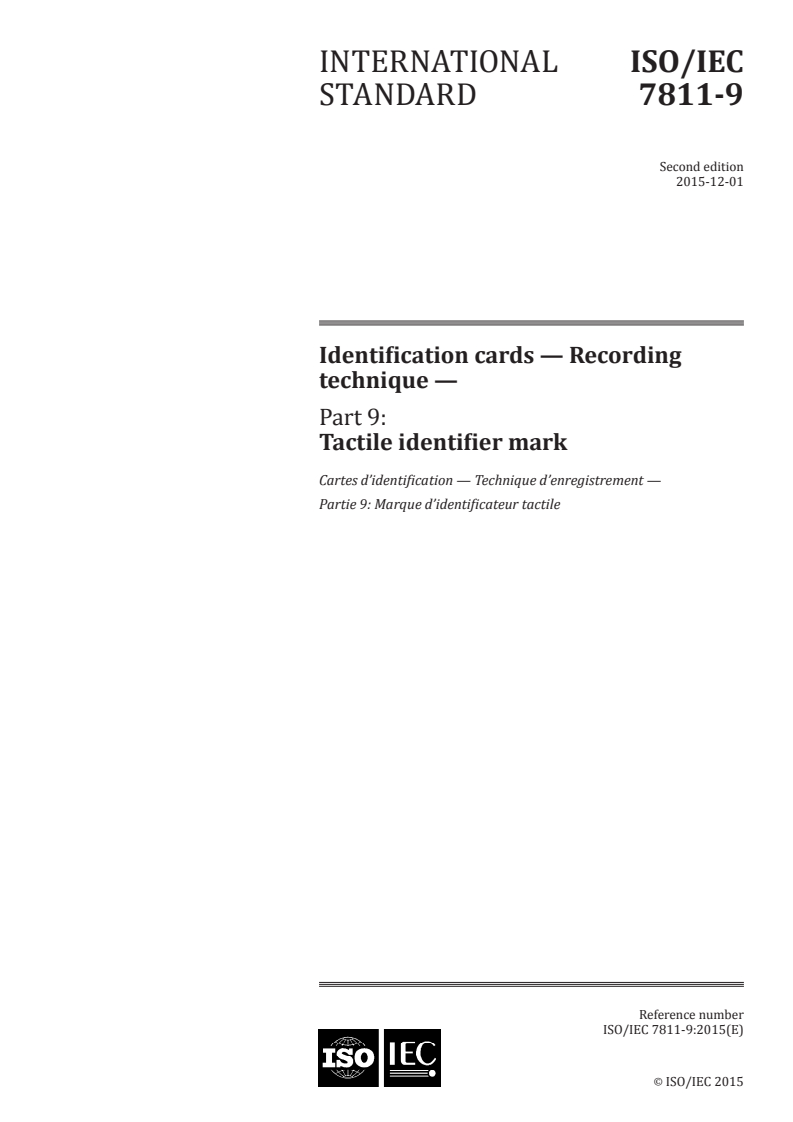
INTERNATIONAL ISO/IEC
STANDARD 7811-9
Second edition
2015-12-01
Identification cards — Recording
technique —
Part 9:
Tactile identifier mark
Cartes d’identification — Technique d’enregistrement —
Partie 9: Marque d’identificateur tactile
Reference number
©
ISO/IEC 2015
© ISO/IEC 2015, Published in Switzerland
All rights reserved. Unless otherwise specified, no part of this publication may be reproduced or utilized otherwise in any form
or by any means, electronic or mechanical, including photocopying, or posting on the internet or an intranet, without prior
written permission. Permission can be requested from either ISO at the address below or ISO’s member body in the country of
the requester.
ISO copyright office
Ch. de Blandonnet 8 • CP 401
CH-1214 Vernier, Geneva, Switzerland
Tel. +41 22 749 01 11
Fax +41 22 749 09 47
copyright@iso.org
www.iso.org
ii © ISO/IEC 2015 – All rights reserved
Contents Page
Foreword .iv
1 Scope .1
2 Conformance .1
3 Terms and definitions .1
4 TIM physical characteristics .1
4.1 Location of TIM . 1
4.2 TIM dot arrangement . 2
4.3 Dot dimensions . 3
4.4 Sign design . 3
© ISO/IEC 2015 – All rights reserved iii
Foreword
ISO (the International Organization for Standardization) and IEC (the International Electrotechnical
Commission) form the specialized system for worldwide standardization. National bodies that are
members of ISO or IEC participate in the development of International Standards through technical
committees established by the respective organization to deal with particular fields of technical
activity. ISO and IEC technical committees collaborate in fields of mutual interest. Other international
organizations, governmental and non-governmental, in liaison with ISO and IEC, also take part in the
work. In the field of information technology, ISO and IEC have established a joint technical committee,
ISO/IEC JTC 1.
The procedures used to develop this document and those intended for its further maintenance are
described in the ISO/IEC Directives, Part 1. In particular the different approval criteria needed for
the different types of document should be noted. This document was drafted in accordance with the
editorial rules of the ISO/IEC Directives, Part 2 (see www.iso.org/directives).
Attention is drawn to the possibility that some of the elements of this document may be the subject
of patent rights. ISO and IEC shall not be held responsible for identifying any or all such patent
rights. Details of any patent rights identified during the development of the document will be in the
Introduction and/or on the ISO list of patent declarations received (see www.iso.org/patents).
Any trade name used in this document is information given for the convenience of users and does not
constitute an endorsement.
For an explanation on the meaning of ISO specific terms and expressions related to conformity
assessment, as well as information about ISO’s adherence to the WTO principles in the Technical
Barriers to Trade (TBT) see the following URL: Foreword - Supplementary informati
...
INTERNATIONAL ISO/IEC
STANDARD 7811-9
Second edition
2015-12-01
Identification cards — Recording
technique —
Part 9:
Tactile identifier mark
Cartes d’identification — Technique d’enregistrement —
Partie 9: Marque d’identificateur tactile
Reference number
©
ISO/IEC 2015
© ISO/IEC 2015, Published in Switzerland
All rights reserved. Unless otherwise specified, no part of this publication may be reproduced or utilized otherwise in any form
or by any means, electronic or mechanical, including photocopying, or posting on the internet or an intranet, without prior
written permission. Permission can be requested from either ISO at the address below or ISO’s member body in the country of
the requester.
ISO copyright office
Ch. de Blandonnet 8 • CP 401
CH-1214 Vernier, Geneva, Switzerland
Tel. +41 22 749 01 11
Fax +41 22 749 09 47
copyright@iso.org
www.iso.org
ii © ISO/IEC 2015 – All rights reserved
Contents Page
Foreword .iv
1 Scope .1
2 Conformance .1
3 Terms and definitions .1
4 TIM physical characteristics .1
4.1 Location of TIM . 1
4.2 TIM dot arrangement . 2
4.3 Dot dimensions . 3
4.4 Sign design . 3
© ISO/IEC 2015 – All rights reserved iii
Foreword
ISO (the International Organization for Standardization) and IEC (the International Electrotechnical
Commission) form the specialized system for worldwide standardization. National bodies that are
members of ISO or IEC participate in the development of International Standards through technical
committees established by the respective organization to deal with particular fields of technical
activity. ISO and IEC technical committees collaborate in fields of mutual interest. Other international
organizations, governmental and non-governmental, in liaison with ISO and IEC, also take part in the
work. In the field of information technology, ISO and IEC have established a joint technical committee,
ISO/IEC JTC 1.
The procedures used to develop this document and those intended for its further maintenance are
described in the ISO/IEC Directives, Part 1. In particular the different approval criteria needed for
the different types of document should be noted. This document was drafted in accordance with the
editorial rules of the ISO/IEC Directives, Part 2 (see www.iso.org/directives).
Attention is drawn to the possibility that some of the elements of this document may be the subject
of patent rights. ISO and IEC shall not be held responsible for identifying any or all such patent
rights. Details of any patent rights identified during the development of the document will be in the
Introduction and/or on the ISO list of patent declarations received (see www.iso.org/patents).
Any trade name used in this document is information given for the convenience of users and does not
constitute an endorsement.
For an explanation on the meaning of ISO specific terms and expressions related to conformity
assessment, as well as information about ISO’s adherence to the WTO principles in the Technical
Barriers to Trade (TBT) see the following URL: Foreword - Supplementary informati
...