

ISO/TS 19016:2019
(Main)Gas cylinders — Cylinders and tubes of composite construction — Modal acoustic emission (MAE) testing for periodic inspection and testing
General Information
- Abstract
This document describes the use of modal acoustic emission (MAE) testing during periodic inspection and testing of hoop wrapped and fully wrapped composite transportable gas cylinders and tubes, with aluminium-alloy, steel or non-metallic liners or of linerless construction, intended for compressed and liquefied gases under pressure. This document addresses the periodic inspection and testing of composite cylinders constructed to ISO 11119‑1, ISO 11119‑2, ISO 11119‑3, ISO 11515 and ISO/TS 17519 and can be applied to other composite cylinders designed to comparable standards when authorized by the competent authority. Unless noted by exception, the use of "cylinder" in this document refers to both cylinders and tubes.
- Status
- Published
- Publication Date
- 14-Oct-2019
- Technical Committee
- ISO/TC 58/SC 4 - Operational requirements for gas cylinders
- Drafting Committee
- ISO/TC 58/SC 4/WG 15 - MAE examination for composite cylinders
- Current Stage
- 9093 - International Standard confirmed
- Start Date
- 25-Feb-2026
- Completion Date
- 29-Aug-2026
Buy Documents
ISO/TS 19016:2019 - Gas cylinders — Cylinders and tubes of composite construction — Modal acoustic emission (MAE) testing for periodic inspection and testing Released:10/15/2019
ISO/TS 19016:2019 - Gas cylinders — Cylinders and tubes of composite construction — Modal acoustic emission (MAE) testing for periodic inspection and testing/15/2019
Overview
ISO/TS 19016:2019 - Modal acoustic emission (MAE) testing for periodic inspection of composite gas cylinders - defines a technical specification for using modal acoustic emission (MAE) as a non‑destructive examination (NDE) method during periodic inspection and testing of hoop‑wrapped and fully wrapped composite cylinders and tubes. It applies to composite constructions with aluminium‑alloy, steel or non‑metallic liners, or linerless designs, intended for compressed and liquefied gases under pressure. Unless otherwise stated, “cylinder” covers both cylinders and tubes.
MAE captures broadband acoustic waveforms generated by damage mechanisms (fibre tow breakage, delamination, rubbing, cracking) and uses waveform modal analysis to identify damage that can compromise burst strength. MAE testing is intended for in‑service periodic inspection - not for new production qualification.
Key Topics
- MAE operational principles: detection, capture and modal analysis of acoustic events to characterise damage type.
- Personnel qualification: references ISO 9712 for NDT personnel competence requirements.
- Equipment & calibration: requirements for broadband piezoelectric sensors, preamplifiers, rolling‑ball impact and absolute sensor calibration, and MAE data acquisition system calibration.
- Testing procedure: sensor coupling and positioning, attenuation measurement, system settings and sampling rates, pressurisation methods (hydraulic or pneumatic) to the cylinder’s design test pressure, and repeating tests for validity.
- Data interpretation: noise filtering (EMI, mechanical rubbing, flow noise, leakage), waveform analysis, background energy and background energy oscillation (BEO) indicators.
- Acceptance/rejection: evaluation criteria and analysis procedures to determine when a cylinder is unserviceable; guidance on test reporting and rendering cylinders unserviceable.
Applications
- Periodic inspection of composite gas cylinders and tubes used in transportation, industrial gas supply, SCBA (self‑contained breathing apparatus), and specialty gas systems.
- Test laboratories and NDT service providers performing regulatory inspections or fleet maintenance.
- Cylinder manufacturers and OEMs incorporating MAE into maintenance programs when authorized by competent authorities.
- Regulators and competent authorities evaluating alternative NDE methods for periodic testing regimes.
Who uses it: NDT technicians, inspection engineers, maintenance managers, test laboratories, competent authorities and standards compliance teams.
Related Standards
- ISO 11119‑1 / ISO 11119‑2 / ISO 11119‑3 (composite cylinder design)
- ISO 11515, ISO/TS 17519 (composite cylinder specifications)
- ISO 11623 (composite construction - periodic inspection)
- ISO 16148 (acoustic emission for monolithic cylinders)
- ISO 9712 (NDT personnel qualification)
- ASTM E1106 (acoustic emission sensor calibration)
ISO/TS 19016:2019 provides a practical, physics‑based MAE framework to improve detection of structural damage in in‑service composite cylinders and to support safe, standards‑based inspection decisions.
Buy Documents
ISO/TS 19016:2019 - Gas cylinders — Cylinders and tubes of composite construction — Modal acoustic emission (MAE) testing for periodic inspection and testing Released:10/15/2019
ISO/TS 19016:2019 - Gas cylinders — Cylinders and tubes of composite construction — Modal acoustic emission (MAE) testing for periodic inspection and testing/15/2019
Get Certified
Connect with accredited certification bodies for this standard

Institut za varilstvo d.o.o. (Welding Institute)
Slovenia's leading welding institute since 1952. ISO 3834, EN 1090, pressure equipment certification, NDT personnel, welder qualification. Only IIW Au
Sponsored listings
Frequently Asked Questions
ISO/TS 19016:2019 is a technical specification published by the International Organization for Standardization (ISO). Its full title is "Gas cylinders — Cylinders and tubes of composite construction — Modal acoustic emission (MAE) testing for periodic inspection and testing". This standard covers: This document describes the use of modal acoustic emission (MAE) testing during periodic inspection and testing of hoop wrapped and fully wrapped composite transportable gas cylinders and tubes, with aluminium-alloy, steel or non-metallic liners or of linerless construction, intended for compressed and liquefied gases under pressure. This document addresses the periodic inspection and testing of composite cylinders constructed to ISO 11119‑1, ISO 11119‑2, ISO 11119‑3, ISO 11515 and ISO/TS 17519 and can be applied to other composite cylinders designed to comparable standards when authorized by the competent authority. Unless noted by exception, the use of "cylinder" in this document refers to both cylinders and tubes.
This document describes the use of modal acoustic emission (MAE) testing during periodic inspection and testing of hoop wrapped and fully wrapped composite transportable gas cylinders and tubes, with aluminium-alloy, steel or non-metallic liners or of linerless construction, intended for compressed and liquefied gases under pressure. This document addresses the periodic inspection and testing of composite cylinders constructed to ISO 11119‑1, ISO 11119‑2, ISO 11119‑3, ISO 11515 and ISO/TS 17519 and can be applied to other composite cylinders designed to comparable standards when authorized by the competent authority. Unless noted by exception, the use of "cylinder" in this document refers to both cylinders and tubes.
ISO/TS 19016:2019 is classified under the following ICS (International Classification for Standards) categories: 23.020.35 - Gas cylinders. The ICS classification helps identify the subject area and facilitates finding related standards.
ISO/TS 19016:2019 is available in PDF format for immediate download after purchase. The document can be added to your cart and obtained through the secure checkout process. Digital delivery ensures instant access to the complete standard document.
Standards Content (Sample)
TECHNICAL ISO/TS
SPECIFICATION 19016
First edition
2019-10
Gas cylinders — Cylinders and tubes
of composite construction — Modal
acoustic emission (MAE) testing for
periodic inspection and testing
Bouteilles à gaz — Bouteilles et tubes composites — Essai par
émission acoustique modale (EAM) pour les besoins du contrôle et des
essais périodiques
Reference number
©
ISO 2019
© ISO 2019
All rights reserved. Unless otherwise specified, or required in the context of its implementation, no part of this publication may
be reproduced or utilized otherwise in any form or by any means, electronic or mechanical, including photocopying, or posting
on the internet or an intranet, without prior written permission. Permission can be requested from either ISO at the address
below or ISO’s member body in the country of the requester.
ISO copyright office
CP 401 • Ch. de Blandonnet 8
CH-1214 Vernier, Geneva
Phone: +41 22 749 01 11
Fax: +41 22 749 09 47
Email: copyright@iso.org
Website: www.iso.org
Published in Switzerland
ii © ISO 2019 – All rights reserved
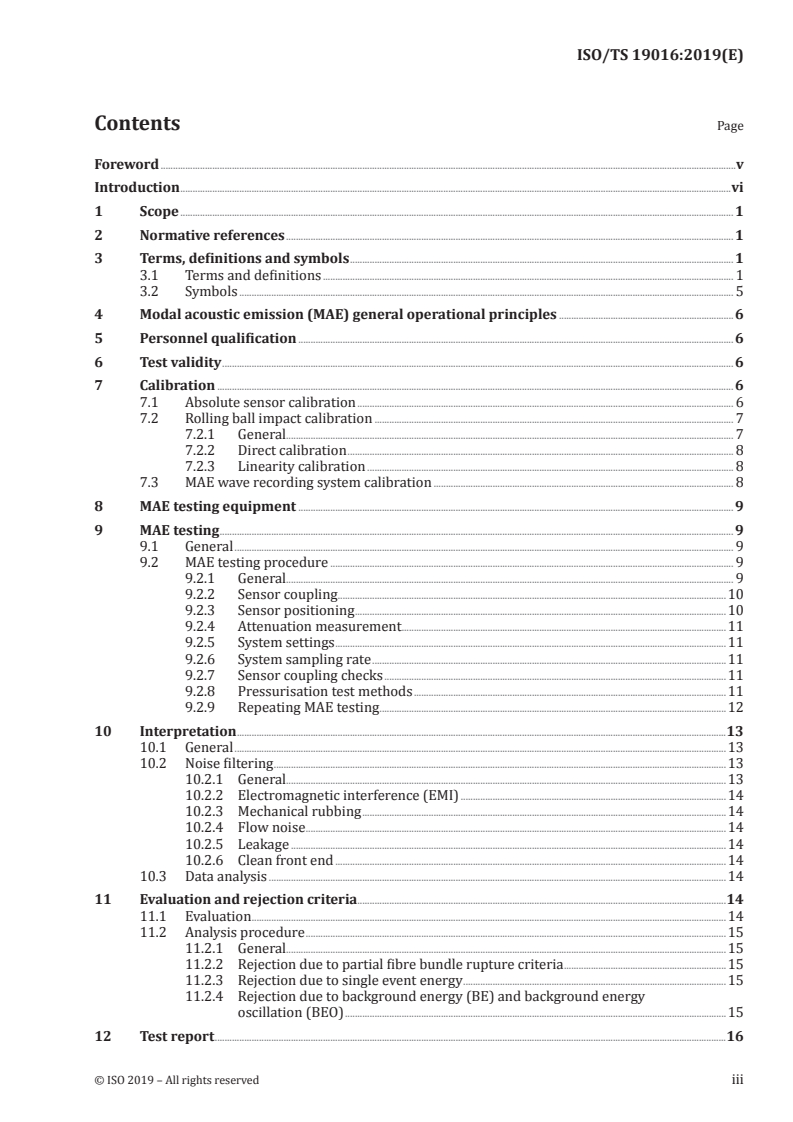
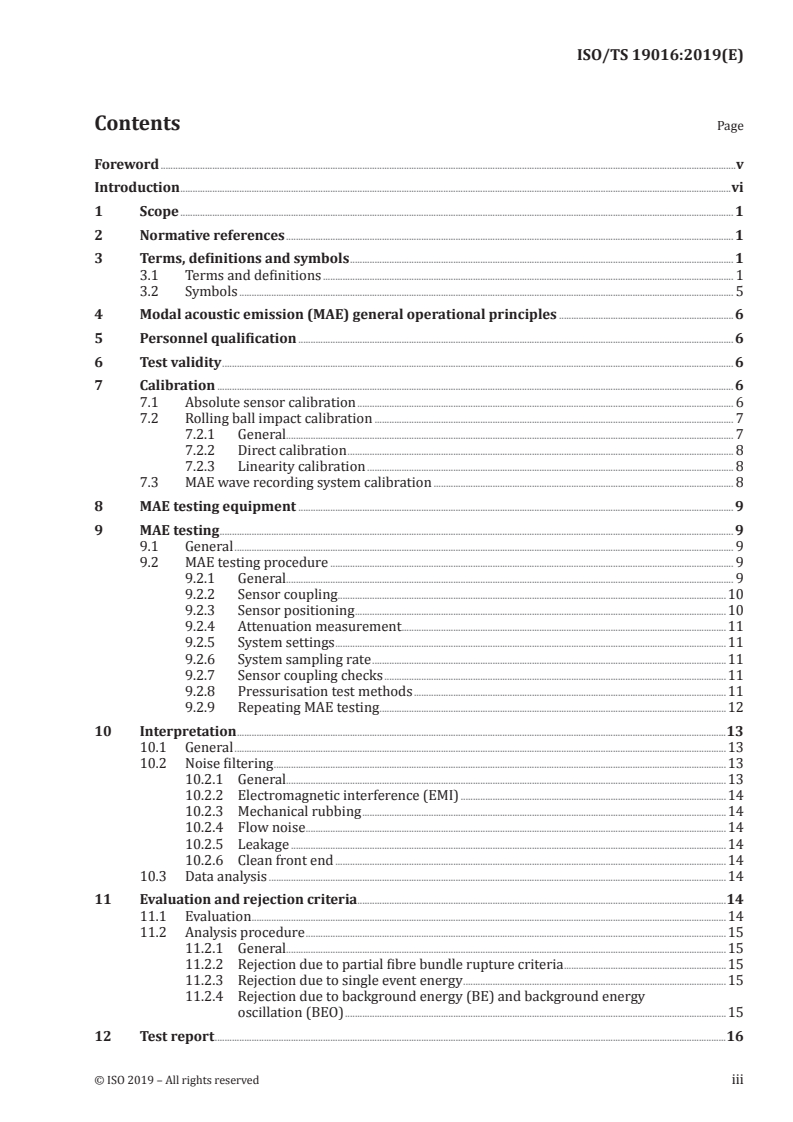
Contents Page
Foreword .v
Introduction .vi
1 Scope . 1
2 Normative references . 1
3 Terms, definitions and symbols . 1
3.1 Terms and definitions . 1
3.2 Symbols . 5
4 Modal acoustic emission (MAE) general operational principles .6
5 Personnel qualification . 6
6 Test validity . 6
7 Calibration . 6
7.1 Absolute sensor calibration . 6
7.2 Rolling ball impact calibration . 7
7.2.1 General. 7
7.2.2 Direct calibration . 8
7.2.3 Linearity calibration . 8
7.3 MAE wave recording system calibration . 8
8 MAE testing equipment . 9
9 MAE testing . 9
9.1 General . 9
9.2 MAE testing procedure . 9
9.2.1 General. 9
9.2.2 Sensor coupling . . .10
9.2.3 Sensor positioning .10
9.2.4 Attenuation measurement . .11
9.2.5 System settings .11
9.2.6 System sampling rate .11
9.2.7 Sensor coupling checks .11
9.2.8 Pressurisation test methods .11
9.2.9 Repeating MAE testing . .12
10 Interpretation .13
10.1 General .13
10.2 Noise filtering .13
10.2.1 General.13
10.2.2 Electromagnetic interference (EMI) .14
10.2.3 Mechanical rubbing .14
10.2.4 Flow noise .14
10.2.5 Leakage .14
10.2.6 Clean front end .14
10.3 Data analysis .14
11 Evaluation and rejection criteria.14
11.1 Evaluation .14
11.2 Analysis procedure .15
11.2.1 General.15
11.2.2 Rejection due to partial fibre bundle rupture criteria .15
11.2.3 Rejection due to single event energy .15
11.2.4 Rejection due to background energy (BE) and background energy
oscillation (BEO) .15
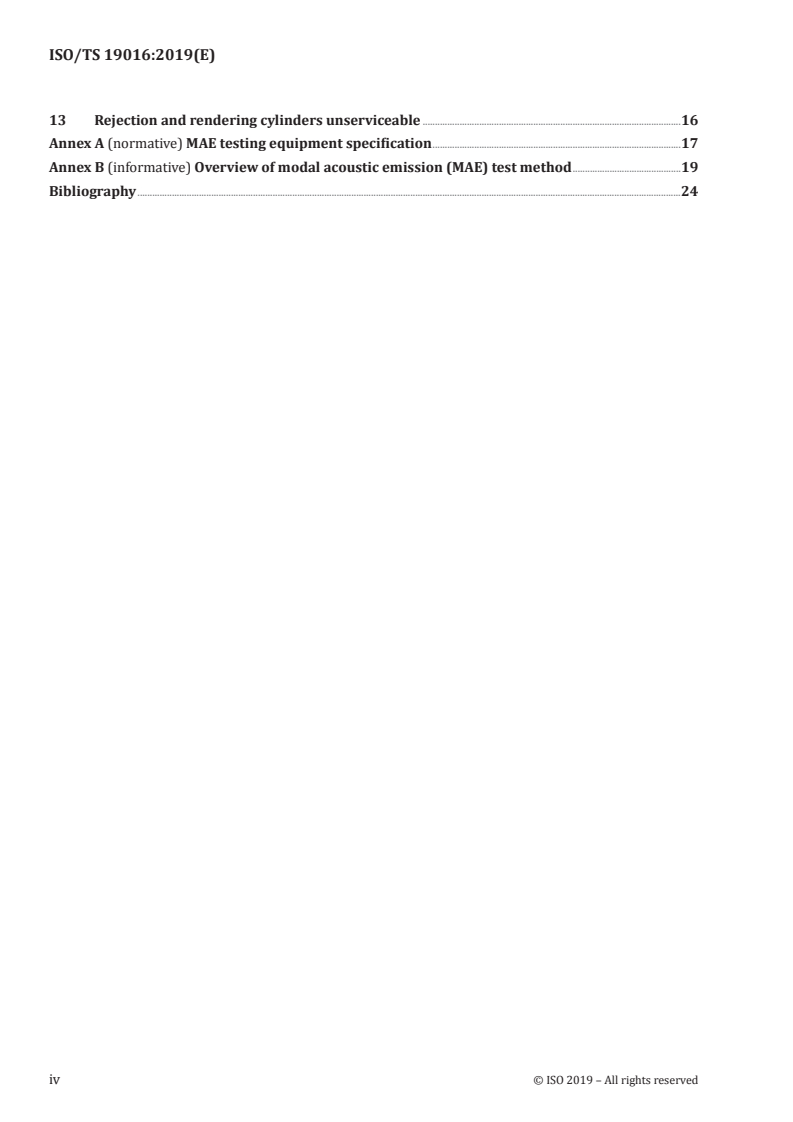
12 Test report .16
13 Rejection and rendering cylinders unserviceable .16
Annex A (normative) MAE testing equipment specification .17
Annex B (informative) Overview of modal acoustic emission (MAE) test method .19
Bibliography .24
iv © ISO 2019 – All rights reserved
Foreword
ISO (the International Organization for Standardization) is a worldwide federation of national standards
bodies (ISO member bodies). The work of preparing International Standards is normally carried out
through ISO technical committees. Each member body interested in a subject for which a technical
committee has been established has the right to be represented on that committee. International
organizations, governmental and non-governmental, in liaison with ISO, also take part in the work.
ISO collaborates closely with the International Electrotechnical Commission (IEC) on all matters of
electrotechnical standardization.
The procedures used to develop this document and those intended for its further maintenance are
described in the ISO/IEC Directives, Part 1. In particular, the different approval criteria needed for the
different types of ISO documents should be noted. This document was drafted in accordance with the
editorial rules of the ISO/IEC Directives, Part 2 (see www .iso .org/directives).
Attention is drawn to the possibility that some of the elements of this document may be the subject of
patent rights. ISO shall not be held responsible for identifying any or all such patent rights. Details of
any patent rights identified during the development of the document will be in the Introduction and/or
on the ISO list of patent declarations received (see www .iso .org/patents).
Any trade name used in this document is information given for the convenience of users and does not
constitute an endorsement.
For an explanation of the voluntary nature of standards, the meaning of ISO specific terms and
expressions related to conformity assessment, as well as information about ISO's adherence to the
World Trade Organization (WTO) principles in the Technical Barriers to Trade (TBT) see www .iso
.org/iso/foreword .html.
This document was prepared by Technical Committee ISO/TC 58, Gas cylinders, Subcommittee SC 4,
Operational requirements for gas cylinders.
Any feedback or questions on this document should be directed to the user’s national standards body. A
complete listing of these bodies can be found at www .iso .org/members .html.
Introduction
In recent years, new non-destructive examination (NDE) techniques have been successfully introduced
as an alternative to the conventional retesting procedures of gas cylinders, tubes and other cylinders.
One of the alternative NDE methods for certain applications is acoustic emission testing (AT), which in
several countries has proved to be an acceptable testing method applied during periodic inspection.
This AT method is described in ISO 16148, which authorizes pressurization pneumatically to a value
equal to 110 % of the cylinder’s working pressure and hydraulic pressurization to a value equal to the
cylinder’s test pressure. Since ISO 16148 was developed for periodic inspection and testing of monolithic
materials (seamless steel and aluminium-alloy cylinders), the test method was not appropriate for
composite cylinders. The modal acoustic emission (MAE) test method described in this document was
developed to address this shortcoming.
The MAE test method described in this document applies during periodic inspection and testing, and
it uses either hydraulic (liquid) pressurization or pneumatic (gas) pressurization to a level equal to the
design test pressure of the cylinder. It detects structural damage that can result in a compromised burst
pressure strength in a composite cylinder. The MAE waveforms can be used to identify damage such
as fibre breakage and delamination. An MAE waveform is distinguished by the wave (mode) shapes,
velocities, waveform energy and frequency spectrums. This MAE test method is not intended for newly
manufactured composite cylinders.
The application of MAE testing on composite overwrapped gas cylinders with metallic and polymer
liners was applied to a sample of composite cylinders [180 self-contained breathing apparatus (SCBA)
cylinders selected from 50 000] that were near the end of their 15-year service life. The MAE testing
was performed during physical testing, which was similar to design qualification testing for this type
of composite cylinder. The physical testing included pressure cycling, burst testing, flaw tolerance
testing and ISO 11119-2 drop testing. The MAE testing consistently detected and differentiated each
cylinder that had a compromised burst pressure strength, which had been defined for this project to be
a pressure less than the original design burst pressure of the cylinder, by the presence of background
energy oscillation (BEO) at or near the test pressure.
vi © ISO 2019 – All rights reserved
TECHNICAL SPECIFICATION ISO/TS 19016:2019(E)
Gas cylinders — Cylinders and tubes of composite
construction — Modal acoustic emission (MAE) testing for
periodic inspection and testing
CAUTION — Some of the tests specified in this document involve the use of processes (e.g.
pneumatic pressurization) which could lead to a hazardous situation.
1 Scope
This document describes the use of modal acoustic emission (MAE) testing during periodic inspection
and testing of hoop wrapped and fully wrapped composite transportable gas cylinders and tubes, with
aluminium-alloy, steel or non-metallic liners or of linerless construction, intended for compressed and
liquefied gases under pressure.
This document addresses the periodic inspection and testing of composite cylinders constructed
to ISO 11119-1, ISO 11119-2, ISO 11119-3, ISO 11515 and ISO/TS 17519 and can be applied to other
composite cylinders designed to comparable standards when authorized by the competent authority.
Unless noted by exception, the use of “cylinder” in this document refers to both cylinders and tubes.
2 Normative references
The following documents are referred to in the text in such a way that some or all of their content
constitutes requirements of this document. For dated references, only the edition cited applies. For
undated references, the latest edition of the referenced document (including any amendments) applies.
ISO 9712, Non-destructive testing — Qualification and certification of NDT personnel
ISO 11623, Gas cylinders — Composite construction — Periodic inspection and testing
ASTM E1106-12, Standard Test Method for Primary Calibration of Acoustic Emission Sensor
3 Terms, definitions and symbols
3.1 Terms and definitions
For the purposes of this document, the following terms and definitions apply.
ISO and IEC maintain terminological databases for use in standardization at the following addresses:
— IEC Electropedia: available at http: //www .electropedia .org/
— ISO Online browsing platform: available at http: //www .iso .org/obp
3.1.1
modal acoustic emission
MAE
branch of acoustic emission (AT) focused on the detection, capture and analysis of the sound waves
generated by acoustic events due to fibre tow (3.1.19) breakage, cracking, crazing, rubbing, delamination
or fracture of structural components
Note 1 to entry: The sound waves can be produced either by defects [e.g. fibre tow (3.1.19) breakage, crack
growth, delamination] or by surface rubbing. The wave frequencies typically extend from the sonic to the lower
ultrasonic range. MAE is distinguished from AT by its focus on capturing waveforms with broader bandwidth
sensors and analysing the waveforms according to wave propagation physics in an attempt to determine the type
of source, as is done in seismology, whereas AT has been generally concerned with counts, amplitudes and other
signal features based on different theories of analysis than MAE.
3.1.2
broadband piezoelectric sensor
sensor having a response that is flat-with-frequency (±6 dB) when calibrated in an absolute sense over
the frequency range of interest
Note 1 to entry: Due to a lack of signal distortion or “coloration”, broadband piezoelectric sensors enable the
observation of the extensional and flexural plate waves which facilitates the direct comparison to physical
models for proper damage mechanism identification.
3.1.3
preamplifier
amplifier that converts a lower level voltage signal to a higher level voltage signal
Note 1 to entry: A preamplifier can also have a 0 dB gain where it would function purely as a buffer or unity gain
amplifier.
3.1.4
high-pass filter
electronic filter applied to the wave signals to reduce mechanical noise
3.1.5
low-pass filter
electronic filter applied to the wave signals to prevent aliasing (3.1.13)
3.1.6
analogue-to-digital converter
A/D converter
electronic device that changes an analogue electrical signal into a digital representation
3.1.7
input impedance
value of the impedance, denoted as Z, at the input to the voltage preamplifier (3.1.3) to which the
transducer is directly connected
3.1.8
Nyquist frequency
bandwidth of the sampled signal, equal to half the sampling rate
3.1.9
primary AE
acoustic emissions caused by damage mechanisms (e.g. fracture, crack propagation, defect growth)
originating from the material under test
2 © ISO 2019 – All rights reserved
3.1.10
secondary AE
acoustic emissions caused by sources other than damage mechanisms originating from the material
under test (frictional rubbing against containment, EMI, flow noise, etc.)
Note 1 to entry: See Clause 10 for information regarding filtering out extraneous noise.
3.1.11
background energy
BE
minimum energy in a windowed portion of a given waveform
3.1.12
background energy oscillation
BEO
excursion of greater than BEO multiplication factor (M ) (3.1.26) between neighbouring maxima and
minima of an N point moving average calculated from all background energy (3.1.11) values
3.1.13
aliasing
effect resulting from under sampling that causes different signals to become indistinguishable (or
aliases of one another) when sampled
3.1.14
clean front end
−15
pre-trigger energy of less than 0,01 × 10 J when accounting for gain
3.1.15
working pressure
settled pressure of a compressed gas at a uniform reference temperature of 15 °C in a full gas cylinder
Note 1 to entry: In North America, service pressure is often used to indicate a similar condition, usually at 21,1 °C
(70 °F).
Note 2 to entry: In East Asia, service pressure is often used to indicate a similar condition, usually at 35 °C.
[SOURCE: ISO 10286:2015, 736]
3.1.16
developed pressure
pressure developed by the gas contents in a cylinder at a uniform reference temperature of Temp
max
Note 1 to entry: Temp is the expected maximum uniform temperature in normal service as specified in
max
international or national cylinder filling regulations.
[SOURCE: ISO 10286:2015, 733, modified — “T ” replaced with “Temp ”]
max max
3.1.17
composite overwrap
combination of fibres (3.1.18) and matrix (3.1.20)
3.1.18
fibre
load-carrying part of the composite overwrap (3.1.17)
EXAMPLE Glass, aramid or carbon.
3.1.19
fibre tow
group or bundle of fibres (3.1.18)
3.1.20
matrix
material used to bind and hold fibres (3.1.18) in place
3.1.21
extensional waves
collection of wave modes characterized by dominant in-plane deformation characteristics
Note 1 to entry: Extensional wave modes are analogous to symmetric (S) wave modes in isotropic plate-type
structures.
3.1.22
flexural waves
collection of wave modes characterized by dominant out-of-plane deformation characteristics
Note 1 to entry: Flexural wave modes are analogous to antisymmetric (A) wave modes in isotropic plate-type
structures.
3.1.23
fibre bundle rupture energy multiplication factor
F
allowance factor for fibre (3.1.18) bundle rupture energy
Note 1 to entry: The value of F is determined by analysis of the composite material and pressure vessel design.
3.1.24
total single event energy multiplication factor
F
allowance factor for single event energy
3.1.25
BE multiplication factor
M
multiplicative factor that corresponds to a rise in the background energy (3.1.11) level above the
quiescent level
Note 1 to entry: The value of M is a function of vessel type, fibre (3.1.18) construction, size and pressure rating of
the composite cylinder and is determined through theory and/or testing.
Note 2 to entry: M indicates that the damage accumulation has commenced in the composite pressure vessel
under test.
Note 3 to entry: See 3.1.27.
3.1.26
BEO multiplication factor
M
difference factor between neighbouring maxima and minima of an N point moving average calculated
from all background energy (3.1.11) values
Note 1 to entry: The value of M is a function of vessel type, fibre (3.1.18) construction, size and pressure rating of
the composite cylinder and is determined through theory and/or testing.
Note 2 to entry: M indicates that the composite pressure vessel under test is progressing towards failure.
3.1.27
quiescent background energy
U
QE
energy determined in a windowed portion of a waveform during a period of inactivity
4 © ISO 2019 – All rights reserved
3.1.28
wave energy
U
WAVE
t 2
U =∫ Vdt
WAVE
z
Note 1 to entry: For comparison to physical energy values (e.g. the theoretical energy released by a fibre fracture
event), the total system gain is accounted for by dividing V by the gain factor before squaring, e.g. 40 dB gain is a
gain factor of 100, 48 dB is a gain factor of 251,2, 60 dB is a gain factor of 1 000, etc.
3.2 Symbols
C speed of the first arriving frequency in the E wave
E
C speed of the last arriving frequency in the F wave
F
d diameter of the fibre
E Young's modulus of the fibre
ε strain to failure of the fibre
g acceleration due to gravity
h vertical height of the centre of the rolling ball at the top of the inclined plane
I ineffective fibre length for the fibre and matrix combination
L distance between sensors, in m
m mass
N constant value relating to the type of fibre in the composite cylinder
T period of the cycle
t time, in μs, when the first part of the direct E wave will arrive
(i.e. the arrival of the lowest observable frequency of interest in the E mode)
t time, in μs, when the last part of the direct F wave will arrive
(i.e. the arrival of the lowest observable frequency of interest in the F mode)
t time
Temp expected maximum uniform temperature in normal service
max
energy produced by the occurrence of fibre breakage
AE
U
FB
energy produced by the occurrence of fibre bundle breakage
AE
U
FBB
AE
U rolling ball impact acoustical wave energy
RBI
U theoretical fibre break energy
FB
U known mechanical energy
mgh
U rolling ball impact energy
RBI
U wave energy
WAVE
V voltage
Z preamplifier input impedance
4 Modal acoustic emission (MAE) general operational principles
When a composite cylinder containing flaws is pressurized, stress waves can be generated by several
different sources (fibre breakage, matrix cracking, delamination, etc.). These stress waves are defined
as acoustic emissions (AE). The AE resulting from major flaws such as delamination or fibre bundle
breakage starts at a pressure less than or equal to the test pressure of the cylinder. The internal
pressure causes stress in the fibre overwrap which can result in AE waves that propagate throughout
the structure. The AE waveform is captured, digitized and stored for analysis. MAE analysis essentially
“fingerprints” each waveform by mode, energy and frequency content to determine the damage
mechanism which occurred (delamination, matrix crack, fibre breakage, etc.). The connections between
waveforms and fracture mechanisms have been determined through theoretical elastodynamic
calculation and experiment and published in open literature.
The formulae for determining fibre break sources in composite cylinders are given in Annex A. Annex B
provides examples for calculating fibre break energy and energy scaling, using representative values
for F , F , M and M , which are components of the formulae used to determine the reject criteria.
1 2 1 2
After an MAE source is identified, this information is used to assess cylinder integrity. The values for
rejection criteria are calculated as described in Clause 11.
NOTE The MAE test method described in this document is not intended for newly manufactured composite
cylinders.
5 Personnel qualification
The MAE equipment shall be operated by, and its operation supervised by, qualified and experienced
personnel only, certified in accordance with ISO 9712 or equivalent (e.g. ASNT SNT-TC-1A). The operator
shall be certified to Level I and this individual shall be supervised by a Level II person. The testing
organization shall retain a Level III (company employee or a third party) to oversee the organization’s
entire MAE programme.
6 Test validity
The type of construction of the cylinder (e.g. hoop or fully wrapped) and the type of fibre and resin
(matrix) shall be known for input in the computer program (software) that analyses the MAE test.
To obtain an accurate MAE testing result, the cylinder should not have been pressurized to or above
the MAE test pressure within the past 12 months prior to the requalification. However, if suspected
external damage has occurred to the cylinder within 12 months of the previous requalification
(mechanical impact, etc.), then an MAE test is recommended.
7 Calibration
7.1 Absolute sensor calibration
Sensors shall have a flat frequency response (±6 dB amplitude response over the frequency range
specified, 50 kHz to 400 kHz) as determined by an absolute calibration. MAE sensors shall have a
diameter no greater than 13 mm for the active part of the sensor face. The aperture effect shall be
taken into account during MAE testing. Sensor sensitivity shall be at least 0,05 V/nm (with the removal
of all amplification).
6 © ISO 2019 – All rights reserved
Absolute sensor calibration shall conform to the requirements specified in ASTM E1106-12.
7.2 Rolling ball impact calibration
7.2.1 General
The MAE system calibration or impact energy conversion shall be performed to detect and measure
the wave energy of the test object (e.g. fibre breakage in a composite cylinder) by using the rolling ball
impactor method. The rolling ball impactor is used to create an acoustical impulse in an aluminium-
alloy calibration plate. Figure 1 illustrates the rolling ball impact setup.
Key
1 sensor 6 ball impactor
2 sensor output to MAE instrumentation 7 incline angle
3 aluminium-alloy calibration plate 8 rolling length
4 support blocks 9 propagation distance
5 inclined plane with groove
Figure 1 — Example of a rolling ball impactor energy calibration setup
The setup shall include a 13-mm diameter ball made of a chrome steel alloy hardened to a minimum
of HRC 63, ground and lapped to a minimum surface finish of 38 µm, within 2,5 µm of actual size and
roundness within 0,6 µm.
The calibration plate shall be made of high strength 7000 series aluminium-alloy (e.g. 7075-T6) with
a smooth surface, lateral dimensions of at least 1,20 m by 1,20 m and a thickness of 3 mm ± 10 % (e.g.
maximum rolled flatness deviation of 3 mm/1 m). The calibration plate is supported by rigid blocks (e.g.
steel or wood). The surface finish of the impact edge of the calibration plate shall be at least 13 µm RMS.
The impact ball rolls down an inclined plane that has a 9,5 mm-wide by 2,5 mm-deep machined square
groove that supports and guides it to the impact point. The length of the groove shall be a minimum of
400 mm, with a minimum surface finish of 26 μm RMS. The angle of the inclined plane shall be 6°.
The top surface of the inclined plane shall be positioned next to the edge of the calibration plate and
stationed below the lower edge of the plate so that the ball impacts the calibration plate with equal
parts of the ball projecting above and below the plane of the calibration plate (i.e. the tangent point of
the ball impacts the centre plane of the plate). A mechanism (manual or automated) shall be used to
release the impact ball down the inclined plane.
The system shall compute and record the measured wave energy.
7.2.2 Direct calibration
The sensor shall be placed on the calibration plate in a perpendicular orientation 300 mm ± 10 mm
from the impact edge, in line with the impact location.
The sensor shall be mounted on the calibration plate using a couplant that prevents any air between the
sensor and the surface of the calibration plate and tested separately via the rolling ball impact method.
An MAE sensor may be damped in order to broaden the bandwidth. The vertical position of the ball’s
impact point shall be adjusted gradually in order to “peak up” the acoustical signal, such as is done in
ultrasonic testing where the angle is varied slightly to peak up the response. The centre frequency of
the first cycle of the extensional mode plate wave (E wave) shall be confirmed as 125 kHz ± 10 kHz. The
AE
energy value, in joules (J), of the received first cycle of the E mode wave is defined as U , while the
RBI
mechanical potential energy for the rolling ball is determined in the classical mechanics sense using
Formula (1):
U = m × g × h (1)
mgh
AE
U is the energy detected by the MAE system and is scaled by U in order to compare measured
RBI mgh
MAE fibre break waveforms to U [see Formula (A.4)]. This shall be an “end-to-end” calibration,
FB
meaning that the energy is measured using the complete MAE instrumentation (sensor, cables,
preamplifiers, amplifiers, filters and digitizer) that are to be used during the actual test.
7.2.3 Linearity calibration
The energy linearity of the complete MAE instrumentation shall be measured by using three different
roll lengths (200 ± 10 mm, 300 ± 10 mm and 400 ± 10 mm) with a ±10 % tolerance. A representative
sensor with a typical sensitivity curve may be used for the linearity check of the system. The
centre frequency of the first cycle of the extensional mode plate wave (E wave) shall be confirmed
as 125 kHz ± 10 kHz. The energy value, in joules (J), of the received first cycle of the E mode wave
AE
is defined as U , while the mechanical potential energy for the rolling ball is determined in the
RBI
classical mechanics sense using Formula (1).
7.3 MAE wave recording system calibration
The recording system (consisting of all amplifiers, filters and digitizers beyond the sensor) shall be
calibrated by using a 20-cycle long tone burst with amplitude of 0,1 V at 100 kHz, 200 kHz, 300 kHz
and 400 kHz. This calibration ensures that the sampling rate of the high speed analogue-to-digital
(A/D) converter is functioning properly (e.g. not aliasing the waveform). For each frequency, the MAE
calibration system shall be programmed to display an energy value using Formula (2):
V ××NT
U = (2)
2Z
where
V is equal to 0,1 volts;
N is equal to 20.
Formula (2) is valid for a system gain of 0 dB.
8 © ISO 2019 – All rights reserved
To ensure that a proper sampling rate has been set and that the energy measurement is functioning
correctly, the measured values of energy shall be equal to the value calculated using Formula (2) with a
tolerance of ±15 %.
8 MAE testing equipment
A typical MAE system includes:
— broadband piezoelectric sensors,
— preamplifiers,
— high- and low-pass filters,
— amplifiers,
— A/D converters,
— a computer program (software) for the collection of data,
— a computer and monitor for the display of data, and
— a computer program (software) for the analysis of data.
The MAE testing system shall include software capable of indicating the channel that detects the first
arriving waveform. It shall also include sensors and recording equipment with a current calibration
sticker (yearly) or a current certificate of calibration. Preamplifiers and amplifiers shall have a flat
frequency response (±1 dB) over the sensor frequency specified. The MAE testing system shall include
a high-pass filter of nominally 20 kHz. A high-pass filter as low as 5 kHz may be used if extraneous noise
does not hamper the measurement. Also, a low-pass filter shall be applied to prevent digital aliasing
that occurs if frequencies higher than the Nyquist frequency (half the sampling rate) are in the signal.
The MAE testing system shall also include the memory depth (wave window length) and sampling rate
of the A/D converter and shall be set in accordance with the test requirement in Annex A. The software
shall compute the rejection criteria energy values for the specific composite material after the operator
inputs the required material properties and allowance factors, i.e. the fibre bundle rupture energy
multiplication factor (F ), the total single event energy multiplication factor (F ), the BE multiplication
1 2
factor (M ) and the BEO multiplication factor (M ). The software shall identify fibre rupture waveform
1 2
signals and compare energies with acceptable energy values and compute both the quiescent BEs and
BEs to compare against acceptable rise and oscillation energy values (see Annex A).
9 MAE testing
9.1 General
Prior to performing MAE testing, the external and internal surfaces of each cylinder shall be inspected
in accordance with ISO 11623 or an equivalent standard accepted by the competent authority.
9.2 MAE testing procedure
9.2.1 General
After completion of the MAE system calibration and cylinder visual inspection, the MAE testing
procedure in 9.2.2 to 9.2.9 shall be performed.
9.2.2 Sensor coupling
Each sensor shall be coupled to the cylinder in such a way that good ultrasonic coupling of the sensor
to the part is assured, as described in 9.2.7. Good practice requires that care be taken to remove any air
bubbles under the sensor that would interfere with wave transmission. Each sensor shall be connected
to the testing equipment and a sensor performance check conducted prior to MAE testing to verify
proper operation and good coupling to the cylinder (see 9.2.7).
9.2.3 Sensor positioning
A minimum of two sensors shall be used for each cylinder, with one sensor installed at each end.
Dependent upon cylinder size, additional sensors can be necessary. Sensors shall be positioned in rings,
at equal distances around the circumference of the cylinder on its cylindrical portion adjacent to the
tangent point of the dome such that the distance between sensors does not exceed 0,6 m in principal
stress state directions. The sensors shall be located on the cylindrical section within 50 mm from the
dome-to-shell transition area and in line to the axial direction of the cylinder.
If the sensor-to-sensor distance becomes greater than 0,6 m on large diameter cylinders for wave
propagation in the dome portion of the cylinder, attenuation shall be measured (as described in 9.2.4) and
appropriate sensors added to the dome portion. Adjacent rings of sensors shall be offset by half a cycle.
However, if the attenuation of MAE is measured and found to be acceptable, the distance between sensors
may be increased accordingly. Attenuation shall be measured by determining the maximum distance that
the 400-kHz component of either the extensional or flexural wave (e.g., produced by a suitable source such
as an ultrasonic pulser or a pencil lead break applied to a wedge with a relevant angle) can be observed
with a signal-to-noise ratio of at least 1,4 using the sensitivity established in 9.2.5.
For example, if the first ring of sensors is placed at 0°, 120° and 240°, the second ring of sensors is
placed at 60°, 180° and 300°. This pattern shall be continued along the length of the cylinder at evenly
spaced intervals until the opposite end of the cylinder is reached.
See Figure 2 for an example of sensor positioning.
Key
1 broadband piezoelectric sensor
2 cylinder
Figure 2 — Example of sensor positioning for MAE testing
10 © ISO 2019 – All rights reserved
9.2.4 Attenuation measurement
The frequency and wave mode (extensional and flexural)-dependent attenuation behaviour of a cylinder
of nominal design shall be measured and used for the normalization of measured energy values.
9.2.5 System settings
The threshold for each channel shall be a minimum sensitivity of 50 dB referred to 1 μV at the
preamplifier input.
The system shall have minimum dynamic range of 65 dB.
9.2.6 System sampling rate
The sampling speed and memory depth (wave window length) are dictated by the test requirements.
The wave window length shall include as a minimum the first part of the direct E wave and the last
part of the direct F wave for a given event (pulse). One quarter of the window shall be reserved for pre-
trigger memory (see Annex A).
The sampling rate, or sampling speed, shall be at least twice the maximum frequency present in the
filtered waveform before A/D conversion so that aliasing does not occur.
9.2.7 Sensor coupling checks
Conduct sensor coupling checks prior to the test to verify proper operation and good coupling to the
cylinder. For the coupling check, the superimposed E and F waveforms shall be observed by breaking
and recording a 0,3 mm, 2H pencil lead at approximately 100 mm ± 10 mm from each sensor along the
axial direction of the cylinder. The energy of the lead break waveforms shall be a minimum energy of
-15
2,6E J and the same within a factor of 4 for all sensors used in the test. If this energy comparison is
not met by a sensor, the sensor shall be recoupled or replaced, and the sensor coupling shall be checked
again to verify its energy is within the acceptable range. All lead breaks shall be recorded.
If an auto-sensor test is used in lieu of pencil lead breaks, all received waveform energies shall have the
same values within a factor of 4. If so, repeat the lead breaks (or auto-sensor test) at a system gain that
does not saturate the system. Prior to pressurization, reset the gain to the test gain.
All sensor coupling check data shall be recorded. The gain settings for the sensor coupling check shall
be such that the signal does not saturate either the amplifiers or the A/D converter. If so, repeat the lead
breaks at a system gain that does not saturate the system. Prior to pressurization, reset the gain to the
test gain.
9.2.8 Pressurisation test methods
9.2.8.1 General
There are two pressurization methods that may be used during MAE testing. Both Method A (9.2.8.2)
and Method B (9.2.8.3) are suitable for the periodic inspection and testing of composite cylinders. Each
method has its own benefit. For example, Method A can provide additional information for cylinders
that have a very high burst-to-test ratio; when using Method B, water does not need to be put into the
cylinder.
The cylinder that is used for MAE testing shall be instrumented in accordance with 9.2.2 to 9.2.7 and
then pressurized by either Method A or Method B. Based upon the test method selected, appropriate
allowance factors shall be chosen (see B.3). The allowance factors used for each of the two methods are
dependent upon the burst-to-test ratio developed in the laminate at the MAE test pressure.
WARNING — When performing the MAE test (especially pneumatically), safety precautions shall
be taken to protect personnel carrying out the examination because of the considerable damage
potential from the stored energy that can be released. Additionally, since MAE equipment might
not be explosion-proof, precautions shall be taken when the pneumatic pressurization gas is
flammable.
Monitor and record the MAE event waveforms during the entire process. If detected MAE indications
suggest that the cylinder could rupture, pressure should be released immediately.
Repeated pressurizations above the test pressure will compromise the MAE test result and can affect
the structural integrity of the cylinder. The cylinder owner and manufacturer should be consulted for
cylinder disposition.
During MAE testing, if a cylinder fails a test method, it is not permissible to use a different periodic
inspection and testing method such as a proof pressure test to retest the cylinder.
9.2.8.2 Method A
MAE test pressure is equal to the cylinder’s design test pressure. Each cylinder shall be subjected to a
hydraulic pressurization from 0 bar to the cylinder’s design test
...
TECHNICAL ISO/TS
SPECIFICATION 19016
First edition
2019-10
Gas cylinders — Cylinders and tubes
of composite construction — Modal
acoustic emission (MAE) testing for
periodic inspection and testing
Bouteilles à gaz — Bouteilles et tubes composites — Essai par
émission acoustique modale (EAM) pour les besoins du contrôle et des
essais périodiques
Reference number
©
ISO 2019
© ISO 2019
All rights reserved. Unless otherwise specified, or required in the context of its implementation, no part of this publication may
be reproduced or utilized otherwise in any form or by any means, electronic or mechanical, including photocopying, or posting
on the internet or an intranet, without prior written permission. Permission can be requested from either ISO at the address
below or ISO’s member body in the country of the requester.
ISO copyright office
CP 401 • Ch. de Blandonnet 8
CH-1214 Vernier, Geneva
Phone: +41 22 749 01 11
Fax: +41 22 749 09 47
Email: copyright@iso.org
Website: www.iso.org
Published in Switzerland
ii © ISO 2019 – All rights reserved
Contents Page
Foreword .v
Introduction .vi
1 Scope . 1
2 Normative references . 1
3 Terms, definitions and symbols . 1
3.1 Terms and definitions . 1
3.2 Symbols . 5
4 Modal acoustic emission (MAE) general operational principles .6
5 Personnel qualification . 6
6 Test validity . 6
7 Calibration . 6
7.1 Absolute sensor calibration . 6
7.2 Rolling ball impact calibration . 7
7.2.1 General. 7
7.2.2 Direct calibration . 8
7.2.3 Linearity calibration . 8
7.3 MAE wave recording system calibration . 8
8 MAE testing equipment . 9
9 MAE testing . 9
9.1 General . 9
9.2 MAE testing procedure . 9
9.2.1 General. 9
9.2.2 Sensor coupling . . .10
9.2.3 Sensor positioning .10
9.2.4 Attenuation measurement . .11
9.2.5 System settings .11
9.2.6 System sampling rate .11
9.2.7 Sensor coupling checks .11
9.2.8 Pressurisation test methods .11
9.2.9 Repeating MAE testing . .12
10 Interpretation .13
10.1 General .13
10.2 Noise filtering .13
10.2.1 General.13
10.2.2 Electromagnetic interference (EMI) .14
10.2.3 Mechanical rubbing .14
10.2.4 Flow noise .14
10.2.5 Leakage .14
10.2.6 Clean front end .14
10.3 Data analysis .14
11 Evaluation and rejection criteria.14
11.1 Evaluation .14
11.2 Analysis procedure .15
11.2.1 General.15
11.2.2 Rejection due to partial fibre bundle rupture criteria .15
11.2.3 Rejection due to single event energy .15
11.2.4 Rejection due to background energy (BE) and background energy
oscillation (BEO) .15
12 Test report .16
13 Rejection and rendering cylinders unserviceable .16
Annex A (normative) MAE testing equipment specification .17
Annex B (informative) Overview of modal acoustic emission (MAE) test method .19
Bibliography .24
iv © ISO 2019 – All rights reserved
Foreword
ISO (the International Organization for Standardization) is a worldwide federation of national standards
bodies (ISO member bodies). The work of preparing International Standards is normally carried out
through ISO technical committees. Each member body interested in a subject for which a technical
committee has been established has the right to be represented on that committee. International
organizations, governmental and non-governmental, in liaison with ISO, also take part in the work.
ISO collaborates closely with the International Electrotechnical Commission (IEC) on all matters of
electrotechnical standardization.
The procedures used to develop this document and those intended for its further maintenance are
described in the ISO/IEC Directives, Part 1. In particular, the different approval criteria needed for the
different types of ISO documents should be noted. This document was drafted in accordance with the
editorial rules of the ISO/IEC Directives, Part 2 (see www .iso .org/directives).
Attention is drawn to the possibility that some of the elements of this document may be the subject of
patent rights. ISO shall not be held responsible for identifying any or all such patent rights. Details of
any patent rights identified during the development of the document will be in the Introduction and/or
on the ISO list of patent declarations received (see www .iso .org/patents).
Any trade name used in this document is information given for the convenience of users and does not
constitute an endorsement.
For an explanation of the voluntary nature of standards, the meaning of ISO specific terms and
expressions related to conformity assessment, as well as information about ISO's adherence to the
World Trade Organization (WTO) principles in the Technical Barriers to Trade (TBT) see www .iso
.org/iso/foreword .html.
This document was prepared by Technical Committee ISO/TC 58, Gas cylinders, Subcommittee SC 4,
Operational requirements for gas cylinders.
Any feedback or questions on this document should be directed to the user’s national standards body. A
complete listing of these bodies can be found at www .iso .org/members .html.
Introduction
In recent years, new non-destructive examination (NDE) techniques have been successfully introduced
as an alternative to the conventional retesting procedures of gas cylinders, tubes and other cylinders.
One of the alternative NDE methods for certain applications is acoustic emission testing (AT), which in
several countries has proved to be an acceptable testing method applied during periodic inspection.
This AT method is described in ISO 16148, which authorizes pressurization pneumatically to a value
equal to 110 % of the cylinder’s working pressure and hydraulic pressurization to a value equal to the
cylinder’s test pressure. Since ISO 16148 was developed for periodic inspection and testing of monolithic
materials (seamless steel and aluminium-alloy cylinders), the test method was not appropriate for
composite cylinders. The modal acoustic emission (MAE) test method described in this document was
developed to address this shortcoming.
The MAE test method described in this document applies during periodic inspection and testing, and
it uses either hydraulic (liquid) pressurization or pneumatic (gas) pressurization to a level equal to the
design test pressure of the cylinder. It detects structural damage that can result in a compromised burst
pressure strength in a composite cylinder. The MAE waveforms can be used to identify damage such
as fibre breakage and delamination. An MAE waveform is distinguished by the wave (mode) shapes,
velocities, waveform energy and frequency spectrums. This MAE test method is not intended for newly
manufactured composite cylinders.
The application of MAE testing on composite overwrapped gas cylinders with metallic and polymer
liners was applied to a sample of composite cylinders [180 self-contained breathing apparatus (SCBA)
cylinders selected from 50 000] that were near the end of their 15-year service life. The MAE testing
was performed during physical testing, which was similar to design qualification testing for this type
of composite cylinder. The physical testing included pressure cycling, burst testing, flaw tolerance
testing and ISO 11119-2 drop testing. The MAE testing consistently detected and differentiated each
cylinder that had a compromised burst pressure strength, which had been defined for this project to be
a pressure less than the original design burst pressure of the cylinder, by the presence of background
energy oscillation (BEO) at or near the test pressure.
vi © ISO 2019 – All rights reserved
TECHNICAL SPECIFICATION ISO/TS 19016:2019(E)
Gas cylinders — Cylinders and tubes of composite
construction — Modal acoustic emission (MAE) testing for
periodic inspection and testing
CAUTION — Some of the tests specified in this document involve the use of processes (e.g.
pneumatic pressurization) which could lead to a hazardous situation.
1 Scope
This document describes the use of modal acoustic emission (MAE) testing during periodic inspection
and testing of hoop wrapped and fully wrapped composite transportable gas cylinders and tubes, with
aluminium-alloy, steel or non-metallic liners or of linerless construction, intended for compressed and
liquefied gases under pressure.
This document addresses the periodic inspection and testing of composite cylinders constructed
to ISO 11119-1, ISO 11119-2, ISO 11119-3, ISO 11515 and ISO/TS 17519 and can be applied to other
composite cylinders designed to comparable standards when authorized by the competent authority.
Unless noted by exception, the use of “cylinder” in this document refers to both cylinders and tubes.
2 Normative references
The following documents are referred to in the text in such a way that some or all of their content
constitutes requirements of this document. For dated references, only the edition cited applies. For
undated references, the latest edition of the referenced document (including any amendments) applies.
ISO 9712, Non-destructive testing — Qualification and certification of NDT personnel
ISO 11623, Gas cylinders — Composite construction — Periodic inspection and testing
ASTM E1106-12, Standard Test Method for Primary Calibration of Acoustic Emission Sensor
3 Terms, definitions and symbols
3.1 Terms and definitions
For the purposes of this document, the following terms and definitions apply.
ISO and IEC maintain terminological databases for use in standardization at the following addresses:
— IEC Electropedia: available at http: //www .electropedia .org/
— ISO Online browsing platform: available at http: //www .iso .org/obp
3.1.1
modal acoustic emission
MAE
branch of acoustic emission (AT) focused on the detection, capture and analysis of the sound waves
generated by acoustic events due to fibre tow (3.1.19) breakage, cracking, crazing, rubbing, delamination
or fracture of structural components
Note 1 to entry: The sound waves can be produced either by defects [e.g. fibre tow (3.1.19) breakage, crack
growth, delamination] or by surface rubbing. The wave frequencies typically extend from the sonic to the lower
ultrasonic range. MAE is distinguished from AT by its focus on capturing waveforms with broader bandwidth
sensors and analysing the waveforms according to wave propagation physics in an attempt to determine the type
of source, as is done in seismology, whereas AT has been generally concerned with counts, amplitudes and other
signal features based on different theories of analysis than MAE.
3.1.2
broadband piezoelectric sensor
sensor having a response that is flat-with-frequency (±6 dB) when calibrated in an absolute sense over
the frequency range of interest
Note 1 to entry: Due to a lack of signal distortion or “coloration”, broadband piezoelectric sensors enable the
observation of the extensional and flexural plate waves which facilitates the direct comparison to physical
models for proper damage mechanism identification.
3.1.3
preamplifier
amplifier that converts a lower level voltage signal to a higher level voltage signal
Note 1 to entry: A preamplifier can also have a 0 dB gain where it would function purely as a buffer or unity gain
amplifier.
3.1.4
high-pass filter
electronic filter applied to the wave signals to reduce mechanical noise
3.1.5
low-pass filter
electronic filter applied to the wave signals to prevent aliasing (3.1.13)
3.1.6
analogue-to-digital converter
A/D converter
electronic device that changes an analogue electrical signal into a digital representation
3.1.7
input impedance
value of the impedance, denoted as Z, at the input to the voltage preamplifier (3.1.3) to which the
transducer is directly connected
3.1.8
Nyquist frequency
bandwidth of the sampled signal, equal to half the sampling rate
3.1.9
primary AE
acoustic emissions caused by damage mechanisms (e.g. fracture, crack propagation, defect growth)
originating from the material under test
2 © ISO 2019 – All rights reserved
3.1.10
secondary AE
acoustic emissions caused by sources other than damage mechanisms originating from the material
under test (frictional rubbing against containment, EMI, flow noise, etc.)
Note 1 to entry: See Clause 10 for information regarding filtering out extraneous noise.
3.1.11
background energy
BE
minimum energy in a windowed portion of a given waveform
3.1.12
background energy oscillation
BEO
excursion of greater than BEO multiplication factor (M ) (3.1.26) between neighbouring maxima and
minima of an N point moving average calculated from all background energy (3.1.11) values
3.1.13
aliasing
effect resulting from under sampling that causes different signals to become indistinguishable (or
aliases of one another) when sampled
3.1.14
clean front end
−15
pre-trigger energy of less than 0,01 × 10 J when accounting for gain
3.1.15
working pressure
settled pressure of a compressed gas at a uniform reference temperature of 15 °C in a full gas cylinder
Note 1 to entry: In North America, service pressure is often used to indicate a similar condition, usually at 21,1 °C
(70 °F).
Note 2 to entry: In East Asia, service pressure is often used to indicate a similar condition, usually at 35 °C.
[SOURCE: ISO 10286:2015, 736]
3.1.16
developed pressure
pressure developed by the gas contents in a cylinder at a uniform reference temperature of Temp
max
Note 1 to entry: Temp is the expected maximum uniform temperature in normal service as specified in
max
international or national cylinder filling regulations.
[SOURCE: ISO 10286:2015, 733, modified — “T ” replaced with “Temp ”]
max max
3.1.17
composite overwrap
combination of fibres (3.1.18) and matrix (3.1.20)
3.1.18
fibre
load-carrying part of the composite overwrap (3.1.17)
EXAMPLE Glass, aramid or carbon.
3.1.19
fibre tow
group or bundle of fibres (3.1.18)
3.1.20
matrix
material used to bind and hold fibres (3.1.18) in place
3.1.21
extensional waves
collection of wave modes characterized by dominant in-plane deformation characteristics
Note 1 to entry: Extensional wave modes are analogous to symmetric (S) wave modes in isotropic plate-type
structures.
3.1.22
flexural waves
collection of wave modes characterized by dominant out-of-plane deformation characteristics
Note 1 to entry: Flexural wave modes are analogous to antisymmetric (A) wave modes in isotropic plate-type
structures.
3.1.23
fibre bundle rupture energy multiplication factor
F
allowance factor for fibre (3.1.18) bundle rupture energy
Note 1 to entry: The value of F is determined by analysis of the composite material and pressure vessel design.
3.1.24
total single event energy multiplication factor
F
allowance factor for single event energy
3.1.25
BE multiplication factor
M
multiplicative factor that corresponds to a rise in the background energy (3.1.11) level above the
quiescent level
Note 1 to entry: The value of M is a function of vessel type, fibre (3.1.18) construction, size and pressure rating of
the composite cylinder and is determined through theory and/or testing.
Note 2 to entry: M indicates that the damage accumulation has commenced in the composite pressure vessel
under test.
Note 3 to entry: See 3.1.27.
3.1.26
BEO multiplication factor
M
difference factor between neighbouring maxima and minima of an N point moving average calculated
from all background energy (3.1.11) values
Note 1 to entry: The value of M is a function of vessel type, fibre (3.1.18) construction, size and pressure rating of
the composite cylinder and is determined through theory and/or testing.
Note 2 to entry: M indicates that the composite pressure vessel under test is progressing towards failure.
3.1.27
quiescent background energy
U
QE
energy determined in a windowed portion of a waveform during a period of inactivity
4 © ISO 2019 – All rights reserved
3.1.28
wave energy
U
WAVE
t 2
U =∫ Vdt
WAVE
z
Note 1 to entry: For comparison to physical energy values (e.g. the theoretical energy released by a fibre fracture
event), the total system gain is accounted for by dividing V by the gain factor before squaring, e.g. 40 dB gain is a
gain factor of 100, 48 dB is a gain factor of 251,2, 60 dB is a gain factor of 1 000, etc.
3.2 Symbols
C speed of the first arriving frequency in the E wave
E
C speed of the last arriving frequency in the F wave
F
d diameter of the fibre
E Young's modulus of the fibre
ε strain to failure of the fibre
g acceleration due to gravity
h vertical height of the centre of the rolling ball at the top of the inclined plane
I ineffective fibre length for the fibre and matrix combination
L distance between sensors, in m
m mass
N constant value relating to the type of fibre in the composite cylinder
T period of the cycle
t time, in μs, when the first part of the direct E wave will arrive
(i.e. the arrival of the lowest observable frequency of interest in the E mode)
t time, in μs, when the last part of the direct F wave will arrive
(i.e. the arrival of the lowest observable frequency of interest in the F mode)
t time
Temp expected maximum uniform temperature in normal service
max
energy produced by the occurrence of fibre breakage
AE
U
FB
energy produced by the occurrence of fibre bundle breakage
AE
U
FBB
AE
U rolling ball impact acoustical wave energy
RBI
U theoretical fibre break energy
FB
U known mechanical energy
mgh
U rolling ball impact energy
RBI
U wave energy
WAVE
V voltage
Z preamplifier input impedance
4 Modal acoustic emission (MAE) general operational principles
When a composite cylinder containing flaws is pressurized, stress waves can be generated by several
different sources (fibre breakage, matrix cracking, delamination, etc.). These stress waves are defined
as acoustic emissions (AE). The AE resulting from major flaws such as delamination or fibre bundle
breakage starts at a pressure less than or equal to the test pressure of the cylinder. The internal
pressure causes stress in the fibre overwrap which can result in AE waves that propagate throughout
the structure. The AE waveform is captured, digitized and stored for analysis. MAE analysis essentially
“fingerprints” each waveform by mode, energy and frequency content to determine the damage
mechanism which occurred (delamination, matrix crack, fibre breakage, etc.). The connections between
waveforms and fracture mechanisms have been determined through theoretical elastodynamic
calculation and experiment and published in open literature.
The formulae for determining fibre break sources in composite cylinders are given in Annex A. Annex B
provides examples for calculating fibre break energy and energy scaling, using representative values
for F , F , M and M , which are components of the formulae used to determine the reject criteria.
1 2 1 2
After an MAE source is identified, this information is used to assess cylinder integrity. The values for
rejection criteria are calculated as described in Clause 11.
NOTE The MAE test method described in this document is not intended for newly manufactured composite
cylinders.
5 Personnel qualification
The MAE equipment shall be operated by, and its operation supervised by, qualified and experienced
personnel only, certified in accordance with ISO 9712 or equivalent (e.g. ASNT SNT-TC-1A). The operator
shall be certified to Level I and this individual shall be supervised by a Level II person. The testing
organization shall retain a Level III (company employee or a third party) to oversee the organization’s
entire MAE programme.
6 Test validity
The type of construction of the cylinder (e.g. hoop or fully wrapped) and the type of fibre and resin
(matrix) shall be known for input in the computer program (software) that analyses the MAE test.
To obtain an accurate MAE testing result, the cylinder should not have been pressurized to or above
the MAE test pressure within the past 12 months prior to the requalification. However, if suspected
external damage has occurred to the cylinder within 12 months of the previous requalification
(mechanical impact, etc.), then an MAE test is recommended.
7 Calibration
7.1 Absolute sensor calibration
Sensors shall have a flat frequency response (±6 dB amplitude response over the frequency range
specified, 50 kHz to 400 kHz) as determined by an absolute calibration. MAE sensors shall have a
diameter no greater than 13 mm for the active part of the sensor face. The aperture effect shall be
taken into account during MAE testing. Sensor sensitivity shall be at least 0,05 V/nm (with the removal
of all amplification).
6 © ISO 2019 – All rights reserved
Absolute sensor calibration shall conform to the requirements specified in ASTM E1106-12.
7.2 Rolling ball impact calibration
7.2.1 General
The MAE system calibration or impact energy conversion shall be performed to detect and measure
the wave energy of the test object (e.g. fibre breakage in a composite cylinder) by using the rolling ball
impactor method. The rolling ball impactor is used to create an acoustical impulse in an aluminium-
alloy calibration plate. Figure 1 illustrates the rolling ball impact setup.
Key
1 sensor 6 ball impactor
2 sensor output to MAE instrumentation 7 incline angle
3 aluminium-alloy calibration plate 8 rolling length
4 support blocks 9 propagation distance
5 inclined plane with groove
Figure 1 — Example of a rolling ball impactor energy calibration setup
The setup shall include a 13-mm diameter ball made of a chrome steel alloy hardened to a minimum
of HRC 63, ground and lapped to a minimum surface finish of 38 µm, within 2,5 µm of actual size and
roundness within 0,6 µm.
The calibration plate shall be made of high strength 7000 series aluminium-alloy (e.g. 7075-T6) with
a smooth surface, lateral dimensions of at least 1,20 m by 1,20 m and a thickness of 3 mm ± 10 % (e.g.
maximum rolled flatness deviation of 3 mm/1 m). The calibration plate is supported by rigid blocks (e.g.
steel or wood). The surface finish of the impact edge of the calibration plate shall be at least 13 µm RMS.
The impact ball rolls down an inclined plane that has a 9,5 mm-wide by 2,5 mm-deep machined square
groove that supports and guides it to the impact point. The length of the groove shall be a minimum of
400 mm, with a minimum surface finish of 26 μm RMS. The angle of the inclined plane shall be 6°.
The top surface of the inclined plane shall be positioned next to the edge of the calibration plate and
stationed below the lower edge of the plate so that the ball impacts the calibration plate with equal
parts of the ball projecting above and below the plane of the calibration plate (i.e. the tangent point of
the ball impacts the centre plane of the plate). A mechanism (manual or automated) shall be used to
release the impact ball down the inclined plane.
The system shall compute and record the measured wave energy.
7.2.2 Direct calibration
The sensor shall be placed on the calibration plate in a perpendicular orientation 300 mm ± 10 mm
from the impact edge, in line with the impact location.
The sensor shall be mounted on the calibration plate using a couplant that prevents any air between the
sensor and the surface of the calibration plate and tested separately via the rolling ball impact method.
An MAE sensor may be damped in order to broaden the bandwidth. The vertical position of the ball’s
impact point shall be adjusted gradually in order to “peak up” the acoustical signal, such as is done in
ultrasonic testing where the angle is varied slightly to peak up the response. The centre frequency of
the first cycle of the extensional mode plate wave (E wave) shall be confirmed as 125 kHz ± 10 kHz. The
AE
energy value, in joules (J), of the received first cycle of the E mode wave is defined as U , while the
RBI
mechanical potential energy for the rolling ball is determined in the classical mechanics sense using
Formula (1):
U = m × g × h (1)
mgh
AE
U is the energy detected by the MAE system and is scaled by U in order to compare measured
RBI mgh
MAE fibre break waveforms to U [see Formula (A.4)]. This shall be an “end-to-end” calibration,
FB
meaning that the energy is measured using the complete MAE instrumentation (sensor, cables,
preamplifiers, amplifiers, filters and digitizer) that are to be used during the actual test.
7.2.3 Linearity calibration
The energy linearity of the complete MAE instrumentation shall be measured by using three different
roll lengths (200 ± 10 mm, 300 ± 10 mm and 400 ± 10 mm) with a ±10 % tolerance. A representative
sensor with a typical sensitivity curve may be used for the linearity check of the system. The
centre frequency of the first cycle of the extensional mode plate wave (E wave) shall be confirmed
as 125 kHz ± 10 kHz. The energy value, in joules (J), of the received first cycle of the E mode wave
AE
is defined as U , while the mechanical potential energy for the rolling ball is determined in the
RBI
classical mechanics sense using Formula (1).
7.3 MAE wave recording system calibration
The recording system (consisting of all amplifiers, filters and digitizers beyond the sensor) shall be
calibrated by using a 20-cycle long tone burst with amplitude of 0,1 V at 100 kHz, 200 kHz, 300 kHz
and 400 kHz. This calibration ensures that the sampling rate of the high speed analogue-to-digital
(A/D) converter is functioning properly (e.g. not aliasing the waveform). For each frequency, the MAE
calibration system shall be programmed to display an energy value using Formula (2):
V ××NT
U = (2)
2Z
where
V is equal to 0,1 volts;
N is equal to 20.
Formula (2) is valid for a system gain of 0 dB.
8 © ISO 2019 – All rights reserved
To ensure that a proper sampling rate has been set and that the energy measurement is functioning
correctly, the measured values of energy shall be equal to the value calculated using Formula (2) with a
tolerance of ±15 %.
8 MAE testing equipment
A typical MAE system includes:
— broadband piezoelectric sensors,
— preamplifiers,
— high- and low-pass filters,
— amplifiers,
— A/D converters,
— a computer program (software) for the collection of data,
— a computer and monitor for the display of data, and
— a computer program (software) for the analysis of data.
The MAE testing system shall include software capable of indicating the channel that detects the first
arriving waveform. It shall also include sensors and recording equipment with a current calibration
sticker (yearly) or a current certificate of calibration. Preamplifiers and amplifiers shall have a flat
frequency response (±1 dB) over the sensor frequency specified. The MAE testing system shall include
a high-pass filter of nominally 20 kHz. A high-pass filter as low as 5 kHz may be used if extraneous noise
does not hamper the measurement. Also, a low-pass filter shall be applied to prevent digital aliasing
that occurs if frequencies higher than the Nyquist frequency (half the sampling rate) are in the signal.
The MAE testing system shall also include the memory depth (wave window length) and sampling rate
of the A/D converter and shall be set in accordance with the test requirement in Annex A. The software
shall compute the rejection criteria energy values for the specific composite material after the operator
inputs the required material properties and allowance factors, i.e. the fibre bundle rupture energy
multiplication factor (F ), the total single event energy multiplication factor (F ), the BE multiplication
1 2
factor (M ) and the BEO multiplication factor (M ). The software shall identify fibre rupture waveform
1 2
signals and compare energies with acceptable energy values and compute both the quiescent BEs and
BEs to compare against acceptable rise and oscillation energy values (see Annex A).
9 MAE testing
9.1 General
Prior to performing MAE testing, the external and internal surfaces of each cylinder shall be inspected
in accordance with ISO 11623 or an equivalent standard accepted by the competent authority.
9.2 MAE testing procedure
9.2.1 General
After completion of the MAE system calibration and cylinder visual inspection, the MAE testing
procedure in 9.2.2 to 9.2.9 shall be performed.
9.2.2 Sensor coupling
Each sensor shall be coupled to the cylinder in such a way that good ultrasonic coupling of the sensor
to the part is assured, as described in 9.2.7. Good practice requires that care be taken to remove any air
bubbles under the sensor that would interfere with wave transmission. Each sensor shall be connected
to the testing equipment and a sensor performance check conducted prior to MAE testing to verify
proper operation and good coupling to the cylinder (see 9.2.7).
9.2.3 Sensor positioning
A minimum of two sensors shall be used for each cylinder, with one sensor installed at each end.
Dependent upon cylinder size, additional sensors can be necessary. Sensors shall be positioned in rings,
at equal distances around the circumference of the cylinder on its cylindrical portion adjacent to the
tangent point of the dome such that the distance between sensors does not exceed 0,6 m in principal
stress state directions. The sensors shall be located on the cylindrical section within 50 mm from the
dome-to-shell transition area and in line to the axial direction of the cylinder.
If the sensor-to-sensor distance becomes greater than 0,6 m on large diameter cylinders for wave
propagation in the dome portion of the cylinder, attenuation shall be measured (as described in 9.2.4) and
appropriate sensors added to the dome portion. Adjacent rings of sensors shall be offset by half a cycle.
However, if the attenuation of MAE is measured and found to be acceptable, the distance between sensors
may be increased accordingly. Attenuation shall be measured by determining the maximum distance that
the 400-kHz component of either the extensional or flexural wave (e.g., produced by a suitable source such
as an ultrasonic pulser or a pencil lead break applied to a wedge with a relevant angle) can be observed
with a signal-to-noise ratio of at least 1,4 using the sensitivity established in 9.2.5.
For example, if the first ring of sensors is placed at 0°, 120° and 240°, the second ring of sensors is
placed at 60°, 180° and 300°. This pattern shall be continued along the length of the cylinder at evenly
spaced intervals until the opposite end of the cylinder is reached.
See Figure 2 for an example of sensor positioning.
Key
1 broadband piezoelectric sensor
2 cylinder
Figure 2 — Example of sensor positioning for MAE testing
10 © ISO 2019 – All rights reserved
9.2.4 Attenuation measurement
The frequency and wave mode (extensional and flexural)-dependent attenuation behaviour of a cylinder
of nominal design shall be measured and used for the normalization of measured energy values.
9.2.5 System settings
The threshold for each channel shall be a minimum sensitivity of 50 dB referred to 1 μV at the
preamplifier input.
The system shall have minimum dynamic range of 65 dB.
9.2.6 System sampling rate
The sampling speed and memory depth (wave window length) are dictated by the test requirements.
The wave window length shall include as a minimum the first part of the direct E wave and the last
part of the direct F wave for a given event (pulse). One quarter of the window shall be reserved for pre-
trigger memory (see Annex A).
The sampling rate, or sampling speed, shall be at least twice the maximum frequency present in the
filtered waveform before A/D conversion so that aliasing does not occur.
9.2.7 Sensor coupling checks
Conduct sensor coupling checks prior to the test to verify proper operation and good coupling to the
cylinder. For the coupling check, the superimposed E and F waveforms shall be observed by breaking
and recording a 0,3 mm, 2H pencil lead at approximately 100 mm ± 10 mm from each sensor along the
axial direction of the cylinder. The energy of the lead break waveforms shall be a minimum energy of
-15
2,6E J and the same within a factor of 4 for all sensors used in the test. If this energy comparison is
not met by a sensor, the sensor shall be recoupled or replaced, and the sensor coupling shall be checked
again to verify its energy is within the acceptable range. All lead breaks shall be recorded.
If an auto-sensor test is used in lieu of pencil lead breaks, all received waveform energies shall have the
same values within a factor of 4. If so, repeat the lead breaks (or auto-sensor test) at a system gain that
does not saturate the system. Prior to pressurization, reset the gain to the test gain.
All sensor coupling check data shall be recorded. The gain settings for the sensor coupling check shall
be such that the signal does not saturate either the amplifiers or the A/D converter. If so, repeat the lead
breaks at a system gain that does not saturate the system. Prior to pressurization, reset the gain to the
test gain.
9.2.8 Pressurisation test methods
9.2.8.1 General
There are two pressurization methods that may be used during MAE testing. Both Method A (9.2.8.2)
and Method B (9.2.8.3) are suitable for the periodic inspection and testing of composite cylinders. Each
method has its own benefit. For example, Method A can provide additional information for cylinders
that have a very high burst-to-test ratio; when using Method B, water does not need to be put into the
cylinder.
The cylinder that is used for MAE testing shall be instrumented in accordance with 9.2.2 to 9.2.7 and
then pressurized by either Method A or Method B. Based upon the test method selected, appropriate
allowance factors shall be chosen (see B.3). The allowance factors used for each of the two methods are
dependent upon the burst-to-test ratio developed in the laminate at the MAE test pressure.
WARNING — When performing the MAE test (especially pneumatically), safety precautions shall
be taken to protect personnel carrying out the examination because of the considerable damage
potential from the stored energy that can be released. Additionally, since MAE equipment might
not be explosion-proof, precautions shall be taken when the pneumatic pressurization gas is
flammable.
Monitor and record the MAE event waveforms during the entire process. If detected MAE indications
suggest that the cylinder could rupture, pressure should be released immediately.
Repeated pressurizations above the test pressure will compromise the MAE test result and can affect
the structural integrity of the cylinder. The cylinder owner and manufacturer should be consulted for
cylinder disposition.
During MAE testing, if a cylinder fails a test method, it is not permissible to use a different periodic
inspection and testing method such as a proof pressure test to retest the cylinder.
9.2.8.2 Method A
MAE test pressure is equal to the cylinder’s design test pressure. Each cylinder shall be subjected to a
hydraulic pressurization from 0 bar to the cylinder’s design test
...