

ISO 11623:2023
(Main)Gas cylinders — Composite cylinders and tubes — Periodic inspection and testing
General Information
- Abstract
This document specifies the requirements for periodic inspection and testing to verify the integrity for further service of hoop-wrapped and fully-wrapped composite transportable gas cylinders and tubes, with aluminium-alloy, steel or non-metallic liners or of linerless construction (Types 2, 3, 4, and 5), intended for compressed, liquefied or dissolved gases under pressure, of water capacity from 0,5 l up to 3 000 l. This document addresses the periodic inspection and testing of composite cylinders and tubes constructed according to ISO 11119-1, ISO 11119-2, ISO 11119-3, ISO 11119-4 or ISO 11515. It can be applied to other composite cylinders and tubes designed to comparable standards when authorized by the competent authority. As far as practicable, this document can also be applied to cylinders of less than 0,5 l water capacity when authorized by the manufacturer. NOTE Unless noted by exception, the use of the word “cylinder” in this document refers to both cylinders and tubes.
- Status
- Published
- Publication Date
- 12-Jul-2023
- Technical Committee
- ISO/TC 58/SC 4 - Operational requirements for gas cylinders
- Drafting Committee
- ISO/TC 58/SC 4/WG 10 - Inspection and testing of composite cylinders
- Current Stage
- 6060 - International Standard published
- Start Date
- 13-Jul-2023
- Due Date
- 20-Oct-2022
- Completion Date
- 13-Jul-2023
Buy Documents

ISO 11623:2023 - Gas cylinders — Composite cylinders and tubes — Periodic inspection and testing Released:13. 07. 2023

ISO 11623:2023 - Bouteilles a gaz — Bouteilles et tubes composites — Contrôles et essais périodiques Released:13. 07. 2023
Overview
ISO 11623:2023 - "Gas cylinders - Composite cylinders and tubes - Periodic inspection and testing" defines requirements for periodic inspection and testing of hoop‑wrapped and fully‑wrapped composite cylinders and tubes (Types 2, 3, 4 and 5). The standard covers transportable cylinders with aluminium‑alloy, steel or non‑metallic liners or linerless construction, for compressed, liquefied or dissolved gases, with a water capacity from 0.5 L up to 3 000 L. ISO 11623:2023 is intended to verify cylinder integrity for continued service and to support safety, regulatory compliance and interoperability with UN model regulations.
Key Topics and Requirements
- Scope & applicability: Applies to cylinders constructed to ISO 11119‑1/2/3/4 and ISO 11515; may be applied to comparable designs with competent authority approval.
- Inspection procedures: Detailed procedures for external visual inspection, internal visual inspection, pressure testing, leak testing, and valve inspection.
- Preparation & identification: Requirements for cylinder identification, valve removal, cleaning, protective attachments (sleeves), and safe handling prior to inspection.
- Damage assessment & repairs: Criteria for categorizing external and internal damage, repairability limits, and when to render a cylinder unserviceable.
- Testing methods: Pressure test and leak test procedures and acceptance criteria to verify integrity for further service.
- Documentation & marking: Retest marking, record keeping, reference to next inspection date and re‑valving considerations.
- Safety & special procedures: Heat exposure considerations, handling of translucent cylinders, and safety precautions for inspection personnel.
- Supporting annexes: Annex A (inspection intervals), Annex B (damage criteria), Annexes C–F with guidance on translucent cylinders, corrosive gases, cleaning, and test date rings.
Practical Applications - Who Uses ISO 11623:2023
- Cylinder manufacturers - to define inspection regimes and after‑market support.
- Inspection and testing bodies / service stations - to perform compliant periodic inspections, pressure and leak tests.
- Gas suppliers & distributors - to ensure cylinders in their fleet meet regulatory safety requirements.
- Transport and logistics companies - for safe carriage of composite cylinders and tubes.
- Regulators and competent authorities - for authorizing alternative standards or special cases. Using ISO 11623 helps reduce risk, extend service life where safe, and harmonize inspection practices internationally.
Related Standards
Normative and related references include: ISO 11119 (all parts), ISO 11515, ISO 10460, ISO 18119, ISO 11621, ISO 13341, ISO 22434, ISO 13769, ISO 7225, ISO 10286, and ISO 25760. These complement ISO 11623:2023 for design, valve handling, marking and material compatibility.
Practical takeaways: follow ISO 11623:2023 for standardized, safety‑focused periodic inspection and testing of composite gas cylinders and tubes to ensure regulatory compliance and safe continued service.
Relations
- Effective Date
- 12-Feb-2026
- Effective Date
- 23-Apr-2020
Buy Documents
ISO 11623:2023 - Gas cylinders — Composite cylinders and tubes — Periodic inspection and testing Released:13. 07. 2023
ISO 11623:2023 - Bouteilles a gaz — Bouteilles et tubes composites — Contrôles et essais périodiques Released:13. 07. 2023
Get Certified
Connect with accredited certification bodies for this standard

Institut za varilstvo d.o.o. (Welding Institute)
Slovenia's leading welding institute since 1952. ISO 3834, EN 1090, pressure equipment certification, NDT personnel, welder qualification. Only IIW Au
Sponsored listings
Frequently Asked Questions
ISO 11623:2023 is a standard published by the International Organization for Standardization (ISO). Its full title is "Gas cylinders — Composite cylinders and tubes — Periodic inspection and testing". This standard covers: This document specifies the requirements for periodic inspection and testing to verify the integrity for further service of hoop-wrapped and fully-wrapped composite transportable gas cylinders and tubes, with aluminium-alloy, steel or non-metallic liners or of linerless construction (Types 2, 3, 4, and 5), intended for compressed, liquefied or dissolved gases under pressure, of water capacity from 0,5 l up to 3 000 l. This document addresses the periodic inspection and testing of composite cylinders and tubes constructed according to ISO 11119-1, ISO 11119-2, ISO 11119-3, ISO 11119-4 or ISO 11515. It can be applied to other composite cylinders and tubes designed to comparable standards when authorized by the competent authority. As far as practicable, this document can also be applied to cylinders of less than 0,5 l water capacity when authorized by the manufacturer. NOTE Unless noted by exception, the use of the word “cylinder” in this document refers to both cylinders and tubes.
This document specifies the requirements for periodic inspection and testing to verify the integrity for further service of hoop-wrapped and fully-wrapped composite transportable gas cylinders and tubes, with aluminium-alloy, steel or non-metallic liners or of linerless construction (Types 2, 3, 4, and 5), intended for compressed, liquefied or dissolved gases under pressure, of water capacity from 0,5 l up to 3 000 l. This document addresses the periodic inspection and testing of composite cylinders and tubes constructed according to ISO 11119-1, ISO 11119-2, ISO 11119-3, ISO 11119-4 or ISO 11515. It can be applied to other composite cylinders and tubes designed to comparable standards when authorized by the competent authority. As far as practicable, this document can also be applied to cylinders of less than 0,5 l water capacity when authorized by the manufacturer. NOTE Unless noted by exception, the use of the word “cylinder” in this document refers to both cylinders and tubes.
ISO 11623:2023 is classified under the following ICS (International Classification for Standards) categories: 23.020.35 - Gas cylinders. The ICS classification helps identify the subject area and facilitates finding related standards.
ISO 11623:2023 has the following relationships with other standards: It is inter standard links to EN ISO 11623:2023, ISO 11623:2015. Understanding these relationships helps ensure you are using the most current and applicable version of the standard.
ISO 11623:2023 is available in PDF format for immediate download after purchase. The document can be added to your cart and obtained through the secure checkout process. Digital delivery ensures instant access to the complete standard document.
Standards Content (Sample)
INTERNATIONAL ISO
STANDARD 11623
Third edition
2023-07
Gas cylinders — Composite cylinders
and tubes — Periodic inspection and
testing
Bouteilles à gaz — Bouteilles et tubes composites — Contrôles et
essais périodiques
Reference number
© ISO 2023
All rights reserved. Unless otherwise specified, or required in the context of its implementation, no part of this publication may
be reproduced or utilized otherwise in any form or by any means, electronic or mechanical, including photocopying, or posting on
the internet or an intranet, without prior written permission. Permission can be requested from either ISO at the address below
or ISO’s member body in the country of the requester.
ISO copyright office
CP 401 • Ch. de Blandonnet 8
CH-1214 Vernier, Geneva
Phone: +41 22 749 01 11
Email: copyright@iso.org
Website: www.iso.org
Published in Switzerland
ii
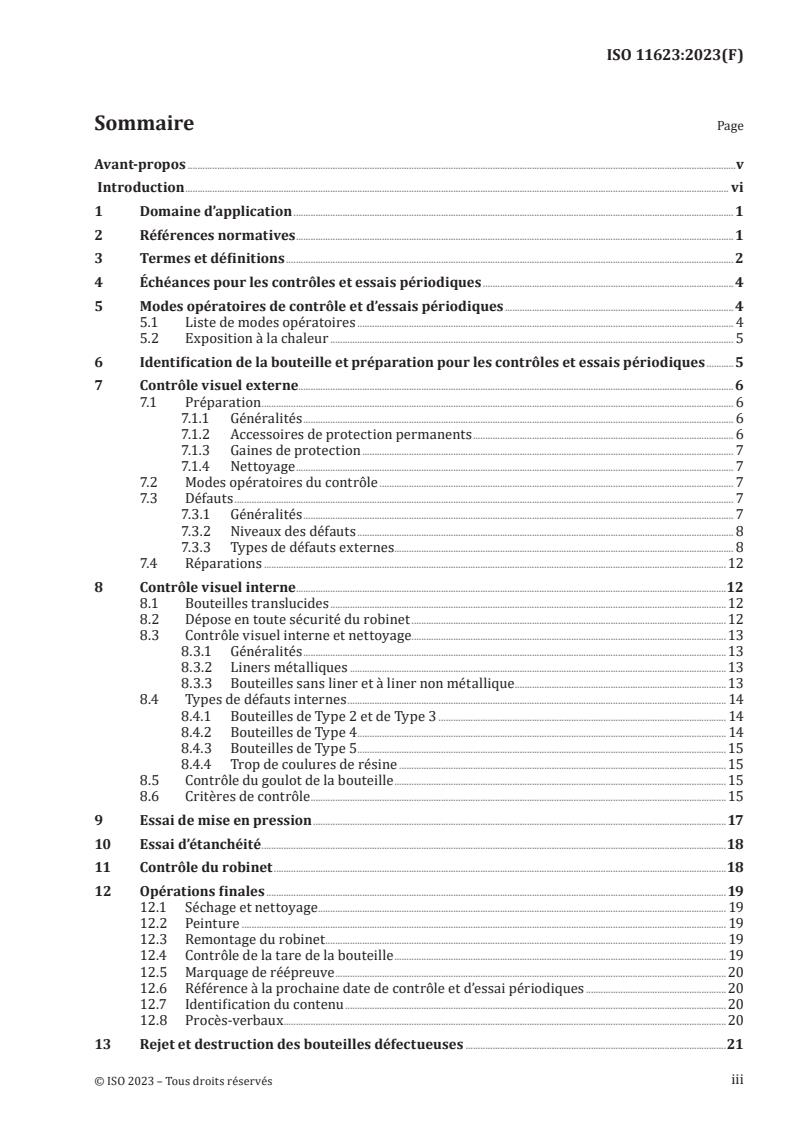
Contents Page
Foreword .v
Introduction . vi
1 Scope . 1
2 Normative references . 1
3 Terms and definitions . 2
4 Due dates for periodic inspection and testing . 4
5 Procedures for periodic inspection and testing . 4
5.1 List of procedures . 4
5.2 Heat exposure. 5
6 Identification of cylinder and preparation for periodic inspection and testing .5
7 External visual inspection . 6
7.1 Preparation . 6
7.1.1 General . 6
7.1.2 Permanent protective attachments. 6
7.1.3 Sleeves . 6
7.1.4 Cleaning . 6
7.2 Inspection procedures . 7
7.3 Damage . 7
7.3.1 General . 7
7.3.2 Damage levels . . 7
7.3.3 Types of external damage . 8
7.4 Repairs . 11
8 Internal visual inspection .11
8.1 Translucent cylinders . 11
8.2 Safe removal of valve . 11
8.3 Internal visual inspection and cleaning. 11
8.3.1 General . 11
8.3.2 Metallic liners . .12
8.3.3 Linerless and non-metallic liners .12
8.4 Types of internal damage .12
8.4.1 Type 2 and Type 3 cylinders .12
8.4.2 Type 4 cylinders .13
8.4.3 Type 5 cylinders .13
8.4.4 Excess resin droplets . 14
8.5 Inspection of cylinder neck . 14
8.6 Inspection criteria . 14
9 Pressure test .15
10 Leak test .16
11 Inspection of valve .17
12 Final operations .17
12.1 Drying and cleaning . 17
12.2 Painting . 17
12.3 Cylinder re-valving . 17
12.4 Check of cylinder tare . 17
12.5 Retest marking . 18
12.6 Reference to next periodic inspection and test date . 18
12.7 Identification of contents . 18
12.8 Records . 18
13 Rejection and rendering cylinders unserviceable .19
iii
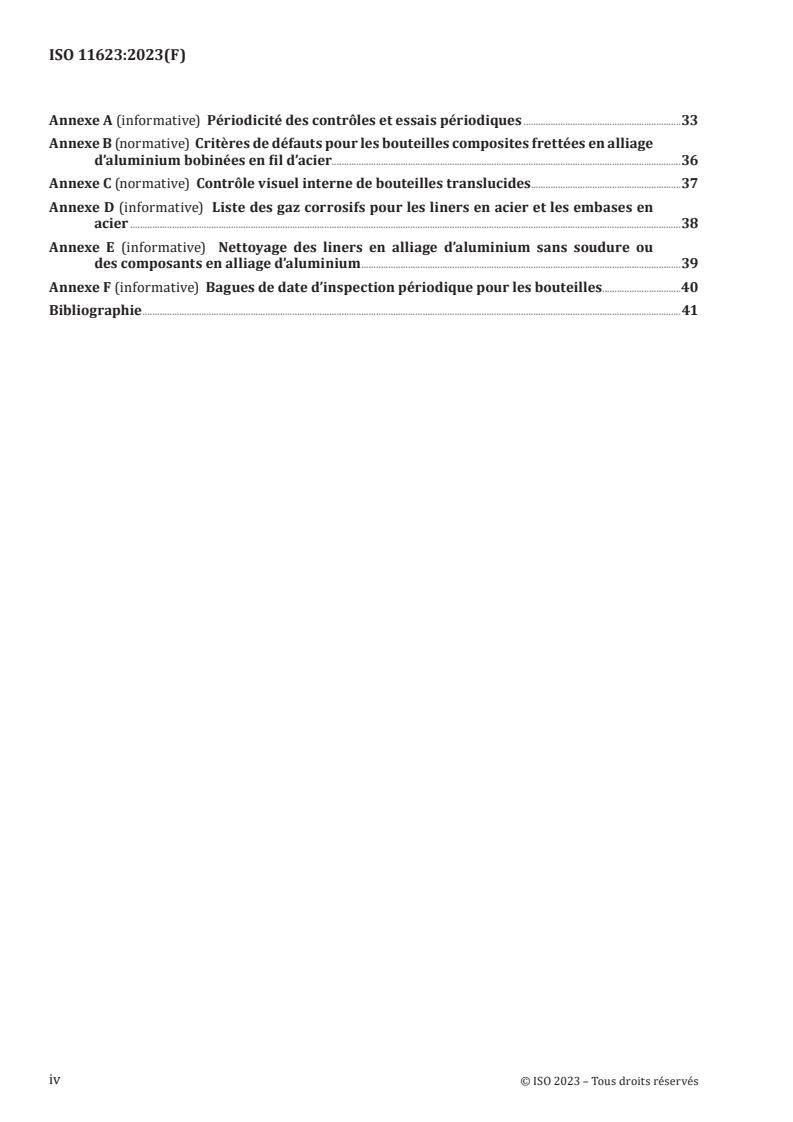
Annex A (informative) Intervals between periodic inspection and testing .31
Annex B (normative) Damage criteria for steel wire wound, aluminium-alloy cylinders .34
Annex C (normative) Internal visual inspection of translucent cylinders .35
Annex D (informative) List of gases corrosive to steel liners and steel bosses .36
Annex E (informative) Cleaning of seamless aluminium-alloy liners or aluminium-alloy
components .37
Annex F (informative) Periodic inspection date rings for cylinders .38
Bibliography .39
iv
Foreword
ISO (the International Organization for Standardization) is a worldwide federation of national standards
bodies (ISO member bodies). The work of preparing International Standards is normally carried out
through ISO technical committees. Each member body interested in a subject for which a technical
committee has been established has the right to be represented on that committee. International
organizations, governmental and non-governmental, in liaison with ISO, also take part in the work.
ISO collaborates closely with the International Electrotechnical Commission (IEC) on all matters of
electrotechnical standardization.
The procedures used to develop this document and those intended for its further maintenance are
described in the ISO/IEC Directives, Part 1. In particular, the different approval criteria needed for the
different types of ISO document should be noted. This document was drafted in accordance with the
editorial rules of the ISO/IEC Directives, Part 2 (see www.iso.org/directives).
ISO draws attention to the possibility that the implementation of this document may involve the use
of (a) patent(s). ISO takes no position concerning the evidence, validity or applicability of any claimed
patent rights in respect thereof. As of the date of publication of this document, ISO had not received
notice of (a) patent(s) which may be required to implement this document. However, implementers are
cautioned that this may not represent the latest information, which may be obtained from the patent
database available at www.iso.org/patents. ISO shall not be held responsible for identifying any or all
such patent rights.
Any trade name used in this document is information given for the convenience of users and does not
constitute an endorsement.
For an explanation of the voluntary nature of standards, the meaning of ISO specific terms and
expressions related to conformity assessment, as well as information about ISO's adherence to
the World Trade Organization (WTO) principles in the Technical Barriers to Trade (TBT), see
www.iso.org/iso/foreword.html.
This document was prepared by Technical Committee ISO/TC 58, Gas cylinders, Subcommittee
SC 4, Operational requirements for gas cylinders, in collaboration with the European Committee for
Standardization (CEN) Technical Committee CEN/TC 23, Transportable gas cylinders, in accordance
with the Agreement on technical cooperation between ISO and CEN (Vienna Agreement).
This third edition cancels and replaces the second edition (ISO 11623:2015), which has been technically
revised.
The main changes are as follows:
— revision of the Scope to include cylinders and tubes with a water capacity up to 3 000 l;
— modification of Table 1 to separate abrasion damage based on water capacity of the cylinder;
— clarification that a transparent sleeve may be left in place during inspection (7.1.3);
— clarification on the use of tare during inspection.
Any feedback or questions on this document should be directed to the user’s national standards body. A
complete listing of these bodies can be found at www.iso.org/members.html.
v
Introduction
The principal aim of periodic inspection and testing is that at the completion of the test, the cylinders
can be reintroduced into service. It is not possible to identify all considerations for periodic inspection
and testing of composite cylinders in this document. In such cases or where there is doubt, questions
regarding specific cylinders should be directed to the manufacturer or owner.
This document is intended to be used under a variety of national regulatory regimes but has been
[1]
written so that it is suitable for the application of the UN Model Regulations.
This document also gives other requirements concerning preparation, finishing and maintenance of
composite cylinders and tubes as well as the safety precautions for the personnel performing this work.
These requirements can be mandatory under other regulations.
vi
INTERNATIONAL STANDARD ISO 11623:2023(E)
Gas cylinders — Composite cylinders and tubes — Periodic
inspection and testing
1 Scope
This document specifies the requirements for periodic inspection and testing to verify the integrity for
further service of hoop-wrapped and fully-wrapped composite transportable gas cylinders and tubes,
with aluminium-alloy, steel or non-metallic liners or of linerless construction (Types 2, 3, 4, and 5),
intended for compressed, liquefied or dissolved gases under pressure, of water capacity from 0,5 l up to
3 000 l.
This document addresses the periodic inspection and testing of composite cylinders and tubes
constructed according to ISO 11119-1, ISO 11119-2, ISO 11119-3, ISO 11119-4 or ISO 11515. It can be
applied to other composite cylinders and tubes designed to comparable standards when authorized by
the competent authority.
As far as practicable, this document can also be applied to cylinders of less than 0,5 l water capacity
when authorized by the manufacturer.
NOTE Unless noted by exception, the use of the word “cylinder” in this document refers to both cylinders
and tubes.
2 Normative references
The following documents are referred to in the text in such a way that some or all of their content
constitutes requirements of this document. For dated references, only the edition cited applies. For
undated references, the latest edition of the referenced document (including any amendments) applies.
ISO 7225, Gas cylinders — Precautionary labels
ISO 10286, Gas cylinders — Vocabulary
ISO 10460, Gas cylinders — Welded aluminium-alloy, carbon and stainless steel gas cylinders — Periodic
inspection and testing
ISO 11114-2, Gas cylinders — Compatibility of cylinder and valve materials with gas contents — Part 2:
Non-metallic materials
ISO 11119 (all parts), Gas cylinders — Design, construction and testing of refillable composite gas cylinders
and tubes
ISO 11515, Gas cylinders — Refillable composite reinforced tubes of water capacity between 450 l and 3000
l — Design, construction and testing
ISO 11621, Gas cylinders — Procedures for change of gas service
ISO 13341, Gas cylinders — Fitting of valves to gas cylinders
ISO 13769, Gas cylinders — Stamp marking
ISO 18119, Gas cylinders — Seamless steel and seamless aluminium-alloy gas cylinders and tubes — Periodic
inspection and testing
ISO 22434, Gas cylinders — Inspection and maintenance of valves
ISO 25760, Gas cylinders — Operational procedures for the safe removal of valves from gas cylinders
3 Terms and definitions
For the purposes of this document, the terms and definitions given in ISO 10286 and the following apply.
ISO and IEC maintain terminology databases for use in standardization at the following addresses:
— ISO Online browsing platform: available at https:// www .iso .org/ obp
— IEC Electropedia: available at https:// www .electropedia .org/
3.1
composite overwrap
combination of fibres (3.3) (including steel wire) and matrix (3.15)
3.2
external coating
layer of material applied to the cylinder as a protective coating not intended to be removed or for
cosmetic purposes
EXAMPLE Gel coat and paint.
Note 1 to entry: Not all composite cylinders have a special external coating.
3.3
fibre
load-carrying part of the composite overwrap (3.1)
EXAMPLE Glass, aramid or carbon.
3.4
Type 5 cylinder
fully wrapped cylinder without a liner (3.11) and with composite reinforcement on both the cylindrical
portion and dome ends
3.5
Type 4 cylinder
fully wrapped cylinder with a non-load sharing liner (3.11) and composite reinforcement on both the
cylindrical portion and dome ends
3.6
Type 3 cylinder
fully wrapped cylinder with a load sharing metal liner (3.11) and composite reinforcement on both the
cylindrical portion and the dome ends
3.7
Type 2 cylinder
hoop-wrapped cylinder with a load-sharing metal liner (3.11) and composite reinforcement on the
cylindrical portion only
3.8
translucent cylinder
cylinder that permits the passage of light
3.9
identification label
label containing the permanent markings required by the relevant design specification
3.10
design life
maximum life (in number of years) to which a composite cylinder or tube is designed and approved in
accordance with the applicable standard
3.11
liner
inner portion of a composite cylinder, comprising a metallic or non-metallic vessel, whose purpose is
both to contain the gas and transmit the gas pressure to the composite overwrap (3.1)
3.12
non-metallic liner
liner (3.11) made from thermoplastic, thermosetting or elastomeric material
3.13
sleeve
transparent or non-transparent cover fitted to the outside surface of the cylinder
3.14
repair
set of activities performed on defective pressure equipment to restore its compliance with the relevant
specification
Note 1 to entry: Repair can include replacing worn or damaged parts meeting the original specification.
3.15
matrix
material that is used to bind and hold the fibres (3.3) in place
Note 1 to entry: The matrix is sometimes called resin.
3.16
rejected cylinder
cylinder not fit for service or which needs to be set aside for further evaluation or testing in its present
condition
3.17
bulge
visible swelling of the wall
Note 1 to entry: A bulge is away from the centre line (convex) and a dent is towards the centre line (concave).
3.18
crack
split or separation in the material, typically appearing as a line on the surface
3.19
crease
off-colour linear or non-linear feature formed as a result of previous localized over-stressing
3.20
protective attachment
component connected to the cylinder that prevents or resists damage to the composite cylinder
EXAMPLE Casing.
Note 1 to entry: Some protective attachments are designed to be removed at the time of periodic inspection and
testing.
3.21
permanent protective attachment
integral part of the cylinder design permanently affixed to composite cylinders (Types 2 to 5) covering
part of or the entire surface of the cylinder, providing additional functions during handling, transport
and use
3.22
stoving
treat by heating (e.g. in an oven) in order to apply a desired surface coating
4 Due dates for periodic inspection and testing
A cylinder shall be due for periodic inspection and testing on its first receipt by a filler following the
expiry of the interval established in accordance with the requirements of national or international
[1]
regulations or, in the absence of regulations, in accordance with the UN Model Regulations.
NOTE Annex A provides guidance regarding the intervals between periodic inspection and testing.
The expiry date is based on the last test date shown on the cylinder. Other means of indicating the
expiry date are permitted.
Provided the cylinder has not been subjected to abusive and abnormal conditions such as being
involved in an accident, heat exposure or other severe conditions that would render it unsafe, there is
no requirement for the user to return a cylinder before the contents have been used even though the
periodic inspection and testing interval has lapsed.
When the design life has expired, the cylinder shall not be refilled and shall be removed from service
when presented for the next filling (see Clause 13).
In some jurisdictions, it is the responsibility of the owner or user to submit cylinders used for emergency
purposes for periodic inspection and testing within the specified interval.
5 Procedures for periodic inspection and testing
5.1 List of procedures
The inspection, testing and repair of composite cylinders shall be carried out only by competent persons
in suitable facilities for cylinders of the size and type being requalified. Care shall be taken to ensure
that during the retest procedure, cylinders are handled carefully, particularly with respect to loading.
When moving from handling pallets or other transport frames, processes shall be developed to ensure
cylinders are not dropped or impacted during movement. Special handling methods and tooling may be
required to safely handle cylinders.
Handling procedures shall be available at the authorized inspection site.
Tests and examinations performed to demonstrate compliance shall be conducted using instruments
calibrated before being put into service and thereafter according to an established programme.
Each cylinder shall be submitted to periodic inspection and testing. The following procedures form the
requirements for this periodic inspection and testing and are explained more fully in this document in
the noted clauses:
— identification of cylinder and preparation for periodic inspection and testing (see Clause 6);
— external visual inspection (see Clause 7);
— safe removal of valve (see 8.2);
— internal visual inspection and cleaning (see 8.3);
— pressure test (see Clause 9);
— leak test (see Clause 10);
— inspection of valve (see Clause 11);
— final operations (see Clause 12);
— rejection and rendering cylinders unserviceable (see Clause 13).
The external and internal visual examination (see Clauses 7 and 8) shall be carried out prior to the
pressure test (see Clause 9). It is recommended that the other tests are performed in the sequence listed
in 5.1; for the safe removal of a valve, the requirements in ISO 25760 shall be met.
Cylinders that fail inspection or testing shall be rejected (see Clause 13). When a cylinder passes
the procedures listed in 5.1, but the condition of the cylinder remains in doubt, additional testing
shall be performed to confirm its suitability for continued service or the cylinder shall be rendered
unserviceable. Depending on the reason for the rejection, cylinders may be recovered and/or repaired
(see 7.4).
5.2 Heat exposure
When cylinders are refurbished during periodic inspection, it can be necessary to expose them to heat,
for example, during initial cleaning, or as part of a stoving operation when painting or powder coating
the cylinder. This heat exposure can affect the mechanical properties of the liners and/or the finished
composite cylinder.
It is therefore essential that information on precise heat-effect temperatures from the cylinder
manufacturer be available; in the absence of this information, cylinders shall not be exposed to a
temperature exceeding 70 °C during refurbishment. If the cylinder manufacturer confirms (i.e. either
on a cylinder label or through documentation) that the allowable temperature is greater than 70 °C,
then the manufacturer’s recommendations shall be followed during refurbishment.
6 Identification of cylinder and preparation for periodic inspection and testing
Before any work is carried out, the relevant cylinder marks (as defined in ISO 13769) and the gas
contents (as defined in ISO 7225) shall be identified. The marking shall be checked to ensure that
the cylinder in question is within its design life. When composite cylinders have been designed and
manufactured for a limited design life, this is indicated on the cylinder marking.
The cylinder shall be depressurized and emptied in a safe, controlled manner before proceeding. For
Type 4 and Type 5 cylinders, take necessary precautions and/or consult the cylinder manufacturer for
depressurization procedures to avoid damaging the cylinder.
WARNING — The uncontrolled opening and/or removal of valves from cylinders can lead to
injury, death and/or property damage.
Prior to valve removal, the user shall follow the procedures described in ISO 25760 to verify that the
cylinder is empty of gas. Provided that the requirements in ISO 25760 have been complied with, the
cylinder shall be considered safely depressurized, and the valve shall be removed.
Cylinders with unknown gas contents shall be emptied as if the gas is dangerous (i.e. toxic, flammable
or oxidizing) as described in ISO 25760.
When the valve is non-functional, cylinders shall be emptied safely as described in ISO 25760.
Access shall be provided to the entire external surface of the cylinder for visual inspection and
measurement.
7 External visual inspection
7.1 Preparation
7.1.1 General
The composite material including any external coating applied for protection shall not be removed for
the visual inspection.
Composite cylinders differ from their metal counterparts in that a competent person may repair them
when only limited damage has taken place (see 7.4). (This repair is not allowed for metal cylinders.)
These limits are specified in Table 1. Following this repair, cylinders shall be subjected to a pressure
test before being returned to service.
If the cylinder identification label is illegible, the manufacturer shall be contacted, or the cylinder shall
be rejected in accordance with Clause 13.
The manufacturer can provide a supplementary identification label to the cylinder if, as a minimum, the
original label’s serial number is still clearly legible.
When the cylinder manufacturer provides acceptance/rejection criteria for external damage, it takes
precedence over the criteria specified in Table 1.
7.1.2 Permanent protective attachments
Permanent protective attachments of the composite cylinder shall not be removed prior to inspection,
provided that these attachments are part of the original design. The manufacturer shall provide
acceptance/rejection criteria to be applied during the visual inspection for any damage to the
permanent protective attachments.
Markings specific to permanent attachments on the cylinder shall indicate if the attachments shall
remain in place at the time of the periodic inspection and testing. If such markings are not present, the
cylinder manufacturer shall be consulted to establish whether the permanent attachments need to be
removed.
7.1.3 Sleeves
When a transparent sleeve is used, it may be left in place as long as the composite wrapping can be
inspected effectively without its removal.
When a non-transparent sleeve is used that is not part of the cylinder design, it shall be removed prior
to inspection.
When the cylinder is suspected to be damaged, or if there are concerns regarding the operating
environment of the cylinder, e.g. saline atmosphere, the transparent sleeve shall be removed, and an
inspection of the composite material undertaken.
7.1.4 Cleaning
Care shall be taken not to remove any evidence of in-service damage (e.g. heat and fire damage), which
can affect the outcome of this inspection (see Table 1).
Each cylinder shall be cleaned and have all loose foreign matter removed from its external surface by a
suitable method (e.g. washing, light brushing, controlled water jet cleaning, plastic bead blasting).
Grit and shot blasting are not suitable. Chemical cleaning agents, paint strippers and solvents shall not
be used unless it has been established that they would not have an adverse effect on the cylinder or its
materials.
Care shall be taken to ensure the legibility of the identification marks when undertaking a cleaning
operation.
7.2 Inspection procedures
The cylinder manufacturer should determine the acceptance/rejection criteria for external damage
and make the criteria available to the inspector. The manufacturer’s guidance takes precedence over
the criteria outlined in Table 1.
The acceptance/rejection criteria given in Table 1 are to be followed in the absence of specific
instructions from the manufacturer of the cylinder being examined. The external metallic surface
of hoop-wrapped cylinders shall be visually inspected in accordance with the applicable clauses of
ISO 18119. Particular attention shall be paid to the interface with the composite overwrap to check for
crevice corrosion.
The external surface shall be inspected for damage to the composite overwrap. There are three levels
of damage that shall be considered (see 7.3.2); of these, only Level 2 can be repaired (see Table 1).
7.3 Damage
7.3.1 General
Damage to the composite overwrap can appear in many forms, and examples of these are described in
7.3.3. The acceptance/rejection criteria are specified in Table 1, which refers to specified damage levels
and the types of damage. Care shall be taken to establish the total extent of damage from impact (see
7.3.3.3) and delamination (see 7.3.3.4) as surface appearance will possibly not indicate the full extent of
the damage.
Annex B specifies additional damage criteria for steel wire wound, aluminium-alloy cylinders that shall
be taken into account.
When damage is caused by installation (e.g. trailer or bundle), severity or conditions of service, or by
improper cylinder use, the inspector should advise the cylinder owner of the need to take corrective
action to prevent or reduce further cylinder damage, or to prevent damage to a replacement cylinder.
Such actions should be developed with the manufacturer of the cylinder and the original installer.
7.3.2 Damage levels
7.3.2.1 General
The surface of the cylinder shall be inspected for evidence of damage. Damage shall be evaluated
in accordance with Table 1. For damage not specified in this document, the manufacturer shall be
consulted for guidance.
7.3.2.2 Level 1 damage
Cylinders with minor or superficial damage are categorized as having Level 1 damage. Such damage has
no adverse effects on the safety of the cylinder and its continued use. These cylinders may be returned
to service with no repair.
Scratched paint or nicks that have no appreciable depth in metal, or similar damage in the composite
cylinder paint or resin where there are no visible frayed fibres, are considered to be of this level of
damage.
7.3.2.3 Level 2 damage
Level 2 damage is rejectable damage that requires repair, testing or rendering the cylinder
unserviceable. Level 2 damage is also reserved for conditions specified by the manufacturer, which can
differ from Level 1 or Level 3 damage outlined in Table 1.
7.3.2.4 Level 3 damage
Level 3 damage is sufficiently severe that the cylinder shall not be repaired but shall be rejected and
subsequently rendered unserviceable. See Tables 1 and 2.
7.3.3 Types of external damage
7.3.3.1 Abrasion damage
Abrasion damage is caused by wearing, grinding or rubbing away by friction of the overwrap material.
Minor abrasion damage to the protective coating or paint is shown in Figure 1 a) and b). “Flat spots”
evident on the surface can indicate excessive loss of composite overwrap thickness [see Figure 1 c)].
7.3.3.2 Damage from cuts
Cuts or gouges are caused by contact with sharp objects in such a way as to cut into the composite
overwrap, reducing its thickness at that point, see Figure 2 a), b) and c).
7.3.3.3 Impact damage
Impact damage can appear as hairline cracks in the resin, or delamination or cuts of the composite
overwrap, see Figure 3 a) and b). The resin can have a frosted, crazed or opaque appearance.
7.3.3.4 Delamination
Delamination is a separation of layers of strands, or of the strands themselves, of the composite
overwrap, see Figure 4 a) and b). It also can appear as a whitish patch, like a blister, or an air space
beneath the surface.
7.3.3.5 Heat or fire damage [see Figure 5 a) and b)]
7.3.3.6 Structural damage
Structural damage is any evidence of:
— external bulges, distorted neck thread connections or depressions not originally designed;
— bulging of the liner of Type 2 or Type 3 cylinders;
— internal bulging of Type 4 or Type 5 cylinders.
7.3.3.7 Chemical attack
Chemical attack would appear as the dissolution of the matrix surrounding the fibres, see Figure 6 a)
and b). The resulting cylinder surface can be pitted, feel soft/sticky, discoloured, etc.
7.3.3.8 Loose permanent attachments
For example, signs of a collar, neck ring or permanent protective attachment that is part of the design
becoming loose are causes for rejecting the cylinder.
7.3.3.9 Damaged permanent attachments
Damage to permanent attachments, e.g. cage, outer casing, permanent protective attachment, etc.,
excluding transparent sleeves (see 7.1.3), that are part of the original cylinder design is Level 3 damage
unless the manufacturer provides an inspection manual of damage criteria based on experimental data.
7.3.3.10 Improper repairs
Signs of damage in the repaired area in excess of Level 1 are causes for rejecting the cylinder.
Table 1 — Acceptance/rejection criteria for external damage
Level of damage
Type of damage Level 1 Level 2 Level 3
Acceptable damage Rejectable damage Condemned damage
(requiring additional (not repairable)
inspections or repairs)
Abrasion damage Damage to the following Damage greater than Level 1 but Without further refer-
for cylinders with depth is acceptable: less than Level 3 shall be referred ence to manufacturer’s
a water capacity of to the manufacturer for repair instructions, damage
Less than or equal to 10 % of
less than 80 l procedures. Otherwise, the dam- greater than 10 % of
the thickness of the compos-
age shall be considered Level 3. the thickness of the
ite overwrap with a maxi-
composite overwrap
mum length in any direction If the manufacturer does not pro-
or with a maximum
of 25 % of the cylinder vide repair instructions, the dam-
length in any direction
diameter. age shall be considered Level 3.
more than 25 % of the
cylinder diameter shall
be considered Level 3.
Abrasion damage Damage to the following Damage greater than Level 1 but Without further refer-
for cylinders with depth is acceptable: less than Level 3 shall be referred ence to manufacturer’s
a water capacity of to the manufacturer for repair instructions, damage
Less than or equal to 15 % of
80 l or more procedures. Otherwise, the dam- greater than 15 % of
the thickness of the compos-
age shall be considered Level 3. the thickness of the
ite overwrap with a maxi-
composite overwrap
mum length in any direction If the manufacturer does not pro-
or with a maximum
of 15 % of the cylinder vide repair instructions, the dam-
length in any direction
diameter. age shall be considered Level 3.
more than 15 % of the
cylinder diameter shall
be considered Level 3.
Damage from cuts Damage to the following Damage greater than Level 1 but Without further refer-
for cylinders with depth is acceptable: less than Level 3 shall be referred ence to manufacturer’s
a water capacity of to the manufacturer for repair instructions, damage
Less than or equal to 20 % of
less than 80 l procedures. Otherwise, the dam- greater than 20 % of
the thickness of the compos-
age shall be considered Level 3. the thickness of the
ite overwrap to a maximum
composite overwrap
of 2 mm. If the manufacturer does not pro-
to a maximum of 2 mm
vide repair instructions, the dam-
shall be considered
age shall be considered Level 3.
Level 3.
Damage from cuts Damage to the following Damage greater than Level 1 but Without further refer-
for cylinders with depth is acceptable: less than Level 3 shall be referred ence to manufacturer’s
a water capacity of to the manufacturer for repair instructions, damage
Less than or equal to 20 % of
80 l or more procedures. Otherwise, the dam- greater than 20 % of
the thickness of the compos-
age shall be considered Level 3. the thickness of the
ite overwrap to a maximum
composite overwrap
of 2 mm If the manufacturer does not pro-
to a maximum of 2 mm
vide repair instructions, the dam-
shall be considered
age shall be considered Level 3.
Level 3.
TTabablele 1 1 ((ccoonnttiinnueuedd))
Level of damage
Type of damage Level 1 Level 2 Level 3
Acceptable damage Rejectable damage Condemned damage
(requiring additional (not repairable)
inspections or repairs)
Impact damage Damage from impact, which Damage greater than Level 1 shall Without further refer-
causes a frosted appearance be referred to the manufacturer ence to manufacturer’s
or hairline cracking in the for evaluation. instructions, damage
impact area that is less than greater than Level 1
Otherwise, the damage shall be
25 mm in diameter without shall be considered
considered Level 3.
permanent deformation, is Level 3.
acceptable.
Delamination No visible delamination Loose fibre ends from the termina- Delaminating fibres
tion of the wrapping process shall not included in Level 2
be repaired.
Heat or fire When the composite over- Damage greater than Level 1 Cylinders with evi-
damage wrap is only soiled from no repair allowed – consider as dence of heat or fire
smoke or other debris and Level 3. damage greater than
is found to be suitable for Level 1 shall be ren-
further service. Additional dered unserviceable.
attention shall be given to
cylinders with an alumini-
um-alloy liner/boss or a non-
load sharing liner.
Composite matrix Yellowing of the external sur- Minor deterioration of the matrix, Extensive deterio-
shows deteriora- face, or superficial deteriora- exposing the outermost layer of ration, fibres have
tion and/or loose tion of the matrix reinforcing fibres. become exposed and
fibres loose
No fibre ends exposed Repair in accordance with 7.4
Structural damage Not acceptable No repair allowed Cylinders with struc-
tural damage shall be
rendered unservicea-
ble.
Chemical attack When the cylinder has only If the chemical's nature is known, All cylinders if chemi-
superficial discoloration the cylinder manufacturer shall cal unknown
provide documentation confirm-
Any attack of the fibre
ing Level 1 or 2. If Level 2, the
manufacturer shall suggest a
suitable repair procedure.
Missing/illegible Not applicable When the manufacturer can un- All cylinders that can-
identification label mistakably identify the cylinder, not be identified and
or markings by at least the serial number, a relabelled/ remarked
new label shall be supplied by the
manufacturer and affixed or the
marks applied either by the in-
spector or the manufacturer (see
ISO 13769).
Loose permanent Not applicable Repair possible provided manufac- All cylinders other
attachments turer gives written consent. than those in Level 2
Improper repair Not applicable Following a repair (see 7.4), all All cylinders with de-
defects can be repaired a second fects after the second
and final time; the cylinder shall repair
be retested.
TTabablele 1 1 ((ccoonnttiinnueuedd))
Level of damage
Type of damage Level 1 Level 2 Level 3
Acceptable damage Rejectable damage Condemned damage
(requiring additional (not repairable)
inspections or repairs)
Damaged perma- No damage or minor damage When dented, cracked, broken, If Level 2 damage ex-
nent attachment such as nicks, scratches con- showing other signs of damage ists and replacement of
sistent with normal wear (e.g. discolouration from impact) the damaged attach-
or as advised by the manufactur- ment is not possible
er. Permanent attachment to be
Or
removed and composite cylinder
to be assessed for damage. New
If the composite cyl-
attachment may be fitted provided
inder shows damage
cylinder suitable for further ser-
adjacent to a damaged
vice.
area on the attachment
7.4 Repairs
Any repairs shall be made by a person competent in repair procedures.
A resin system compatible with that used in the construction of the cylinder may be used to repair
composite cylinders. Reference shall be made to the manufacturer for the repair procedure.
All repaired cylinders shall be subjected to a pressure test before being returned to service. After
the pressure test, the repairs shall be examined for lifting, peeling or delamination of the composite
overwrap. The damage criteria identified in 7.3 shall be used. In the event of a failure, if it can be
established that the repair procedure was inadequate or not follo
...
NORME ISO
INTERNATIONALE 11623
Troisième édition
2023-07
Bouteilles à gaz — Bouteilles et tubes
composites — Contrôles et essais
périodiques
Gas cylinders — Composite cylinders and tubes — Periodic inspection
and testing
Numéro de référence
DOCUMENT PROTÉGÉ PAR COPYRIGHT
© ISO 2023
Tous droits réservés. Sauf prescription différente ou nécessité dans le contexte de sa mise en œuvre, aucune partie de cette
publication ne peut être reproduite ni utilisée sous quelque forme que ce soit et par aucun procédé, électronique ou mécanique,
y compris la photocopie, ou la diffusion sur l’internet ou sur un intranet, sans autorisation écrite préalable. Une autorisation peut
être demandée à l’ISO à l’adresse ci-après ou au comité membre de l’ISO dans le pays du demandeur.
ISO copyright office
Case postale 401 • Ch. de Blandonnet 8
CH-1214 Vernier, Genève
Tél.: +41 22 749 01 11
E-mail: copyright@iso.org
Web: www.iso.org
Publié en Suisse
ii
Sommaire Page
Avant-propos .v
Introduction . vi
1 Domaine d’application . 1
2 Références normatives .1
3 Termes et définitions . 2
4 Échéances pour les contrôles et essais périodiques . 4
5 Modes opératoires de contrôle et d’essais périodiques . 4
5.1 Liste de modes opératoires . 4
5.2 Exposition à la chaleur . 5
6 Identification de la bouteille et préparation pour les contrôles et essais périodiques .5
7 Contrôle visuel externe.6
7.1 Préparation . 6
7.1.1 Généralités . 6
7.1.2 Accessoires de protection permanents . 6
7.1.3 Gaines de protection . 7
7.1.4 Nettoyage . 7
7.2 Modes opératoires du contrôle . 7
7.3 Défauts . 7
7.3.1 Généralités . 7
7.3.2 Niveaux des défauts . 8
7.3.3 Types de défauts externes. 8
7.4 Réparations . 12
8 Contrôle visuel interne.12
8.1 Bouteilles translucides .12
8.2 Dépose en toute sécurité du robinet .12
8.3 Contrôle visuel interne et nettoyage . 13
8.3.1 Généralités .13
8.3.2 Liners métalliques .13
8.3.3 Bouteilles sans liner et à liner non métallique .13
8.4 Types de défauts internes . 14
8.4.1 Bouteilles de Type 2 et de Type 3 . 14
8.4.2 Bouteilles de Type 4 . 14
8.4.3 Bouteilles de Type 5 . 15
8.4.4 Trop de coulures de résine . 15
8.5 Contrôle du goulot de la bouteille . 15
8.6 Critères de contrôle .15
9 Essai de mise en pression .17
10 Essai d’étanchéité .18
11 Contrôle du robinet .18
12 Opérations finales .19
12.1 Séchage et nettoyage . 19
12.2 Peinture . 19
12.3 Remontage du robinet . 19
12.4 Contrôle de la tare de la bouteille . 19
12.5 Marquage de réépreuve .20
12.6 Référence à la prochaine date de contrôle et d’essai périodiques .20
12.7 Identification du contenu . 20
12.8 Procès-verbaux . .20
13 Rejet et destruction des bouteilles défectueuses .21
iii
Annexe A (informative) Périodicité des contrôles et essais périodiques .33
Annexe B (normative) Critères de défauts pour les bouteilles composites frettées en alliage
d’aluminium bobinées en fil d’acier.36
Annexe C (normative) Contrôle visuel interne de bouteilles translucides .37
Annexe D (informative) Liste des gaz corrosifs pour les liners en acier et les embases en
acier .38
Annexe E (informative) Nettoyage des liners en alliage d’aluminium sans soudure ou
des composants en alliage d’aluminium .39
Annexe F (informative) Bagues de date d’inspection périodique pour les bouteilles.40
Bibliographie .41
iv
Avant-propos
L'ISO (Organisation internationale de normalisation) est une fédération mondiale d'organismes
nationaux de normalisation (comités membres de l'ISO). L'élaboration des Normes internationales est
en général confiée aux comités techniques de l'ISO. Chaque comité membre intéressé par une étude
a le droit de faire partie du comité technique créé à cet effet. Les organisations internationales,
gouvernementales et non gouvernementales, en liaison avec l'ISO participent également aux travaux.
L'ISO collabore étroitement avec la Commission électrotechnique internationale (IEC) en ce qui
concerne la normalisation électrotechnique.
Les procédures utilisées pour élaborer le présent document et celles destinées à sa mise à jour sont
décrites dans les Directives ISO/IEC, Partie 1. Il convient, en particulier, de prendre note des différents
critères d'approbation requis pour les différents types de documents ISO. Le présent document a
été rédigé conformément aux règles de rédaction données dans les Directives ISO/IEC, Partie 2 (voir
www.iso.org/directives).
L’ISO attire l’attention sur le fait que la mise en application du présent document peut entraîner
l’utilisation d’un ou de plusieurs brevets. L’ISO ne prend pas position quant à la preuve, à la validité
et à l’applicabilité de tout droit de brevet revendiqué à cet égard. À la date de publication du présent
document, l’ISO n'avait pas reçu notification qu’un ou plusieurs brevets pouvaient être nécessaires à sa
mise en application. Toutefois, il y a lieu d’avertir les responsables de la mise en application du présent
document que des informations plus récentes sont susceptibles de figurer dans la base de données de
brevets, disponible à l'adresse www.iso.org/brevets. L’ISO ne saurait être tenue pour responsable de ne
pas avoir identifié tout ou partie de tels droits de propriété.
Les appellations commerciales éventuellement mentionnées dans le présent document sont données
pour information, par souci de commodité, à l’intention des utilisateurs et ne sauraient constituer un
engagement.
Pour une explication de la nature volontaire des normes, la signification des termes et expressions
spécifiques de l'ISO liés à l'évaluation de la conformité, ou pour toute information au sujet de l'adhésion
de l'ISO aux principes de l’Organisation mondiale du commerce (OMC) concernant les obstacles
techniques au commerce (OTC), voir www.iso.org/avant-propos.
Le présent document a été élaboré par le comité technique ISO/TC 58, Bouteilles à gaz, sous-comité
SC 4, Contraintes de service des bouteilles à gaz, en collaboration avec le comité technique CEN/TC 23,
Bouteilles à gaz transportables, du Comité européen de normalisation (CEN), conformément à l’Accord
de coopération technique entre l’ISO et le CEN (Accord de Vienne).
Cette troisième édition annule et remplace la deuxième édition (ISO 11623:2015), qui a fait l’objet d’une
révision technique.
Les principales modifications sont les suivantes:
— révision du domaine d’application pour inclure les bouteilles et les tubes pouvant contenir
jusqu’à 3 000 l d’eau;
— modification du Tableau 1 pour séparer les défauts dus à l’abrasion en fonction de la contenance en
eau de la bouteille;
— clarification du fait qu’une gaine de protection transparente peut être laissée en place pendant le
contrôle (7.1.3);
— clarification quant à l’utilisation d’une tare pendant le contrôle.
Il convient que l’utilisateur adresse tout retour d’information ou toute question concernant le présent
document à l’organisme national de normalisation de son pays. Une liste exhaustive desdits organismes
se trouve à l’adresse www.iso.org/fr/members.html.
v
Introduction
L’objectif principal du contrôle et des essais périodiques est qu’à l’issue de ces essais, les bouteilles
puissent être remises en service. Il n’est pas possible de définir dans le présent document tous les
aspects liés au contrôle et aux essais périodiques des bouteilles en matériau composite. Dans de tels
cas, ou en cas de doute, il convient de s’adresser au fabricant ou au propriétaire pour toute question
relative aux modèles de bouteilles spécifiques.
Même si le présent document est destiné à être utilisé sous divers régimes réglementaires nationaux,
[1]
il a néanmoins été élaboré de manière à être adapté à l’application du Règlement type de l’ONU.
Le présent document donne également d’autres exigences relatives à la préparation, la finition et
l’entretien des bouteilles et des tubes en matériau composite ainsi qu’aux précautions de sécurité
pour le personnel effectuant ces tâches. Ces exigences peuvent être obligatoires dans le cadre d’autres
règlements.
vi
NORME INTERNATIONALE ISO 11623:2023(F)
Bouteilles à gaz — Bouteilles et tubes composites —
Contrôles et essais périodiques
1 Domaine d’application
Le présent document spécifie les exigences relatives aux contrôles et essais périodiques des bouteilles
et tubes à gaz en matériau composite transportables, frettés ou entièrement bobinés, dotés ou non d’un
liner en alliage d’aluminium, en acier ou non métallique (Types 2, 3, 4 et 5), destinés à contenir des
gaz comprimés, liquéfiés ou dissous sous pression et ayant une contenance en eau comprise entre 0,5 l
et 3 000 l inclus, et vise à vérifier leur intégrité pour leur maintien en service.
Le présent document traite du contrôle et des essais périodiques des bouteilles et des tubes en
matériau composite fabriqués conformément à l’ISO 11119-1, l’ISO 11119-2, l’ISO 11119-3, l’ISO 11119-4
ou l’ISO 11515. Il peut être appliqué à d’autres bouteilles et tubes en matériau composite conçus
conformément à des normes comparables en cas d’autorisation par l’autorité compétente.
Dans la mesure du possible, le présent document peut également être appliqué aux bouteilles ayant une
contenance en eau inférieure à 0,5 l en cas d’autorisation par le fabricant.
NOTE Sauf exception, l’utilisation du terme «bouteille» dans le présent document se rapporte aux bouteilles
et aux tubes.
2 Références normatives
Les documents suivants sont cités dans le texte de sorte qu’ils constituent, pour tout ou partie de leur
contenu, des exigences du présent document. Pour les références datées, seule l’édition citée s’applique.
Pour les références non datées, la dernière édition du document de référence s’applique (y compris les
éventuels amendements).
ISO 7225, Bouteilles à gaz — Étiquettes informatives
ISO 10286, Bouteilles à gaz — Vocabulaire
ISO 10460, Bouteilles à gaz — Bouteilles à gaz soudées en alliage d'aluminium, carbone et acier inoxydable
— Contrôles et essais périodiques
ISO 11114-2, Bouteilles à gaz — Compatibilité des matériaux des bouteilles et des robinets avec les contenus
gazeux — Partie 2: Matériaux non métalliques
ISO 11119 (toutes les parties), Bouteilles à gaz — Conception, construction et essais des tubes et bouteilles
à gaz rechargeables en matériau composite
ISO 11515, Bouteilles à gaz — Tubes composites renforcés rechargeables d'une capacité de 450 l à 3000 l —
Conception, construction et essais
ISO 11621, Bouteilles à gaz — Mode opératoire pour le changement de service de gaz
ISO 13341, Bouteilles à gaz — Montage des robinets sur les bouteilles à gaz
ISO 13769, Bouteilles à gaz — Marquage
ISO 18119, Bouteilles à gaz — Bouteilles et tubes à gaz en acier et en alliages d'aluminium, sans soudure —
Contrôles et essais périodiques
ISO 22434, Bouteilles à gaz — Contrôle et maintenance des robinets
ISO 25760, Bouteilles à gaz — Modes opératoires de dépose en toute sécurité des robinets de bouteilles à
gaz
3 Termes et définitions
Pour les besoins du présent document, les termes et les définitions de l’ISO 10286 ainsi que les suivants,
s’appliquent.
L'ISO et l'IEC tiennent à jour des bases de données terminologiques destinées à être utilisées en
normalisation, consultables aux adresses suivantes:
— ISO Online browsing platform: disponible à l'adresse https:// www .iso .org/ obp
— IEC Electropedia: disponible à l'adresse https:// www .electropedia .org/
3.1
enveloppe composite
combinaison de fibres (3.3) (incluant le fil d’acier) et d’une matrice (3.15)
3.2
revêtement extérieur
couche de matériau déposée sur une bouteille à des fins de protection ou de décoration, faisant partie
ou pas de la conception de la bouteille, donc à retirer ou pas au moment de l’inspection périodique
EXEMPLE Enduit gélifié («gel coat») et peinture.
Note 1 à l'article: Les bouteilles en matériau composite ne sont pas toutes dotées d’un revêtement extérieur
spécial.
3.3
fibre
partie de l’enveloppe composite (3.1) supportant la charge
EXEMPLE Fibre de verre, d’aramide ou de carbone.
3.4
bouteille de Type 5
bouteille entièrement bobinée sans liner (3.11) et avec renforcement composite sur la portion
cylindrique et les extrémités bombées
3.5
bouteille de Type 4
bouteille entièrement bobinée avec liner (3.11) non structural et renforcement composite sur la portion
cylindrique et les extrémités bombées
3.6
bouteille de Type 3
bouteille entièrement bobinée avec liner (3.11) structural métallique et renforcement composite sur la
portion cylindrique et les extrémités bombées
3.7
bouteille de Type 2
bouteille frettée avec liner (3.11) structural métallique et renforcement composite uniquement sur la
portion cylindrique
3.8
bouteille translucide
bouteille qui laisse passer la lumière
3.9
étiquette d’identification
étiquette sur laquelle figurent les marquages permanents requis par la spécification de conception
correspondante
3.10
durée de vie
durée de vie maximale (en nombre d’années) prévue pour une bouteille ou un tube composite et
approuvée conformément à la norme applicable
3.11
liner
partie intérieure d’une bouteille composite, comprenant un contenant métallique ou non métallique,
ayant pour fonction de contenir le gaz et de transmettre la pression de gaz à l’enveloppe composite (3.1)
3.12
liner non métallique
liner (3.11) fabriqué à base de matériaux thermoplastiques, thermodurcissables ou élastomères
3.13
gaine de protection
manchon, transparent ou non, placé sur la surface extérieure de la bouteille
3.14
réparation
ensemble d’activités réalisées sur un équipement sous pression défectueux pour rétablir sa conformité
à la spécification pertinente
Note 1 à l'article: Une réparation peut inclure le remplacement de pièces endommagées ou usées permettant de
satisfaire à la spécification d’origine.
3.15
matrice
matériau servant à lier les fibres (3.3) entre elles et à les maintenir en place
Note 1 à l'article: La matrice est parfois appelée résine.
3.16
bouteille rejetée
bouteille qui, dans son état actuel, ne peut pas être mise en service ou qui doit être mise à l’écart pour
une évaluation ou des essais ultérieurs
3.17
saillie
renflement visible de la paroi
Note 1 à l'article: Une saillie s’écarte de l’axe central (convexe) et un enfoncement est en direction de l’axe central
(concave).
3.18
fissure
fente ou séparation dans le matériau, apparaissant en général sous forme de ligne au niveau de la surface
3.19
pli
marque décolorée linéaire ou non linéaire formée à la suite d’une précédente contrainte excessive
localisée
3.20
accessoire de protection
composant raccordé à la bouteille destiné à prévenir ou résister aux détériorations de la bouteille
composite
EXEMPLE Enveloppe de protection.
Note 1 à l'article: Certains accessoires de protection sont conçus pour être déposés au moment des contrôles et
essais périodiques.
3.21
accessoire de protection permanent
partie intégrante de la conception de bouteille liée de manière permanente aux bouteilles en matériau
composite (Types 2 à 5) couvrant une partie ou l’ensemble de la surface de la bouteille, fournissant des
fonctions supplémentaires pendant la manipulation, le transport et l’utilisation
3.22
étuvage
traitement thermique (par exemple dans un four) afin d’appliquer un revêtement de surface souhaité
4 Échéances pour les contrôles et essais périodiques
Une bouteille doit être soumise à des contrôles et essais périodiques dès sa première réception par le
remplisseur après le dépassement de l’intervalle établi conformément aux exigences des règlements
nationaux ou internationaux ou, en l’absence de règlements, conformément au Règlement type de
[1]
l’ONU .
NOTE L’Annexe A donne des recommandations relatives aux intervalles entre les contrôles et les essais
périodiques.
L’échéance dépend de la dernière date d’essai indiquée sur la bouteille. D’autres moyens d’indiquer
l’échéance sont autorisés.
Pour autant que la bouteille n’a pas été soumise à des conditions abusives et anormales telles que
l’implication dans un accident, l’exposition à la chaleur ou d’autres conditions extrêmes qui la rendraient
dangereuse, il n’est pas exigé de l’utilisateur qu’il renvoie une bouteille avant que le contenu ait été
utilisé, même si l’intervalle de contrôle et d’essais périodiques est dépassé.
En revanche, lorsque la durée de vie est arrivée à expiration, la bouteille ne doit pas être remplie et doit
être retirée du service lorsqu’elle est présentée pour un nouveau remplissage (voir Article 13).
Dans certaines juridictions, il est de la responsabilité du propriétaire ou de l’utilisateur de soumettre les
bouteilles utilisées en situation d’urgence aux contrôles et essais périodiques dans les délais spécifiés.
5 Modes opératoires de contrôle et d’essais périodiques
5.1 Liste de modes opératoires
Le contrôle, l’essai et la réparation des bouteilles en matériau composite doivent être effectués
uniquement par des personnes compétentes dans des installations appropriées pour les bouteilles
de la taille et du type en cours de requalification. Il faut s’assurer que, pendant le mode opératoire
de réépreuve, les bouteilles sont manipulées avec soin, surtout en ce qui concerne le chargement.
Lors du déplacement des palettes de manutention ou d’autres châssis de transport, des processus
doivent être élaborés pour s’assurer que les bouteilles ne subissent pas de chute ou de choc pendant
leur déplacement. Des méthodes et un outillage spéciaux de manipulation peuvent être exigés pour
manipuler les bouteilles en toute sécurité.
Des modes opératoires de manipulation doivent être disponibles sur le site de contrôle agréé.
Les essais et examens effectués pour démontrer la conformité doivent être réalisés à l’aide d’instruments
étalonnés avant et après leur mise en service conformément à un programme établi.
Chaque bouteille doit être soumise à des contrôles et essais périodiques. Les modes opératoires
suivants, qui sont expliqués plus en détail dans les articles notés du présent document, constituent les
exigences de base pour ces contrôles et essais périodiques:
— identification de la bouteille et préparation en vue des contrôles et essais périodiques (voir Article 6);
— contrôle visuel externe (voir Article 7);
— dépose en toute sécurité du robinet (voir 8.2);
— contrôle visuel interne et nettoyage (voir 8.3);
— essai de mise en pression (voir Article 9);
— essai d’étanchéité (voir Article 10);
— contrôle du robinet (voir Article 11);
— opérations finales (voir Article 12);
— rejet et destruction des bouteilles défectueuses (voir Article 13).
Le contrôle visuel externe et interne (voir Articles 7 et 8) doit être effectué avant l’essai de mise en
pression (voir Article 9). Il est recommandé que les autres essais soient effectués dans l’ordre suggéré en
5.1; pour la dépose en toute sécurité d’un robinet, les exigences de l’ISO 25760 doivent être satisfaites.
Les bouteilles qui ne satisfont pas aux contrôles ou aux essais doivent être mises au rebut (voir Article 13).
Lorsqu’une bouteille donne des résultats satisfaisants lorsqu’elle est soumise aux modes opératoires
énumérés en 5.1, mais que son état reste douteux, des essais supplémentaires doivent être mis en
œuvre pour confirmer son aptitude à rester en service; sinon, la bouteille doit être rendue inutilisable.
Certains motifs de rebut permettent néanmoins une récupération et/ou une réparation de certaines
bouteilles (voir 7.4).
5.2 Exposition à la chaleur
Lorsque des bouteilles sont réparées lors du contrôle périodique, il peut se révéler nécessaire de les
exposer à la chaleur, par exemple lors du nettoyage initial ou dans le cadre de l’étuvage lors de la mise
en peinture simple ou par poudrage de la bouteille. Cette exposition à la chaleur peut affecter les
propriétés mécaniques des liners et/ou des bouteilles composites finies.
Il est par conséquent essentiel que les informations sur les températures précises des effets de la
chaleur soient mises à disposition par le fabricant de la bouteille; en l’absence de telles informations,
les bouteilles ne doivent pas être exposées à une température au-dessus de 70 °C lors de la remise à
neuf. Si le fabricant de la bouteille confirme (c’est-à-dire sur une étiquette de la bouteille ou dans la
documentation) que la température admissible est supérieure à 70 °C, alors les recommandations du
fabricant doivent être respectées pendant la remise à neuf.
6 Identification de la bouteille et préparation pour les contrôles et essais
périodiques
Avant toute opération, les marquages concernant la bouteille (tels que définis dans l’ISO 13769) et le
gaz contenu (tel que défini dans l’ISO 7225) doivent être identifiés. Le marquage doit être vérifié de
manière à s’assurer que la durée de vie de la bouteille en question n’est pas arrivée à expiration. Lorsque
les bouteilles en matériau composite ont été conçues et fabriquées pour une durée de vie limitée, le
marquage de la bouteille précise cette spécification.
Les bouteilles doivent au préalable être dépressurisées et vidées en toute sécurité et sous contrôle avant
toute autre opération. Pour les bouteilles de Type 4 et de Type 5, prendre les précautions nécessaires
et/ou consulter le fabricant de la bouteille pour les modes opératoires de dépressurisation afin d’éviter
d’endommager la bouteille.
AVERTISSEMENT — L’ouverture intempestive et/ou la dépose des robinets des bouteilles
peuvent entraîner des blessures, des décès et/ou des dégâts matériels.
Avant de procéder à la dépose du robinet, l’utilisateur doit suivre les modes opératoires décrits dans
l’ISO 25760 pour vérifier que la bouteille ne contient pas de gaz. Sous condition que les exigences de
l’ISO 25760 soient respectées, la bouteille doit être considérée comme étant dépressurisée en toute
sécurité et le robinet doit être déposé.
Les bouteilles contenant un gaz de nature inconnue doivent être vidées, en procédant comme
s’il s’agissait d’un gaz dangereux (c’est-à-dire, toxique, inflammable ou oxydant) tel que décrit dans
l’ISO 25760.
Lorsque le robinet n’est pas opérationnel, les bouteilles doivent être vidées dans les conditions de
sécurité souhaitées telles que décrites dans l’ISO 25760.
Il doit être possible d’accéder à toute la surface extérieure de la bouteille pour le contrôle visuel et le
mesurage.
7 Contrôle visuel externe
7.1 Préparation
7.1.1 Généralités
Le matériau composite, y compris tout revêtement extérieur appliqué à des fins de protection,
ne doit pas être enlevé afin de procéder au contrôle visuel.
Les bouteilles à gaz en matériau composite se distinguent de leurs homologues métalliques par le fait
qu’une personne compétente peut les réparer lorsque seuls des défauts d’importance limitée sont
survenus (voir en 7.4). (Cette réparation n’est pas autorisée pour les bouteilles métalliques). Ces limites
sont spécifiées dans le Tableau 1. Après réparation, les bouteilles doivent toujours être soumises à un
essai de mise en pression avant d’être remises en service.
Si l’étiquette d’identification de la bouteille est illisible, le fabricant doit être contacté ou la bouteille doit
être rejetée conformément à l’Article 13.
Le fabricant peut apposer sur la bouteille une étiquette d’identification supplémentaire si, au minimum,
le numéro de série de l’étiquette d’origine est toujours clairement lisible.
Lorsque le fabricant de la bouteille fournit des critères d’acceptation/rejet pour les défauts externes,
ceux-ci ont la priorité sur les critères spécifiés dans le Tableau 1.
7.1.2 Accessoires de protection permanents
Les accessoires de protection permanents de la bouteille en matériau composite ne doivent pas être
retirés avant le contrôle, à condition que ces accessoires fassent partie de la conception d’origine.
Le fabricant doit fournir des critères d’acceptation/rejet à appliquer lors du contrôle visuel pour tout
défaut des accessoires de protection permanents.
Les marquages spécifiques aux accessoires permanents de la bouteille doivent indiquer si ces
accessoires doivent rester en place lors des contrôles et essais périodiques. S’il n’y a pas de tels
marquages, le fabricant de la bouteille doit être consulté afin de déterminer s’il est nécessaire de
déposer les accessoires permanents.
7.1.3 Gaines de protection
Lorsqu’une gaine de protection transparente est utilisée, elle peut être laissée en place pour autant
qu’elle ne gêne pas le contrôle efficace de l’enveloppe composite.
Lorsqu’une gaine de protection non transparente ne faisant pas partie de la conception de la bouteille
est utilisée, elle doit être retirée avant le contrôle.
S’il existe un soupçon de défaut de la bouteille, ou une inquiétude au sujet de l’environnement
d’utilisation de la bouteille, par exemple, une atmosphère saline, la gaine de protection transparente
doit être retirée et un contrôle du matériau composite entrepris.
7.1.4 Nettoyage
Des précautions doivent être prises pour ne pas éliminer des indices prouvant que la bouteille a été
endommagée pendant son utilisation (par exemple défauts dus à une exposition à la chaleur et au feu),
ce qui peut altérer le résultat du présent mode opératoire de contrôle (voir Tableau 1).
Chaque bouteille doit être nettoyée pour éliminer de sa surface extérieure tout corps étranger qui peut
s’y trouver par tout moyen approprié (par exemple lavage, brossage léger, nettoyage au jet d’eau, jet de
billes en matière plastique).
Le sablage et le grenaillage ne conviennent pas. Les nettoyants chimiques, les décapants pour peinture
et les solvants ne doivent pas être utilisés, à moins qu’il n’ait été démontré qu’ils n’ont pas d’effet nuisible
pour la bouteille ou ses matériaux.
La lisibilité des marquages d’identification doit être assurée après une opération de nettoyage.
7.2 Modes opératoires du contrôle
Il convient que le fabricant de la bouteille détermine les critères d’acceptation/rejet pour les défauts
externes et les communique à l’inspecteur. Les recommandations du fabricant prévalent sur les critères
indiqués dans le Tableau 1.
Les critères d’acceptation/rejet donnés dans le Tableau 1 sont à respecter en l’absence de consignes
spécifiques du fabricant de la bouteille examinée. La surface métallique extérieure des bouteilles
frettées doit faire l’objet d’un contrôle visuel conformément aux articles applicables de l’ISO 18119.
Une attention particulière doit être portée à l’interface avec l’enveloppe composite pour vérifier
l’absence de corrosion caverneuse.
La surface extérieure de chaque bouteille doit être contrôlée pour détecter tout défaut de l’enveloppe
composite. Trois niveaux de défauts doivent être pris en compte (voir 7.3.2); parmi ces trois niveaux de
défauts, seul le Niveau 2 peut être réparé (voir Tableau 1).
7.3 Défauts
7.3.1 Généralités
Les défauts de l’enveloppe composite peuvent prendre diverses formes dont des exemples sont donnés
en 7.3.3. Les critères d’acceptation/de mise au rebut sont indiqués dans le Tableau 1, qui fait référence
aux niveaux et aux types des défauts spécifiés. Des précautions doivent être prises pour déterminer
l’étendue totale des défauts résultant d’un impact (voir 7.3.3.3) et du délaminage (voir 7.3.3.4),
l’aspect de la surface ne sera pas nécessairement révélateur de l’étendue du défaut.
L’Annexe B spécifie des critères de défauts supplémentaires pour les bouteilles en alliage d’aluminium
bobinées de fils d’acier qui doivent être pris en compte.
Lorsque le défaut est le résultat de l’installation (par exemple, remorque ou cadre), de l’intensité ou
des conditions de service, ou d’une utilisation non adaptée de la bouteille, il convient que le contrôleur
informe le propriétaire de la nécessité d’engager une action corrective afin de prévenir ou de réduire
d’autres défauts de la bouteille, ou de prévenir les défauts sur une bouteille de remplacement. Il convient
que de telles actions soient développées de concert avec le fabricant de la bouteille et l’installateur
d’origine.
7.3.2 Niveaux des défauts
7.3.2.1 Généralités
La surface de la bouteille doit être contrôlée pour déterminer si des défauts peuvent être identifiés.
Les défauts doivent être évalués conformément au Tableau 1. Pour les défauts non spécifiés dans le
présent document, le fabricant doit être consulté pour obtenir des recommandations.
7.3.2.2 Défaut de Niveau 1
Les bouteilles présentant des défauts mineurs ou superficiels sont catégorisées comme ayant des
défauts de Niveau 1. De tels défauts n’ont pas de conséquences graves sur la sécurité de la bouteille et
son maintien en service. Ces bouteilles peuvent être remises en service sans réparation.
Des rayures dans la peinture ou des entailles du métal n’ayant pas de profondeur appréciable, ou des
défauts similaires au niveau de la peinture ou de la résine de la bouteille en matériau composite, lorsqu’il
n’existe pas de fibres visiblement éraillées, sont considérés comme constituant ce niveau de défaut.
7.3.2.3 Défaut de Niveau 2
Les défauts de Niveau 2 sont inacceptables et exigent que la bouteille soit réparée, soumise à essai
ou retirée du service. Les défauts de Niveau 2 sont également réservés pour des états spécifiés par le
fabricant, pouvant se distinguer des défauts de Niveau 1 ou de Niveau 3 définis dans le Tableau 1.
7.3.2.4 Défaut de Niveau 3
Les défauts de Niveau 3 sont suffisamment graves pour que la bouteille ne soit pas réparée, mais rejetée
et rendue inutilisable pour le service par la suite. Voir Tableaux 1 et 2.
7.3.3 Types de défauts externes
7.3.3.1 Défauts dus à l’abrasion
Les défauts dus à l’abrasion résultent de l’usure, du meulage ou de la friction du matériau de l’enveloppe.
Un exemple de défaut mineur dû à l’abrasion sur le revêtement de protection ou la peinture est présenté
à la Figure 1 a) et b). Des «méplats» apparaissant nettement sur la surface peuvent indiquer que
l’enveloppe composite a excessivement perdu en épaisseur [voir Figure 1 c)].
7.3.3.2 Défauts dus aux entailles
Les entailles ou goujures résultent d’un contact avec des objets pointus qui ont entaillé l’enveloppe
composite et réduit son épaisseur au point de contact, voir Figure 2 a), b) et c).
7.3.3.3 Défaut dû à un impact mécanique
Les défauts dus à un choc peuvent se présenter sous forme de fissures très fines, d’un décollement
de la résine ou d’entailles dans l’enveloppe composite, voir Figure 3 a) et b). La résine peut avoir une
apparence «glacée», craquelée ou opaque.
7.3.3.4 Délaminage
Le délaminage est une séparation des couches de fibres ou des fibres elles-mêmes constituant
l’enveloppe composite, voir Figure 4 a) et b). Cela peut également prendre l’aspect d’une petite zone
blanchâtre, ressemblant à une cloque ou à une bulle d’air emprisonnée sous la surface.
7.3.3.5 Défauts dus à une exposition à la chaleur ou au feu [voir Figure 5 a) et b)]
7.3.3.6 Défauts structurels
Les défauts structurels consistent en tout signe de:
— saillies externes, filetages déformés dans les raccords du goulot ou dépressions ne faisant pas partie
de la conception d’origine;
— saillie du liner de bouteilles de Type 2 ou de Type 3;
— saillie interne des bouteilles de Type 4 ou de Type 5.
7.3.3.7 Attaque chimique
Une attaque chimique est reconnue à la dissolution de la matrice enrobant les fibres, voir Figure 6 a)
et b). La surface résultante de la bouteille peut présenter des piqûres, être molle/collante au toucher,
décolorée, etc.
7.3.3.8 Accessoires permanents mal fixés
Par exemple, les signes qu’une bague, une collerette ou un autre accessoire de protection permanent
faisant partie de la conception se détache sont des causes suffisantes pour rejeter la bouteille.
7.3.3.9 Accessoires permanents endommagés
Les défauts dans les accessoires permanents, par exemple, l’élément de protection, l’enveloppe
de protection extérieure, l’accessoire de protection permanent, etc., à l’exclusion des enveloppes
transparentes (voir 7.1.3), faisant partie de la conception d’origine de la bouteille constituent des
défauts de Niveau 3, à moins que le fabricant ne fournisse un manuel de contrôle des critères de défauts
fondés sur des données expérimentales.
7.3.3.10 Réparations inadéquates
Les signes qu’il existe des défauts dans la zone réparée plus importants que le Niveau 1 sont des causes
suffisantes pour rejeter la bouteille.
Tableau 1 — Critères d’acceptation/rejet en cas de défaut externe
Niveau de défaut
Type de défaut Niveau 1 Niveau 2 Niveau 3
Défaut acceptable Défaut inadmissible Défaut rédhibitoire
(nécessitant des contrôles (aucune réparation
supplémentaires ou possible)
des réparations)
Défaut dû à Des défauts jusqu’à la profon- Pour les défauts plus importants En l’absence de réfé-
l’abrasion pour les deur suivante sont accep- que le Niveau 1 mais moins que rence supplémentaire
bouteilles dont la tables: le Niveau 3, le fabricant doit être aux instructions du
contenance en eau consulté sur les modes opératoires fabricant, les défauts
Inférieure ou égale à 10 %
est inférieure à 80 l de réparation. Sinon, les défauts de plus de 10 % de
de l’épaisseur de l’enveloppe
doivent être considérés comme l’épaisseur de l’enve-
composite avec une longueur
étant de Niveau 3. loppe composite
maximale dans toute direc-
ou d’une longueur
tion de 25 % du diamètre de Si le fabricant ne fournit pas
maximale dans toute
la bouteille. d’instructions sur la réparation,
direction supérieure
les défauts doivent être considérés
à 25 % du diamètre
comme étant de Niveau 3.
de la bouteille doivent
être considérés comme
étant de Niveau 3.
Défaut dû à Des défauts jusqu’à la profon- Pour les défauts plus importants En l’absence de réfé-
l’abrasion pour les deur suivante sont accep- que le Niveau 1 mais moins que rence supplémentaire
bouteilles dont la tables: le Niveau 3, le fabricant doit être aux instructions du
contenance en eau consulté sur les modes opératoires fabricant, les défauts
Inférieure ou égale à 15 %
est supérieure ou de réparation. Sinon, les défauts de plus de 15 % de
de l’épaisseur de l’enveloppe
égale à 80 l doivent être considérés comme l’épaisseur de l’enve-
composite avec une longueur
étant de Niveau 3. loppe composite
maximale dans toute direc-
ou d’une longueur
tion de 15 % du diamètre de Si le fabricant ne fournit pas
maximale dans toute
la bouteille. d’instructions sur la réparation,
direction supérieure
les défauts doivent être considérés
à 15 % du diamètre
comme étant de Niveau 3.
de la bouteille doivent
être considérés comme
étant de Niveau 3.
Défaut dû à des Des défauts jusqu’à la profon- Pour les défauts plus importants En l’absence de réfé-
entailles pour les deur suivante sont accep- que le Niveau 1 mais moins que rence supplémentaire
bouteilles dont la tables: le Niveau 3, le fabricant doit être aux instructions du
contenance en eau consulté sur les modes opératoires fabricant, les défauts
Inférieure ou égale à 20 %
est inférieure à 80 l de réparation. Sinon, les défauts de plus de 20 % de
de l’épaisseur de l’enve
...