


ISO 5215:2022
(Main)Laboratory plastic ware - Volumetric flasks
Laboratory plastic ware - Volumetric flasks
This document sets out requirements for the construction of general laboratory volumetric flasks made of plastic material.
Matériel en plastique de laboratoire — Fioles jaugées
General Information
- Status
- Published
- Publication Date
- 29-May-2022
- Technical Committee
- ISO/TC 48 - Laboratory equipment
- Drafting Committee
- ISO/TC 48/WG 7 - Volumetric apparatus made of glass and plastic
- Current Stage
- 6060 - International Standard published
- Start Date
- 30-May-2022
- Due Date
- 14-Dec-2022
- Completion Date
- 30-May-2022
Overview
ISO 5215:2022 - "Laboratory plastic ware - Volumetric flasks" specifies construction, marking and accuracy requirements for general laboratory volumetric flasks made of plastic. It defines nominal capacities (10, 25, 50, 100, 250, 500, 1 000 ml), two accuracy classes (A and B), the reference temperature (normally 20 °C, or 27 °C where adopted), and testing and identification rules used for preparing volumetric standard solutions and routine analytical work.
Key topics and technical requirements
- Capacity and reference temperature: Capacity is the volume of water contained at the reference temperature (20 °C or 27 °C where applicable). Corrections for other temperatures follow ISO 4787.
- Classes of accuracy: Two classes - Class A (higher accuracy, used for standard solutions) and Class B (lower accuracy). Maximum permitted errors are defined in the standard (see Table A.1).
- Materials: Flasks must be made of generally non-brittle, translucent or transparent plastics with suitable chemical/thermal resistance. Typical materials noted: PFA and PMP for Class A; PP may be used for Class B.
- Construction & dimensions:
- Wall thickness must be robust and reasonably uniform.
- Body shapes allowed (pear or conical) must provide a stable base; stability tests specified (no toppling at defined inclinations).
- Neck must be approximately cylindrical, perpendicular to the base, and avoid undue variation in internal diameter.
- Internal neck diameter and distance of the graduation line from diameter changes are essential for accuracy.
- Closures and threads: Stoppers and screw caps must comply with ISO 383 (interchangeable joints) and DIN 168‑1 (knuckle threads) as applicable. Annex B describes knuckle thread dimensions.
- Graduation line & marking:
- Graduation line must be permanent, uniform and ≤ 0.4 mm thick, encircling the neck in the lower two‑thirds.
- Required markings: nominal capacity, unit (ml/cm3), reference temperature, “In” (contains), class letter (A/B) with tolerance, maker’s mark, joint/thread size and plastic material code (per ISO 1043‑1). Class A flasks for verification must carry an identification number.
- Testing and uncertainty: Capacity testing is carried out in accordance with ISO 4787; uncertainty calculations reference ISO/TR 20461, ISO/IEC Guide 98‑3, or EURAMET guidance.
Applications and users
- Laboratories preparing volumetric standard solutions and performing quantitative chemical analysis.
- Manufacturers of laboratory plastic ware and closures.
- Quality assurance, procurement, and calibration laboratories verifying volumetric capacity and traceability.
- Regulatory bodies and testing laboratories specifying equipment for compliance with good laboratory practice.
Related standards
- ISO 4787 - Volumetric instruments - Methods for testing capacity
- ISO 384:2015 - Design and construction of volumetric instruments
- ISO 383 - Interchangeable conical ground joints
- ISO 1043‑1 - Plastics symbols and abbreviations
- DIN 168‑1 - Knuckle threads
- ISO/TR 20461, ISO/IEC Guide 98‑3, EURAMET Calibration Guide No. 19 - uncertainty and calibration guidance
Keywords: ISO 5215:2022, laboratory plastic ware, volumetric flasks, class A volumetric flask, capacity testing, ISO 4787, PFA, PMP, polypropylene.

Frequently Asked Questions
ISO 5215:2022 is a standard published by the International Organization for Standardization (ISO). Its full title is "Laboratory plastic ware - Volumetric flasks". This standard covers: This document sets out requirements for the construction of general laboratory volumetric flasks made of plastic material.
This document sets out requirements for the construction of general laboratory volumetric flasks made of plastic material.
ISO 5215:2022 is classified under the following ICS (International Classification for Standards) categories: 17.060 - Measurement of volume, mass, density, viscosity. The ICS classification helps identify the subject area and facilitates finding related standards.
You can purchase ISO 5215:2022 directly from iTeh Standards. The document is available in PDF format and is delivered instantly after payment. Add the standard to your cart and complete the secure checkout process. iTeh Standards is an authorized distributor of ISO standards.
Standards Content (Sample)
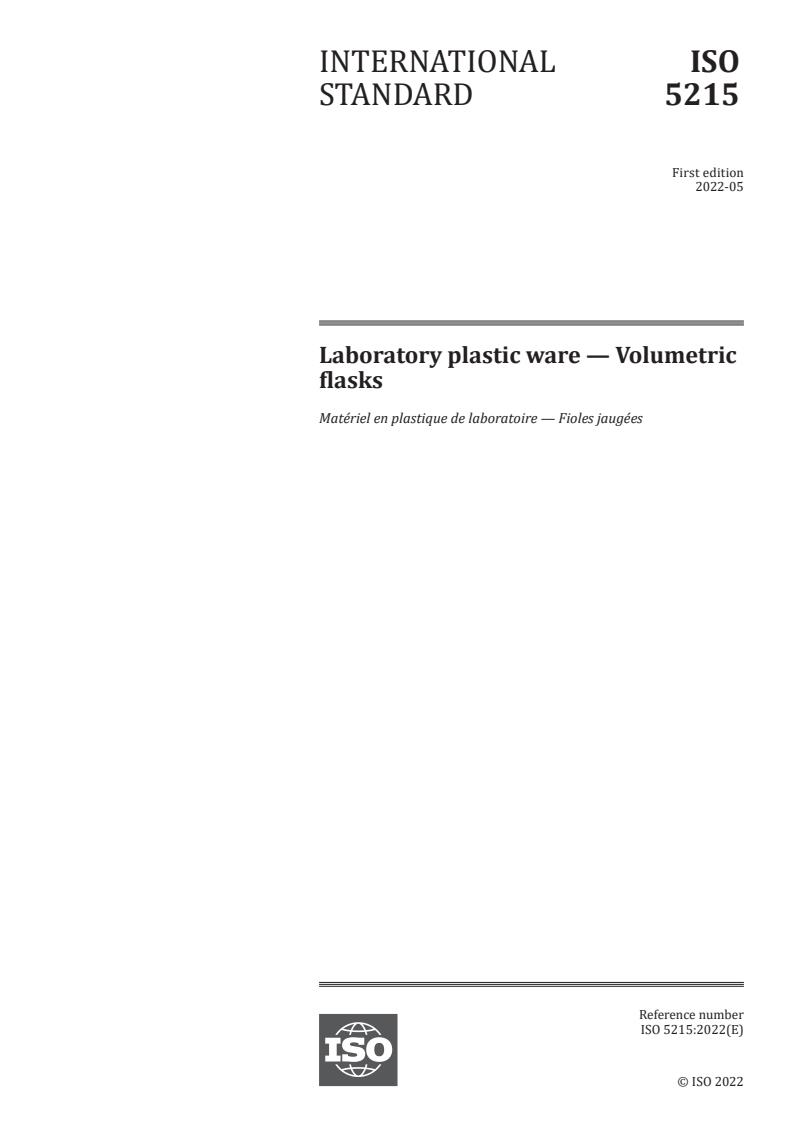
INTERNATIONAL ISO
STANDARD 5215
First edition
2022-05
Laboratory plastic ware — Volumetric
flasks
Matériel en plastique de laboratoire — Fioles jaugées
Reference number
© ISO 2022
All rights reserved. Unless otherwise specified, or required in the context of its implementation, no part of this publication may
be reproduced or utilized otherwise in any form or by any means, electronic or mechanical, including photocopying, or posting on
the internet or an intranet, without prior written permission. Permission can be requested from either ISO at the address below
or ISO’s member body in the country of the requester.
ISO copyright office
CP 401 • Ch. de Blandonnet 8
CH-1214 Vernier, Geneva
Phone: +41 22 749 01 11
Email: copyright@iso.org
Website: www.iso.org
Published in Switzerland
ii
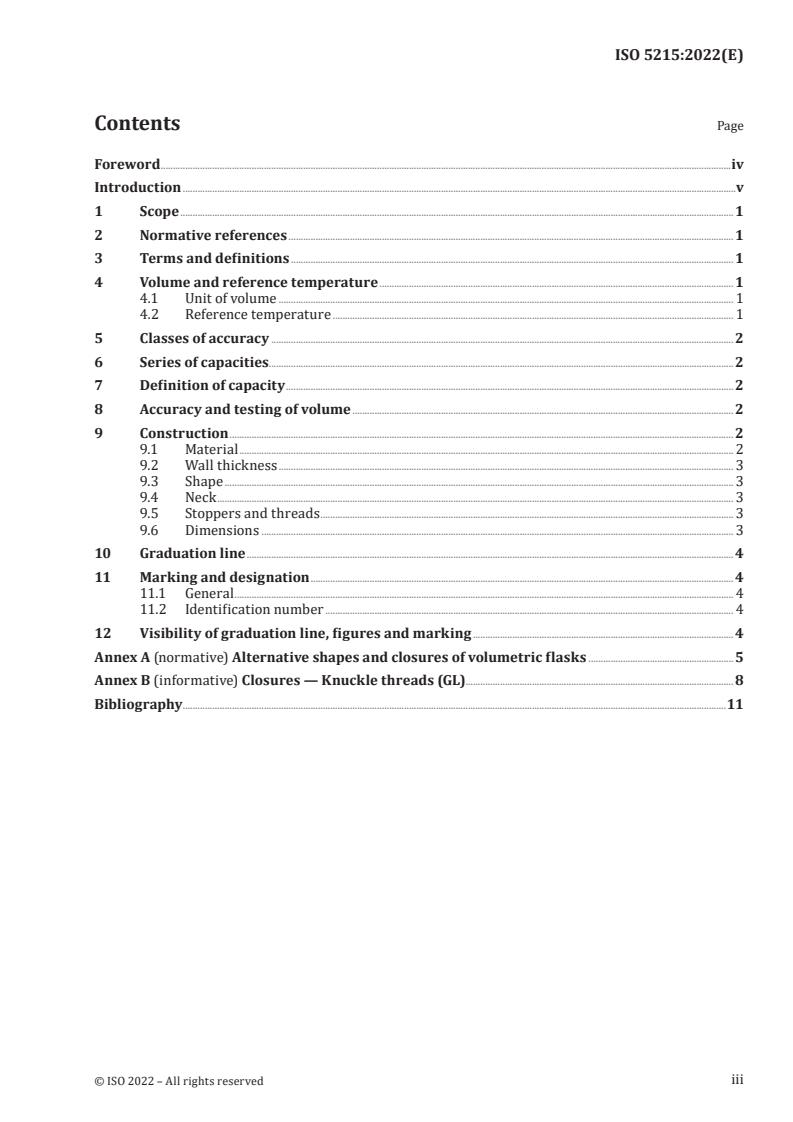
Contents Page
Foreword .iv
Introduction .v
1 Scope . 1
2 Normative references . 1
3 Terms and definitions . 1
4 Volume and reference temperature . 1
4.1 Unit of volume . 1
4.2 Reference temperature . 1
5 Classes of accuracy . 2
6 Series of capacities.2
7 Definition of capacity .2
8 Accuracy and testing of volume . 2
9 Construction . 2
9.1 Material . 2
9.2 Wall thickness . 3
9.3 Shape . 3
9.4 Neck . 3
9.5 Stoppers and threads . 3
9.6 Dimensions . 3
10 Graduation line . 4
11 Marking and designation . 4
11.1 General . 4
11.2 Identification number . 4
12 Visibility of graduation line, figures and marking . 4
Annex A (normative) Alternative shapes and closures of volumetric flasks .5
Annex B (informative) Closures — Knuckle threads (GL). 8
Bibliography .11
iii
Foreword
ISO (the International Organization for Standardization) is a worldwide federation of national standards
bodies (ISO member bodies). The work of preparing International Standards is normally carried out
through ISO technical committees. Each member body interested in a subject for which a technical
committee has been established has the right to be represented on that committee. International
organizations, governmental and non-governmental, in liaison with ISO, also take part in the work.
ISO collaborates closely with the International Electrotechnical Commission (IEC) on all matters of
electrotechnical standardization.
The procedures used to develop this document and those intended for its further maintenance are
described in the ISO/IEC Directives, Part 1. In particular, the different approval criteria needed for the
different types of ISO documents should be noted. This document was drafted in accordance with the
editorial rules of the ISO/IEC Directives, Part 2 (see www.iso.org/directives).
Attention is drawn to the possibility that some of the elements of this document may be the subject of
patent rights. ISO shall not be held responsible for identifying any or all such patent rights. Details of
any patent rights identified during the development of the document will be in the Introduction and/or
on the ISO list of patent declarations received (see www.iso.org/patents).
Any trade name used in this document is information given for the convenience of users and does not
constitute an endorsement.
For an explanation of the voluntary nature of standards, the meaning of ISO specific terms and
expressions related to conformity assessment, as well as information about ISO's adherence to
the World Trade Organization (WTO) principles in the Technical Barriers to Trade (TBT), see
www.iso.org/iso/foreword.html.
This document was prepared by Technical Committee ISO/TC 48, Laboratory equipment.
Any feedback or questions on this document should be directed to the user’s national standards body. A
complete listing of these bodies can be found at www.iso.org/members.html.
iv
Introduction
Volumetric flasks together with analytical balances are the fundamental tools for the preparation of
volumetric standard solutions – the basis of chemical analysis. The design of class A volumetric flasks
has been optimized to achieve the fewest possible acceptable errors.
Class A volumetric flasks are used for the production of standard solutions and where necessary, a
suitable quantity is poured into an intermediate vessel into which a pipette tip may be introduced.
In accordance with good laboratory practice, only class A volumetric flasks conforming to this document
should be used for precise analytical purposes.
v
INTERNATIONAL STANDARD ISO 5215:2022(E)
Laboratory plastic ware — Volumetric flasks
1 Scope
This document sets out requirements for the construction of general laboratory volumetric flasks made
of plastic material.
2 Normative references
The following documents are referred to in the text in such a way that some or all of their content
constitutes requirements of this document. For dated references, only the edition cited applies. For
undated references, the latest edition of the referenced document (including any amendments) applies.
ISO/IEC Guide 99, International vocabulary of metrology — Basic and general concepts and associated
terms (VIM)
ISO 383, Laboratory glassware — Interchangeable conical ground joints
ISO 384:2015, Laboratory glass and plastics ware — Principles of design and construction of volumetric
instruments
ISO 1043-1, Plastics — Symbols and abbreviated terms — Part 1: Basic polymers and their special
characteristics
ISO 4787, Laboratory glass and plastic ware — Volumetric instruments — Methods for testing of capacity
and for use
DIN 168-1, Knuckle threads — Part 1: Especially for glass containers; thread sizes
3 Terms and definitions
For the purposes of this document, the terms and definitions given in ISO/IEC Guide 99 apply.
ISO and IEC maintain terminology databases for use in standardization at the following addresses:
— ISO Online browsing platform: available at https:// www .iso .org/ obp
— IEC Electropedia: available at https:// www .electropedia .org/
4 Volume and reference temperature
4.1 Unit of volume
The unit of volume shall be the millilitre (ml), which is equivalent to the cubic centimetre (cm ).
4.2 Reference temperature
The standard reference temperature, i.e. the temperature at which the volumetric flask is intended to
contain or deliver its volume (capacity), shall be 20 °C.
When the volumetric flask is required for use in a country which has adopted a standard reference
temperature of 27 °C, this value shall be substituted for 20 °C.
5 Classes of accuracy
Two classes of accuracy are specified:
— class A for the higher grade of accuracy;
— class B for the lower grade of accuracy.
6 Series of capacities
The series of nominal capacities of volumetric flasks is as follows (in millilitres):
10 – 25 – 50 – 100 – 250 – 500 – 1 000
All these flasks may be finished with a thread or may include a stopper.
If volumetric flasks of capacities other than those listed above are required, it is recommended that
they conform, as far as possible, to the essential requirements of this document. A cross-check with
ISO 384 is recommended since, in particular, error li
...
Questions, Comments and Discussion
Ask us and Technical Secretary will try to provide an answer. You can facilitate discussion about the standard in here.
Loading comments...