


ISO/IEC TR 24741:2007
(Main)Information technology — Biometrics tutorial
Information technology — Biometrics tutorial
ISO/IEC TR 24741:2007 describes the main biometric technologies, with some historical information. An annex describes the work of creating International Standards for biometrics and provides a layered model for the placement of the various International Standards being produced, with a short description of each. A second annex contains some of the terms and definitions currently used in these International Standards or the drafts of these International Standards.
Technologies de l'information — Tutoriel biométrique
General Information
- Status
- Withdrawn
- Publication Date
- 17-Sep-2007
- Withdrawal Date
- 17-Sep-2007
- Technical Committee
- ISO/IEC JTC 1/SC 37 - Biometrics
- Drafting Committee
- ISO/IEC JTC 1/SC 37/WG 2 - Biometric technical interfaces
- Current Stage
- 9599 - Withdrawal of International Standard
- Start Date
- 24-Jan-2018
- Completion Date
- 14-Feb-2026
Relations
- Effective Date
- 20-Aug-2016

Get Certified
Connect with accredited certification bodies for this standard

BSI Group
BSI (British Standards Institution) is the business standards company that helps organizations make excellence a habit.

NYCE
Mexican standards and certification body.
Sponsored listings
Frequently Asked Questions
ISO/IEC TR 24741:2007 is a technical report published by the International Organization for Standardization (ISO). Its full title is "Information technology — Biometrics tutorial". This standard covers: ISO/IEC TR 24741:2007 describes the main biometric technologies, with some historical information. An annex describes the work of creating International Standards for biometrics and provides a layered model for the placement of the various International Standards being produced, with a short description of each. A second annex contains some of the terms and definitions currently used in these International Standards or the drafts of these International Standards.
ISO/IEC TR 24741:2007 describes the main biometric technologies, with some historical information. An annex describes the work of creating International Standards for biometrics and provides a layered model for the placement of the various International Standards being produced, with a short description of each. A second annex contains some of the terms and definitions currently used in these International Standards or the drafts of these International Standards.
ISO/IEC TR 24741:2007 is classified under the following ICS (International Classification for Standards) categories: 35.040 - Information coding; 35.240.15 - Identification cards. Chip cards. Biometrics. The ICS classification helps identify the subject area and facilitates finding related standards.
ISO/IEC TR 24741:2007 has the following relationships with other standards: It is inter standard links to ISO/IEC TR 24741:2018. Understanding these relationships helps ensure you are using the most current and applicable version of the standard.
ISO/IEC TR 24741:2007 is available in PDF format for immediate download after purchase. The document can be added to your cart and obtained through the secure checkout process. Digital delivery ensures instant access to the complete standard document.
Standards Content (Sample)
TECHNICAL ISO/IEC
REPORT TR
First edition
2007-09-15
Information technology — Biometrics
tutorial
Technologies de l'information — Tutoriel biométrique
Reference number
©
ISO/IEC 2007
PDF disclaimer
This PDF file may contain embedded typefaces. In accordance with Adobe's licensing policy, this file may be printed or viewed but
shall not be edited unless the typefaces which are embedded are licensed to and installed on the computer performing the editing. In
downloading this file, parties accept therein the responsibility of not infringing Adobe's licensing policy. The ISO Central Secretariat
accepts no liability in this area.
Adobe is a trademark of Adobe Systems Incorporated.
Details of the software products used to create this PDF file can be found in the General Info relative to the file; the PDF-creation
parameters were optimized for printing. Every care has been taken to ensure that the file is suitable for use by ISO member bodies. In
the unlikely event that a problem relating to it is found, please inform the Central Secretariat at the address given below.
© ISO/IEC 2007
All rights reserved. Unless otherwise specified, no part of this publication may be reproduced or utilized in any form or by any means,
electronic or mechanical, including photocopying and microfilm, without permission in writing from either ISO at the address below or
ISO's member body in the country of the requester.
ISO copyright office
Case postale 56 • CH-1211 Geneva 20
Tel. + 41 22 749 01 11
Fax + 41 22 749 09 47
E-mail copyright@iso.org
Web www.iso.org
Published in Switzerland
ii © ISO/IEC 2007 – All rights reserved
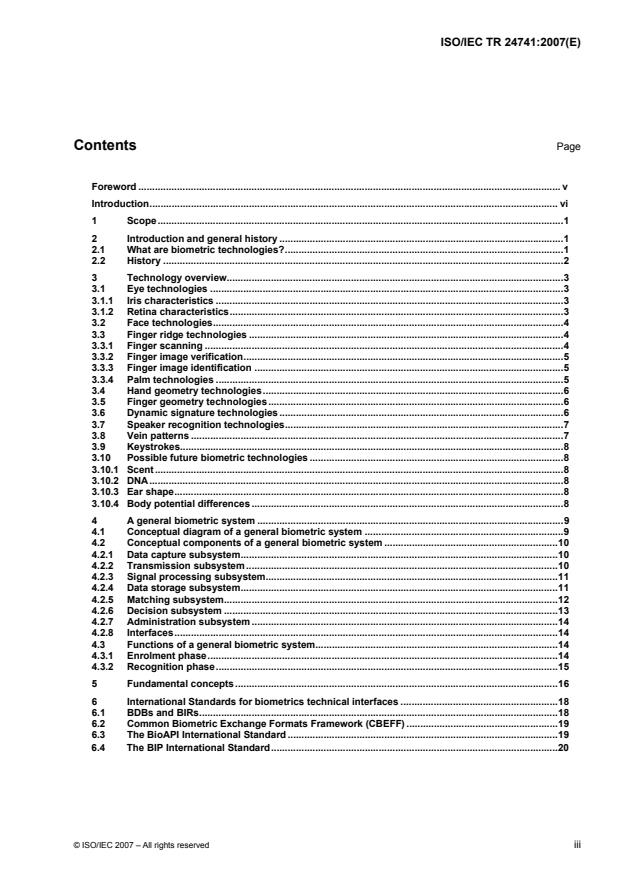
Contents Page
Foreword . v
Introduction. vi
1 Scope.1
2 Introduction and general history .1
2.1 What are biometric technologies?.1
2.2 History.2
3 Technology overview.3
3.1 Eye technologies.3
3.1.1 Iris characteristics.3
3.1.2 Retina characteristics.3
3.2 Face technologies.4
3.3 Finger ridge technologies.4
3.3.1 Finger scanning.4
3.3.2 Finger image verification.5
3.3.3 Finger image identification.5
3.3.4 Palm technologies.5
3.4 Hand geometry technologies.6
3.5 Finger geometry technologies.6
3.6 Dynamic signature technologies.6
3.7 Speaker recognition technologies.7
3.8 Vein patterns.7
3.9 Keystrokes.8
3.10 Possible future biometric technologies .8
3.10.1 Scent.8
3.10.2 DNA.8
3.10.3 Ear shape.8
3.10.4 Body potential differences .8
4 A general biometric system .9
4.1 Conceptual diagram of a general biometric system .9
4.2 Conceptual components of a general biometric system .10
4.2.1 Data capture subsystem.10
4.2.2 Transmission subsystem.10
4.2.3 Signal processing subsystem.11
4.2.4 Data storage subsystem.11
4.2.5 Matching subsystem.12
4.2.6 Decision subsystem.13
4.2.7 Administration subsystem.14
4.2.8 Interfaces.14
4.3 Functions of a general biometric system.14
4.3.1 Enrolment phase.14
4.3.2 Recognition phase.15
5 Fundamental concepts.16
6 International Standards for biometrics technical interfaces .18
6.1 BDBs and BIRs.18
6.2 Common Biometric Exchange Formats Framework (CBEFF) .19
6.3 The BioAPI International Standard .19
6.4 The BIP International Standard.20
© ISO/IEC 2007 – All rights reserved iii
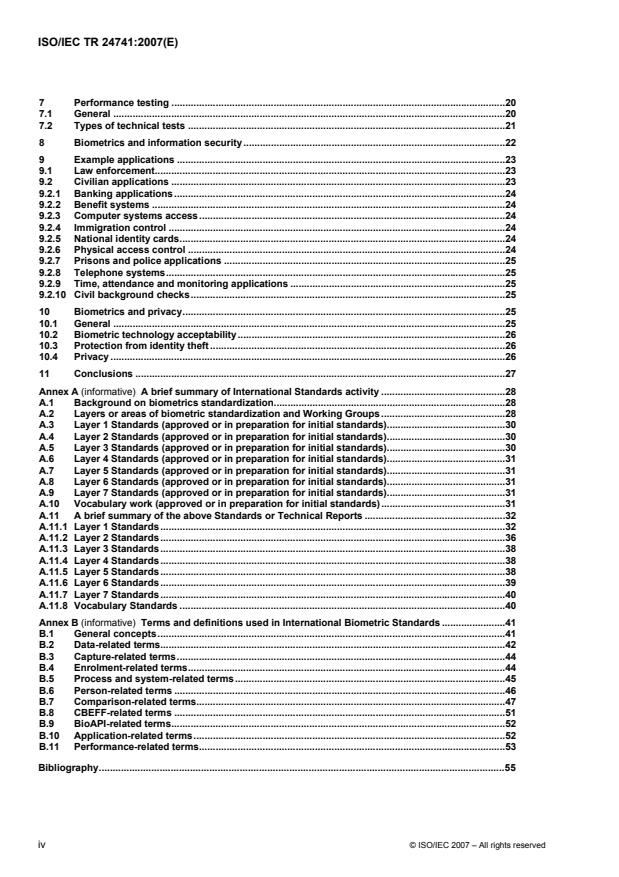
7 Performance testing.20
7.1 General.20
7.2 Types of technical tests .21
8 Biometrics and information security.22
9 Example applications.23
9.1 Law enforcement.23
9.2 Civilian applications.23
9.2.1 Banking applications.24
9.2.2 Benefit systems.24
9.2.3 Computer systems access.24
9.2.4 Immigration control.24
9.2.5 National identity cards.24
9.2.6 Physical access control .24
9.2.7 Prisons and police applications .25
9.2.8 Telephone systems.25
9.2.9 Time, attendance and monitoring applications .25
9.2.10 Civil background checks.25
10 Biometrics and privacy.25
10.1 General.25
10.2 Biometric technology acceptability.26
10.3 Protection from identity theft .26
10.4 Privacy.26
11 Conclusions.27
Annex A (informative) A brief summary of International Standards activity .28
A.1 Background on biometrics standardization.28
A.2 Layers or areas of biometric standardization and Working Groups.28
A.3 Layer 1 Standards (approved or in preparation for initial standards).30
A.4 Layer 2 Standards (approved or in preparation for initial standards).30
A.5 Layer 3 Standards (approved or in preparation for initial standards).30
A.6 Layer 4 Standards (approved or in preparation for initial standards).31
A.7 Layer 5 Standards (approved or in preparation for initial standards).31
A.8 Layer 6 Standards (approved or in preparation for initial standards).31
A.9 Layer 7 Standards (approved or in preparation for initial standards).31
A.10 Vocabulary work (approved or in preparation for initial standards).31
A.11 A brief summary of the above Standards or Technical Reports .32
A.11.1 Layer 1 Standards.32
A.11.2 Layer 2 Standards.36
A.11.3 Layer 3 Standards.38
A.11.4 Layer 4 Standards.38
A.11.5 Layer 5 Standards.38
A.11.6 Layer 6 Standards.39
A.11.7 Layer 7 Standards.40
A.11.8 Vocabulary Standards.40
Annex B (informative) Terms and definitions used in International Biometric Standards .41
B.1 General concepts.41
B.2 Data-related terms.42
B.3 Capture-related terms.44
B.4 Enrolment-related terms.44
B.5 Process and system-related terms.45
B.6 Person-related terms.46
B.7 Comparison-related terms.47
B.8 CBEFF-related terms.51
B.9 BioAPI-related terms.52
B.10 Application-related terms.52
B.11 Performance-related terms.53
Bibliography.55
iv © ISO/IEC 2007 – All rights reserved
Foreword
ISO (the International Organization for Standardization) and IEC (the International Electrotechnical
Commission) form the specialized system for worldwide standardization. National bodies that are members of
ISO or IEC participate in the development of International Standards through technical committees
established by the respective organization to deal with particular fields of technical activity. ISO and IEC
technical committees collaborate in fields of mutual interest. Other international organizations, governmental
and non-governmental, in liaison with ISO and IEC, also take part in the work. In the field of information
technology, ISO and IEC have established a joint technical committee, ISO/IEC JTC 1.
International Standards are drafted in accordance with the rules given in the ISO/IEC Directives, Part 2.
The main task of the joint technical committee is to prepare International Standards. Draft International
Standards adopted by the joint technical committee are circulated to national bodies for voting. Publication as
an International Standard requires approval by at least 75 % of the national bodies casting a vote.
In exceptional circumstances, the joint technical committee may propose the publication of a Technical Report
of one of the following types:
— type 1, when the required support cannot be obtained for the publication of an International Standard,
despite repeated efforts;
— type 2, when the subject is still under technical development or where for any other reason there is the
future but not immediate possibility of an agreement on an International Standard;
— type 3, when the joint technical committee has collected data of a different kind from that which is
normally published as an International Standard (“state of the art”, for example).
Technical Reports of types 1 and 2 are subject to review within three years of publication, to decide whether
they can be transformed into International Standards. Technical Reports of type 3 do not necessarily have to
be reviewed until the data they provide are considered to be no longer valid or useful.
Attention is drawn to the possibility that some of the elements of this document may be the subject of patent
rights. ISO and IEC shall not be held responsible for identifying any or all such patent rights.
ISO/IEC TR 24741, which is a Technical Report of type 3, was prepared by Joint Technical Committee
ISO/IEC JTC 1, Information technology, Subcommittee SC 37, Biometrics.
© ISO/IEC 2007 – All rights reserved v
Introduction
“Biometric authentication” is the automatic recognition of individual persons based on distinguishing biological
and behavioural traits. The field is a subset of the broader field of human identification science. Example
technologies include fingerprinting, face recognition, hand geometry, speaker recognition and iris recognition.
At the current level of technology, DNA analysis is a laboratory technique not fully automated and requiring
human processing, so it is not considered “biometric authentication” under this definition (it is not currently
automatic and fast, but may become so in the near future).
Some techniques (such as iris recognition) are more biologically based and some (such as signature recognition)
are more behaviourally based, but all techniques are influenced by both behavioural and biological elements.
There are no purely “behavioural” or “biological” biometric systems.
Biometric authentication is frequently referred to as simply “biometrics”, although this latter word has
historically been associated with the statistical analysis of general biological data. The word “biometrics”, like
“genetics”, is usually treated as singular. It first appeared in the vocabulary of physical and information
security around 1980 as a substitute for the earlier descriptor “automatic personal identification”, in use in the
1970s. Biometric systems recognize “persons” by recognizing “bodies”. The distinction between person and
body is subtle, but is of key importance in understanding the inherent capabilities and limitations of these
technologies. In our context, biometrics deals with computer recognition of patterns created by human
behaviours and biological structures, and is usually associated more with the field of computer engineering and
statistical pattern analysis than with the behavioural or biological sciences.
Today, biometrics is being used to recognize individuals in a wide variety of contexts, such as computer and
physical access control, law enforcement, voting, border crossing, social benefit programs and driver licensing.
vi © ISO/IEC 2007 – All rights reserved
TECHNICAL REPORT
Information technology — Biometrics tutorial
1 Scope
This Technical Report provides a tutorial on biometrics.
It contains a description of the architecture of biometric processes and of the processes themselves.
An annex provides further details of International Standards' activity in the field of biometrics.
A further annex provides terms and definitions that are in use in these International Standards.
2 Introduction and general history
2.1 What are biometric technologies?
The all-encompassing term ‘biometrics’ refers to the quantification or statistical analysis of biological
characteristics. In this context, we are concerned with technologies that analyze human characteristics for
recognition security purposes. The statistical science of biometrics, usually used in biomedical contexts, is a
separate discipline. A broadly accepted definition of biometrics for recognition states that:
A biometric is a unique, measurable characteristic or trait for automatically recognizing or verifying the identity
of a human being.
The agreed SC37 definition comes in two parts, and broadly agrees with the above. It is recommended that
the word biometric be normally used only as an adjective, and not where the fuller term biometric
characteristic (as above) would be more appropriate. We have for adjectival use:
biometric
of or having to do with biometrics
and for noun use:
biometrics
automated recognition of individuals based on their behavioural and biological characteristics
So, biometric technologies are concerned with the physical parts of the human body or the personal traits of
human beings, and the recognition of individuals based on either or both of those parts or traits. It is important
to note the term ‘automatic’ in the above definition. This essentially means that a biometric technology must
recognize or verify a human characteristic quickly and automatically, in real time. (A fuller explanation of the
various biometric technologies is given in clause 3.) In summary the most common physical biometric
characteristics are the eye, face, fingerprints, hand and voice; while signature, typing rhythm and gait are the
most common behavioural biometric characteristics. Use of DNA is excluded today, as it is not yet a fast
automated process, although that is likely to change in the next few years.
© ISO/IEC 2007 – All rights reserved 1
2.2 History
In a non-sophisticated way, biometric characteristics have been used for centuries. Parts of our bodies and
aspects of our behaviour have historically been used, and continue to be used, as a means of identification.
The study of fingerprinting dates back to ancient China; we often remember and identify a person by their face
or by the sound of their voice; and a signature is the established method of authentication in banking, for legal
contracts and many other walks of life.
The modern science of recognizing people based on physical measurements owes much to the French police
[3] [11]
clerk, Alphonse Bertillon, who began his work in the late 1870s (Beavan, 2001 ; Cole, 2001 ). The
Bertillon system involved multiple measurements, including height, weight, the length and width of the head,
width of the cheeks, and the lengths of the trunk, feet, ears, forearms, and middle and little fingers.
Categorization of iris colour and pattern was also included in the system. By the 1880s, the Bertillon system
was in use in France to identify repeat criminal offenders. Use of the system in the United States for the
identification of prisoners began shortly thereafter and continued into the 1920s.
Although research on fingerprinting by a British colonial magistrate in India, William Herschel, began in the
late 1850s, knowledge of the technique did not become known in the western world until the 1880s (Faulds,
[13] [18] [16]
1880 ; Herschel, 1880 ) when it was popularized scientifically by Sir Francis Galton (1888) and in
[47]
literature by Mark Twain (1893). Galton’s work also included the identification of persons from profile facial
measurements.
By the mid-1920s, fingerprinting had completely replaced the Bertillon system within the U.S. Bureau of
Investigation (later to become the Federal Bureau of Investigation). Research on new methods of human
identification continued, however, in the scientific world. Handwriting analysis was recognized by 1929
[36] [44]
(Osborne, 1929 ) and retinal identification was suggested in 1935 (Simon and Goldstein, 1935 )
None of these techniques was "automatic", however, so none meets the definition of “biometric authentication”
being used in this Technical Report. Automatic techniques require automatic computation (and are expected
to be fast). Work in automatic speaker recognition can be traced directly to experiments with analogue filters
[38]
done in the 1940s (Potter, Kopp and Green, 1947 ) and early 1950s (Chang, Pihl, and Essignmann, 1951
[10] [39]
). With the computer revolution picking up speed in the 1960s, speaker (Pruzansky, 1963 ) and
[46]
fingerprint (Trauring, 1963 ) pattern recognition were among the very first applications in automatic signal
processing. By 1963, a “wide, diverse market” for automatic fingerprint recognition was identified, with
potential applications in “credit systems”, “industrial and military security systems” and for “personal locks”.
[6] [17]
Computerized facial recognition research followed (Bledsoe, 1966 ; Goldstein, Harmon, and Lesk, 1971 ).
In the 1970’s, the first operational fingerprint and hand geometry systems were fielded (for example, the
[52]
Identimat system), results from formal biometric system tests were reported (Wegstein, 1970 ;), measures
[27]
from multiple biometric devices were being combined (Messner, Cleciwa, Kibbler, and Parlee, 1974 ; Fejfar,
[14] [28]
1978 ) and government testing guidelines were published (NBS, 1977 ).
Running parallel to the development of hand technology, fingerprint biometrics were making progress in the
60s and 70s. During this time a number of companies were involved in automatic identification of fingerprints
to assist law enforcers. The manual process of matching prints against criminal records was laborious and
used up far too much manpower. Various fingerprint systems developed for the FBI in the 1960s and 70s
increased the level of automation, but these were ultimately based on human fingerprint comparisons.
Automated Fingerprint Identification Systems (AFIS) were first implemented in the late 70s, most notably the
Royal Canadian Mounted Police AFIS in 1977. The role of biometrics in law enforcement has mushroomed
since then and Automated Fingerprint Identification Systems (AFIS) are used by a significant number of police
forces throughout the globe. Building on this early success, fingerprinting is now exploring a range of civilian
markets.
In the 1980s, fingerprint scanners and speaker recognition systems were being connected to personal
computers to control access to stored information. Based on a concept patented in the 1980s (Flom and Safir,
[15] [12]
1987 ), iris recognition systems became available in the mid-1990s (Daugman, 1993 ). Today there are
close to a dozen approaches used in commercially-available systems, utilizing hand and finger geometry, iris
and fingerprint patterns, face images, voice and signature dynamics, computer keystroke, and hand vein
patterns.
2 © ISO/IEC 2007 – All rights reserved
Today’s speaker verification systems have their roots in technological achievements of the 1970s, while
biometric technologies such as signature verification and facial recognition are relative newcomers to the
industry. The migration from R&D towards commercialization continues today. Research in universities and
by biometric vendors throughout the globe is essential for refining the performance of existing biometric
technologies, while developing new and more diverse techniques. The hard part is bringing a product to
market and proving its operational performance. It does take time for a system to become fully operational.
However, such systems are now in place and proving themselves across a range of diverse applications.
3 Technology overview
Biometric systems now come in many shapes and sizes. This can range from hardware, software, OEMs,
software development kits or complete solutions. Systems may be marketed and sold by vendors directly or
through various distribution channels, such as systems integrators, strategic partners or value added resellers.
All biometric systems have the principles of capture, extraction, and comparison in common. Yet, biometric
technologies focus on different parts of the human make-up, so the workings of each technology and each
vendor’s specific system will differ. This clause looks at the operation of each biometric technology within the
four stages of capture, extraction, comparison and decision.
3.1 Eye technologies
Biometric technologies that analyze the eye are generally thought to offer the highest levels of accuracy at
present, and differ even between identical twins. They can be divided into two specific technologies: iris
biometric characteristics and retina biometric characteristics.
3.1.1 Iris characteristics
The iris is the coloured ring of textured tissue that surrounds the pupil of the eye. Each iris is a unique
structure, featuring a complex pattern. This can be a combination of specific characteristics known as corona,
crypts, filaments, freckles, pits, radial furrows and striations. It is claimed that artificial duplication of the iris is
virtually impossible because of its unique properties and that no two irises are alike. The iris is closely
connected to the human brain and is thought to be one of the first parts of the body to be rendered unusable
for biometric recognition after death. It is therefore very unlikely that an artificial iris could be recreated or that
a dead iris could be used to fraudulently by-pass the biometric system. (Equally, this means that identification
of a dead body using recorded iris data is unlikely to work as well as DNA, which survives death very well
under most conditions - heat and salt-water excluded.)
In most implementations, a grayscale image of the iris is acquired in the near-IR spectrum to maximize detail
in dark-colored eyes; some implementations capture irises in color. This should be done in a well-lit
environment. Non-patterned contact lenses do not interfere with image capture. Sunglasses and glasses,
however, should not be worn as these can affect the capture process.
Unique features of the iris are extracted from the captured sample by the biometric engine. These features
are then converted into a unique mathematical code and stored as a template (a biometric reference) for that
individual.
3.1.2 Retina characteristics
The retina is the layer of blood vessels situated at the back of the eye. As with the iris, the retina forms a
unique pattern and is thought to be one of the first parts of the body to be rendered unusable for biometric
recognition after death. A precise enrolment procedure is necessary, which involves lining up the eye to
achieve an optimum reading.
The eye is positioned in front of the system, The eye is positioned in front of the system, at a capture distance
ranging from 8 cm to one metre. The subject must look at a series of markers, viewed through the eyepiece,
© ISO/IEC 2007 – All rights reserved 3
and line them up. When this is done, the eye is sufficiently focused for the scanner to capture the retina
pattern. The retina is scanned and the unique pattern of the blood vessels is captured.
The biometric engine maps out the position of the blood vessels; a unique mathematical representation is
extracted and stored as a template (a biometric reference) for that individual.
3.2 Face technologies
The face is a key component in determining the way human beings remember and recognize each other.
Automatically identifying an individual by analyzing a face is a complex process which can require
sophisticated artificial intelligence and machine learning techniques. A number of biometric vendors and
research institutions have developed facial recognition systems, using either standard video or thermal
imaging to capture facial images. Because people change over time, and facial hair, glasses and the position
of the head can affect the way a biometric system can match one face with another, machine learning is
important in order to adapt to changes and accurately compare new samples with previously recorded
templates.
Standard video techniques use a facial image, or collection of images, captured by a video camera. The
precise position of the subject’s face and the surrounding lighting conditions may affect the system’s
performance. The complete facial image is usually captured and a number of points on the face can then be
mapped out. For example, the position of the eyes, mouth and nostrils may be plotted so that a unique
template is built. Three-dimensional maps of the face can be created through various means, such as the
projection of an infrared grid (“structured light”), merging of multiple images, or using shading information in a
single image.
Thermal imaging analyzes heat caused by the flow of blood under the face. A thermal camera captures the
hidden, heat-generated pattern of blood vessels underneath the skin. Because infrared cameras are used to
capture facial images, lighting is not important, and systems can capture images in the dark. However, such
cameras are significantly more expensive than standard video cameras.
A proprietary algorithm or neural network within the biometric engine will convert the facial image sample into
a pattern and then a unique mathematical code. This is stored as a template (a biometric reference) for that
individual.
3.3 Finger ridge technologies
3.3.1 Finger scanning
Finger image biometrics are largely regarded as an accurate method of biometric identification and verification.
Most one-to-many AFIS and one-to-one fingerprint systems analyze small unique marks on the fingerprint –
which are known as minutiae. These may be defined as fingerprint ridge endings, or bifurcations (branches
made by fingerprint ridges). Some fingerprinting systems also analyze tiny sweat pores on the finger which, in
the same way as minutiae, are uniquely positioned to differentiate one person from another. Finger image
density, or the distance between ridges, may also be analyzed.
Certain conditions may affect the prints of different individuals. For example, dirty, dry or cracked prints will all
reduce the quality of image capture. Age, gender and ethnic background are also found to have an impact on
the quality of finger images. The way a subject interacts with a finger scanner is another important
consideration. By pressing too hard on the scanner surface, for example, an image can be distorted.
Vendors are addressing these problems so that scanners are ergonomically designed to optimize the
fingerprinting process.
A key difference between the various fingerprint technologies on the market is the means of capturing an
image. One-to-one fingerprint verification systems use four main capture techniques: optical, thermal or
tactile, capacitance and ultra-sound. Most one-to-many systems capture finger images using the optical
technique or by electronically scanning images from paper.
4 © ISO/IEC 2007 – All rights reserved
3.3.2 Finger image verification
The optical image technique typically involves generating a light source, which is refracted through a prism.
Subjects place a finger on a glass surface, known as a platen. Light shines on the fingerprint and the
impression made by the print is captured.
Tactile or thermal techniques use sophisticated silicon chip technology to acquire fingerprint data. A subject
places a finger on the chip sensor which senses heat or pressure from the finger. Fingerprint data is then
captured.
Capacitance silicon sensors measure electrical charges and give an electrical signal when a finger is placed
on the sensor surface. The core element of capacitance techniques, as with tactile and thermal methods, is
the chip sensor. Using capacitance, the peaks and troughs of fingerprint ridges and valleys are analyzed. An
electrical signal is given when fingerprint ridges contact the sensor. No signal is generated by the valleys.
This variance in electrical charge produces an image of the fingerprint.
Ultra-sound image capture uses sound waves beyond the limit of human hearing. A finger is placed on a
scanner and acoustic waves are used to measure the density of the fingerprint pattern.
The biometric engine extracts fingerprint data contained in the print. A unique mathematical representation of
the print is then stored as a template (a biometric reference) for that individual.
3.3.3 Finger image identification
For one-to-many identification, individuals are enrolled using the optical live-scan capture process described
above for finger image verification. Law enforcement AFIS systems, also known as booking stations, capture
all ten fingerprints. A civil AFIS, however, need not capture all fingerprints and can operate effectively using
one or two. Latent prints, those taken from the scene of a crime, or inked images on paper can also be
captured by the AFIS using a flatbed scanner.
For an AFIS, the process of binning fingerprints refines the extraction process. Minutiae data is extracted and
is stored as a template (a biometric reference) for that individual.
A new sample, captured by either live-scan, latent or paper scanning techniques, is compared against the
database of references. If binning has taken place the comparison will be against the bin that holds similar
features as the newly presented print.
3.3.4 Palm technologies
Palm biometrics can be closely aligned with fingers-canning, and in particular AFIS technology. Ridges,
valleys and minutiae data are found on the palm, as with fingerprints. These are usually analyzed using
optical capture techniques. This area of the biometrics industry is particularly focused on the law enforcement
community, as latent palm prints are equally as useful in crime detection as latent fingerprints. However,
certain vendors are also looking at the access control market and hope to migrate to civil applications,
following in the footsteps of fingerprinting.
Palm biometric characteristics are predominantly used for one-to-many identification and the capture process
is essentially the same as the optical technique described for fingerprinting. A palm print system captures
prints when a hand is placed on a scanner. Latent or ink palm prints can also be scanned into the system in
the same way as an AFIS.
Minutiae data are extracted by the biometric engine and the palm print data is stored as a template (a
biometric reference) on a database.
A newly captured print, by either live-scan, latent or paper scanning techniques, is compared against the
database of reference templates.
© ISO/IEC 2007 – All rights reserved 5
3.4 Hand geometry technologies
Hand geometry takes one or more two-dimensional images of the hand and measures the shape and length
of fingers and knuckles. It has been widely used since the early 1980s – predominantly for access control
applications. Although hand geometry, like finger geometry (see below), does not achieve the highest levels
of accuracy, it is convenient to use and the primary advantage is that large volumes of subjects can be
processed quickly. For this reason, hand and finger geometry are often used for repeat accesses to theme
parks.
A subject places a hand on the hand reader, aligning fingers with specially positioned guides. A mirror reflects
light horizontally across the top of the hand, supplying a second two-dimensional shadow of the side of the
hand. A camera, positioned above the hand, captures an image. Measurements of selected points on the
hand are then taken.
The biometric engine extracts the measurements into a unique mathematical identifier and a template (a
biometric reference) is created for that individual.
Hand geometry is predominantly used for one-to-one verification. A new sample is compared against a
database of templates (references).
3.5 Finger geometry technologies
A handful of biometric vendors use finger geometry, or the measurement of finger shape, to determine identity.
This technology uses similar principles to hand geometry. The geometry of one or two fingers may be
analyzed, depending on the biometric system being used. Measurements of unique finger characteristics,
such as finger width, length, thickness and knuckle size are then taken. Finger geometry systems can
perform one-to-one verification or one-to-many identification. The main advantage is that systems are robust
and can accommodate a high throughput of subjects.
As with fingerprint verification, the method of capture depends on the system being used. There are currently
two main techniques on the market.
The first measures the geometry of two or more fingers. A mirror reflects light horizontally across the top of the
hand, supplying a second two-dimensional shadow of the side of the hand. A camera, positioned above the
hand, now takes a three-dimensional measurement when a subject places the index and middle finger, of
either the right or left hand, onto the reader.
The second technique requires a subject to insert a finger into a tunnel so that three-dimensional
measurements of the finger can be taken.
The three-dimensional measurements are then extracted by the biometric engine and a template (a biometric
reference) is then created for that individual.
3.6 Dynamic signature technologies
Signature biometrics is often referred to as dynamic signature verification (DSV) and look at the way we sign
our names or initial a document. It is the method of signing rather than the finished signature that is important.
Thus DSV can be differentiated from the study of static signatures on paper. A number of characteristics can
be extracted and measured by DSV. For example, the angle at which the pen is held, the time taken to sign,
the velocity and acceleration of the signature, the pressure exerted when holding the pen and the number of
ti
...
Questions, Comments and Discussion
Ask us and Technical Secretary will try to provide an answer. You can facilitate discussion about the standard in here.
Loading comments...