


ISO/IEC TR 24741:2018
(Main)Information technology — Biometrics — Overview and application
Information technology — Biometrics — Overview and application
ISO/IEC TR 24741:2018 describes the history of biometrics and what biometrics does, the various biometric technologies in general use today (for example, fingerprint recognition and face recognition) and the architecture of the systems and the system processes that allow automated recognition using those technologies. It also provides information about the application of biometrics in various business domains such as border management, law enforcement and driver licensing, the societal and jurisdiction considerations that are typically taken into account in biometric systems, and the international standards that underpin their use.
Technologies de l'information — Biométrie — Aperçu général et applications
General Information
- Status
- Withdrawn
- Publication Date
- 23-Jan-2018
- Technical Committee
- ISO/IEC JTC 1/SC 37 - Biometrics
- Drafting Committee
- ISO/IEC JTC 1/SC 37/WG 2 - Biometric technical interfaces
- Current Stage
- 9599 - Withdrawal of International Standard
- Start Date
- 12-Jun-2024
- Completion Date
- 12-Feb-2026
Relations
- Effective Date
- 23-Apr-2020
- Effective Date
- 20-Aug-2016

Get Certified
Connect with accredited certification bodies for this standard

BSI Group
BSI (British Standards Institution) is the business standards company that helps organizations make excellence a habit.

NYCE
Mexican standards and certification body.
Sponsored listings
Frequently Asked Questions
ISO/IEC TR 24741:2018 is a technical report published by the International Organization for Standardization (ISO). Its full title is "Information technology — Biometrics — Overview and application". This standard covers: ISO/IEC TR 24741:2018 describes the history of biometrics and what biometrics does, the various biometric technologies in general use today (for example, fingerprint recognition and face recognition) and the architecture of the systems and the system processes that allow automated recognition using those technologies. It also provides information about the application of biometrics in various business domains such as border management, law enforcement and driver licensing, the societal and jurisdiction considerations that are typically taken into account in biometric systems, and the international standards that underpin their use.
ISO/IEC TR 24741:2018 describes the history of biometrics and what biometrics does, the various biometric technologies in general use today (for example, fingerprint recognition and face recognition) and the architecture of the systems and the system processes that allow automated recognition using those technologies. It also provides information about the application of biometrics in various business domains such as border management, law enforcement and driver licensing, the societal and jurisdiction considerations that are typically taken into account in biometric systems, and the international standards that underpin their use.
ISO/IEC TR 24741:2018 is classified under the following ICS (International Classification for Standards) categories: 35.040 - Information coding; 35.240.15 - Identification cards. Chip cards. Biometrics. The ICS classification helps identify the subject area and facilitates finding related standards.
ISO/IEC TR 24741:2018 has the following relationships with other standards: It is inter standard links to ISO/IEC 24741:2024, ISO/IEC TR 24741:2007. Understanding these relationships helps ensure you are using the most current and applicable version of the standard.
ISO/IEC TR 24741:2018 is available in PDF format for immediate download after purchase. The document can be added to your cart and obtained through the secure checkout process. Digital delivery ensures instant access to the complete standard document.
Standards Content (Sample)
TECHNICAL ISO/IEC TR
REPORT 24741
Second edition
2018-02
Information technology — Biometrics
— Overview and application
Technologies de l'information — Biométrie — Aperçu général et
applications
Reference number
©
ISO/IEC 2018
© ISO/IEC 2018, Published in Switzerland
All rights reserved. Unless otherwise specified, no part of this publication may be reproduced or utilized otherwise in any form
or by any means, electronic or mechanical, including photocopying, or posting on the internet or an intranet, without prior
written permission. Permission can be requested from either ISO at the address below or ISO’s member body in the country of
the requester.
ISO copyright office
Ch. de Blandonnet 8 • CP 401
CH-1214 Vernier, Geneva, Switzerland
Tel. +41 22 749 01 11
Fax +41 22 749 09 47
copyright@iso.org
www.iso.org
ii © ISO/IEC 2018 – All rights reserved
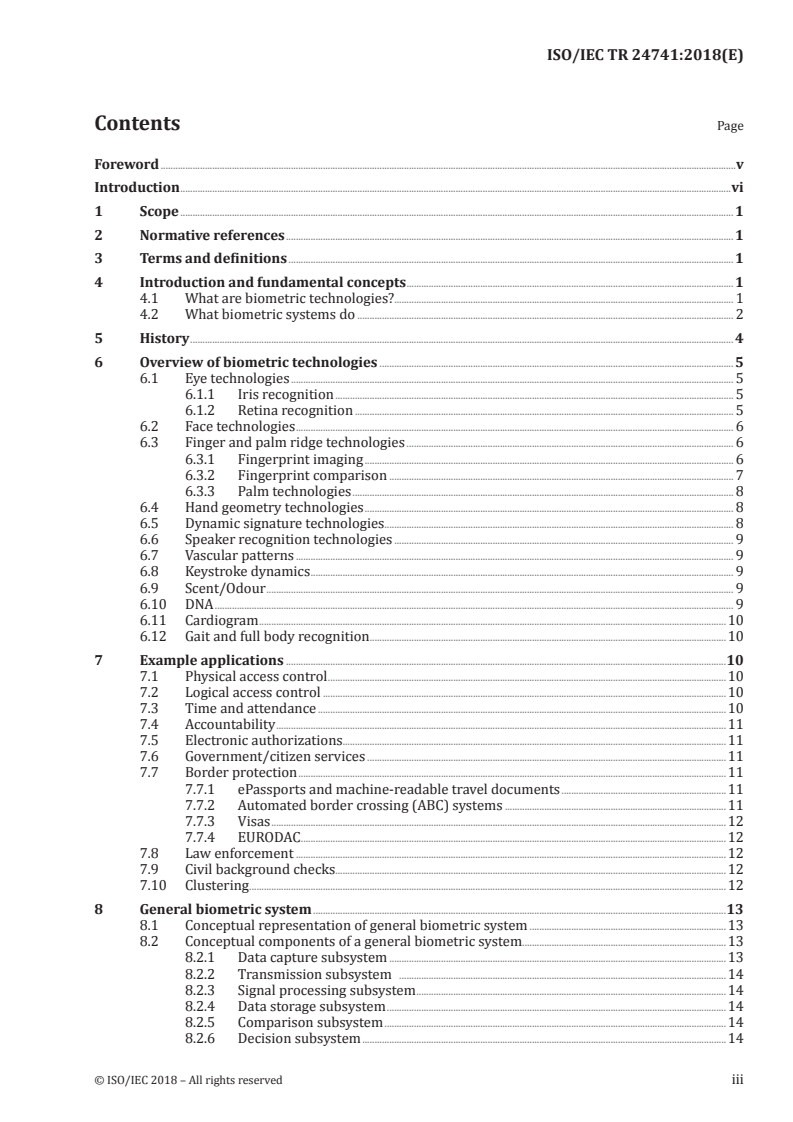
Contents Page
Foreword .v
Introduction .vi
1 Scope . 1
2 Normative references . 1
3 Terms and definitions . 1
4 Introduction and fundamental concepts . 1
4.1 What are biometric technologies?. 1
4.2 What biometric systems do . 2
5 History . 4
6 Overview of biometric technologies . 5
6.1 Eye technologies . 5
6.1.1 Iris recognition . 5
6.1.2 Retina recognition . 5
6.2 Face technologies . 6
6.3 Finger and palm ridge technologies . 6
6.3.1 Fingerprint imaging . 6
6.3.2 Fingerprint comparison . 7
6.3.3 Palm technologies . 8
6.4 Hand geometry technologies . 8
6.5 Dynamic signature technologies. 8
6.6 Speaker recognition technologies . 9
6.7 Vascular patterns . 9
6.8 Keystroke dynamics . 9
6.9 Scent/Odour . 9
6.10 DNA . 9
6.11 Cardiogram .10
6.12 Gait and full body recognition .10
7 Example applications .10
7.1 Physical access control .10
7.2 Logical access control .10
7.3 Time and attendance .10
7.4 Accountability .11
7.5 Electronic authorizations.11
7.6 Government/citizen services .11
7.7 Border protection .11
7.7.1 ePassports and machine-readable travel documents .11
7.7.2 Automated border crossing (ABC) systems .11
7.7.3 Visas .12
7.7.4 EURODAC .12
7.8 Law enforcement .12
7.9 Civil background checks.12
7.10 Clustering .12
8 General biometric system .13
8.1 Conceptual representation of general biometric system .13
8.2 Conceptual components of a general biometric system.13
8.2.1 Data capture subsystem .13
8.2.2 Transmission subsystem .14
8.2.3 Signal processing subsystem .14
8.2.4 Data storage subsystem .14
8.2.5 Comparison subsystem .14
8.2.6 Decision subsystem .14
© ISO/IEC 2018 – All rights reserved iii
8.2.7 Administration subsystem .15
8.2.8 Interface .15
8.3 Functions of general biometric system .15
8.3.1 Enrolment .15
8.3.2 Verification of a positive biometric claim .16
8.3.3 Identification .17
9 Performance testing.17
9.1 General .17
9.2 Types of technical tests .18
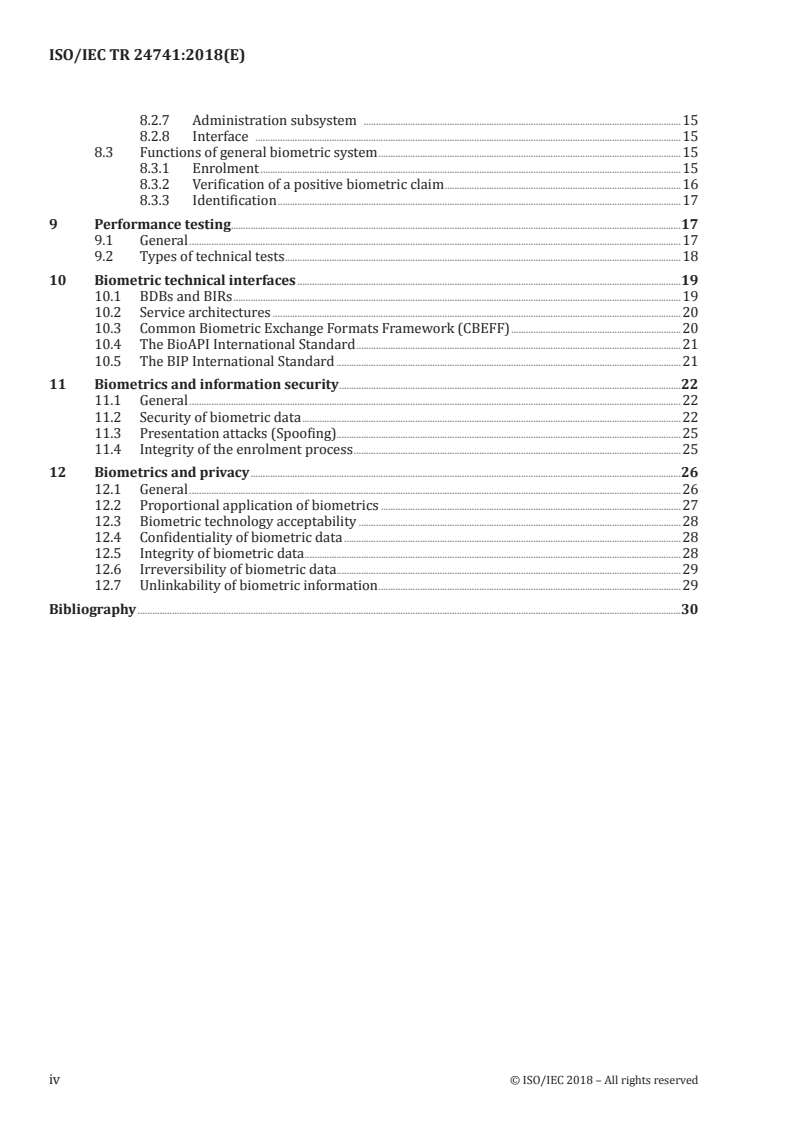
10 Biometric technical interfaces .19
10.1 BDBs and BIRs .19
10.2 Service architectures .20
10.3 Common Biometric Exchange Formats Framework (CBEFF) .20
10.4 The BioAPI International Standard .21
10.5 The BIP International Standard .21
11 Biometrics and information security .22
11.1 General .22
11.2 Security of biometric data .22
11.3 Presentation attacks (Spoofing).25
11.4 Integrity of the enrolment process .25
12 Biometrics and privacy .26
12.1 General .26
12.2 Proportional application of biometrics .27
12.3 Biometric technology acceptability .28
12.4 Confidentiality of biometric data .28
12.5 Integrity of biometric data .28
12.6 Irreversibility of biometric data .29
12.7 Unlinkability of biometric information .29
Bibliography .30
iv © ISO/IEC 2018 – All rights reserved
Foreword
ISO (the International Organization for Standardization) and IEC (the International Electrotechnical
Commission) form the specialized system for worldwide standardization. National bodies that are
members of ISO or IEC participate in the development of International Standards through technical
committees established by the respective organization to deal with particular fields of technical
activity. ISO and IEC technical committees collaborate in fields of mutual interest. Other international
organizations, governmental and non-governmental, in liaison with ISO and IEC, also take part in the
work. In the field of information technology, ISO and IEC have established a joint technical committee,
ISO/IEC JTC 1.
The procedures used to develop this document and those intended for its further maintenance are
described in the ISO/IEC Directives, Part 1. In particular the different approval criteria needed for
the different types of document should be noted. This document was drafted in accordance with the
editorial rules of the ISO/IEC Directives, Part 2 (see www .iso .org/ directives).
Attention is drawn to the possibility that some of the elements of this document may be the subject
of patent rights. ISO and IEC shall not be held responsible for identifying any or all such patent
rights. Details of any patent rights identified during the development of the document will be in the
Introduction and/or on the ISO list of patent declarations received (see www .iso .org/ patents).
Any trade name used in this document is information given for the convenience of users and does not
constitute an endorsement.
For an explanation on the voluntary nature of standards, the meaning of ISO specific terms and
expressions related to conformity assessment, as well as information about ISO's adherence to the
World Trade Organization (WTO) principles in the Technical Barriers to Trade (TBT) see the following
URL: www .iso .org/ iso/ foreword .html.
This document was prepared by ISO/IEC JTC 1, Information technology, SC 37, Biometrics.
This second edition cancels and replaces the first edition (ISO/IEC TR 24741:2007), which has been
technically revised with the following changes:
— terminology is revised to align with that of ISO/IEC 2382-37;
— clauses on “Overview of biometric technologies” and “Example applications” have been updated to
reflect state of art;
— clauses on “Biometrics and information security” and “Biometrics and privacy” have been
considerably expanded.
© ISO/IEC 2018 – All rights reserved v
Introduction
“Biometric recognition” is the automated recognition of individuals based on their biological and
behavioural characteristics. The field is a subset of the broader field of human identification science.
Example technologies include, among others: fingerprinting, face recognition, hand geometry, speaker
recognition and iris recognition.
Some techniques (such as iris recognition) are more biologically-based, some (such as signature
recognition) more behaviourally based, but all techniques are influenced by both behavioural and
biological elements. There are no purely “behavioural” or “biological” biometric systems.
“Biometric recognition” is frequently referred to as simply “biometrics”, although this latter word
has historically been associated with the statistical analysis of general biological data. The word
“biometrics”, like “genetics”, is usually treated as singular. It first appeared in the vocabulary of
physical and information security around 1980 as a substitute for the earlier descriptor, “automatic
personal identification”, in use in the 1970s. Biometric systems recognize “persons” by recognizing
“bodies”. The distinction between person and body is subtle, but is of key importance in understanding
the inherent capabilities and limitations of these technologies. In our context, biometrics deals with
computer recognition of patterns created by human behaviours and biological structures and is usually
associated more with the field of computer engineering and statistical pattern analysis than with the
behavioural or biological sciences.
Today, biometrics is being used to recognize individuals in a wide variety of contexts, such as computer
and physical access control, law enforcement, voting, border crossing, social benefit programs and
driver licensing.
vi © ISO/IEC 2018 – All rights reserved
TECHNICAL REPORT ISO/IEC TR 24741:2018(E)
Information technology — Biometrics — Overview and
application
1 Scope
This document describes the history of biometrics and what biometrics does, the various biometric
technologies in general use today (for example, fingerprint recognition and face recognition) and the
architecture of the systems and the system processes that allow automated recognition using those
technologies. It also provides information about the application of biometrics in various business
domains such as border management, law enforcement and driver licensing, the societal and jurisdiction
considerations that are typically taken into account in biometric systems, and the international
standards that underpin their use.
2 Normative references
There are no normative references in this document.
3 Terms and definitions
No terms and definitions are listed in this document.
ISO and IEC maintain terminological databases for use in standardization at the following addresses:
— IEC Electropedia: available at http:// www .electropedia .org/
— ISO Online browsing platform: available at http:// www .iso .org/ obp
4 Introduction and fundamental concepts
4.1 What are biometric technologies?
[27]
The definition of biometrics in ISO/IEC 2382-37 is “automated recognition of individuals based on
their biological and behavioural characteristics”.
NOTE 1 The all-encompassing term “biometrics” refers to “the application to biology of the modern methods
of statistics”. In the context of this document, we are concerned with automated technologies that analyse human
characteristics for recognition purposes; the general application of statistics to biological systems is a separate
discipline.
The term “biometric characteristic” is defined as “biological and behavioural characteristic of an
individual from which distinguishing, repeatable biometric features can be extracted for the purpose
of biometric recognition”. So, biometric technologies are related to physical parts of the human body
or the behavioural traits of human beings, and the recognition of individuals based on either or both of
those parts or traits. A fuller explanation of the various biometric technologies is given in Clause 6.
NOTE 2 ISO/IEC 2382-37 recommends the use of the term “biometric” only as an adjective and deprecates its
use as a noun in places where the fuller term biometric characteristic (as above) would be more appropriate.
The perfect biometric characteristic for all applications would be:
— Distinctive: different across all subjects;
— Repeatable: similar across time for each subject, over a long time period (several years);
© ISO/IEC 2018 – All rights reserved 1
— Accessible: easily presented to a sensor (for example, camera or fingerprint scanner or finger-
geometry measurement device);
— Universal: observable on all people;
— Acceptable: the subject is prepared to use the biometric characteristic in the given application.
Unfortunately, no biometric characteristic has all of the above properties, and practical biometric
technologies must compromise on every point: there are great similarities among different individuals;
biometric characteristics change over time; some physical limitations prevent presentation; not all
people have all characteristics; “acceptability” is in the mind of the subject. Consequently, the challenge
of biometric deployment is to develop robust systems to deal with the vagaries and variations of
human beings.
4.2 What biometric systems do
It has been recognized since 1970 that for some applications there are three pillars of automated
[25]
personal recognition (IBM 1970 ):
a) something known or memorized;
b) something carried;
c) a personal physical characteristic.
The original context for this concept was secure access control to computer data. The underlying
assumptions were that persons authorized to access secure data would cooperatively make positive
claims (e.g. “I am authorized to access data on the system”) and could be counted on to protect their
Personal Identification Numbers (PINs) and passwords. In such applications, biometric technologies do
indeed compete with PINs, passwords and tokens, but have received less acceptance. For example, most
web-based access control requires a User ID and an associated password, not biometrics. Passwords
have been more widespread than biometrics in such applications because they are easily replaced, can
vary across applications, require no specialized acquisition hardware, can be created with different
levels of security and are exactly repeatable under conscious control.
However, in many applications, PINs, passwords and tokens cannot logically meet the security
requirements. For example, PINs, passwords and tokens cannot logically be used in applications where
enrolled individuals have little motivation to protect their accounts against use by others, such as with
amusement parks. Similarly, in applications where the claim is negative (e.g. “I am not enrolled in the
system as Pat”) PINs, passwords and tokens cannot logically meet the requirements of demonstrating
the truth of the claim.
Biometric systems recognize persons by observing physical and behavioural characteristics of
their bodies. Biometric characteristics are not as easy to transfer, forget or steal as PINs, passwords
and tokens, so they can be used in applications for which these other authentication methods are
inappropriate. Biometrics can be combined with PINs and tokens into “multifactor” systems for added
security.
Although biometric technologies cannot directly “identify” persons, they can link bodies to records of
attributes, which we will call “identities”. Consequently, biometric recognition can become part of an
identity management system.
Biometric recognition is used in two main classes of applications: 1) those that use biometric
comparison to verify a biometric “claim of identity”; and 2) those that search a database of the biometric
characteristics of known individuals to find and return the identifier attributable to a single individual.
The former applications are called “biometric verification” and the latter, “biometric identification”.
Biometric systems can also be used to “cluster” characteristics, labelling together those that come from
the same bodily source, even when the bodily source cannot be attributed to any known individual.
Such types of systems are gaining application in law enforcement.
2 © ISO/IEC 2018 – All rights reserved
Biometric verification systems verify claims (test hypotheses) regarding the source of a biometric data
record in a database. The claim can be made by the person presenting a biometric sample (e.g. “I am the
source of a biometric data record in the database”) or the claim can be made about the source by another
actor in the system (“She is the source of a biometric data record in the database”). The claims can be
positive (“I am the source of a biometric record in the database”; “These two samples came from the same
bodily source”) or negative (“I am not the source of a biometric record in the database”). Claims can be
specific (“I am the source of biometric record A in the database”) or unspecific (“I am not the source of any
biometric record in the database”). Any combination of specific or unspecific, positive or negative, first-
person or third-person is possible in a claim.
To introduce the terminology of ISO/IEC 2382-37, an individual’s biometric data record in a database
is referred to as a “biometric reference” and the biometric sample used for comparison with the stored
biometric reference is referred to as a “biometric probe”. We can look for a “match” between the
biometric probe of an individual and an identified biometric reference stored in the database, or we
can search a population of biometric references in a database for a match with the supplied biometric
probe and return an identifier for any reference that matches. In both cases, we have to set thresholds
for how close the comparison has to be before we can consider the biometric probe and the biometric
reference to have come from the same bodily source (a “match”). Of course, errors can be made: either
by a “false non-match”, failing to correctly declare a “match” when the probe and reference are indeed
from the same bodily source, or by a “false match”, incorrectly declaring a match when the probe and
reference are from different bodily sources. We talk about the proportion of such errors over the total
number of comparisons, the “false match rate” (FMR) and the “false non-match rate” (FNMR) for a given
technology and a given population in a given application environment.
Systems requiring a positive claim to a specific enrolled reference treat the biometric reference as an
attribute of the enrolment record. These systems “verify” that the biometric reference in the claimed
enrolment record matches the probe sample submitted by the subject. Some systems, such as those
for social service and driver licensing, verify negative claims of no biometric data record already
in the database by treating the biometric reference as a record identifier or pointer. These systems
search the database of biometric pointers to find one matching the submitted biometric probe (and the
process is one of biometric identification). However, the act of finding an identifier (or pointer) in a list
of identifiers also verifies an unspecific claim of enrolment in the database, and not finding a pointer
verifies a negative claim of enrolment. Consequently, the differentiation between “identification” and
“verification” systems is not always clear and these terms are not mutually exclusive.
In the simplest systems, “verification” of a positive claim to a specific enrolment record might require the
comparison of submitted biometric probe to only the biometric reference in the single claimed record.
For example, a subject might claim to be the source of the fingerprint biometric reference stored on an
immigration card. To prove the claim, the subject would insert the card into a card reader which reads
the reference record, then place their finger on the fingerprint reading device. The system compares the
biometric characteristics of the fingerprint on the reader with those of reference recorded on the card.
The system may conclude, in accordance with defined thresholds, that the subject is indeed the source
of the reference on the card, and therefore should be afforded the rights and privileges associated
with the card. (This does, of course, assume that the card has not been forged. All that the biometric
verification achieves is to determine that the human being has presented biometric characteristics that
are a close match to that recorded on the card.)
Simple “identification” might require the comparison of the submitted biometric sample with all of the
biometric references stored in the database. The State of California requires applicants for social service
benefits to verify the negative claim of no previously enrolled identity in the system by submitting
fingerprints from both index fingers. Depending upon the specific automated search strategy, these
fingerprints might be searched against the entire database of enrolled benefit recipients to verify
that there are no matching fingerprints already in the system, or perhaps just the part of the database
corresponding to subjects of the same sex as the applicant. If matching fingerprints are found, the
enrolment record pointed to by those fingerprints is returned to the system administrator to confirm
the rejection of the applicant’s claim of no previous enrolment.
© ISO/IEC 2018 – All rights reserved 3
The number of comparisons to be made, and the “prior” probabilities that those comparisons will
result in a “match” (determination that biometric probe and reference have the same bodily source)
will depend upon both the claim and the system architecture. The security risk posed by a wrong
determination will also vary by system function. Consequently, some systems are very sensitive to false
matches (false positives), while some systems are very sensitive to false non-matches (false negatives)
for any comparison. Depending upon the claim, either a false positive or a false negative might result in
either a “false acceptance” or “false rejection” of the claim.
5 History
In a non-automated way, biometric characteristics have been used for centuries. Parts of our bodies
and aspects of our behaviour have historically been used, and continue to be used, as a means of
identification. The use of fingerprinting dates back to ancient China; we often remember and identify
a person by their face or by the sound of their voice; and a signature is the established method of
authentication in banking, for legal contracts and many other walks of life.
The modern science of recognizing people based on physical measurements owes much to the French
[4]
police clerk, Alphonse Bertillon, who began his work in the late 1870s (Bertillon 1889 ). The Bertillon
system involved multiple measurements, including height, weight, the length and width of the head,
width of the cheeks, and the lengths of the trunk, feet, ears, forearms, and middle and little fingers.
Categorization of iris colour and pattern was also included in the system. By the 1880s, the Bertillon
system was in use in France to identify repeat criminal offenders. Use of the system in the United States
for the identification of prisoners began shortly thereafter and continued into the 1920s.
Although research on fingerprinting, began in the late 1850s, knowledge of the technique did not
[15] [23]
become known in the western world until the 1880s (Faulds, 1880 ; Herschel, 1880 ) when it was
[18] [71]
popularized scientifically by Sir Francis Galton (1888 ) and in literature by Mark Twain (1893 ).
Galton’s work also included the identification of persons from profile facial measurements.
By the mid-1920s, fingerprinting had completely replaced the Bertillon system within the U.S. Bureau
of Investigation (later to become the Federal Bureau of Investigation). Research on new methods of
human identification continued, however, in the scientific world. Handwriting analysis was recognized
[57]
by 1929 (Osborne, 1929 ) and retinal identification was suggested in 1935 (Simon and Goldstein,
[67]
1935 ). However, at this time none of these techniques were automated.
Work in automated speaker recognition can be traced directly to experiments with analogue filters
[61]
done in the 1940s (Potter, Kopp and Green, 1947 ) and early 1950s (Chang, Pihl, and Essignmann,
[13] [62]
1951 ). With the computer revolution picking up speed in the 1960s, speaker (Pruzansky, 1963 )
[69]
and fingerprint (Trauring, 1963a ) pattern recognition were among the very first applications in
automated signal processing. By 1963, a “wide, diverse market” for automated fingerprint recognition
was identified, with potential applications in “credit systems”, “industrial and military security
[70]
systems” and for “personal locks” (Trauring, 1963b ). Computerized facial recognition research
[6] [19]
followed (Bledsoe, 1966 ; Goldstein, Harmon, and Lesk, 1971 ). In the 1970s, the first operational
fingerprint and hand geometry systems were fielded (for example, the Identimat system), results from
[77]
formal biometric system tests were reported (Wegstein, 1970 ), measures from multiple biometric
[52] [16]
devices were being combined (Messner, Cleciwa, Kibbler, and Parlee, 1974 ; Fejfar, 1978 ) and
[51]
government testing guidelines were published (Meissner, 1977 ).
Running parallel to the development of hand technology, fingerprint recognition was making
progress in the 1960s and 1970s. During this time a number of companies were involved in automated
identification of fingerprints to assist law enforcers. The manual process of matching prints against
criminal records was laborious and used up far too much manpower. Various fingerprint identification
systems developed for the FBI in the 1960s and 1970s increased the level of automation, but these
were ultimately based on fingerprint comparisons by trained examiners. Automated Fingerprint
Identification Systems (AFIS) were first implemented in the late 1970s, most notably by the Royal
Canadian Mounted Police AFIS in 1977. The role of biometrics in law enforcement has mushroomed
since then and AFIS are used by a significant number of police forces throughout the globe. Building on
this early success, fingerprinting is now exploring a range of civilian markets.
4 © ISO/IEC 2018 – All rights reserved
In the 1980s, fingerprint scanners and speaker recognition systems were being connected to personal
computers to control access to stored information. Based on a concept patented in the 1980s (Flom
[17] [14]
and Safir, 1987 ), iris recognition systems became available in the mid-1990s (Daugman, 1993 ).
Today there are close to a dozen approaches used in commercially-available systems, utilizing hand and
finger geometry, iris and fingerprint patterns, face images, voice and signature dynamics, computer
keystroke, and hand/finger vein patterns.
Today’s speaker verification systems have their roots in technological achievements of the 1960s,
while biometric technologies such as iris, finger vein, and facial recognition are relative newcomers to
the industry. Research in universities and by biometric vendors throughout the globe is essential for
refining the performance of existing biometric technologies, while developing new and more diverse
techniques. The hard part is bringing a product to market and proving its operational performance. It
does take time for any laboratory technology to migrate to a fully operational system. However, such
systems are now in place and proving themselves across a range of diverse applications.
6 Overview of biometric technologies
6.1 Eye technologies
6.1.1 Iris recognition
Iris recognition technology is now available from a variety of commercial sources and has been used
successfully in border crossing, benefit programs and access control environments. Iris recognition has
been successfully used in access control applications without the need for any form of identification
or claim of identity by the data subject. The data subject can be verified as allowed system access
by searching through the entire database of enrolled persons. Technologies vary by vendor, with
some systems collecting images from a single eye and some systems collecting images of both eyes
simultaneously. Technologies are now available that can collect iris images from distances of over a
metre or from persons walking through a portal.
In most implementations, a grayscale image of the iris is acquired in the near-infrared (IR) spectrum
to maximize detail in eyes of all colours. To ensure pupil constriction to maximize the area of the iris,
acquisition should be done in a well-lit environment. Non-patterned contact lenses and glasses do not
interfere significantly with image capture. Sunglasses, however, should not be worn as these can affect
the capture process. The computer algorithms unwrap these images to form a rectangular matrix of
pixels over which a smaller filter is placed in multiple locations. The filter represents a smooth wave
with a frequency and direction. At every filter placement, the phase of the same frequency and direction
in iris image is observed relative to the filter and used to create a pattern of 0s and 1s. These 0s and
1s are the iris “features” and do not directly represent any of the visible patterns on the iris such as
crypts, filaments and freckles. Features of two iris patterns are compared by counting the percentage
of 0s and 1s that coincide over the length of this binary vector, a function that can be performed by a
computer at the bit level with extreme efficiency. If over about ⅔ of the 0s and 1s coincide, the patterns
are assumed to be from the same eye. This value of ⅔ represents a threshold that can be varied to aid in
balancing the false negatives and false positives.
6.1.2 Retina recognition
The retina is the light-sensitive layer of nerves and blood vessels on the inner surface of the eye. During
the 1980s and 1990s, retinal recognition systems that mapped the vein patterns on the retina were
commercially available. Such systems did not develop images of the vein patterns, but rather scanned
an IR light beam in a circular pattern over the retina and recorded the intensity of the returned light.
This resulted in a one-dimensional pattern with high values of reflected light over portions of the
circle for which no blood vessel was encountered and low values of reflected light where blood vessels
absorbed the IR beam. Despite rumours to the contrary, no health information was known to exist in
these patterns and no laser light was ever used. Because of the requirement to shine the imperceptible
IR light onto the back surface of the eye, data subjects were required to look into the scanner at a
© ISO/IEC 2018 – All rights reserved 5
very close proximity, in near contact with the device. Today, retinal recognition devices are no longer
commercially available.
6.2 Face technologies
Automatically identifying an individual by analysing a face is a complex process for which there are
a variety of algorithmic approaches. A number of biometric vendors and research institutions have
developed facial recognition systems that use digital photographs or video to capture images in visible,
near IR or far IR (thermal) wavelengths. Facial recognition is made difficult by changes in images of
the same face owing to pose angle, lighting, facial expression or adornment, and by the basic structural
similarity of all faces (generally a mouth placed under a nose placed below and between two eyes).
Algorithms often start the identification process with image enhancement and normalization: finding
eye centres, reposing the facial image to a full-frontal orientation, and adjusting for shadows etc. On the
normalized image, a variety of image processing techniques are available to extract abstract measures
from the image by the placement of filters over all or parts of the face. The extracted “facial features”
are abstract measures not related directly to distances between “landmarks” on the face, such as nose,
mouth and ears. Such measures, however, need to be both stable (not changing much for each person
from image to image) and distinctive (varying greatly between persons).
At the current level of development, facial recognition technology can work quite accurately with high
resolution (more than 100 pixels between the eye centres), full frontal images in good lighting. However
performance degrades as resolution reduces or pose angle increases. Lighting variations also cause a
decrease in accuracy.
Three-dimensional maps of the face can be created through various means, such as through laser
ranging, the projection of a grid on to the face to observe grid distortion owing to facial structure,
merging of multiple images, or using shading information in a single image.
Thermal imaging analyses heat caused by the flow of blood under the face. A thermal camera captures
the hidden, heat-generated pattern of blood vessels underneath the skin. Because infrared cameras
are used to capture facial images, lighting is not impo
...
Questions, Comments and Discussion
Ask us and Technical Secretary will try to provide an answer. You can facilitate discussion about the standard in here.
Loading comments...