

ISO 8890:1988
(Main)Dense shaped refractory products — Determination of resistance to sulfuric acid
General Information
- Abstract
- Status
- Published
- Publication Date
- 30-Mar-1988
- Technical Committee
- ISO/TC 33 - Refractories
- Drafting Committee
- ISO/TC 33 - Refractories
- Current Stage
- 9093 - International Standard confirmed
- Start Date
- 10-Jun-2025
- Completion Date
- 29-Aug-2026
Buy Documents
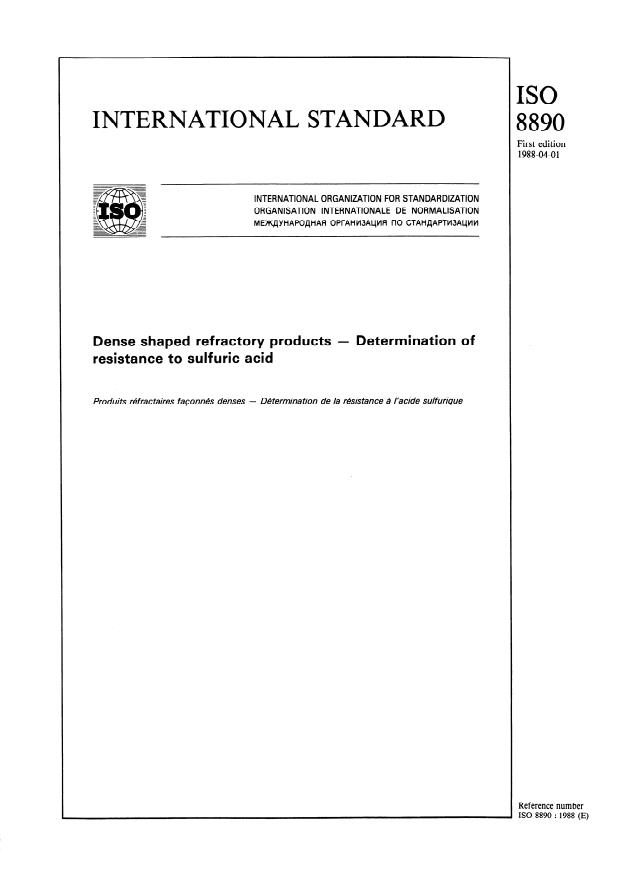
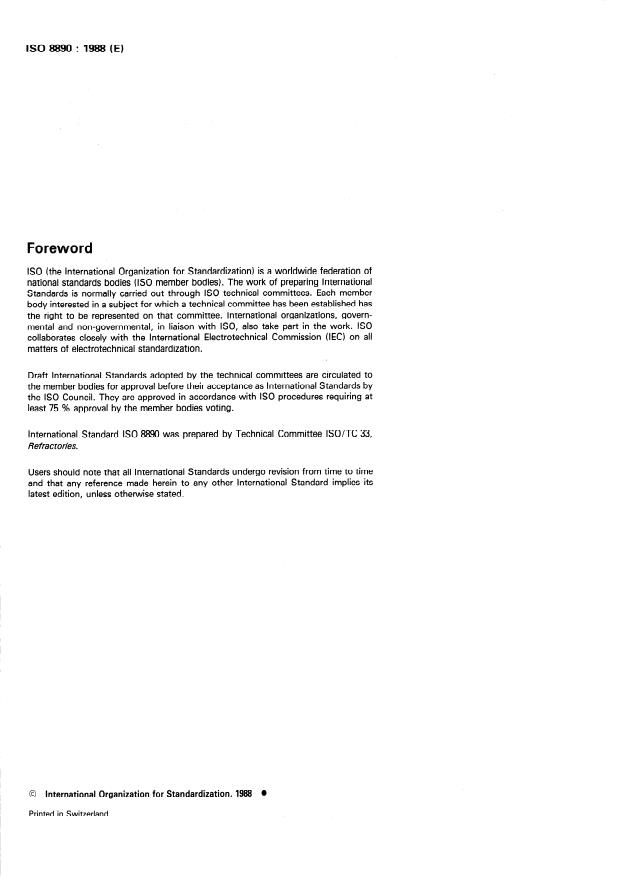
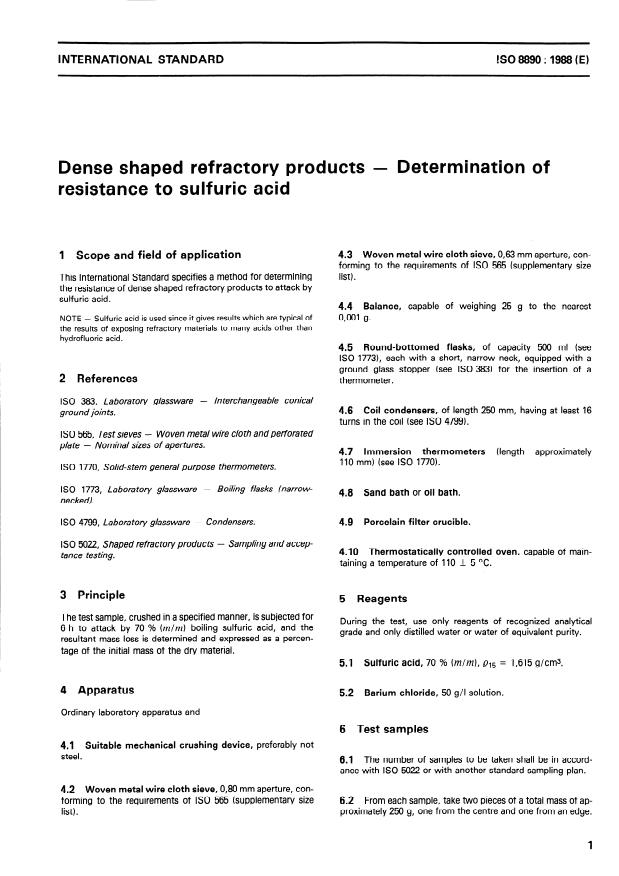

ISO 8890:1988 - Dense shaped refractory products — Determination of resistance to sulfuric acid Released:3/31/1988
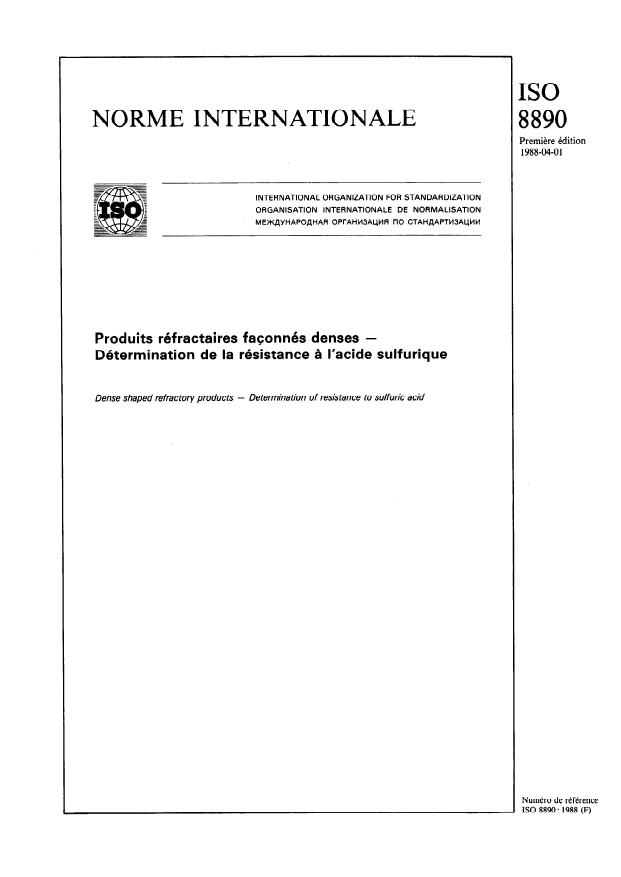
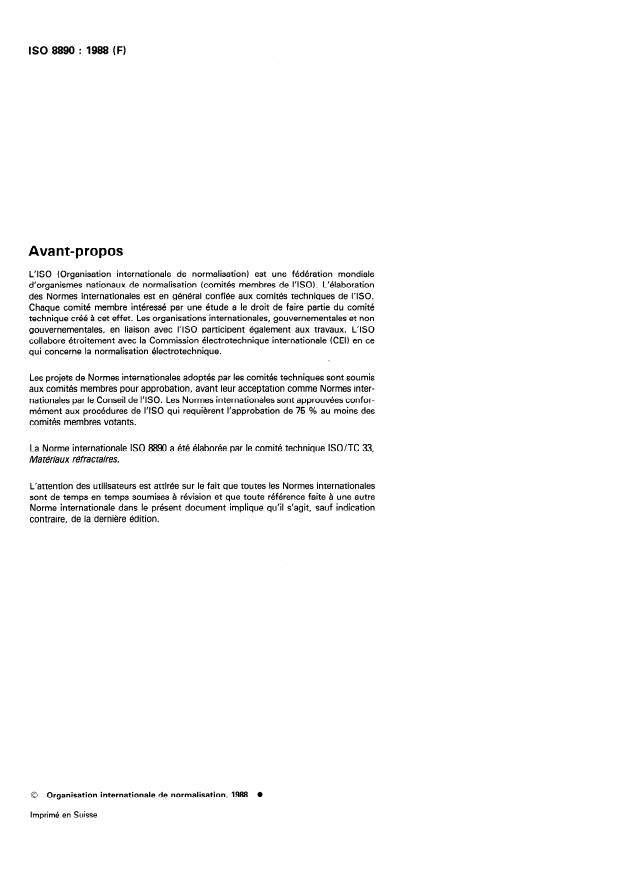
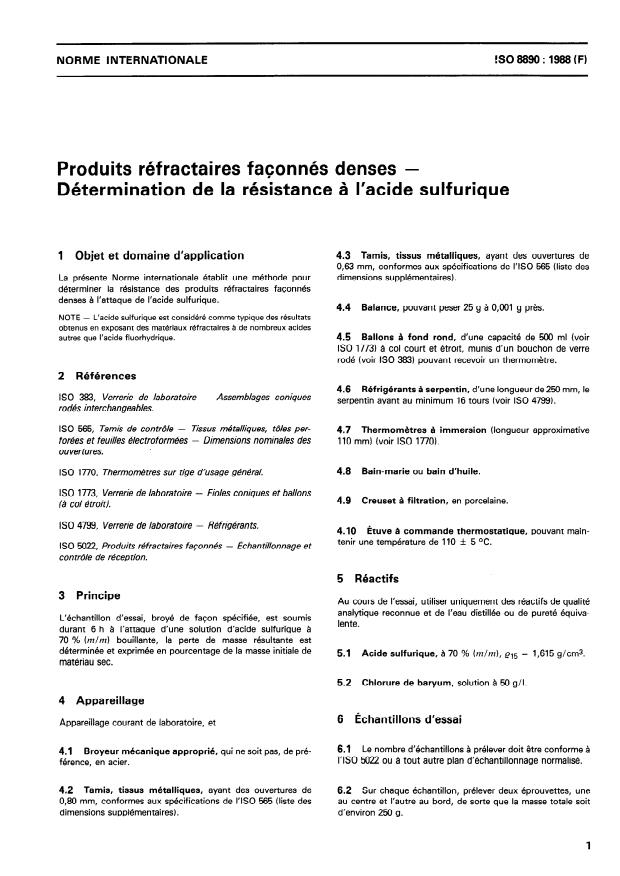

ISO 8890:1988 - Produits réfractaires façonnés denses — Détermination de la résistance a l'acide sulfurique Released:3/31/1988
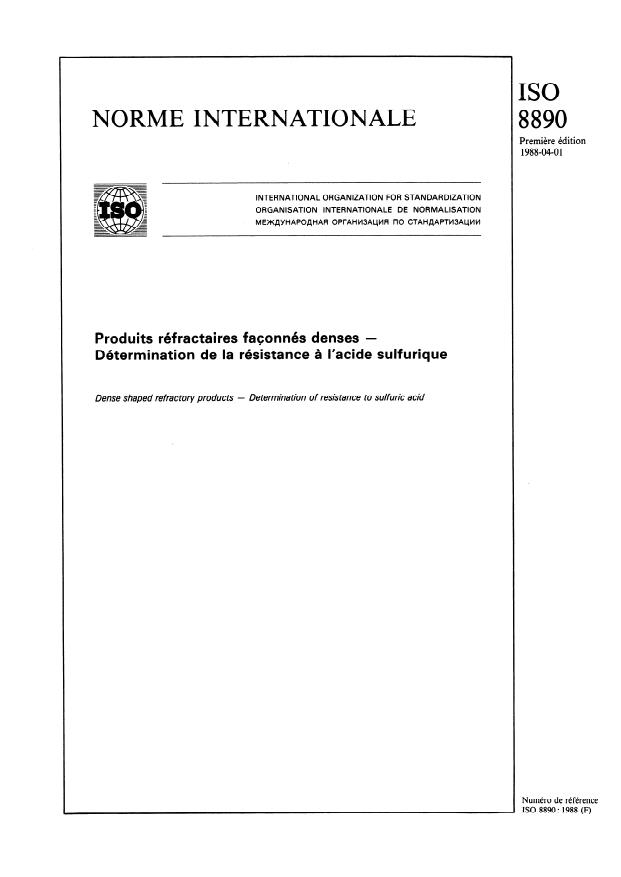
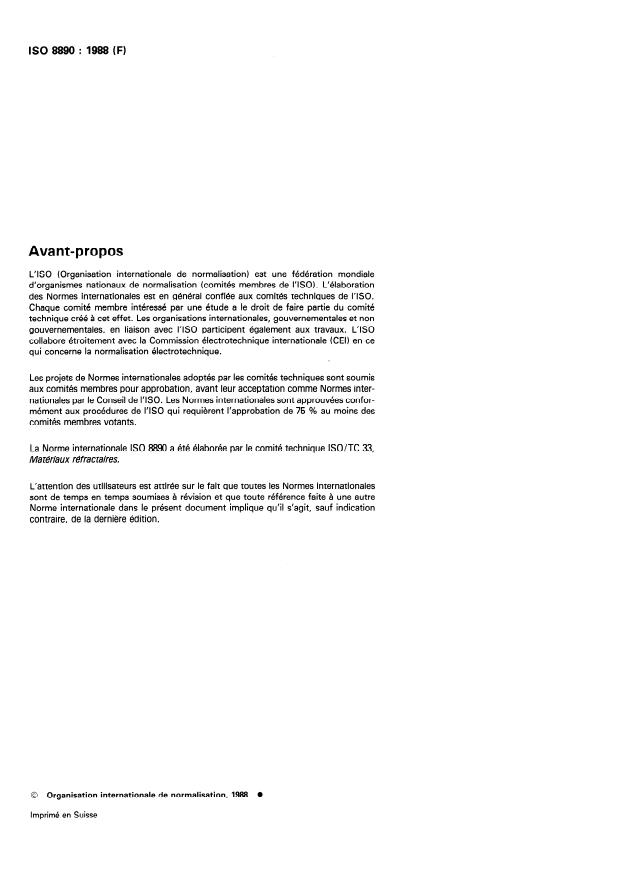

ISO 8890:1988 - Produits réfractaires façonnés denses — Détermination de la résistance a l'acide sulfurique Released:3/31/1988
Overview
ISO 8890:1988 specifies a standardized method for determining the resistance of dense shaped refractory products to sulfuric acid. This international standard is essential for assessing the durability and chemical stability of refractories when exposed to aggressive acidic environments, particularly sulfuric acid. By providing a clear and reproducible test method, ISO 8890 helps manufacturers, suppliers, and users ensure the quality and longevity of refractory materials used in industrial processes.
Key Topics
- Test Methodology: The standard outlines a detailed procedure where the refractory sample, crushed to a specified particle size, is subjected to boiling 70% sulfuric acid for 6 hours. Subsequent mass loss is measured to evaluate acid resistance.
- Sample Preparation: Samples must be carefully crushed and sieved to particle sizes between 0.63 mm and 0.80 mm to ensure consistency and avoid errors in results.
- Apparatus and Reagents: The testing requires specialized laboratory equipment including boiling flasks, condensers, thermometers, and precise analytical balances. Analytical-grade sulfuric acid (70% mass concentration) is used to simulate acid exposure.
- Measurement of Mass Loss: After acid treatment, the remaining residue is filtered, washed, dried, and weighed to determine mass loss percentage, which is a direct indicator of the refractory’s resistance.
- Reporting Requirements: Test reports must include detailed information such as testing establishment, date, material identification, temperatures during testing, and the calculated mean mass loss percentage.
Applications
ISO 8890:1988 is utilized primarily in industries where refractory products are exposed to acidic conditions, such as:
- Chemical Processing Plants: Evaluating refractories in acid production or handling environments.
- Metallurgical Industries: Assessing lining materials subjected to acidic slags or fumes.
- Cement and Lime Manufacturing: Confirming durability of refractory linings in acid-containing atmospheres.
- Quality Control and R&D: Ensuring new refractory formulations meet required resistance standards before commercial deployment.
- Certification and Compliance: Providing standardized test results for international trade and contract fulfillment.
By applying this test method, industries can predict service life, improve material choices, reduce maintenance costs, and enhance safety when working with sulfuric acid or similar acidic conditions.
Related Standards
- ISO 565 – Test sieves for particle sizing, critical in sample preparation.
- ISO 5622 – Sampling and acceptance testing of shaped refractory products.
- ISO 1770, 1773, 4799 – Laboratory glassware and thermometer standards essential for reproducibility.
- ISO 5022 – Sampling plans and statistical analysis guidance for refractories.
Integration of ISO 8890 with these complementary standards ensures a harmonized approach to testing, sampling, and quality assessment of refractories across various applications.
Keywords: ISO 8890, refractory products, sulfuric acid resistance, dense shaped refractory, chemical durability testing, acid resistance test, refractory sample preparation, industrial refractories, international standard.
Relations
- Effective Date
- 09-Feb-2026
Buy Documents
ISO 8890:1988 - Dense shaped refractory products — Determination of resistance to sulfuric acid Released:3/31/1988
ISO 8890:1988 - Produits réfractaires façonnés denses — Détermination de la résistance a l'acide sulfurique Released:3/31/1988
ISO 8890:1988 - Produits réfractaires façonnés denses — Détermination de la résistance a l'acide sulfurique Released:3/31/1988
Frequently Asked Questions
ISO 8890:1988 is a standard published by the International Organization for Standardization (ISO). Its full title is "Dense shaped refractory products — Determination of resistance to sulfuric acid". This standard covers: Dense shaped refractory products — Determination of resistance to sulfuric acid
Dense shaped refractory products — Determination of resistance to sulfuric acid
ISO 8890:1988 is classified under the following ICS (International Classification for Standards) categories: 81.080 - Refractories. The ICS classification helps identify the subject area and facilitates finding related standards.
ISO 8890:1988 has the following relationships with other standards: It is inter standard links to EN ISO 1927-8:2012. Understanding these relationships helps ensure you are using the most current and applicable version of the standard.
ISO 8890:1988 is available in PDF format for immediate download after purchase. The document can be added to your cart and obtained through the secure checkout process. Digital delivery ensures instant access to the complete standard document.
Standards Content (Sample)
IS0
INTERNATIONAL STANDARD
First edition
1988-04-01
INTERNATIONAL ORGANIZATION FOR STANDARDIZATION
ORGANISATION INTERNATIONALE DE NORMALISATION
MEXAYHAPOAHAfl OPTAHM3AL(Mfl l-l0 CTAH~APTM3A~MM
Dense shaped refractory products - Determination of
resistance to sulfuric acid
Prod&s rhfractaires faponnhs denses - D&termination de la rbsistance 3 l’acide sulfurique
Reference numb ler
IS0 8890 : 1988
(E)
IS0 8890 : 1988 (El
Foreword
IS0 (the international Organization for Standardization) is a worldwide federation of
national standards bodies (IS0 member bodies). The work of preparing International
Standards is normally carried out through IS0 technical committees. Each member
body interested in a subject for which a technical committee has been established has
the right to be represented on that committee. International organizations, govern-
mental and non-governmental, in liaison with ISO, also take part in the work. IS0
collaborates closely with the International Electrotechnical Commission (IEC) on all
matters of electrotechnical standardization.
Draft International Standards adopted by the technical committees are circulated to
the member bodies for approval before their acceptance as International Standards by
the IS0 Council. They are approved in accordance with IS0 procedures requiring at
least 75 % approval by the member bodies voting.
International Standard IS0 8890 was prepared by Technical Committee ISO/TC 33,
Refractories.
Users should note that all International Standards undergo revision from time to time
and that any reference made herein to any other International Standard implies its
latest edition, unless othetwise stated.
International Organization for Standardization, 1988
Printed in Switzerland
INTERNATIONAL STANDARD IS0 8890 : 1988 (E)
Dense shaped refractory products - Determination of
resistance to sulfuric acid
4.3 Woven metal wire cloth sieve, 063 mm aperture, con-
1 Scope and field of application
forming to the requirements of IS0 565 (supplementary size
list).
This International Standard specifies a method for determining
the resistance of dense shaped refractory products to attack by
sulfuric acid.
4.4 Balance, capable of weighing 25 g to the nearest
NOTE - Sulfuric acid is used since it gives results which are typical of 0,001 g.
the results of exposing refractory materials to many acids other than
hydrof luoric acid.
4.5 Round-bottomed flasks, of capacity 500 ml (see
IS0 1773), each with a short, narrow neck, equipped with a
ground glass stopper (see IS0 393) for the insertion of a
2 References
thermometer.
IS0 393, Laboratory glassware - Interchangeable conical
4.6 Coil condensers, of length 250 mm, having at least 16
ground joints.
turns in the coil (see IS0 4799).
Woven metal wire cloth and perfora ted
IS0 565, Test sieves -
Nominal sizes of apertures.
plate -
4.7 Immersion thermometers (length approximately
110 mm) (see IS0 1770).
IS0 1770, Solid-stem general purpose thermometers.
IS0 1773, Laboratory glassware - Boiling flasks (narrow-
4.8 Sand bath or oil bath.
necked).
IS0 4799, Laboratory glassware - Condensers. 4.9 Porcelain filter crucible.
IS0 5022, Shaped refractory products - Sampling and accep-
4. IO Thermostatically controlled oven, capable of main-
tance testing.
taining a temperature of 110 + 5 OC.
3 Principle
5 Reagents
The test sample, crushed in a specified manner, is subjected for
During the test, use only reagents of recognized analytical
6 h to attack by 70 % (m/m) boiling sulfuric acid, and the
grade and only distilled water or water of equivalent purity.
resultant mass loss is determined and expressed as a percen-
tage of the initial mass of the dry material.
5.1 Sulfuric acid, 70 % (m/m), ,p15 = 1,615 g/cm?
4 Apparatus
5.2 Barium chloride, 50 g/l solution.
Ordinary laboratory apparatus and
6 Test samples
4.1 Suitable mechanical crushing device, preferably not
ste
...
ISO
NORME INTERNATIONALE
Première édition
1988-04-o 1
INTERNATIONAL ORGANIZATION FOR STANDARDIZATION
ORGANISATION INTERNATIONALE DE NORMALISATION
MEX,QYHAPOJJHAFl OPrAHM3A~MR Il0 CTAH~APTM3A~MM
Produits réfractaires faconnés denses -
Détermination de la résistance à l’acide sulfurique
Determination of resistance to sulfuric acid
Dense shaped refractory products -
Numéro de référence
ISO 8890: 1988 (F)
ISO 8890 : 1988 (FI
Avant-propos
L’ISO (Organisation internationale de normalisation) est une fédération mondiale
d’organismes nationaux de normalisation (comités membres de I’ISO). L’élaboration
des Normes internationales est en général confiée aux comités techniques de I’ISO.
Chaque comité membre intéressé par une étude a le droit de faire partie du comité
technique créé à cet effet. Les organisations internationales, gouvernementales et non
gouvernementales, en liaison avec I’ISO participent également aux travaux. L’ISO
collabore étroitement avec la Commission électrotechnique internationale (CEI) en ce
qui concerne la normalisation électrotechnique.
Les projets de Normes internationales adoptés par les comités techniques sont soumis
aux comités membres pour approbation, avant leur acceptation comme Normes inter-
nationales par le Conseil de I’ISO. Les Normes internationales sont approuvées confor-
mément aux procédures de I’ISO qui requièrent l’approbation de 75 % au moins des
comités membres votants.
La Norme internationale ISO 8890 a été élaborée par le comité technique ISO/TC 33,
Matériaux ré frac taires.
L’attention des utilisateurs est attirée sur le fait que toutes les Normes internationales
sont de temps en temps soumises à révision et que toute référence faite à une autre
Norme internationale dans le présent document implique qu’il s’agit, sauf indication
contraire, de la dernière édition.
Organisation internationale de normalisation, 1988
Imprimé en Suisse
ESO 8890 : 1988 (F)
NORME INTERNATIONALE
Produits réfractaires faconnés denses -
Détermination de la résistance à l’acide sulfurique
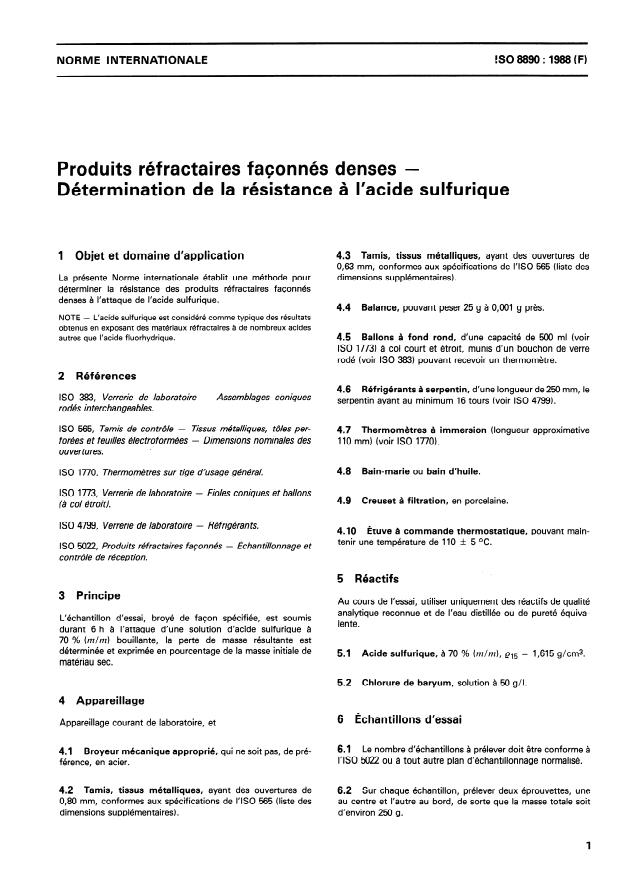
4.3 Tamis, tissus métalliques, ayant des ouvertures de
1 Objet et domaine d’application
063 mm, conformes aux spécifications de I’ISO 565 (liste des
La présente Norme internationale établit une méthode pour dimensions supplémentaires).
déterminer la résistance des produits réfractaires faconnés
denses à l’attaque de l’acide sulfurique.
4.4 Balance, pouvant peser 25 g à 0,001 g près.
NOTE - L’acide sulfurique est considéré comme typique des résultats
obtenus en exposant des matériaux réfractaires à de nombreux acides
autres que l’acide fluorhydrique. 4.5 Ballons à fond rond, d’une capacité de 500 ml (voir
ISO 1773) à col court et étroit, munis d’un bouchon de verre
rodé (voir ISO 383) pouvant recevoir un thermomètre.
2 Références
4.6 Réfrigérants à serpentin, d’une longueur de 250 mm, le
ISO 393, Verrerie de laboratoire - Assemblages coniques
serpentin ayant au minimum 16 tours (voir ISO 4799).
rodés interchangeables.
I SO 565, Tamis de contrôle - 7Ïssus métalliques, tôles per-
4.7 Thermomètres à immersion (longueur approximative
forées et feuilles électroformées - Dimensions nominales des
110 mm) (voir ISO 1770).
ouvertures.
4.8 Bain-marie ou bain d’huile.
ISO 1770, Thermomètres sur tige d’usage général.
ISO 1773, Verrerie de laboratoire - Fioles coniques et ballons
4.9 Creuset à filtration, en porcelaine.
(à col étroit).
I SO 4799, Verrerie de laboratoire - Réfrigérants.
4.10 Étuve à commande thermostatique, pouvant main-
tenir une température de 110 k 5 OC.
ISO 5022, Produits réfractaires façonnés - Échantillonnage et
contrôle de recep tion.
5 Réactifs
3 Principe
Au cours de l’essai, utiliser uniquement des réactifs de qualité
analytique reconnue et de l’eau distillée ou de pureté équiva-
L’échantillon d’essai, broyé de facon spécifiée, est soumis
lente.
durant 6 h à l’attaque d’une solution d’acide sulfurique à
70 % (mlm) bouillante, la perte de masse résultante est
déterminée et exprimée en pourcentage de la masse initiale de
5.1 Acide sulfurique, à 70 % (mlm), e15 = 1,615 g/cm?
matériau sec.
5.2 Chlorure de baryum, solution à 50 g/l.
4 Appareillage
6 Échantillons d’essai
Appareillage courant de laboratoire, et
6.1 Le nombre d’échantillons à prélever doit être conforme à
4.1 Broyeur mécanique approprié, qui ne soit
...
ISO
NORME INTERNATIONALE
Première édition
1988-04-o 1
INTERNATIONAL ORGANIZATION FOR STANDARDIZATION
ORGANISATION INTERNATIONALE DE NORMALISATION
MEX,QYHAPOJJHAFl OPrAHM3A~MR Il0 CTAH~APTM3A~MM
Produits réfractaires faconnés denses -
Détermination de la résistance à l’acide sulfurique
Determination of resistance to sulfuric acid
Dense shaped refractory products -
Numéro de référence
ISO 8890: 1988 (F)
ISO 8890 : 1988 (FI
Avant-propos
L’ISO (Organisation internationale de normalisation) est une fédération mondiale
d’organismes nationaux de normalisation (comités membres de I’ISO). L’élaboration
des Normes internationales est en général confiée aux comités techniques de I’ISO.
Chaque comité membre intéressé par une étude a le droit de faire partie du comité
technique créé à cet effet. Les organisations internationales, gouvernementales et non
gouvernementales, en liaison avec I’ISO participent également aux travaux. L’ISO
collabore étroitement avec la Commission électrotechnique internationale (CEI) en ce
qui concerne la normalisation électrotechnique.
Les projets de Normes internationales adoptés par les comités techniques sont soumis
aux comités membres pour approbation, avant leur acceptation comme Normes inter-
nationales par le Conseil de I’ISO. Les Normes internationales sont approuvées confor-
mément aux procédures de I’ISO qui requièrent l’approbation de 75 % au moins des
comités membres votants.
La Norme internationale ISO 8890 a été élaborée par le comité technique ISO/TC 33,
Matériaux ré frac taires.
L’attention des utilisateurs est attirée sur le fait que toutes les Normes internationales
sont de temps en temps soumises à révision et que toute référence faite à une autre
Norme internationale dans le présent document implique qu’il s’agit, sauf indication
contraire, de la dernière édition.
Organisation internationale de normalisation, 1988
Imprimé en Suisse
ESO 8890 : 1988 (F)
NORME INTERNATIONALE
Produits réfractaires faconnés denses -
Détermination de la résistance à l’acide sulfurique
4.3 Tamis, tissus métalliques, ayant des ouvertures de
1 Objet et domaine d’application
063 mm, conformes aux spécifications de I’ISO 565 (liste des
La présente Norme internationale établit une méthode pour dimensions supplémentaires).
déterminer la résistance des produits réfractaires faconnés
denses à l’attaque de l’acide sulfurique.
4.4 Balance, pouvant peser 25 g à 0,001 g près.
NOTE - L’acide sulfurique est considéré comme typique des résultats
obtenus en exposant des matériaux réfractaires à de nombreux acides
autres que l’acide fluorhydrique. 4.5 Ballons à fond rond, d’une capacité de 500 ml (voir
ISO 1773) à col court et étroit, munis d’un bouchon de verre
rodé (voir ISO 383) pouvant recevoir un thermomètre.
2 Références
4.6 Réfrigérants à serpentin, d’une longueur de 250 mm, le
ISO 393, Verrerie de laboratoire - Assemblages coniques
serpentin ayant au minimum 16 tours (voir ISO 4799).
rodés interchangeables.
I SO 565, Tamis de contrôle - 7Ïssus métalliques, tôles per-
4.7 Thermomètres à immersion (longueur approximative
forées et feuilles électroformées - Dimensions nominales des
110 mm) (voir ISO 1770).
ouvertures.
4.8 Bain-marie ou bain d’huile.
ISO 1770, Thermomètres sur tige d’usage général.
ISO 1773, Verrerie de laboratoire - Fioles coniques et ballons
4.9 Creuset à filtration, en porcelaine.
(à col étroit).
I SO 4799, Verrerie de laboratoire - Réfrigérants.
4.10 Étuve à commande thermostatique, pouvant main-
tenir une température de 110 k 5 OC.
ISO 5022, Produits réfractaires façonnés - Échantillonnage et
contrôle de recep tion.
5 Réactifs
3 Principe
Au cours de l’essai, utiliser uniquement des réactifs de qualité
analytique reconnue et de l’eau distillée ou de pureté équiva-
L’échantillon d’essai, broyé de facon spécifiée, est soumis
lente.
durant 6 h à l’attaque d’une solution d’acide sulfurique à
70 % (mlm) bouillante, la perte de masse résultante est
déterminée et exprimée en pourcentage de la masse initiale de
5.1 Acide sulfurique, à 70 % (mlm), e15 = 1,615 g/cm?
matériau sec.
5.2 Chlorure de baryum, solution à 50 g/l.
4 Appareillage
6 Échantillons d’essai
Appareillage courant de laboratoire, et
6.1 Le nombre d’échantillons à prélever doit être conforme à
4.1 Broyeur mécanique approprié, qui ne soit
...