

ISO 4759-3:2016
(Main)Tolerances for fasteners — Part 3: Washers for bolts, screws and nuts — Product grades A, C and F
General Information
- Abstract
ISO 4759-3:2016 specifies tolerances for flat washers of product grades A, C and F with nominal diameters of 1 mm to 150 mm inclusive, designed to be used in bolted joints in combination with bolts, screws, studs and nuts. This part of ISO 4759 may be applied to non-flat washers however it does not include all the tolerances related to these washers. It applies to non-captive and captive washers, and to standard and non-standard washers. It does not apply to dynamic disc springs. Washers of product grades F and A are intended to be used with bolts, screws, studs and nuts of product grades A and B; washers of product grade C are intended to be used with bolts, screws, studs and nuts of product grade C. NOTE The product grade refers to a specific tolerance range related to dimensional and geometrical characteristics (product grade F for fine tolerances, product grade A for precise tolerances, product grade C for large tolerances). Annex A presents tolerances taken from ISO 286‑1 and ISO 286‑2.
- Status
- Published
- Publication Date
- 31-May-2016
- Technical Committee
- ISO/TC 2 - Fasteners
- Drafting Committee
- ISO/TC 2/WG 13 - Washer and non-threaded fasteners
- Current Stage
- 9093 - International Standard confirmed
- Start Date
- 19-Jun-2026
- Completion Date
- 29-Aug-2026
Buy Documents



ISO 4759-3:2016 - Tolerances for fasteners — Part 3: Washers for bolts, screws and nuts — Product grades A, C and F/1/2016

ISO 4759-3:2016 - Tolérances pour fixations — Partie 3: Rondelles pour vis et écrous — Grades A, C et F/1/2016
Overview
ISO 4759-3:2016 - "Tolerances for fasteners - Part 3: Washers for bolts, screws and nuts - Product grades A, C and F" specifies dimensional and geometrical tolerances for flat washers (nominal diameters 1 mm to 150 mm) used in bolted joints. It covers non-captive and captive washers, standard and non‑standard washers, and can be applied (partially) to non‑flat washers. The standard defines three product grades: F (fine tolerances), A (precise tolerances) and C (large tolerances), and clarifies compatibility with bolt/screw/stud/nut product grades.
Key topics and technical requirements
- Scope and applicability: Washers for bolts, screws, studs and nuts with nominal diameters 1–150 mm; excludes dynamic disc springs.
- Product grades: Grade F (fine), A (precise), C (coarse) - each with defined tolerance ranges for dimensional and geometrical characteristics.
- Dimensional tolerances:
- Clearance hole (d1) and outside diameter (d2) tolerances given by IT/H classes (see Annex A referencing ISO 286‑1/2).
- Thickness tolerances specified by ranges (e.g., t ≤ 0.5 mm…10–20 mm) and measured after burr removal.
- Chamfer dimensions and minimum values for inner/outer chamfers are specified (including optional captive-washer requirements).
- Form and position tolerances:
- Flatness (deflection) z (effective height vs effective thickness) with limits by thickness and grade.
- Coaxiality y (concentricity between hole and outer diameter) based on IT grades.
- Thickness variation Δt limits on the same part at defined ring-width positions.
- Manufacturing notes:
- Tolerances apply prior to coating.
- Rollover and fracture features from punching are allowed but may be undefined; specific fracture/rollover considerations are noted.
- Deviations are permitted only where product standards justify them; product standards take precedence.
Practical applications
- Ensures interchangeability and fit of washers with bolts, screws, studs and nuts in mechanical assemblies.
- Guides designers in specifying washer geometry and tolerance grades for performance and assembly clearance.
- Provides inspection criteria for quality control and incoming‑goods inspection (thickness, flatness, coaxiality).
- Used by manufacturers to set production tolerances, tooling specs and finishing operations (grinding/calibrating to meet flatness).
Who uses this standard
- Fastener manufacturers and tooling designers
- Mechanical and product engineers specifying bolted joints
- Quality/inspection engineers and metrology labs
- Procurement/specification writers for industrial components
Related standards
- ISO 286‑1 / ISO 286‑2 (tolerance grades and limit deviations) - referenced in Annex A
- ISO 1101 and ISO 2692 (geometrical tolerancing and MMR/LMR reciprocity) - normative references
Keywords: ISO 4759-3:2016, washers tolerances, fasteners, product grades A C F, flat washers, clearance hole, chamfer tolerances, thickness tolerances, flatness, coaxiality, ISO 286.
Relations
- Effective Date
- 12-Feb-2026
- Effective Date
- 08-Dec-2012
Buy Documents
ISO 4759-3:2016 - Tolerances for fasteners — Part 3: Washers for bolts, screws and nuts — Product grades A, C and F/1/2016
ISO 4759-3:2016 - Tolérances pour fixations — Partie 3: Rondelles pour vis et écrous — Grades A, C et F/1/2016
Frequently Asked Questions
ISO 4759-3:2016 is a standard published by the International Organization for Standardization (ISO). Its full title is "Tolerances for fasteners — Part 3: Washers for bolts, screws and nuts — Product grades A, C and F". This standard covers: ISO 4759-3:2016 specifies tolerances for flat washers of product grades A, C and F with nominal diameters of 1 mm to 150 mm inclusive, designed to be used in bolted joints in combination with bolts, screws, studs and nuts. This part of ISO 4759 may be applied to non-flat washers however it does not include all the tolerances related to these washers. It applies to non-captive and captive washers, and to standard and non-standard washers. It does not apply to dynamic disc springs. Washers of product grades F and A are intended to be used with bolts, screws, studs and nuts of product grades A and B; washers of product grade C are intended to be used with bolts, screws, studs and nuts of product grade C. NOTE The product grade refers to a specific tolerance range related to dimensional and geometrical characteristics (product grade F for fine tolerances, product grade A for precise tolerances, product grade C for large tolerances). Annex A presents tolerances taken from ISO 286‑1 and ISO 286‑2.
ISO 4759-3:2016 specifies tolerances for flat washers of product grades A, C and F with nominal diameters of 1 mm to 150 mm inclusive, designed to be used in bolted joints in combination with bolts, screws, studs and nuts. This part of ISO 4759 may be applied to non-flat washers however it does not include all the tolerances related to these washers. It applies to non-captive and captive washers, and to standard and non-standard washers. It does not apply to dynamic disc springs. Washers of product grades F and A are intended to be used with bolts, screws, studs and nuts of product grades A and B; washers of product grade C are intended to be used with bolts, screws, studs and nuts of product grade C. NOTE The product grade refers to a specific tolerance range related to dimensional and geometrical characteristics (product grade F for fine tolerances, product grade A for precise tolerances, product grade C for large tolerances). Annex A presents tolerances taken from ISO 286‑1 and ISO 286‑2.
ISO 4759-3:2016 is classified under the following ICS (International Classification for Standards) categories: 21.060.30 - Washers, locking elements. The ICS classification helps identify the subject area and facilitates finding related standards.
ISO 4759-3:2016 has the following relationships with other standards: It is inter standard links to EN ISO 4759-3:2016, ISO 4759-3:2000. Understanding these relationships helps ensure you are using the most current and applicable version of the standard.
ISO 4759-3:2016 is available in PDF format for immediate download after purchase. The document can be added to your cart and obtained through the secure checkout process. Digital delivery ensures instant access to the complete standard document.
Standards Content (Sample)
INTERNATIONAL ISO
STANDARD 4759-3
Fourth edition
2016-06-01
Tolerances for fasteners —
Part 3:
Washers for bolts, screws and nuts —
Product grades A, C and F
Tolérances pour fixations —
Partie 3: Rondelles pour vis et écrous — Grades A, C et F
Reference number
©
ISO 2016
© ISO 2016, Published in Switzerland
All rights reserved. Unless otherwise specified, no part of this publication may be reproduced or utilized otherwise in any form
or by any means, electronic or mechanical, including photocopying, or posting on the internet or an intranet, without prior
written permission. Permission can be requested from either ISO at the address below or ISO’s member body in the country of
the requester.
ISO copyright office
Ch. de Blandonnet 8 • CP 401
CH-1214 Vernier, Geneva, Switzerland
Tel. +41 22 749 01 11
Fax +41 22 749 09 47
copyright@iso.org
www.iso.org
ii © ISO 2016 – All rights reserved
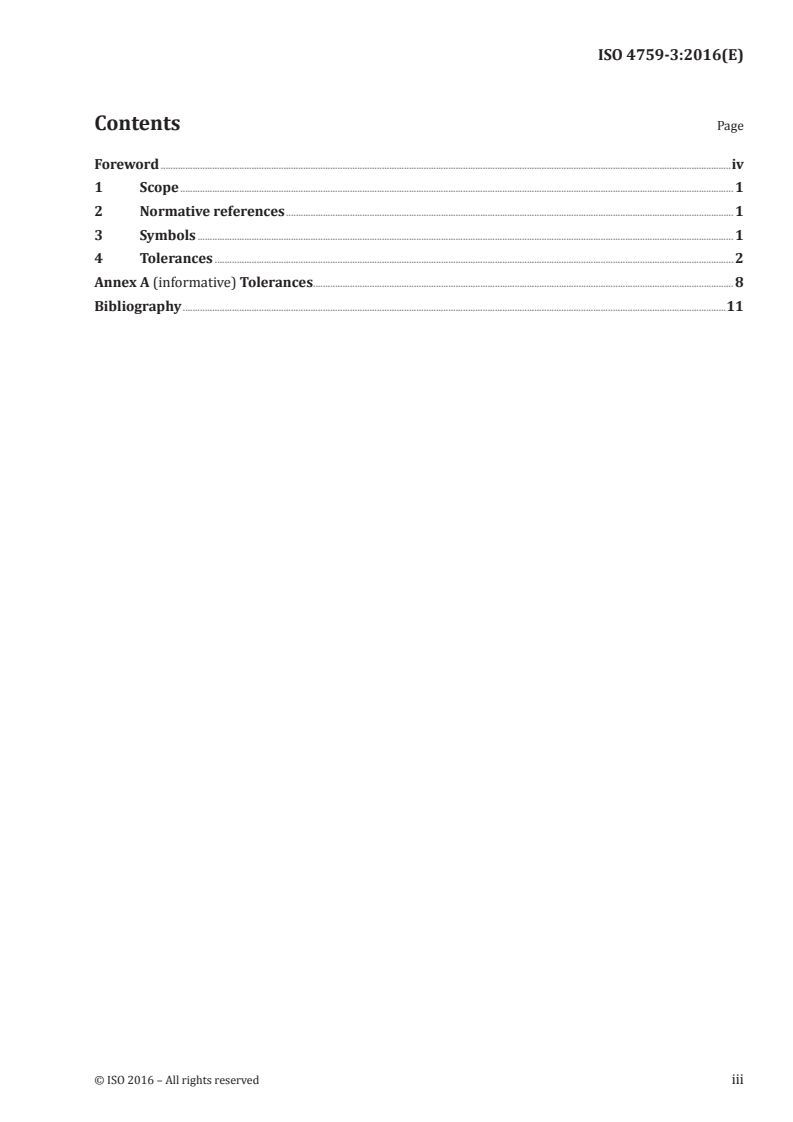
Contents Page
Foreword .iv
1 Scope . 1
2 Normative references . 1
3 Symbols . 1
4 Tolerances . 2
Annex A (informative) Tolerances . 8
Bibliography .11
Foreword
ISO (the International Organization for Standardization) is a worldwide federation of national standards
bodies (ISO member bodies). The work of preparing International Standards is normally carried out
through ISO technical committees. Each member body interested in a subject for which a technical
committee has been established has the right to be represented on that committee. International
organizations, governmental and non-governmental, in liaison with ISO, also take part in the work.
ISO collaborates closely with the International Electrotechnical Commission (IEC) on all matters of
electrotechnical standardization.
The procedures used to develop this document and those intended for its further maintenance are
described in the ISO/IEC Directives, Part 1. In particular the different approval criteria needed for the
different types of ISO documents should be noted. This document was drafted in accordance with the
editorial rules of the ISO/IEC Directives, Part 2 (see www.iso.org/directives).
Attention is drawn to the possibility that some of the elements of this document may be the subject of
patent rights. ISO shall not be held responsible for identifying any or all such patent rights. Details of
any patent rights identified during the development of the document will be in the Introduction and/or
on the ISO list of patent declarations received (see www.iso.org/patents).
Any trade name used in this document is information given for the convenience of users and does not
constitute an endorsement.
For an explanation on the meaning of ISO specific terms and expressions related to conformity
assessment, as well as information about ISO’s adherence to the WTO principles in the Technical
Barriers to Trade (TBT) see the following URL: Foreword - Supplementary information
The committee responsible for this document is ISO/TC 2, Fasteners.
This fourth edition cancels and replaces the third edition (ISO 4759-3:2000), which has been technically
revised.
In comparison to ISO 4759-3:2000, the following changes have been made.
a) the scope has been amended;
b) the normative references have been updated;
c) a new Clause 3 “Symbols and abbreviated terms” has been added;
d) new product grade F has been included (F for Fine tolerances);
e) tolerances for chamfers have been included;
f) in Table A.1 tolerances for standard tolerance grades IT11 and IT14 have been included and IT16
has been deleted;
g) in Tables A.2 and A.3 limit deviations for tolerance classes h13 and H12 respectively have been
included;
h) the bibliography has been updated;
i) this part of ISO 4759 has been editorially revised.
ISO 4759 consists of the following parts, under the general title Tolerances for fasteners:
— Part 1: Bolts, screws, studs and nuts — Product grades A, B and C
— Part 3: Washers for bolts, screws and nuts — Product grades A, C and F
iv © ISO 2016 – All rights reserved
INTERNATIONAL STANDARD ISO 4759-3:2016(E)
Tolerances for fasteners —
Part 3:
Washers for bolts, screws and nuts — Product grades A, C
and F
1 Scope
This part of ISO 4759 specifies tolerances for flat washers of product grades A, C and F with nominal
diameters of 1 mm to 150 mm inclusive, designed to be used in bolted joints in combination with bolts,
screws, studs and nuts.
This part of ISO 4759 may be applied to non-flat washers however it does not include all the tolerances
related to these washers.
It applies to non-captive and captive washers, and to standard and non-standard washers.
It does not apply to dynamic disc springs.
Washers of product grades F and A are intended to be used with bolts, screws, studs and nuts of product
grades A and B; washers of product grade C are intended to be used with bolts, screws, studs and nuts
of product grade C.
NOTE The product grade refers to a specific tolerance range related to dimensional and geometrical
characteristics (product grade F for fine tolerances, product grade A for precise tolerances, product grade C for
large tolerances).
Annex A presents tolerances taken from ISO 286-1 and ISO 286-2.
2 Normative references
The following documents, in whole or in part, are normatively referenced in this document and are
indispensable for its application. For dated references, only the edition cited applies. For undated
references, the latest edition of the referenced document (including any amendments) applies.
ISO 1101, Geometrical product specifications (GPS) — Geometrical tolerancing — Tolerances of form,
orientation, location and run-out
ISO 2692, Geometrical product specifications (GPS) — Geometrical tolerancing — Maximum material
requirement (MMR), least material requirement (LMR) and reciprocity requirement (RPR)
3 Symbols
c height of the internal chamfer, mm
c height of the external chamfer, mm
d clearance hole, mm
d outside diameter, mm
e radial difference between the clearance hole (area subject to shearing) and the end of the brittle
fracture on the bearing side of the washer
e radial difference between the outside diameter (area subject to shearing) and the end of the
brittle fracture on the bearing side of the washer
h effective height of the washer, mm
eff
t nominal thickness of the washer, mm
t effective thickness of the washer, mm
eff
t part of the clearance hole within the tolerance specified for d
1 1
t part
...
INTERNATIONAL ISO
STANDARD 4759-3
Fourth edition
2016-06-01
Tolerances for fasteners —
Part 3:
Washers for bolts, screws and nuts —
Product grades A, C and F
Tolérances pour fixations —
Partie 3: Rondelles pour vis et écrous — Grades A, C et F
Reference number
©
ISO 2016
© ISO 2016, Published in Switzerland
All rights reserved. Unless otherwise specified, no part of this publication may be reproduced or utilized otherwise in any form
or by any means, electronic or mechanical, including photocopying, or posting on the internet or an intranet, without prior
written permission. Permission can be requested from either ISO at the address below or ISO’s member body in the country of
the requester.
ISO copyright office
Ch. de Blandonnet 8 • CP 401
CH-1214 Vernier, Geneva, Switzerland
Tel. +41 22 749 01 11
Fax +41 22 749 09 47
copyright@iso.org
www.iso.org
ii © ISO 2016 – All rights reserved
Contents Page
Foreword .iv
1 Scope . 1
2 Normative references . 1
3 Symbols . 1
4 Tolerances . 2
Annex A (informative) Tolerances . 8
Bibliography .11
Foreword
ISO (the International Organization for Standardization) is a worldwide federation of national standards
bodies (ISO member bodies). The work of preparing International Standards is normally carried out
through ISO technical committees. Each member body interested in a subject for which a technical
committee has been established has the right to be represented on that committee. International
organizations, governmental and non-governmental, in liaison with ISO, also take part in the work.
ISO collaborates closely with the International Electrotechnical Commission (IEC) on all matters of
electrotechnical standardization.
The procedures used to develop this document and those intended for its further maintenance are
described in the ISO/IEC Directives, Part 1. In particular the different approval criteria needed for the
different types of ISO documents should be noted. This document was drafted in accordance with the
editorial rules of the ISO/IEC Directives, Part 2 (see www.iso.org/directives).
Attention is drawn to the possibility that some of the elements of this document may be the subject of
patent rights. ISO shall not be held responsible for identifying any or all such patent rights. Details of
any patent rights identified during the development of the document will be in the Introduction and/or
on the ISO list of patent declarations received (see www.iso.org/patents).
Any trade name used in this document is information given for the convenience of users and does not
constitute an endorsement.
For an explanation on the meaning of ISO specific terms and expressions related to conformity
assessment, as well as information about ISO’s adherence to the WTO principles in the Technical
Barriers to Trade (TBT) see the following URL: Foreword - Supplementary information
The committee responsible for this document is ISO/TC 2, Fasteners.
This fourth edition cancels and replaces the third edition (ISO 4759-3:2000), which has been technically
revised.
In comparison to ISO 4759-3:2000, the following changes have been made.
a) the scope has been amended;
b) the normative references have been updated;
c) a new Clause 3 “Symbols and abbreviated terms” has been added;
d) new product grade F has been included (F for Fine tolerances);
e) tolerances for chamfers have been included;
f) in Table A.1 tolerances for standard tolerance grades IT11 and IT14 have been included and IT16
has been deleted;
g) in Tables A.2 and A.3 limit deviations for tolerance classes h13 and H12 respectively have been
included;
h) the bibliography has been updated;
i) this part of ISO 4759 has been editorially revised.
ISO 4759 consists of the following parts, under the general title Tolerances for fasteners:
— Part 1: Bolts, screws, studs and nuts — Product grades A, B and C
— Part 3: Washers for bolts, screws and nuts — Product grades A, C and F
iv © ISO 2016 – All rights reserved
INTERNATIONAL STANDARD ISO 4759-3:2016(E)
Tolerances for fasteners —
Part 3:
Washers for bolts, screws and nuts — Product grades A, C
and F
1 Scope
This part of ISO 4759 specifies tolerances for flat washers of product grades A, C and F with nominal
diameters of 1 mm to 150 mm inclusive, designed to be used in bolted joints in combination with bolts,
screws, studs and nuts.
This part of ISO 4759 may be applied to non-flat washers however it does not include all the tolerances
related to these washers.
It applies to non-captive and captive washers, and to standard and non-standard washers.
It does not apply to dynamic disc springs.
Washers of product grades F and A are intended to be used with bolts, screws, studs and nuts of product
grades A and B; washers of product grade C are intended to be used with bolts, screws, studs and nuts
of product grade C.
NOTE The product grade refers to a specific tolerance range related to dimensional and geometrical
characteristics (product grade F for fine tolerances, product grade A for precise tolerances, product grade C for
large tolerances).
Annex A presents tolerances taken from ISO 286-1 and ISO 286-2.
2 Normative references
The following documents, in whole or in part, are normatively referenced in this document and are
indispensable for its application. For dated references, only the edition cited applies. For undated
references, the latest edition of the referenced document (including any amendments) applies.
ISO 1101, Geometrical product specifications (GPS) — Geometrical tolerancing — Tolerances of form,
orientation, location and run-out
ISO 2692, Geometrical product specifications (GPS) — Geometrical tolerancing — Maximum material
requirement (MMR), least material requirement (LMR) and reciprocity requirement (RPR)
3 Symbols
c height of the internal chamfer, mm
c height of the external chamfer, mm
d clearance hole, mm
d outside diameter, mm
e radial difference between the clearance hole (area subject to shearing) and the end of the brittle
fracture on the bearing side of the washer
e radial difference between the outside diameter (area subject to shearing) and the end of the
brittle fracture on the bearing side of the washer
h effective height of the washer, mm
eff
t nominal thickness of the washer, mm
t effective thickness of the washer, mm
eff
t part of the clearance hole within the tolerance specified for d
1 1
t part
...
NORME ISO
INTERNATIONALE 4759-3
Quatrième édition
2016-06-01
Tolérances pour fixations —
Partie 3:
Rondelles pour vis et écrous — Grades
A, C et F
Tolerances for fasteners —
Part 3: Washers for bolts, screws and nuts — Product grades A, C and F
Numéro de référence
©
ISO 2016
DOCUMENT PROTÉGÉ PAR COPYRIGHT
© ISO 2016, Publié en Suisse
Droits de reproduction réservés. Sauf indication contraire, aucune partie de cette publication ne peut être reproduite ni utilisée
sous quelque forme que ce soit et par aucun procédé, électronique ou mécanique, y compris la photocopie, l’affichage sur
l’internet ou sur un Intranet, sans autorisation écrite préalable. Les demandes d’autorisation peuvent être adressées à l’ISO à
l’adresse ci-après ou au comité membre de l’ISO dans le pays du demandeur.
ISO copyright office
Ch. de Blandonnet 8 • CP 401
CH-1214 Vernier, Geneva, Switzerland
Tel. +41 22 749 01 11
Fax +41 22 749 09 47
copyright@iso.org
www.iso.org
ii © ISO 2016 – Tous droits réservés
Sommaire Page
Avant-propos .iv
1 Domaine d’application . 1
2 Références normatives . 1
3 Symboles . 1
4 Tolérances . 2
Annexe A (informative) Tolérances . 8
Bibliographie .11
Avant-propos
L’ISO (Organisation internationale de normalisation) est une fédération mondiale d’organismes
nationaux de normalisation (comités membres de l’ISO). L’élaboration des Normes internationales est
en général confiée aux comités techniques de l’ISO. Chaque comité membre intéressé par une étude
a le droit de faire partie du comité technique créé à cet effet. Les organisations internationales,
gouvernementales et non gouvernementales, en liaison avec l’ISO participent également aux travaux.
L’ISO collabore étroitement avec la Commission électrotechnique internationale (IEC) en ce qui
concerne la normalisation électrotechnique.
Les procédures utilisées pour élaborer le présent document et celles destinées à sa mise à jour sont
décrites dans les Directives ISO/IEC, Partie 1. Il convient, en particulier de prendre note des différents
critères d’approbation requis pour les différents types de documents ISO. Le présent document a été
rédigé conformément aux règles de rédaction données dans les Directives ISO/IEC, Partie 2 (voir www.
iso.org/directives).
L’attention est appelée sur le fait que certains des éléments du présent document peuvent faire l’objet de
droits de propriété intellectuelle ou de droits analogues. L’ISO ne saurait être tenue pour responsable
de ne pas avoir identifié de tels droits de propriété et averti de leur existence. Les détails concernant
les références aux droits de propriété intellectuelle ou autres droits analogues identifiés lors de
l’élaboration du document sont indiqués dans l’Introduction et/ou dans la liste des déclarations de
brevets reçues par l’ISO (voir www.iso.org/brevets).
Les appellations commerciales éventuellement mentionnées dans le présent document sont données
pour information, par souci de commodité, à l’intention des utilisateurs et ne sauraient constituer un
engagement.
Pour une explication de la signification des termes et expressions spécifiques de l’ISO liés à
l’évaluation de la conformité, ou pour toute information au sujet de l’adhésion de l’ISO aux principes
de l’OMC concernant les obstacles techniques au commerce (OTC), voir le lien suivant: Avant-propos —
Informations supplémentaires.
Le comité responsable de l’élaboration du présent document est l’ISO/TC 2, Fixations.
Cette quatrième édition annule et remplace la troisième édition (ISO 4759-3:2000), qui a fait l’objet
d’une révision technique.
Par rapport à l’ISO 4759-3:2000, les modifications suivantes ont été apportées:
a) le domaine d’application a été révisé;
b) les références normatives ont été mises à jour;
c) un nouvel Article 3 « Symboles et termes abrégés » a été ajouté;
d) le nouveau grade F a été ajouté (F pour tolérances Fines);
e) les tolérances pour les chanfreins ont été ajoutées;
f) dans le Tableau A.1, les tolérances pour les degrés de tolérance normalisés IT11 et IT14 ont été
ajoutées, et l’IT16 a été supprimé;
g) dans les Tableaux A.2 et A.3, les écarts limites pour les tolérances h13 et H12 ont été ajoutés;
h) la bibliographie a été mise à jour;
i) la rédaction de la présente partie de l’ISO 4759 a été mise à jour.
L’ISO 4759 est constituée des parties suivantes, sous le titre général Tolérances pour fixations:
— Partie 1: Vis, goujons et écrous — Grades A, B et C
iv © ISO 2016 – Tous droits réservés
— Partie 3: Rondelles pour vis et écrous — Grades A, C et F
NORME INTERNATIONALE ISO 4759-3:2016(F)
Tolérances pour fixations —
Partie 3:
Rondelles pour vis et écrous — Grades A, C et F
1 Domaine d’application
La présente partie de l’ISO 4759 spécifie les tolérances pour les rondelles de forme plane de grades A, C
et F de diamètre nominal de 1 mm à 150 mm inclus, conçues pour être utilisées dans des assemblages
boulonnés en combinaison avec des vis, goujons, tiges filetées et écrous.
La présente partie de l’ISO 4759 peut être appliquée aux rondelles de forme non plane cependant, elle
ne comporte pas toutes les tolérances liées à ces rondelles.
Elle s’applique aux rondelles libres et aux rondelles imperdables, normalisées et non normalisées.
Elle ne s’applique pas aux rondelles ressorts dynamiques (dites « Belleville »).
Les rondelles de grades F et A sont destinées à être utilisées avec des vis, goujons, tiges filetées et
écrous de grades A et B, les rondelles de grade C sont destinées à être utilisées avec des vis, goujons,
tiges filetées et écrous de grade C.
NOTE Le grade correspond à une gamme de tolérances spécifiques relatives aux caractéristiques
dimensionnelles et géométriques (grade F pour les tolérances fines, grade A pour les tolérances précises, grade C
pour les tolérances larges).
L’Annexe A présente les tolérances issues de l’ISO 286-1 et l’ISO 286-2.
2 Références normatives
Les documents suivants, en tout ou partie, sont référencés de façon normative dans le présent document
et sont indispensables à son application. Pour les références datées, seule l’édition citée s’applique.
Pour les références non datées, la dernière édition du document de référence s’applique (y compris les
éventuels amendements).
ISO 1101, Spécification géométrique des produits (GPS) — Tolérancement géométrique — Tolérancement
de forme, orientation, position et battement
ISO 2692, Spécification géométrique des produits (GPS) — Tolérancement géométrique — Exigence du
maximum de matière (MMR), exigence du minimum de matière (LMR) et exigence de réciprocité (RPR)
3 Symboles
c hauteur du chanfrein intérieur, mm
c hauteur du chanfrein extérieur, mm
d trou de passage, mm
d diamètre extérieur, mm
e différence radiale entre le trou de passage (zone cisaillée) et la limite de la zone fracturée au
niveau de la face d’appui de la rondelle
e différence radiale entre le diamètre extérieur (zone cisaillée) et la limite de la zone fracturée au
niveau de la face d’appui de la rondelle
h hauteur effective de la rondelle, mm
eff
t épaisseur nominale de la rondelle, mm
t épaisseur effective de la rondelle, mm
eff
t partie du trou de passage dans la tolérance s
...
NORME ISO
INTERNATIONALE 4759-3
Quatrième édition
2016-06-01
Tolérances pour fixations —
Partie 3:
Rondelles pour vis et écrous — Grades
A, C et F
Tolerances for fasteners —
Part 3: Washers for bolts, screws and nuts — Product grades A, C and F
Numéro de référence
©
ISO 2016
DOCUMENT PROTÉGÉ PAR COPYRIGHT
© ISO 2016, Publié en Suisse
Droits de reproduction réservés. Sauf indication contraire, aucune partie de cette publication ne peut être reproduite ni utilisée
sous quelque forme que ce soit et par aucun procédé, électronique ou mécanique, y compris la photocopie, l’affichage sur
l’internet ou sur un Intranet, sans autorisation écrite préalable. Les demandes d’autorisation peuvent être adressées à l’ISO à
l’adresse ci-après ou au comité membre de l’ISO dans le pays du demandeur.
ISO copyright office
Ch. de Blandonnet 8 • CP 401
CH-1214 Vernier, Geneva, Switzerland
Tel. +41 22 749 01 11
Fax +41 22 749 09 47
copyright@iso.org
www.iso.org
ii © ISO 2016 – Tous droits réservés
Sommaire Page
Avant-propos .iv
1 Domaine d’application . 1
2 Références normatives . 1
3 Symboles . 1
4 Tolérances . 2
Annexe A (informative) Tolérances . 8
Bibliographie .11
Avant-propos
L’ISO (Organisation internationale de normalisation) est une fédération mondiale d’organismes
nationaux de normalisation (comités membres de l’ISO). L’élaboration des Normes internationales est
en général confiée aux comités techniques de l’ISO. Chaque comité membre intéressé par une étude
a le droit de faire partie du comité technique créé à cet effet. Les organisations internationales,
gouvernementales et non gouvernementales, en liaison avec l’ISO participent également aux travaux.
L’ISO collabore étroitement avec la Commission électrotechnique internationale (IEC) en ce qui
concerne la normalisation électrotechnique.
Les procédures utilisées pour élaborer le présent document et celles destinées à sa mise à jour sont
décrites dans les Directives ISO/IEC, Partie 1. Il convient, en particulier de prendre note des différents
critères d’approbation requis pour les différents types de documents ISO. Le présent document a été
rédigé conformément aux règles de rédaction données dans les Directives ISO/IEC, Partie 2 (voir www.
iso.org/directives).
L’attention est appelée sur le fait que certains des éléments du présent document peuvent faire l’objet de
droits de propriété intellectuelle ou de droits analogues. L’ISO ne saurait être tenue pour responsable
de ne pas avoir identifié de tels droits de propriété et averti de leur existence. Les détails concernant
les références aux droits de propriété intellectuelle ou autres droits analogues identifiés lors de
l’élaboration du document sont indiqués dans l’Introduction et/ou dans la liste des déclarations de
brevets reçues par l’ISO (voir www.iso.org/brevets).
Les appellations commerciales éventuellement mentionnées dans le présent document sont données
pour information, par souci de commodité, à l’intention des utilisateurs et ne sauraient constituer un
engagement.
Pour une explication de la signification des termes et expressions spécifiques de l’ISO liés à
l’évaluation de la conformité, ou pour toute information au sujet de l’adhésion de l’ISO aux principes
de l’OMC concernant les obstacles techniques au commerce (OTC), voir le lien suivant: Avant-propos —
Informations supplémentaires.
Le comité responsable de l’élaboration du présent document est l’ISO/TC 2, Fixations.
Cette quatrième édition annule et remplace la troisième édition (ISO 4759-3:2000), qui a fait l’objet
d’une révision technique.
Par rapport à l’ISO 4759-3:2000, les modifications suivantes ont été apportées:
a) le domaine d’application a été révisé;
b) les références normatives ont été mises à jour;
c) un nouvel Article 3 « Symboles et termes abrégés » a été ajouté;
d) le nouveau grade F a été ajouté (F pour tolérances Fines);
e) les tolérances pour les chanfreins ont été ajoutées;
f) dans le Tableau A.1, les tolérances pour les degrés de tolérance normalisés IT11 et IT14 ont été
ajoutées, et l’IT16 a été supprimé;
g) dans les Tableaux A.2 et A.3, les écarts limites pour les tolérances h13 et H12 ont été ajoutés;
h) la bibliographie a été mise à jour;
i) la rédaction de la présente partie de l’ISO 4759 a été mise à jour.
L’ISO 4759 est constituée des parties suivantes, sous le titre général Tolérances pour fixations:
— Partie 1: Vis, goujons et écrous — Grades A, B et C
iv © ISO 2016 – Tous droits réservés
— Partie 3: Rondelles pour vis et écrous — Grades A, C et F
NORME INTERNATIONALE ISO 4759-3:2016(F)
Tolérances pour fixations —
Partie 3:
Rondelles pour vis et écrous — Grades A, C et F
1 Domaine d’application
La présente partie de l’ISO 4759 spécifie les tolérances pour les rondelles de forme plane de grades A, C
et F de diamètre nominal de 1 mm à 150 mm inclus, conçues pour être utilisées dans des assemblages
boulonnés en combinaison avec des vis, goujons, tiges filetées et écrous.
La présente partie de l’ISO 4759 peut être appliquée aux rondelles de forme non plane cependant, elle
ne comporte pas toutes les tolérances liées à ces rondelles.
Elle s’applique aux rondelles libres et aux rondelles imperdables, normalisées et non normalisées.
Elle ne s’applique pas aux rondelles ressorts dynamiques (dites « Belleville »).
Les rondelles de grades F et A sont destinées à être utilisées avec des vis, goujons, tiges filetées et
écrous de grades A et B, les rondelles de grade C sont destinées à être utilisées avec des vis, goujons,
tiges filetées et écrous de grade C.
NOTE Le grade correspond à une gamme de tolérances spécifiques relatives aux caractéristiques
dimensionnelles et géométriques (grade F pour les tolérances fines, grade A pour les tolérances précises, grade C
pour les tolérances larges).
L’Annexe A présente les tolérances issues de l’ISO 286-1 et l’ISO 286-2.
2 Références normatives
Les documents suivants, en tout ou partie, sont référencés de façon normative dans le présent document
et sont indispensables à son application. Pour les références datées, seule l’édition citée s’applique.
Pour les références non datées, la dernière édition du document de référence s’applique (y compris les
éventuels amendements).
ISO 1101, Spécification géométrique des produits (GPS) — Tolérancement géométrique — Tolérancement
de forme, orientation, position et battement
ISO 2692, Spécification géométrique des produits (GPS) — Tolérancement géométrique — Exigence du
maximum de matière (MMR), exigence du minimum de matière (LMR) et exigence de réciprocité (RPR)
3 Symboles
c hauteur du chanfrein intérieur, mm
c hauteur du chanfrein extérieur, mm
d trou de passage, mm
d diamètre extérieur, mm
e différence radiale entre le trou de passage (zone cisaillée) et la limite de la zone fracturée au
niveau de la face d’appui de la rondelle
e différence radiale entre le diamètre extérieur (zone cisaillée) et la limite de la zone fracturée au
niveau de la face d’appui de la rondelle
h hauteur effective de la rondelle, mm
eff
t épaisseur nominale de la rondelle, mm
t épaisseur effective de la rondelle, mm
eff
t partie du trou de passage dans la tolérance s
...