

ISO 16650:2025
(Main)Bead wire
General Information
- Abstract
This document specifies the requirements and characteristics of round and flat wire used for strengthening the bead of all kinds of tyres.
- Status
- Published
- Publication Date
- 13-Aug-2025
- Technical Committee
- ISO/TC 17/SC 17 - Steel wire rod and wire products
- Drafting Committee
- ISO/TC 17/SC 17 - Steel wire rod and wire products
- Current Stage
- 6060 - International Standard published
- Start Date
- 14-Aug-2025
- Due Date
- 20-Apr-2026
- Completion Date
- 14-Aug-2025
Overview
ISO 16650:2025 specifies requirements and characteristics for round and flat bead wire used to strengthen the bead of all kinds of tyres. It replaces the 2004 edition and defines material, coating, mechanical properties, testing, delivery and marking requirements to ensure consistent performance in tyre bead reinforcement.
Key topics and technical requirements
- Scope: Applies to round wire (nominal diameters typically 0.78 mm to 3.00 mm) and flat wire used in tyre beads.
- Classification: Three tensile-strength grades - NT (normal), HT (high) and ST (super tensile).
- Tensile strength (minimum): Specified as functions of nominal diameter d (mm):
- NT-min: T = 2050 − 200·d (MPa)
- HT-min: T = 2350 − 200·d (MPa)
- ST-min: T = 2550 − 250·d (MPa)
- Mechanical properties:
- Elongation at fracture ≥ 5%
- Yield ratio (0,2 % proof strength / tensile strength) ≥ 70%
- Tests are performed on delivered material; tensile and torsion tests are specified (ref. ISO 6892-1 and ISO 7800).
- Metallic coatings: Brass, low‑tin bronze or high‑tin bronze with defined copper/tin/zinc ranges (Table 1). Alternate coatings or zinc ranges may be agreed between purchaser and supplier.
- Chemical composition of steel and cumar weight (surface finish/weight) are to be agreed between purchaser and supplier.
- Quality and inspection: Surface quality, coating thickness, adhesion testing (Annex A), straightness, residual torsion, dimensions and tolerances, welds, packaging and marking are all covered. Inspection document formats align with ISO 10474.
- Designation and ordering: Prescribed format - e.g. “Bead wire bronze‑coated ISO 16650‑HT‑1,295”. Purchaser must state quantity, delivery unit/type and inspection document.
Practical applications and users
- Primary users: tyre manufacturers, tyre component suppliers, steel wire producers and drawing plants.
- Applications: reinforcement of tyre bead cores (passenger, light truck, commercial tyres), procurement/specification of coated bead wire, quality control and incoming inspection of bead wire batches.
- Why it matters: Ensures consistent mechanical performance (tensile, yield, elongation), reliable coating adhesion and dimensional tolerances - critical for tyre assembly, safety, and lifecycle performance.
Related standards
- ISO 404 - Steel and steel products: general technical delivery requirements
- ISO 6892-1 - Metallic materials: tensile testing at room temperature
- ISO 7800 - Metallic materials: simple torsion test for wire
- ISO 10474 - Steel and steel products: inspection documents
ISO 16650:2025 is essential for specifying and procuring bead wire that meets reproducible mechanical and coating requirements for tyre bead reinforcement.
Relations
- Revises
ISO 16650:2004 - Bead wire - Effective Date
- 22-Apr-2023
Get Certified
Connect with accredited certification bodies for this standard

Element Materials Technology
Materials testing and product certification.

Inštitut za kovinske materiale in tehnologije
Institute of Metals and Technology. Materials testing, metallurgical analysis, NDT.
Sponsored listings
Frequently Asked Questions
ISO 16650:2025 is a standard published by the International Organization for Standardization (ISO). Its full title is "Bead wire". This standard covers: This document specifies the requirements and characteristics of round and flat wire used for strengthening the bead of all kinds of tyres.
This document specifies the requirements and characteristics of round and flat wire used for strengthening the bead of all kinds of tyres.
ISO 16650:2025 is classified under the following ICS (International Classification for Standards) categories: 77.140.65 - Steel wire, wire ropes and link chains. The ICS classification helps identify the subject area and facilitates finding related standards.
ISO 16650:2025 has the following relationships with other standards: It is inter standard links to ISO 16650:2004. Understanding these relationships helps ensure you are using the most current and applicable version of the standard.
ISO 16650:2025 is available in PDF format for immediate download after purchase. The document can be added to your cart and obtained through the secure checkout process. Digital delivery ensures instant access to the complete standard document.
Standards Content (Sample)
International
Standard
ISO 16650
Second edition
Bead wire
2025-08
Fil d'acier pour tringle
Reference number
© ISO 2025
All rights reserved. Unless otherwise specified, or required in the context of its implementation, no part of this publication may
be reproduced or utilized otherwise in any form or by any means, electronic or mechanical, including photocopying, or posting on
the internet or an intranet, without prior written permission. Permission can be requested from either ISO at the address below
or ISO’s member body in the country of the requester.
ISO copyright office
CP 401 • Ch. de Blandonnet 8
CH-1214 Vernier, Geneva
Phone: +41 22 749 01 11
Email: copyright@iso.org
Website: www.iso.org
Published in Switzerland
ii
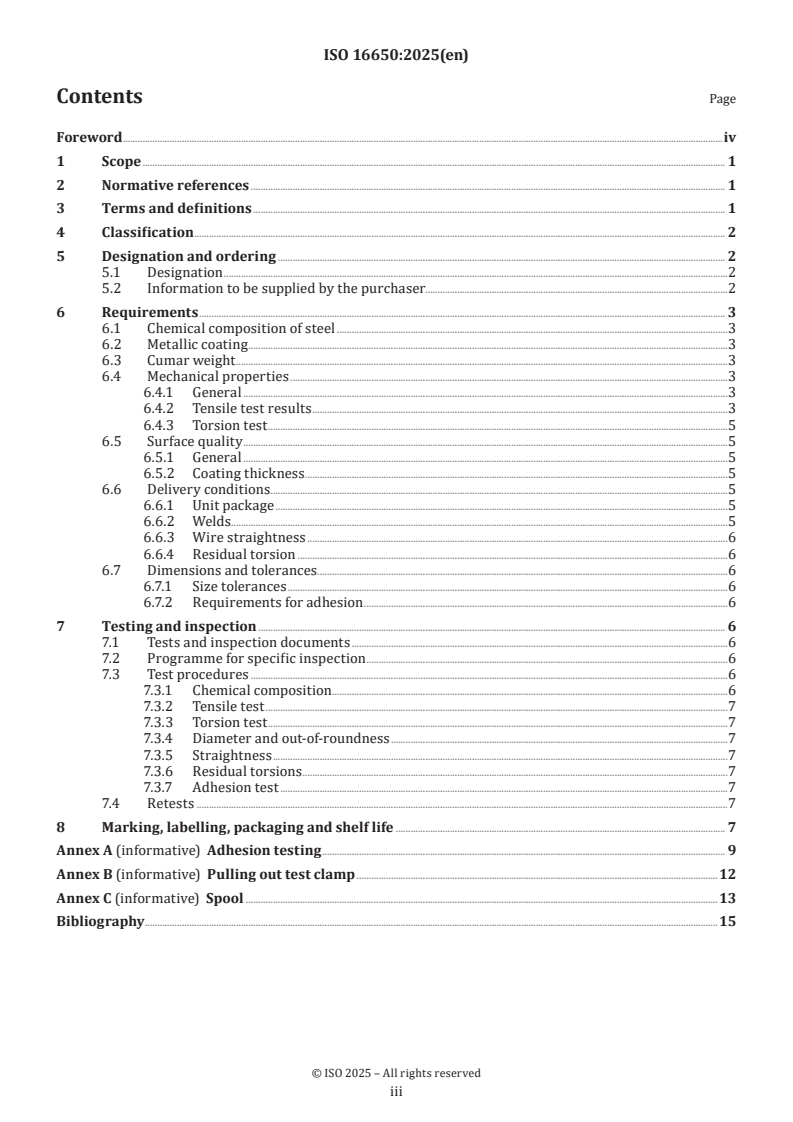
Contents Page
Foreword .iv
1 Scope . 1
2 Normative references . 1
3 Terms and definitions . 1
4 Classification . 2
5 Designation and ordering . 2
5.1 Designation .2
5.2 Information to be supplied by the purchaser.2
6 Requirements . 3
6.1 Chemical composition of steel .3
6.2 Metallic coating .3
6.3 Cumar weight .3
6.4 Mechanical properties .3
6.4.1 General .3
6.4.2 Tensile test results .3
6.4.3 Torsion test .5
6.5 Surface quality .5
6.5.1 General .5
6.5.2 Coating thickness .5
6.6 Delivery conditions . .5
6.6.1 Unit package .5
6.6.2 Welds . .5
6.6.3 Wire straightness .6
6.6.4 Residual torsion .6
6.7 Dimensions and tolerances . .6
6.7.1 Size tolerances .6
6.7.2 Requirements for adhesion .6
7 Testing and inspection . 6
7.1 Tests and inspection documents .6
7.2 Programme for specific inspection .6
7.3 Test procedures .6
7.3.1 Chemical composition .6
7.3.2 Tensile test .7
7.3.3 Torsion test .7
7.3.4 Diameter and out-of-roundness .7
7.3.5 Straightness .7
7.3.6 Residual torsions .7
7.3.7 Adhesion test .7
7.4 Retests .7
8 Marking, labelling, packaging and shelf life . 7
Annex A (informative) Adhesion testing . 9
Annex B (informative) Pulling out test clamp .12
Annex C (informative) Spool .13
Bibliography .15
iii
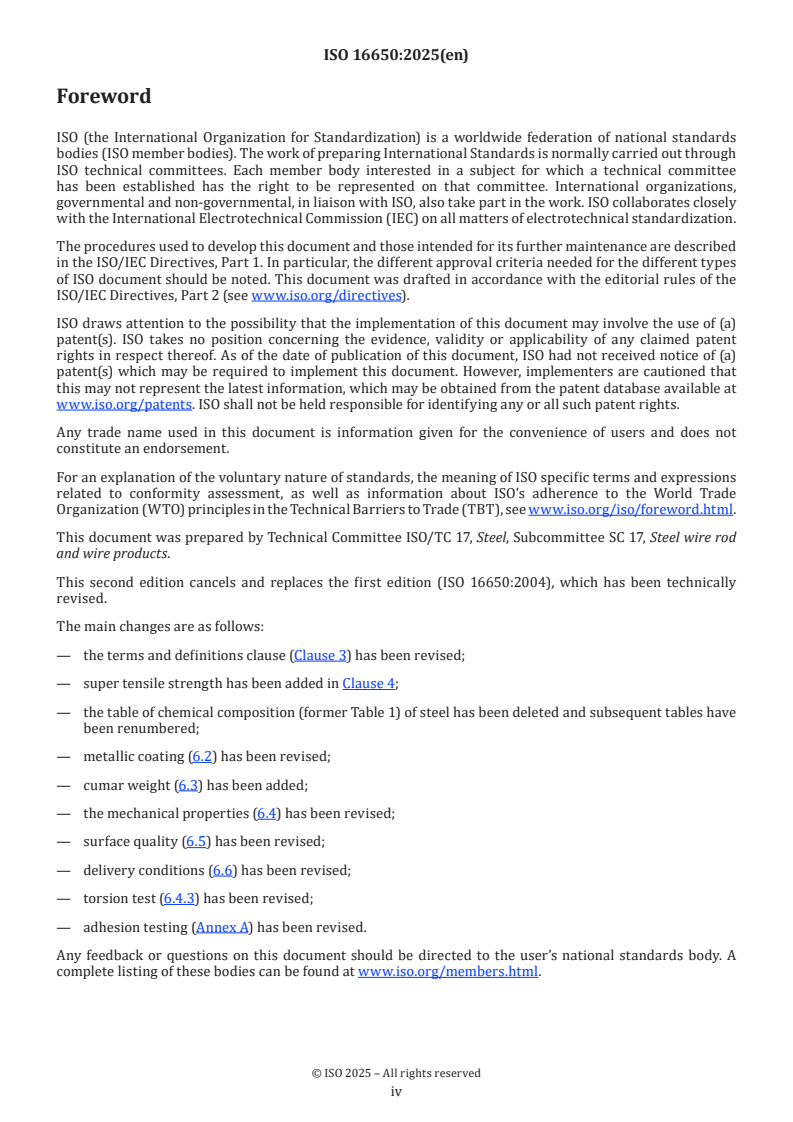
Foreword
ISO (the International Organization for Standardization) is a worldwide federation of national standards
bodies (ISO member bodies). The work of preparing International Standards is normally carried out through
ISO technical committees. Each member body interested in a subject for which a technical committee
has been established has the right to be represented on that committee. International organizations,
governmental and non-governmental, in liaison with ISO, also take part in the work. ISO collaborates closely
with the International Electrotechnical Commission (IEC) on all matters of electrotechnical standardization.
The procedures used to develop this document and those intended for its further maintenance are described
in the ISO/IEC Directives, Part 1. In particular, the different approval criteria needed for the different types
of ISO document should be noted. This document was drafted in accordance with the editorial rules of the
ISO/IEC Directives, Part 2 (see www.iso.org/directives).
ISO draws attention to the possibility that the implementation of this document may involve the use of (a)
patent(s). ISO takes no position concerning the evidence, validity or applicability of any claimed patent
rights in respect thereof. As of the date of publication of this document, ISO had not received notice of (a)
patent(s) which may be required to implement this document. However, implementers are cautioned that
this may not represent the latest information, which may be obtained from the patent database available at
www.iso.org/patents. ISO shall not be held responsible for identifying any or all such patent rights.
Any trade name used in this document is information given for the convenience of users and does not
constitute an endorsement.
For an explanation of the voluntary nature of standards, the meaning of ISO specific terms and expressions
related to conformity assessment, as well as information about ISO's adherence to the World Trade
Organization (WTO) principles in the Technical Barriers to Trade (TBT), see www.iso.org/iso/foreword.html.
This document was prepared by Technical Committee ISO/TC 17, Steel, Subcommittee SC 17, Steel wire rod
and wire products.
This second edition cancels and replaces the first edition (ISO 16650:2004), which has been technically
revised.
The main changes are as follows:
— the terms and definitions clause (Clause 3) has been revised;
— super tensile strength has been added in Clause 4;
— the table of chemical composition (former Table 1) of steel has been deleted and subsequent tables have
been renumbered;
— metallic coating (6.2) has been revised;
— cumar weight (6.3) has been added;
— the mechanical properties (6.4) has been revised;
— surface quality (6.5) has been revised;
— delivery conditions (6.6) has been revised;
— torsion test (6.4.3) has been revised;
— adhesion testing (Annex A) has been revised.
Any feedback or questions on this document should be directed to the user’s national standards body. A
complete listing of these bodies can be found at www.iso.org/members.html.
iv
International Standard ISO 16650:2025(en)
Bead wire
1 Scope
This document specifies the requirements and characteristics of round and flat wire used for strengthening
the bead of all kinds of tyres.
2 Normative references
The following documents are referred to in the text in such a way that some or all of their content constitutes
requirements of this document. For dated references, only the edition cited applies. For undated references,
the latest edition of the referenced document (including any amendments) applies.
ISO 404, Steel and steel products — General technical delivery requirements
ISO 6892-1, Metallic materials — Tensile testing — Part 1: Method of test at room temperature
ISO 7800, Metallic materials — Wire — Simple torsion test
ISO 10474, Steel and steel products — Inspection documents
3 Terms and definitions
For the purposes of this document, the following terms and definitions apply.
ISO and IEC maintain terminology databases for use in standardization at the following addresses:
— ISO Online browsing platform: available at https:// www .iso .org/ obp
— IEC Electropedia: available at https:// www .electropedia .org/
3.1
nominal diameter
d
diameter by which the wire is designated and specified by the purchaser
Note 1 to en
...