

ISO 8000-115:2024
(Main)Data quality — Part 115: Master data: Exchange of quality identifiers: Syntactic, semantic and resolution requirements
General Information
- Abstract
This document specifies the requirements for the quality identifiers that form part of an exchange of master data. These requirements supplement those of ISO 8000‑110. The following are within the scope of this document: — the syntax and semantics of quality identifiers to allow the unambiguous identification of the owner of the identifier and any restrictions on the use of the identifier; — the principles of resolving quality identifiers to the data set they represent; — the characteristics that define quality identifiers. The following are outside the scope of this document: — the methods used for the creation of identifiers; — the syntax of the query and of the response used in the resolution of identifiers; — the methods used for the resolution of identifiers.
- Status
- Published
- Publication Date
- 11-Jun-2024
- Technical Committee
- ISO/TC 184/SC 4 - Industrial data
- Drafting Committee
- ISO/TC 184/SC 4/WG 13 - Industrial Data Quality
- Current Stage
- 6060 - International Standard published
- Start Date
- 12-Jun-2024
- Due Date
- 15-Jul-2025
- Completion Date
- 12-Jun-2024
Overview
ISO 8000-115:2024 is a key international standard focused on data quality, specifically addressing the exchange of quality identifiers in master data management. This second edition enhances requirements related to the syntactic, semantic, and resolution aspects of quality identifiers, ensuring precise and unambiguous identification of data owners and improving data interoperability across organizations. It complements ISO 8000-110 by providing detailed specifications for how quality identifiers should be structured, interpreted, and resolved within data exchanges.
The standard is essential for organizations handling master data who need to guarantee data integrity, traceability, and standardized communication when sharing identifiers for entities such as products, assets, services, or regulatory elements.
Key Topics
Syntax Requirements
Quality identifiers must begin with a prefix element (denoting the owner), which excludes full stop (“.”) or colon (“:”) characters, followed optionally by sub-domain elements and ending with an identifier element starting with a colon. The total length is limited to 254 UTF-8 characters to maintain consistency.Semantic Requirements
The prefix must clearly resolve to the definitive owner of the identifier and declare any restrictions on its use. Additionally, the prefix should provide an electronic address (such as a URI) to enable the resolution of the full quality identifier.Resolution Principles
The identifier must link to a data set conforming to ISO 8000-110, allowing users to resolve and validate the data referenced by the identifier effectively.Conformance
Compliance demands meeting specific clauses on syntax, semantics, and resolution. Although sub-domain elements are optional, parties exchanging identifiers must agree on the syntax of query and response mechanisms for resolution.
Applications
ISO 8000-115:2024 plays a crucial role in multiple practical domains:
Master Data Management (MDM)
Enables organizations to exchange master data identifiers while maintaining data quality, unambiguously identifying owners and use restrictions.Supply Chain and Asset Tracking
Assures that unique product or asset IDs reference consistent and resolvable data sets, supporting traceability and operational efficiency.Government and Regulatory Data Exchange
Improves reliability when exchanging identifiers for legal entities, licenses, permits, or compliance-related records.Information Technology and Systems Integration
Facilitates interoperability between diverse systems by standardizing identifiers’ syntax and semantics, reducing errors in data exchange.Industry and Automation
Supports automation systems requiring robust, standardized master data identifiers for process control and industrial data integration.
Related Standards
ISO 8000-115:2024 works alongside and supplements several key standards:
ISO 8000-110: Covers the exchange of characteristic data and data specification conformance, forming the foundation for resolving identifiers described in ISO 8000-115.
ISO 8000-2: Provides standardized terminology for data quality, ensuring consistency in definitions and understanding.
ISO/IEC 10646: Defines the Universal Coded Character Set (UTF-8 encoding), referenced for valid character representations in quality identifiers.
ISO/IEC 8824-1 and ISO 10303-1: Offer foundational frameworks for syntax notation and product data representation that underpin the identification mechanisms.
Internet Engineering Task Force (IETF) RFC 3986: Specifies uniform resource identifiers (URIs) as electronic addresses for resolving quality identifiers.
Summary
Adopting ISO 8000-115:2024 is vital for organizations aiming to enhance their master data quality through standardized, unambiguous, and resolvable quality identifiers. This standard ensures that data owners are clearly identifiable, use restrictions are transparent, and identifiers systematically link to authoritative data sets. It fosters trust and precision in data exchanges across industries, boosting efficiency in master data management, regulatory compliance, and digital integration initiatives.
By aligning your data exchange processes with ISO 8000-115:2024, you support robust data governance, interoperability, and effective master data utilization in complex, multi-party environments.
Relations
- Effective Date
- 20-Jan-2024
Get Certified
Connect with accredited certification bodies for this standard

DVS-ZERT GmbH
German welding certification society.
CARES (UK Certification Authority for Reinforcing Steels)
UK certification for reinforcing steels and construction.
EWF/IIW (European/International Welding Federation)
International welding personnel certification.
Sponsored listings
Frequently Asked Questions
ISO 8000-115:2024 is a standard published by the International Organization for Standardization (ISO). Its full title is "Data quality — Part 115: Master data: Exchange of quality identifiers: Syntactic, semantic and resolution requirements". This standard covers: This document specifies the requirements for the quality identifiers that form part of an exchange of master data. These requirements supplement those of ISO 8000‑110. The following are within the scope of this document: — the syntax and semantics of quality identifiers to allow the unambiguous identification of the owner of the identifier and any restrictions on the use of the identifier; — the principles of resolving quality identifiers to the data set they represent; — the characteristics that define quality identifiers. The following are outside the scope of this document: — the methods used for the creation of identifiers; — the syntax of the query and of the response used in the resolution of identifiers; — the methods used for the resolution of identifiers.
This document specifies the requirements for the quality identifiers that form part of an exchange of master data. These requirements supplement those of ISO 8000‑110. The following are within the scope of this document: — the syntax and semantics of quality identifiers to allow the unambiguous identification of the owner of the identifier and any restrictions on the use of the identifier; — the principles of resolving quality identifiers to the data set they represent; — the characteristics that define quality identifiers. The following are outside the scope of this document: — the methods used for the creation of identifiers; — the syntax of the query and of the response used in the resolution of identifiers; — the methods used for the resolution of identifiers.
ISO 8000-115:2024 is classified under the following ICS (International Classification for Standards) categories: 25.040.40 - Industrial process measurement and control. The ICS classification helps identify the subject area and facilitates finding related standards.
ISO 8000-115:2024 has the following relationships with other standards: It is inter standard links to ISO 8000-115:2018. Understanding these relationships helps ensure you are using the most current and applicable version of the standard.
ISO 8000-115:2024 is available in PDF format for immediate download after purchase. The document can be added to your cart and obtained through the secure checkout process. Digital delivery ensures instant access to the complete standard document.
Standards Content (Sample)
International
Standard
ISO 8000-115
Second edition
Data quality —
2024-06
Part 115:
Master data: Exchange of quality
identifiers: Syntactic, semantic and
resolution requirements
Qualité des données —
Partie 115: Données permanentes: Échange des identificateurs
qualité: Exigences syntaxiques, sémantiques et de résolution
Reference number
© ISO 2024
All rights reserved. Unless otherwise specified, or required in the context of its implementation, no part of this publication may
be reproduced or utilized otherwise in any form or by any means, electronic or mechanical, including photocopying, or posting on
the internet or an intranet, without prior written permission. Permission can be requested from either ISO at the address below
or ISO’s member body in the country of the requester.
ISO copyright office
CP 401 • Ch. de Blandonnet 8
CH-1214 Vernier, Geneva
Phone: +41 22 749 01 11
Email: copyright@iso.org
Website: www.iso.org
Published in Switzerland
ii
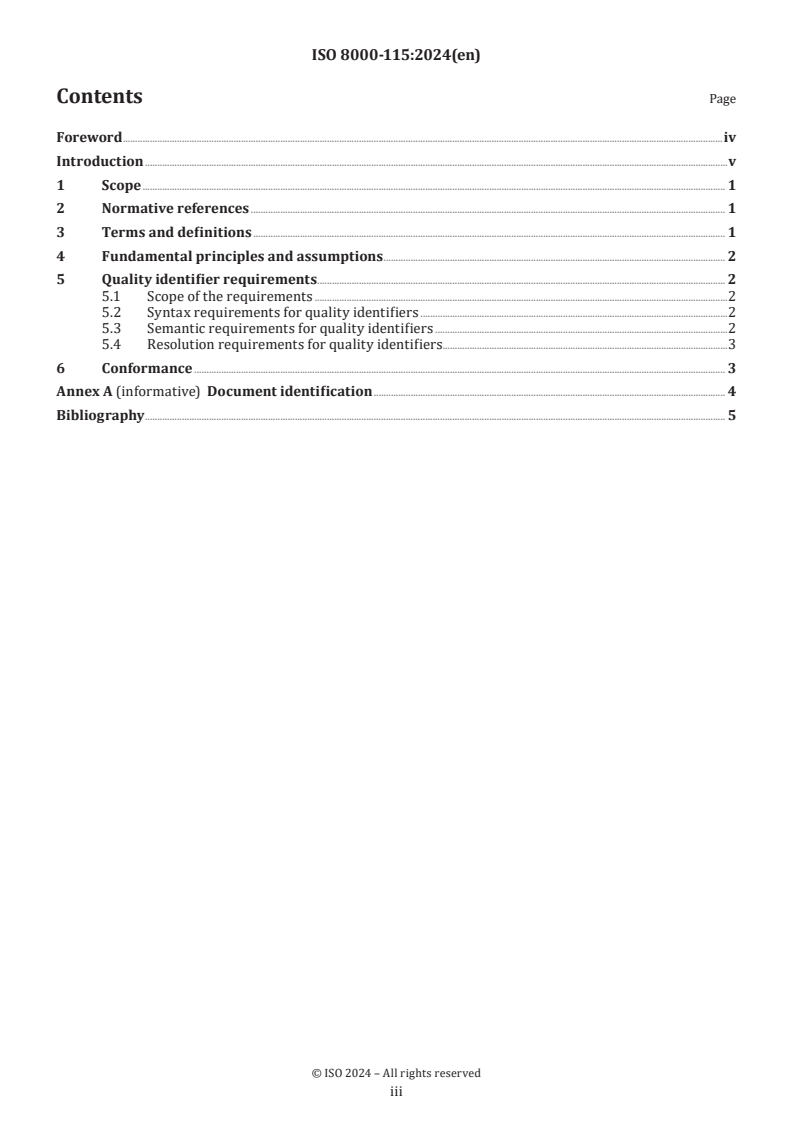
Contents Page
Foreword .iv
Introduction .v
1 Scope . 1
2 Normative references . 1
3 Terms and definitions . 1
4 Fundamental principles and assumptions . 2
5 Quality identifier requirements . . 2
5.1 Scope of the requirements .2
5.2 Syntax requirements for quality identifiers .2
5.3 Semantic requirements for quality identifiers .2
5.4 Resolution requirements for quality identifiers.3
6 Conformance . 3
Annex A (informative) Document identification . 4
Bibliography . 5
iii
Foreword
ISO (the International Organization for Standardization) is a worldwide federation of national standards
bodies (ISO member bodies). The work of preparing International Standards is normally carried out through
ISO technical committees. Each member body interested in a subject for which a technical committee
has been established has the right to be represented on that committee. International organizations,
governmental and non-governmental, in liaison with ISO, also take part in the work. ISO collaborates closely
with the International Electrotechnical Commission (IEC) on all matters of electrotechnical standardization.
The procedures used to develop this document and those intended for its further maintenance are described
in the ISO/IEC Directives, Part 1. In particular, the different approval criteria needed for the different types
of ISO document should be noted. This document was drafted in accordance with the editorial rules of the
ISO/IEC Directives, Part 2 (see www.iso.org/directives).
ISO draws attention to the possibility that the implementation of this document may involve the use of (a)
patent(s). ISO takes no position concerning the evidence, validity or applicability of any claimed patent
rights in respect thereof. As of the date of publication of this document, ISO had not received notice of (a)
patent(s) which may be required to implement this document. However, implementers are cautioned that
this may not represent the latest information, which may be obtained from the patent database available at
www.iso.org/patents. ISO shall not be held responsible for identifying any or all such patent rights.
Any trade name used in this document is information given for the convenience of users and does not
constitute an endorsement.
For an explanation of the voluntary nature of standards, the meaning of ISO specific terms and expressions
related to conformity assessment, as well as information about ISO's adherence to the World Trade
Organization (WTO) principles in the Technical Barriers to Trade (TBT), see www.iso.org/iso/foreword.html.
This document was prepared by Technical Committee ISO/TC 184, Automation systems and integration,
Subcommittee SC 4, Industrial data.
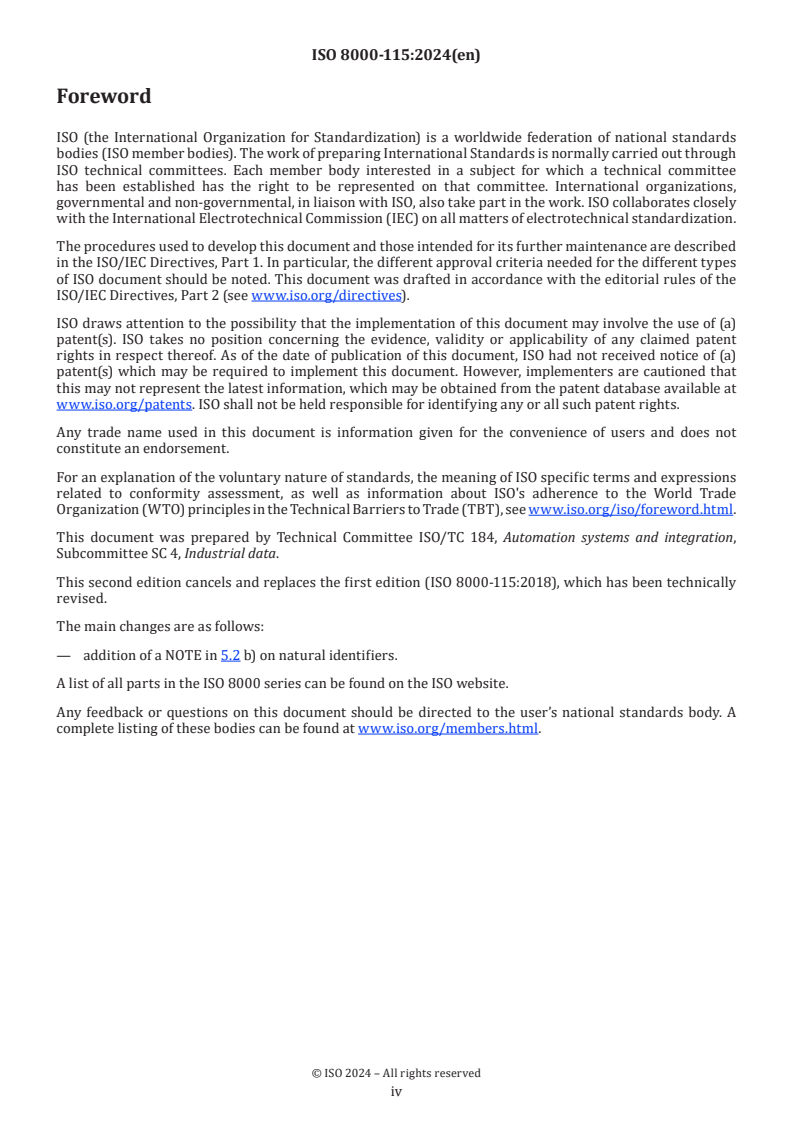
This second edition cancels and replaces the first edition (ISO 8000-115:2018), which has been technically
revised.
The main changes are as follows:
— addition of a NOTE in 5.2 b) on natural identifiers.
A list of all parts in the ISO 8000 series can be found on the ISO website.
Any feedback or questions on this document should be directed to the user’s national standards body. A
complete listing of these bodies can be found at www.iso.org/members.html.
iv
Introduction
The ability to create, collect, store, maintain, transfer, process and present information and to support
business processes in a timely and cost-effective manner requires both an understanding of the
characteristics of the information and data that determine its quality, and an ability to measure, manage
and report on information and data quality.
The ISO 8000 series defines characteristics of information and data that determine its quality, and provides
methods to manage, measure and improve the quality of information and data.
It is useful to perform the assessment in accordance with documented methods. It is also important to
document the tailoring of standardized methods with respect to the expectation and requirements pertinent
to the business.
The ISO 8000 series includes parts applicable to all types of data, and parts applicable to specific types of data.
The ISO 8000 series can be used independently or in conjunction with quality management systems.
Most commonly an identifier is a reference to a data set managed by the owner of the identifier and, as such,
it is an alias for a master data record. Identifiers are widely ex
...