

ISO 15104:2025
(Main)Space systems — Environmental testing for spacecraft thermal control materials
General Information
- Abstract
This document establishes requirements and guidance for the ground-based environmental testing of thermal control materials (TCMs) applied on spacecraft surface. This document describes the test methods for the following environmental conditions: charged particle radiation(s), solar ultraviolet (UV) radiation, atomic oxygen (AO) and thermal cycling. This document does not cover other environmental effects such as contamination effect of the Xenon ion engines plume (so called artificial effect) or the effects of neutron (see detailed information in Annex B). This document is applicable to typical TCM(s), including but not limited to, paint, silicate, film, anodic oxide, and glass (optical solar reflector, OSR). This document can be referenced for other materials, to which similar requirements apply. This document is devoted to material estimation or evaluation tests and can be tailored according to specific applications.
- Status
- Published
- Publication Date
- 22-Jan-2025
- Technical Committee
- ISO/TC 20/SC 14 - Space systems and operations
- Drafting Committee
- ISO/TC 20/SC 14 - Space systems and operations
- Current Stage
- 6060 - International Standard published
- Start Date
- 23-Jan-2025
- Due Date
- 11-Apr-2025
- Completion Date
- 23-Jan-2025
Overview
ISO 15104:2025 - Space systems - Environmental testing for spacecraft thermal control materials establishes requirements and guidance for ground‑based environmental testing of spacecraft thermal control materials (TCMs). It defines test methods to simulate key space environmental stressors: charged particle radiation, solar ultraviolet (UV) radiation, atomic oxygen (AO) and thermal cycling. The standard is applicable to typical TCMs such as paint, silicate, films, anodic oxide and glass (optical solar reflector, OSR) and is intended for material estimation or evaluation tests that can be tailored to specific applications.
Key topics and technical requirements
- Test scope and exclusions: Covers charged particles, UV (VUV/MUV/NUV), AO and thermal cycling; explicitly excludes effects such as Xenon-ion plume contamination and neutron effects (see Annex B).
- Test principle: Ground‑based single‑factor simulations (rather than synergistic multi‑factor tests) to reproduce relevant space conditions.
- Test lifecycle: Procedures for test request determination, test specification, test preparation and execution, and test reporting including deliverables and success criteria.
- Sample and measurement guidance: Requirements for test samples, properties to measure (thermo‑optical, mechanical, mass loss, etc.), and in‑vacuum (in‑situ) vs post‑exposure (ex‑situ) measurements to account for the recovery (bleaching) effect.
- Radiation testing specifics: Concepts such as acceleration factor and depth dose profile are referenced for charged particle exposure planning.
- Facilities and methods: Separate facility specifications and process steps for charged‑particle irradiation, UV exposure, AO exposure and thermal cycling (Annex C provides facility information).
- Quality assurance and non‑conformity control: Guidance tied to program management and conformity processes.
Practical applications and users
- Organizations developing or qualifying spacecraft surface coatings and TCMs for satellites, probes and instruments.
- Materials engineers, thermal analysts, test laboratories and procurement teams needing standardized environmental test procedures for:
- Validating thermo‑optical stability of paints, films, OSRs.
- Predicting on‑orbit degradation and lifetime performance.
- Producing formal test reports and pass/fail criteria for procurement and qualification.
- Useful during design trade studies, supplier acceptance testing and pre‑flight qualification.
Related standards
- ISO 17851 and ASTM E595 - outgassing/volatile materials testing.
- ISO 11227 - ejecta from micrometeoroid/space debris impacts.
- ISO 23461 - programme management - non‑conformance control system.
- Annexes A–C in ISO 15104 provide additional guidance on UV degradation, neutron effects (informative) and facility specifications.
Keywords: ISO 15104:2025, thermal control materials, TCM testing, spacecraft environmental testing, UV radiation, atomic oxygen, thermal cycling, charged particle radiation, OSR, in‑situ measurement.
Get Certified
Connect with accredited certification bodies for this standard

BUREAU VERITAS Certification Germany
Bureau Veritas certification in Germany.

Element Materials Technology
Materials testing and product certification.

AQMS Ltd.
AQMS provides ISO certification to SMEs across the UK.
Sponsored listings
Frequently Asked Questions
ISO 15104:2025 is a standard published by the International Organization for Standardization (ISO). Its full title is "Space systems — Environmental testing for spacecraft thermal control materials". This standard covers: This document establishes requirements and guidance for the ground-based environmental testing of thermal control materials (TCMs) applied on spacecraft surface. This document describes the test methods for the following environmental conditions: charged particle radiation(s), solar ultraviolet (UV) radiation, atomic oxygen (AO) and thermal cycling. This document does not cover other environmental effects such as contamination effect of the Xenon ion engines plume (so called artificial effect) or the effects of neutron (see detailed information in Annex B). This document is applicable to typical TCM(s), including but not limited to, paint, silicate, film, anodic oxide, and glass (optical solar reflector, OSR). This document can be referenced for other materials, to which similar requirements apply. This document is devoted to material estimation or evaluation tests and can be tailored according to specific applications.
This document establishes requirements and guidance for the ground-based environmental testing of thermal control materials (TCMs) applied on spacecraft surface. This document describes the test methods for the following environmental conditions: charged particle radiation(s), solar ultraviolet (UV) radiation, atomic oxygen (AO) and thermal cycling. This document does not cover other environmental effects such as contamination effect of the Xenon ion engines plume (so called artificial effect) or the effects of neutron (see detailed information in Annex B). This document is applicable to typical TCM(s), including but not limited to, paint, silicate, film, anodic oxide, and glass (optical solar reflector, OSR). This document can be referenced for other materials, to which similar requirements apply. This document is devoted to material estimation or evaluation tests and can be tailored according to specific applications.
ISO 15104:2025 is classified under the following ICS (International Classification for Standards) categories: 49.140 - Space systems and operations. The ICS classification helps identify the subject area and facilitates finding related standards.
ISO 15104:2025 is available in PDF format for immediate download after purchase. The document can be added to your cart and obtained through the secure checkout process. Digital delivery ensures instant access to the complete standard document.
Standards Content (Sample)
International
Standard
ISO 15104
First edition
Space systems — Environmental
2025-01
testing for spacecraft thermal
control materials
Systèmes spatiaux — Essais environnementaux pour les
matériaux de contrôle thermique des engins spatiaux
Reference number
© ISO 2025
All rights reserved. Unless otherwise specified, or required in the context of its implementation, no part of this publication may
be reproduced or utilized otherwise in any form or by any means, electronic or mechanical, including photocopying, or posting on
the internet or an intranet, without prior written permission. Permission can be requested from either ISO at the address below
or ISO’s member body in the country of the requester.
ISO copyright office
CP 401 • Ch. de Blandonnet 8
CH-1214 Vernier, Geneva
Phone: +41 22 749 01 11
Email: copyright@iso.org
Website: www.iso.org
Published in Switzerland
ii
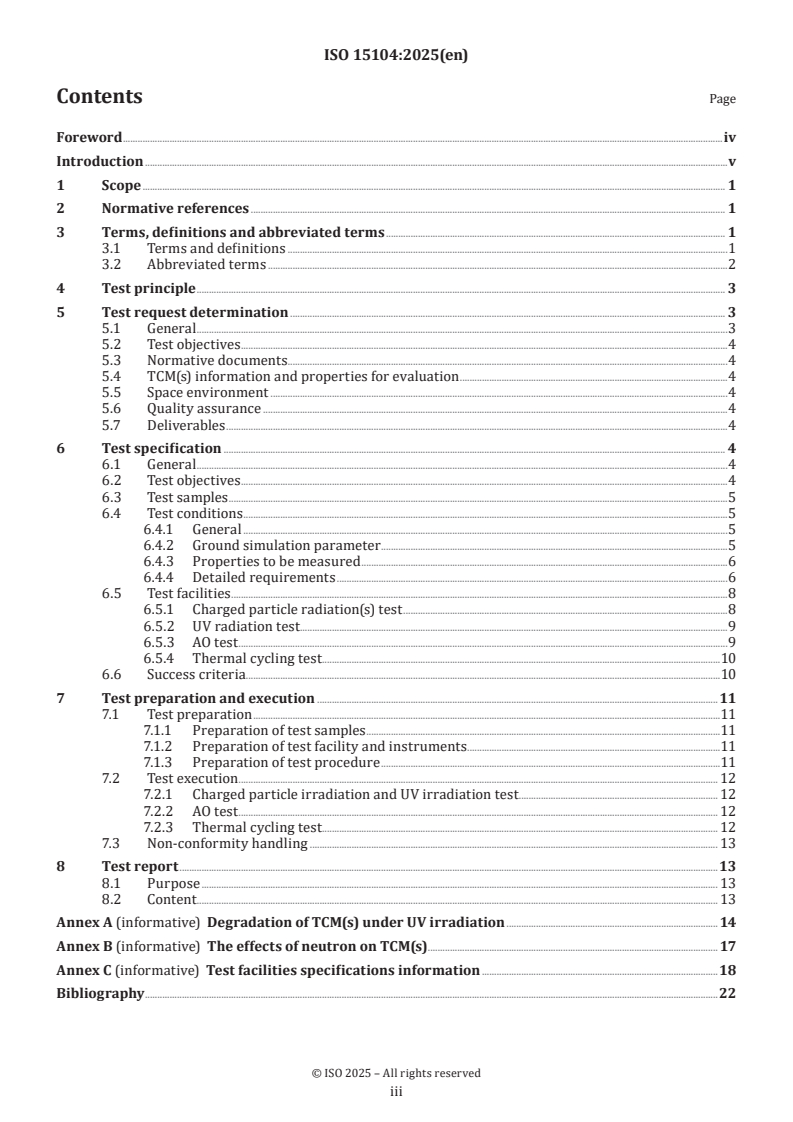
Contents Page
Foreword .iv
Introduction .v
1 Scope . 1
2 Normative references . 1
3 Terms, definitions and abbreviated terms . 1
3.1 Terms and definitions .1
3.2 Abbreviated terms .2
4 Test principle . 3
5 Test request determination . 3
5.1 General .3
5.2 Test objectives .4
5.3 Normative documents.4
5.4 TCM(s) information and properties for evaluation .4
5.5 Space environment .4
5.6 Quality assurance .4
5.7 Deliverables .4
6 Test specification . 4
6.1 General .4
6.2 Test objectives .4
6.3 Test samples .5
6.4 Test conditions .5
6.4.1 General .5
6.4.2 Ground simulation parameter .5
6.4.3 Properties to be measured .6
6.4.4 Detailed requirements .6
6.5 Test facilities .8
6.5.1 Charged particle radiation(s) test .8
6.5.2 UV radiation test.9
6.5.3 AO test .9
6.5.4 Thermal cycling test .10
6.6 Success criteria.10
7 Test preparation and execution .11
7.1 Test preparation .11
7.1.1 Preparation of test samples .11
7.1.2 Preparation of test facility and instruments . .11
7.1.3 Preparation of test procedure .11
7.2 Test execution . . 12
7.2.1 Charged particle irradiation and UV irradiation test . 12
7.2.2 AO test . 12
7.2.3 Thermal cycling test . 12
7.3 Non-conformity handling . 13
8 Test report .13
8.1 Purpose . 13
8.2 Content . . 13
Annex A (informative) Degradation of TCM(s) under UV irradiation . 14
Annex B (informative) The effects of neutron on TCM(s) . 17
Annex C (informative) Test facilities specifications information .18
Bibliography .22
iii
Foreword
ISO (the International Organization for Standardization) is a worldwide federation of national standards
bodies (ISO member bodies). The work of preparing International Standards is normally carried out through
ISO technical committees. Each member body interested in a subject for which a technical committee
has been established has the right to be represented on that committee. International organizations,
governmental and non-governmental, in liaison with ISO, also take part in the work. ISO collaborates closely
with the International Electrotechnical Commission (IEC) on all matters of electrotechnical standardization.
The procedures used to develop this document and those intended for its further maintenance are described
in the ISO/IEC Directives, Part 1. In particular, the different approval criteria needed for the different types
of ISO document should be noted. This document was drafted in accordance with the editorial rules of the
ISO/IEC Directives, Part 2 (see www.iso.org/directives).
ISO draws attention to the possibility that the implementation of this document may involve the use of (a)
patent(s). ISO takes no position concerning the evidence, validity or applicability of any claimed patent
rights in respect thereof. As of the date of publication of this document, ISO had not received notice of (a)
patent(s) which may be required to implement this document. However, implementers are cautioned that
this may not represent the latest information, which may be obtained from the patent database available at
www.iso.org/patents. ISO shall not be held responsible for identifying any or all such patent rights.
Any trade name used in this document is information given for the convenience of users and does not
constitute an endorsement.
For an explanation of the voluntary nature of standards, the meaning of ISO specific terms and expressions
related to conformity assessment, as well as information about ISO's adherence to the World Trade
Organization (WTO) principles in the Technical Barriers to Trade (TBT), see www.iso.org/iso/foreword.html.
This document was prepared by Technical Committee ISO/TC 20, Aircraft and space vehicles, Subcommittee
SC 14, Space systems and operations.
Any feedback or questions on this document should be directed to the user’s national standards body. A
complete listing of these bodies can be found at www.iso.org/members.html.
iv
Introduction
Spacecraft thermal control materials (TCMs) are functional materials applied to control spacecraft
temperature within design operation limits, by regulating the thermo-optical properties of spacecraft
surfaces exposed to the space environment. TCMs’ thermo-optical properties can degrade while exposed
to the space environment. To ensure that the performance of TCM(s) is within design limits, environmental
testing on TCM(s) is necessary. For application to spacecraft, TCMs’ performance is evaluated in relevant
simulated environments including charged particle radiation(s), solar ultraviolet (UV) radiation, atomic
oxygen (AO), and thermal cycling, with parameters depending on spacecraft orbit and life time. The purpose
of this document is to specify the environmental testing methods applied for experiments simulating effects
of the space environment.
v
International Standard ISO 15104:2025(en)
Space systems — Environmental testing for spacecraft
thermal control materials
1 Scope
This document establishes requirements and guidance for the ground-based environmental testing of
thermal control materials (TCMs) applied on spacecraft surface.
This document describes the test methods for the following environmental conditions: charged particle
radiation(s), solar ultraviolet (UV) radiation, atomic oxygen (AO) and thermal cycling.
This document does not cover other environmental effects such as contamination effect of the Xenon ion
engines plume (so called artificial effect) or the effects of neutron (see detailed information in Annex B).
This document is applicable to typical TCM(s), including but not limited to, paint, silicate, film, anodic oxide,
and glass (optical solar reflector, OSR). This document can be referenced for other materials, to which similar
requirements apply. This document is devoted to material estimation or evaluation tests and can be tailored
according to specific applications.
2 Normative references
The following documents are referred to in the text in such a way that some or all of their content constitutes
requirements of this document. For dated references, only the edition cited applies. For undated references,
the latest edition of the referenced document (including any amendments) applies.
ISO 23461, Space systems — Programme management — Non-conformance control system
3 Terms, definitions and abbreviated terms
3.1 Terms and definitions
For the purposes of this document, the following terms and definitions apply.
ISO and IEC maintain terminology databases for use in standardization at the following addresses:
— ISO Online browsing platform: available at https:// www .iso .org/ obp
— IEC Electropedia: available at https:// www .electropedia .org/
3.1.1
acceleration factor
ratio of dose rate between simulation and expectation in space application for the same type of radiation
[SOURCE: ISO 15856:2010, 3.1.2]
3.1.2
depth dose profile
distribution of the absorbed dose through the depth of the material.
[SOURCE: ISO 15856:2010, 3.1.5]
3.1.3
ex-situ measurement
measurement performed after exposure to atmosphere
3.1.4
in-situ measurement
measurement performed in vacuum or pressurized (without exposure to atmosphere)
Note 1 to entry: In-situ measurement is employed to avoid the influence of recovery effect (3.1.7) to test results. See
Clause A.2.
3.1.5
MUV radiation
medium ultraviolet radiation
solar electromagnetic radiation with a wavelength in the range of 200 nm to 300 nm
Note 1 to entry: See ISO 21348.
3.1.6
NUV radiation
near ultraviolet radiation
solar electromagnetic radiation with a wavelength in the range of 300 nm to 400 nm
Note 1 to entry: See ISO 21348.
3.1.7
recovery effect
bleaching effect
phenomenon observed when a TCM is moved into atmosphere from vacuum after an environmental test,
where the degradation after exposure to atmosphere is less than that in vacuum
Note 1 to entry: Detailed information is shown in Annex A.
3.1.8
solar absorptance
α
s
ratio of the solar radiant flux absorbed by a material (or body) to the radiant flux of the incident radiation
[SOURCE: ISO 16691:2014, 3.1.13]
3.1.9
VUV radiation
vacuum ultraviolet radiation
solar electromagnetic radiation with a wavelength in the range of 10 nm to 200 nm
[SOURCE: ISO 15856:2010, 3.1.21]
3.2 Abbreviated terms
AO atomic oxygen
AM0 air mass 0
eV electron volts
GCR galactic cosmic ray
OSR optical solar reflector
QCM quartz crystal microbalance
SEP solar event proton
UV ultraviolet
4 Test principle
The test principle is to simulate space environmental effects on spacecraft TCM(s) by ground-based tests.
This includes exposure to the following environmental factors:
a) charged particle radiation;
b) UV radiation;
c) AO;
d) thermal cycling.
Unless otherwise specified, the space environmental test is performed with single-factor effect test instead
of synergistic effect test.
Environmental tests relating to the outgassing of TCM(s) are specified in ISO 17851 and ASTM E595.
Environmental tests relating to the ejecta released by micrometeoroid or space debris impacts on TCM(s)
are specified in ISO 11227.
NOTE 1 This document can be referenced for tests of other environmental effects (such as Xe erosion or
contamination).
This document specifies requirements for test customers and test suppliers regarding the following aspects
to perform environmental tests for TCM(s) evaluation:
— test request;
— test specification;
— test preparation and execution;
— test report.
NOTE 2 The test customer is the test proposer or demander. The test supplier is the test executor.
NOTE 3 The forecast of material durability in relation to the impact of the space environment is based on results
of ground tests, mathematical modelling of processes of space environment effects on materials and on-board
experiments (refer to ISO 17851).
Aspects related to the test request, test specification approval by the customer and non-conformities
treatment, if any, shall be resolved through communication or negotiation between the customer and the
supplier.
5 Test request determination
5.1 General
The test customer and the test supplier shall reach an agreement on the test request, which contains the
following information:
a) test objectives;
b) normative documents;
c) TCM(s) information and properties for evaluation;
d) spacecraft orbit, lifetime and environment parameters;
e) quality assurance;
f) deliverables.
Unless otherwise specified, the test request is a general document that applies to all tests in this document.
5.2 Test objectives
The test customer shall describe the objectives of the tests.
5.3 Normative documents
The test customer shall specify standards and technical documents as normative documents to be applied
or used as references for the test supplier.
5.4 TCM(s) information and properties for evaluation
The test customer shall specify the shape or form of the TCM(s) sample and its main constituent materials
or material family. For the purpose of this document, measurements include, but are not limited to, thermo-
optical properties, electric properties (surface resistivity or volume resistivity), and mechanical properties
(refer to ISO 16378, ECSS-Q-ST-70-09C, and ISO 16691).
The test samples should be visually checked after the test to determine whether there is flaking or shedding.
If such a possibility exists, the mass of samples should be measured.
5.5 Space environment
The test customer shall specify requirements for test environment parameters, in particular, spacecraft
orbit parameters and life time, the absorbed dose, the TCMs' locations on the external and internal surfaces
of spacecraft, the main constituent materials or material family of TCM(s) and environmental models.
5.6 Quality assurance
The test customer shall specify quality assurance requirements, including handling of failed tests and non-
conformities.
5.7 Deliverables
The test customer shall specify the deliverables and due dates.
6 Test specification
6.1 General
The test specification serves as a basis to prepare for and perform the test and shall be approved by the test
customer. The test supplier shall establish a test specification according to consideration of the test request.
The test specification should contain the following items:
a) test objectives;
b) test samples;
c) test conditions;
d) test facilities;
e) success criteria.
6.2 Test objectives
The test specification shall contain objectives for each test to be performed, as agreed by the test customer
and the test supplier.
6.3 Test samples
Unless otherwise specified, the following general requirements and recommendations apply for test samples
in this document.
a) The sample shape, size, and quantity shall meet the requirements of the corresponding measurement.
b) Each sample shall be traceable (e.g. marked with identification sign or serial number).
c) Samples shall be packed or wrapped with an appropriate material to avoid mechanical damage or
contamination.
d) For the charged particle radiation(s) test, all the electrically conductive coating on TCM(s) should be
electrically grounded to decrease surface charging induced by the charged particle radiation(s).
e) For the AO test, besides test samples, witness samples should be applied to measure the effective atomic
oxygen flux or fluence. The erosion yield of witness samples should be well known (polyimide films are
[1]
recommended ).
6.4 Test conditions
6.4.1 General
Test conditions are defined as test parameters performed during the test.
6.4.2 Ground simulation parameter
Ground simulation parameters should be provided by the test customer. If not, the test supplier shall specify
the environment parameters during testing based on the information provided and approved by the test
customer in the test request. The ground simulation environment test and corresponded parameters are
shown in Table 1.
Table 1 — Ground simulation parameter of environment test
Environment test Ground simulation parameter
Type of charged particle
Energy of charged particle
Fluence of charged particle
Charged particle radiation
Flux of charged particle
(include proton and electron)
Pressure during test
Sample temperature
Contamination
UV irradiance
UV spectrum range
Exposure
Solar ultraviolet (UV)
Pressure during test
Sample temperature
Contamination
AO flux
AO fluence
Atomic oxygen (AO) Pressure during test
Sample temperature
Contamination
Temperature extremes
Temperature changing rate
Temperature dwell time
Thermal cycling
Thermal cycling numbers
Environment (vacuum/inert gas)
Contamination
NOTE To avoid the interference of temperature measurement on the test results, the temperature measured on
the back of the samples is taken as the sample temperature.
The test supplier shall specify the laboratory environmental specifications, such as room temperature,
humidity and cleanliness conditions.
6.4.3 Properties to be measured
Properties to be measured and in-situ measurement requirements shall be specified in accordance with 5.4
and 6.5.1 f). The in-situ measurement should be performed because the recovery effect of solar absorptance
[2],[3]
is observed up to 0,05 .
6.4.4 Detailed requirements
6.4.4.1 Charged particle radiation(s) test
Charged particle radiation(s) type, energies, flux, fluence, pressure, and allowed contamination on TCM(s)
shall be specified. The following requirements and recommendations apply for the specification of charged
particle radiation(s) test conditions.
a) The charged particle radiation(s) depth dose profile in TCM(s) shall be calculated based on environment
models, spacecraft orbit parameters and life time, TCM(s) material constituents and other parameters
provided or approved by test customer (refer to ISO 15856, and ECSS-Q-ST-70-06C). The dose depth
profile can be calculated by the available particle transport codes.
b) The charged particle radiation(s) depth dose profile calculated based on the energy and fluence of particles
should be as close as possible to the space charged particle radiation(s) depth dose profile on TCM(s).
c) The charged particle radiation(s) flux shall be determined by acceleration factors, which shall not cause
unexpected damage and degradation mode during the irradiation.
d) Surface charging induced by the charged particle on TCM(s) should be mitigated to avoid the decrease of
effects of irradiation beam to samples. For anti-static coating, the conductive layer on the surface should
be grounded reliably. For insulating coating, it should be neutralized by particles of opposite charge at
intervals.
e) The sample surface should be covered by charged particle beam as uniform as possible.
f) The sample temperature during the accelerated test should be monitored and provided to the test
customer for evaluation.
-3
g) The pressure in the chamber during the test shall be less than 10 Pa under the charged particle
irradiation. In addition, the irradiation of gamma-ray and electron also can be performed under inert
atmosphere.
h) The contamination on TCM(s) during irradiation shall not affect the degradation results.
I) The test facilities should meet the cleanliness requirements provided by the test customer.
6.4.4.2 UV radiation test
The UV radiation (including NUV radiation, MUV radiation and VUV radiation) test parameters include UV
irradiance, UV spectrum range, exposure, pressure, TCM(s) temperature, and allowed contamination on
TCM(s). The following requirements and recommendations apply for the specification of UV radiation test
conditions.
a) The space solar NUV, MUV and VUV radiation impacting to TCM(s) shall be calculated based on AM0
solar spectra, spacecraft orbit parameters and life time, the TCMs’ locations on the external surface of
spacecraft and other parameters that are provided by the test customer.
b) NUV radiation tests, MUV radiation tests and VUV radiation tests may be combined or performed
separately.
c) The simulated solar UV irradiance shall be no less than the space solar UV.
d) The test exposure shall be specified by the test customer.
e) The UV irradiance during the test is determined by acceleration factors, which shall not cause
unexpected damage and degradation mode during the irradiation
NOTE The acceleration factors apply to both individual (separate) and combined irradiations.
f) The sample temperature during the accelerated test should be monitored and provided to the test
customer for evaluation.
-2
g) The pressure in the chamber during the test shall be less than 10 Pa.
h) The contamination on TCM(s) during irradiation shall not affect the degradation results of the TCM(s).
i) The test facilities should meet the cleanliness requirements provided by the test customer.
6.4.4.3 AO test
The AO test parameters include AO flux, AO fluence, pressure, TCM(s) temperature, and allowed
contamination on TCM(s). The following requirements and recommendations apply for the specification of
AO test conditions.
a) The space AO flux and fluence on TCM(s) shall be calculated from space atmosphere models, spacecraft
mission parameters and life time and the TCMs’ locations on the external surface of spacecraft, which
are provided or approved by the test customer.
b) The simulated AO fluence shall be equivalent to the space AO effect or at least should be enough
[1]
to measure or calculate the AO erosion yield . The simulated flux may be greater than space flux
depending on the facility capability.
NOTE The UV exposure can affect the AO erosion yield.
c) The sample temperature during the accelerated test should be monitored and provided to the test
customer for evaluation.
d) The contamination on TCM(s) during irradiation shall not affect the degradation results of the TCM(s).
e) The test facilities should meet the cleanliness requirements provided by the test customer.
6.4.4.4 Thermal cycling test
The thermal cycling test conditions shall include temperature extremes (limits or range), temperature
changing rate, temperature dwell time or thermal soak, thermal cycling numbers, environment (in vacuum or
in inert gas) and allowed contamination on TCM(s) (refer to ECSS-Q-ST-70-04C). The following requirements
and recommendations apply for the specification of thermal cycling test conditions.
a) The thermal cycling test conditions shall be speci
...