


ISO 16345:2014
(Main)Water-cooling towers — Testing and rating of thermal performance
Water-cooling towers — Testing and rating of thermal performance
ISO 16345:2014 covers the measurement of the thermal performance and pumping head of open- and closed-circuit, mechanical draft, wet and wet/dry cooling towers and natural draft and fan-assisted natural draft, wet and wet/dry cooling towers. The standard rating boundaries for series mechanical draft, open- and closed-circuit cooling towers are specified. ISO 16345:2014 does not apply to the testing and rating of closed-circuit towers where the process fluid undergoes a change in phase as it passes through the heat exchanger or where the thermophysical properties of the process fluid are not available.
Tours de refroidissement de l'eau — Essais et détermination des caractéristiques de performance
General Information
- Status
- Withdrawn
- Publication Date
- 26-May-2014
- Technical Committee
- ISO/TC 86/SC 6 - Testing and rating of air-conditioners and heat pumps
- Drafting Committee
- ISO/TC 86/SC 6 - Testing and rating of air-conditioners and heat pumps
- Current Stage
- 9599 - Withdrawal of International Standard
- Start Date
- 06-Dec-2023
- Completion Date
- 12-Feb-2026

Get Certified
Connect with accredited certification bodies for this standard

DNV
DNV is an independent assurance and risk management provider.

Lloyd's Register
Lloyd's Register is a global professional services organisation specialising in engineering and technology.
DNV Energy Systems
Energy and renewable energy certification.
Sponsored listings
Frequently Asked Questions
ISO 16345:2014 is a standard published by the International Organization for Standardization (ISO). Its full title is "Water-cooling towers — Testing and rating of thermal performance". This standard covers: ISO 16345:2014 covers the measurement of the thermal performance and pumping head of open- and closed-circuit, mechanical draft, wet and wet/dry cooling towers and natural draft and fan-assisted natural draft, wet and wet/dry cooling towers. The standard rating boundaries for series mechanical draft, open- and closed-circuit cooling towers are specified. ISO 16345:2014 does not apply to the testing and rating of closed-circuit towers where the process fluid undergoes a change in phase as it passes through the heat exchanger or where the thermophysical properties of the process fluid are not available.
ISO 16345:2014 covers the measurement of the thermal performance and pumping head of open- and closed-circuit, mechanical draft, wet and wet/dry cooling towers and natural draft and fan-assisted natural draft, wet and wet/dry cooling towers. The standard rating boundaries for series mechanical draft, open- and closed-circuit cooling towers are specified. ISO 16345:2014 does not apply to the testing and rating of closed-circuit towers where the process fluid undergoes a change in phase as it passes through the heat exchanger or where the thermophysical properties of the process fluid are not available.
ISO 16345:2014 is classified under the following ICS (International Classification for Standards) categories: 27.080 - Heat pumps. The ICS classification helps identify the subject area and facilitates finding related standards.
ISO 16345:2014 is available in PDF format for immediate download after purchase. The document can be added to your cart and obtained through the secure checkout process. Digital delivery ensures instant access to the complete standard document.
Standards Content (Sample)
INTERNATIONAL ISO
STANDARD 16345
First edition
2014-06-01
Water-cooling towers — Testing and
rating of thermal performance
Tours de refroidissement de l’eau — Essais et détermination des
caractéristiques de performance
Reference number
©
ISO 2014
© ISO 2014
All rights reserved. Unless otherwise specified, no part of this publication may be reproduced or utilized otherwise in any form
or by any means, electronic or mechanical, including photocopying, or posting on the internet or an intranet, without prior
written permission. Permission can be requested from either ISO at the address below or ISO’s member body in the country of
the requester.
ISO copyright office
Case postale 56 • CH-1211 Geneva 20
Tel. + 41 22 749 01 11
Fax + 41 22 749 09 47
E-mail copyright@iso.org
Web www.iso.org
Published in Switzerland
ii © ISO 2014 – All rights reserved
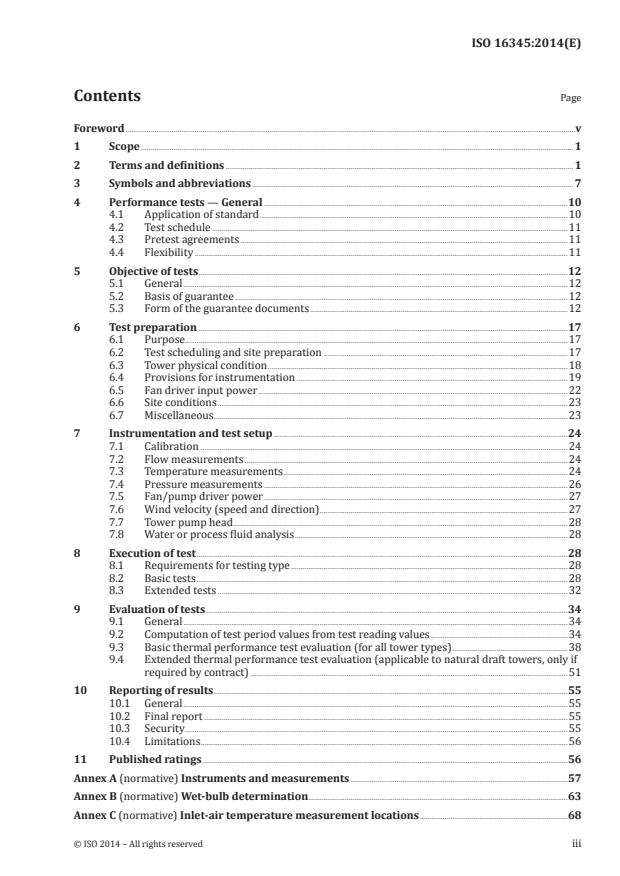
Contents Page
Foreword .v
1 Scope . 1
2 Terms and definitions . 1
3 Symbols and abbreviations . 7
4 Performance tests — General .10
4.1 Application of standard .10
4.2 Test schedule .11
4.3 Pretest agreements .11
4.4 Flexibility .11
5 Objective of tests .12
5.1 General .12
5.2 Basis of guarantee .12
5.3 Form of the guarantee documents .12
6 Test preparation .17
6.1 Purpose .17
6.2 Test scheduling and site preparation .17
6.3 Tower physical condition .18
6.4 Provisions for instrumentation .19
6.5 Fan driver input power .22
6.6 Site conditions .23
6.7 Miscellaneous .23
7 Instrumentation and test setup .24
7.1 Calibration .24
7.2 Flow measurements .24
7.3 Temperature measurements .24
7.4 Pressure measurements .26
7.5 Fan/pump driver power .27
7.6 Wind velocity (speed and direction) .27
7.7 Tower pump head .28
7.8 Water or process fluid analysis .28
8 Execution of test .28
8.1 Requirements for testing type .28
8.2 Basic tests .28
8.3 Extended tests .32
9 Evaluation of tests .34
9.1 General .34
9.2 Computation of test period values from test reading values .34
9.3 Basic thermal performance test evaluation (for all tower types) .38
9.4 Extended thermal performance test evaluation (applicable to natural draft towers, only if
required by contract) .51
10 Reporting of results .55
10.1 General .55
10.2 Final report .55
10.3 Security .55
10.4 Limitations .56
11 Published ratings .56
Annex A (normative) Instruments and measurements .57
Annex B (normative) Wet-bulb determination .63
Annex C (normative) Inlet-air temperature measurement locations .68
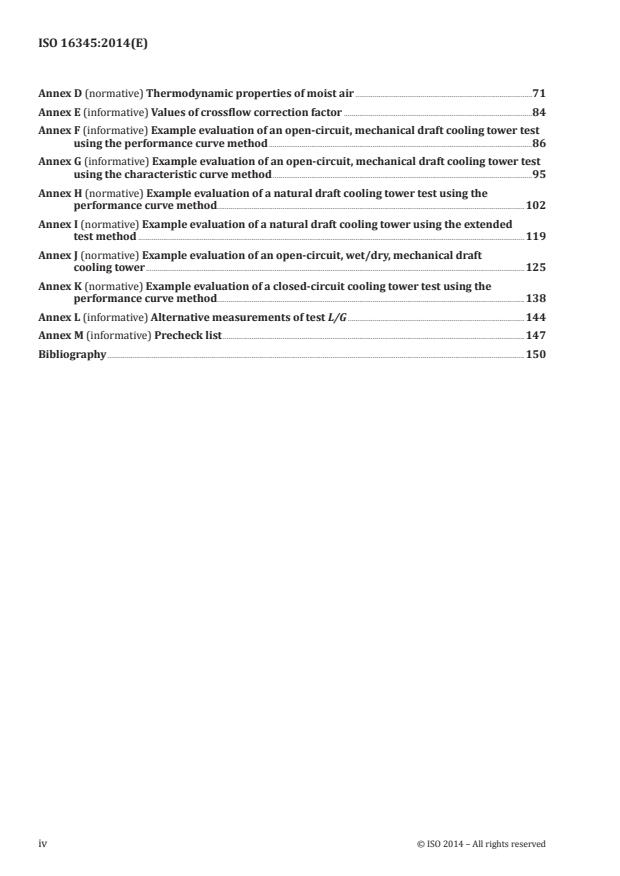
Annex D (normative) Thermodynamic properties of moist air .71
Annex E (informative) Values of crossflow correction factor .84
Annex F (informative) Example evaluation of an open-circuit, mechanical draft cooling tower test
using the performance curve method .86
Annex G (informative) Example evaluation of an open-circuit, mechanical draft cooling tower test
using the characteristic curve method .95
Annex H (normative) Example evaluation of a natural draft cooling tower test using the
performance curve method.102
Annex I (normative) Example evaluation of a natural draft cooling tower using the extended
test method .119
Annex J (normative) Example evaluation of an open-circuit, wet/dry, mechanical draft
cooling tower .125
Annex K (normative) Example evaluation of a closed-circuit cooling tower test using the
performance curve method.138
Annex L (informative) Alternative measurements of test L/G .144
Annex M (informative) Precheck list .147
Bibliography .150
iv © ISO 2014 – All rights reserved
Foreword
ISO (the International Organization for Standardization) is a worldwide federation of national standards
bodies (ISO member bodies). The work of preparing International Standards is normally carried out
through ISO technical committees. Each member body interested in a subject for which a technical
committee has been established has the right to be represented on that committee. International
organizations, governmental and non-governmental, in liaison with ISO, also take part in the work.
ISO collaborates closely with the International Electrotechnical Commission (IEC) on all matters of
electrotechnical standardization.
The procedures used to develop this document and those intended for its further maintenance are
described in the ISO/IEC Directives, Part 1. In particular the different approval criteria needed for the
different types of ISO documents should be noted. This document was drafted in accordance with the
editorial rules of the ISO/IEC Directives, Part 2 (see www.iso.org/directives).
Attention is drawn to the possibility that some of the elements of this document may be the subject of
patent rights. ISO shall not be held responsible for identifying any or all such patent rights. Details of
any patent rights identified during the development of the document will be in the Introduction and/or
on the ISO list of patent declarations received (see www.iso.org/patents).
Any trade name used in this document is information given for the convenience of users and does not
constitute an endorsement.
For an explanation on the meaning of ISO specific terms and expressions related to conformity
assessment, as well as information about ISO’s adherence to the WTO principles in the Technical Barriers
to Trade (TBT) see the following URL: Foreword - Supplementary information
The committee responsible for this document is ISO/TC 86, Refrigeration and air-conditioning,
Subcommittee SC 6, Testing and rating of air-conditioners and heat pumps.
INTERNATIONAL STANDARD ISO 16345:2014(E)
Water-cooling towers — Testing and rating of thermal
performance
1 Scope
This International Standard covers the measurement of the thermal performance and pumping head
of open- and closed-circuit, mechanical draft, wet and wet/dry cooling towers and natural draft and
fan-assisted natural draft, wet and wet/dry cooling towers. The standard rating boundaries for series
mechanical draft, open- and closed-circuit cooling towers are specified.
This International Standard does not apply to the testing and rating of closed-circuit towers where
the process fluid undergoes a change in phase as it passes through the heat exchanger or where the
thermophysical properties of the process fluid are not available.
2 Terms and definitions
For the purposes of this document, the following terms and definitions apply. The symbols used to
identify the terms contained in this International Standard are listed and defined in Clause 3.
2.1
airflow rate
total amount of dry air and associated vapour water moving through the cooling tower
2.2
ambient air conditions
atmosphere adjacent to, but not affected by, the cooling tower
2.3
approach
difference between cold (re-cooled) water temperature and the inlet-air wet-bulb temperature
2.4
approach deviation
deviation between the guaranteed and adjusted test approach
2.5
atmospheric gradient (lapse rate)
average rate of change of dry-bulb temperature with change in altitude from cold water basin curb, or
sill, level to around twice the height of the cooling tower
Note 1 to entry: The convention for use with this International Standard will be to use a negative value for decrease
in temperature as height increases.
2.6
average wind direction
predominant direction of the wind over the duration of the test period
2.7
average wind speed
arithmetical average of wind speed measurements taken over the duration of the test period
2.8
barometric pressure
atmospheric pressure taken over the duration of each test period
2.9
basin
open structure located beneath the cooling tower for collecting the circulating water and directing it to
the sump or suction line of the circulating pump
2.10
basin curb
top elevation of the tower basin
Note 1 to entry: Usually the datum from tower elevations is measured.
2.11
blowdown
water discharged from the system to control the concentration of salts or other impurities in the
circulating water
2.12
capability
measured thermal capacity of a cooling tower, expressed as a percentage of the design water flow rate
2.13
cell
smallest subdivision of the tower, bounded by exterior walls and partition walls, which can function as
an independent unit
Note 1 to entry: Each cell can have one or more fans or stacks and one or more distribution systems.
2.14
cell dimensions
dimensions that describe the size of a cooling tower cell
Note 1 to entry: The dimensions include
a) dimension perpendicular to the tower longitudinal axis and usually at right angles to the air inlet faces,
b) length: dimension parallel to the longitudinal axis and the plane where air inlets are usually located, and
c) height: on induced draft towers, the distance from the basin curb to the top of the fan deck, but not including
the fan stack.
Note 2 to entry: On forced and natural draft towers, the distance from the basin curb to the discharge plane of
the tower.
2.15
closed-circuit cooling tower
cooling tower comprised of a water flow loop re-circulating over the outside of a closed-circuit heat
exchanger containing the process fluid loop
Note 1 to entry: Air is drawn through the water passing over the outside of the closed-circuit heat exchanger,
enabling cooling by evaporation. No direct contact occurs between the process fluid loop and the open evaporative
cooling loop.
2.16
cold (re-cooled water temperature) water
in an open cooling tower, the average temperature of the water entering the tower basin
Note 1 to entry: The convention from here on will be to use the term “cold water” in ISO 16245.
Note 2 to entry: In the case where the measurement is downstream of the basin or the pump, corrections are
needed for the effects of the pump and any other makeup water, blowdown, or heat sources entering the basin.
2 © ISO 2014 – All rights reserved
2.17
cooling range
difference between the hot and cold water or process fluid temperatures
Note 1 to entry: The term ‘range’ is also applied to this definition, but is regarded as a non-preferred term.
2.18
cooling tower
apparatus in which process fluid is cooled by evaporative heat exchange with ambient air
2.19
counter-flow
situation in which air and water flow in opposite direction within the cooling tower
2.20
cross-flow
situation in which air flows perpendicularly to the water flow within the cooling tower
2.21
discharge plume
discharge air stream of the cooling tower when made visible (wholly or in part) by the condensation of
water vapour as the moist air stream is cooled to ambient temperature
2.22
distribution system
system for receiving the water entering the cooling tower and distributing it over the area where it
contacts the atmospheric air
2.23
drift eliminator
assemblies downstream of the heat transfer media which serve to reduce the drift loss
2.24
drift loss
portion of the water flow rate lost from the tower in the form of fine droplets mechanically entrained in
the discharge air stream, commonly expressed as mass per unit time or a percentage of the circulating
water flow rate
Note 1 to entry: It is independent of water lost by evaporation.
2.25
dry-bulb temperature
temperature of an air-vapour mixture indicated by a thermometer with a clean, dry sensing element
that is shielded from radiation effects
Note 1 to entry: Dry-bulb temperature can be further categorised as either
a) ambient dry-bulb temperature: the dry-bulb temperature of air measured windward of the tower and free
from the influence of the tower or
b) entering dry-bulb temperature: the dry-bulb temperature of the air entering the tower, including the effect
of any re-circulation and/or interference.
2.26
entering air conditions
average characteristics of the airflow entering the cooling tower
2.27
fan power
power consumed by the fan driver, which might or might not include the efficiency of the driver,
depending on the contract
2.28
fill (pack)
devices placed in the cooling tower within the heat exchange section for the purpose of enhancing the
surface area and/or the rate of heat transfer from the water stream to the air stream
2.29
final test result
average of the results from the minimum number of valid test periods
2.30
flow rate
quantity of hot process fluid to be cooled by the tower
2.31
fluid type
type of process fluid to be cooled by the tower
2.32
fouling factors
expression of reduction of heat transfer capability caused by internal and/or external contamination of
the heat exchanger
2.33
heat exchanger pressure drop
pressure drop of the process fluid across the contractual inlet and outlet locations of the heat exchanger(s)
of a closed-circuit or wet/dry cooling tower, adjusted for elevation and velocity
2.34
heat load
rate of heat removal from the process fluid within the tower
2.35
hot process fluid temperature
average temperature of the process fluid entering the heat exchanger in a closed-circuit tower
2.36
hot water temperature
average temperature of the inlet water in an open-circuit cooling tower
2.37
interference
thermal contamination of air entering the cooling tower by a source extraneous to the tower, generally
another cooling tower
2.38
L/G
ratio of total mass flow rates of liquid (water) over gas (dry air) in an open-circuit cooling tower
2.39
makeup
water added to the system to replace the water lost by evaporation, drift, blowdown, and leakage
2.40
mechanical draft cooling tower
cooling tower where the air circulation is produced by a fan
Note 1 to entry: Mechanical draft cooling towers can be further categorised as either
a) forced draft: the fan is located in the entering air stream or
b) induced draft: the fan is located in the discharge air stream.
4 © ISO 2014 – All rights reserved
2.41
natural draft cooling tower
cooling tower wherein the air circulation is produced by a difference in density between the cooler air
outside the cooling tower and the warmer, more humid air inside
Note 1 to entry: Natural draft towers can be fan assisted.
2.42
non-series type
design, generally site constructed, for which the performance is project dependent
2.43
open-circuit (wet) cooling tower
cooling tower wherein the process fluid is warm water which is cooled by the transfer of mass and heat
through direct contact with atmospheric air
2.44
partition wall
vertical interior wall, either transverse, longitudinal, or radial, that subdivides a cooling tower into cells
2.45
process fluid
working fluid used to transport heat from heat source to the cooling tower
Note 1 to entry: It can be water or any chemical element, compound or mixture, liquid or gas, in single phase flow.
2.46
pump head
in an open-circuit tower, the sum of static head and dynamic head from the contractual inlet interface to
the discharge of the distribution system to atmosphere
2.47
re-circulation
portion of the outlet air that re-enters the tower
2.48
relative humidity
ratio of the mole fraction of water vapour in a given air sample to the mole fraction of water vapour in a
sample of saturated air at the same temperature and pressure, usually expressed as a percentage
2.49
series type
design which is fixed and described in the manufacturer’s catalogue, generally factory assembled, and
for which the performance data are pre-determined
2.50
spray water flow
quantity of water flowing over the outside of the heat exchanger in a closed-circuit tower
2.51
test agent
person or entity responsible for conducting the testing
2.52
test period
time duration where readings or recordings of every measurement have to be averaged and test period
results can be calculated
2.53
test readings
individual sets of data recorded at regular intervals for each instrument or measurement point required
2.54
thermal lag
time interval before the temperature of the water leaving the influence of the cooling air is detected at
the point of cold water temperature measurement
2.55
tolerance
numerical value defined in contract documents or by a certification program expressed in percentage
points or degrees Celsius which can be applied to the test results when determining compliance with
the pass/fail criteria
Note 1 to entry: Typically, a tolerance is agreed for taking test variability into account.
2.56
top of shell wind speed
for natural draft or fan-assisted natural draft towers, the wind speed at the elevation of the plane
through the top of shell and within the defined distance from the tower
2.57
total dissolved solids
weight of inorganic and organic matter in true solution per unit volume of water
Note 1 to entry: Typically, over 90 % of all solids dissolved in water are present as six different ions. Calcium,
magnesium, sodium, chlorides, sulphates, and carbonates are usually expressed as mg/l.
2.58
total suspended solids
weight of particulates, both organic and inorganic, suspended, but not dissolved, per unit of water
Note 1 to entry: Total suspended solids are usually expressed as mg/l.
2.59
uncertainty, random
estimate characterizing the range of values within which it is asserted with a given degree of confidence
that the true value of the measure can be expected to lie
2.60
valid test period
test period where constancy and values of measured parameters are within the limits of this code
2.61
water flow rate
quantity of hot water flowing into an open cooling tower
2.62
water loading
water flow rate expressed as quantity per unit of fill plan area of the tower
2.63
wet-bulb temperature
temperature of air indicated by a thermometer, shielded from radiation, with the sensing element
covered by a thoroughly wetted and adequately ventilated wick
Note 1 to entry: Properly measured, it closely approximates the temperature of an adiabatic saturation and can
be further categorised as either
a) ambient wet-bulb temperature: the wet-bulb temperature of air measured windward of the tower and free
from the influence of the tower or
b) entering wet-bulb temperature: the wet-bulb temperature of the air entering the tower, including the effect
of any re-circulation and/or interference.
6 © ISO 2014 – All rights reserved
2.64
wet/dry cooling tower
cooling tower incorporating two concurrent modes of heat transfer: wet or evaporative and dry or
sensible
Note 1 to entry: Wet/dry towers can be of open or closed type and are most often used to control or limit the
discharge plume, but can also be used to reduce water consumption.
2.65
design
set of parameters defined by specification or contract as the basis against which the cooling tower
performance is analyzed
3 Symbols and abbreviations
A total internal area of hot water conduit at tower inlet, expressed in square metres, m
C
A gross face area of fill, perpendicular to direction of airflow, expressed in square metres, m
FILL
a area of transfer surface per unit of fill volume, expressed in square metres per cubic metres, m /
m
C heat transfer coefficient
C tower capability, expressed as a percentage (%) of design flow
CAP
C pressure loss coefficient, expressed as a dimensionless unit
F
c specific heat of a fluid at constant pressure, expressed in kJ/kg °C
p
NOTE Assumed to be 4,186 kJ/kg °C for water.
D diameter of pipe, expressed in metres, m
d diameter of wet bulb and covering, expressed in millimetres, mm
ΔE difference in elevation between the inlet and outlet nozzles of the heat exchanger of a closed-
circuit tower, expressed in metres, m
G mass flow rate of dry air through the cooling tower, expressed in kilograms of dry air per second,
kg dry air/s
g acceleration due to gravity, expressed in metres per square second, m/s
c
H elevation difference between top of the shell of a natural draft tower and the midpoint of fill
height, expressed in metres, m
H tower pumping head of flowing fluid, expressed in metres, m
P
h enthalpy, expressed in kiloJoules per kilogram dry air, kJ/kg dry air
h enthalpy difference, expressed in kiloJoules per kilogram of dry air, kJ/kg dry air
h enthalpy of air, expressed in kiloJoules per kilogram dry air, kJ/kg dry air
A
h enthalpy of air-water vapour mixture at bulb air temperature, expressed in kiloJoules per kilo-
ha
gram dry air, kJ/kg dry air
h enthalpy of saturated air-water vapour mixture at bulb water temperature, expressed in kilo-
M
Joules per kilogram of dry air, kJ/kg dry air
I tolerance for instance for tests uncertainty on tower capability, expressed as a percentage, %
CAP
I tolerance for instance for tests uncertainty on tower approach deviation, expressed in degrees
TEMP
Celsius, °C
K overall heat and mass transfer coefficient, expressed in kilograms per second, kg/s°m
KaV/L tower characteristic, expressed in dimensionless units
kW input power to an electric fan motor, expressed in kilowatts, kW
FM
kW input power to an electric pump motor, expressed in kilowatts, kW
PM
K K constants in formulae, derived by combining known values of K
0: 1: 2
L mass flow rate of water entering the cooling tower, expressed in kilograms per second, kg/s
L/G ratio of mass flow rate of water to that of air, expressed in dimensionless units
th
n an integer number, typically the n term in a series
P barometric pressure, expressed in pascals, Pa
B
P pressure loss across the heat exchanger of a closed-circuit or wet/dry cooling tower, expressed in
HE
kilopascals, kPa
P static pressure of the process fluid at the inlet nozzle to the heat exchanger of a closed-circuit
I
tower, expressed in pascals, Pa
P static pressure of the process fluid at the outlet nozzle to the heat exchanger of a closed-circuit
O
tower, expressed in pascals, Pa
P total pressure referred to atmospheric, expressed in pascals, Pa
T
P static pressure at the centreline of the tower hot water inlet conduit, expressed in metres of flow-
ST
ing fluid, m
P velocity pressure (computed from v /2g ) at the centreline of tower hot water inlet conduit,
V c
expressed in metres of flowing fluid, m
P static pressure of water or process fluid at suction of main circulating pump, expressed in kilo-
pascals, kPa
P static pressure of water or process fluid at discharge of main circulating pump, expressed in
kilopascals, kPa
Q volumetric flow rate of air, expressed in cubic metres per second, m /s
A
Q volumetric flow rate of blowdown water, expressed in mass flow rate of water per second, L/s
BD
Q volumetric flow rate of makeup water, expressed in mass flow rate of water per second, L/s
MU
Q volumetric flow rate of process fluid, expressed in mass flow rate of water per second, L/s
PF
Q volumetric flow rate of water re-circulating over the external surface of the heat exchanger of a
RW
closed-circuit cooling tower, expressed in mass flow rate of water per second, L/s
Q volumetric flow rate of circulating water in an open cooling tower, expressed in mass flow rate of
W
water per second, L/s
q heat transfer rate from water/process fluid to the ambient air, expressed in kiloJoules per second,
kJ/s
q dry heat transfer rate for wet/dry cooling tower, expressed in kiloJoules per second, kJ/s
DRY
q wet heat transfer rate for wet/dry cooling tower, expressed in kiloJoules per second, kJ/s
WET
8 © ISO 2014 – All rights reserved
q total heat transfer rate for wet/dry cooling tower, expressed in kiloJoules per second, kJ/s
TOT
R cooling range, expressed in degrees Celsius, °C
RH relative humidity, expressed as a percentage, %
S thermal lag, expressed in seconds, s
T approach deviation, expressed in degrees Celsius, °C
App
T temperature, blowdown water, expressed in degrees Celsius, °C
BD
T temperature, cold water leaving the tower, expressed in degrees Celsius, °C
CW
T temperature, cold process fluid leaving the tower, expressed in degrees Celsius, °C
CPF
T temperature, air dry-bulb, expressed in degrees Celsius, °C
DB
T temperature, hot water entering the cooling tower, expressed in degrees Celsius, °C
HW
T temperature, hot process fluid entering the tower, expressed in degrees Celsius, °C
HPF
T temperature, makeup water, expressed in degrees Celsius, °C
MU
T temperature, re-circulating water of a closed-circuit cooling tower measured at the pump dis-
RW
charge, expressed in degrees Celsius, °C
T temperature, air wet-bulb, expressed in degrees Celsius, °C
WB
T ambient dry-bulb temperature, expressed in °C
am
T average entering dry-bulb temperature, expressed in °C
ent
−6
tex linear mass density of fibres, expressed as mass in grams per 1 000 metres (1 tex = 10 kg/m)
V effective cooling tower fill volume, expressed in cubic metres, m
V velocity of air, expressed in metres per second, m/s
A
Vavg average wind velocity
VFD variable frequency drive
V velocity of liquid, expressed in metres per second, m/s
L
V velocity of wind, expressed in metres per second, m/s
W
v specific volume of air, expressed in cubic metres of mixture per kilogram of dry air, m mixture/
A
kg dry air
W fan motor power output, expressed in kilowatts, kW
FM
X designates the value has been adjusted, e.g. for fan power, makeup water temperature, etc.
x, adj
X designates the value pertains to the ambient air surrounding the tower
x, amb
X designates value pertains to air entering the tower inlet
x, 1
X designates value pertains to air leaving the tower (discharge)
x, 2
X designates the value pertains to the design condition
x, d
X indicates the value pertains to the dry section of a wet/dry cooling tower
x, dry
X indicates the value is obtained from the intercept of two curves
x, i
th
X number counter, e.g. the n term
x, (n)
X designates the value pertains to the process fluid circulating through the heat exchanger of a
x, PF
closed-circuit cooling tower
X designates a predicted value determined from the manufacturer’s performance data
x,pred
X designates the value pertains to a measured test condition
x, t
X designates the value pertains to the water circulating through an open cooling tower
x, w
X indicates the value pertains to the wet portion of a wet/dry
x, wet
x exponent applied to L/G ratio in the cooling tower operating formula, expressed in dimensionless
units
NOTE Typically on the order of −0,6.
y exponent applied to ratio of design to test fan motor power to adjust dry capacity of wet/dry tow-
ers expressed in dimensionless units
Z vertical distance from basin curb to centreline of tower piping inlet, expressed in metres, m
i
z exponent applied to ratio of design to test fan motor power to adjust capacity of closed-circuit
towers, expressed in dimensionless units
NOTE Typically on the order of 0,2.
γ weighting coefficient, expressed in dimensionless units
ρ density of water, expressed in kilograms per cubic metre, kg/m
W
ϒ correction factor for crossflow towers, from Annex E, expressed in dimensionless units
η efficiency of fan motor, expressed as a percentage, %
FM
η efficiency of main circulating pump (not motor), expressed as a percentage, %
P
ρ specific mass or density, expressed in kilograms per cubic metre, kg/m
ρ density of air, expressed in kilograms per cubic metre, kg/m
A
ρ density of process fluid, expressed in kilograms per cubic metre, kg/m
PF
τ time at the start of the test period, expressed in hours and minutes, hr-min
τ time at the end of the test period, expressed in hours and minutes, hr-min
φ absolute humidity of air, expressed in kilograms of mixtures per kilograms of air, kg mixture/kg
A
air
4 Performance tests — General
4.1 Application of standard
The performance test forming the subject of this International Standard can be carried out as a contractual
acceptance test or as a qualification or re-verification test, as part of a certification programme. This
International Standard can also be used as a guideline to monitor the performance of equipment during
its operation. The method described in this International Standard for the verification of performance
applies to all cooling towers described in the Scope.
10 © ISO 2014 – All rights reserved
4.2 Test schedule
Acceptance tests should be carried out within a period of one year after start up, preferably after
commissioning. To achieve full thermal performance of open cooling towers with film fill, the cooling
tower shall operate under heat load for a sufficient period to condition the fill. For this reason, a
mutual agreement about the anticipated test schedule between owner/purchaser, testing agency, and
manufacturer shall be reached.
For closed-circuit cooling towers, it is preferred to conduct the test as shortly as possible after the start
up to avoid the influence of heat exchanger surface contamination. This can also apply to certain wet/dry
configurations, where water is sprayed on the heat exchanger surface.
4.3 Pretest agreements
4.3.1 General
If the test is being performed to establish compliance with contractual obligations, it is recommended
the parties to the contract agree to several aspects of the test, prior to the test.
4.3.2 Test tolerance and uncertainty
When testing is run according to this code, the results represent without correction for uncertainty
the best available assessment of the actual performance of the equipment. The parties to a test should
agree before starting a test and ideally before signing a contact on any tolerances that can be applied
to measured final test results. Agreement should also be reached prior to testing as to whether, how,
and by whom an uncertainty calculation shall be made to assess the quality of the testing conducted,
including any criteria for rejection of testing based on uncertainty.
4.3.3 Fouling factors
On closed-circuit cooling towers where a fouling factor is included in the performance guarantee, the
purchaser and the manufacturer should agree upon the degree of fouling assumed to be present at the
time of the test and the method for adjusting the test results to the fouling allowance specified.
4.3.4 Additional or rescheduled tests
The parties to the test should agree to the allocation of additional expenses incurred if for some reason
the test shall be halted and rescheduled at another time or if one or more parties request additional
tests.
4.3.5 Scope of test and evaluation method
The parties of the test should agree on the scope of the test, i.e. the use of single or multiple valid test
periods, engineering or survey grade, extended test method, and the test evaluation method, either
by determination of the tower capability or by approach deviation. For wet/dry closed-circuit cooling
towers, it needs to be determined whether the test shall also include verification of performance in the
dry operating mode.
4.3.6 Documentation
Prior to the testing contract and preferably with the original tower proposal, the manufacturer shall
submit performance documents setting out the guaranteed properties as function of the allowable
influence parameters (see 5.3).
4.4 Flexibility
It is recognized that the data limitations specified throughout this test procedure represent desired
conditions which might not exist at the time the test is performed. In such cases, existing conditions can
be used for performance test, if mutually agreed upon by authorized representatives of the manufacturer,
the purchaser, and the agency conducting the test (if applicable). In such cases, the accuracy of the test
is compromised (see 10.4) and full compliance to this code can no longer be claimed.
5 Objective of tests
5.1 General
The objective of the testing is to verify the guaranteed thermal and hydraulic properties of the cooling
tower supplied, including verifying the following items:
a) determination of the tower capability or approach deviation at measured conditions;
b) pump head, flow rates, and pressure losses.
5.2 Basis of guarantee
The cold water (process fluid) temperature is as a function of:
a) water (process fluid) flow rate;
b) wet-bulb temperature or relative humidity and dry bulb;
c) cooling range, or hot water temperature, and where applicable, as a function of other parameters
such as
— dry-bulb temperature,
— fan driver power consumption (as driver input or output as contractually agreed),
— atmospheric pressure,
— atmospheric vertical temperature gradient,
— wind speed, and
— wind direction;
d) cooling tower pump head or the heat exchanger pressure drop applicable parameters, which are
defined by tower type in Table 1;
e) other parameters can be guaranteed subject to the contract.
5.3 Form of the guarantee documents
5.3.1 General
The guarantee documents shall take the form of performance curves or characteristic curves and
associated tabular data, or spread sheets, curves, formulas, computer programs, etc. A block of data
shall be included on the curves containing the guaranteed parameters for the appropriate products as
defined in Table 1. If supplied as spread sheets, formulas, computer programs, etc., the information shall
be equivalent in scope and detail to the requirements for curves in 5.3.2 through 5.3.6 and characteristic
equations in 5.3.7.
5.3.2 Performance curves — Mechanical draft
The tower manufacturer shall submit tower performance data in the form of a family of performance
curves consisting of a minimum of three sets of three curves each. One set shall apply to 90 %, one set to
100 %, and the other to 110 % of the design process fluid flow rate. Each set shall be presented as a plot
12 © ISO 2014 – All rights reserved
of wet-bulb temperature as the abscissa versus cold water temperature as the ordinate, with cooling
range as a parameter. Curves shall be based on constant fan speed and pitch.
a) In addition to the design cooling range curve, at least two bracketing curves at approximately 80 %
and 120 % of the design cooling range shall be included as a minimum. The design point shall be
clearly indicated on the appropriate curve.
b) The curves shall fully cover (but not necessarily be limited to) allowable variations from design
specified in 8.2.4.2.
c) On closed-circuit towers, i
...
Questions, Comments and Discussion
Ask us and Technical Secretary will try to provide an answer. You can facilitate discussion about the standard in here.
Loading comments...