

ISO 19967-2:2024
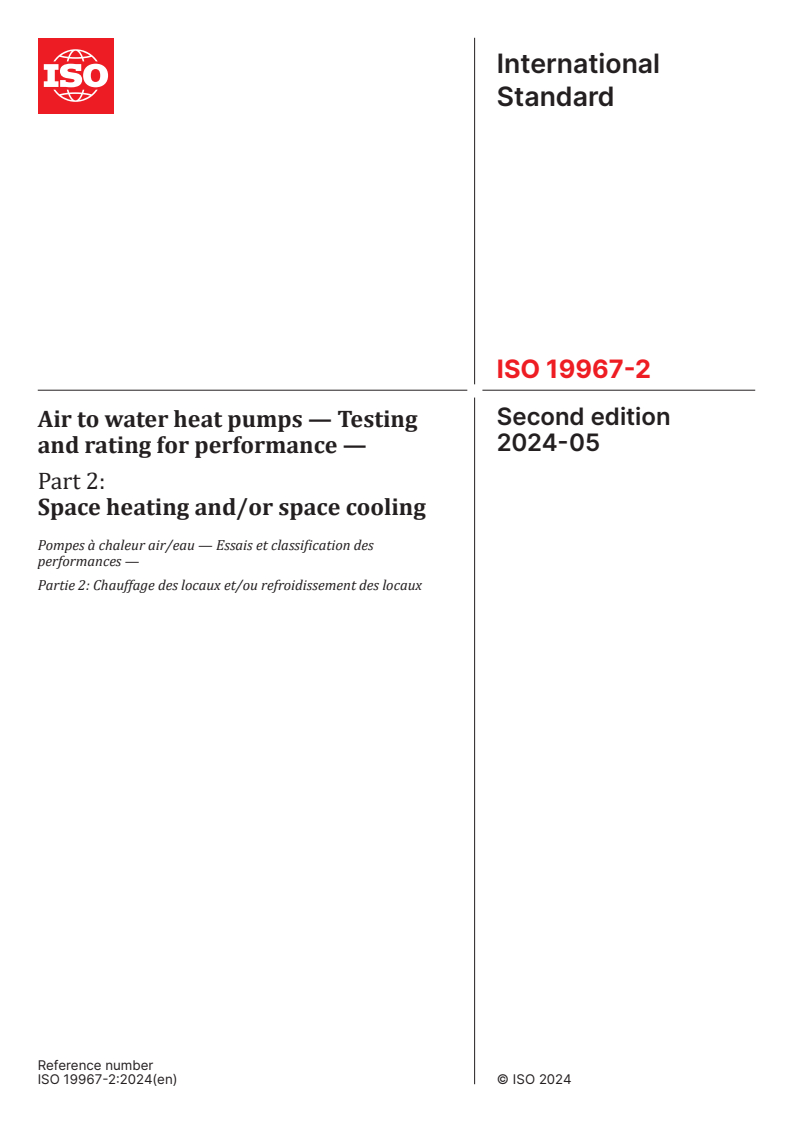
(Main)Air to water heat pumps — Testing and rating for performance — Part 2: Space heating and/or space cooling
General Information
- Abstract
This document specifies test conditions and test procedures for determining the performance characteristics of air to water heat pumps for space heating and/or space cooling with electrically driven compressors with or without supplementary heater. The purpose of this document is to rate the performance of the air to water heat pumps for space heating and/or space cooling. In the case of air to water heat pumps for space heating and/or space cooling consisting of several parts with refrigerant or water connections, this document applies only to those designed and supplied as a complete package. This document does not apply to large chiller or large liquid chilling package for space cooling and/or heating. This document does not apply to air to water heat pumps not intended for human comfort. NOTE Testing procedures for simultaneous operation for hot water supply and space heating and/or space cooling are not treated in this document. Simultaneous means that hot water supply and space heating and/or space cooling generation occur at the same time and can interact.
- Status
- Published
- Publication Date
- 30-May-2024
- Technical Committee
- ISO/TC 86/SC 6 - Testing and rating of air-conditioners and heat pumps
- Drafting Committee
- ISO/TC 86/SC 6 - Testing and rating of air-conditioners and heat pumps
- Current Stage
- 6060 - International Standard published
- Start Date
- 31-May-2024
- Due Date
- 05-Jan-2024
- Completion Date
- 31-May-2024
Overview
ISO 19967-2:2024 - "Air to water heat pumps - Testing and rating for performance - Part 2: Space heating and/or space cooling" (ISO, 2024) specifies standardized test conditions and procedures to determine the performance of factory-made air-to-water heat pumps with electrically driven compressors (with or without supplementary heaters). The standard is intended to rate performance for space heating and/or space cooling of packaged units and excludes large chillers, large liquid chilling packages, and equipment not intended for human comfort. It does not treat simultaneous operation where hot water supply and space heating/cooling interact.
Key topics and technical requirements
- Scope & applicability: Packaged air-to-water heat pumps for space heating and/or space cooling; electrically driven compressors only.
- Installation requirements: Test apparatus, uncertainties of measurement, test room arrangements for airside and remote condensers, and specific installation rules for multi-part units.
- Setting and test conditions: Prescribed operating points and configuration for non-ducted and ducted units, external static pressure settings, and integral pump settings.
- Space heating tests: Procedures for heating capacity measurement, capacity corrections (including pump and fan corrections), effective power input, steady-state and transient tests, and calculation methods.
- Space cooling tests: Procedures for cooling capacity measurement, analogous capacity corrections and effective power input calculations, steady-state conditions and measurement methods.
- Performance metrics defined: Heating capacity, cooling capacity, effective power input, COP (coefficient of performance) and EER (energy efficiency ratio).
- Test reporting: Required data to record and the format of the test report.
- Annexes: Normative annexes include heating capacity test procedures and determination of liquid pump efficiency.
Practical applications and users
- Manufacturers: for product development, internal verification and declaring rated heating/cooling performance.
- Accredited test laboratories: to perform repeatable, comparable performance tests for certification and compliance.
- HVAC designers and specifiers: to compare products using consistent COP/EER and capacity ratings.
- Certification bodies and regulators: for energy labeling, compliance checks and performance verification.
- Energy modelers and consultants: to ensure equipment performance data align with standardized test conditions.
Using ISO 19967-2:2024 enables consistent, comparable ratings of air-to-water heat pumps, helping stakeholders select and certify systems based on reliable heating and cooling performance metrics.
Related standards
- ISO 19967-2 is part of the ISO 19967 series prepared by ISO/TC 86/SC 6 (testing and rating of air‑conditioners and heat pumps). For full implementation and exact procedures, obtain the complete standard from the ISO website.
Relations
- Effective Date
- 06-Jun-2022
Get Certified
Connect with accredited certification bodies for this standard

DNV
DNV is an independent assurance and risk management provider.

Lloyd's Register
Lloyd's Register is a global professional services organisation specialising in engineering and technology.
DNV Energy Systems
Energy and renewable energy certification.
Sponsored listings
Frequently Asked Questions
ISO 19967-2:2024 is a standard published by the International Organization for Standardization (ISO). Its full title is "Air to water heat pumps — Testing and rating for performance — Part 2: Space heating and/or space cooling". This standard covers: This document specifies test conditions and test procedures for determining the performance characteristics of air to water heat pumps for space heating and/or space cooling with electrically driven compressors with or without supplementary heater. The purpose of this document is to rate the performance of the air to water heat pumps for space heating and/or space cooling. In the case of air to water heat pumps for space heating and/or space cooling consisting of several parts with refrigerant or water connections, this document applies only to those designed and supplied as a complete package. This document does not apply to large chiller or large liquid chilling package for space cooling and/or heating. This document does not apply to air to water heat pumps not intended for human comfort. NOTE Testing procedures for simultaneous operation for hot water supply and space heating and/or space cooling are not treated in this document. Simultaneous means that hot water supply and space heating and/or space cooling generation occur at the same time and can interact.
This document specifies test conditions and test procedures for determining the performance characteristics of air to water heat pumps for space heating and/or space cooling with electrically driven compressors with or without supplementary heater. The purpose of this document is to rate the performance of the air to water heat pumps for space heating and/or space cooling. In the case of air to water heat pumps for space heating and/or space cooling consisting of several parts with refrigerant or water connections, this document applies only to those designed and supplied as a complete package. This document does not apply to large chiller or large liquid chilling package for space cooling and/or heating. This document does not apply to air to water heat pumps not intended for human comfort. NOTE Testing procedures for simultaneous operation for hot water supply and space heating and/or space cooling are not treated in this document. Simultaneous means that hot water supply and space heating and/or space cooling generation occur at the same time and can interact.
ISO 19967-2:2024 is classified under the following ICS (International Classification for Standards) categories: 27.080 - Heat pumps. The ICS classification helps identify the subject area and facilitates finding related standards.
ISO 19967-2:2024 has the following relationships with other standards: It is inter standard links to ISO 19967-2:2019. Understanding these relationships helps ensure you are using the most current and applicable version of the standard.
ISO 19967-2:2024 is available in PDF format for immediate download after purchase. The document can be added to your cart and obtained through the secure checkout process. Digital delivery ensures instant access to the complete standard document.
Standards Content (Sample)
International
Standard
ISO 19967-2
Second edition
Air to water heat pumps — Testing
2024-05
and rating for performance —
Part 2:
Space heating and/or space cooling
Pompes à chaleur air/eau — Essais et classification des
performances —
Partie 2: Chauffage des locaux et/ou refroidissement des locaux
Reference number
© ISO 2024
All rights reserved. Unless otherwise specified, or required in the context of its implementation, no part of this publication may
be reproduced or utilized otherwise in any form or by any means, electronic or mechanical, including photocopying, or posting on
the internet or an intranet, without prior written permission. Permission can be requested from either ISO at the address below
or ISO’s member body in the country of the requester.
ISO copyright office
CP 401 • Ch. de Blandonnet 8
CH-1214 Vernier, Geneva
Phone: +41 22 749 01 11
Email: copyright@iso.org
Website: www.iso.org
Published in Switzerland
ii
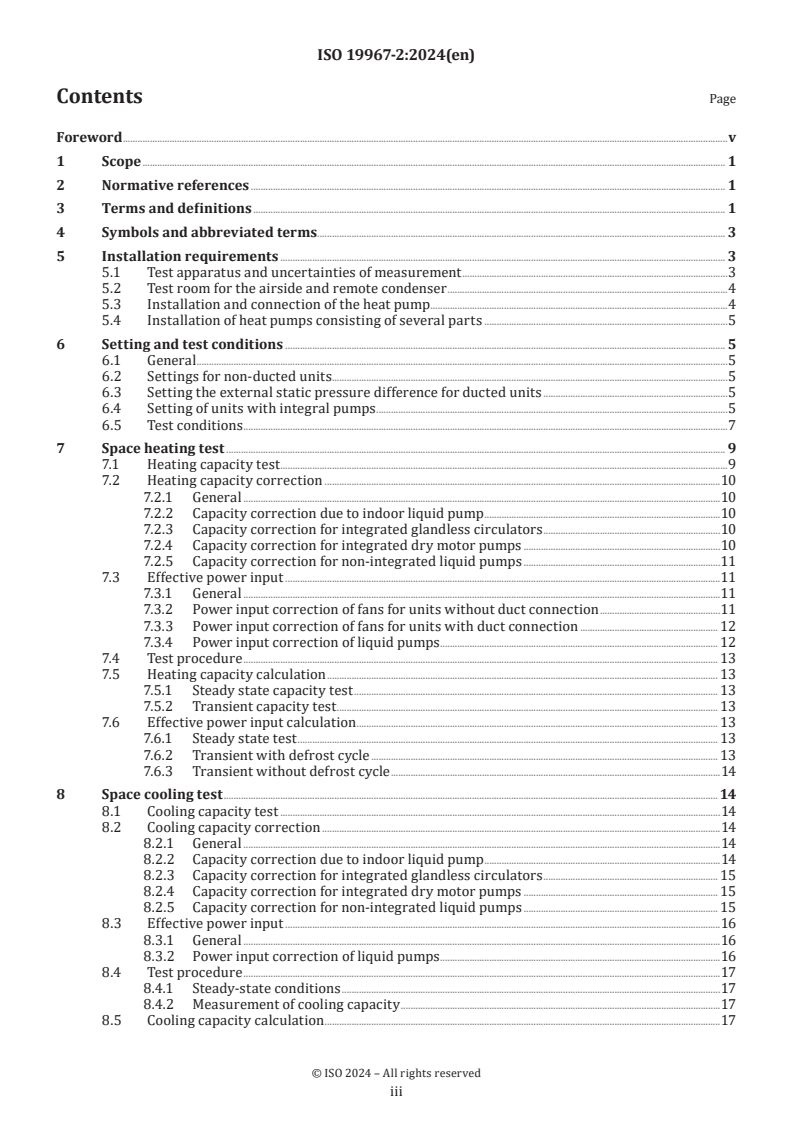
Contents Page
Foreword .v
1 Scope . 1
2 Normative references . 1
3 Terms and definitions . 1
4 Symbols and abbreviated terms. 3
5 Installation requirements . 3
5.1 Test apparatus and uncertainties of measurement .3
5.2 Test room for the airside and remote condenser .4
5.3 Installation and connection of the heat pump .4
5.4 Installation of heat pumps consisting of several parts .5
6 Setting and test conditions . 5
6.1 General .5
6.2 Settings for non-ducted units . .5
6.3 Setting the external static pressure difference for ducted units .5
6.4 Setting of units with integral pumps .5
6.5 Test conditions .7
7 Space heating test . 9
7.1 Heating capacity test .9
7.2 Heating capacity correction .10
7.2.1 General .10
7.2.2 Capacity correction due to indoor liquid pump .10
7.2.3 Capacity correction for integrated glandless circulators .10
7.2.4 Capacity correction for integrated dry motor pumps .10
7.2.5 Capacity correction for non-integrated liquid pumps .11
7.3 Effective power input .11
7.3.1 General .11
7.3.2 Power input correction of fans for units without duct connection .11
7.3.3 Power input correction of fans for units with duct connection . 12
7.3.4 Power input correction of liquid pumps . 12
7.4 Test procedure . 13
7.5 Heating capacity calculation . 13
7.5.1 Steady state capacity test . 13
7.5.2 Transient capacity test . 13
7.6 Effective power input calculation . 13
7.6.1 Steady state test . 13
7.6.2 Transient with defrost cycle . 13
7.6.3 Transient without defrost cycle .14
8 Space cooling test . 14
8.1 Cooling capacity test .14
8.2 Cooling capacity correction .14
8.2.1 General .14
8.2.2 Capacity correction due to indoor liquid pump .14
8.2.3 Capacity correction for integrated glandless circulators . 15
8.2.4 Capacity correction for integrated dry motor pumps . 15
8.2.5 Capacity correction for non-integrated liquid pumps . 15
8.3 Effective power input .16
8.3.1 General .16
8.3.2 Power input correction of liquid pumps .16
8.4 Test procedure .17
8.4.1 Steady-state conditions .17
8.4.2 Measurement of cooling capacity .17
8.5 Cooling capacity calculation .17
iii
8.6 Effective power input calculation .17
9 Test results and test report . 17
9.1 Data to be recorded .17
9.2 Test report .18
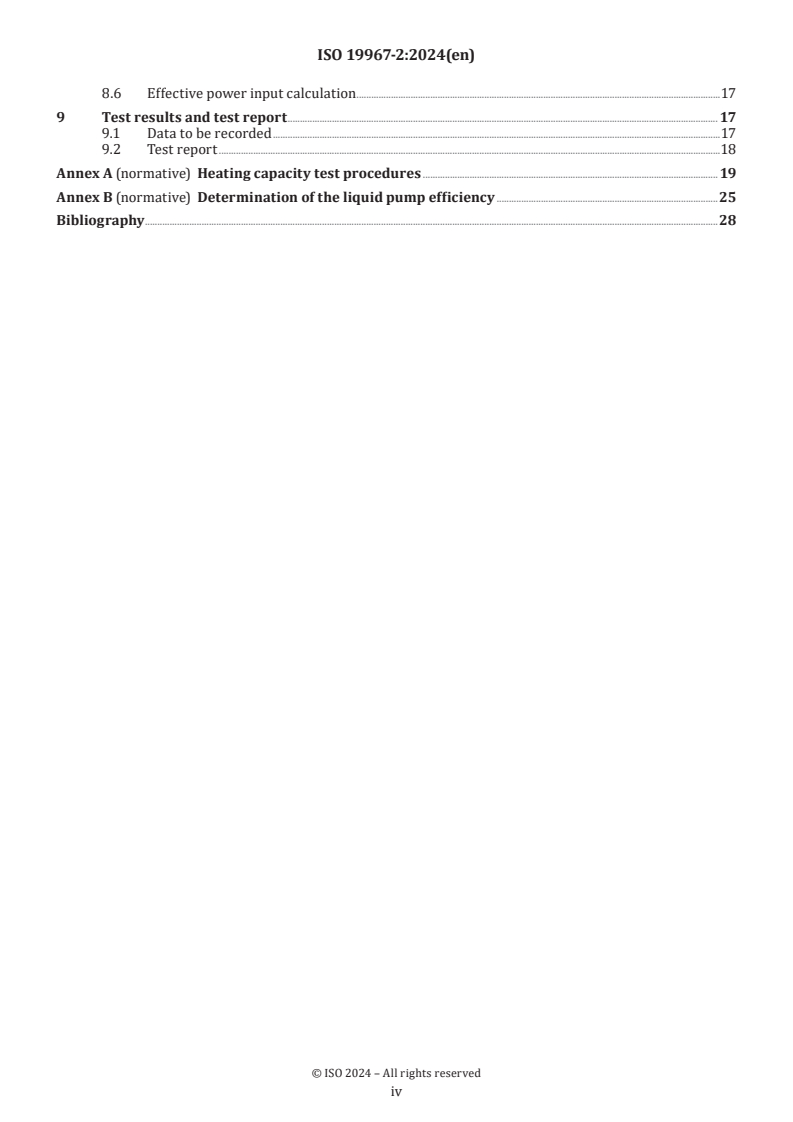
Annex A (normative) Heating capacity test procedures . 19
Annex B (normative) Determination of the liquid pump efficiency .25
Bibliography .28
iv
Foreword
ISO (the International Organization for Standardization) is a worldwide federation of national standards
bodies (ISO member bodies). The work of preparing International Standards is normally carried out through
ISO technical committees. Each member body interested in a subject for which a technical committee
has been established has the right to be represented on that committee. International organizations,
governmental and non-governmental, in liaison with ISO, also take part in the work. ISO collaborates closely
with the International Electrotechnical Commission (IEC) on all matters of electrotechnical standardization.
The procedures used to develop this document and those intended for its further maintenance are described
in the ISO/IEC Directives, Part 1. In particular, the different approval criteria needed for the different types
of ISO document should be noted. This document was drafted in accordance with the editorial rules of the
ISO/IEC Directives, Part 2 (see www.iso.org/directives).
ISO draws attention to the possibility that the implementation of this document may involve the use of (a)
patent(s). ISO takes no position concerning the evidence, validity or applicability of any claimed patent
rights in respect thereof. As of the date of publication of this document, ISO had not received notice of (a)
patent(s) which may be required to implement this document. However, implementers are cautioned that
this may not represent the latest information, which may be obtained from the patent database available at
www.iso.org/patents. ISO shall not be held responsible for identifying any or all such patent rights.
Any trade name used in this document is information given for the convenience of users and does not
constitute an endorsement.
For an explanation of the voluntary nature of standards, the meaning of ISO specific terms and expressions
related to conformity assessment, as well as information about ISO's adherence to the World Trade
Organization (WTO) principles in the Technical Barriers to Trade (TBT) see www.iso.org/iso/foreword.html.
This document was prepared by Technical Committee ISO/TC 86, Refrigeration and air-conditioning,
Subcommittee SC 6, Testing and rating of air-conditioners and heat pumps.
This second edition cancels and replaces the first edition (ISO 19967-2:2019), which has been technically
revised.
The main changes are as follows:
— the title has been changed;
— terms and definitions have been added and clarified;
— test conditions have been defined and added for space cooling and/or space heating;
— the installation of test item (object) of several parts has been clarified;
— the test report information has been updated;
— the maximum and minimum operation annex has been deleted.
A list of all parts in the ISO 19967 series can be found on the ISO website.
Any feedback or questions on this document should be directed to the user’s national standards body. A
complete listing of these bodies can be found at www.iso.org/members.html.
v
International Standard ISO 19967-2:2024(en)
Air to water heat pumps — Testing and rating for
performance —
Part 2:
Space heating and/or space cooling
1 Scope
This document specifies test conditions and test procedures for determining the performance characteristics
of air to water heat pumps for space heating and/or space cooling with electrically driven compressors with
or without supplementary heater. The purpose of this document is to rate the performance of the air to
water heat pumps for space heating and/or space cooling.
In the case of air to water heat pumps for space heating and/or space cooling consisting of several parts with
refrigerant or water connections, this document applies only to those designed and supplied as a complete
package. This document does not apply to large chiller or large liquid chilling package for space cooling and/
or heating.
This document does not apply to air to water heat pumps not intended for human comfort.
NOTE Testing procedures for simultaneous operation for hot water supply and space heating and/or space cooling
are not treated in this document. Simultaneous means that hot water supply and space heating and/or space cooling
generation occur at the same time and can interact.
2 Normative references
There are no normative references in this document.
3 Terms and definitions
For the purposes of this document, the following terms and definitions apply.
ISO and IEC maintain terminology databases for use in standardization at the following addresses:
— ISO Online browsing platform: available at https:// www .iso .org/ obp
— IEC Electropedia: available at https:// www .electropedia .org/
3.1
air to water heat pumps
heat pump which consists of one or more factory-made assemblies which normally include at least space
side refrigerant to water heat exchanger(s) (load side), electrically driven compressor(s), and outdoor-side
air-to-refrigerant heat exchanger(s) (source side), including means to provide space heating and/or space
cooling functions
Note 1 to entry: It can include a supplementary heater for space heating.
3.2
heating capacity
Φ
H
heat given off by the unit to the heat transfer medium per unit of time
Note 1 to entry: Heating capacity is expressed in watts.
3.3
cooling capacity
Φ
C
heat removed by the unit from the heat transfer medium per unit of time
Note 1 to entry: Cooling capacity is expressed in watts.
3.4
effective power input
average electrical power input of the unit within the defined interval of time obtained from:
— power input for operation of the compressor and any power input for defrosting;
— power input for all control and safety devices of the unit;
— proportional power input of the conveying devices (e.g. fans, pumps) for ensuring the transport of the
heat transfer media inside the unit
Note 1 to entry: Effective power input is expressed in watts.
3.5
outdoor heat exchanger
Heat exchanger which is designed to remove/add heat from/to the outdoor ambient environment
3.6
internal static pressure difference
Δp
i
negative pressure difference measured between the air (or water) outlet section and air (or water) inlet
section of the unit, which corresponds to the total pressure drop of all components on the air (or water) side
of the unit
3.7
energy efficiency ratio
EER
ratio of the cooling capacity to the effective power input in the unit at any given set of rating conditions
Note 1 to entry: Expressed in units of watt per watt.
3.8
coefficient of performance
COP
ratio of heating capacity to the effective power input of the equipment at any given set of rating conditions
Note 1 to entry: Expressed in units of watt per watt.
4 Symbols and abbreviated terms
Symbol Definition Units
c Specific heat capacity at constant pressure J/kg·K
p
C Scaling factor equal to 0,49 —
E Energy efficiency index equal to 0,23 —
EI
I Motor efficiency —
E
Φ Heating capacity W
H
Φ Cooling capacity W
C
P Hydraulic power of the pump W
hyd
q Volume flow rate m /s
τ Time s
ρ Density of the hot water depending on the temperature at the flow meter kg/m
Δh Specific enthalpy change J/kg
Δp External static pressure difference Pa
e
Δp Internal static pressure difference Pa
i
Δt Difference between inlet and outlet temperatures K
η 0,3 by convention —
5 Installation requirements
5.1 Test apparatus and uncertainties of measurement
The test apparatus shall be designed in such a way that all requirements for adjustment of set values,
stability criteria and uncertainties of measurement according to this document are fulfilled.
Water systems or other heat transfer liquid systems shall be sufficiently free of entrained gas as to ensure
that the measured results are not significantly influenced.
The response time of the temperature sensor and the sampling interval shall be chosen to maintain the
uncertainties in Table 1.
Ducted air systems shall be sufficiently airtight to ensure that the measured results are not significantly
influenced by exchange of air with the surroundings.
Temperature and pressure measuring points shall be arranged in order to obtain mean significant values.
For free air intake dry bulb temperature measurements, it is required either:
— to have at least one sensor per square meter, with not less than four measuring points and by restricting
to 20 the number of sensors equally distributed on the free air surface; or
— to use a sampling device. It shall be completed by four sensors for checking uniformity if the surface area
is greater than 1 m .
Air dry bulb temperature sensors shall be placed at a distance between 0,15 m and 0,3 m from the free air
surface, defined as the minimal enveloping surface containing the coil(s).
For units consisting of a heat pump and a storage tank as a factory-made unit, water inlet and outlet
temperature measurements shall be taken at the inlet and outlet of this unit.
For water, the density and specific heat in Formulae (1) and (10) shall be determined in the temperature
conditions measured near the volume flow measuring device.
For inverter type control units, the setting of the frequency shall be done for each rating condition. The
manufacturer shall provide in the documentation information instructions on how to obtain the necessary
data to set the required frequencies. If skilled personnel with knowledge of control software is required for
the start of the system, the manufacturer or the nominated agent should be in attendance when the system
is being installed and prepared for tests.
The uncertainties of measurement shall not exceed the values specified in Table 1. Additionally, the heating
and/or cooling capacities measured on the liquid side shall be determined within a maximum uncertainty
of 5 % independently of the individual uncertainties of measurements including the uncertainties on the
properties of the fluid.
Table 1 — Uncertainties of measurement
Measured quantity Unit Uncertainty
Liquid
Temperature °C 0,15 K
Temperature difference K 0,15 K
Volume flow m /s 1 %
1 kPa (≤20 kPa)
Static pressure difference kPa
5 % (>20 kPa)
Concentration % 2 %
Air
Dry bulb temperature °C 0,2 K
Wet bulb temperature °C 0,4 K
Volume flow m /s 5 %
5 Pa (∆p ≤ 100 Pa)
Static pressure difference Pa
5 % (∆p ≥ 100 Pa)
Electrical quantities
Electric power W 1 %
Electrical energy kWh 1 %
Voltage V 0,5 %
Current A 0,5 %
5.2 Test room for the airside and remote condenser
The size of the test room shall be selected to avoid any resistance to air flow at the air inlet and air outlet
orifices of the test object. The air flow through the room shall not be capable of initiating any short circuit
between the two orifices, and therefore the velocity of air flow at these two locations shall not exceed
1,5 m/s when the test object is switched off.
Unless otherwise stated by the manufacturer, the air inlet and air outlet orifices shall not be less than 1 m
from the surfaces of the test room.
Any direct heat radiation (e.g. solar radiation) onto space heating and/or space cooling units in the test room
onto the heat pump or onto the temperature measuring points shall be avoided.
5.3 Installation and connection of the heat pump
The heat pump shall be installed and connected for the test as recommended by the manufacturer in the
installation and operation manual. If a supplementary heater is provided in option or not, it shall be switched
off or disconnected to be excluded from the testing. Temperature and pressure measuring points shall be
arranged in order to obtain representative mean values.
5.4 Installation of heat pumps consisting of several parts
In the case of heat pumps consisting of several refrigeration parts (split heat pumps), the following
installation conditions shall be complied with for the tests:
a) each refrigerant line shall be installed in accordance with the manufacturer's instructions; the length
of each line shall be 5 m except if the constraints of the test installation make 5 m not possible, in which
case a greater length may be used, with a maximum of 7,5 m;
b) the lines shall be installed so that the difference in elevation does not exceed 2,5 m;
c) thermal insulation shall be applied to the lines in accordance with the manufacturer's instructions;
d) unless constrained by the design, at least half of the interconnecting lines shall be exposed to the
outdoor conditions with the rest of the lines exposed to the indoor conditions.
6 Setting and test conditions
6.1 General
Set points for internal control equipment of the unit, i.e. thermostats, pressure switches or mixing valves,
shall be set to the values as stated in the installation and operating instructions.
If several set points or a range are stated, the manufacturer shall indicate the one to be used for the tests.
6.2 Settings for non-ducted units
For non-ducted units, the adjustable settings, i.e. louvers and fan speed, shall be set according to the
installations and operating instructions.
Without information from the manufacturer, louvers and fan speed shall be set for maximum air flow rate.
6.3 Setting the external static pressure difference for ducted units
The volume flow and the pressure difference shall be related to standard air and with dry heat exchanger.
If the air flow rate is given by the manufacturer with no atmospheric pressure, temperature and humidity
conditions, it shall be considered as given for standard air conditions.
The air flow rate as stated in the installation and operating instructions shall be converted into standard air
conditions. The air flow rate setting shall be made when the fan only is operating.
The rated air flow rate as stated in the installation and operating instructions shall be set and the resulting
external static pressure (ESP) measured.
If the ESP is lower than 30 Pa, the air flow rate is decreased to reach this minimum value. The apparatus
used for setting the ESP shall be maintained in the same position during all the tests.
If the installation and operating instructions state that the maximum allowable duct length is for inlet and
outlet together less than 2 m, then the unit shall be tested with the duct length and the ESP is considered to be 0.
6.4 Setting of units with integral pumps
For units with integral water pumps, the external static pressure shall be set at the same time as the
temperature difference.
Deviations from set values shall not exceed values indicated in Table 2. Variations from specified conditions
shall not exceed values indicated in Table 3.
Table 2 — Permissible deviations from set values for steady-state operation
Permissible deviation of the arith-
Permissible deviations of individu-
Measured quantity metic mean values from
al measured values from set values
set values
Liquid
— inlet temperature ±0,2 K ±0,5 K
— outlet temperature ±0,3 K ±0,6 K
a
— volume (mass) flow ±1 % ±2,5 %
— static pressure difference — ±10 %
Air
a
— inlet temperature (dry bulb) ±0,3 K ±1 K
a
— inlet temperature (wet bulb) ±0,4 K ±1 K
— (dry bulb - wet bulb) ±0,3 K —
b
temperature difference
— volume flow ±5 % ±10 %
— static pressure difference — ±10 %
Refrigerant
— liquid temperature ±1 K ±2 K
— saturated liquid/bubble point ±0,5 K ±1 K
temperature
Voltage ±4 % ±4 %
a 2
For units with outdoor heat exchanger surfaces greater than 5 m , the permissible deviation is double. When testing
single duct units, the arithmetic mean value of the difference between the dry bulb temperature of the indoor compartment
and of the air introduced from the outdoor compartment should have a maximum permissible deviation of 0,3 K.
This requirement also applies to the wet bulb temperature difference.
b
This variation applies to the set temperature difference. If equal to 1 K, the temperature difference is thus allowed to vary
between 0,7 K and 1,3 K.
Table 3 — Permissible deviations from set values for transient operation
Permissible deviation of the arith-
Permissible deviations of individual
Readings metic mean values from
measured values from set values
set values
Interval H Interval D Interval H Interval D
Air (entering outdoor-side)
a
— dry-bulb temperature ±0,6 K ±1,5 K ±1,0 K ±5,0 K
a
— wet-bulb temperature ±0,4 K ±1,0 K ±1,0 K —
— temperature difference (dry ±0,6 K — — —
d
bulb-wet bulb)
Liquid
c c b
— inlet temperature ±0,2 K — ±0,5 K
— outlet temperature ±0,5 K — — —
a 2
For units with outdoor heat exchanger surfaces greater than 5 m , the allowed deviation is doubled.
b
The variation shall not exceed –5,0 K and +2,0 K of the arithmetic mean value measured during the previous interval H.
c
Only applies to units tested with a fixed temperature difference between water inlet and outlet temperatures.
d
This variation applies to the set temperature difference. If equal to 1 K, The temperature difference is thus allowed to vary
between 0,4 K and 1,6 K.
6.5 Test conditions
The space heating and/or space cooling tests shall be carried out under the environmental conditions
specified in Table 4 depending on the location of the unit. For all units, electrical power voltage and frequency
shall be given by the manufacturer.
For the rating heating tests, the appropriate test conditions shall be applied in accordance with Tables 5, 6 and 7.
For the rating cooling tests, the appropriate test conditions shall be applied in accordance with Tables 8 and 9.
Table 4 — Environmental conditions
Type Measured quantities Environmental temperature
Air to water units installed indoors Dry bulb temperature 15 °C to 30 °C
Air to water units installed outdoors Dry bulb temperature Air inlet temperatures
(Heating conditions) Wet bulb temperature (see Tables 5, 6 and 7)
Air to water units installed outdoors Dry bulb temperature Air inlet temperatures
Wet bulb temperature (see Tables 8 and 9)
(Cooling conditions)
b
Table 5 — Test conditions for air to water units: heating mode (35 °C application )
Outdoor heat exchanger Indoor heat exchanger
Low temperature applications
Inlet dry bulb Inlet wet bulb Inlet temperature Outlet
temperature temperature °C temperature
°C °C °C
Standard
7 6 30 35
rating conditions
a
Application 2 1 35
Rating conditions
a
−7 −8 35
a
−15 — 35
a
12 11 35
a
The test is performed at the fixed flow rate or the Δt obtained during the test at the corresponding standard rating
conditions for units with variable flow rate. If the resulting flow rate is below the minimum flow rate, then this minimum is used
with the outlet temperatures. If the resulting flow rate is above the maximum flow, then this maximum is used with the outlet
temperature.
b
Temperature 35 °C application means the indoor heat exchanger water outlet temperature of 35 °C meets the design
temperature
b
Table 6 — Test conditions for air to water units: heating mode (45 °C application )
Indoor heat exchanger
Outdoor heat exchanger
Medium temperature applications
Inlet dry bulb Inlet wet bulb Inlet Outlet
temperature temperature temperature temperature
°C °C °C °C
Standard
7 6 40 45
rating conditions
a
Application 2 1 45
Rating conditions
a
−7 −8 45
a
−15 — 45
a
12 11 45
a
The test is performed at the fixed flow rate or the Δt obtained during the test at the corresponding standard rating
conditions for units with variable flow rate. If the resulting flow rate is below the minimum flow rate, then this minimum is used
with the outlet temperatures. If the resulting flow rate is above the maximum flow, then this maximum is used with the outlet
temperature.
b
Temperature 45 °C application means the indoor heat exchanger water outlet temperature of 45 °C meets the design
temperature.
b
Table 7 — Test conditions for air to water units: heating mode (55 °C application )
Indoor heat exchanger
Outdoor heat exchanger
High temperature applications
Inlet dry bulb Inlet wet bulb Inlet Outlet
temperature temperature temperature temperature
°C °C °C °C
Standard
7 6 47 55
rating conditions
a
Application 2 1 55
Rating conditions
a
−7 −8 55
a
−15 — 55
a
12 11 55
a
The test is performed at the fixed flow rate or the Δt obtained during the test at the corresponding standard rating
conditions for units with variable flow rate. If the resulting flow rate is below the minimum flow rate, then this minimum is used
with the outlet temperatures. If the resulting flow rate is above the maximum flow, then this maximum is used with the outlet
temperature.
b
Temperature 55 °C application means the indoor heat exchanger water outlet temperature of 55 °C meets the design
temperature.
b
Table 8 — Test conditions for air to water units: cooling mode (7 °C application )
Outdoor heat exchanger Indoor heat exchanger
Low temperature applications
Inlet dry bulb Inlet wet bulb Inlet tempera- Outlet
temperature temperature ture temperature
°C °C °C °C
Standard
35 - 12 7
rating conditions
a
Application 27 - 7
Rating conditions
a
46 - 7
a
The test is performed at the fixed flow rate or the Δt obtained during the test at the corresponding standard rating
conditions for units with variable flow rate. If the resulting flow rate is below the minimum flow rate, then this minimum is used
with the outlet temperatures. If the resulting flow rate is above the maximum flow, then this maximum is used with the outlet
temperature.
b
Temperature 7 °C application means the indoor heat exchanger water outlet temperature of 7 °C meets the design
temperature.
b
Table 9 — Test conditions for air to water units: cooling mode (18 °C application )
Outdoor heat exchanger Indoor heat exchanger
Low temperature applications
Inlet dry bulb Inlet wet bulb Inlet tempera- Outlet
temperature temperature ture temperature
°C °C °C °C
Standard
35 - 23 18
rating conditions
a
Application 27 - 18
Rating conditions
a
The test is performed at the fixed flow rate or the Δt obtained during the test at the corresponding standard rating
conditions for units with variable flow rate. If the resulting flow rate is below the minimum flow rate, then this minimum is used
with the outlet temperatures. If the resulting flow rate is above the maximum flow, then this maximum is used with the outlet
temperature.
b
Temperature 18 °C application means the indoor heat exchanger water outlet temperature of 18 °C meets the design
temperature.
7 Space heating test
7.1 Heating capacity test
The heating capacity of heat pumps shall be determined in accordance with the direct method at the water
heat exchanger at test conditions of Tables 5, 6 and 7, by determination of the volume flow of the heat
transfer medium, and the inlet and outlet temperatures, taking into consideration the specific heat capacity
and density of the heat transfer medium. The measured heating capacity shall be corrected for the heat from
the indoor liquid pump as specified in 7.2. The heating capacity test for steady state operation is referred in
7.5.1. The heating capacity for transient operation is referred in 7.5.2.
For steady state operation, the heating capacity shall be determined using Formula (1):
Φ =×qcρ××Δt (1)
Hp
where
Φ is the heating capacity in W;
H
q is the volume flow rate, expressed in m /s;
ρ is the density, measured at the flow meter location, expressed in kg/m ;
c is the specific heat, measured at the flow meter location, at constant pressure, expressed in J/(kg·K);
p
Δt is the difference between inlet and outlet temperatures, expressed in K;
NOTE 1 The mass flow rate can be determined directly instead of the term (q × ρ).
NOTE 2 The enthalpy change Δh can be directly measured instead of the item (c × Δt).
p
7.2 Heating capacity correction
7.2.1 General
The capacity shall include the correction due to the heat output of indoor pumps, integrated into the unit or
not as follows.
7.2.2 Capacity correction due to indoor liquid pump
7.2.2.1 Units with integrated liquid pump
If the liquid pump is an integrated part of the unit, the capacity correction as defined in 7.2.3 or 7.2.4 shall be:
— subtracted from the measured heating capacity.
7.2.2.2 Units with non-integrated liquid pump
If the liquid pump is not an integral part of the unit, the capacity correction as defined in 7.2.5 shall be:
— added to the measured heating capacity.
7.2.3 Capacity correction for integrated glandless circulators
If the unit is equipped with a glandless circulator, the capacity correction is calculated using Formula (2):
1−η
()
()qp×Δ × (2)
e
η
where
η is the global efficiency of the pump calculated according to Annex B;
Δp is the measured available external static pressure difference, in Pa;
e
q is the measured liquid flow rate, in m /s.
7.2.4 Capacity correction for integrated dry motor pumps
If the unit is equipped with a dry-motor pump, the capacity correction shall be calculated using Formula (3):
I −η
()
E
qp×Δ × (3)
()
e
η
where
η is the global efficiency of the pump calculated according to Annex B;
Δp is the measured available external static pressure difference, in Pa;
e
q is the measured liquid flow rate, in m /s;
I is the motor efficiency as specified in IEC 60034-30-1.
E
7.2.5 Capacity correction for non-integrated liquid pumps
If the measured hydraulic power according to Annex B is ≤300 W, the liquid pump is considered as a glandless
circulator. The capacity correction is calculated using Formula (4):
()1−η
qp×−Δ × (4)
[]()
i
η
where
η is the global efficiency of the pump calculated according to Annex B;
Δp is the measured internal static pressure difference, in Pa;
i
q is the measured liquid flow rate, in m /s.
If the measured hydraulic power according to Annex B is >300 W, the liquid pump is considered as a dry-
motor pump. The capacity correction is calculated using Formula (5):
I −η
()
E
qp×−()Δ × (5)
[]
i
η
where
η is the global efficiency of the pump calculated according to Annex B;
Δp is the measured internal static pressure difference, in Pa;
i
q is the measured liquid flow rate, in m /s;
I is equal to 0,88 (average motor nominal efficiency for IE3 efficiency in IEC 60034-30-1).
E
7.3 Effective power input
7.3.1 General
The effective power input shall include the correction due to power input of indoor pump and outdoor fans
integrated or not to the unit as follows.
7.3.2 Power input correction of fans for units without duct connection
In the case of units which are not designed for duct connection, i.e. which do not permit any external pressure
differences, and which are equipped with an integral fan, the power absorbed by the fan shall be included in
the effective power absorbed by the unit.
7.3.3 Power input correction of fans for units with duct connection
7.3.3.1 Power input correction for integrated fans
If a fan is an integral part of the unit, only a fraction of the power input of the fan motor shall be included in
the effective power absorbed by the unit. The fraction that is to be excluded from the total power absorbed
by the unit shall be calculated using Formula (6):
()qp×Δ
e
(6)
η
where
η is 0,3 by convention;
Δp is the measured available external static pressure difference, in Pa;
e
q is the nominal air flow rate, in m /s.
7.3.3.2 Power input correction for non-integrated fans
If no fan is provided with the unit, the proportional power input which is to be included in the effective
power absorbed by the unit shall be calculated using the Formula (7):
qp×−()Δ
[]
i
(7)
η
where
η is 0,3 by convention;
Δp is the measured available internal static pressure difference, in Pa;
i
q is the nominal air flow rate, in m /s.
7.3.4 Power input correction of liquid pumps
7.3.4.1 Power input correction for integrated liquid pumps
When the liquid pump is integrated into the unit, it shall be connected for operation. When the liquid pump
is delivered by the manufacturer apart from the unit, it shall be connected for operation according to the
manufacturer’s instructions and be then considered as an integral part of the unit.
For an integrated liquid pump, only a fraction of the input to the pump motor shall be included in the effective
power absorbed by the unit. The fraction which is to be excluded from the total power absorbed by the unit
shall be calculated using Formula (8):
()qp×Δ
e
(8)
η
where
η is the efficiency of the pump calculated according to Annex B;
Δp is the measured available external static pressure difference, in Pa;
e
q is the measured liquid flow rate, in m /s.
In case the liquid pump is not able to provide any external static pressure difference, then this correction
does not apply but the correction shall be made according to 7.3.4.2.
7.3.4.2 Power input correction for non-integrated liquid pumps
If no liquid pump is provided with the unit, the proportional power input which is to be included in the
effective power absorbed by the unit shall be calculated using Formula (9):
qp×−()Δ
[]
i
(9)
η
where
η is the efficiency of the pump calculated according to Annex B;
Δp is the measured available internal static pressure difference, in Pa;
i
q is the measured liquid flow rate, in m /s.
7.4 Test procedure
The test procedure consists of three periods: a preconditioning period, an equilibrium period and a data
collection period. The duration of the data collection period differs depending on whether the heat pump's
operation is steady-state or transient. The heating capacity test procedure shall be carried out as described
in Annex A.
7.5 Heating capacity calculation
7.5.1 Steady state capacity test
An average heating capacity shall be determined from the set of heating capacities recorded over the data
collection period or on the basis of average values of temperature and volume flow recorded over the data
collection period.
7.5.2 Transient capacity test
For equipment where one or more complete cycles occur during the data collection period, the following
shall apply. The average heating capacity shall be determined using the integrated capacity and the elapsed
time corresponding to the total number of complete cycles that occurred over the data collection period.
For equipment where no complete cycle occurs during the data collection period, the following shall apply.
The average heating capacity shall be determined by using the integrated capacity and the elapsed time
corresponding to the total data collection period.
7.6 Effective power input calculation
7.6.1 Steady state test
An average electric power input shall be determined from the integrated electrical power over the same
data collection period than the one used for the heating capacity calculation.
7.6.2 Transient with defrost cycle
An average electric power input shall be determined on the basis of the integrated electrical power and the
time corresponding to the total number of complete cycles during the same data collection period as the one
used for the
...