

ISO 20662:2020
(Main)Ships and marine technology — Hopper dredger supervisory and control systems
General Information
- Abstract
This document specifies the components and structure, general requirements, and functional requirements of trailing suction hopper dredger supervisory and control systems. It is applicable only to the installed components, functions or systems. It covers design, manufacture and modification.
- Status
- Published
- Publication Date
- 05-Jan-2020
- Technical Committee
- ISO/TC 8 - Ships and marine technology
- Drafting Committee
- ISO/TC 8/WG 11 - Dredgers
- Current Stage
- 9060 - Close of review
- Completion Date
- 02-Sep-2030
Buy Documents


ISO 20662:2020 - Ships and marine technology -- Hopper dredger supervisory and control systems
ISO 20662:2020 - Ships and marine technology — Hopper dredger supervisory and control systems/6/2020
Overview
ISO 20662:2020 - Ships and marine technology: Hopper dredger supervisory and control systems (HD‑SCS) - specifies the components, structure, general requirements, and functional requirements for supervisory and control systems installed on trailing suction hopper dredgers. The standard applies only to installed components, functions or systems and covers design, manufacture and modification of the HD‑SCS.
Key scope notes:
- Applies to on‑board, installed systems only (not optional descriptions of uninstalled equipment).
- Treats the HD‑SCS as an integrated SCADA-type system for dredging operations.
- Prepared by ISO/TC 8 (Ships and marine technology).
Key topics and technical requirements
ISO 20662 structures requirements across components, general requirements and functional requirements. Major technical topics include:
Components and structure
- Defines HD‑SCS subsystems: STPM/STWC (suction tube position monitor/winch controller), DSLS (draught and soil loading system), unloading system, dredge pump system, jet water system, and dredge valve system.
- Recommends a multi‑layer network architecture (equipment layer, process monitoring layer).
General requirements
- Operating position and control mode (local/remote, manual/automatic).
- External communication interfaces and requirements.
- Diagnostics and fault reporting.
- Human–Machine Interface (HMI): graphics, alarm levels, colour conventions and brightness.
Functional requirements
- Detailed functional behavior and controls for each subsystem (Section 6), e.g.:
- STPM/STWC: preset positions, operation, controllers, displays, alarms, calibration.
- DSLS: draught/soil monitoring, overflow and light mixture overboard (LMO) control, alarms, calibration.
- Unloading, dredge pump, jet water and dredge valve systems: operation, controller/display requirements and alarm handling.
- Detailed functional behavior and controls for each subsystem (Section 6), e.g.:
Normative reference
- ISO 8384 (Dredgers - Vocabulary) is referenced for terms and definitions used throughout the standard.
Applications and practical value
ISO 20662 provides a consistent baseline for:
- Designing and manufacturing integrated control and supervisory systems for hopper dredgers.
- Upgrading or modifying existing dredger control systems to meet recognized functional and safety criteria.
- Technical procurement specifications and acceptance testing for control system integrators and OEMs.
- Improving operational safety and efficiency in dredging operations by standardizing alarms, HMI, diagnostics and control logic.
Who should use this standard
- Shipyards and naval architects building hopper dredgers
- Control system OEMs, PLC and SCADA integrators
- Dredging contractors and operators implementing or updating onboard systems
- Classification societies and marine surveyors reviewing installations
- Marine systems engineers responsible for design, commissioning and maintenance
Related standards
- ISO 8384 - Ships and marine technology - Dredgers - Vocabulary
- ISO/IEC Directives (editorial rules referenced in the standard)
Buy Documents
ISO 20662:2020 - Ships and marine technology -- Hopper dredger supervisory and control systems
ISO 20662:2020 - Ships and marine technology — Hopper dredger supervisory and control systems/6/2020
Get Certified
Connect with accredited certification bodies for this standard

DNV
DNV is an independent assurance and risk management provider.

Lloyd's Register
Lloyd's Register is a global professional services organisation specialising in engineering and technology.

FSC International
Forest Stewardship Council certification.
Sponsored listings
Frequently Asked Questions
ISO 20662:2020 is a standard published by the International Organization for Standardization (ISO). Its full title is "Ships and marine technology — Hopper dredger supervisory and control systems". This standard covers: This document specifies the components and structure, general requirements, and functional requirements of trailing suction hopper dredger supervisory and control systems. It is applicable only to the installed components, functions or systems. It covers design, manufacture and modification.
This document specifies the components and structure, general requirements, and functional requirements of trailing suction hopper dredger supervisory and control systems. It is applicable only to the installed components, functions or systems. It covers design, manufacture and modification.
ISO 20662:2020 is classified under the following ICS (International Classification for Standards) categories: 47.020.99 - Other standards related to shipbuilding and marine structures. The ICS classification helps identify the subject area and facilitates finding related standards.
ISO 20662:2020 is available in PDF format for immediate download after purchase. The document can be added to your cart and obtained through the secure checkout process. Digital delivery ensures instant access to the complete standard document.
Standards Content (Sample)
INTERNATIONAL ISO
STANDARD 20662
First edition
2020-01
Ships and marine technology —
Hopper dredger supervisory and
control systems
Reference number
©
ISO 2020
© ISO 2020
All rights reserved. Unless otherwise specified, or required in the context of its implementation, no part of this publication may
be reproduced or utilized otherwise in any form or by any means, electronic or mechanical, including photocopying, or posting
on the internet or an intranet, without prior written permission. Permission can be requested from either ISO at the address
below or ISO’s member body in the country of the requester.
ISO copyright office
CP 401 • Ch. de Blandonnet 8
CH-1214 Vernier, Geneva
Phone: +41 22 749 01 11
Fax: +41 22 749 09 47
Email: copyright@iso.org
Website: www.iso.org
Published in Switzerland
ii © ISO 2020 – All rights reserved
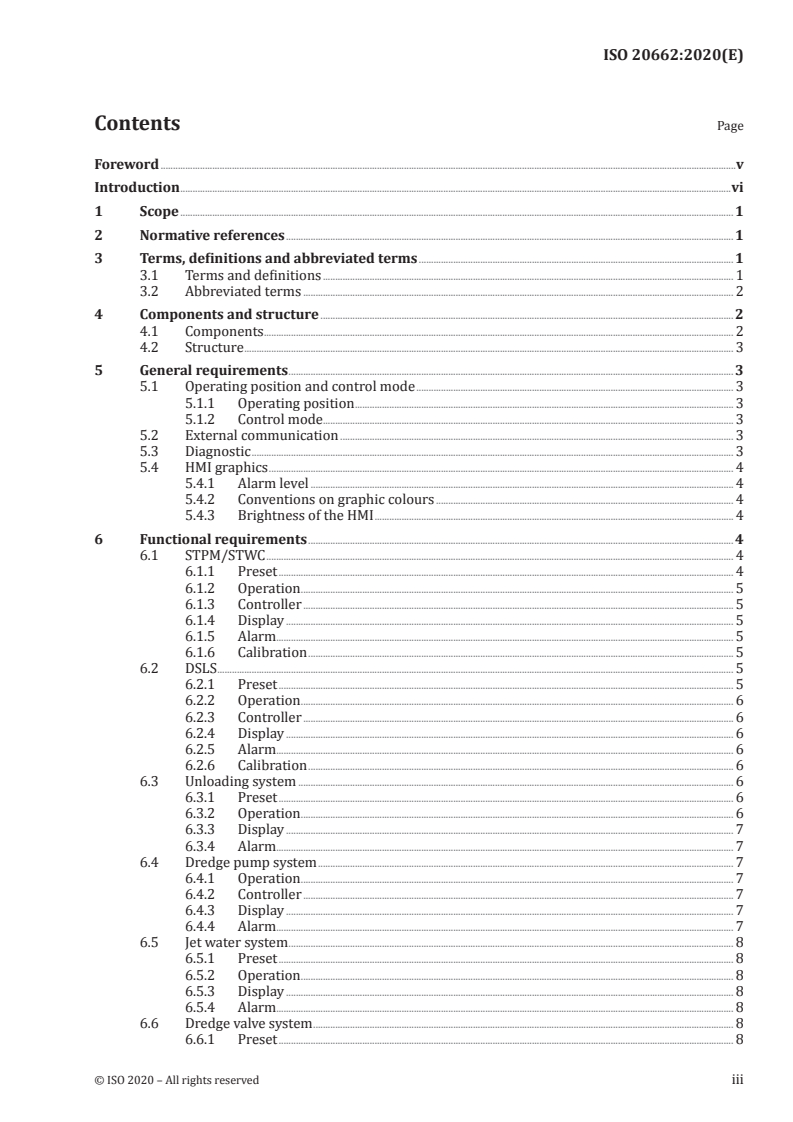
Contents Page
Foreword .v
Introduction .vi
1 Scope . 1
2 Normative references . 1
3 Terms, definitions and abbreviated terms . 1
3.1 Terms and definitions . 1
3.2 Abbreviated terms . 2
4 Components and structure . 2
4.1 Components . 2
4.2 Structure . 3
5 General requirements . 3
5.1 Operating position and control mode . 3
5.1.1 Operating position . 3
5.1.2 Control mode. 3
5.2 External communication . 3
5.3 Diagnostic . 3
5.4 HMI graphics . 4
5.4.1 Alarm level . 4
5.4.2 Conventions on graphic colours . 4
5.4.3 Brightness of the HMI . 4
6 Functional requirements . 4
6.1 STPM/STWC . 4
6.1.1 Preset . 4
6.1.2 Operation . 5
6.1.3 Controller . 5
6.1.4 Display . 5
6.1.5 Alarm. 5
6.1.6 Calibration . 5
6.2 DSLS . 5
6.2.1 Preset . 5
6.2.2 Operation . 6
6.2.3 Controller . 6
6.2.4 Display . 6
6.2.5 Alarm. 6
6.2.6 Calibration . 6
6.3 Unloading system . 6
6.3.1 Preset . 6
6.3.2 Operation . 6
6.3.3 Display . 7
6.3.4 Alarm. 7
6.4 Dredge pump system . 7
6.4.1 Operation . 7
6.4.2 Controller . 7
6.4.3 Display . 7
6.4.4 Alarm. 7
6.5 Jet water system . 8
6.5.1 Preset . 8
6.5.2 Operation . 8
6.5.3 Display . 8
6.5.4 Alarm. 8
6.6 Dredge valve system . 8
6.6.1 Preset . 8
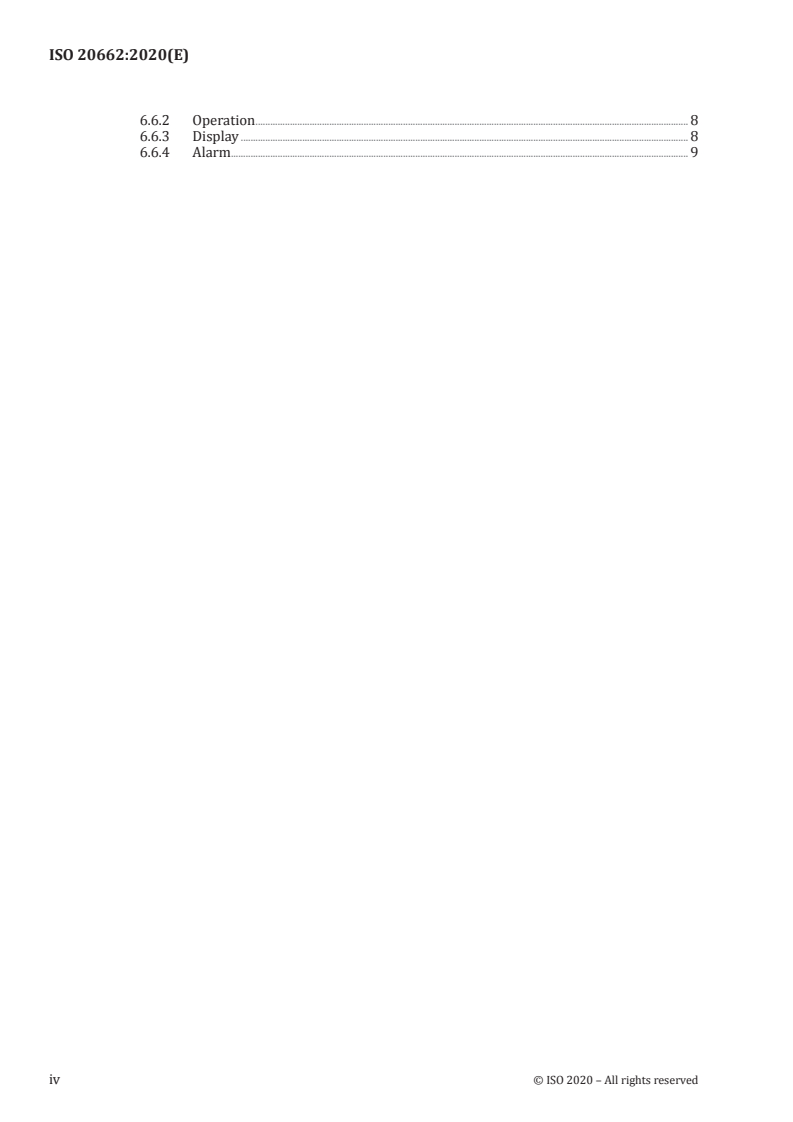
6.6.2 Operation . 8
6.6.3 Display . 8
6.6.4 Alarm. 9
iv © ISO 2020 – All rights reserved
Foreword
ISO (the International Organization for Standardization) is a worldwide federation of national standards
bodies (ISO member bodies). The work of preparing International Standards is normally carried out
through ISO technical committees. Each member body interested in a subject for which a technical
committee has been established has the right to be represented on that committee. International
organizations, governmental and non-governmental, in liaison with ISO, also take part in the work.
ISO collaborates closely with the International Electrotechnical Commission (IEC) on all matters of
electrotechnical standardization.
The procedures used to develop this document and those intended for its further maintenance are
described in the ISO/IEC Directives, Part 1. In particular, the different approval criteria needed for the
different types of ISO documents should be noted. This document was drafted in accordance with the
editorial rules of the ISO/IEC Directives, Part 2 (see www .iso .org/ directives).
Attention is drawn to the possibility that some of the elements of this document may be the subject of
patent rights. ISO shall not be held responsible for identifying any or all such patent rights. Details of
any patent rights identified during the development of the document will be in the Introduction and/or
on the ISO list of patent declarations received (see www .iso .org/ patents).
Any trade name used in this document is information given for the convenience of users and does not
constitute an endorsement.
For an explanation of the voluntary nature of standards, the meaning of ISO specific terms and
expressions related to conformity assessment, as well as information about ISO's adherence to the
World Trade Organization (WTO) principles in the Technical Barriers to Trade (TBT), see www .iso .org/
iso/ foreword .html.
This document was prepared by Technical Committee ISO/TC 8, Ships and marine technology.
Any feedback or questions on this document should be directed to the user’s national standards body. A
complete listing of these bodies can be found at www .iso .org/ members .html.
Introduction
This document describes the supervisory and control system for a number of components, functions
and systems that can, but do not have to, be installed on board of a hopper dredger. It does not prescribe
that all described components, functions and systems need to be installed.
vi © ISO 2020 – All rights reserved
INTERNATIONAL STANDARD ISO 20662:2020(E)
Ships and marine technology — Hopper
...
INTERNATIONAL ISO
STANDARD 20662
First edition
2020-01
Ships and marine technology —
Hopper dredger supervisory and
control systems
Reference number
©
ISO 2020
© ISO 2020
All rights reserved. Unless otherwise specified, or required in the context of its implementation, no part of this publication may
be reproduced or utilized otherwise in any form or by any means, electronic or mechanical, including photocopying, or posting
on the internet or an intranet, without prior written permission. Permission can be requested from either ISO at the address
below or ISO’s member body in the country of the requester.
ISO copyright office
CP 401 • Ch. de Blandonnet 8
CH-1214 Vernier, Geneva
Phone: +41 22 749 01 11
Fax: +41 22 749 09 47
Email: copyright@iso.org
Website: www.iso.org
Published in Switzerland
ii © ISO 2020 – All rights reserved
Contents Page
Foreword .v
Introduction .vi
1 Scope . 1
2 Normative references . 1
3 Terms, definitions and abbreviated terms . 1
3.1 Terms and definitions . 1
3.2 Abbreviated terms . 2
4 Components and structure . 2
4.1 Components . 2
4.2 Structure . 3
5 General requirements . 3
5.1 Operating position and control mode . 3
5.1.1 Operating position . 3
5.1.2 Control mode. 3
5.2 External communication . 3
5.3 Diagnostic . 3
5.4 HMI graphics . 4
5.4.1 Alarm level . 4
5.4.2 Conventions on graphic colours . 4
5.4.3 Brightness of the HMI . 4
6 Functional requirements . 4
6.1 STPM/STWC . 4
6.1.1 Preset . 4
6.1.2 Operation . 5
6.1.3 Controller . 5
6.1.4 Display . 5
6.1.5 Alarm. 5
6.1.6 Calibration . 5
6.2 DSLS . 5
6.2.1 Preset . 5
6.2.2 Operation . 6
6.2.3 Controller . 6
6.2.4 Display . 6
6.2.5 Alarm. 6
6.2.6 Calibration . 6
6.3 Unloading system . 6
6.3.1 Preset . 6
6.3.2 Operation . 6
6.3.3 Display . 7
6.3.4 Alarm. 7
6.4 Dredge pump system . 7
6.4.1 Operation . 7
6.4.2 Controller . 7
6.4.3 Display . 7
6.4.4 Alarm. 7
6.5 Jet water system . 8
6.5.1 Preset . 8
6.5.2 Operation . 8
6.5.3 Display . 8
6.5.4 Alarm. 8
6.6 Dredge valve system . 8
6.6.1 Preset . 8
6.6.2 Operation . 8
6.6.3 Display . 8
6.6.4 Alarm. 9
iv © ISO 2020 – All rights reserved
Foreword
ISO (the International Organization for Standardization) is a worldwide federation of national standards
bodies (ISO member bodies). The work of preparing International Standards is normally carried out
through ISO technical committees. Each member body interested in a subject for which a technical
committee has been established has the right to be represented on that committee. International
organizations, governmental and non-governmental, in liaison with ISO, also take part in the work.
ISO collaborates closely with the International Electrotechnical Commission (IEC) on all matters of
electrotechnical standardization.
The procedures used to develop this document and those intended for its further maintenance are
described in the ISO/IEC Directives, Part 1. In particular, the different approval criteria needed for the
different types of ISO documents should be noted. This document was drafted in accordance with the
editorial rules of the ISO/IEC Directives, Part 2 (see www .iso .org/ directives).
Attention is drawn to the possibility that some of the elements of this document may be the subject of
patent rights. ISO shall not be held responsible for identifying any or all such patent rights. Details of
any patent rights identified during the development of the document will be in the Introduction and/or
on the ISO list of patent declarations received (see www .iso .org/ patents).
Any trade name used in this document is information given for the convenience of users and does not
constitute an endorsement.
For an explanation of the voluntary nature of standards, the meaning of ISO specific terms and
expressions related to conformity assessment, as well as information about ISO's adherence to the
World Trade Organization (WTO) principles in the Technical Barriers to Trade (TBT), see www .iso .org/
iso/ foreword .html.
This document was prepared by Technical Committee ISO/TC 8, Ships and marine technology.
Any feedback or questions on this document should be directed to the user’s national standards body. A
complete listing of these bodies can be found at www .iso .org/ members .html.
Introduction
This document describes the supervisory and control system for a number of components, functions
and systems that can, but do not have to, be installed on board of a hopper dredger. It does not prescribe
that all described components, functions and systems need to be installed.
vi © ISO 2020 – All rights reserved
INTERNATIONAL STANDARD ISO 20662:2020(E)
Ships and marine technology — Hopper
...