

ISO 26431-1:2008
(Main)Digital cinema (D-cinema) quality — Part 1: Screen luminance level, chromaticity and uniformity
General Information
- Abstract
ISO 26431-1:2008 specifies the absolute luminance level, white point chromaticity and luminance uniformity of the reflected screen light for the presentation of motion pictures by projectors with digital light engines in review rooms and commercial cinemas. It is the purpose of ISO 26431-1:2008 to achieve the tone scale and contrast in the projected image that will correspond to that intended during the mastering process.
- Status
- Published
- Publication Date
- 19-Aug-2008
- Technical Committee
- ISO/TC 36 - Cinematography
- Drafting Committee
- ISO/TC 36 - Cinematography
- Current Stage
- 9093 - International Standard confirmed
- Start Date
- 10-Jul-2023
- Completion Date
- 29-Aug-2026


Overview
ISO 26431-1:2008 is an international standard that defines critical quality parameters for digital cinema (D-cinema) presentations, focusing specifically on the screen luminance level, chromaticity, and uniformity of reflected light. Developed by the International Organization for Standardization (ISO) in collaboration with the Society of Motion Picture and Television Engineers (SMPTE), this standard ensures that motion pictures projected with digital light engine projectors reproduce the tone scale and contrast as intended during the mastering process. It applies to both review rooms (color timing and mastering suites) and commercial cinema theaters.
By adhering to ISO 26431-1:2008, cinemas and post-production facilities can achieve consistent image quality, allowing creative intent to be faithfully presented across different venues and viewing environments.
Key Topics
1. Absolute Luminance Level
- Nominal screen luminance is set at 48 cd/m² (14 foot-Lamberts).
- Precision varies by application: review rooms demand tighter tolerances (±3.5 cd/m²), theaters allow broader ranges (±10.2 cd/m²).
- Luminance must be measured using calibrated spot photometers with photopic spectral response for accuracy.
2. Chromaticity (White Point)
- The white point chromaticity coordinates are standardized at x = 0.314 and y = 0.351.
- Uniform chromaticity across the screen ensures accurate color reproduction without color shifts or tints.
- Spectroradiometers with accuracy ±0.002 (review rooms) to ±0.006 (theaters) measure chromaticity.
3. Luminance Uniformity and Screen Measurement Locations
- Measurements are taken at the screen center, sides (inset 5% from edges), and corners (review rooms only).
- Screen luminance should be symmetrically distributed about the center with no abrupt changes or “hot spots.”
- Uniformity guidelines help maintain consistent brightness and avoid distracting visual artifacts.
4. Measurement Procedures and Instruments
- Measurements simulate audience eye height at about 1.1 meters from the floor.
- Projectors are tested while displaying a 100% white test signal at optimal focus and format settings.
- Photometers and spectroradiometers must meet strict acceptance angles and accuracy criteria.
5. Two Performance Classes
- Review Room Class: Highest precision for mastering and color timing workflows.
- Theater Class: Minimum performance for consistent commercial cinema presentations.
6. Ancillary Considerations
- Luminance range affects contrast and dynamic range perception, impacting artistic quality.
- The standard addresses the impact of stray light sources and recommends minimizing their effect to preserve contrast.
- Recommendations on gain screens, projector adjustments, and aging factors provide guidance for maintaining standards over time.
Applications
ISO 26431-1:2008 is essential for ensuring consistent and accurate digital cinema image quality across various settings:
- Post-production and Mastering Suites: Enables colorists and quality control professionals to verify that projected images meet exacting standards before distribution.
- Commercial Cinema Venues: Provides guidelines for calibration of digital projectors and screens to deliver visual experiences that honor the filmmaker’s intent.
- Equipment Manufacturers: Helps projector and screen manufacturers design products that comply with international luminance and chromaticity requirements.
- Certification and Compliance: Facilitates industry-wide quality assurance protocols to uphold image fidelity in digital cinema chains worldwide.
By applying this standard, stakeholders can reduce variability in digital cinema presentations, enhance audience satisfaction, and preserve the artistic vision created in the content mastering phase.
Related Standards
ISO 26431-1:2008 aligns with and references the following standards and recommendations to achieve comprehensive digital cinema quality:
- ISO 10527:2007 – CIE standard colorimetric observers for photometric measurements.
- SMPTE 431-1-2006 – The foundational standard upon which ISO 26431-1 is based, establishing D-cinema quality criteria for screen luminance and chromaticity.
- SMPTE RP 95 and RP 98 – Recommended practices for screen curve design and detailed luminance measurement distribution.
- French National Standard NF S27-100 – Electronic projection room guidelines complementing regional implementation of digital cinema standards.
- SMPTE 196M-2003 – Standards for 35-mm film projection conditions that provide comparative historical context for luminance and viewing environments.
Compliance with ISO 26431-1:2008, together with these complementary documents, facilitates uniform quality standards across diverse cinema ecosystems and technological platforms.
Maintaining screen luminance, chromaticity, and uniformity in accordance with ISO 26431-1:2008 is vital for delivering a superior digital cinema experience that faithfully renders the original artistic vision, ensuring visual consistency for audiences worldwide.
Frequently Asked Questions
ISO 26431-1:2008 is a standard published by the International Organization for Standardization (ISO). Its full title is "Digital cinema (D-cinema) quality — Part 1: Screen luminance level, chromaticity and uniformity". This standard covers: ISO 26431-1:2008 specifies the absolute luminance level, white point chromaticity and luminance uniformity of the reflected screen light for the presentation of motion pictures by projectors with digital light engines in review rooms and commercial cinemas. It is the purpose of ISO 26431-1:2008 to achieve the tone scale and contrast in the projected image that will correspond to that intended during the mastering process.
ISO 26431-1:2008 specifies the absolute luminance level, white point chromaticity and luminance uniformity of the reflected screen light for the presentation of motion pictures by projectors with digital light engines in review rooms and commercial cinemas. It is the purpose of ISO 26431-1:2008 to achieve the tone scale and contrast in the projected image that will correspond to that intended during the mastering process.
ISO 26431-1:2008 is classified under the following ICS (International Classification for Standards) categories: 37.060.99 - Other standards related to cinematography. The ICS classification helps identify the subject area and facilitates finding related standards.
ISO 26431-1:2008 is available in PDF format for immediate download after purchase. The document can be added to your cart and obtained through the secure checkout process. Digital delivery ensures instant access to the complete standard document.
Standards Content (Sample)
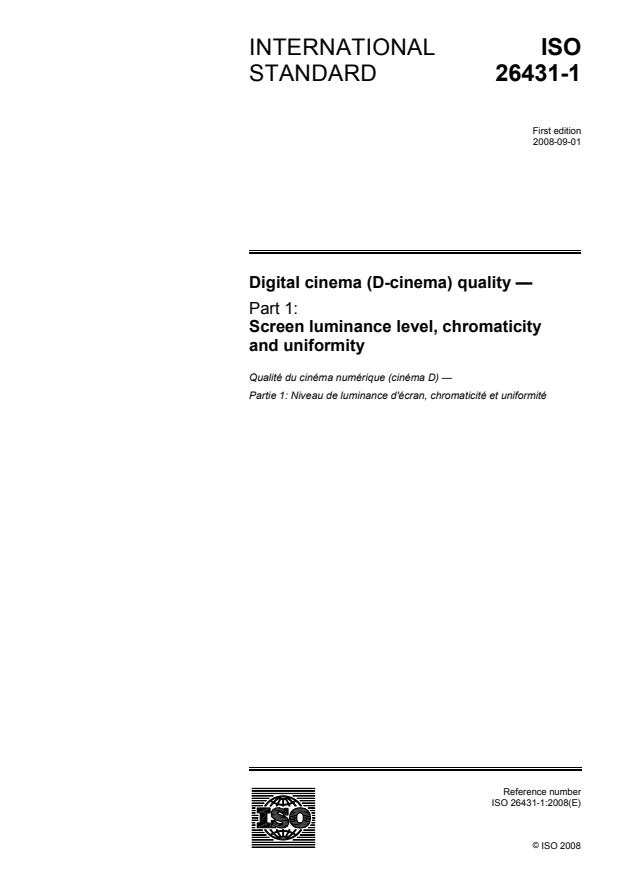
INTERNATIONAL ISO
STANDARD 26431-1
First edition
2008-09-01
Digital cinema (D-cinema) quality —
Part 1:
Screen luminance level, chromaticity
and uniformity
Qualité du cinéma numérique (cinéma D) —
Partie 1: Niveau de luminance d'écran, chromaticité et uniformité
Reference number
©
ISO 2008
PDF disclaimer
This PDF file may contain embedded typefaces. In accordance with Adobe's licensing policy, this file may be printed or viewed but
shall not be edited unless the typefaces which are embedded are licensed to and installed on the computer performing the editing. In
downloading this file, parties accept therein the responsibility of not infringing Adobe's licensing policy. The ISO Central Secretariat
accepts no liability in this area.
Adobe is a trademark of Adobe Systems Incorporated.
Details of the software products used to create this PDF file can be found in the General Info relative to the file; the PDF-creation
parameters were optimized for printing. Every care has been taken to ensure that the file is suitable for use by ISO member bodies. In
the unlikely event that a problem relating to it is found, please inform the Central Secretariat at the address given below.
© ISO 2008
All rights reserved. Unless otherwise specified, no part of this publication may be reproduced or utilized in any form or by any means,
electronic or mechanical, including photocopying and microfilm, without permission in writing from either ISO at the address below or
ISO's member body in the country of the requester.
ISO copyright office
Case postale 56 • CH-1211 Geneva 20
Tel. + 41 22 749 01 11
Fax + 41 22 749 09 47
E-mail copyright@iso.org
Web www.iso.org
Published in Switzerland
ii © ISO 2008 – All rights reserved
Foreword
ISO (the International Organization for Standardization) is a worldwide federation of national standards bodies
(ISO member bodies). The work of preparing International Standards is normally carried out through ISO
technical committees. Each member body interested in a subject for which a technical committee has been
established has the right to be represented on that committee. International organizations, governmental and
non-governmental, in liaison with ISO, also take part in the work. ISO collaborates closely with the
International Electrotechnical Commission (IEC) on all matters of electrotechnical standardization.
International Standards are drafted in accordance with the rules given in the ISO/IEC Directives, Part 2.
The main task of technical committees is to prepare International Standards. Draft International Standards
adopted by the technical committees are circulated to the member bodies for voting. Publication as an
International Standard requires approval by at least 75 % of the member bodies casting a vote.
Attention is drawn to the possibility that some of the elements of this document may be the subject of patent
rights. ISO shall not be held responsible for identifying any or all such patent rights.
ISO 26431-1 was prepared by the Society of Motion Picture and Television Engineers (as
SMPTE 431-1-2006) and was adopted, under a special “fast-track procedure”, by Technical Committee
ISO/TC 36, Cinematography, in parallel with its approval by the ISO member bodies.
ISO 26431 consists of the following parts, under the general title Digital cinema (D-cinema) quality:
⎯ Part 1: Screen luminance level, chromaticity and uniformity
Introduction
This International Standard comprises SMPTE 431-1-2006 and the following informative notes.
⎯ Informative reference: The French national standard NF S27-100, Cinematography — Electronic
projection rooms of digital cinema type, provides additional regional information.
⎯ Stray light and contrast (see Clause A.7): The reader is encouraged to review national standards and
recommendations.
iv © ISO 2008 – All rights reserved
SMPTE 431-1-2006
SMPTE STANDARD
for D-Cinema Quality —
Screen Luminance Level,
Chromaticity and Uniformity
Page 1 of 5 pages
1 Scope
This standard specifies the absolute luminance level, white point chromaticity, and luminance uniformity of the
reflected screen light for the presentation of motion pictures by projectors with digital light engines in review
rooms and commercial cinemas. It is the purpose of this specification to achieve the tone scale and contrast
in the projected image that will correspond to that intended during the mastering process.
2 Normative reference
The following standards contain provisions which, through reference in this text, constitute provisions of this
standard. At the time of publication, the editions indicated were valid. All standards are subject to revision,
and parties to agreement based on this standard are encouraged to investigate the possibility of applying the
most recent edition of the standards indicated below.
ISO 10527:2007, CIE standard colorimetric observers
3 Performance classes
It should be recognized that different applications within the industry have varying requirements for
tolerances, or the precision of the target specifications attained in any particular installation. For example,
greater precision may be required for a system in a mastering suite than in a commercial cinema theatre. In
order to simplify communication, two levels or classes of precision are defined herein as follows:
Review Room intended as the highest practical precision, for the most critical colorimetry
applications, recommended for the mastering activities of color timing and
color matching.
Theater intended as the minimum level for commercial cinema presentations.
Performance criteria for each class are defined in section 5.
4 Measurement criteria
4.1 Projector conditions
Measurements shall be made with the projector in normal operation, with its lens(es) set at optimal focus
position, set for the format covering the largest area of the screen, and a 100% white signal being displayed
on the screen (either the entire screen or as a minimum the five zones consisting of the screen center and
four corner locations defined in section 4.2). The 100% white signal is defined as the digital code values
assigned to the maximum color-neutral white level allowed in the input signal standard of interest.
MOTION PICTURE AND TELEVISION ENGINEERS
April 18, 2006
3 Barker Avenue, White Plains, NY 10601
(914) 761-1100
SMPTE 431-1-2006
4.2 Measurement locations on the screen
Measurements of light levels shall be taken at screen locations consisting of the geometric center of the
screen and the four sides in theaters, and those measurements with the addition of the four corners in review
rooms. The side and corner locations are inset 5% ± 1% of the screen width from both of the adjacent screen
edges.
4.3 Measurement locations in the auditorium
All screen measurements shall be performed at the center of the seating row closest to the geometric center
of the seating area. All readings shall be taken at a height of approximately 1.1 m (43 in) above the floor to
simulate the eye height of an audience member.
4.4 Photometer type
Screen luminance shall be measured with a spot photometer having the spectral luminance response of the
standard observer (photopic vision), as defined in ISO 10527:2007. The acceptance angle of the photometer
shall be 2° or less. The photometer shall have an accuracy of ± 0.5 cd/m² (± 0.2 fL) or better. The photometer
response to luminance variation over time shall be to properly integrate any such variation occurring at
frequencies at or above 24 Hz and display the arithmetic mean value.
4.5 Spectroradiometer type
Screen chromaticity shall be measured with a spot spectroradiometer w
...