

ISO 21727:2016
(Main)Cinematography — Method of measurement of perceived loudness of short duration motion-picture audio material
General Information
- Abstract
ISO 21727:2016 specifies a method of measurement of short duration motion-picture sound that allows assessment of the subjective loudness and annoyance of the sound recording when replayed at the recommended replay level in rooms aligned with the characteristics of ISO 2969. The specified method of measurement assesses the entire duration of the sound recording, typically commercials and trailers that do not exceed 3 min in length, with suitable channel summation, frequency weighting and time integration. It does not specify a maximum recommended level for such material and is solely aimed at describing a measurement method. NOTE Typical recording and replay levels are discussed in Annex A.
- Status
- Published
- Publication Date
- 24-Apr-2016
- Technical Committee
- ISO/TC 36 - Cinematography
- Drafting Committee
- ISO/TC 36/WG 3 - Audio technology
- Current Stage
- 9093 - International Standard confirmed
- Start Date
- 17-Jan-2023
- Completion Date
- 29-Aug-2026
Buy Documents

ISO 21727:2016 - Cinematography -- Method of measurement of perceived loudness of short duration motion-picture audio material

ISO 21727:2016 - Cinematography — Method of measurement of perceived loudness of short duration motion-picture audio material/25/2016
Overview
ISO 21727:2016 is an international standard developed by the International Organization for Standardization (ISO) that defines a precise method for measuring the perceived loudness of short-duration motion-picture audio material. This standard applies primarily to motion-picture soundtracks of brief content such as commercials and trailers, typically not exceeding three minutes in length. The measurement method described enables an assessment of subjective loudness and annoyance levels of sound recordings when replayed at recommended audio levels within cinema auditoriums designed in compliance with ISO 2969.
This measurement approach is electrical and employs specific channel summation, M-type frequency weighting, and time integration to ensure reliable loudness evaluation. It does not set a maximum loudness level limit but instead focuses on providing a consistent and objective measurement method. Its adoption supports maintaining audio level consistency between short promotional content and feature presentations, enhancing the overall cinema sound experience.
Key Topics
Scope and Purpose
ISO 21727:2016 specifies a method to assess the subjective loudness of short-duration cinema sound such as commercials and trailers, promoting sound-level consistency in playback venues.Measurement Methodology
The measurement is conducted in the electrical domain and involves:- Channel Calibration: Normalizing each audio channel to a reference level aligned with ISO 22234’s recommended replay levels.
- M-type Frequency Weighting: Applying a specific frequency filter designed to simulate human loudness perception and annoyance.
- Scalar Channel Summation: Combining channel signals by rectification and squaring to simulate multi-channel soundfield summation.
- Time Integration: Measuring the loudness-equivalent level over the entire duration of the short audio content.
Recommended Replay Levels
The standard supports assessment at the recommended replay levels designed around ISO 2969-compliant theatre environments. These levels guide sound system calibration to establish consistent sound pressure levels (SPL).Annex A Insights
Annex A provides practical observations on typical recording and replay level preferences, including tendencies for exhibitors to reduce replay levels by 2–3 dB for main features and 8–12 dB for commercials and trailers to manage loudness perception.
Applications
ISO 21727:2016 serves multiple practical applications, including:
Sound Quality Control in Cinemas:
Facilitates consistent loudness matching between trailers, commercials, and main features, preventing abrupt loudness changes that can affect viewer experience.Content Production and Post-Production:
Audio engineers and content producers can utilize the standard to verify that short-duration audio materials meet perceived loudness expectations when replayed in cinema environments.Theatre Calibration:
Helps cinema operators and audio technicians calibrate and verify cinema sound systems to recommended replay levels, improving audio level consistency for diverse content types.Broadcasting and Regulatory Compliance:
Enables broadcasters and regulators to objectively measure and assess loudness to ensure compliance with local or international sound level guidelines.
Related Standards
ISO 21727:2016 is designed to be used alongside complementary standards in motion-picture sound:
ISO 2969: Specifies electro-acoustic response requirements and measurements for motion-picture control rooms and indoor theatres, ensuring suitable room acoustics for playback.
ISO 22234: Defines relative and absolute sound pressure levels for multi-channel motion-picture sound systems, supporting correct calibration of playback systems.
IEC 61260: Covers octave-band and fractional-octave-band filters referenced for frequency analysis in audio measurements.
IEC 61672 Series: Concerns specifications and pattern evaluation tests for sound level meters, relevant for consistent and accurate measurement instrumentation.
Adopting ISO 21727:2016 enhances the predictability and quality of audio loudness in cinemas, particularly for short promotional content, ensuring a balanced listening environment that aligns with recommended sound pressure characteristics and audience comfort. This standard is essential for cinema sound professionals aiming to optimize the audience's auditory experience consistently.
Relations
- Effective Date
- 04-Nov-2015
Buy Documents
ISO 21727:2016 - Cinematography -- Method of measurement of perceived loudness of short duration motion-picture audio material
ISO 21727:2016 - Cinematography — Method of measurement of perceived loudness of short duration motion-picture audio material/25/2016
Frequently Asked Questions
ISO 21727:2016 is a standard published by the International Organization for Standardization (ISO). Its full title is "Cinematography — Method of measurement of perceived loudness of short duration motion-picture audio material". This standard covers: ISO 21727:2016 specifies a method of measurement of short duration motion-picture sound that allows assessment of the subjective loudness and annoyance of the sound recording when replayed at the recommended replay level in rooms aligned with the characteristics of ISO 2969. The specified method of measurement assesses the entire duration of the sound recording, typically commercials and trailers that do not exceed 3 min in length, with suitable channel summation, frequency weighting and time integration. It does not specify a maximum recommended level for such material and is solely aimed at describing a measurement method. NOTE Typical recording and replay levels are discussed in Annex A.
ISO 21727:2016 specifies a method of measurement of short duration motion-picture sound that allows assessment of the subjective loudness and annoyance of the sound recording when replayed at the recommended replay level in rooms aligned with the characteristics of ISO 2969. The specified method of measurement assesses the entire duration of the sound recording, typically commercials and trailers that do not exceed 3 min in length, with suitable channel summation, frequency weighting and time integration. It does not specify a maximum recommended level for such material and is solely aimed at describing a measurement method. NOTE Typical recording and replay levels are discussed in Annex A.
ISO 21727:2016 is classified under the following ICS (International Classification for Standards) categories: 37.060.99 - Other standards related to cinematography. The ICS classification helps identify the subject area and facilitates finding related standards.
ISO 21727:2016 has the following relationships with other standards: It is inter standard links to ISO 21727:2004. Understanding these relationships helps ensure you are using the most current and applicable version of the standard.
ISO 21727:2016 is available in PDF format for immediate download after purchase. The document can be added to your cart and obtained through the secure checkout process. Digital delivery ensures instant access to the complete standard document.
Standards Content (Sample)
INTERNATIONAL ISO
STANDARD 21727
Second edition
2016-05-01
Cinematography — Method of
measurement of perceived loudness of
short duration motion-picture audio
material
Cinématographie — Méthode de mesure de l’intensité sonore percue
pour les films cinématographiques de courte durée
Reference number
©
ISO 2016
© ISO 2016, Published in Switzerland
All rights reserved. Unless otherwise specified, no part of this publication may be reproduced or utilized otherwise in any form
or by any means, electronic or mechanical, including photocopying, or posting on the internet or an intranet, without prior
written permission. Permission can be requested from either ISO at the address below or ISO’s member body in the country of
the requester.
ISO copyright office
Ch. de Blandonnet 8 • CP 401
CH-1214 Vernier, Geneva, Switzerland
Tel. +41 22 749 01 11
Fax +41 22 749 09 47
copyright@iso.org
www.iso.org
ii © ISO 2016 – All rights reserved
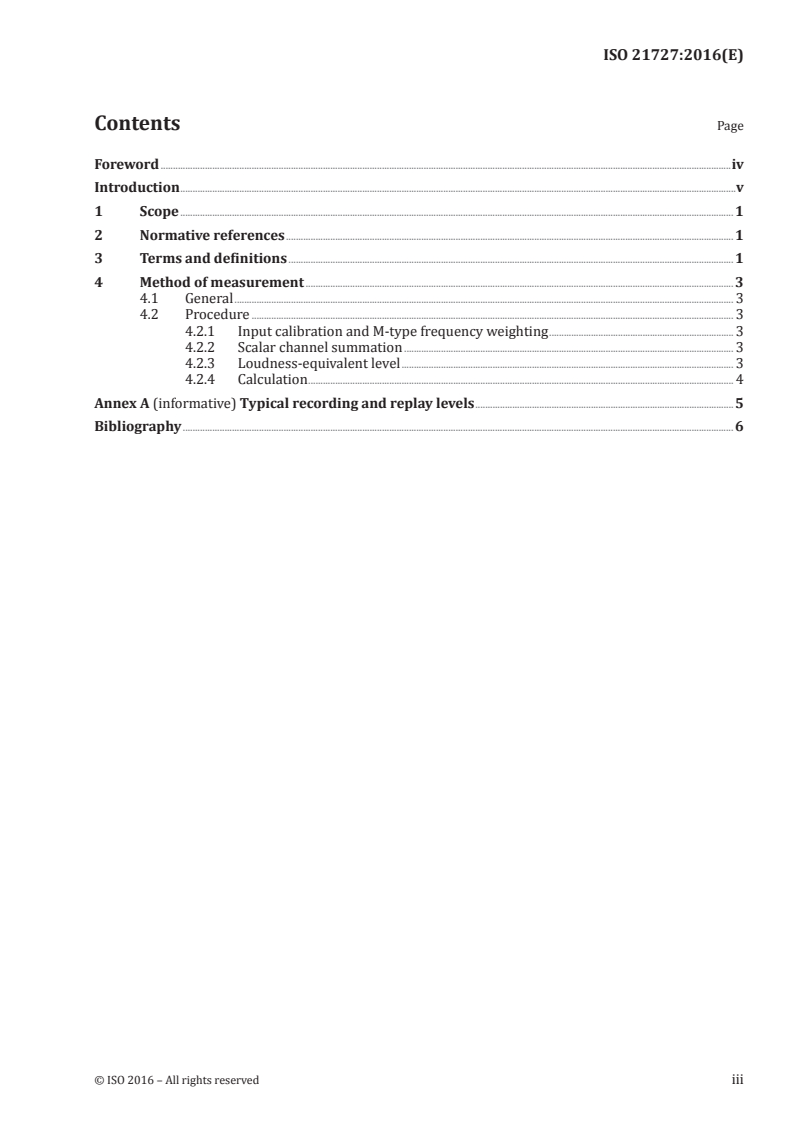
Contents Page
Foreword .iv
Introduction .v
1 Scope . 1
2 Normative references . 1
3 Terms and definitions . 1
4 Method of measurement . 3
4.1 General . 3
4.2 Procedure . 3
4.2.1 Input calibration and M-type frequency weighting . 3
4.2.2 Scalar channel summation . 3
4.2.3 Loudness-equivalent level . 3
4.2.4 Calculation . 4
Annex A (informative) Typical recording and replay levels . 5
Bibliography . 6
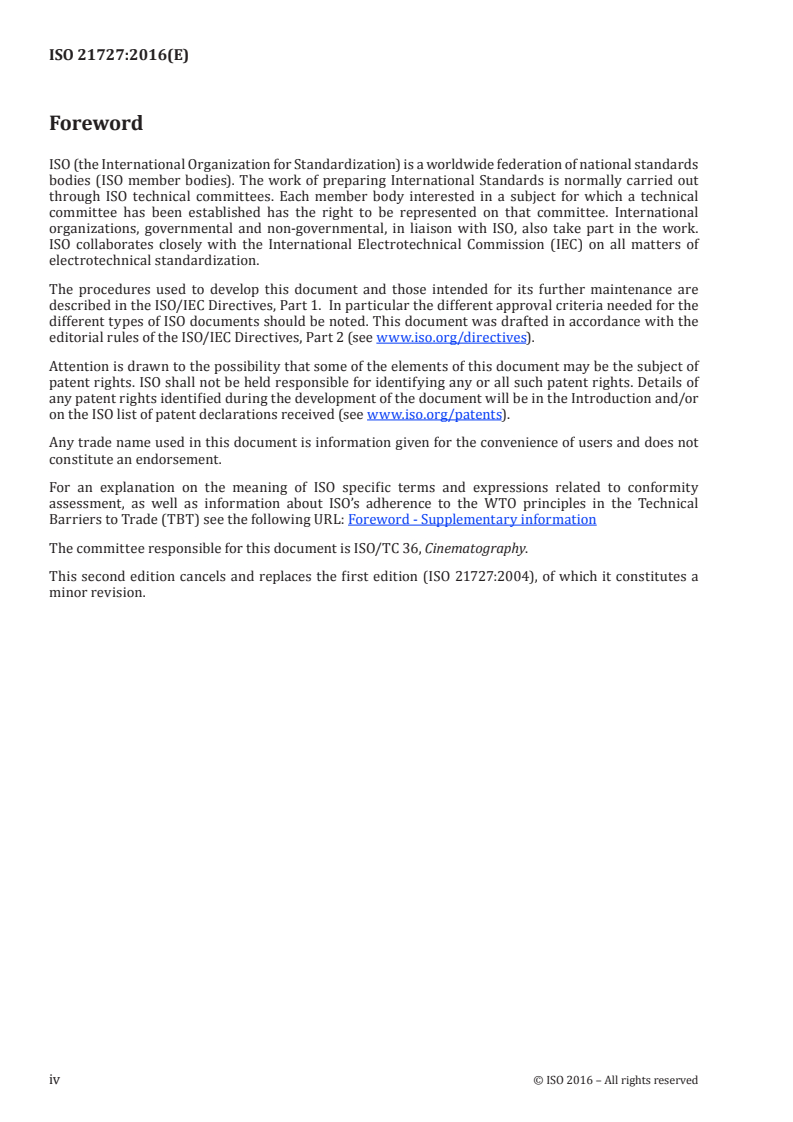
Foreword
ISO (the International Organization for Standardization) is a worldwide federation of national standards
bodies (ISO member bodies). The work of preparing International Standards is normally carried out
through ISO technical committees. Each member body interested in a subject for which a technical
committee has been established has the right to be represented on that committee. International
organizations, governmental and non-governmental, in liaison with ISO, also take part in the work.
ISO collaborates closely with the International Electrotechnical Commission (IEC) on all matters of
electrotechnical standardization.
The procedures used to develop this document and those intended for its further maintenance are
described in the ISO/IEC Directives, Part 1. In particular the different approval criteria needed for the
different types of ISO documents should be noted. This document was drafted in accordance with the
editorial rules of the ISO/IEC Directives, Part 2 (see www.iso.org/directives).
Attention is drawn to the possibility that some of the elements of this document may be the subject of
patent rights. ISO shall not be held responsible for identifying any or all such patent rights. Details of
any patent rights identified during the development of the document will be in the Introduction and/or
on the ISO list of patent declarations received (see www.iso.org/patents).
Any trade name used in this document is information given for the convenience of users and does not
constitute an endorsement.
For an explanation on the meaning of ISO specific terms and expressions related to conformity
assessment, as well as information about ISO’s adherence to the WTO principles in the Technical
Barriers to Trade (TBT) see the following URL: Foreword - Supplementary information
The committee responsible for this document is ISO/TC 36, Cinematography.
This second edition cancels and replaces the first edition (ISO 21727:2004), of which it constitutes a
minor revision.
iv © ISO 2016 – All rights reserved
Introduction
This International Standard is intended to be used in conjunction with the International Standards
that cover the reproduction of motion-picture sound, A-chain and B-chain, including ISO 2969 and
ISO 22234.
A recommended replay level architecture exists for most current cinema sound formats. This matches
a specific recorded modulation level with a specific sound-pressure level at the main seating position
in a room designed in accordance with ISO 2969 and ISO 22234. The noise and over-modulation points
of each sound format are positioned to allow for a wide range of signal components to be recorded and
faithfully reproduced at a valid absolute level as part of a motion-picture soundtrack.
Perhaps due to their competitive nature, many motion-picture commercials and trailers make
sustained use of the highest recording level possible for the format. Consequently, many exhibitors
now find the need to reduce the replay level to a point much lower than the recommendation. This has
caused uncertainty as to the validity of the recommended replay level, which in turn creates problems
in matching dubbing theatre sound to that expected from the average cinema.
This International Standard is intended to assist in assessing the subjective loudness of motion-picture
sound so that a better match between the sound levels of commercials, trailers and main features is
maintained, and so that confidence in the validity of the recommended replay level is re-established.
INTERNATIONAL STANDARD ISO 21727:2016(E)
Cinematography — Method of measu
...
INTERNATIONAL ISO
STANDARD 21727
Second edition
2016-05-01
Cinematography — Method of
measurement of perceived loudness of
short duration motion-picture audio
material
Cinématographie — Méthode de mesure de l’intensité sonore percue
pour les films cinématographiques de courte durée
Reference number
©
ISO 2016
© ISO 2016, Published in Switzerland
All rights reserved. Unless otherwise specified, no part of this publication may be reproduced or utilized otherwise in any form
or by any means, electronic or mechanical, including photocopying, or posting on the internet or an intranet, without prior
written permission. Permission can be requested from either ISO at the address below or ISO’s member body in the country of
the requester.
ISO copyright office
Ch. de Blandonnet 8 • CP 401
CH-1214 Vernier, Geneva, Switzerland
Tel. +41 22 749 01 11
Fax +41 22 749 09 47
copyright@iso.org
www.iso.org
ii © ISO 2016 – All rights reserved
Contents Page
Foreword .iv
Introduction .v
1 Scope . 1
2 Normative references . 1
3 Terms and definitions . 1
4 Method of measurement . 3
4.1 General . 3
4.2 Procedure . 3
4.2.1 Input calibration and M-type frequency weighting . 3
4.2.2 Scalar channel summation . 3
4.2.3 Loudness-equivalent level . 3
4.2.4 Calculation . 4
Annex A (informative) Typical recording and replay levels . 5
Bibliography . 6
Foreword
ISO (the International Organization for Standardization) is a worldwide federation of national standards
bodies (ISO member bodies). The work of preparing International Standards is normally carried out
through ISO technical committees. Each member body interested in a subject for which a technical
committee has been established has the right to be represented on that committee. International
organizations, governmental and non-governmental, in liaison with ISO, also take part in the work.
ISO collaborates closely with the International Electrotechnical Commission (IEC) on all matters of
electrotechnical standardization.
The procedures used to develop this document and those intended for its further maintenance are
described in the ISO/IEC Directives, Part 1. In particular the different approval criteria needed for the
different types of ISO documents should be noted. This document was drafted in accordance with the
editorial rules of the ISO/IEC Directives, Part 2 (see www.iso.org/directives).
Attention is drawn to the possibility that some of the elements of this document may be the subject of
patent rights. ISO shall not be held responsible for identifying any or all such patent rights. Details of
any patent rights identified during the development of the document will be in the Introduction and/or
on the ISO list of patent declarations received (see www.iso.org/patents).
Any trade name used in this document is information given for the convenience of users and does not
constitute an endorsement.
For an explanation on the meaning of ISO specific terms and expressions related to conformity
assessment, as well as information about ISO’s adherence to the WTO principles in the Technical
Barriers to Trade (TBT) see the following URL: Foreword - Supplementary information
The committee responsible for this document is ISO/TC 36, Cinematography.
This second edition cancels and replaces the first edition (ISO 21727:2004), of which it constitutes a
minor revision.
iv © ISO 2016 – All rights reserved
Introduction
This International Standard is intended to be used in conjunction with the International Standards
that cover the reproduction of motion-picture sound, A-chain and B-chain, including ISO 2969 and
ISO 22234.
A recommended replay level architecture exists for most current cinema sound formats. This matches
a specific recorded modulation level with a specific sound-pressure level at the main seating position
in a room designed in accordance with ISO 2969 and ISO 22234. The noise and over-modulation points
of each sound format are positioned to allow for a wide range of signal components to be recorded and
faithfully reproduced at a valid absolute level as part of a motion-picture soundtrack.
Perhaps due to their competitive nature, many motion-picture commercials and trailers make
sustained use of the highest recording level possible for the format. Consequently, many exhibitors
now find the need to reduce the replay level to a point much lower than the recommendation. This has
caused uncertainty as to the validity of the recommended replay level, which in turn creates problems
in matching dubbing theatre sound to that expected from the average cinema.
This International Standard is intended to assist in assessing the subjective loudness of motion-picture
sound so that a better match between the sound levels of commercials, trailers and main features is
maintained, and so that confidence in the validity of the recommended replay level is re-established.
INTERNATIONAL STANDARD ISO 21727:2016(E)
Cinematography — Method of measu
...