

ISO 17949:2013/Amd 2:2018
(Amendment)Impact test procedures for road vehicles — Seating and positioning procedures for anthropomorphic test devices — Procedure for the WorldSID 5Oth percentile male side-impact dummy in front outboard seating positions — Amendment 2
General Information
- Abstract
- Status
- Published
- Publication Date
- 29-Nov-2018
- Technical Committee
- ISO/TC 22/SC 36 - Safety and impact testing
- Drafting Committee
- ISO/TC 22/SC 36/WG 1 - Car collision test procedures
- Current Stage
- 6060 - International Standard published
- Start Date
- 30-Nov-2018
- Due Date
- 15-Nov-2018
- Completion Date
- 15-Nov-2018
Buy Documents


ISO 17949:2013/Amd 2:2018 - Impact test procedures for road vehicles — Seating and positioning procedures for anthropomorphic test devices — Procedure for the WorldSID 5Oth percentile male side-impact dummy in front outboard seating positions — Amendment 2 Released:11/30/2018
Overview
ISO 17949:2013/Amd 2:2018 is an amendment to the international standard that specifies impact test procedures for road vehicles, focusing on the seating and positioning of anthropomorphic test devices (ATDs). This amendment updates the procedure for positioning the WorldSID 50th percentile male side-impact dummy in front outboard seating positions during side-impact testing. Published by ISO, this standard ensures a consistent and reproducible method to simulate occupant positioning for vehicle safety evaluations related to side-impact crashes.
Key Topics
Seating and Positioning Procedures
Detailed instructions are provided for placing and adjusting the vehicle test seat to replicate realistic human seating postures during impact tests. This positioning is critical for accurate and reliable side-impact dummy test results.WorldSID 50th Percentile Male Dummy
The document focuses on the procedure for positioning the WorldSID dummy, representing an average adult male, in front outboard seats (driver or front passenger positions).Test Seat Placement
- Adjustments using primary seat controls vertically, fore-aft, and pitch angle to set seat reference points precisely.
- Midpoint calculations and seat track adjustments to define the appropriate seating position.
- Recording seat placement data to ensure test repeatability.
H-point Determination for Side-Impact Testing
- Usage of the SAE H-point manikin to establish the dummy’s seating reference point (H-point) based on SAE J 826 procedures with modifications for 50th percentile measurements.
- Seat back angle setting according to manufacturer specifications or standardized angle (23° ±1°).
- Documentation of exact H-point coordinates (X, Y, Z).
Applications
Vehicle Safety Testing
Automotive manufacturers and testing laboratories can implement these procedures to conduct side-impact crash tests with the WorldSID dummy, which is widely recognized in regulatory and consumer safety evaluations.Crashworthiness Assessment
Accurate dummy placement ensures reliable data collection on injury risk metrics during side-impact scenarios, improving evaluations of occupant protection systems such as side airbags, door structures, and seatbelt restraints.Research and Development
Engineers use this standardized method during vehicle design and prototype testing phases to optimize seating ergonomics and improve overall road vehicle safety performance.Regulatory Compliance
The amendment supports compliance with global safety regulations and standards that mandate use of fully specified anthropomorphic test devices and precise seating positions for side-impact crashworthiness testing.
Related Standards
ISO 17949:2013
The original standard detailing impact test procedures prior to this 2018 amendment.SAE J 826 – Device for Positioning the Drivers Seat Relative to the Steering System
Basis for H-point measurement procedures referenced for dummy positioning.Other Anthropomorphic Test Device Standards
Standards covering seating and positioning for various crash test dummies, including front-impact dummies and other side-impact dummy variants.Global Vehicle Safety Regulations
Alignment with UNECE regulations and regional testing protocols that specify anthropomorphic test device usage and impact test methodologies.
By following ISO 17949:2013/Amd 2:2018, vehicle safety professionals ensure consistent, precise, and reproducible side-impact dummy positioning, enhancing test validity and ultimately contributing to improved occupant protection in real-world crashes. This amendment reinforces the importance of standardized anthropomorphic test device procedures within the automotive safety testing community.
Relations
- Effective Date
- 04-Dec-2021
Buy Documents
ISO 17949:2013/Amd 2:2018 - Impact test procedures for road vehicles — Seating and positioning procedures for anthropomorphic test devices — Procedure for the WorldSID 5Oth percentile male side-impact dummy in front outboard seating positions — Amendment 2 Released:11/30/2018
Get Certified
Connect with accredited certification bodies for this standard

TÜV Rheinland
TÜV Rheinland is a leading international provider of technical services.

TÜV SÜD
TÜV SÜD is a trusted partner of choice for safety, security and sustainability solutions.

DEKRA Certification Inc.
DEKRA US certification services.
Sponsored listings
Frequently Asked Questions
ISO 17949:2013/Amd 2:2018 is a standard published by the International Organization for Standardization (ISO). Its full title is "Impact test procedures for road vehicles — Seating and positioning procedures for anthropomorphic test devices — Procedure for the WorldSID 5Oth percentile male side-impact dummy in front outboard seating positions — Amendment 2". This standard covers: Impact test procedures for road vehicles — Seating and positioning procedures for anthropomorphic test devices — Procedure for the WorldSID 5Oth percentile male side-impact dummy in front outboard seating positions — Amendment 2
Impact test procedures for road vehicles — Seating and positioning procedures for anthropomorphic test devices — Procedure for the WorldSID 5Oth percentile male side-impact dummy in front outboard seating positions — Amendment 2
ISO 17949:2013/Amd 2:2018 is classified under the following ICS (International Classification for Standards) categories: 43.180 - Diagnostic, maintenance and test equipment. The ICS classification helps identify the subject area and facilitates finding related standards.
ISO 17949:2013/Amd 2:2018 has the following relationships with other standards: It is inter standard links to ISO 17949:2013. Understanding these relationships helps ensure you are using the most current and applicable version of the standard.
ISO 17949:2013/Amd 2:2018 is available in PDF format for immediate download after purchase. The document can be added to your cart and obtained through the secure checkout process. Digital delivery ensures instant access to the complete standard document.
Standards Content (Sample)
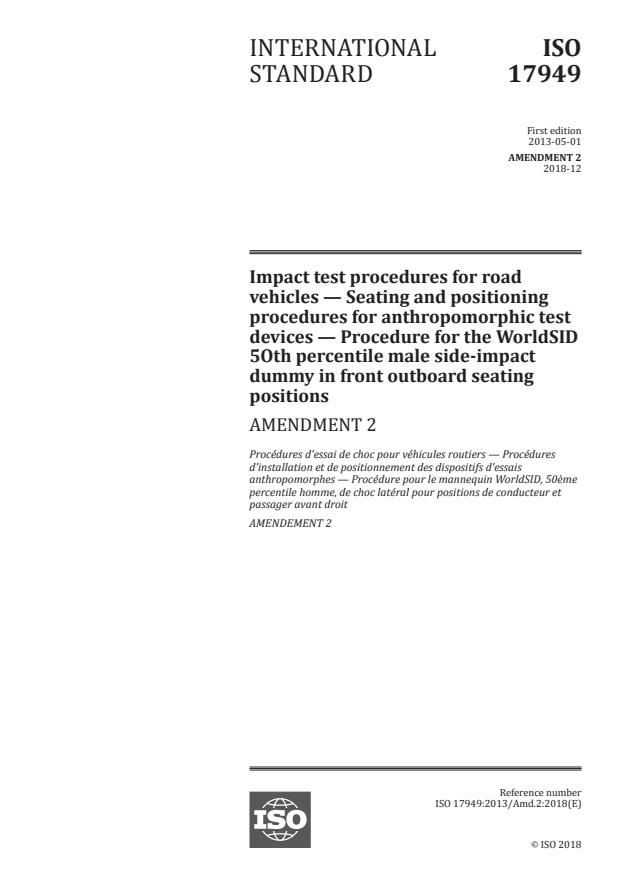
INTERNATIONAL ISO
STANDARD 17949
First edition
2013-05-01
AMENDMENT 2
2018-12
Impact test procedures for road
vehicles — Seating and positioning
procedures for anthropomorphic test
devices — Procedure for the WorldSID
5Oth percentile male side-impact
dummy in front outboard seating
positions
AMENDMENT 2
Procédures d'essai de choc pour véhicules routiers — Procédures
d'installation et de positionnement des dispositifs d'essais
anthropomorphes — Procédure pour le mannequin WorldSID, 50ème
percentile homme, de choc latéral pour positions de conducteur et
passager avant droit
AMENDEMENT 2
Reference number
ISO 17949:2013/Amd.2:2018(E)
©
ISO 2018
ISO 17949:2013/Amd.2:2018(E)
© ISO 2018
All rights reserved. Unless otherwise specified, or required in the context of its implementation, no part of this publication may
be reproduced or utilized otherwise in any form or by any means, electronic or mechanical, including photocopying, or posting
on the internet or an intranet, without prior written permission. Permission can be requested from either ISO at the address
below or ISO’s member body in the country of the requester.
ISO copyright office
CP 401 • Ch. de Blandonnet 8
CH-1214 Vernier, Geneva
Phone: +41 22 749 01 11
Fax: +41 22 749 09 47
Email: copyright@iso.org
Website: www.iso.org
Published in Switzerland
ii © ISO 2018 – All rights reserved
ISO 17949:2013/Amd.2:2018(E)
Foreword
ISO (the International Organization for Standardization) is a worldwide federation of national standards
bodies (ISO member bodies). The work of preparing International Standards is normally carried out
through ISO technical committees. Each member body interested in a subject for which a technical
committee has been established has the right to be represented on that committee. International
organizations, governmental and non-governmental, in liaison with ISO, also take part in the work.
ISO collaborates closely with the International Electrotechnical Commission (IEC) on all matters of
electrotechnical standardization.
The procedures used to develop this document and those intended for its further maintenance are
described in the ISO/IEC Directives, Part 1. In particular, the different approval criteria needed for the
different types of ISO documents should be noted. This document was drafted in accordance with the
editorial rules of the ISO/IEC Directives, Part 2 (see www .iso .org/directives).
Attention is drawn to the possibility that some of the elements of this document may be the subject of
patent rights. ISO shall not be held responsible for identifying any or all such patent rights. Details of
any patent rights identified during the development of the document will be in the Introduction and/or
on the ISO list of patent declarations received (see www .iso .org/patents).
Any trade name used in this document is information given for the convenience of users and does not
constitute an endorsement.
For an explanation of the voluntary nature of standards, the meaning of ISO specific terms and
expressions related to conformity assessment, as well as information about ISO's adherence to the
World Trade Organization (WTO) principles in the Technical Barriers to Trade (TBT) see www .iso
.org/iso/foreword .html.
This document was prepared by Technical Committee ISO/TC 22, Road vehicles, Subcommittee SC 36,
Safety and impact testing.
Any feedback or questions on this document should be directed to the user’
...