

ISO 7730:2005
(Main)Ergonomics of the thermal environment — Analytical determination and interpretation of thermal comfort using calculation of the PMV and PPD indices and local thermal comfort criteria
General Information
- Abstract
ISO 7730:2005 presents methods for predicting the general thermal sensation and degree of discomfort (thermal dissatisfaction) of people exposed to moderate thermal environments. It enables the analytical determination and interpretation of thermal comfort using calculation of PMV (predicted mean vote) and PPD (predicted percentage of dissatisfied) and local thermal comfort, giving the environmental conditions considered acceptable for general thermal comfort as well as those representing local discomfort.
- Status
- Withdrawn
- Publication Date
- 22-Nov-2005
- Technical Committee
- ISO/TC 159/SC 5 - Ergonomics of the physical environment
- Drafting Committee
- ISO/TC 159/SC 5/WG 1 - Thermal environments
- Current Stage
- 9599 - Withdrawal of International Standard
- Start Date
- 05-Sep-2025
- Completion Date
- 29-Aug-2026
Buy Documents


ISO 7730:2005 - Ergonomics of the thermal environment — Analytical determination and interpretation of thermal comfort using calculation of the PMV and PPD indices and local thermal comfort criteria Released:11/23/2005

ISO 7730:2005 - Ergonomie des ambiances thermiques — Détermination analytique et interprétation du confort thermique par le calcul des indices PMV et PPD et par des criteres de confort thermique local Released:11/23/2005
Overview
ISO 7730:2005 - "Ergonomics of the thermal environment" - provides analytical methods for predicting and interpreting human thermal comfort in moderate indoor environments. The standard defines how to calculate the PMV (Predicted Mean Vote) and PPD (Predicted Percentage Dissatisfied) indices to assess overall thermal sensation and the expected proportion of occupants who will be thermally dissatisfied. It also addresses local thermal discomfort (draught, radiant asymmetry, vertical temperature gradients, floor temperatures), non‑steady‑state conditions, long‑term evaluation and human adaptation.
Key topics and technical requirements
- PMV index: Predicts the mean thermal sensation on a 7‑point scale (from −3 Cold to +3 Hot) based on metabolic rate, clothing insulation, air temperature, mean radiant temperature, air velocity and humidity. PMV is calculated from the standard equations (Clause 4) or via Annex D (computer program) and Annex E (tables).
- Validity limits: PMV should be applied mainly for PMV values between −2 and +2 and when the six main parameters lie within specified ranges (metabolic rate, clothing insulation, operative temperature, radiant temperature, air velocity 0–1 m/s, vapour pressure up to 2700 Pa - see Clause 4).
- PPD index: Derived from PMV (Equation in Clause 5) to estimate the percentage of people likely to feel too warm or too cool. The standard includes the expected distribution of individual votes for different PMV values.
- Local thermal discomfort: Procedures to predict dissatisfaction from draught, vertical air temperature difference, radiant temperature asymmetry and floor temperature (Clause 6).
- Transient and long‑term conditions: Guidance on non‑steady‑state environments (temperature ramps, cycles, transients), time‑averaging (1 hour) and long‑term evaluation and adaptation (Clauses 8–10).
- Tools and annexes: Annex D (computational program), Annex E (PMV tables), Annexes B/C for metabolic rates and clothing insulation estimation.
Applications and practical value
ISO 7730 is used to:
- Set HVAC design targets and control setpoints to achieve acceptable thermal comfort.
- Evaluate indoor environmental quality (IEQ) in offices, industrial workplaces and public buildings.
- Inform ergonomics and occupational health assessments to reduce thermal dissatisfaction.
- Support building performance evaluation, retrofit planning and occupant comfort studies by predicting percent dissatisfied and identifying local discomfort causes.
Who should use this standard
- HVAC engineers and building services designers
- Architects and façade consultants
- Occupational health & safety and ergonomics professionals
- Facility managers and indoor environmental quality specialists
- Researchers conducting thermal comfort studies
Related standards
Relevant documents referenced by ISO 7730 include ISO 7726 (measurements), ISO 8996 (metabolic rates), ISO 9920 (clothing insulation), ISO/TS 14415 (special requirements), ISO 13731 and ISO/TS 13732‑2, plus standards for extreme environments (ISO 7243, ISO 7933, ISO/TR 11079).
Keywords: ISO 7730, thermal comfort, PMV, PPD, operative temperature, local thermal discomfort, HVAC design, indoor environmental quality.
Relations
- Effective Date
- 25-Aug-2026
- Referred By
EN ISO 2603:2016 - Simultaneous interpreting - Permanent booths - Requirements (ISO 2603:2016) - Effective Date
- 25-Aug-2026
- Effective Date
- 25-Aug-2026
- Effective Date
- 25-Aug-2026
- Effective Date
- 12-Feb-2026
- Effective Date
- 06-Jun-2022
- Effective Date
- 15-Oct-2022
- Effective Date
- 15-Apr-2008
Buy Documents
ISO 7730:2005 - Ergonomics of the thermal environment — Analytical determination and interpretation of thermal comfort using calculation of the PMV and PPD indices and local thermal comfort criteria Released:11/23/2005
ISO 7730:2005 - Ergonomie des ambiances thermiques — Détermination analytique et interprétation du confort thermique par le calcul des indices PMV et PPD et par des criteres de confort thermique local Released:11/23/2005
Get Certified
Connect with accredited certification bodies for this standard

CIS Institut d.o.o.
Personal Protective Equipment (PPE) certification body. Notified Body NB-2890 for EU Regulation 2016/425 PPE.

Kiwa BDA Testing
Building and construction product certification.
Kmetijski inštitut Slovenije
Agricultural Institute of Slovenia. Soil testing, plant health, agricultural product analysis.
Sponsored listings
Frequently Asked Questions
ISO 7730:2005 is a standard published by the International Organization for Standardization (ISO). Its full title is "Ergonomics of the thermal environment — Analytical determination and interpretation of thermal comfort using calculation of the PMV and PPD indices and local thermal comfort criteria". This standard covers: ISO 7730:2005 presents methods for predicting the general thermal sensation and degree of discomfort (thermal dissatisfaction) of people exposed to moderate thermal environments. It enables the analytical determination and interpretation of thermal comfort using calculation of PMV (predicted mean vote) and PPD (predicted percentage of dissatisfied) and local thermal comfort, giving the environmental conditions considered acceptable for general thermal comfort as well as those representing local discomfort.
ISO 7730:2005 presents methods for predicting the general thermal sensation and degree of discomfort (thermal dissatisfaction) of people exposed to moderate thermal environments. It enables the analytical determination and interpretation of thermal comfort using calculation of PMV (predicted mean vote) and PPD (predicted percentage of dissatisfied) and local thermal comfort, giving the environmental conditions considered acceptable for general thermal comfort as well as those representing local discomfort.
ISO 7730:2005 is classified under the following ICS (International Classification for Standards) categories: 13.180 - Ergonomics. The ICS classification helps identify the subject area and facilitates finding related standards.
ISO 7730:2005 has the following relationships with other standards: It is inter standard links to EN ISO 11855-1:2015, EN ISO 2603:2016, EN ISO 17651-1:2024, EN ISO 28802:2012, EN ISO 7730:2005, ISO 18:1981, ISO 7730:2025, ISO 7730:1994. Understanding these relationships helps ensure you are using the most current and applicable version of the standard.
ISO 7730:2005 is available in PDF format for immediate download after purchase. The document can be added to your cart and obtained through the secure checkout process. Digital delivery ensures instant access to the complete standard document.
Standards Content (Sample)
INTERNATIONAL ISO
STANDARD 7730
Third edition
2005-11-15
Ergonomics of the thermal
environment — Analytical determination
and interpretation of thermal comfort
using calculation of the PMV and PPD
indices and local thermal comfort criteria
Ergonomie des ambiances thermiques — Détermination analytique et
interprétation du confort thermique par le calcul des indices PMV et
PPD et par des critères de confort thermique local
Reference number
©
ISO 2005
PDF disclaimer
This PDF file may contain embedded typefaces. In accordance with Adobe's licensing policy, this file may be printed or viewed but
shall not be edited unless the typefaces which are embedded are licensed to and installed on the computer performing the editing. In
downloading this file, parties accept therein the responsibility of not infringing Adobe's licensing policy. The ISO Central Secretariat
accepts no liability in this area.
Adobe is a trademark of Adobe Systems Incorporated.
Details of the software products used to create this PDF file can be found in the General Info relative to the file; the PDF-creation
parameters were optimized for printing. Every care has been taken to ensure that the file is suitable for use by ISO member bodies. In
the unlikely event that a problem relating to it is found, please inform the Central Secretariat at the address given below.
© ISO 2005
All rights reserved. Unless otherwise specified, no part of this publication may be reproduced or utilized in any form or by any means,
electronic or mechanical, including photocopying and microfilm, without permission in writing from either ISO at the address below or
ISO's member body in the country of the requester.
ISO copyright office
Case postale 56 • CH-1211 Geneva 20
Tel. + 41 22 749 01 11
Fax + 41 22 749 09 47
E-mail copyright@iso.org
Web www.iso.org
Published in Switzerland
ii © ISO 2005 – All rights reserved
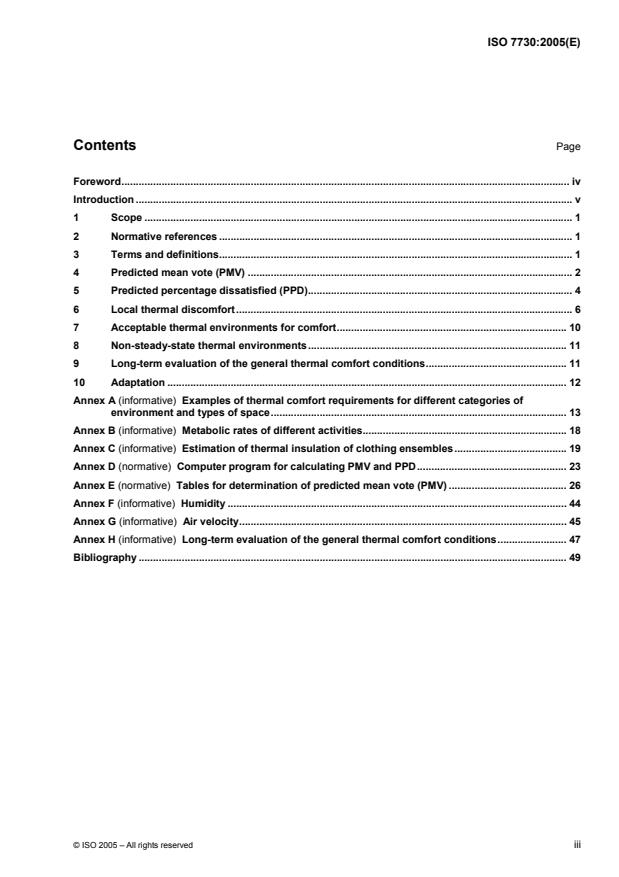
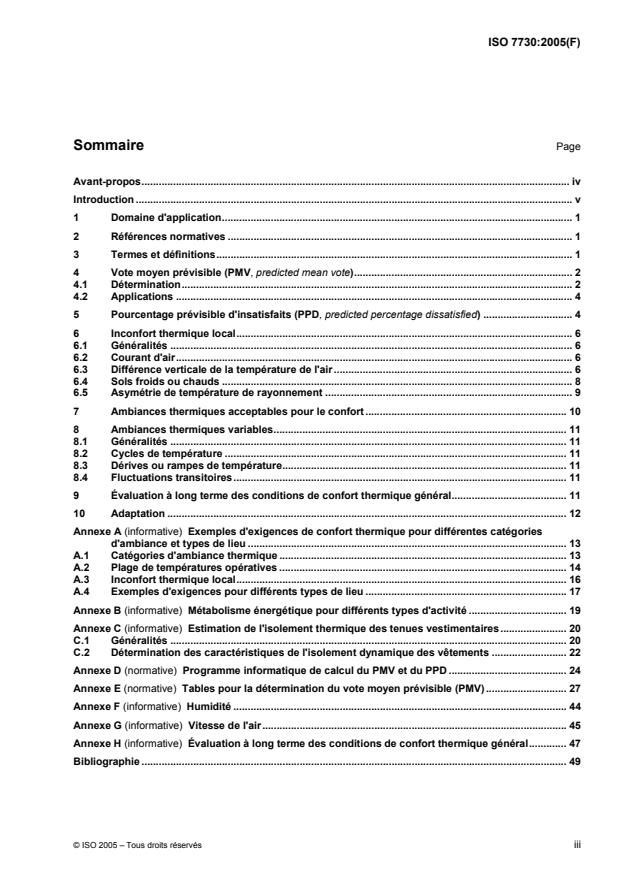
Contents Page
Foreword. iv
Introduction . v
1 Scope . 1
2 Normative references . 1
3 Terms and definitions. 1
4 Predicted mean vote (PMV) . 2
5 Predicted percentage dissatisfied (PPD). 4
6 Local thermal discomfort. 6
7 Acceptable thermal environments for comfort. 10
8 Non-steady-state thermal environments. 11
9 Long-term evaluation of the general thermal comfort conditions. 11
10 Adaptation . 12
Annex A (informative) Examples of thermal comfort requirements for different categories of
environment and types of space. 13
Annex B (informative) Metabolic rates of different activities. 18
Annex C (informative) Estimation of thermal insulation of clothing ensembles. 19
Annex D (normative) Computer program for calculating PMV and PPD. 23
Annex E (normative) Tables for determination of predicted mean vote (PMV) . 26
Annex F (informative) Humidity . 44
Annex G (informative) Air velocity. 45
Annex H (informative) Long-term evaluation of the general thermal comfort conditions. 47
Bibliography . 49
Foreword
ISO (the International Organization for Standardization) is a worldwide federation of national standards bodies
(ISO member bodies). The work of preparing International Standards is normally carried out through ISO
technical committees. Each member body interested in a subject for which a technical committee has been
established has the right to be represented on that committee. International organizations, governmental and
non-governmental, in liaison with ISO, also take part in the work. ISO collaborates closely with the
International Electrotechnical Commission (IEC) on all matters of electrotechnical standardization.
International Standards are drafted in accordance with the rules given in the ISO/IEC Directives, Part 2.
The main task of technical committees is to prepare International Standards. Draft International Standards
adopted by the technical committees are circulated to the member bodies for voting. Publication as an
International Standard requires approval by at least 75 % of the member bodies casting a vote.
Attention is drawn to the possibility that some of the elements of this document may be the subject of patent
rights. ISO shall not be held responsible for identifying any or all such patent rights.
ISO 7730 was prepared by Technical Committee ISO/TC 159, Ergonomics, Subcommittee SC 5, Ergonomics
of the physical environment.
This third edition cancels and replaces the second edition (ISO 7730:1994), which has been technically
revised. A method for long term evaluation has been added, as well as information on local thermal discomfort,
non-steady-state conditions and adaptation, and an annex stating how thermal comfort requirements can be
expressed in different categories.
iv © ISO 2005 – All rights reserved
Introduction
This International Standard covering the evaluation of moderate thermal environments was developed in
1)
parallel with the revised ASHRAE standard 55 and is one of a series of ISO documents specifying methods
for the measurement and evaluation of the moderate and extreme thermal environments to which human
beings are exposed (ISO 7243, ISO 7933 and ISO/TR 11079, all three dealing with extreme environmental
conditions, are others in the series).
A human being's thermal sensation is mainly related to the thermal balance of his or her body as a whole.
This balance is influenced by physical activity and clothing, as well as the environmental parameters: air
temperature, mean radiant temperature, air velocity and air humidity. When these factors have been
estimated or measured, the thermal sensation for the body as a whole can be predicted by calculating the
predicted mean vote (PMV). See Clause 4.
The predicted percentage dissatisfied (PPD) index provides information on thermal discomfort or thermal
dissatisfaction by predicting the percentage of people likely to feel too warm or too cool in a given environment.
The PPD can be obtained from the PMV. See Clause 5.
Thermal discomfort can also be caused by unwanted local cooling or heating of the body. The most common
local discomfort factors are radiant temperature asymmetry (cold or warm surfaces), draught (defined as a
local cooling of the body caused by air movement), vertical air temperature difference, and cold or warm floors.
Clause 6 specifies how to predict the percentage dissatisfied owing to local discomfort parameters.
Dissatisfaction can be caused by hot or cold discomfort for the body as a whole. Comfort limits can in this
case be expressed by the PMV and PPD indices. But thermal dissatisfaction can also be caused by local
thermal discomfort parameters. Clause 7 deals with acceptable thermal environments for comfort.
Clauses 6 and 7 are based mainly on steady-state conditions. Means of evaluating non-steady-state
conditions such as transients (temperature steps), cycling temperatures or temperature ramps are presented
in Clause 8. The thermal environments in buildings or at workplaces will change over time and it might not
always be possible to keep conditions within recommended limits. A method for long-term evaluation of
thermal comfort is given in Clause 9.
Clause 10 gives recommendations on how to take into account the adaptation of people when evaluating and
designing buildings and systems.
1) American Society of Heating, Refrigerating and Air-conditioning Engineers.
INTERNATIONAL STANDARD ISO 7730:2005(E)
Ergonomics of the thermal environment — Analytical
determination and interpretation of thermal comfort using
calculation of the PMV and PPD indices and local thermal
comfort criteria
1 Scope
This International Standard presents methods for predicting the general thermal sensation and degree of
discomfort (thermal dissatisfaction) of people exposed to moderate thermal environments. It enables the
analytical determination and interpretation of thermal comfort using calculation of PMV (predicted mean vote)
and PPD (predicted percentage of dissatisfied) and local thermal comfort criteria, giving the environmental
conditions considered acceptable for general thermal comfort as well as those representing local discomfort. It
is applicable to healthy men and women exposed to indoor environments where thermal comfort is desirable,
but where moderate deviations from thermal comfort occur, in the design of new environments or the
assessment of existing ones. Although developed specifically for the work environment, it is applicable to
other kinds of environment as well. It is intended to be used with reference to ISO/TS 14415:2005, 4.2, when
considering persons with special requirements, such as those with physical disabilities. Ethnic, national or
geographical differences need also to be taken into account when considering non-conditioned spaces.
2 Normative references
The following referenced documents are indispensable for the application of this document. For dated
references, only the edition cited applies. For undated references, the latest edition of the referenced
document (including any amendments) applies.
ISO 13731, Ergonomics of the thermal environment — Vocabulary and symbols
ISO/TS 13732-2, Ergonomics of the thermal environment — Methods for the assessment of human responses
to contact with surfaces — Part 2: Human contact with surfaces at moderate temperature
ISO/TS 14415:2005, Ergonomics of the thermal environment — Application of International Standards to
people with special requirements
3 Terms and definitions
For the purposes of this document, the terms and definitions given in ISO 13731 and the following apply.
3.1
temperature cycle
variable temperature with a given amplitude and frequency
3.2
drift temperature
passive monotonic, steady, non-cyclic change in the operative temperature of an enclosed space
3.3
ramp temperature
actively controlled monotonic, steady, non-cyclic change in the operative temperature of an enclosed space
3.4
operative temperature
t
o
uniform temperature of an imaginary black enclosure in which an occupant would exchange the same amount
of heat by radiation and convection as in the actual non-uniform environment
3.5
transient temperature
sudden change in the thermal conditions due to step change in temperature, humidity, activity or clothing
3.6
draught
unwanted local cooling of the body caused by air movement
4 Predicted mean vote (PMV)
4.1 Determination
The PMV is an index that predicts the mean value of the votes of a large group of persons on the 7-point
thermal sensation scale (see Table 1), based on the heat balance of the human body. Thermal balance is
obtained when the internal heat production in the body is equal to the loss of heat to the environment. In a
moderate environment, the human thermoregulatory system will automatically attempt to modify skin
temperature and sweat secretion to maintain heat balance.
Table 1 — Seven-point thermal sensation scale
+ 3 Hot
+ 2 Warm
+ 1 Slightly warm
0 Neutral
− 1 Slightly cool
−2 Cool
− 3 Cold
2 © ISO 2005 – All rights reserved
Calculate the PMV using Equations (1) to (4):
PMV=⋅0,303 exp(−0,036⋅M )+ 0,028⋅
⎡⎤
⎣⎦
⎧ ⎫
−3
⎡ ⎤⎡ ⎤
MW−− 3,05⋅10⋅ 5 733− 6,99⋅M−−W p− 0,42⋅ M−−W 58,15
() () ()
⎪ a ⎪
⎣ ⎦⎣ ⎦
⎪ ⎪
⎪ ⎪
−5
−1,7⋅10 ⋅⋅Mp5 867− − 0,0014⋅⋅M 34−t (1)
() ( )
⎨ ⎬
aa
⎪ ⎪
−8
⎡⎤
⎪ ⎪
−⋅3,96 10⋅ft⋅()+ 273−()t+ 273 −f⋅h⋅(t−t)
cl cl r cl c cl a
⎢⎥
⎪ ⎪
⎣⎦
⎩ ⎭
−8⎡⎤
tM=−35,7 0,028⋅ −W−I⋅ 3,96⋅10⋅f⋅t+ 273−t+ 273+f⋅h⋅t−t (2)
() ()() ( )
cl cl cl cl r cl c cl a
{}
⎢⎥
⎣⎦
0,25 0,25
⎧
2,38⋅−tt for 2,38⋅−tt > 12,1⋅v
cl a cl a ar
⎪
h = (3)
⎨
c
0,25
⎪
12,1⋅⋅vtfor 2,38−t<12,1⋅v
ar cl a ar
⎩
⎧
1,00+⋅1,290llfor u 0,078 m K/W
⎪ cl cl
f = (4)
⎨
cl
1,05+>0,645llfor 0,078 m⋅K/W
⎪
⎩ cl cl
where
M is the metabolic rate, in watts per square metre (W/m );
W is the effective mechanical power, in watts per square metre (W/m );
I is the clothing insulation, in square metres kelvin per watt (m ⋅ K/W);
cl
f is the clothing surface area factor;
cl
t is the air temperature, in degrees Celsius (°C);
a
t is the mean radiant temperature, in degrees Celsius (°C);
r
v is the relative air velocity, in metres per second (m/s);
ar
p is the water vapour partial pressure, in pascals (Pa);
a
h is the convective heat transfer coefficient, in watts per square metre kelvin [W/(m ⋅ K)];
c
t is the clothing surface temperature, in degrees Celsius (°C).
cl
2 2
NOTE 1 metabolic unit = 1 met = 58,2 W/m ; 1 clothing unit = 1 clo = 0,155 m ⋅ °C/W.
PMV may be calculated for different combinations of metabolic rate, clothing insulation, air temperature, mean
radiant temperature, air velocity and air humidity (see ISO 7726). The equations for t and h may be solved
cl c
by iteration.
The PMV index is derived for steady-state conditions but can be applied with good approximation during minor
fluctuations of one or more of the variables, provided that time-weighted averages of the variables during the
previous 1 h period are applied.
The index should be used only for values of PMV between −2 and +2, and when the six main parameters are
within the following intervals:
2 2
M 46 W/m to 232 W/m (0,8 met to 4 met);
2 2
I 0 m ⋅ K/W to 0,310 m ⋅ K/W (0 clo to 2 clo);
cl
t 10 °C to 30 °C;
a
t 10 °C to 40 °C;
r
v 0 m/s to 1 m/s;
ar
p 0 Pa to 2 700 Pa.
a
NOTE In respect of v , during light, mainly sedentary, activity, a mean velocity within this range can be felt as a
ar
draught.
Estimate the metabolic rate using ISO 8996 or Annex B, taking into account the type of work. For varying
metabolic rates, a time-weighted average should be estimated during the previous 1 h period. Estimate the
thermal resistance of clothing and chair using ISO 9920 or Annex C, taking into account the time of year.
Determine the PMV in one of the following ways.
a) From Equation (1) using a digital computer. A BASIC program is given in Annex D for this purpose. For
verification of other computer programs, Annex D provides example output.
b) Directly from Annex E, where tables of PMV values are given for different combinations of activity,
clothing, operative temperature and relative velocity.
c) By direct measurement, using an integrating sensor (equivalent and operative temperatures).
The PMV values given in Annex E apply for a relative humidity of 50 %. The influence of humidity on thermal
sensation is small at moderate temperatures close to comfort and may usually be disregarded when
determining the PMV value (see Annex F).
4.2 Applications
The PMV can be used to check whether a given thermal environment complies with comfort criteria (see
Clause 7 and Annex A), and to establish requirements for different levels of acceptability.
By setting PMV = 0, an equation is established which predicts combinations of activity, clothing and
environmental parameters which on average will provide a thermally neutral sensation.
5 Predicted percentage dissatisfied (PPD)
The PMV predicts the mean value of the thermal votes of a large group of people exposed to the same
environment. But individual votes are scattered around this mean value and it is useful to be able to predict
the number of people likely to feel uncomfortably warm or cool.
The PPD is an index that establishes a quantitative prediction of the percentage of thermally dissatisfied
people who feel too cool or too warm. For the purposes of this International Standard, thermally dissatisfied
people are those who will vote hot, warm, cool or cold on the 7-point thermal sensation scale given in Table 1.
With the PMV value determined, calculate the PPD using Equation (5), see Figure 1:
PPD=−100 95⋅ exp(−0,033 53⋅PMV− 0,217 9⋅PMV ) (5)
4 © ISO 2005 – All rights reserved
Key
PMV predicted mean vote
PPD predicted percentage dissatisfied, %
Figure 1 — PPD as function of PMV
The PPD predicts the number of thermally dissatisfied persons among a large group of people. The rest of the
group will feel thermally neutral, slightly warm or slightly cool. The predicted distribution of votes is given in
Table 2.
Table 2 — Distribution of individual thermal sensation votes for different values of mean vote
a
PMV PPD Persons predicted to vote
%
0 −1, 0 or +1 −2, −1, 0, +1 or +2
+2 75 5 25 70
+1 25 30 75 95
+0,5 10 55 90 98
0 5 60 95 100
−0,5 10 55 90 98
−1 25 30 75 95
−2 75 5 25 70
a
Based on experiments involving 1 300 subjects.
6 Local thermal discomfort
6.1 General
The PMV and PPD express warm and cold discomfort for the body as a whole. But thermal dissatisfaction can
also be caused by unwanted cooling or heating of one particular part of the body. This is known as local
discomfort. The most common cause of local discomfort is draught (6.2). But local discomfort can also be
caused by an abnormally high vertical temperature difference between the head and ankles (6.3), by too warm
or too cool a floor (6.4), or by too high a radiant temperature asymmetry (6.5). Annex A provides examples of
local and overall thermal comfort requirements for different categories of environment and types of space.
It is mainly people at light sedentary activity who are sensitive to local discomfort. These will have a thermal
sensation for the whole body close to neutral. At higher levels of activity, people are less thermally sensitive
and consequently the risk of local discomfort is lower.
6.2 Draught
The discomfort due to draught may be expressed as the percentage of people predicted to be bothered by
draught. Calculate the draught rate (DR) using Equation (6) (model of draught):
0,62
DR=−34 t v− 0,05 0,37⋅v⋅Tu+ 3,14 (6)
() a,l a,l
()()
a,l
For v < 0,05 m/s: use v = 0,05 m/s
a,l a,l
For DR > 100 %: use DR = 100 %
where
t is the local air temperature, in degrees Celsius, 20 °C to 26 °C;
a,l
v is the local mean air velocity, in metres per second, < 0,5 m/s;
a,l
Tu is the local turbulence intensity, in percent, 10 % to 60 % (if unknown, 40 % may be used).
The model applies to people at light, mainly sedentary activity with a thermal sensation for the whole body
close to neutral and for prediction of draught at the neck. At the level of arms and feet, the model could
overestimate the predicted draught rate. The sensation of draught is lower at activities higher than sedentary
(> 1,2 met) and for people feeling warmer than neutral. Additional information on the effect of air velocity can
be found in Annex G.
6.3 Vertical air temperature difference
A high vertical air temperature difference between head and ankles can cause discomfort. Figure 2 shows the
percentage dissatisfied (PD) as a function of the vertical air temperature difference between head and ankles.
The figure applies when the temperature increases upwards. People are less sensitive under decreasing
temperatures. Determine the PD using Equation (7):
(7)
PD=
1+−exp(5,76 0,856⋅∆t )
a,v
Equation (7), derived from the original data using logistic regression analysis, should only be used at
∆t < 8 °C.
a,v
6 © ISO 2005 – All rights reserved
Key
PD percentage dissatisfied, %
∆t vertical air temperature difference between head and feet, °C
a,v
Figure 2 — Local discomfort caused by vertical air temperature difference
6.4 Warm and cool floors
If the floor is too warm or too cool, the occupants could feel uncomfortable owing to thermal sensation of their
feet. For people wearing light indoor shoes, it is the temperature of the floor rather than the material of the
floor covering which is important for comfort. Figure 3 shows the percentage dissatisfied as a function of the
floor temperature, based on studies with standing and/or sedentary people.
Key
PD percentage dissatisfied, %
t floor temperature, °C
f
Figure 3 — Local thermal discomfort caused by warm or cold floors
For people sitting or lying on the floor, similar values may be used. Determine the PD using Equation (8),
derived from the original data using non-linear regression analysis:
PD=−100 94⋅ exp(−1,387+ 0,118⋅t− 0,002 5⋅t ) (8)
ff
For longer occupancy the results are not valid for electrically heated floors.
NOTE By electrical heating, a certain heat input is provided independent of the surface temperature. A water-based
heating system will not produce temperatures higher than the water temperature.
For spaces that people occupy with bare feet, see ISO/TS 13732-2.
8 © ISO 2005 – All rights reserved
6.5 Radiant asymmetry
Radiant asymmetry (∆t ) can also cause discomfort. People are most sensitive to radiant asymmetry caused
pr
by warm ceilings or cool walls (windows). Figure 4 shows the percentage dissatisfied as a function of the
radiant temperature asymmetry caused by a warm ceiling, a cool wall, a cool ceiling or by a warm wall. For
horizontal radiant asymmetry, Figure 4 applies from side-to-side (left/right or right/left) asymmetry, the curves
providing a conservative estimate of the discomfort: no other positions of the body in relation to the surfaces
(e.g. front/back) cause higher asymmetry discomfort. Determine the PD using Equations (9) to (12), as
applicable.
a) Warm ceiling
PD=− 5,5 (9)
1+−exp(2,84 0,174⋅∆t )
pr
∆t < 23 °C
pr
b) Cool wall
PD= (10)
1+−exp(6,61 0,345⋅∆t )
pr
∆t < 15 °C
pr
c) Cool ceiling
PD= (11)
1e+−xp(9,93 0,50⋅∆t )
pr
∆t < 15 °C
pr
d) Warm wall
PD=− 3,5 (12)
1+−exp(3,72 0,052⋅∆t )
pr
∆t < 35 °C
pr
Equations (9) to (12) were derived from the original data using logistic regression analysis, and should not be
used beyond the ranges shown above. Those for a) (warm ceiling) and for d) (warm wall) have been adjusted
to account for discomfort not caused by radiant asymmetry. See Figure 4.
Key
PD percentage dissatisfied, %
∆t radiant temperature asymmetry, °C
pr
1 Warm ceiling.
2 Cool wall.
3 Cool ceiling.
4 Warm wall.
Figure 4 — Local thermal discomfort caused by radiant temperature asymmetry
7 Acceptable thermal environments for comfort
Thermal comfort is that condition of mind which expresses satisfaction with the thermal environment.
Dissatisfaction can be caused by warm or cool discomfort of the body as a whole, as expressed by the PMV
and PPD, or by an unwanted cooling (or heating) of one particular part of the body.
Due to individual differences, it is impossible to specify a thermal environment that will satisfy everybody.
There will always be a percentage dissatisfied occupants. But it is possible to specify environments predicted
to be acceptable by a certain percentage of the occupants.
Often it will be the same persons who are sensitive to different types of local discomfort. For instance, a
person sensitive to draught may also be sensitive to local cooling caused by radiant asymmetry or by a cold
floor. Such a cold-sensitive person may also more easily experience cool discomfort for the body as a whole.
Therefore, the PPD, DR or PD caused by other types of local discomfort should not be added.
Due to local or national priorities, technical developments and climatic regions, a higher thermal quality (fewer
dissatisfied) or lower quality (more dissatisfied) in some cases may be accepted. In such cases, the PMV and
PPD, the model of draught, the relation between local thermal discomfort parameters (see Clause 6), and the
expected percentage of dissatisfied people may be used to determine different ranges of environmental
parameters for the evaluation and design of the thermal environment.
Examples of different categories of requirements are given in Annex A.
10 © ISO 2005 – All rights reserved
8 Non-steady-state thermal environments
8.1 General
The basis for the methods given in the preceding clauses is steady-state conditions. The thermal environment
is, however, often in a non-steady-state and the question arises as to whether the methods then apply. Three
types of non-steady-state conditions can occur: temperature cycles, temperature drifts or ramps, and
transients.
8.2 Temperature cycles
Temperature cycles can occur due to the control of the temperature in a space. If the peak-to-peak variation is
less than 1 K, there will be no influence on the comfort and the recommendations for steady-state may be
used. Higher peak variations can decrease comfort.
8.3 Temperature drifts or ramps
If the rate of temperature change for drifts or ramps is lower than 2,0 K/h, the methods for steady-state
variation apply.
8.4 Transients
In general, the following statements regarding transients can be made.
⎯ A step-change of operative temperature is felt instantaneously.
⎯ After an up-step in operative temperature, the new steady-state thermal sensation is experienced
immediately, i.e. the PMV-PPD can be used to predict comfort.
⎯ Following a down-step in operative temperature, the thermal sensation drops at first to a level beneath
the one predicted by PMV, then increases and reaches under steady-state conditions the steady-state
level after approximately 30 min, i.e. the PMV-PPD predicts values that are too high for the first 30 min.
The time to reach a new steady-state condition depends on the initial conditions.
9 Long-term evaluation of the general thermal comfort conditions
Different categories of general comfort may be specified as ranges for the PMV-PPD (see Annex A).
If these criteria are to be met, including extreme situations, the heating- and/or cooling capacity of any HVAC
(heating, ventilation, air-conditioning) installation should be relatively high. Economic and/or environmental
considerations can lead to acceptable limited time intervals during which the PMV will be allowed to stay
outside the specified ranges.
By computer simulation or measurements, comfort conditions are often tested during longer periods for
different types of building and/or HVAC design. The need here is to specify a characteristic value for the long-
term comfort conditions for comparison of designs and performances.
For this purpose, a non-exhaustive list of methods that could be applied is presented in Annex H.
10 Adaptation
In determining the acceptable range of operative temperature according to this International Standard, a
clothing insulation value that corresponds to the local clothing habits and climate shall be used.
In warm or cold environments, there can often be an influence due to adaptation. Apart from clothing, other
forms of adaptation, such as body posture and decreased activity, which are difficult to quantify, can result in
the acceptance of higher indoor temperatures. People used to working and living in warm climates can more
easily accept and maintain a higher work performance in hot environments than those living in colder climates
(see ISO 7933 and ISO 7243).
Extended acceptable environments may be applied for occupant-controlled, naturally conditioned, spaces in
warm climate regions or during warm periods, where the thermal conditions of the space are regulated
primarily by the occupants through the opening and closing of windows. Field experiments have shown that
occupants of such buildings could accept higher temperatures than those predicted by the PMV. In such
cases, the thermal conditions may be designed for higher PMV values than those given in Clause 6 and
Annex A.
12 © ISO 2005 – All rights reserved
Annex A
(informative)
Examples of thermal comfort requirements for different categories
of environment and types of space
A.1 Categories of thermal environment
The desired thermal environment for a space may be selected from among the three categories, A, B and C
according to Table A.1. All the criteria should be satisfied simultaneously for each category.
Table A.1 — Categories of thermal environment
Thermal state of the body as a whole Local discomfort
PPD PMV DR PD
% % %
Category
caused by
vertical air warm or cool radiant
temperature floor asymmetry
difference
A < 6 − 0,2 < PMV < + 0,2 < 10 < 3 < 10 < 5
B < 10 − 0,5 < PMV < + 0,5 < 20 < 5 < 10 < 5
C < 15 − 0,7 < PMV < + 0,7 < 30 < 10 < 15 < 10
Each category prescribes a maximum percentage dissatisfied for the body as a whole (PPD) and a PD for
each of the four types of local discomfort. Some requirements are difficult to meet in practice while others are
quite easily met. The different percentages express a balance struck between the aim of a few dissatisfied
and what is practically obtainable using existing technology.
Owing to the accuracy of instrumentation for measuring the input parameters, it can be difficult to verify that
the PMV conforms to the Class A category (−0,2 < PMV < +0,2). Instead, the verification may be based on the
equivalent operative temperature range, as specified in A.2 and in Table A.5.
The three categories presented in Table A.1 apply to spaces where persons are exposed to the same thermal
environment. It is an advantage if some kind of individual control of the thermal environment can be
established for each person in a space. Individual control of the local air temperature, mean radiant
temperature or air velocity can contribute to balancing the rather large differences between individual
requirements and consequently can lead to fewer dissatisfied.
Modification of the clothing can also contribute to balance individual differences. The effect on the optimum
operative temperature of adding or removing different garments is described in Table C.2.
A.2 Operative temperature range
For a given space there exists an optimum operative temperature corresponding to PMV = 0, depending on
the activity and the clothing of the occupants. Figure A.1 shows the optimum operative temperature and the
permissible temperature range as a function of clothing and activity for each of the three categories. The
optimum operative temperature is the same for the three categories, while the permissible range around the
optimum operative temperature varies.
The operative temperature at all locations within the occupied zone of a space should at all times be within the
permissible range. This means that the permissible range should cover both spatial and temporal variations,
including fluctuations caused by the control system.
Figure A.1 applies for a relative humidity of 50 %; however, in moderate environments the air humidity has
only a modest impact on the thermal sensation. Typically, a 10 % higher relative humidity and a 0,3 °C higher
operative temperature are perceived as being warmer in equal measure.
The PDs in Table A.1 are not additive. In practice, a higher or lower number of dissatisfied persons may be
found when using subjective questionnaires in field investigations (see ISO 10551).
The air velocity in the space is assumed to be < 0,1 m/s. The relative air velocity, v , caused by body
ar
movement is estimated to be zero for a metabolic rate, M, less than 1 met and v = 0,3 (M − 1) for M > 1 met.
ar
The diagrams are determined for a relative humidity = 50 %, but the humidity only has a slight influence on the
optimum and permissible temperature ranges.
A.3 Local thermal discomfort
Figure A.2 give ranges for local thermal discomfort parameters for the three categories presented in Table A.1.
The max. allowable mean air velocity is a function of local air temperature and turbulence intensity. The
turbulence intensity may vary between 30 % and 60 % in spaces with mixed-flow air distribution. In spaces
with displacement ventilation or without mechanical ventilation, the turbulence intensity may be lower.
Category A: PPD < 6 %
14 © ISO 2005 – All rights reserved
Category B: PPD < 10 %
Category C: PPD < 15 %
The diagrams also show the range around the optimum temperature for the three categories.
Key
PPD predicted percentage dissatisfied, %
X basic clothing insulation, in clothing units, (clo)
X′ basic clothing insulation, in clothing units, m⋅°C/W
Y metabolic rate, in metabolic units, (met)
Y′ metabolic rate, in metabolic units, W/m
Figure A.1 — Optimum operative temperature as function of clothing and activity
Category A: DR = 10 % Category B: DR = 20 % Category C: DR = 30 %
Key
t local air temperature, °C
a,l
v local mean air velocity, m/s
a,l
Tu turbulence intensity, %
Figure A.2 — Max. allowable mean air velocity as function of local air temperature
and turbulence intensity
Tables A.2, A.3 and A.4 give values for the local thermal discomfort causes: vertical air temperature difference,
warm/cold floor and radiant temperature asymmetry.
Table A.2 — Vertical air temperature difference between head and ankles
a
Category Vertical air temperature difference
°C
A < 2
B < 3
C < 4
a
1,1 and 0,1 m above floor.
Table A.3 — Range of floor temperature
Category Floor surface temperature range
°C
A 19 to 29
B 19 to 29
C 17 to 31
16 © ISO 2005 – All rights reserved
Table A.4 — Radiant temperature asymmetry
Category Radiant temperature asymmetry
°C
Warm ceiling Cool wall Cool ceiling Warm wall
A < 5 < 10 < 14 < 23
B < 5 < 10 < 14 < 23
C < 7 < 13 < 18 < 35
A.4 Design criteria for different types of space — Examples
The design criteria specified in Table A.5 are derived under certain assumptions. For the thermal environment,
the criteria for the operative temperature are based on typical levels of activity, for clothing of 0,5 clo during
summer (“cooling season”) and 1,0 clo during winter (“heating season”). The criteria for the mean air velocity
apply for a turbulence intensity of approximately 40 % (mixing ventilation). The design criteria are valid for the
occupancy conditions as given, but could also be applicable to other types of spaces used in similar ways.
Table A.5 — Example design criteria for spaces in various types of building
a
Type of Activity Category Operative temperature Maximum mean air velocity
building/space W/m °C m/s
Summer Winter Summer Winter
(cooling season) (heating season) (cooling season) (heating season)
Single office
A 24,5 ± 1,0 22,0 ± 1,0 0,12 0,10
Landscape office
Conference room
70 B 24,5 ± 1,5 22,0 ± 2,0 0,19 0,16
Auditorium
Cafeteria/restaurant
b
C 24,5 ± 2,5 22,0 ± 3,0 0,24 0,21
Classroom
b
Kindergarten 81 A 23,5 ± 1,0 20,0 ± 1,0 0,11 0,10
b
B 23,5 ± 2,0 22,0 ± 2,5 0,18 0,15
b
C 23,5 ± 2,5 22,0 ± 3,5 0,23 0,19
b
Department store 93 A 23,0 ± 1,0 19,0 ± 1,5 0,16 0,13
b
B 23,0 ± 2,0 19,0 ± 3,0 0,20 0,15
b
C 23,0 ± 3,0 19,0 ± 4,0 0,23 0,18
a
The maximum mean air velocity is based on a turbulence intensity of 40 % and air temperature equal to the operative temperature
according to 6.2 and Figure A.2. A relative humidity of 60 % and 40 % is used for summer and winter, respectively. For both summer
and winter a lower temperature in the range is used to determine the maximum mean air velocity.
b
Below 20 °C limit (see Figure A.2).
Annex B
(informative)
Metabolic rates of different activities
Further information on metabolic rates is given in ISO 8996. That elderly people often have a lower average
activity than younger people also needs to be taken into account.
Table B.1 — Metabolic rates
Activity Metabolic rate
W/m met
Reclining 46 0,8
Seated, relaxed 58 1,0
Sedentary activity (office, dwelling, school, laboratory) 70 1,2
Standing, light activity (shopping, laboratory, light industry) 93 1,6
Standing, medium activity (shop assistant, domestic work, machine work) 116 2,0
Walking on level ground:
2 km/h 110 1,9
3 km/h 140 2,4
4 km/h 165 2,8
5 km/h 200 3,4
18 © ISO 2005 – All rights reserved
Annex C
(informative)
Estimation of thermal insulation of clothing ensembles
C.1 General
The clothing insulation (I ) can be estimated directly from the data presented in Table C.1 for typical
cl
combinations of garments (the values are for static thermal insulation), or indirectly, by summation of the
partial insulation values for each item of clothing, I , as presented in Table C.2.
clu
Table C.2 gives the corresponding change in the optimum operative temperature necessary to maintain
thermal sensation at neutral when a garment is added or removed at light mainly sedentary activity (1,2 met).
For sedentary persons, the chair can contribute an additional insulation of 0 clo to 0,4 clo (see Table C.3).
Further information is given in ISO 9920.
Table C.1 — Thermal insulation for typical combinations of garments
Work clothing I Daily wear clothing I
cl cl
2 2
clo m ⋅ K/W clo m ⋅ K/W
Panties, T-shirt, shorts, light socks,
Underpants, boiler suit, socks, shoes 0,70 0,110 0,30 0,050
sandals
Underpants, shirt, boiler suit, socks, Underpants, shirt with short sleeves,
0,80 0,125 0,50 0,080
shoes light trousers, light socks, shoes
Underpants, shirt, trousers, smock, Panties, petticoat, stockings, dress,
0,90 0,140 0,70 0,105
socks, shoes shoes
Underwear with short sleeves and
Underwear, shirt, trousers, socks,
legs, shirt, trousers, jacket, socks, 1,00 0,155 0,70 0,110
shoes
shoes
Underwear with long legs and Panties, shirt, trousers, jacket, socks,
1,20 0,185 1,00 0,155
sleeves, thermo-jacket, socks, shoes shoes
Underwear with short sleeves and
legs, shirt, trousers, jacket, heavy Panties, stockings, blouse, long skirt,
1,40 0,220 1,10 0,170
quilted outer jacket and overalls, jacket, shoes
socks, shoes, cap, gloves
Underwear with short sleeves and
Underwear with long sleeves and
legs, shirt, trousers, jacket, heavy
2,00 0,310 legs, shirt, trousers, V-neck sweater, 1,30 0,200
quilted outer jacket and overalls,
jacket, socks, shoes
socks, shoes
Underwear with long sleeves and
legs, thermo-jacket and trousers, Underwear with short sleeves and
Parka with heavy quitting, overalls 2,55 0,395 legs, shirt, trousers, vest, jacket, coat, 1,50 0,230
with heave quilting, socks, shoes, socks, shoes
cap, gloves
Table C.2 — Thermal insulation for garments and changes of optimum operative temperature
Garment I Change of optimum operative
clu
temperature, °C
clo m ⋅ K/W
Underwear
Panties 0,03 0,005 0,2
Underpants with long legs 0,10 0,016 0,6
Singlet 0,04 0,006 0,3
T-shirt 0,09 0,014 0,6
Shirt with long sleeves 0,12 0,019 0,8
Panties and bra 0,03 0,005 0,2
Shirts/Blouses
Short sleeves 0,15 0,023 0,9
Light-weight, long sleeves 0,20 0,031 1,3
Normal, long sleeves 0,25 0,039 1,6
Flannel shirt, long sleeves 0,30 0,047 1,9
Light-weight blouse, long sleeves 0,15 0,023 0,9
Trousers
Shorts 0,06 0,009 0,4
Light-weight 0,20 0,031 1,3
Normal 0,25 0,039 1,6
Flannel 0,28 0,043 1,7
Dresses/Skirts
Light skirts (summer) 0,15 0,023 0,9
Heavy skirt (winter) 0,25 0,039 1,6
Light dress, short sleeves 0,20 0,031 1,3
Winter dress, long sleeves 0,40 0,062 2,5
Boiler suit 0,55 0,085 3,4
Sweaters
Sleeveless vest 0,12 0,019 0,8
Thin sweater 0,20 0,031 1,3
Sweater 0,28 0,043 1,7
Thick sweater 0,35 0,054 2,2
Jackets
Light, summer jacket 0,25 0,039 1,6
Jacket 0,35 0,054 2,2
Smock 0,30 0,047 1,9
High-insulative, fibre-pelt
Boiler suit 0,90 0,140 5,6
Trousers 0,35 0,054 2,2
Jacket 0,40 0,062 2,5
Vest 0,20 0,031 1,3
Outdoor clothing
Coat 0,60 0,093 3,7
Down jacket 0,55 0,085 3,4
Parka 0,70 0,109 4,3
Fibre-pelt overalls 0,55 0,085 3,4
Sundries
Socks 0,02 0,003 0,1
Thick, ankle socks 0,05 0,008 0,3
Thick, long socks 0,10 0,016 0,6
Nylon stockings 0,03 0,005 0,2
Shoes (thin soled) 0,02 0,003 0,1
Shoes (thick soled) 0,04 0,006 0,3
Boots 0,10 0,016 0,6
Gloves 0,05 0,008 0,3
20 © ISO 2005 – All rights reserved
Table C.3 — Thermal insulation values for chairs
Type of chair I
clu
clo m ⋅ K/W
Net/metal chair 0,00 0,00
Wooden stool 0,01 0,002
Standard office chair 0,1 0,016
Executive chair 0,15 0,023
The values given in Table C.3 may be added to individual garment insulation values taken from Table C.2 or
to the ensemble values from Table C.1.
C.2 Determination of dynamic insulation characteristics of clothing
The activity as well as ventilation modify the insulation characteristics of the clothing and the adjacent air layer.
Both wind and body movement reduce the insulation, which therefore needs to be corrected. The correction
factor for the static total clothing insulation and the external air layer insulation can be estimated using
Equations (B.1) to (B.3).
For a clothed person in normal or light clothing (0,6 < I < 1,4 clo or 1,2 < I < 2,0 clo):
cl T
⎡⎤
I =⋅ICorr,I ex=⋅I p−0,281⋅(v−0,15)+0,44⋅(v−0,15)−0,492⋅v+0,176⋅v (B.1)
T,r T T T ar ar ww
⎣⎦
where
I is the resultant total clothing insulation, in square metres kelvin per watt or clothing units
T,r
...
NORME ISO
INTERNATIONALE 7730
Troisième édition
2005-11-15
Ergonomie des ambiances thermiques —
Détermination analytique et interprétation
du confort thermique par le calcul des
indices PMV et PPD et par des critères de
confort thermique local
Ergonomics of the thermal environment — Analytical determination and
interpretation of thermal comfort using calculation of the PMV and PPD
indices and local thermal comfort criteria
Numéro de référence
©
ISO 2005
PDF – Exonération de responsabilité
Le présent fichier PDF peut contenir des polices de caractères intégrées. Conformément aux conditions de licence d'Adobe, ce fichier
peut être imprimé ou visualisé, mais ne doit pas être modifié à moins que l'ordinateur employé à cet effet ne bénéficie d'une licence
autorisant l'utilisation de ces polices et que celles-ci y soient installées. Lors du téléchargement de ce fichier, les parties concernées
acceptent de fait la responsabilité de ne pas enfreindre les conditions de licence d'Adobe. Le Secrétariat central de l'ISO décline toute
responsabilité en la matière.
Adobe est une marque déposée d'Adobe Systems Incorporated.
Les détails relatifs aux produits logiciels utilisés pour la création du présent fichier PDF sont disponibles dans la rubrique General Info
du fichier; les paramètres de création PDF ont été optimisés pour l'impression. Toutes les mesures ont été prises pour garantir
l'exploitation de ce fichier par les comités membres de l'ISO. Dans le cas peu probable où surviendrait un problème d'utilisation,
veuillez en informer le Secrétariat central à l'adresse donnée ci-dessous.
© ISO 2005
Droits de reproduction réservés. Sauf prescription différente, aucune partie de cette publication ne peut être reproduite ni utilisée sous
quelque forme que ce soit et par aucun procédé, électronique ou mécanique, y compris la photocopie et les microfilms, sans l'accord écrit
de l'ISO à l'adresse ci-après ou du comité membre de l'ISO dans le pays du demandeur.
ISO copyright office
Case postale 56 • CH-1211 Geneva 20
Tel. + 41 22 749 01 11
Fax. + 41 22 749 09 47
E-mail copyright@iso.org
Web www.iso.org
Publié en Suisse
ii © ISO 2005 – Tous droits réservés
Sommaire Page
Avant-propos. iv
Introduction . v
1 Domaine d'application. 1
2 Références normatives. 1
3 Termes et définitions. 1
4 Vote moyen prévisible (PMV, predicted mean vote). 2
4.1 Détermination. 2
4.2 Applications . 4
5 Pourcentage prévisible d'insatisfaits (PPD, predicted percentage dissatisfied) . 4
6 Inconfort thermique local. 6
6.1 Généralités. 6
6.2 Courant d'air. 6
6.3 Différence verticale de la température de l'air . 6
6.4 Sols froids ou chauds . 8
6.5 Asymétrie de température de rayonnement . 9
7 Ambiances thermiques acceptables pour le confort. 10
8 Ambiances thermiques variables. 11
8.1 Généralités. 11
8.2 Cycles de température . 11
8.3 Dérives ou rampes de température. 11
8.4 Fluctuations transitoires. 11
9 Évaluation à long terme des conditions de confort thermique général. 11
10 Adaptation. 12
Annexe A (informative) Exemples d'exigences de confort thermique pour différentes catégories
d'ambiance et types de lieu . 13
A.1 Catégories d'ambiance thermique . 13
A.2 Plage de températures opératives . 14
A.3 Inconfort thermique local. 16
A.4 Exemples d'exigences pour différents types de lieu . 17
Annexe B (informative) Métabolisme énergétique pour différents types d'activité . 19
Annexe C (informative) Estimation de l'isolement thermique des tenues vestimentaires. 20
C.1 Généralités. 20
C.2 Détermination des caractéristiques de l'isolement dynamique des vêtements . 22
Annexe D (normative) Programme informatique de calcul du PMV et du PPD . 24
Annexe E (normative) Tables pour la détermination du vote moyen prévisible (PMV) . 27
Annexe F (informative) Humidité . 44
Annexe G (informative) Vitesse de l'air. 45
Annexe H (informative) Évaluation à long terme des conditions de confort thermique général. 47
Bibliographie . 49
Avant-propos
L'ISO (Organisation internationale de normalisation) est une fédération mondiale d'organismes nationaux de
normalisation (comités membres de l'ISO). L'élaboration des Normes internationales est en général confiée
aux comités techniques de l'ISO. Chaque comité membre intéressé par une étude a le droit de faire partie du
comité technique créé à cet effet. Les organisations internationales, gouvernementales et non
gouvernementales, en liaison avec l'ISO participent également aux travaux. L'ISO collabore étroitement avec
la Commission électrotechnique internationale (CEI) en ce qui concerne la normalisation électrotechnique.
Les Normes internationales sont rédigées conformément aux règles données dans les Directives ISO/CEI,
Partie 2.
La tâche principale des comités techniques est d'élaborer les Normes internationales. Les projets de Normes
internationales adoptés par les comités techniques sont soumis aux comités membres pour vote. Leur
publication comme Normes internationales requiert l'approbation de 75 % au moins des comités membres
votants.
L'attention est appelée sur le fait que certains des éléments du présent document peuvent faire l'objet de
droits de propriété intellectuelle ou de droits analogues. L'ISO ne saurait être tenue pour responsable de ne
pas avoir identifié de tels droits de propriété et averti de leur existence.
L'ISO 7730 a été élaborée par le comité technique ISO/TC 159, Ergonomie, sous-comité SC 5, Ergonomie de
l'environnement physique.
Cette troisième édition annule et remplace la deuxième édition (ISO 7730:1994), qui a fait l'objet d'une
révision technique. Une méthode d'évaluation à long terme a été ajoutée, ainsi que des informations sur les
inconforts thermiques locaux, sur les ambiances thermiques variables et sur l'adaptation. Une annexe
informative, indiquant comment les exigences de confort thermique peuvent être exprimées dans différentes
catégories, a également été ajoutée.
iv © ISO 2005 – Tous droits réservés
Introduction
La présente Norme internationale traite de l'évaluation des ambiances thermiques modérées. Elle a été
1)
développée en parallèle avec la norme «standard 55» de l'ASHRAE , et elle fait partie d'une série de
documents ISO spécifiant des méthodes de mesure et d'évaluation des ambiances thermiques modérées et
extrêmes, auxquelles l'homme est exposé (l'ISO 7243, l'ISO 7933 et l'ISO/TR 11079, qui traitent des
ambiances thermiques extrêmes, font également partie de cette série de documents).
Les sensations thermiques de l'homme sont liées principalement à l'équilibre thermique du corps dans son
ensemble. Cet équilibre est influencé par son activité physique et par son vêtement ainsi que par les
paramètres de l'environnement: température de l'air, température moyenne de rayonnement, vitesse de l'air et
humidité de l'air. Lorsque ces facteurs ont été estimés ou mesurés, la sensation thermique du corps considéré
dans son ensemble peut être prédite en calculant l'indice PMV (vote moyen prévisible, de l'anglais predicted
mean vote). Voir l'Article 4.
L'indice PPD (pourcentage prévisible d'insatisfaits, de l'anglais predicted percentage dissatisfied) donne des
informations sur l'inconfort thermique ou l'insatisfaction thermique, en estimant le pourcentage de personnes
susceptibles d'avoir trop chaud ou trop froid dans une ambiance donnée. Le PPD peut être déterminé à partir
du PMV. Voir l'Article 5.
L'inconfort thermique peut aussi être causé par un refroidissement ou un réchauffement local non désiré du
corps. Les causes d'inconfort local les plus courantes sont l'asymétrie de température de rayonnement
(surfaces froides ou chaudes), le courant d'air (défini comme un refroidissement local du corps causé par un
déplacement d'air), les différences verticales de température et les sols froids ou chauds. L'Article 6 spécifie
comment prédire le pourcentage d'insatisfaits du fait d'un inconfort local.
L'insatisfaction peut être causée par un inconfort chaud ou froid du corps considéré dans son ensemble. Les
limites de confort peuvent, dans ce cas, être exprimées par les indices PMV et PPD. Mais l'insatisfaction
thermique peut aussi être causée par des paramètres d'inconfort thermique local. L'Article 7 traite des
ambiances thermiques acceptables pour le confort.
Les Articles 6 et 7 traitent essentiellement des conditions stationnaires. L'Article 8 présente les méthodes
d'évaluation de conditions non stationnaires, comme les fluctuations transitoires (échelons de température),
les variations cycliques de température ou les rampes de température. Les ambiances thermiques des
immeubles ou des bureaux fluctuent et il n'est pas toujours possible de maîtriser ces fluctuations dans des
limites recommandées. L'Article 9 présente une méthode d'évaluation à long terme du confort thermique.
L'Article 10 donne des recommandations sur la manière de prendre en compte l'adaptation des personnes
lors de l'évaluation et de la conception des immeubles et des systèmes.
1) American Society oh Heating, Refrigerating and Air-conditioning Engineers.
NORME INTERNATIONALE ISO 7730:2005(F)
Ergonomie des ambiances thermiques — Détermination
analytique et interprétation du confort thermique par le calcul
des indices PMV et PPD et par des critères de confort
thermique local
1 Domaine d'application
La présente Norme internationale présente des méthodes de prévision de la sensation thermique générale et
du degré d'inconfort (insatisfaction thermique) général des personnes exposées à des ambiances thermiques
modérées. Elle permet de déterminer analytiquement et d'interpréter le confort thermique, par le calcul des
indices PMV et PPD et par des critères de confort thermique local, donnant les conditions des ambiances
thermiques considérées acceptables du point de vue du confort thermique général et les conditions
représentant les inconforts locaux. Elle est applicable aux hommes et aux femmes en bonne santé, exposés à
des ambiances intérieures où le confort thermique est recherché, mais où des écarts modérés dudit confort
thermique peuvent se produire, pour concevoir de nouvelles ambiances ou pour évaluer les ambiances
existantes. Spécifiquement développée pour les environnements de travail, elle peut cependant être
appliquée à d'autres types d'environnement. Elle est censée être utilisée avec une référence à
l'ISO/TS 14415:2005, 4.2, eu égard aux personnes ayant des exigences particulières, dont les personnes
physiquement handicapées. Il s'avère également nécessaire de prendre en compte les différences ethniques,
nationales et géographiques, lorsqu'on considère les espaces non climatisés.
2 Références normatives
Les documents de référence suivants sont indispensables pour l'application du présent document. Pour les
références datées, seule l'édition citée s'applique. Pour les références non datées, la dernière édition du
document de référence s'applique (y compris les éventuels amendements).
ISO 13731, Ergonomie des ambiances thermiques — Vocabulaire et symboles
ISO/TS 13732-2, Ergonomie des ambiances thermiques — Méthodes d'évaluation de la réponse humaine au
contact avec des surfaces — Partie 2: Contact humain avec des surfaces à température modérée
ISO/TS 14415:2005, Ergonomie des ambiances thermiques — Application des Normes internationales aux
personnes ayant des exigences particulières
3 Termes et définitions
Pour les besoins du présent document, les termes et définitions donnés dans l'ISO 13731 ainsi que les
suivants s'appliquent.
3.1
cycle de température
variation de la température, d'amplitude et de fréquence données
3.2
dérive de température
évolution passive, monotone, stable et non cyclique de la température opérative d'un lieu clos
3.3
rampe de température
variation contrôlée, monotone, stable et non cyclique de la température opérative d'un lieu clos
3.4
température opérative
t
o
température uniforme d'une enceinte noire virtuelle dans laquelle l'occupant échangerait la même quantité de
chaleur par rayonnement plus convection que dans l'environnement réel non uniforme
3.5
fluctuation transitoire
changement soudain des conditions thermiques dû à des changements par paliers de la température, de
l'humidité, de l'activité ou de l'habillement
3.6
courant d'air
refroidissement local non désiré du corps provoqué par un déplacement d'air
4 Vote moyen prévisible (PMV, predicted mean vote)
4.1 Détermination
Le PMV est un indice qui donne la valeur moyenne des votes d'un groupe important de personnes exprimant
leur sensation thermique sur une échelle à 7 niveaux (voir Tableau 1). Il est basé sur le bilan thermique du
corps humain. L'équilibre thermique est atteint lorsque la production interne de chaleur dans le corps est
égale à la perte de chaleur vers l'ambiance. Dans une ambiance modérée, le système de thermorégulation
humain tentera automatiquement de modifier la température cutanée et la sécrétion sudorale pour maintenir
l'équilibre thermique.
Tableau 1 — Échelle de sensation thermique à sept niveaux
+ 3 Chaud
+ 2 Tiède
+ 1 Légèrement tiède
0 Neutre
− 1 Légèrement frais
− 2 Frais
Froid
− 3
2 © ISO 2005 – Tous droits réservés
Calculer le PMV en utilisant les Équations (1) à (4):
PMV=⋅0,303 exp(−0,036⋅ M )+ 0,028⋅
⎡⎤
⎣⎦
⎧ ⎫
−3
⎡ ⎤
(MW−−) 3,05⋅10⋅⎡⎤5 733− 6,99⋅(M−W )−p − 0,42⋅ M−W− 58,15
()
⎣⎦a
⎪ ⎣ ⎦⎪
⎪ ⎪
−5
−⋅1,7 10 ⋅Mp⋅(5 867− )− 0,0014⋅M⋅(34−t ) (1)
⎨ ⎬
aa
⎪ ⎪
−84⎡⎤
⎪−⋅3,96 10⋅ft⋅ + 273− (t+ 273)−f⋅h⋅(t−t ) ⎪
()
cl cl r cl c cl a
⎢⎥
⎣⎦
⎩ ⎭
−84⎡⎤
tM=−35,7 0,028⋅(−W )−I⋅ 3,96⋅10⋅f⋅t+ 273− (t+ 273)+f⋅h⋅(t−t ) (2)
()
cl cl cl cl r cl c cl a
{}
⎢⎥
⎣⎦
0,25 0,25
⎧
2,38⋅−tt pour 2,38⋅−tt > 12,1⋅v
cl a cl a ar
⎪
h = (3)
⎨
c
0,25
⎪
12,1⋅⋅vt pour 2,38−t< 12,1⋅v
ar cl a ar
⎩
⎧
1,00+⋅1,290ll pour u 0,078 m K/W
⎪ cl cl
f = (4)
⎨
cl
1,05+>0,645ll pour 0,078 m⋅K/W
⎪
⎩ cl cl
où
M est le métabolisme énergétique, en watts par mètre carré (W/m );
W est la puissance mécanique utile, en watts par mètre carré (W/m );
I est l'isolement thermique du vêtement, en mètres carrés kelvins par watt [m⋅K/W)];
cl
f est le facteur de surface du vêtement;
cl
t est la température de l'air, en degrés Celsius (°C);
a
t est la température moyenne de rayonnement, en degrés Celsius (°C);
r
v est la vitesse relative de l'air, en mètres par seconde (m/s);
ar
p est la pression partielle de vapeur d'eau, en pascals (Pa);
a
h est le coefficient d'échange de chaleur par convection, en watts par mètre carré kelvin W/(m⋅K);
c
t est la température de la surface externe du vêtement, en degrés Celsius (°C).
cl
2 2
NOTE 1 unité métabolique = 1 met = 58,2 W/m ; 1 unité vestimentaire = 1 clo = 0,155 m⋅°C/W.
Le PMV peut être calculé pour différentes combinaisons de métabolisme énergétique, isolement thermique,
température de l'air, température moyenne de rayonnement, vitesse de l'air et humidité de l'air (voir
l'ISO 7726). Les équations pour t et h peuvent être résolues par itération.
cl c
L'indice PMV a été établi pour des valeurs stationnaires de ces différentes variables, mais il peut être
déterminé avec une bonne approximation lorsqu'une ou plusieurs variables fluctuent faiblement, à condition
de considérer leurs moyennes pondérées en fonction du temps pendant l'heure précédente.
II est recommandé d'utiliser l'indice PMV uniquement pour des valeurs de PMV comprises entre − 2 et + 2. De
plus, il est recommandé de n'utiliser l'indice PMV que lorsque les six principaux paramètres sont compris dans
les intervalles suivants:
2 2
M 46 W/m à 232 W/m (0,8 met à 4 met);
2 2
I 0 m⋅K/W à 0,310 m⋅K/W (0 clo à 2 clo);
cl
t 10 °C à 30 °C;
a
t 10 °C à 40 °C;
r
v 0 m/s à 1 m/s;
ar
p 0 Pa à 2 700 Pa.
a
NOTE En ce qui concerne v , durant une activité légère essentiellement sédentaire, une vitesse moyenne dans cette
ar
plage peut être ressentie comme un courant d’air.
Estimer le métabolisme énergétique à l'aide de l'ISO 8996 ou de l'Annexe B, en tenant compte du type de
travail. Pour des métabolismes énergétiques variables, il est recommandé d'estimer une valeur moyenne
pondérée en fonction du temps sur l'heure précédente. Estimer la résistance thermique des vêtements et du
siège à l'aide de l'ISO 9920 ou de l'Annexe C, en tenant compte de la période de l'année.
Déterminer le PMV selon l'une des manières suivantes.
a) À partir de l'Équation (1), à l'aide d'un ordinateur. Un programme en BASIC est donné dans l'Annexe D.
Le Tableau D.1 fournit des exemples de résultats permettant de valider d'autres programmes
informatiques.
b) Directement à partir de l'Annexe E, où des tables de valeurs de PMV sont données pour différentes
combinaisons d'activité, d'habillement, de température opérative et de vitesse relative.
c) Par mesure directe, en utilisant un capteur intégrateur (température opérative et température équivalente).
Les valeurs figurant dans l'Annexe E correspondent à une humidité relative de 50 %. L'influence de l'humidité
sur la sensation thermique est faible à des températures modérées proches du confort et peut habituellement
être négligée pour évaluer la valeur du PMV (voir l'Annexe F).
4.2 Applications
L'indice PMV peut être utilisé pour vérifier si une ambiance thermique donnée est conforme aux critères de
confort (voir l'Article 7 et l'Annexe A) et pour formuler des exigences relatives à différents niveaux
d'acceptabilité.
En fixant PMV = 0, on établit une relation permettant de prévoir des combinaisons de l'activité, du vêtement et
des paramètres de l'environnement, qui, en moyenne, doivent procurer une sensation thermique neutre.
5 Pourcentage prévisible d'insatisfaits (PPD, predicted percentage dissatisfied)
L'indice PMV est une estimation de la valeur moyenne des votes de sensation thermique donnés par un
groupe important de personnes exposées à la même ambiance. Mais les votes individuels sont dispersés
autour de cette valeur moyenne et il peut être utile de prévoir le nombre de personnes susceptibles de
ressentir un inconfort chaud ou froid.
L'indice PPD établit une prévision quantitative du pourcentage de personnes insatisfaites thermiquement,
susceptibles d'avoir trop chaud ou trop froid. Dans la présente Norme internationale, les personnes
insatisfaites thermiquement sont celles qui votent chaud, tiède, frais ou froid sur l'échelle de sensation
thermique à sept niveaux du Tableau 1.
Lorsque la valeur du PMV a été déterminée, calculer le PPD à partir de l'Équation (5), voir la Figure 1:
PPD=−100 95⋅ exp−0,033 53⋅ PMV− 0,217 9⋅ PMV (5)
()
4 © ISO 2005 – Tous droits réservés
Légende
PMV vote moyen prévisible
PPD pourcentage prévisible d'insatisfaits, %
Figure 1 — PPD en fonction du PMV
L'indice PPD prévoit le nombre de personnes insatisfaites thermiquement parmi un groupe important de
personnes. Le reste du groupe se sentira thermiquement neutre, légèrement tiède ou légèrement frais. La
distribution prévisible des votes est donnée dans le Tableau 2.
Tableau 2 — Distribution des votes individuels de sensation thermique
pour diverses valeurs du vote moyen
a
Pourcentage prévu de personnes votant
%
PMV PPD
− 1, 0 ou + 1 − 2, − 1, 0, + 1 ou + 2
+ 2 75 5 25 70
+ 1 25 30 75 95
+ 0,5 10 55 90 98
0 5 60 95 100
− 0,5 10 55 90 98
− 1 25 30 75 95
− 2 75 5 25 70
a
Basé sur une expérimentation comprenant 1 300 sujets.
6 Inconfort thermique local
6.1 Généralités
Les indices PMV et PPD expriment les inconforts dus à des températures froides ou chaudes pour le corps
considéré dans son ensemble. Mais l'insatisfaction thermique peut également résulter d'un refroidissement ou
réchauffement local non désiré du corps: c'est l'inconfort local. La cause la plus fréquente de l'inconfort local
est le courant d'air (6.2). Mais l'inconfort local peut également être causé par une différence verticale de
température entre la tête et les chevilles anormalement grande (6.3), par un sol trop chaud ou trop froid (6.4)
ou par une asymétrie de température de rayonnement excessive (6.5). L'Annexe A fournit des exemples
d'exigences en matière de confort thermique local et général pour différentes catégories d'ambiance et
différents types d'espace.
Ce sont souvent les personnes en activité sédentaire légère qui sont sensibles aux inconforts locaux. Ce
groupe de personnes a une sensation thermique pour l'ensemble du corps proche de la neutralité. Pour des
niveaux d'activité supérieurs, les personnes sont thermiquement moins sensibles et par conséquent le risque
d'inconfort local est moindre.
6.2 Courant d'air
La gêne par courant d'air peut être exprimée par le pourcentage prévisible de la population se déclarant
dérangé par ce courant d'air. Calculer la gêne par courant d'air, DR (de l'anglais draught rate), à partir de
l'Équation (6) (modèle d'évaluation de la gêne par courant d'air):
0,62
DR=−34 t v− 0,05 0,37⋅ v⋅Tu+ 3,14 (6)
()()()
a,l a,l a,l
Pour v < 0,05 m/s, utiliser v = 0,05 m/s
a,l a,l
Si DR > 100 %, utiliser DR = 100 %
où
t est la température locale de l'air, en degrés Celsius, 20 °C à 26 °C;
a,l
v est la vitesse moyenne locale de l'air, en mètres par seconde, < 0,5 m/s;
a,l
Tu est l'intensité locale de turbulence, en pourcentage, 10 % à 60 % (si la valeur n'est pas connue, il est
possible d'utiliser 40 %).
Le modèle s'applique aux sujets dont l'activité est légère, essentiellement sédentaire, et dont la sensation
thermique est proche de la neutralité pour le corps entier, pour prédire une éventuelle gêne par courant d'air
au niveau du cou. Au niveau des bras et des pieds, le modèle peut surestimer les prévisions de gêne par
courant d'air. La sensation de gêne par courant d'air est plus faible pour des activités plus intenses que le
travail sédentaire (> 1,2 met) et pour des sujets estimant avoir plus chaud qu'à la neutralité thermique. De
plus amples informations sur les effets de la vitesse de l'air sont répertoriées dans l'Annexe G.
6.3 Différence verticale de la température de l'air
Une forte différence verticale de la température de l'air entre la tête et les chevilles peut être à l'origine d'un
inconfort. La Figure 2 représente le pourcentage de personnes insatisfaites (PD, de l'anglais percentage
dissatisfied) en fonction de la différence verticale de température de l'air entre la tête et les chevilles. La figure
s'applique lorsque la température augmente dans le sens de la hauteur. Les personnes sont moins sensibles
à ce type de gêne lorsque la température décroît avec la hauteur. Déterminer le PD au moyen de
l'Équation (7):
PD= (7)
1+−exp(5,76 0,856⋅∆t
a,v
6 © ISO 2005 – Tous droits réservés
L'Équation (7) a été établie à partir des données d'origine par une analyse de régression logistique. Il convient
d'utiliser l'Équation (7) uniquement lorsque ∆t < 8 °C.
a,v
Légende
PD pourcentage d'insatisfaits, %
∆t différence verticale de la température de l'air entre la tête et les pieds, °C
a,v
Figure 2 — Inconfort local causé par une différence verticale de la température de l'air
6.4 Sols froids ou chauds
Si le sol est trop chaud ou trop froid, les personnes peuvent ressentir de l'inconfort du fait de la sensation
thermique au niveau des pieds. Pour celles qui portent des chaussures d'intérieur légères, c'est la
température du sol plus que la nature du revêtement du sol qui influe sur le confort. La Figure 3 représente le
pourcentage d'insatisfaits en fonction de la température du sol. Ce diagramme est basé sur des études
menées sur des personnes sédentaires et/ou debout.
Légende
PD pourcentage d'insatisfaits, %
t température du sol, °C
f
Figure 3 — Inconfort thermique local causé par des sols chauds ou froids
Des valeurs similaires peuvent être utilisées pour les personnes assises ou allongées par terre. Déterminer le
pourcentage d'insatisfaits au moyen de l'Équation (8), établie à partir des données d'origine par une analyse
de régression non linéaire:
PD=−100 94⋅ exp−1,387+ 0,118⋅ t− 0,002 5⋅ t (8)
()
ff
En cas de période plus longue, les résultats ne sont pas valables dans le cas d'un chauffage électrique par le
sol.
NOTE Le chauffage électrique fournit un certain apport de chaleur indépendant de la température de surface. Un
système de chauffage à circulation d’eau ne génèrera pas de températures supérieures à la température de l’eau.
Pour des lieux où les personnes sont pieds nus, voir l'ISO/TS 13732-2.
8 © ISO 2005 – Tous droits réservés
6.5 Asymétrie de température de rayonnement
L'asymétrie de température de rayonnement (∆t ) peut également générer un inconfort. Les individus sont
pr
plus sensibles à l'asymétrie de rayonnement causée par des plafonds chauds ou des murs (fenêtres) froids.
La Figure 4 représente le pourcentage d'insatisfaits en fonction de l'asymétrie de température de
rayonnement causée par un plafond chaud, un mur froid, un plafond froid ou un mur chaud. Pour l'asymétrie
de rayonnement horizontale, la Figure 4 se rapporte à une asymétrie latérale (gauche/droite ou droite/gauche).
Les courbes fournissent alors une estimation conservatrice de l'inconfort et aucune autre position du corps
par rapport aux surfaces (par exemple avant/arrière) n'entraînera un plus grand inconfort lié à l'asymétrie.
Déterminer le pourcentage d'insatisfaits au moyen des Équations (9) à (12):
a) Plafond chaud
PD=− 5,5 (9)
1+−exp (2,84 0,174⋅∆t )
pr
∆t < 23 °C
pr
b) Mur froid
PD= (10)
1+−exp (6,61 0,345⋅∆t )
pr
∆t < 15 °C
pr
c) Plafond froid
PD= (11)
1+−exp (9,93 0,50⋅∆t )
pr
∆t < 15 °C
pr
d) Mur chaud
PD=− 3,5 (12)
1+−exp (3,72 0,052⋅∆t )
pr
∆t < 35 °C
pr
Les Équations (9) à (12) ont été établies à partir des données d'origine par une analyse de régression
logistique. Il convient de ne pas utiliser les Équations (9) à (12) au-delà des plages indiquées ci-dessus. Les
équations pour a) (plafond chaud) et pour d) (mur chaud) ont été ajustées pour tenir compte de l'inconfort qui
n'est pas dû à l'asymétrie de température de rayonnement. Voir la Figure 4.
Légende
PD pourcentage d'insatisfaits, %
∆t asymétrie de température de rayonnement, °C
pr
1 plafond chaud
2 mur froid
3 plafond froid
4 mur chaud
Figure 4 — Inconfort thermique local causé par l'asymétrie de température de rayonnement
7 Ambiances thermiques acceptables pour le confort
Le confort thermique est défini comme la satisfaction exprimée quant à l'ambiance thermique. L'insatisfaction
peut être causée par un inconfort «tiède» ou «frais» pour le corps dans son ensemble, exprimé par les indices
PMV et PPD. Mais l'insatisfaction thermique peut également être causée par un refroidissement (ou
réchauffement) non désiré de parties spécifiques du corps.
En raison des différences existant d'un individu à l'autre, il est impossible de spécifier une ambiance
thermique qui puisse satisfaire chacun. Il restera toujours un pourcentage de personnes insatisfaites. Mais il
est possible de spécifier des ambiances pré-estimées comme acceptables par un certain pourcentage
d'occupants.
Ce sont souvent les mêmes personnes qui sont sensibles à différents types d'inconfort local. Par exemple,
une personne sensible aux courants d'air peut également être sensible au refroidissement local causé par
une asymétrie de température de rayonnement ou par un sol froid. Ce type de personne sensible au froid peut
également ressentir plus facilement un inconfort froid pour le corps considéré dans son ensemble. Par
conséquent, il convient de ne pas ajouter les valeurs du PPD, de la DR et du PD obtenu pour d'autres types
d'inconfort local.
En raison des priorités locales ou nationales, des développements techniques et des régions climatiques, une
qualité thermique supérieure (moins d'insatisfaits) ou inférieure (plus d'insatisfaits) peut dans certains cas être
acceptée. Dans de tels cas, les indices PMV et PPD, le modèle de courant d'air, la relation entre les
10 © ISO 2005 – Tous droits réservés
paramètres d'inconfort thermique local (voir l’Article 6) et le pourcentage prévisible d'insatisfaits peuvent être
utilisés pour déterminer différentes plages de paramètres pour l'évaluation et la définition de l'ambiance
thermique.
Des exemples de différentes catégories d'exigences sont donnés dans l'Annexe A.
8 Ambiances thermiques variables
8.1 Généralités
Les méthodes décrites dans les Articles précédents ont été établies pour des conditions stationnaires.
L'ambiance thermique est cependant très souvent variable, et se pose alors la question de l'applicabilité de
ces méthodes. Trois types de condition variable peuvent se présenter: cycles de température, dérives ou
rampes de température et fluctuations transitoires.
8.2 Cycles de température
Les cycles de température peuvent résulter du contrôle de la température dans un local. Si l'amplitude de la
variation reste inférieure à 1 K, il n'y aura aucune répercussion sur le confort, et les recommandations
applicables aux ambiances stationnaires peuvent être appliquées. Des variations plus importantes peuvent
dégrader le confort.
8.3 Dérives ou rampes de température
Si la vitesse de changement de la température propre à une dérive ou à une rampe est inférieure à 2,0 K/h,
les méthodes relatives aux ambiances stationnaires s'appliquent.
8.4 Fluctuations transitoires
En ce qui concerne les fluctuations transitoires, il est possible, en général, de faire les observations suivantes.
⎯ Un saut de température opérative est instantanément ressenti.
⎯ Après un saut vers le haut de la température opérative, la nouvelle sensation thermique stationnaire est
perçue immédiatement; autrement dit, les indices PMV et PPD peuvent être utilisés pour estimer le
niveau de confort.
⎯ Après une chute de la température opérative, la sensation thermique tombe dans un premier temps à un
niveau inférieur à celui prévu par l'indice PMV, puis remonte pour atteindre, dans des conditions
stabilisées, le niveau stationnaire après 30 min environ; en d'autres termes, les indices PMV et PPD
prédisent des valeurs trop élevées pendant les premières 30 min. Le temps d'adaptation à de nouvelles
conditions stationnaires dépend des conditions initiales.
9 Évaluation à long terme des conditions de confort thermique général
Différentes catégories de confort thermique général peuvent être définies comme des plages de valeurs des
indices PMV et PPD (voir l'Annexe A).
Si ces critères doivent être satisfaits, y compris dans les situations extrêmes, il convient que les capacités de
chauffage et/ou de refroidissement de toute installation CVCA (chauffage, ventilation et climatisation d'air)
soient relativement élevées. Les considérations environnementales et/ou économiques conduisent à tolérer
des intervalles de temps limités acceptables, durant lesquels le PMV se trouvera en dehors des plages
spécifiées.
Les conditions de confort sont souvent soumises à l'essai sur de longues périodes, pour différents types de
bâtiments et/ou systèmes de CVCA, par des mesures ou des simulations effectuées par ordinateur. Le besoin
existe dans ce cas de pouvoir spécifier une valeur caractéristique pour les conditions de confort à long terme,
afin de comparer les conceptions et les performances.
À cette fin, une liste non exhaustive de méthodes applicables est présentée à l'Annexe H.
10 Adaptation
Pour déterminer les plages acceptables de températures opératives, conformément à la présente Norme
internationale, une valeur de l'isolement thermique du vêtement, correspondant aux habitudes vestimentaires
et au climat locaux, doit être utilisée.
Dans des ambiances chaudes ou froides, les phénomènes d'adaptation ont souvent une influence. En dehors
de l'habillement, d'autres formes d'adaptation, telles que la posture du corps et la réduction d'activité, difficiles
à quantifier, peuvent favoriser l'acceptation de températures intérieures plus élevées. Des personnes
habituées à travailler et à vivre dans des climats chauds peuvent plus facilement accepter et maintenir un
niveau de performance de travail élevé dans des environnements chauds que des personnes originaires de
climats plus froids (voir l'ISO 7933 et l'ISO 7243).
La plage des ambiances considérées comme acceptables peut être élargie, dans les zones chaudes et/ou
pendant les périodes chaudes de l'année, dans les espaces ventilés naturellement par les occupants, en
d'autres termes, lorsque les conditions thermiques du lieu sont régulées principalement par les occupants par
l'ouverture et la fermeture des fenêtres. Des expérimentations menées sur le terrain ont montré que les
occupants de ces lieux sont susceptibles d'accepter des températures supérieures à celles prévues par
l'indice PMV. Dans ce cas, les conditions thermiques peuvent être spécifiées à des valeurs de PMV
supérieures à celles fournies à l'Article 6 et dans l'Annexe A.
12 © ISO 2005 – Tous droits réservés
Annexe A
(informative)
Exemples d'exigences de confort thermique
pour différentes catégories d'ambiance et types de lieu
A.1 Catégories d'ambiance thermique
L'ambiance thermique souhaitée pour un type de lieu peut être sélectionnée parmi les trois catégories, A, B
et C, conformément au Tableau A.1. Il convient de satisfaire simultanément l'ensemble des critères pour
chaque catégorie.
Tableau A.1 — Catégories d'ambiance thermique
État thermique du corps
Catégorie Inconfort local
dans son ensemble
PPD PMV DR PD
% % %
dû à
une différence un sol chaud une asymétrie
verticale de ou froid de la température
la température de rayonnement
de l'air
A < 6 − 0,2 < PMV < + 0,2 < 10 < 3 < 10 < 5
B < 10 − 0,5 < PMV < + 0,5 < 20 < 5 < 10 < 5
C < 15 − 0,7 < PMV < + 0.7 < 30 < 10 < 15 < 10
Chaque catégorie prescrit un pourcentage maximal d'insatisfaits pour le corps considéré dans son ensemble
(PPD), ainsi que pour chacun des quatre types d'inconfort local. Certaines exigences sont difficiles à satisfaire
alors que d'autres sont très simples à atteindre. Les différents pourcentages expriment un compromis entre
l'objectif de minimiser le nombre d'insatisfaits et ce qui est réalisable en pratique en utilisant les technologies
existantes.
Compte tenu de l'exactitude des appareils de mesure des paramètres d'entrée, il peut s'avérer difficile de
vérifier que le PMV est conforme aux exigences de la catégorie A (− 0,2 < PMV < + 0,2). À la place, la
vérification peut être basée sur la plage de températures opératives équivalente, telle que spécifiée en A.2 et
dans le Tableau A.5.
Les trois catégories du Tableau A.1 s'appliquent à des lieux où toutes les personnes sont exposées à la
même ambiance thermique. L'existence d'un certain contrôle individuel de l'ambiance thermique, pour chaque
personne présente dans la pièce, constitue un avantage. Le contrôle individuel de la température locale de
l'air, de la température moyenne de rayonnement ou de la vitesse de l'air peuvent contribuer à contrebalancer
les écarts plutôt importants existant entre les exigences individuelles, et par suite à générer moins
d'insatisfaits.
L'adaptation des vêtements peut également contribuer à niveler les différences individuelles. L'effet sur la
température opérative optimale de l'ajout (ou du retrait) de différentes pièces vestimentaires est précisé dans
le Tableau C.2.
A.2 Plage de températures opératives
Pour un lieu donné, il existe une température opérative optimale, correspondant à PMV = 0, qui dépend de
l'activité et de l'habillement des occupants. La Figure A.1 représente la température opérative optimale et la
plage acceptable de températures en fonction de l'habillement et de l'activité pour chacune des trois
catégories. La température opérative optimale est la même pour les trois catégories, alors que la plage
acceptable autour de cette température opérative optimale varie.
Il convient que la température opérative reste en permanence comprise dans la plage acceptable, et ce en
tout point de la zone d'occupation. Cela signifie que la plage acceptable doit couvrir à la fois les variations
spatiales et temporelles, y compris les fluctuations dues au système de contrôle.
La Figure A.1 correspond à une humidité relative de 50 %; cependant, dans des ambiances modérées, le taux
d'humidité de l'air a peu d'impact sur la sensation thermique. Dans des situations classiques, un
accroissement de 10 % de l'humidité relative de l'air donne la sensation d'une augmentation de la
température opérative de 0,3 °C.
Les pourcentages d'insatisfaits du Tableau A.1 ne peuvent pas s'additionner. En pratique, il est possible de
trouver un nombre inférieur ou supérieur d'insatisfaits lorsque l'on a recours à des questionnaires subjectifs
lors d'enquêtes sur le terrain (voir l'ISO 10551).
On suppose une vitesse de l'air dans l'espace concerné inférieure à 0,1 m/s. La vitesse relative de l'air, v ,
ar
due au mouvement du corps, est considérée comme nulle pour un métabolisme énergétique, M, inférieur
à 1 met, et v = 0,3 (M − 1) pour M > 1 met. Les diagrammes ont été établis pour une humidité relative = 50 %,
ar
mais l'humidité n'a qu'une faible influence sur la température optimale et les plages acceptables de
températures.
Catégorie A: PPD < 6 %
14 © ISO 2005 – Tous droits réservés
Catégorie B: PPD < 10 %
Catégorie C: PPD < 15 %
Les diagrammes indiquent également la plage autour de la température optimale pour les trois catégories.
Légende
PPD pourcentage prévisible d'insatisfaits, %
X isolement thermique du vêtement, clo
X′ isolement thermique du vêtement, m⋅°C/W
Y métabolisme énergétique, met
Y′ métabolisme énergétique, W/m
Figure A.1 — Température opérative optimale en fonction de l'habillement et de l'activité
A.3 Inconfort thermique local
La Figure A.2 donne les plages de valeurs que peuvent prendre les paramètres d'inconfort thermique local
pour les trois catégories indiquées dans le Tableau A.1.
La valeur maximale admissible de la vitesse moyenne de l'air est fonction de la température locale de l'air et
de l'intensité locale de turbulence. Cette dernière peut varier entre 30 % et 60 % dans des espaces où l'air est
distribué par brassage. Dans le cas d'une ventilation par déplacement ou en l'absence de ventilation
mécanique, l'intensité locale de turbulence peut être inférieure.
Catégorie A: DR = 10 % Catégorie B: DR = 20 %
Catégorie C: DR = 30 %
Légende
t température locale de l'air
a,l
v vitesse locale moyenne de l'air
a,l
Tu intensité locale de turbulence
Figure A.2 — Valeur maximale admissible de la vitesse moyenne de l'air
en fonction de la température locale de l'air et de l'intensité locale de turbulence
16 © ISO 2005 – Tous droits réservés
Les Tableaux A.2, A.3 et A.4 donnent des valeurs pour les causes de l'inconfort thermique local: différence
verticale de la température de l'air, sol chaud/froid et asymétrie de température de rayonnement.
Tableau A.2 — Différence verticale de la température de l'air entre la tête et les chevilles
a
Différence verticale de la température de l'air
Catégorie
°C
A < 2
B
< 3
C < 4
a
1,1 m et 0,1 m a
...